by Tom Gurney
Tom Gurney BSc (Hons) is an art history expert with over 20 years experience
Email: tomgurney1@gmail.com / Phone: +44 7429 011000
The hunt compressed into one crisis
Sir Edwin Henry Landseer's Deer and Deer Hounds in a Mountain Torrent (‘The Hunted Stag’) is dated by Tate “?1832, exhibited 1833”. Tate records the medium as oil paint on canvas on mahogany, the support as 405 by 908 millimetres and the frame as 1,015 by 1,220 by 130 millimetres. The painting is accession N00412 and entered the national collection when Robert Vernon presented it in 1847.[1] Those current particulars identify the object, but they do not make its history simple. Older catalogues give a substantially different height and describe the support as wood or panel.[2][3]
The picture itself is a concentration of unstable forces. One stag and two hounds occupy the centre of a mountain torrent. The stag lifts its head and opens its mouth. A dark hound presses into the area around its head and ear; a pale hound is almost lost in the bright water beneath its body. Antlers, legs, jaws, rock and foam overlap so tightly that the eye cannot turn the struggle into a clean sequence. Behind them, dark water and enclosing Highland slopes make the action feel remote from help.
No hunter appears. There is no rifle, gillie, handler, shot or smoke. Human sport has brought the animals into conflict, but Landseer removes the human agent from the represented instant. The spectator meets the consequences instead: an exhausted quarry, pursuing dogs in danger and water that pushes through them all. The omission matters because it prevents the work from becoming a portrait of sporting skill. Responsibility is outside the frame even while suffering occupies its centre.
Tate's research account explains the picture through the practices and literature of Highland deer stalking, while Richard Ormond identifies it as Landseer's first notable treatment of a stag at bay.[4][2] Both help reconstruct what nineteenth-century viewers could infer. Neither eliminates uncertainty. The image does not show whether the stag has been shot, whether either hound will survive or precisely what happens beyond the lower edge.
That incompletion is the source of the painting's pressure. Landseer gives hair, eye, antler, wet muzzle, rock and spray an almost tangible presence, but withholds the finishing act. Sporting naturalism becomes animal tragedy without settling into a simple declaration for or against hunting. The work attracts through skill and spectacle, then makes the act of looking morally difficult. Its changing names—from a descriptive mountain-torrent title to The Death of the Stag, The Mountain Torrent and The Hunted Stag—record how later viewers kept trying to decide which part of the crisis mattered most.[5][6][3][7]
At a Glance
This work across Edwin Landseer’s career
The Cat's Paw
c. 1824 [9]The Hunting of Chevy Chase
1825–26 [10]Deer and Deer Hounds in a Mountain Torrent ('The Hunted Stag') (current article)
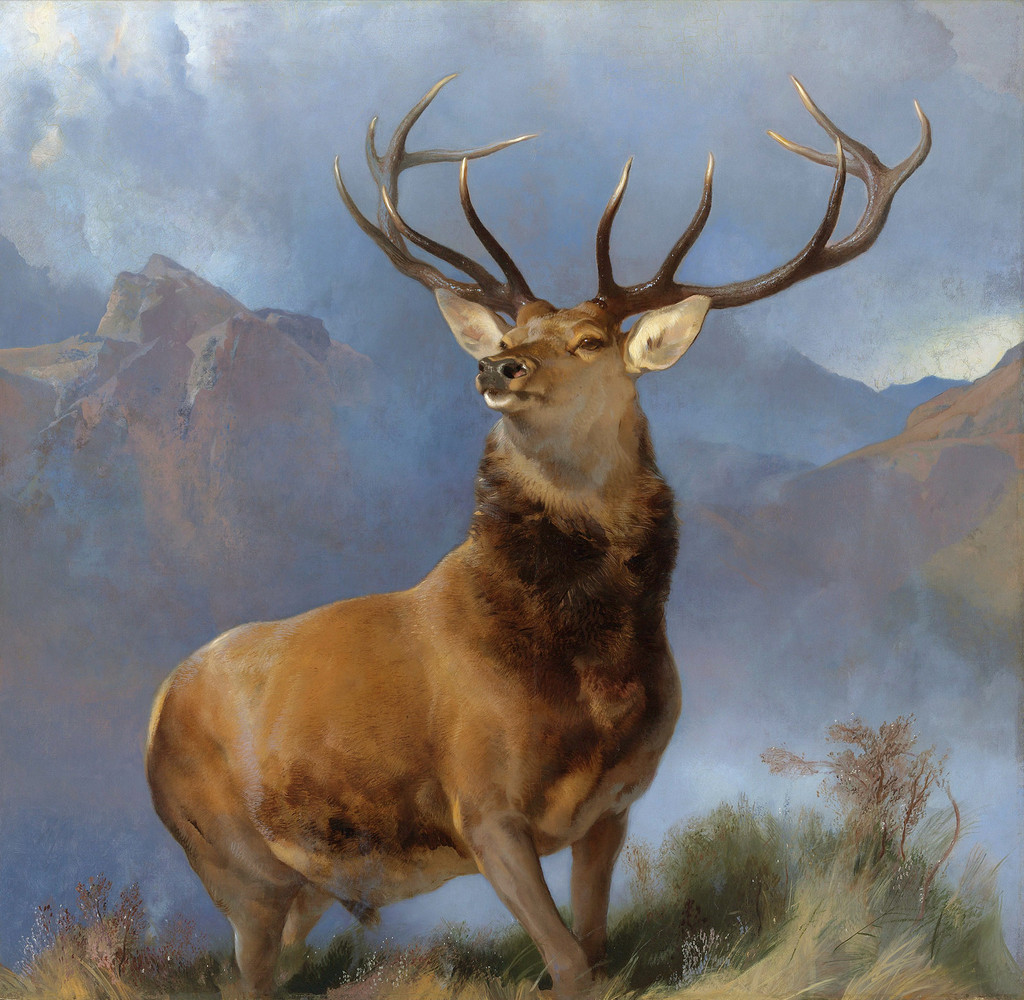
c. 1832 / exhibited 1833 [11]The Monarch of the Glen
about 1851 [15]Contents
- The hunt compressed into one crisis
- Object facts at a glance
- Why Tate says “?1832, exhibited 1833”
- One stag, two hounds and no hunter
- The stag’s head, eye and antlers
- The dark hound at the ear
- The pale hound in the torrent
- Water as the third antagonist
- Rocks, rear water and divided light
- A support record that does not agree
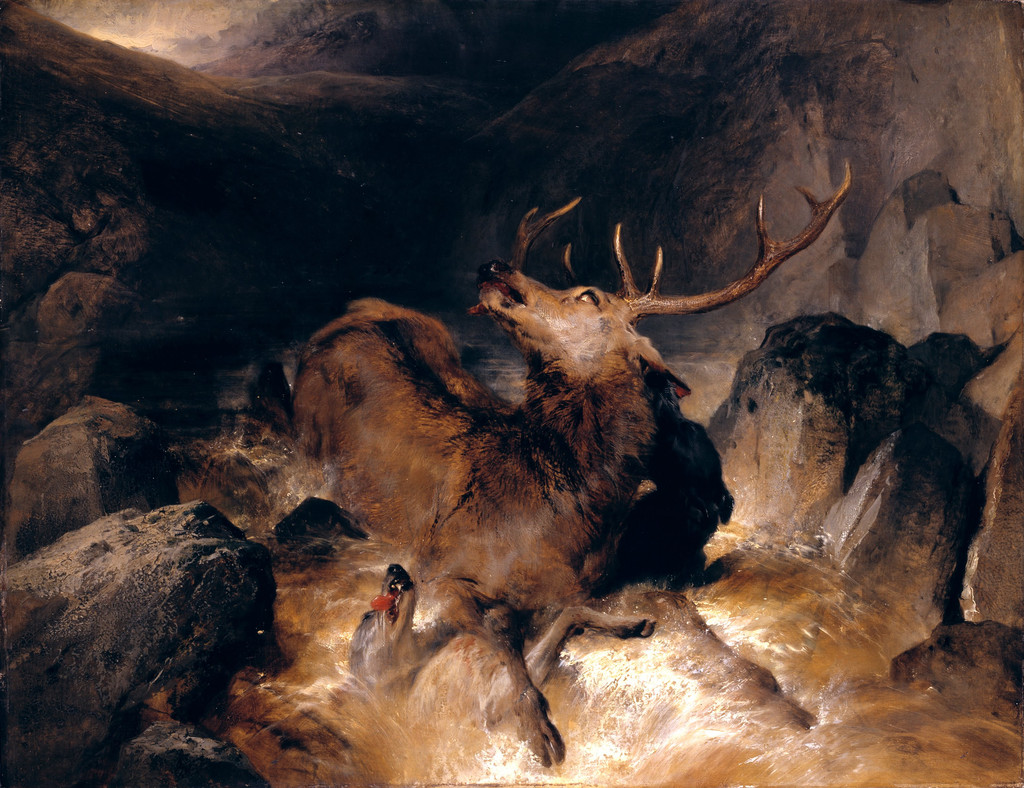
Deer and Deer Hounds in a Mountain Torrent ('The Hunted Stag'). Tate. Image source. Public domain.
Object facts at a glance
Tate's present title preserves two histories at once. Deer and Deer Hounds in a Mountain Torrent closely follows the wording under which the Royal Academy exhibited the picture in 1833. The parenthetical The Hunted Stag retains the shorter name familiar from later catalogues.[1][5][3] The long form is more than administrative tidiness. It names quarry, pursuers and environment, distributing agency among three elements rather than allowing the stag alone to define the scene.
The current date also keeps evidence and inference apart. “?1832” offers a probable year while the phrase “exhibited 1833” states the secure public milestone.[1] The Royal Academy catalogue lists Deer and deer hounds in a mountain torrent as no. 268. The exhibition ran from 6 May to 20 July 1833.[5] No checked inscription, dated preparatory work or letter supplies the day on which the painting was finished.
Tate is the present holder; the durable fact is the collection, not a particular display room or building. Calling it a work at “Tate Modern” would confuse a changing display location with institutional ownership. The accession number N00412 provides the stable identity.[1]
Tate now gives the medium as oil paint on canvas on mahogany. That wording is unusual enough to discourage casual simplification. “Oil on canvas”, “oil on panel” and “oil on mahogany” each omit part of the current record. At the same time, the current entry cannot erase older official descriptions that say on wood or oil on panel.[2][3] The disagreement belongs to the object's catalogue history and cannot be silently repaired.
Robert Vernon's 1847 presentation is the firm provenance anchor.[1] The National Gallery received the painting among the works he gave to the nation, and it was transferred to the Tate Gallery in 1900.[2] A 1907 National Gallery catalogue still listed it as no. 412 in the Vernon Collection.[3] Before Vernon's ownership, the checked evidence does not establish a commission contract, price or complete chain of transactions.
Why Tate says “?1832, exhibited 1833”
The question mark before 1832 is a useful sign of scholarly discipline. It does not mean that the painting's identity is doubtful. It marks the difference between a proposed making date and a documented exhibition. Tate can securely connect the object with the Royal Academy in 1833 because the printed catalogue names Landseer, the title and no. 268.[5] The catalogue proves that the picture existed in exhibitable form by early May. It cannot tell us whether work ended days, months or a year earlier.
Diana Donald's Tate Research essay discusses a date around 1830–32 and notes Landseer's statement to Vernon that the picture was painted in Scotland.[4] Ormond uses the broader formulation “By 1833”.[2] These accounts are compatible with a likely 1832 execution, but neither converts probability into an exact chronology. The current Tate form therefore leads.
The Scottish statement establishes a regional production claim without locating a precise glen, loch or estate. The landscape is recognisably Highland in institutional and scholarly accounts, yet no checked source maps the slopes or rear water to a named viewpoint.[1][4][2] The picture may compress observation, memory and composition rather than reproduce a single surveyed place. A precise place-name would be more specific and less accurate.
Date and place are often tempting because Landseer's Scottish work carries a strong biographical mythology. Here the object supplies a firmer route. By 1833 it had a title, catalogue number and public audience; in 1834 it appeared again at the British Institution as no. 156.[2][18] Its early reception can be followed directly. The precise campaign of painting remains open, and the question mark protects that distinction.
One stag, two hounds and no hunter
The central group contains three animals: one stag and two hounds. The stag's brown-grey body runs through the middle. A dark hound occupies the upper part of the knot beside the head, while a pale-grey hound lies low in the torrent. The second dog is easy to miss because water, light fur and the stag's legs break up its outline. Tate, Donald, Ormond and the Metropolitan Museum's record of the later print all identify two hounds.[1][4][2][7]
The animals are not arranged like separate specimens. Their forms interrupt one another. The stag's antlers spread above the dark dog; its legs cross bright water and the pale hound; the dogs' heads and limbs disappear into shadow, spray or the quarry's body. That visual congestion makes a basic narrative legible—a pursued stag has turned or been forced into a desperate encounter—while resisting a forensic reconstruction of every movement.
Absence is equally exact. The image contains no person and no visible instrument of the hunt. A viewer may infer that people released or followed the hounds, but cannot point to a hidden marksman's position. Nor does the painting show a wound on the stag with enough clarity to prove a previous rifle shot. Sporting procedure makes such a shot possible and perhaps likely; possibility is not direct observation.[4][19]
By leaving the hunter outside, Landseer changes the distribution of attention. A conventional sporting image might celebrate aim, pursuit, possession or the moment a sportsman claims the animal. Here no human face guides emotion and no weapon explains cause. The hounds are not simple extensions of a master's command. They are exposed bodies inside the same torrent as the stag.
The spectator is consequently asked to do two things at once: understand the scene as a hunt and look at it as a conflict among vulnerable animals. The first supplies sequence; the second interrupts triumph. This duality helps explain why early reviewers admired natural truth and later commentary objected to the use of suffering as gratification.[20][6] The picture does not need a visible hunter to implicate a human world.
The stag’s head, eye and antlers
The stag's head is the emotional and structural centre. It rises above the horizontal pressure of body and torrent. The muzzle points upwards; the mouth is open; a pale eye catches the light. Wet highlights on the nose and face separate it from the dark hound and shadowed slope. The head does not command the scene as a serene trophy. Its exposed throat and unstable turn make authority and vulnerability coincide.
The antlers enlarge that contradiction. They announce the mature stag's strength and form a broad visual barrier around the head. Their branching lines also interfere with the dogs and surrounding darks, making approach and retreat difficult to read. Antlers can injure a hound, and institutional descriptions use them to explain the pale dog's condition.[1][4][2][7] The image, however, does not replay the exact blow. The antlers are visibly present as weapon and obstacle; the specific injury sequence remains an attributed account.
Donald compares the raised head with martyred figures in religious and history painting.[4] That analogy describes a tradition of looking: upward face, open mouth and exposed body can transfer a hunted animal into a visual language of sacrifice. It does not establish that the stag prays, that Landseer painted a Christian allegory or that the animal experiences a named human emotion.
Ormond emphasises exhaustion and terror, while the 1907 catalogue found the expectation of death powerfully concentrated in the head.[2][3] The 1851 Art-Journal likewise praised its force even while objecting to the subject's suffering.[6] Across these responses, the head turns sporting quarry into a claimant on sympathy. Viewers may anticipate death because the pose makes strain so legible, not because the painting shows a corpse.
Close looking remains physical before it becomes psychological. The lifted muzzle, open mouth, pale eye, wet light and antler spread are visible. Alarm, appeal, martyrdom and inevitable death are interpretations with historical authority. Keeping those levels separate allows the stag to remain expressive without treating a painted face as a transcript of consciousness.
The dark hound at the ear
The dark hound is difficult to isolate because its body merges with the stag's head and the surrounding shadows. Its muzzle occupies the ear area, and a red mouth or tongue punctuates the compressed forms. Tate's interpretation says that one dog has seized the stag by the ear. Donald, Ormond and the Met's print record repeat that reading.[1][4][2][7] It is the strongest established account of the contact, but remains an interpretation rather than measurable bite mechanics.
The hound's darkness matters pictorially. Against the lighter stag face and broken water, it creates a dense anchor at the upper side of the animal knot. The red at its mouth echoes the more ambiguous red marks on the pale hound below. Because fur, jaw, ear and antler overlap, the eye keeps returning to the point of contact without resolving it completely.
This is not a calm image of canine obedience. No handler appears and no leash or command connects the hound to human control. The animal seems committed to the encounter, but it is also dangerously close to the antlers and rushing water. Its agency is real within the picture, yet its safety is not assured.
Nor can the grip establish the outcome. A bite at the ear may restrain or turn the stag, and historical descriptions imagine it helping to drag the quarry towards danger.[1][4] The painted instant shows pressure, not a completed movement. It gives no bite depth, duration or final direction. The hound is best understood as a dark force attached to the stag's resistance, not as proof that the struggle is already won.
The pale hound in the torrent
The second hound occupies the brightest and most visually unstable part of the picture. Its pale body lies low beneath or beside the stag's legs, broken by white foam and translucent grey water. A dark limb and parts of the head help recover its shape. Red marks are visible against the light fur. Unlike the dark hound, which presses into the head, this dog seems close to being absorbed by the stream.
Tate's account describes one hound as wounded by the stag's antlers; Donald and Ormond identify the lower animal as wounded or submerged after the encounter.[1][4][2] The Met's description of Thomas Landseer's engraving also distinguishes a wounded dog from the one fastened to the ear.[7] These mutually reinforcing readings deserve inclusion. They do not reveal the source of every red mark or establish a fatal goring.
Injury, antler strike and impending fall cannot each be read directly from the image. The difference between mark and cause remains important. Red is visible; a precise wound is not. The animal's low, rolled or struggling position is visible; broken bones, drowning or death are not. Its relation to the stag's leg is compressed enough that even the order of movements remains uncertain.
That uncertainty increases the scene's moral complexity. Hounds are agents of pursuit, but the pale dog is also endangered. It prevents sympathy from settling exclusively on the quarry. Sport has produced a field in which every represented animal may suffer, while the people who organised the encounter remain safely absent.
Formally, the pale hound also stops the torrent from becoming a decorative band. Water crosses its body, conceals its edges and competes with its light fur. Finding the dog requires attention to beak-like muzzle, limb, eye, red marks and changes in grey. The viewer's effort to see becomes an analogue for the animal's struggle not to disappear.
Water as the third antagonist
The torrent is not a backdrop behind a self-contained animal group. It passes through the conflict. Bright foam runs across the foreground, breaks around limbs and rocks and carries the eye towards the lower and right edges. Darker, more transparent passages reveal depth or wet stone, while milky bands obscure the pale hound. The stag's extended legs do not stand securely above it; they are entangled with its direction.
Calling the water a third antagonist is a visual argument, not a claim that nature possesses human intention. Stag and hounds press against each other, but all three also contend with current, footing and rock. The stream destabilises hunter-and-quarry roles. A dog that pursues on land can become a body at risk in water; a stag that turns at bay can still be carried onward.
Ormond calls the darker horizontal water behind the group a lake and describes the foreground water as layered, translucent and milky.[2] Tate's caption and Donald's essay identify a mountain torrent or fast-flowing beck.[1][4] The two readings can coexist spatially: a calmer dark body may feed or adjoin the brighter fall. No checked source names the loch or burn, and the painting gives no basis for calculating depth or velocity.
Handling strengthens the sense of force. Donald states that Landseer used a palette knife for the spray.[4] The broken highlights have a different visual character from the softer modelling of fur and the darker stretches behind. Ormond's discussion of layered glazes likewise helps explain how water can appear both transparent and opaque.[2] These are attributed technical observations, not a complete conservation account. No checked report identifies pigments, binders, ground, varnish or later treatment.
The foreground water also controls time. Its diagonal and horizontal breaks imply continued movement beyond the instant in which animals are fixed. The stag's mouth remains open and the hounds remain engaged, but foam cannot pause with them. That mismatch creates suspense: the composition arrests a crisis while the painted current seems determined to carry it out of the frame.
Historical commentators often completed that movement in words. Donald discusses the idea that the animals are being forced towards a precipice; the 1851 Art-Journal imagined rocks or the torrent overwhelming them.[4][6] Ormond instead notes the illusion that the stag may be swept forward and out of the picture.[2] The lower edge does not clearly depict a precipice or completed fall. Water makes such outcomes imaginable without choosing one.
Rocks, rear water and divided light
Dark rocks give the torrent resistance. Angular masses interrupt foam, close around legs and supply brief places where hoof or paw might find purchase. Their surfaces shift between near-black shadow, brown-grey planes and pale wet edges. They make the animal group tactile, but they do not describe a surveyed geology or a named waterfall.
Behind the struggle lies a darker horizontal band of water. It slows the composition before the eye reaches the enclosed slopes. Ormond's “lake” makes sense of this visual pause.[2] The foreground torrent then appears to accelerate out of a broader body, though the exact topography remains unclear. Landseer gives enough spatial difference to make the water varied, not enough to map its source.
The hills and cliffs form an amphitheatre. Most of the background is low in tone, folding the animals into a remote Highland basin. A lighter opening at the left admits pale sky and distant mountain. Light travels from that opening onto spray, muzzle, antler, fur and wet rock. It reveals the crisis in fragments rather than opening a clear escape.
Donald places this contrast within the sublime: difficult terrain, unstable water, obscurity and threatened bodies turn Highland nature into a field of danger as well as beauty.[4] The word is useful when tied to visible relations. The slopes overwhelm human scale, the current exceeds animal control and the small bright opening cannot neutralise the darkness. It does not identify an exact storm, sunset or weather front.
The divided light also refuses a simple moral code. Darkness does not belong only to the hounds, nor brightness only to the stag. The pale dog is caught in the whitest water; the stag's head emerges through both light and shadow; the dark hound carries a red flash at its mouth. Illumination allows the viewer to see suffering, but does not assign innocence by colour.
A support record that does not agree
The physical record presents a conflict too large to hide. Tate currently describes the work as oil paint on canvas on mahogany and gives the support as 405 by 908 millimetres.[1] Its 2013 research essay used the older phrase oil paint on canvas laid on wood with the same support measurement.[4] Tate's current wording is the present object fact because the institution is responsible for the work now.
The historical record differs. The official 1907 National Gallery catalogue describes the picture as “on wood” and measures it at 2 feet 3½ inches high by 2 feet 11½ inches wide, approximately 69.9 by 90.2 centimetres.[3] Ormond's 1981 catalogue calls it oil on panel and gives 27½ by 35½ inches, again 69.9 by 90.2 centimetres.[2] Width is broadly similar to Tate's 90.8 centimetres. Height is not: 40.5 centimetres and 69.9 centimetres differ by almost 30 centimetres.
The reproduced composition is much closer in proportion to the older near-70-by-90-centimetre record than to a support more than twice as wide as it is high. That observation makes the conflict conspicuous; it does not solve it. The conflict cannot be resolved by silently reversing Tate's numbers, declaring a typographical error or choosing the older dimensions as if current cataloguing had no authority.
Nor does the material wording supply a ready explanation. Canvas on mahogany might describe a composite support, but the checked sources provide no conservation history for when or how those layers were joined. “On wood” and “oil on panel” may be older shorthand, yet no evidence says so. Nothing establishes transfer, marouflage, enlargement, trimming, relining, reconstruction or a change in measuring convention.
The record is therefore double. Tate's exact medium and dimensions control the present object facts.[1] The 1907 and 1981 descriptions and measurements document its catalogue history.[2][3] The discrepancy remains unresolved. The absence of a neat conclusion is useful information: it marks where institutional data ends and amateur conservation fiction would begin.
The painting's title history has a similar, though less physically consequential, instability. The 1833 descriptive title became The Death of the Stag in the 1851 Art-Journal, The Mountain Torrent for Thomas Landseer's 1856 engraving and The Hunted Stag in the 1907 catalogue.[5][6][3][7] Those variants can be reconciled as names for one object and its reproductions. The support conflict cannot yet be reconciled in the same way.
What happened in a Highland deer hunt
The picture assumes knowledge that it does not illustrate step by step. Donald explains that in nineteenth-century Highland sport a stag might be stalked or driven towards concealed guns. Hounds were commonly released once an animal had been wounded. A stricken deer might seek water—a manoeuvre described as going “to soil”—and stand at bay until the sportsman approached to finish it.[4] These practices make the animal grouping intelligible without proving that every stage occurred exactly as described here.
Nothing visible establishes the first shot. The stag may be exhausted, alarmed and at bay, but no secure bullet wound appears. Nothing identifies where the hunters wait. Even the dogs' release cannot be timed from the image. Period procedure clarifies what an early viewer might infer while preserving the difference between the represented instant and the unseen chase around it.
William Scrope's The Art of Deer-Stalking, published in 1838, offers an unusually close textual parallel. In an episode on pages 58–62, a shot stag is followed by two hounds into a mountain cataract. It turns at bay near a precipice; observers fear that deer and dogs may be carried over together; a rifle shot eventually ends the encounter.[19] The combination of stag, two dogs, dangerous water and anticipated fall resembles Landseer's composition strongly.
Chronology prevents a simple source claim. Scrope's book appeared five years after the Royal Academy exhibition. It drew on established practice, and Landseer belonged to the sporting world around such publications, but the later narrative is not a caption written for the painting. The work does not illustrate those numbered pages, and there is no evidence that it records the same hunt.
Used carefully, the parallel clarifies what the painting omits. Scrope supplies people who watch, worry, pursue and finally shoot. Landseer removes them. Scrope resolves danger through another human act; Landseer stops before resolution. Where the book distributes attention across a field episode, the painting compresses it into animal bodies and water.
This is why the absent hunter is more than a missing character. Human organisation exists as a cause inferred from trained hounds and sporting convention. Human control, however, has failed inside the pictured space. The stag cannot master the stream; neither can the dogs. The sportsman's authority survives only outside the frame and in the expectation that someone may arrive with a rifle.
The stag-at-bay subject also differs from a straightforward kill. At bay, the quarry faces its pursuers and can injure them. Antlers become active weapons rather than trophy attributes. The pale hound's interpreted wound makes that reversal central.[1][4][2] Yet the imbalance remains: the hunt has resources beyond the frame, while the stag has only body, terrain and a momentary resistance.
Romantic wilderness and absent labour
The setting can look like untouched wilderness because no building, road, fence, servant or sportsman appears. Donald warns against accepting that appearance as a complete social history. Highland deer sport depended on estates, owners or tenants, organised access, transport and labour. Landscapes celebrated as remote could be shaped by changes in land use and by the displacement of people.[4]
A general history of the Highland Clearances is not required to acknowledge that structure. No source identifies this exact basin as cleared land or ties the picture to a named estate. The object-specific point is simpler: a supposedly solitary encounter between animals is intelligible only within a human sporting economy that the composition excludes.
That exclusion has aesthetic force. Without gillies and guns, dark slopes and rear water seem to surround the struggle on their own terms. The animals appear isolated within nature, and the hunt takes on an archaic or legendary character. Donald connects Landseer's Highland imagination with Sir Walter Scott and with older hunting traditions.[4] Such associations helped transform managed sport into Romantic drama.
Yet the invisible labour does not vanish historically because it vanishes pictorially. Hounds had to be bred, kept, transported and handled. Sporting parties required knowledge of ground and animal movement. Estates governed who could hunt and how land was used. The painting depends on that organisation while granting it no visible heroism.
This creates another double effect. Removing people can universalise the scene as a struggle among animal bodies and elemental water. It can also conceal the social power that produced the encounter. A responsible reading need not choose between Romantic landscape and estate economy. It can recognise that Landseer's sublime enclosure is achieved partly by moving ownership and work beyond sight.
The result is not an anti-estate manifesto. No checked statement gives Landseer that intention. It is a composition in which the absence of human infrastructure is meaningful because its consequences remain. Trained hounds and hunted quarry make the unseen system present. The landscape looks empty, but the scene is not socially innocent.
What critics saw in 1833 and 1834
The Royal Academy catalogue provides the first public anchor. Deer and deer hounds in a mountain torrent appeared as no. 268 in the sixty-fifth annual exhibition, open from 6 May to 20 July 1833. The catalogue page places it among other works rather than announcing a prize or special category.[5] No checked record supports claims of an award, an exceptional sale or unanimous acclaim.
On 25 May, The Athenaeum considered Landseer's representations of four-footed nature superior to his treatment of people and called no. 268 “truth itself; truth exalted by feeling and skill”.[20] The short judgement joins categories often separated now. “Truth” points to observed animal form and convincing action; “feeling” acknowledges emotional effect; “skill” recognises the painter's control. For this critic, naturalism did not exclude imaginative elevation.
The work reappeared at the British Institution in 1834 as no. 156.[2][18] Reviewing that exhibition on 8 February, The Athenaeum singled out the natural foaming stream, exhausted deer and struggling dogs.[18] Its response confirms that water was understood as integral to the action, not merely a picturesque setting. Exhaustion and struggle were legible within a year of the first exhibition.
The Gentleman's Magazine in March responded less comfortably. It described the picture as sober in tone and objected to a “painful minuteness”, contrasting it with Landseer's Suspense.[21] The phrase is revealing. The exactness that one critic praised as truth could make another feel too close to suffering. Naturalistic detail was not emotionally neutral.
These notices do not amount to a scientific survey of public opinion. They are three periodical judgements, and none speaks for Landseer. Their disagreement is more useful than a manufactured consensus. The painting could be admired for fidelity, feeling and technical command while also troubling a viewer through the precision with which strain was described.
The early reviews also correct a modern temptation to separate beauty from ethics chronologically. Unease did not have to wait for a present-day animal-welfare reading. In 1834, “painful minuteness” already named the discomfort produced when pictorial attention lingered on vulnerable bodies.[21] At the same time, praise for truth and skill shows why viewers continued to seek out the image.[20][18]
Reception therefore follows the painting's own structure. Bright water and dark terrain make the animals striking; the clarity of the stag's head and the pale dog's danger makes them difficult to consume as sport alone. Technical success supplies the conditions for emotional disturbance.
Suffering, beauty and the 1851 objection
By January 1851 the picture was circulating under the title The Death of the Stag in the Art-Journal's treatment of the Vernon Gallery. The publication named Landseer as painter and J. Cousen as engraver.[6] The new title resolves the suspended action more decisively than the image itself: “death” tells the reader where the hunt will end even though the painted body is not yet a corpse.
The commentary made an explicit ethical objection. It questioned the presentation of mental or bodily suffering as a source of gratification, yet still praised the work's power and the stag's head.[6] Admiration and resistance occur in the same notice. The critic did not deny Landseer's ability; that ability was part of the problem because it made suffering compelling enough to be enjoyed as art.
The article also imagined the animals being carried towards rocks or overwhelmed by the torrent.[6] Its prose completes motion that the canvas leaves open. This is important reception evidence, but not a licence to report a visible precipice or completed drowning. The critic's anticipation shows how strongly water and lower edge invite narrative projection.
Nor does the objection prove that Landseer intended an anti-hunting argument. He knew Highland sport intimately and worked for patrons who valued it.[4][2] A painting can create sympathy without functioning as a manifesto; it can participate in sporting culture while exposing costs that culture does not fully control. The 1851 response demonstrates the contradiction rather than resolving it.
Reproduction intensified that contradiction. An engraved image could travel beyond Vernon's rooms and reach readers who encountered it alongside commentary. The act of converting paint into print made the scene available as an admired work, while the accompanying text asked whether suffering should gratify. Ethical unease was therefore not external to the picture's fame. It accompanied one of the means by which that fame expanded.
The stag's head again becomes the hinge. Its visual force wins praise; its apparent agony makes pleasure suspect. Landseer does not need to supply a written moral because pose, eye and open mouth already allow viewers to feel the quarry as more than game. The Art-Journal records one historically specific answer to that invitation, not the only permissible one.
Robert Vernon, national ownership and the image in print
Robert Vernon presented the painting to the nation in 1847.[1] Ormond records Vernon as owner, the National Gallery as recipient and the later transfer to the Tate Gallery in 1900.[2] The 1907 catalogue retained the Vernon Collection credit and numbered the work 412, the number still embedded in Tate's accession N00412.[3] National ownership gave the picture an institutional continuity even as its title and material description shifted.
What came before Vernon is less secure. Donald discusses Landseer's statement that the picture was painted in Scotland and made in connection with Vernon, but the checked sources do not provide a surviving commission agreement, purchase receipt, price or original hanging place.[4] It is safer to begin the provenance with documented ownership than to invent a complete transaction history.
Prints created a second history. Ormond lists an engraving by Frederick Stacpoole in 1850, a smaller J. Cousen plate used by James Dafforne in 1873 and a later plate by J. B. Pratt.[2] The Art-Journal directly names J. Cousen as engraver in its January 1851 Vernon Gallery presentation.[6] These publication records cannot be flattened into a single undated reproductive event or assigned casually to Thomas Landseer.
The Metropolitan Museum of Art holds a distinct 1856 print called The Mountain Torrent. It names Thomas Landseer, the painter's brother, as engraver and describes the object as a mixed-media engraving on chine collé. Henry Graves & Co. published it in London, with Williams, Stevens, Williams & Co. named for New York; the Met's object number is 47.30.22.[7] Its title moves attention away from an already decided death and towards the environmental force that fills the lower picture.
The 1907 National Gallery catalogue records both Thomas Landseer and Cousen in the work's reproductive history and uses The Hunted Stag as the painting's title.[3] The sequence of names is instructive. The 1833 title distributes attention among deer, hounds and torrent. The Death of the Stag promises an outcome. The Mountain Torrent promotes the setting into protagonist. The Hunted Stag centres pursuit and quarry. None is wholly false; each edits the viewer's expectations.
Engraving also alters surface. The painted distinctions among wet colour, translucent water, dark glaze and bright spray had to be translated into lines, tones and layered print processes. The Met record documents the later object's materials but does not substitute for Tate's painting data.[7] A print can preserve composition and historical interpretation while remaining a separate work with its own dimensions, publisher and technique.
By the time the painting entered the Tate Gallery, it already existed in multiple public forms: Academy and Institution catalogue entries, periodical descriptions, Vernon Gallery commentary and reproductive prints. Its national status did not freeze a single meaning. Instead, institutional ownership gave successive audiences a stable object around which titles, moral reactions and material records continued to accumulate.
Why the outcome remains suspended
Many historical viewers believed they knew what came next. A hunted stag at bay, one hound interpreted as wounded, another attached to the ear and a torrent pushing the group towards danger made death seem inevitable.[1][4][6][3] Scrope's later sporting narrative even supplies the kind of final rifle shot that could end such an episode.[19] Yet Landseer's painting stops before any ending can be seen.
The lower edge contains water, rock and bodies moving towards or beyond sight. It does not show a clearly bounded precipice, a fall, a coup de grâce or a corpse. Ormond's suggestion that the exhausted stag may be swept out of the picture describes the illusion of movement rather than a completed fact.[2] The image keeps the decisive event one instant and one frame away.
That suspension protects the animals from becoming a simple sporting result. The stag is neither victorious nor dead. The dark hound has contact but not secure possession. The pale hound is endangered without a settled fate. Even the torrent is divided between bright force in front and dark stillness behind. Each part of the picture advances the action and withholds its conclusion.
The absent hunter makes this uncertainty ethically charged. Human beings organised the chase, but cannot be seen assuming responsibility for its end. The spectator occupies the open position: following the hounds' pressure, meeting the stag's eye, finding the pale dog in the foam and anticipating what the water might do. Looking becomes participation without control.
Landseer's achievement lies in holding naturalistic precision and narrative incompletion together. Fur, antler, mouth, water and rock are specific enough to make the crisis bodily real. The support record, exact date, mapped place and final outcome remain unresolved. Even the catalogue history oscillates among hunted stag, death and torrent.[1][5][6][3][7]
The picture endures because no title can domesticate all three forces. The stag solicits sympathy, the hounds embody pursuit and exposure, and the stream refuses to become scenery. Human sport surrounds them as an invisible cause. In the painted instant, however, there is only an animal knot inside moving water—and a viewer left to decide whether admiration can ever be separated from the suffering that Landseer's skill has made impossible to ignore.
Artworks directory
This directory gathers works discussed in the articles, including drawings, original etchings and prints after Landseer. It is not a complete catalogue of every drawing, version, plate or impression. Distinct media are kept separate; uncertain dates are left blank. Linked titles open individual articles.
| Name | Date | Medium |
|---|---|---|
| A Bellowing Stag | Drawing | |
| A Deerhound | 1826 | Painting |
| A Distinguished Member of the Humane Society | 1838 | Painting |
| A Highland Breakfast | 1834 | Painting |
| A Highland Landscape | c. 1830 | Painting |
| A Highland Shepherd's Home | Painting | |
| A Horse, Goat and Bull | 1811 | |
| A Hunting Horse | Drawing | |
| A Jack in Office | Painting | |
| A Lion Disturbed at His Repast | Painting | |
| A Random Shot | Painting | |
| A Scene at Abbotsford | Painting | |
| Adversity | Painting | |
| Alexander and Diogenes | exhibited 1848 | Painting |
| Alpine Mastiffs Reanimating a Distressed Traveler | 1820 | Painting |
| Contending Group after Nature | Drawing | |
| Copy after Rubens's Wolf and Fox Hunt | c. 1824–26 | Painting |
| Dash | Painting | |
| Deer and Deer Hounds in a Mountain Torrent ('The Hunted Stag') | c. 1832 / exhibited 1833 | Painting |
| Deer Family | ||
| Dignity and Impudence | 1839 | Painting |
| Dog Resting Upon a Couch | Drawing | |
| Eos | 1841 | Painting |
| Favourites, the Property of H.R.H. Prince George of Cambridge | 1834–35 | Painting |
| Her Majesty Sketching at Loch Laggan | ||
| High Life | 1829 / exhibited 1831 | Painting |
| Highland Lassie | Drawing | |
| Isaac van Amburgh and his Animals | 1839 | Painting |
| Lady Godiva's Prayer | Painting | |
| Laying Down the Law | 1840 | Painting |
| Lion Defending Its Prey | c. 1840 | Painting |
| Lioness | Drawing | |
| Little Strollers | ||
| Low Life | 1829 / exhibited 1831 | Painting |
| Man Proposes, God Disposes | 1864 | Painting |
| Nell Gwynne / Diana Vernon | Painting | |
| Neptune | ||
| No Hunting Till the Weather Breaks | Painting | |
| Otterhounds | Drawing | |
| Peace | Painting | |
| Pensioners | Painting | |
| Portrait of a Mule | Painting | |
| Portrait of Mr Van Amburgh, as He Appeared with His Animals at the London Theatres | 1846–47 | Painting |
| Portraits of a Pointer Bitch and Puppy | Painting | |
| Pray Let Me Out | ||
| Prosperity | Painting | |
| Ptarmigan in a Landscape | by 1833 | Painting |
| Queen Victoria and Prince Albert at the Bal Costumé of 12 May 1842 | 1842–46 | Painting |
| Queen Victoria at Loch Laggan | Painting | |
| Queen Victoria at Osborne | 1865–67 | Painting |
| Queen Victoria landing at Loch Muick | Painting | |
| Rat-catching | 1823 | |
| Reclining Lion | Drawing | |
| Reclining Lion, From Back | Drawing | |
| Rent-day in the Wilderness | 1855–68 | Painting |
| Return from Deer Stalking | 1839 | |
| Royal Sports on Hill and Loch | Painting | |
| Sam Lovill, Porter at the Royal Academy | Drawing | |
| Scene from A Midsummer Night's Dream | 1848–51 | Painting |
| Scene in the Highlands, with portraits of the Duchess of Bedford, the Duke of Gordon and Lord Alexander Russell | Painting | |
| Scottish Highlands, Lochs and Figures | Drawing | |
| Shoeing | exhibited 1844 | Painting |
| Sleeping Bloodhound | exhibited 1835 | Painting |
| Spaniel and Rabbit | Painting | |
| Stag at Bay | 1866 | Sculpture |
| Stag at Bay | 1846 | Painting |
| Studies of a staghound and the head of a stag for painting ‘The Hunting of Chevy Chase’ | Drawing | |
| Study for Alpine Mastiffs Reanimating a Distressed Traveler | Drawing | |
| Study for the Monkey in The Cat's Paw | Drawing | |
| Study of a Dog | Drawing | |
| Study of a herding dog facing right | Drawing | |
| Study of the horse of Selene, from the East pediment of the Parthenon | Drawing | |
| Suspense | Painting | |
| Taking a Buck | ||
| The Arab Tent | c. 1865–66 | Painting |
| The Barn | Drawing | |
| The Best Run of the Season | ||
| The Cat's Paw | c. 1824 | Painting |
| The Cavalier’s Pets | ||
| The Challenge | Painting | |
| The Chase | Drawing | |
| The Connoisseurs: Portrait of the Artist with Two Dogs | 1865 | Painting |
| The Death of a Stag in Glen Tilt | Painting | |
| The Drive—Shooting Deer in the Pass | Painting | |
| The Drover's Departure | Painting | |
| The Highland Shepherd’s Dog | 1824; portfolio issue 1848 | |
| The Honourable Mrs Norton | Painting | |
| The Hunting of Chevy Chase | 1825–26 | Painting |
| The Illicit Highland Whisky Still | Painting | |
| The Keeper John Crerar with his Pony | Painting | |
| The Larder Invaded | ||
| The Lion-Dog of Malta | ||
| The Lions at the Base of Nelson's Column | 1867 | Sculpture |
| The Monarch of the Glen | about 1851 | Painting |
| The Mountain Torrent | ||
| The Old Shepherd's Chief Mourner | 1837 | Painting |
| The Sanctuary | 1842 | Painting |
| The Stricken Deer | Painting | |
| The Twa Dogs | Painting | |
| Time of Peace | ||
| Two stags running | Drawing | |
| Victoria, Princess Royal, with Eos | Painting | |
| View of Glenfeshie | Painting | |
| War | Painting | |
| White Horse in a Stable | Painting | |
| Windsor Castle in Modern Times | 1841–43 | Painting |
| Woburn Abbey Game Card | 1825; portfolio issue 1848 |
Discussion
Use the article’s images and evidence to develop your own reading of Deer and Deer Hounds in a Mountain Torrent ('The Hunted Stag').
Reader Insights
Which detail is most revealing when you consider “The hunt compressed into one crisis”?
How does the evidence in “Object facts at a glance” affect your reading of Deer and Deer Hounds in a Mountain Torrent ('The Hunted Stag')?
What further question would you bring to “Why the outcome remains suspended”?
Join the Conversation
Share a detail, comparison or question about Deer and Deer Hounds in a Mountain Torrent ('The Hunted Stag') below.
References
- Tate, “Deer and Deer Hounds in a Mountain Torrent (‘The Hunted Stag’)”, N00412. View source.
- Richard Ormond, Sir Edwin Landseer (Philadelphia Museum of Art and Tate Gallery, 1981), p. 81, no. 38. View source.
- National Gallery, Descriptive and Historical Catalogue of the Pictures and Sculpture in the National Gallery, British Art (1907), p. 148, no. 412. View source.
- Diana Donald, “Sublime Subject: Edwin Henry Landseer’s Deer and Deer Hounds in a Mountain Torrent”, Tate Research, January 2013. View source.
- Royal Academy Chronicle 250, “1833”, and The Exhibition of the Royal Academy, 1833, catalogue p. 16, no. 268. View source 1. View source 2.
- The Art-Journal, January 1851, p. 4, “The Vernon Gallery: The Death of the Stag”. View source.
- Metropolitan Museum of Art, “The Mountain Torrent”, 1856, object 47.30.22. View source.
- National Gallery of Art, Alpine Mastiffs Reanimating a Distressed Traveler. View source.
- Minneapolis Institute of Art, The Cat's Paw. View source.
- Birmingham Museums Trust, The Hunting of Chevy Chase. View source.
- Tate, Deer and Deer Hounds in a Mountain Torrent ('The Hunted Stag'). View source.
- Victoria and Albert Museum, The Old Shepherd's Chief Mourner. View source.
- Tate, Dignity and Impudence. View source.
- Royal Collection, Eos. View source.
- National Galleries of Scotland, The Monarch of the Glen. View source.
- Royal Holloway, University of London, Man Proposes, God Disposes. View source.
- Trafalgar Square / Greater London Authority, The Lions at the Base of Nelson's Column. View source.
- The Athenaeum, no. 328, 8 February 1834, p. 107, “British Institution”. View source.
- William Scrope, The Art of Deer-Stalking (John Murray, 1838), pp. 58–62. View source.
- The Athenaeum, no. 291, 25 May 1833, p. 329, “Exhibition of the Royal Academy: Second Notice”. View source.
- The Gentleman’s Magazine, new series, vol. 1, March 1834, p. 308, “Fine Arts: British Institution”. View source.
- Splash image, Deer and Deer Hounds in a Mountain Torrent ('The Hunted Stag'). Tate. Image source. Public domain.
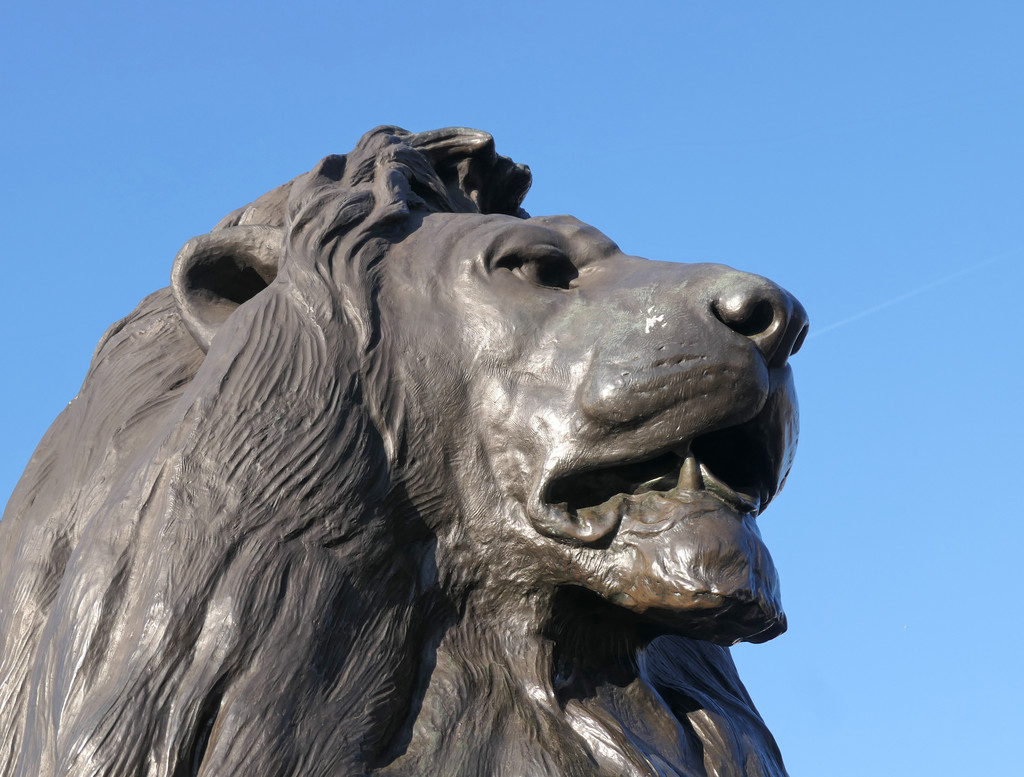
- Navigation image, One of the bronze lions at Nelson’s Column: modelled by Edwin Landseer and cast by Carlo Marochetti. Photograph by Amanda Slater. CC BY-SA 2.0. Image source. CC BY-SA 2.0. Resized.