 by Tom Gurney
Tom Gurney BSc (Hons) is an art history expert with over 20 years experience
Email: tomgurney1@gmail.com / Phone: +44 7429 011000
Sculpture: Introduction
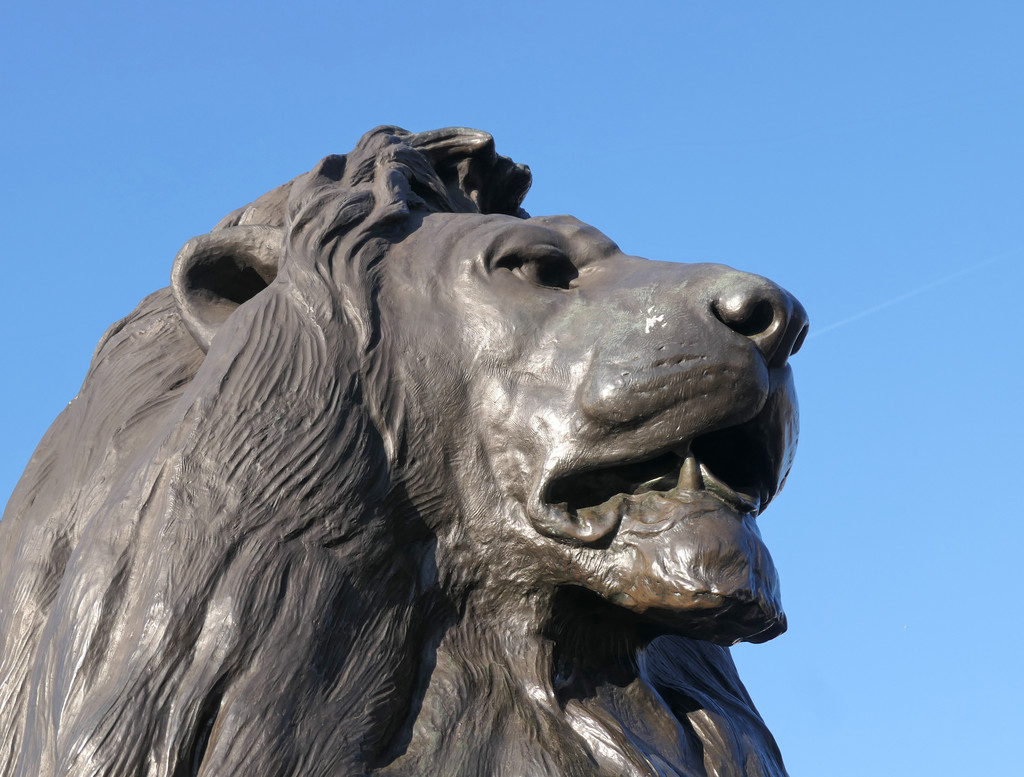
Edwin Landseer’s best-known sculpture is so familiar that it can obscure how unusual it was for him to make sculpture at all. Four immense bronze lions lie at the corners of Nelson’s Column in Trafalgar Square. They have become part of London’s visual grammar: low bodies beneath a high monument, dark metal against pale granite, controlled animal power at the level of the crowd. Yet Landseer built his career in drawing, painting and print culture. His documented sculptural activity occupies a narrow late interval and centres on only two projects, one of them difficult to trace today.[1][2][3]
That imbalance makes the lions more interesting, not less. They are not simply paintings turned solid. A drawn contour can leave the reverse of an animal unstated; a painting can arrange one privileged view and place a body inside weather, colour and narrative. A public sculpture has to survive movement around it. It needs a convincing back as well as a face, a mass that works from across a square and details that withstand close approach. A model in clay must also pass through moulding and founding before it can become bronze. Landseer’s part in that chain was substantial, but it was not solitary.
The most accurate maker line is therefore divided. Landseer designed and modelled the lions. Baron Carlo Marochetti, a sculptor and bronze founder with his own London foundry, cast them. All four installed bronzes came from the same model, despite an earlier parliamentary expectation that two models might be used. Those distinctions recover a real collaboration and reveal a project that changed while the public waited.[4][5][6]
At a Glance
- Best-known worksFour bronze lions, Trafalgar Square [1]
- Design and modellingEdwin Landseer [1]
- Bronze castingCarlo Marochetti [1]
- Installation1867 [1]
Contents
- How small was Landseer’s sculptural practice?
- Learning to see an animal in the round
- The uncertain object called Stag at Bay
- Why give a painter a public sculpture?
- From changing sketches to a colossal clay model
- What Landseer studied at the Zoo
- Designing a lion to hold a corner
- Landseer’s model and Marochetti’s bronze
- One model, four installed casts
- A public work under public scrutiny
The Trafalgar Square lions
How small was Landseer’s sculptural practice?
Calling Landseer a sculptor is correct, but it needs proportion. The Public Statues and Sculpture Association describes his work on the government commission of 1858–67 as a branching-out from his established career. Current museum authorities may classify him as painter and sculptor, or as an occasional sculptor, without implying a long sequence of independent monuments. The secure picture is of a celebrated animal painter who entered three-dimensional work late and whose sculptural reputation rests overwhelmingly on the Trafalgar lions.[1][7]
Historical accounts add one other project: a group called Stag at Bay, exhibited at the Royal Academy in 1866. That gives two documented sculptural undertakings, but not a neat total of two surviving objects. The lion commission involved sketches, a monumental model and four final casts. Stag at Bay existed in more than one reported form or description, while no current public collection record has been found that settles the original group’s present location. Later reductions and objects offered under Landseer’s name cannot simply be added to his original output.[2][3][8]
Vocabulary matters here. A study investigates a form. A model gives it three-dimensional body, perhaps at small scale or perhaps at the dimensions intended for the final work. A mould takes an impression from a model so that another material can reproduce it. A cast is the object produced through that moulding and casting sequence. A bronze after Landseer may be a much later derivative; it is not automatically his 1860s model, one of Marochetti’s four monumental casts or even an object made during his lifetime.
The difference is especially important for animal sculpture. One pose can generate drawings from several viewpoints, a clay model, plaster or other intermediates, four monumental bronzes, photographs, prints and countless later souvenirs. Those things share an image without sharing date, authorship, scale or status. Landseer’s sculptural practice is small because the documented original projects are few, not because every physical object associated with them can be counted as one and the same thing.
Learning to see an animal in the round
Landseer did not begin modelling the lions without visual preparation, but his earlier drawings and paintings should not be treated as secret monument plans. They show a long habit of understanding animal bodies from changing angles. The Art Institute of Chicago lists two drawings dated 1816, Reclining Lion and Reclining Lion, From Back, as well as an undated Lioness. The paired reclining views are revealing: the second title acknowledges that the rear of a body is part of the problem. These sheets were made more than forty years before the government commission and have no documented direct link to it.[9]
A British Museum drawing connects animal observation to sculpture more explicitly. Study of the horse of Selene, from the East pediment of the Parthenon records the gaping head of the celebrated ancient marble in graphite. The museum dates the sheet tentatively to 1820–40, regards it as probably youthful and notes that Landseer may have worked from a cast rather than the original. The uncertainty is valuable. It prevents an imagined encounter while preserving the essential point: he studied how another artist had made strain, bone, skin and breath legible in a solid animal head.[10]
Painted lions posed a different problem. In Lion Defending its Prey, about 1840, Landseer compressed a crouching lion, a carcass and a confronting snake into an oil study only 25.1 by 32.4 centimetres. Colour, foliage, blood and the threatened encounter energise a particular framed view. The finished Trafalgar animal would require almost the opposite conditions: enormous scale, a resting posture, no painted environment and an urban setting that supplied changing backgrounds as pedestrians moved. The earlier painting demonstrates familiarity with leonine structure and drama, not a direct design waiting to become bronze.[11]
These examples suggest continuity without predestination. Drawing taught Landseer to isolate a contour and compare viewpoints. Looking at sculpture drew attention to the way expressive anatomy can be carried by a solid head. Painting trained him to organise an animal as a legible figure at a glance. Modelling then demanded something new: all those decisions had to coexist in a body that could no longer hide an unresolved side beyond the edge of the canvas.
The uncertain object called Stag at Bay
Landseer’s first public sculptural experiment was rooted in a subject he knew well. Deer at the point of exhaustion or confrontation had appeared repeatedly in his paintings and prints. But the sculptural Stag at Bay shown in 1866 must be separated from the painting of the same title exhibited twenty years earlier. It is also distinct from The Chase, the large crayon of a stag pursued by a hound that appeared in the 1866 exhibition. Repeated title, animal and action do not make different media into one object.[2][3]
The exhibition evidence is firm at its most basic level. A retrospective list of Landseer’s Royal Academy exhibits records number 942, Stag at Bay, in 1866, while contemporary reviewing noted that he had contributed to the Sculpture Gallery. Frederick G. Stephens later described the group as Landseer’s first appearance as a sculptor. These records establish an exhibited three-dimensional work at the moment when the Nelson model was approaching its final translation into bronze.[2][3]
Later accounts supply a more elaborate history, but they need their dates attached. James A. Manson wrote in 1902 that the Duke of Abercorn wanted a hunted stag and dogs as a silver centrepiece. According to Manson, Landseer modelled the group too large for that purpose; it was instead cast in bronze, painted by the artist and bought by H. W. Eaton, later Lord Cheylesmore. This is useful historical testimony, not a current object record. It does not securely establish where the group is now, whether the reported surface survives or which object among later bronzes descends from the exhibited model.[3]
William Powell Frith remembered a more intimate encounter. Landseer blindfolded him, led him into the studio and revealed a small coloured sculptural version of Stag at Bay. Frith disliked its resemblance to an elaborate clock ornament and thought the experiment poorly received. His account is both first-person evidence and a partisan judgement. It confirms that colour complicated the boundary between sculptural form and painted naturalism; it cannot tell us that every version looked the same or that public opinion was unanimous.[8]
The group mattered because it exposed the risk of translation. A painted hunt can direct the eye through landscape and suspend a narrative climax in one chosen view. A sculptural stag and dogs create gaps, overlaps, projecting antlers and competing silhouettes as the viewer circles them. Colour may increase naturalistic immediacy while also making the object seem decorative to a critic such as Frith. The project was therefore more than rehearsal for the lions. It tested how far Landseer’s command of animal drama could survive without the enclosing frame of a picture.
The responsible conclusion is deliberately incomplete. A sculptural Stag at Bay was exhibited in 1866 and was remembered as a rare experiment. Historical accounts describe its commission and material afterlife, but present identity has not been secured through a current holder. That gap should remain visible. A famous title is not a provenance.
Why give a painter a public sculpture?
The Nelson commission began inside an unfinished monument and an argument about expertise. Nelson’s Column had been erected in 1843 to William Railton’s design, with Edward Hodges Baily’s statue high above the square. The lions arrived much later. In July 1858 Parliament discussed a £6,000 vote towards completion of the base. One member spoke as though the proposed lions would be granite and said he preferred bronze; the government replied that the material had not yet been decided and that Lord John Manners was communicating with Landseer.[12][13]
The National Portrait Gallery summarises the resulting assignment as a government commission in 1858 for four bronze lions. That is the right broad chronology, while the debate preserves an earlier moment when material and terms were still in motion. The gap between those records is a reminder that a public commission does not spring into being as one perfectly settled instruction. Design, material, cost and maker roles can develop at different speeds.[7][12]
Why Landseer? The official answer was his knowledge of animals. In 1860 William Cowper defended the selection by invoking both Landseer’s established familiarity with animal form and the national rhetoric of the “British Lion”. The phrase belonged to parliamentary persuasion. It wrapped a practical claim about expertise inside a political emblem. It does not prove that the installed animals carry one simple patriotic meaning, but it does show why a painter without a substantial sculptural record could be presented as uniquely suitable.[14]
That reasoning did not convince everyone. Opponents repeatedly observed that Landseer was a painter rather than a sculptor. The objection concerned more than professional territory. A painting rewarded finish across a surface seen frontally; a colossal monument needed breadth, durable mass and clarity at distance. In 1864 one speaker argued that the very refinement admired in Landseer’s painting might work against the boldness required in bronze. The commission became a public test of whether specialist knowledge of animals could outweigh limited experience in monumental making.[15]
The choice also unsettles the idea that nineteenth-century artistic media occupied sealed professions. Landseer was not handed a block of stone and asked to carve it by conventional studio routine. He developed designs and a clay model, then worked with a founder capable of producing immense bronze casts. The project relied on the animal painter’s eye precisely because another specialist would undertake the metal translation. It was both a crossing of media and a division of labour.
From changing sketches to a colossal clay model
Parliament allows the project to be followed in stages, though its speakers often reported expectation rather than accomplished fact. In April 1861 the government said Landseer was carefully occupied in modelling. A year later it admitted that he had not yet satisfied himself and could not name a completion date. In June 1863 Cowper described many sketches and repeated changes of view, then said the design was complete and the clay work would follow. The delay was frustrating to MPs, but the record also reveals that “design” and “model” were not interchangeable milestones.[16][17][4]
A sketch can test the direction of the head, relation of forelegs, fall of mane or outline of the back quickly. A full-size model forces those choices to agree in depth. Parliamentary discussion put each proposed lion at about twenty feet long. At that scale, a line that looks calm on paper can become a heavy ridge; a paw becomes an architectural mass; a small turn of the head redirects the whole silhouette. Revision before casting was not merely perfectionism in miniature. It was the point at which an animal image had to become an inhabitable volume.[4]
The model also had to answer to a site already dominated by verticals. Railton’s column lifts Nelson far above the pedestrian field. The lions occupy the corners at the base, where long horizontal bodies mediate between the square pavement and the rising pedestal. Their pose needed to remain legible from oblique approaches, not just from a position directly in front. The urban setting therefore belonged to the design problem even when Landseer was working indoors.[13][6]
Contemporary debate sometimes confused artistic concentration with administrative failure. MPs wanted completion dates, cost estimates and visible progress. Landseer continued to alter the design. In 1863 Cowper said the models would soon be complete, yet in 1864 the first was still described as nearly finished; in 1865 it was finally reported complete and in the casters’ hands. These statements do not form a smooth production diary. They document successive official understandings of work that repeatedly escaped forecast.[4][15][18]
The sequence nonetheless establishes a material threshold. Before the completed model, expenditure and casting price remained uncertain. Once the form passed to the casters, revision became more consequential and the work entered another specialist environment. The monumental clay object was not a rough draft to be casually corrected in metal. It was the controlling positive form on which the expensive process of reproduction depended.
What Landseer studied at the Zoo
The most secure account of Landseer’s lion study during the commission concerns living animals. In 1862 Cowper told the Commons that the artist was observing lions at the Zoological Gardens and learning their attitudes. Two years later the visits returned as both joke and defence. A critic complained that the public had heard of repeated Zoo study but still had no cast; Lord John Manners replied, in effect, that Landseer had to go to the lions because they could not come to him.[17][15]
Captive observation offered movements that a static anatomical specimen could not: the shift from chest to foreleg, the distribution of weight in repose, the relation of head to mane, the way a paw turns on the ground. It also imposed limits. A zoo enclosure was not a wild habitat, and a watched animal did not automatically assume the exact posture a monument required. Landseer could collect attitudes without copying one moment whole. The finished pose remained a construction designed for bronze and for Trafalgar Square.
There is documentary evidence that he had studied a dead lion, but it belongs to a different decade. Katie Hornstein traces an 1848 approach from the secretary of the Zoological Society after the death of a lion known as Albert. Landseer had the body brought to his studio, examined it over several days and developed an oil study into a painting of the dead animal. This encounter enlarged his anatomical experience ten years before the government commission. It does not make Albert the corpse from which the Trafalgar model was taken.[19]
That chronological separation removes several seductive legends. A story that a named dead lion was arranged into the final pose needs evidence linking that body to the 1858–67 project. None in the present record does so. William Powell Frith’s later anecdote that Landseer once pointed to a domestic cat while discussing his work is equally insufficient to explain the great paws or alleged mistakes in them. A witty remark is not a modelling diagram.[8]
Observation and transformation are compatible. The sculptor may understand the flexion of a joint and still enlarge it for visibility; know how a living lion rests and still stabilise the pose for casting; study the uneven mane of an individual and still organise it into coherent masses. The point of the Zoo visits was not to eliminate design. It was to give invention a more informed bodily vocabulary.
Designing a lion to hold a corner
The installed lions are recumbent, but they are not inert. Their forelegs extend and brace the long body, the chest rises behind them, the head turns slightly and the mane gathers the face into a broad crown of mass. Repose concentrates power rather than spending it. A leaping or roaring animal would pull attention outwards into an episode. A couchant animal makes potential force continuous, suitable for a monument intended to endure rather than narrate a single instant.
The pose also answers the geometry of the base. Each lion occupies a projecting corner and stretches diagonally away from the central pedestal. The body is long enough to act almost like a buttress in visual terms, while the raised head interrupts the horizontal and returns the eye towards the monument. City Hall describes the lions as guarding the column and says they are popularly thought to protect it. Such language identifies their public role without requiring a literal tale of four sentries.[13]
Scale changes anatomy into architecture. At about twenty feet long, the back reads as a sweeping ridge, the mane as grouped volumes and the paws as emphatic terminals. Fine marks matter at close range, but the first task is recognition across space. This was the issue beneath parliamentary doubts about painterly finish: could Landseer subordinate local incident to a shape large enough to hold its own beneath a towering column? The finished composition answers through silhouette before detail.[4][15]
Sculpture also refuses one permanent background. From the north, a lion may be seen against the pedestal or sky; from another angle, against traffic, paving, neighbouring architecture or moving bodies. Light slides across bronze differently through the day, strengthening an edge and then dissolving it. Areas frequently touched can acquire a different sheen from more sheltered surfaces. These changes do not alter the model, but they continually remake how its masses are read.
The relation between naturalism and convention is therefore productive rather than defective. Landseer’s lions have enough anatomical coherence to be credible animals, yet their symmetry, scale and repose belong to public monument. They are not scientific specimens enlarged twenty times. Their job is to convert knowledge of a body into an ordered, repeatable form that can negotiate pedestal, column and crowd.
Landseer’s model and Marochetti’s bronze
The commission’s authorship becomes clearer when modelling and casting are treated as different arts. In the Commons in 1863, Sir Matthew Ridley asked whether Landseer himself had prepared the models. Cowper replied that everything in them had been done by Landseer’s own hand and that he was exclusively responsible. As a ministerial answer, this is powerful evidence of direct authorship. It is not a complete register of everyone who moved clay, built supports or maintained the studio.[4]
The same debate anticipated a contract with a metal founder after the clay was complete, with casting carried out under Landseer’s direction. Westminster’s account names the person who fulfilled that role: Baron Carlo Marochetti. The National Portrait Gallery’s founders register identifies him not only as a sculptor but as a bronze founder who operated his own establishment in Sydney Mews, off Fulham Road, from 1849 until his death in 1867. It dates the casting of Landseer’s lions to 1864–66.[4][5][6]
Marochetti’s role should not be reduced to pressing a button on a reproductive machine. In an 1853 letter about his foundry, he explained that he accepted its expense because controlling the cast helped secure faithful workmanship. His point was general, but it illuminates the professional stakes. An immense clay model could be lost through poor moulding, flawed metal flow, weak assembly or insensitive finishing. Translation into bronze demanded judgement at every stage, even where the exact method used for the lions has not been established here.[5]
It is tempting to fill that technical gap with a generic account of nineteenth-century founding. Doing so would risk assigning the wrong mould system, casting method, alloy or sequence to a specific monument. The safe structure is simpler. Landseer resolved the animal in a model. Marochetti’s foundry transformed that model into cast bronze. Landseer retained artistic direction; Marochetti retained responsibility as the named founder. The finished work holds both forms of expertise.
This division also corrects two opposite errors. Marochetti did not design the lions merely because casting occurred in his studio. Landseer did not personally make every part of the bronze merely because the model was his. “Designed and modelled by Landseer; cast by Marochetti” is not diluted credit. It is a more exact description of how monumental sculpture comes into being.
One model, four installed casts
Project history can preserve a plan that the finished object contradicts. In June 1863 Cowper told Parliament that he believed two models, modified, would produce the four figures. That statement has often encouraged the expectation of subtle individual differences. Westminster’s later description of the installed monument is unambiguous: all four lions came from the same model by Landseer and were cast in bronze by Marochetti.[4][6]
The later physical account governs the outcome; the parliamentary account still matters because it records an abandoned or inaccurate expectation. Together they show design narrowing towards repetition. Four separate sites around the base did not receive four separately invented animal personalities. One model became a quartet through casting.
Repetition is not the absence of composition. The same body behaves differently when rotated to four corners. Viewers approach from different streets, pass at different distances and see one cast with another beyond it. The ensemble creates rhythm and boundary, while the column supplies a common centre. Physical sameness allows setting and viewpoint to generate variation.
Nor do the lions have authoritative individual names. War, Peace, Determination and Vigilance belong to four stone lions by Thomas Milnes at Saltaire: Historic England records the first pair at Victoria Hall and the second at the school opposite. Their differentiated virtues illustrate another way of organising a public quartet, but those titles cannot be borrowed for Landseer’s repeated model.[20]
A public work under public scrutiny
The lions were made with public money for a conspicuous national monument, so delay became political theatre. The original £6,000 vote reappeared in Commons debate while the base remained incomplete. By 1863 Cowper acknowledged that casting alone could exceed that sum and estimated that twenty-foot bronzes might require about twice the voted amount if the metal had to be bought. In 1864 MPs were told that £3,816 had been spent; in 1865 the relevant vote was £9,500. These are changing votes, expenditures and projections, not figures that can be added into a final audited price.[4][15][18]
The arguments reveal competing definitions of artistic responsibility. Critics asked why a painter had been selected and why the government tolerated years of revision. Defenders answered that Landseer’s exceptional animal knowledge justified patience. Some speakers wanted four different lions or four sculptors; others saw unity of authorship as a strength. The debate was never only about whether the work was late. It asked whether public art should reward specialist craft, individual genius, empirical study, administrative speed or economy.[14][4][15]
Landseer’s health was mentioned as one reason for delay, alongside prior picture commitments and repeated changes to the design. Those references should not be turned into a diagnosis of the lions’ appearance. A slow commission can reflect illness, scale, indecision, procurement and technical difficulty at once. Nor does lateness prove failure. The question is what the delay allowed the artist and founder to resolve, and what pressures it placed on them.[7][4]
Parliamentary speech is also rhetorical evidence. Admirers compared Landseer with artists who crossed media and promised that the lions would redeem London’s monuments. Opponents used wit, impatience and cost to undermine the choice. Neither side supplies a neutral verdict on the finished work. Their disagreement is more useful: it preserves the professional uncertainty that the now-familiar bronzes tend to erase.
One myth can be removed through the monument’s material record. Westminster states that the four bronze relief panels on the pedestal were cast from captured guns. It then discusses the lions separately as bronzes cast by Marochetti from Landseer’s model. City Hall likewise associates old guns with another bronze part of the monument. No equivalent evidence establishes captured cannon as the lions’ metal. A compelling naval story has migrated from panels to animals, but the documented attribution does not travel with it.[13][6]
Ballantyne stages the sculptor’s studio
John Ballantyne’s portrait of Landseer, painted about 1865, seems at first to give direct access to the making. The artist sits on a green stool at the foot of a gigantic pale lion in Marochetti’s studio. A dog, tools, pail, steps, dividers, skin and smaller lion image populate the scene. The scale relation is the painting’s most persuasive fact: Landseer’s body is dwarfed by the animal form he is trying to control. The National Portrait Gallery identifies the canvas as NPG 835, an oil measuring 800 by 1,130 millimetres.[21]
Yet it is not a snapshot. Ballantyne made a series of artists in their studios, and the NPG reports that Landseer’s figure was based on a photograph. When the series was exhibited in November 1865, Landseer objected that the picture exposed unfinished lion designs before their formal unveiling. Ballantyne withdrew it, the display closed early, and the portrait remained in his studio. He later altered its lions so that they agreed more closely with the finished casts.[21]
The canvas therefore brings several times together. A photograph contributed to the sitter. A studio setting represented work in progress. The public dispute attached the image to 1865. Later repainting looked forward to the completed monument. What appears to be transparent documentation is a constructed and revised history painting of artistic labour.
That mediation does not make it useless. On the contrary, it teaches the viewer what to ask. Which figure is given authorship? Where does the model sit in relation to the human body? What tools and supporting objects make sculptural work imaginable? Why is Marochetti’s studio the setting even though Landseer occupies the title? The portrait shows collaboration through place while concentrating celebrity in one seated painter.
It also records anxiety about advance publicity. Landseer did not want an unfinished design to become the public’s version before the bronzes appeared. Modelling was not merely private preparation; once pictured and exhibited, it could influence judgement of a national commission. Ballantyne’s canvas made the studio itself part of the lions’ reception.
When animal painting became plastic form
The mixed response to Stag at Bay helps explain what was at stake in the lions. Frith found the coloured group tawdry, while later criticism treated it as vigorous but not enough to establish a continuing sculptural career. The 1911 Encyclopaedia Britannica called Stag at Bay and the Trafalgar lions Landseer’s principal works in the plastic arts, praising the lions’ dignity while judging their treatment not entirely sculptural. Such language belongs to historical taste, but it identifies a persistent question: when does closely observed animal surface become convincing mass?[8][22]
Landseer’s painting could describe fur with changes of colour and touch, sharpen an eye against shadow and place an animal inside a narrative atmosphere. In sculpture, fur must become ridges, planes and transitions that catch real light. An eye is a cavity and projection rather than a painted gleam. Weight must be carried by an actual relation of volumes. These are not simply alternative techniques for the same result; they organise seeing differently.
The lions succeed most clearly where they accept that difference. Their impact does not depend on counting hairs. Long backs, extended forelegs, broad heads and massed manes remain coherent at a distance. Close modelling enriches those structures without replacing them. The animal painter’s knowledge is present, but it has been disciplined by repetition, scale, casting and site.
Stag at Bay seems to have tested a more literal crossing, combining a familiar narrative group with reported naturalistic colour. The lions instead use a stable pose and a single material to become part of an architectural ensemble. That contrast does not prove a simple lesson learned, because the evidence cannot reconstruct every step between the projects. It does show two different answers to the problem of carrying animal life beyond the picture frame.
How to look at Landseer’s sculpture
Begin with the maker line before the legend. Landseer designed and modelled; Marochetti cast. Then identify the object in front of you. In Trafalgar Square it is one of four bronze casts from a common model, not a unique pose with an individual title. A photograph, miniature, garden copy or souvenir may reproduce the image while belonging to a different history.[5][6]
Next, move. The frontal head is only one view. Walk towards a shoulder and notice how the mane thickens the transition from face to body. Continue along the flank and the apparent breadth changes; the long back that looked nearly flat begins to rise and fall. From behind, the relation of haunch, tail and pedestal becomes clearer. Sculpture distributes information around space, so staying in one position is equivalent to reading only one portion of a page.
Compare distance. From across the square, look for the large decisions: horizontal body, raised head, projecting paws and dark silhouette. Nearer the bronze, examine how local modelling guides light across muzzle, mane, ribs and joints. If a detail disappears at distance, that is not necessarily a failure. Monumental sculpture operates at several scales, and each scale assigns a different job to form.
Use the column as part of the composition. The lion’s low length steadies the vertical ascent; its diagonal placement turns a square corner into an outward-facing animal position. Look at the space between cast and pedestal as carefully as the bronze itself. The body does not float free as a museum object. Its meaning depends on the stone, pavement, neighbouring lion and routes through the square.[13][6]
Notice repetition without inventing variation. Because all four derive from the same model, differences in experience come from orientation, light, wear, surrounding activity and your own path. Try to hold the model constant while the city changes around it. The exercise makes casting visible as a reproductive act and the ensemble visible as more than four isolated animals.
Distinguish surface from anatomy. Bronze can show compressed fur, skin over bone and the deep breaks of a mane, but surface pattern should be tested against the underlying volumes. Ask where the weight seems to pass into the forelegs and pedestal, how the chest is supported, whether the head feels carried by the neck and how the pose balances stillness with readiness. These questions are more productive than searching for a single notorious “mistake”.
Consider absence as well as presence. There is no painted landscape, wounded prey or pursuing hound. Unlike Lion Defending its Prey or Stag at Bay, the Trafalgar animals do not require an unfolding episode. Their narrative is suspended. They may be approached as guardians, emblems or simply immense resting animals, but their most durable effect comes from potential: energy held within a stable body.[11][13]
Finally, keep the monument’s histories separate. The relief panels, column, Nelson statue and lions have different designers, makers, dates and material stories. Captured guns belong to the documented history of the panels, not automatically to the lions. The bronze animals were late additions to an ensemble already decades old. Seeing those seams does not fragment the monument. It reveals public art as an accumulation of decisions rather than the product of one hand and one moment.[13][6]
Landseer’s sculptural career was brief, but it forced his art into new relationships: front and back, clay and metal, individual model and repeated cast, studio and square, celebrity and collaboration. Stag at Bay exposes the uncertainty of that move; the Nelson lions make its achievement public. Their familiarity can make them seem inevitable. The evidence shows the opposite. They emerged from prolonged revision, contested expertise and the skilled translation of one enormous model into four bronzes.
Artworks directory
This directory gathers works discussed in the articles, including drawings, original etchings and prints after Landseer. It is not a complete catalogue of every drawing, version, plate or impression. Distinct media are kept separate; uncertain dates are left blank. Linked titles open individual articles.
| Name | Date | Medium |
|---|---|---|
| A Bellowing Stag | Drawing | |
| A Deerhound | 1826 | Painting |
| A Distinguished Member of the Humane Society | 1838 | Painting |
| A Highland Breakfast | 1834 | Painting |
| A Highland Landscape | c. 1830 | Painting |
| A Highland Shepherd's Home | Painting | |
| A Horse, Goat and Bull | 1811 | |
| A Hunting Horse | Drawing | |
| A Jack in Office | Painting | |
| A Lion Disturbed at His Repast | Painting | |
| A Random Shot | Painting | |
| A Scene at Abbotsford | Painting | |
| Adversity | Painting | |
| Alexander and Diogenes | exhibited 1848 | Painting |
| Alpine Mastiffs Reanimating a Distressed Traveler | 1820 | Painting |
| Contending Group after Nature | Drawing | |
| Copy after Rubens's Wolf and Fox Hunt | c. 1824–26 | Painting |
| Dash | Painting | |
| Deer and Deer Hounds in a Mountain Torrent ('The Hunted Stag') | c. 1832 / exhibited 1833 | Painting |
| Deer Family | ||
| Dignity and Impudence | 1839 | Painting |
| Dog Resting Upon a Couch | Drawing | |
| Eos | 1841 | Painting |
| Favourites, the Property of H.R.H. Prince George of Cambridge | 1834–35 | Painting |
| Her Majesty Sketching at Loch Laggan | ||
| High Life | 1829 / exhibited 1831 | Painting |
| Highland Lassie | Drawing | |
| Isaac van Amburgh and his Animals | 1839 | Painting |
| Lady Godiva's Prayer | Painting | |
| Laying Down the Law | 1840 | Painting |
| Lion Defending Its Prey | c. 1840 | Painting |
| Lioness | Drawing | |
| Little Strollers | ||
| Low Life | 1829 / exhibited 1831 | Painting |
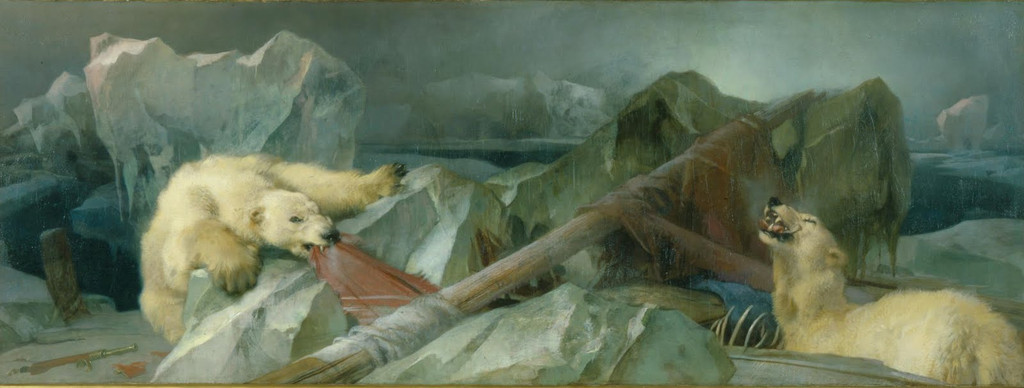
| Man Proposes, God Disposes | 1864 | Painting |
| Nell Gwynne / Diana Vernon | Painting | |
| Neptune | ||
| No Hunting Till the Weather Breaks | Painting | |
| Otterhounds | Drawing | |
| Peace | Painting | |
| Pensioners | Painting | |
| Portrait of a Mule | Painting | |
| Portrait of Mr Van Amburgh, as He Appeared with His Animals at the London Theatres | 1846–47 | Painting |
| Portraits of a Pointer Bitch and Puppy | Painting | |
| Pray Let Me Out | ||
| Prosperity | Painting | |
| Ptarmigan in a Landscape | by 1833 | Painting |
| Queen Victoria and Prince Albert at the Bal Costumé of 12 May 1842 | 1842–46 | Painting |
| Queen Victoria at Loch Laggan | Painting | |
| Queen Victoria at Osborne | 1865–67 | Painting |
| Queen Victoria landing at Loch Muick | Painting | |
| Rat-catching | 1823 | |
| Reclining Lion | Drawing | |
| Reclining Lion, From Back | Drawing | |
| Rent-day in the Wilderness | 1855–68 | Painting |
| Return from Deer Stalking | 1839 | |
| Royal Sports on Hill and Loch | Painting | |
| Sam Lovill, Porter at the Royal Academy | Drawing | |
| Scene from A Midsummer Night's Dream | 1848–51 | Painting |
| Scene in the Highlands, with portraits of the Duchess of Bedford, the Duke of Gordon and Lord Alexander Russell | Painting | |
| Scottish Highlands, Lochs and Figures | Drawing | |
| Shoeing | exhibited 1844 | Painting |
| Sleeping Bloodhound | exhibited 1835 | Painting |
| Spaniel and Rabbit | Painting | |
| Stag at Bay | 1866 | Sculpture |
| Stag at Bay | 1846 | Painting |
| Studies of a staghound and the head of a stag for painting ‘The Hunting of Chevy Chase’ | Drawing | |
| Study for Alpine Mastiffs Reanimating a Distressed Traveler | Drawing | |
| Study for the Monkey in The Cat's Paw | Drawing | |
| Study of a Dog | Drawing | |
| Study of a herding dog facing right | Drawing | |
| Study of the horse of Selene, from the East pediment of the Parthenon | Drawing | |
| Suspense | Painting | |
| Taking a Buck | ||
| The Arab Tent | c. 1865–66 | Painting |
| The Barn | Drawing | |
| The Best Run of the Season | ||
| The Cat's Paw | c. 1824 | Painting |
| The Cavalier’s Pets | ||
| The Challenge | Painting | |
| The Chase | Drawing | |
| The Connoisseurs: Portrait of the Artist with Two Dogs | 1865 | Painting |
| The Death of a Stag in Glen Tilt | Painting | |
| The Drive—Shooting Deer in the Pass | Painting | |
| The Drover's Departure | Painting | |
| The Highland Shepherd’s Dog | 1824; portfolio issue 1848 | |
| The Honourable Mrs Norton | Painting | |
| The Hunting of Chevy Chase | 1825–26 | Painting |
| The Illicit Highland Whisky Still | Painting | |
| The Keeper John Crerar with his Pony | Painting | |
| The Larder Invaded | ||
| The Lion-Dog of Malta | ||
| The Lions at the Base of Nelson's Column | 1867 | Sculpture |
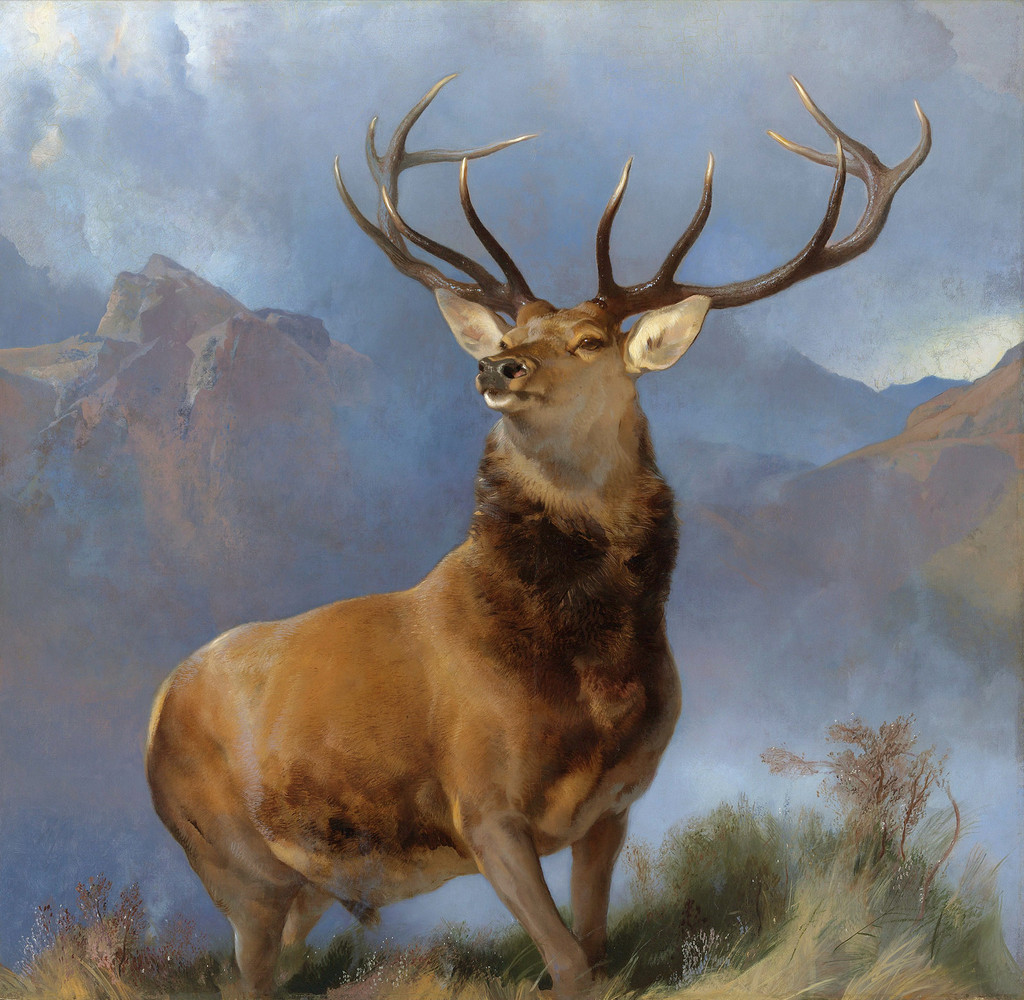
| The Monarch of the Glen | about 1851 | Painting |
| The Mountain Torrent | ||
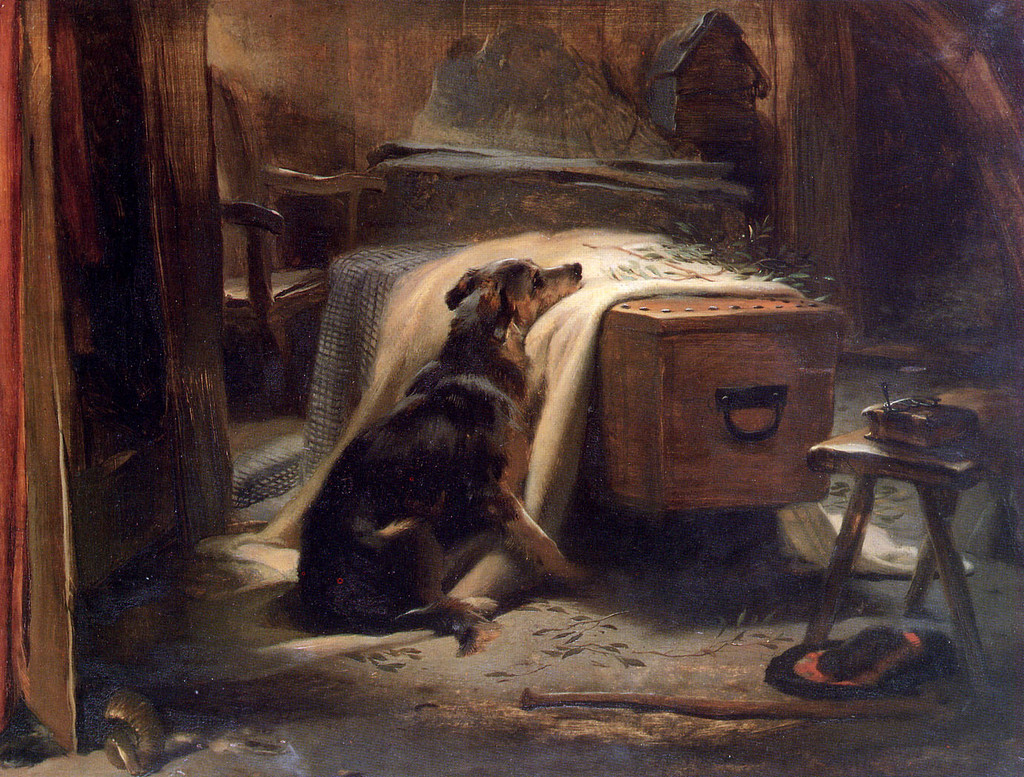
| The Old Shepherd's Chief Mourner | 1837 | Painting |
| The Sanctuary | 1842 | Painting |
| The Stricken Deer | Painting | |
| The Twa Dogs | Painting | |
| Time of Peace | ||
| Two stags running | Drawing | |
| Victoria, Princess Royal, with Eos | Painting | |
| View of Glenfeshie | Painting | |
| War | Painting | |
| White Horse in a Stable | Painting | |
| Windsor Castle in Modern Times | 1841–43 | Painting |
| Woburn Abbey Game Card | 1825; portfolio issue 1848 |
Discussion
Use the article’s images and evidence to develop your own reading of Sculpture.
Reader Insights
Which detail is most revealing when you consider “How small was Landseer’s sculptural practice?”?
How does the evidence in “Learning to see an animal in the round” affect your reading of Sculpture?
What further question would you bring to “How to look at Landseer’s sculpture”?
Join the Conversation
Share a detail, comparison or question about Sculpture below.
References
- Public Statues and Sculpture Association, Philip Ward-Jackson, “Sir Edwin Henry Landseer (1802–1873)”, 2011, bibliography updated 2024. View source.
- James Finch, “1866: Here Nelson Fell”, The Royal Academy of Arts Summer Exhibition: A Chronicle, 1769–2018; historical Landseer exhibition list recording number 942, Stag at Bay. and View source 1. View source 2.
- Frederick G. Stephens, Sir Edwin Landseer, 1880; James A. Manson, Sir Edwin Landseer, R.A., 1902. and View source 1. View source 2.
- UK Parliament, “Supply—Civil Service Estimates”, House of Commons, 8 June 1863. View source.
- National Portrait Gallery, “British bronze sculpture founders and plaster figure makers, 1800–1980 — M”, entry for Baron Carlo Marochetti. View source.
- Westminster City Council, Trafalgar Square Conservation Area Audit, adopted 19 February 2004. View source.
- National Portrait Gallery, Sir Edwin Henry Landseer person record. View source.
- William Powell Frith, My Autobiography and Reminiscences, volume 2, 1887. View source.
- Art Institute of Chicago, Edwin Henry Landseer collection results, including Reclining Lion, Reclining Lion, From Back and Lioness. View source.
- British Museum, Edwin Landseer, Study of the horse of Selene, from the East pediment of the Parthenon, 1820–40?, graphite, 105 × 174 mm, `2003,0929.20`. View source.
- National Gallery of Art, Edwin Landseer, Lion Defending its Prey, c.1840, oil on paper on canvas, 25.1 × 32.4 cm, `2004.166.26`. View source.
- UK Parliament, “Supply—Civil Service Estimates”, House of Commons, 13 July 1858. View source.
- London City Hall, “Trafalgar Square”. View source.
- UK Parliament, “Question”, House of Commons, 12 July 1860. View source.
- UK Parliament, “Supply—Civil Service Estimates”, House of Commons, 30 May 1864. View source.
- UK Parliament, “The Nelson Monument”, House of Commons, 12 April 1861. View source.
- UK Parliament, “The Nelson Monument—Reply”, House of Commons, 4 April 1862. View source.
- UK Parliament, “Class I—Public Works and Buildings”, House of Commons, 12 May 1865. View source.
- Katie Hornstein, “The Corpse at the Door: Edwin Landseer and Albert the Lion”, in Exhibiting Animals in Europe and America, 2025. View source.
- Historic England, Victoria Hall, Saltaire, list entry `1314205`, and Saltaire School, list entry `1300666`. and View source 1. View source 2.
- National Portrait Gallery, John Ballantyne, Sir Edwin Landseer, c.1865, oil on canvas, 800 × 1,130 mm, NPG 835; object and extended catalogue records. and View source 1. View source 2.
- “Sculpture”, Encyclopaedia Britannica, eleventh edition, 1911, historical assessment of Landseer’s sculpture. View source.
- Splash image, One of the bronze lions at Nelson’s Column: modelled by Edwin Landseer and cast by Carlo Marochetti. Photograph by Amanda Slater. CC BY-SA 2.0. Image source. CC BY-SA 2.0. Resized.