by Tom Gurney
Tom Gurney BSc (Hons) is an art history expert with over 20 years experience
Email: tomgurney1@gmail.com / Phone: +44 7429 011000
The Old Shepherd's Chief Mourner: Introduction
A dog rests its head against a closed coffin. That is the plainest description of Edwin Landseer's The Old Shepherd's Chief Mourner, yet almost every word beyond it begins an interpretation. The room contains no living person. The shepherd named in the title cannot be seen, except through the box that encloses his body and the few belongings that outlast him. The dog does not speak, kneel like a human mourner or perform a recognisable funeral rite. Its lowered head, forward pressure and stillness nevertheless invite viewers to call what they see grief.[1][2]
Landseer painted the picture in 1837, in oil on canvas. It is a small horizontal work, 45.7 centimetres high and 61 centimetres wide, now in the Victoria and Albert Museum under accession number FA.93[O]. John Sheepshanks gave it to the nation in 1857. Those concise facts place the painting at three distinct moments: its first appearance in a crowded Royal Academy exhibition; John Ruskin's celebrated use of it in Modern Painters; and its later role in a public museum that wanted British art to educate a very broad audience.[1][3][4][5]
The picture has often been called sentimental, and it plainly seeks feeling. But sentiment is not an alternative to structure. Landseer concentrates light where the living animal touches the funerary cloth. He lets the coffin run as a hard horizontal across the room, then breaks that stability with the dog's diagonal body and the hanging folds. He removes the dead figure from view while scattering enough objects—a book, spectacles, staff, cap and empty furniture—to let a spectator imagine a life. The title completes the operation by giving the dog a social rank: not simply a companion beside a box, but the old shepherd's “chief mourner”.[1][2]
That title also creates the picture's central difficulty. A mourner is a person defined by bereavement and ritual. Applying the term to a dog risks turning animal behaviour into a mirror of human morality. Yet refusing the possibility that another species can respond to loss is also an assumption. Modern studies record behavioural changes in dogs after a social companion dies, while warning that human observers shape the reports and cannot directly retrieve an animal's inward experience. They make Landseer's subject plausible as a question, not provable as a diagnosis.[6][7]
The most rewarding way to approach the painting is therefore to keep three kinds of evidence in view. There is what the oil visibly presents. There is what nineteenth-century critics and museum reformers made those marks mean. And there is what a present viewer may responsibly infer. The force of The Old Shepherd's Chief Mourner lies in the pressure between those levels. It makes an animal seem eloquent while never giving it words.
At a Glance
- ArtistEdwin Landseer [1]
- Date1837 [1]
- Collection or siteVictoria and Albert Museum [1]
- ObjectFA.93[O] [1]
This work across Edwin Landseer’s career
The Cat's Paw
c. 1824 [9]The Hunting of Chevy Chase
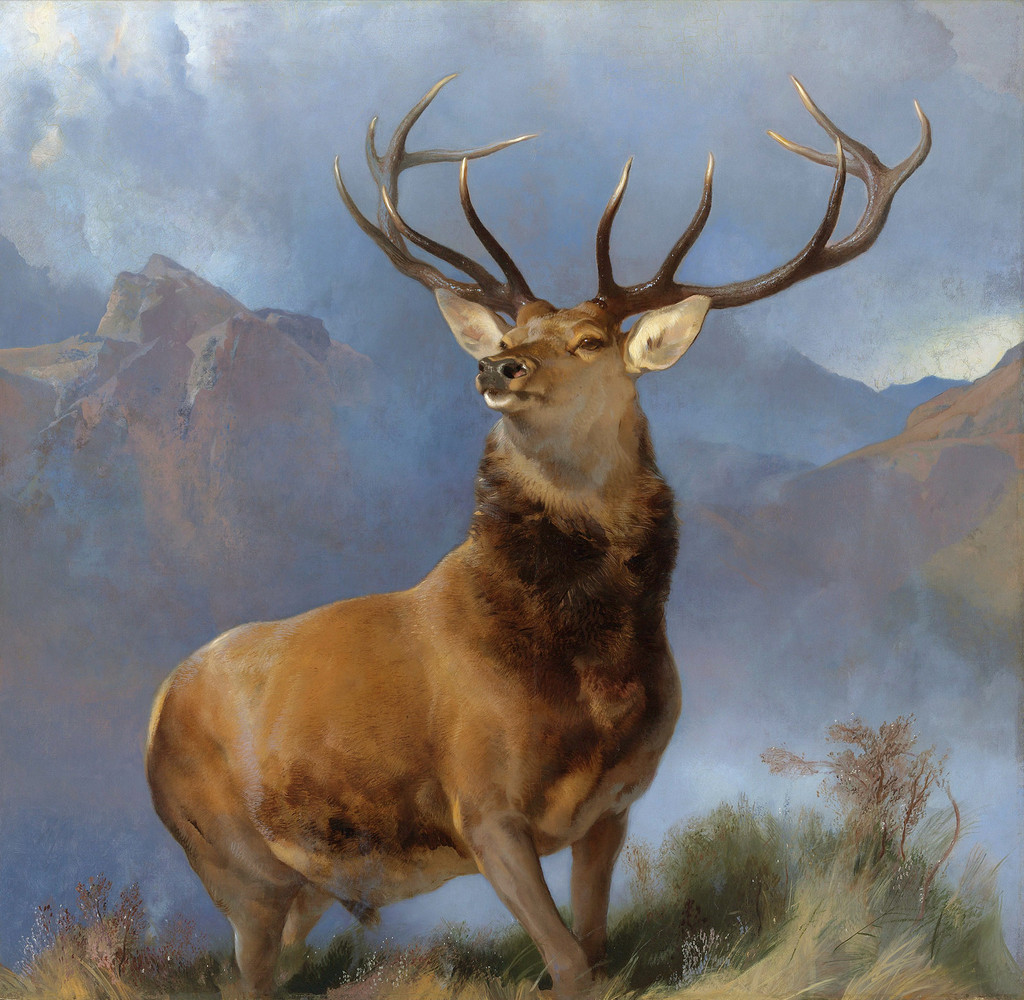
1825–26 [10]The Monarch of the Glen
about 1851 [14]Contents
- What the V&A object record establishes
- A room organised around an absent person
- Why the dog becomes the “chief mourner”
- Coffin, cloth and the traces of a life
- Light, colour and the discipline of stillness
- A Highland life suggested, not located
- Catalogue number 112 at the Royal Academy in 1837
- Ruskin's picture of pictorial thought
- Ruskin's second thoughts about Landseer
- Sentiment without dismissal
What the V&A object record establishes
The Victoria and Albert Museum identifies the work as The Old Shepherd's Chief Mourner, painted by Sir Edwin Henry Landseer in Britain in 1837. Its current record classifies it as an oil painting made with oil paint on canvas. The unframed dimensions are 45.7 by 61 centimetres, with a recorded depth of 7 centimetres; framed, it measures 702 by 857 by 68 millimetres. The accession number, FA.93[O], and system number, O16452, distinguish this particular object from the many prints and later images made after it.[1]
The medium deserves more care than such a familiar picture might seem to require. An older scholarly note in Lancaster University's electronic edition of Ruskin calls it oil on panel, while the Rossetti Archive and the V&A's current catalogue say oil on canvas.[17][18] The current holder's record governs: the painting should be described as oil on canvas. The discrepancy remains useful as a reminder that even apparently elementary catalogue facts can change when an institution re-examines an object.
Dimensions can also become muddled when frame and painted support are combined. A rounded record of about 70 by 85 centimetres refers to the framed object; 45.7 by 61 centimetres describes the unframed painting.[1][18] The latter measurement matters to interpretation. This is not a life-size funeral scene or a public spectacle spread across a monumental canvas. Its drama has been compressed into a surface little more than half a metre wide.
The V&A records that John Sheepshanks gave the painting in 1857 and that it had been exhibited at the Royal Academy in 1837.[1] It does not identify an original commissioner, a purchase price, the date on which Sheepshanks acquired it, a real shepherd or a named dog. Those absences are significant because later descriptions often write an entire biography around the visible objects. The picture invites that imaginative work, but its present catalogue does not turn the invented life into provenance.
The museum's digital record also associates several photographic assets with the object. The principal image provides a clear witness for colour, composition and detail; the accompanying metadata credits the Victoria and Albert Museum.[1][2] Digital availability is not the same as blanket permission to reproduce an image in every context. It lets viewers inspect the painting closely while keeping the photograph, its rights and the nineteenth-century oil conceptually distinct.
The V&A's summary calls the dog accurate and almost anthropomorphic, and describes the picture as a combination of pathos and realism.[1] That phrasing avoids two easy extremes. The animal is not a disguised human actor, but neither is it merely a specimen of canine anatomy. Landseer makes observed body and humanly legible story work together.
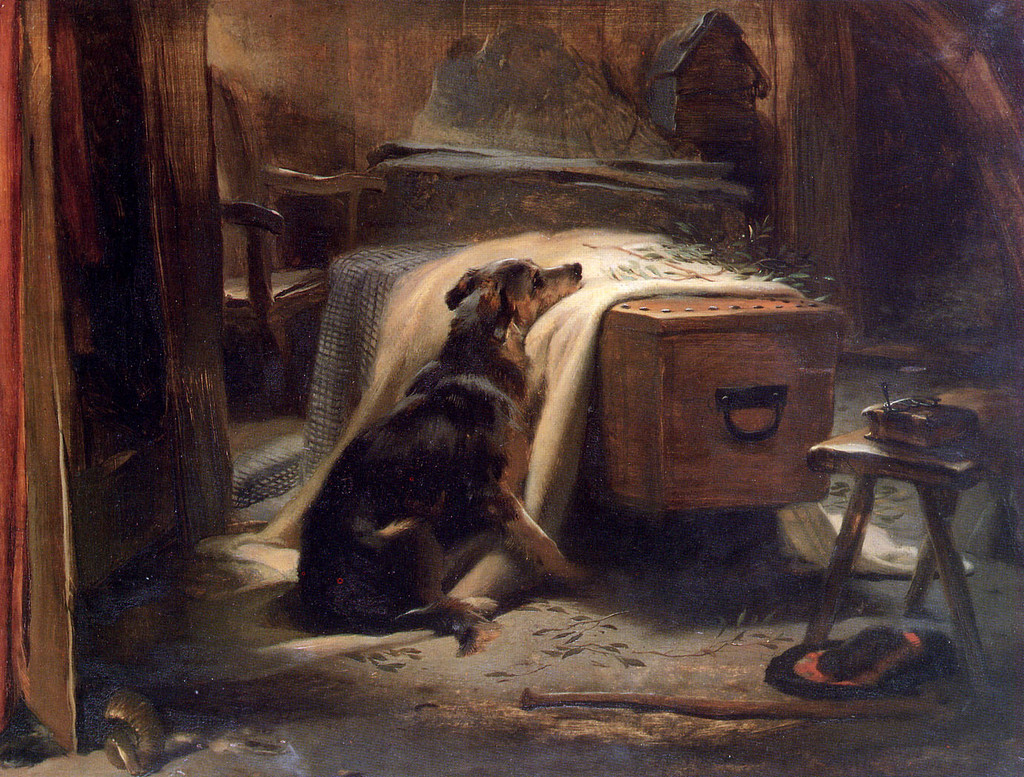
The Old Shepherd's Chief Mourner. Victoria and Albert Museum. Image source. Public domain.
A room organised around an absent person
At first glance the coffin seems to be the room's largest object. It crosses the middle of the picture on simple trestle-like supports, a firm box whose long upper edge helps divide foreground from shadowed interior. The dead shepherd's body is enclosed. There is no face to contemplate, no wound, no display of a corpse and no gathered group whose expressions explain how the spectator should respond.[2]
That withholding changes the subject from death witnessed directly to death reconstructed from consequences. The viewer sees what remains after life has stopped: an occupied coffin, an unused staff, a cap no one will put on, spectacles separated from their wearer and a chair without a sitter. These objects do not prove the exact habits of an individual. Together with the title, however, they make the missing person imaginable as old, working, modestly housed and closely accompanied by a dog.
The emptiness is carefully populated. At the right, a low stool holds or adjoins a dark book and spectacles. A cap or bonnet lies nearby. A long wooden staff or crook-like form crosses the floor, pointing back towards the coffin and dog. Part of a chair can be found at the left or rear. Curtains, doorways or wall planes close the edges in darkness. Each item occupies little space, but each supplies a possible verb from the shepherd's former life: reading, seeing, sitting, walking, tending, returning.[2]
Landseer makes the dog the only visible creature capable of action, then paints it as nearly motionless. The tension is powerful. A room full of inanimate things would read as an interior after a death. The presence of one living body turns it into a vigil. Because the animal is unable to explain itself, the spectator searches its posture for meaning and the surrounding things for narrative confirmation.
The closed coffin is essential to that search. It creates physical contact without reciprocal contact. The dog can press against the box, but the master cannot answer. The hard wooden boundary gives the animal's forward lean an obstacle. The picture does not need to show decay or injury; the impossibility of response is built into the geometry.
The lack of human mourners should not be converted into a factual claim that nobody else cared or that a funeral party has just departed. “Chief” implies precedence, not necessarily solitude. The empty room may suggest isolation, and Victorian writers repeatedly developed that suggestion, but the image provides no clock and no account of who came before or will enter next. Its emotional efficiency depends on making temporary emptiness feel absolute.
This is why the scene remains affecting even when its implied biography is questioned. The viewer does not need to believe in a documented shepherd to recognise objects becoming useless at a death. Landseer gives absence a material form. Human life is distributed among possessions; canine attachment is concentrated in one body.
Why the dog becomes the “chief mourner”
The title reaches into the picture before close looking begins. Without it, the scene would still suggest a dog's attachment to a coffin. With it, the animal receives a place in a funeral hierarchy. “Mourner” translates posture into emotion and custom. “Chief” claims that the dog's relation to the dead is paramount, even though no comparison with other mourners can be seen.
This naming is the picture's boldest anthropomorphic act. Landseer does not clothe the dog, make it stand on two legs or reshape its paws as hands. The body stays low, canine and weight-bearing. The muzzle rests on cloth; the chest presses forward; the forepaws reach the coffin edge while the hind body remains grounded. Human meaning is applied through words and arrangement rather than through a comic physical transformation.[1][19]
The dog's colours also resist a simple silhouette. Black, tan and white patches articulate head, chest and limbs against the dark room and pale drapery. Its coat gives the eye something tactile to follow. Yet the emotional emphasis does not depend on hair alone. The lowered head reverses the alert upward carriage common in portraits of prized dogs. The body points towards the coffin rather than towards a viewer, owner or field of action. The pose closes the dog into a relation from which the spectator is excluded.
To call this fidelity is already to use a moral word. Fidelity means constancy to another across time, and the single image cannot show duration. The title, coffin and stillness prompt viewers to imagine that duration: companionship before the death and continued attendance after it. Nineteenth-century writers supplied walks across hills, shared hardship and a lonely final vigil. Those stories reveal how completely the composition activates a familiar idea of the faithful dog, but they remain stories built from signs.[20][21][22]
Catherine Molloy's study of anthropomorphism notes that later images of canine mourning could use an empty chair, a known animal identity and mass-circulated biography to signify a particular dead owner. Landseer's shepherd and dog work differently. Neither is named. The painting must construct their bond within its frame, using the coffin, the workman's objects and the dog's assigned role.[19] Anonymity makes the pair less biographical and more available to general feeling.
The phrase “chief mourner” also reverses social expectation. In a human funeral, rank might be decided by family relation, household position or ritual convention. Here, emotional proximity supposedly outranks species. The dog becomes chief not through law or speech but through the viewer's belief that its attachment is uncalculated. That belief was central to the work's popularity and to its moral use in the nineteenth century.
A cautious present reading need not discard it. The point is not to prove that the animal feels in precisely human terms. It is to notice how Landseer creates an encounter in which a non-human body becomes the most credible carrier of loss. The painting asks whether mourning is defined by ritual knowledge, by visible behaviour, by attachment or by the spectator who names it.
Coffin, cloth and the traces of a life
The coffin is plain enough to suggest limited means, but its simplicity is pictorial as well as social. Broad wooden planes contrast with the dog's irregular coat and the fabric's folds. Small metal details, handles or studs punctuate its side. The box looks made, closed and ready for removal. It is both a practical container and the painting's unyielding barrier.[2]
Across it lies pale, heavy fabric. One portion covers the top; another falls diagonally towards the floor, gathering near the dog's paws. Later writers called the material a blanket, plaid, shawl, maud and pall. Frederick G. Stephens described the shepherd's maud serving as a funerary covering, while James Dafforne imagined cloth that had once protected its owner from Highland weather.[21][22] Those readings connect clothing, labour and burial, but the exact textile type cannot be established from the digital image alone.
The uncertainty is productive. A formal pall would belong to ceremony; a familiar blanket or plaid would belong to daily use. The fabric can evoke both without becoming either conclusively. Something associated with warmth now covers a coffin. Its folds soften the hard box and provide the surface on which the dog's head can rest. Landseer makes domestic or working cloth mediate between living fur and dead wood.
Green sprigs lie across the upper area. Dafforne calls them laurel, while other retellings have supplied different funerary plants.[22] The image securely shows foliage, not a botanical label. Its colour matters more than an uncertain species: small living green touches interrupt the browns, blacks and creams, while scattered forms prevent the coffin lid from becoming a bare geometric slab.
The book and spectacles generated some of the picture's richest commentary. Ruskin treated the spectacles as marking the place where a Bible had last been closed, turning a tiny still-life detail into evidence of reading, age, loneliness and a recently interrupted life.[4] Stephens likewise read Bible and spectacles as signs of piety and infirmity.[21] The visible object is a dark book whose text cannot be read in the available image. Calling it a Bible is historically important because Ruskin and Redgrave built moral arguments around that identification; it should remain their reading rather than an unqualified visual fact.
The staff works in a similar way. In company with the title, it identifies the absent person's labour more efficiently than a flock or landscape would. It brings outdoor work into the interior as an object no longer in use. The cap and chair repeat the pattern. None is spectacular. Their ordinariness makes the death feel like the end of routines rather than the climax of a heroic narrative.
The arrangement asks the viewer to perform a kind of archaeology of affection. One moves from object to absent user, from dog to past companionship, from cloth to imagined weather and from spectacles to an interrupted act of reading. The risk is that inference hardens into invented fact. The reward is seeing how little visual evidence Landseer needs to generate a large human story.
Light, colour and the discipline of stillness
The scene is dark, but not uniformly so. Illumination gathers along the pale cloth, the coffin's front edge and the dog's head and chest. Those passages form a compact centre of visibility. Towards the margins, furniture, wall and curtain sink into brown-black recession. The light does not reveal an entire room; it selects the point of contact.[2]
That selection keeps grief from becoming a facial close-up. The dog's eye is important, yet the emotion is distributed through the whole pose: weight forward, head lowered, paws held near the box, torso angled into stillness. The viewer reads pressure and duration more than a single expression. Ruskin's famous description intensifies these cues, speaking of clinging paws, immobility and a tearful downward eye.[4] The paint itself presents a lowered eye; the tears belong to his language.
Colour is restrained enough that small differences carry weight. Cream and grey fabric stand out against the dark coffin and room. The dog's white chest and muzzle connect it to that cloth, while black areas merge partly with the surrounding shadow. Tan passages warm the head and limbs. Green foliage and a few reddish notes prevent the composition from collapsing into monochrome.[2]
The horizontal format slows the scene. Nothing rises into a dramatic peak. Coffin, trestles and floor extend laterally; the dog's body makes a diagonal but does not break away from the lower half. This keeps attention near the level of an animal on the ground. The spectator looks down or across rather than up at a heroic protagonist.
Landseer's handling offers different kinds of information. Coat, cloth, foliage and wood are sufficiently differentiated to make each surface legible. Crisp touches identify hair and edges; broader darkness suppresses secondary architecture. Ruskin called this surface articulation pictorial “language”, but he insisted that clear execution became important only when it carried thought.[4] His distinction remains useful because it prevents the work from being reduced to clever fur.
There is no technical study here that would justify naming pigments, glazing stages or individual brush sizes. Visual confidence should stop where the evidence stops. What can be said is that detail is unevenly distributed. The nearer things associated with the shepherd and dog become readable, while the room beyond is denied equivalent precision. The hierarchy makes memory seem sharp at the centre and the wider world unavailable.
Stillness, finally, is not emptiness. It is built from held relationships. The closed box cannot move; the discarded objects have lost their users; the animal could move but appears not to. That last possibility gives the picture its tension. A dog at rest might rise in the next instant. A chief mourner, as the title names it, seems bound to remain.
A Highland life suggested, not located
The V&A records Britain as the place of production and does not identify the represented room.[1] Nevertheless, historical writers often called the picture The Highland Shepherd's Chief Mourner. Plaid-like cloth, a shepherd's staff, cap and spare interior encouraged a Scottish reading, as did Landseer's established association with Highland subjects. The setting is therefore Highland-coded without being a mapped location.[17][21]
This distinction matters because “the Highlands” could function in nineteenth-century art as both place and idea. For metropolitan audiences, rough materials and pastoral labour might suggest distance from urban wealth, older custom, endurance and intimacy with animals. A sparse cottage could be read as evidence of honest poverty or picturesque isolation. Those meanings were cultural constructions, not a complete account of Highland life.
The painting contains no visible mountain, flock or weather. It brings pastoral identity indoors through objects. The staff substitutes for the hillside; the dog for working companionship; the heavy cloth for exposure; the coffin for the end of labour. The move is economical. It lets Landseer evoke an outdoor life while confining the emotional event to a dark room.
Later descriptions expand those cues into a history of shared storms, hunger, watchfulness and journeys over hills.[20][22] Such language helps explain the picture's reception. Viewers imagined the dog's present posture as the final moment in years of mutual dependence. Yet no account identifies the animal model or shepherd as a documented pair, and no landscape detail confirms a particular community.
The anonymity has ethical consequences. A generic “old shepherd” can easily become a vessel for ideas about rural virtue, religious simplicity and contented hardship. Redgrave's later museum speech did precisely this, inviting viewers to infer bare lodging, hard fare and merciful treatment of the dog.[20][23] His reading transformed economic deprivation into a morally legible life. Modern viewers can recognise the compassion in that account while also noticing how class is aestheticised.
The room need not be romanticised to remain affecting. Its limited possessions register material constraint. The dog's companionship may appear especially valuable because human society is absent, but the painting does not prove that the shepherd lived without community. It stages a relation between one dead worker and one living animal, then allows Highland signs to enlarge their shared past.
Catalogue number 112 at the Royal Academy in 1837
The Old Shepherd's Chief Mourner was exhibited at the Royal Academy in 1837 as catalogue number 112.[1][17] That simple exhibition fact placed an intimate dark interior within one of London's largest annual spectacles. The work was not originally encountered in the hushed isolation of a modern digital object page. It competed with hundreds of paintings, sculptures, architectural designs and other works for attention.
The 1837 exhibition was the Academy's first in the National Gallery building at Trafalgar Square. It ran from 1 May to 22 July, presented 1,289 works by 664 artists and drew a recorded 105,800 visitors. The Academy occupied the east wing of William Wilkins's building while construction was still being completed.[3] These figures do not tell us how many people stopped at Landseer's picture, but they define the crowded conditions in which its compressed story first operated.
Its scale may have been an advantage. A large canvas could announce itself across a room; a small one demanded approach. Once near, a spectator could recognise the coffin quickly and then discover the accessories. The subject unfolded in stages suited to exhibition looking: immediate pathos from dog and box, followed by reward for examining book, spectacles, staff, cloth and foliage.
Lancaster University's Ruskin note records that the picture was reviewed in the Athenaeum on 6 May 1837.[17] Without the review text, its verdict should not be reconstructed. The Metropolitan Museum later summarises the Royal Academy reception as acclaim and calls the subject immensely popular.[24] That institutional judgement supports success, but not a claim that every critic agreed or that another Landseer picture eclipsed it.
The exhibition year is also important in Landseer's development. He was already a Royal Academician and a celebrated animal painter, not an unknown artist whose reputation began with this dog. The work could draw on an audience trained by his earlier pictures to look for intelligence, humour, social type and emotional narrative in animals. What was unusual was the extreme concentration: one animal, one absent human and almost no outward action.
The title printed in a catalogue would have guided viewers before or after they reached the wall. It supplied age, occupation, relationship and emotional rank in five words. The public encounter was therefore always verbal as well as visual. The picture did not silently acquire its story generations later; title and image entered exhibition culture together.
One year afterwards, a major engraving made that relation even more explicit by placing the translated image on a printed sheet with publication information. The Royal Academy debut was thus not an isolated event but the beginning of a movement between wall, criticism and reproduction.[24][25]
Ruskin's picture of pictorial thought
When John Ruskin discussed the work in the first volume of Modern Painters, published in 1843, he made it an example in a large argument about artistic greatness. He proposed that painting, like writing, had a language and could also embody thought. Technical fluency mattered, but it was not identical with intellectual value.[4]
For Ruskin, the crisp coat, green foliage, wooden coffin and folded blanket demonstrated clear execution. These were the means by which the painter made things intelligible. The greater achievement lay in their organisation: the dog's pressure against wood, the position of the paws and head, the lowered eye, prolonged stillness, dark chamber, book and spectacles. Together they carried ideas of attachment, interruption, loneliness and death.[4]
He called the painting one of the most perfect modern “poems or pictures” and concluded that it marked Landseer as a “Man of Mind”.[4] Those brief phrases have often been repeated because they gave an animal picture unusually high critical status. Ruskin did not praise it as a charming minor genre scene. He used it to challenge the assumption that elevated thought required a grand historical or mythological subject.
His analysis is compelling because it attends closely to relations rather than merely listing symbols. The dog's chest matters because it presses against the coffin. The paws matter because fabric appears displaced. Spectacles matter because they rest with the book and cannot be used again. Gloom matters because it isolates these signs. Meaning emerges from a network, not from a label attached to one object.
Ruskin's prose also demonstrates how criticism adds a performance of its own. He turns stillness into a long unbroken vigil, imagines the last hammering of the coffin lid and infers an unwatched death. He describes the eye in tearful terms. None of those claims is required by the current museum record. They are acts of intense reading that teach later viewers what to see.[1][4]
This does not make them mistakes to discard. It makes them part of the painting's history. Ruskin revealed how the picture could produce thought in a spectator, even as his own language exceeded what paint could verify. His distinction between execution and idea remains valuable, while his additions show that the observer helps complete the narrative.
The argument also explains why photographic detail cannot replace the work. A close image may reveal individual hairs or cloth edges more clearly than a gallery view, but Ruskin's “thought” lies in their arrangement at the scale of the whole. To study only the dog's face would lose the empty chair, staff and book; to study only the accessories would lose bodily contact. The poem, in his sense, is relational.
Ruskin's second thoughts about Landseer
Ruskin's famous praise can sound final when quoted alone. His later writing was more unsettled. Lancaster's electronic edition records that he criticised Landseer's colour and broader painterly achievement, and judged him more a natural historian than a painter. He believed the artist's strength depended on knowledge and love of animals, attention to their habits, and memory for gesture and expression more than on complete technical excellence.[17]
Yet he did not simply repudiate The Old Shepherd's Chief Mourner. He explicitly preserved his praise for this and related pictures in which he thought the inner life—or, in his tentative wording, the “soul”—of animals had been disclosed in unprecedented ways.[17] The qualification matters on both sides. Ruskin narrowed Landseer's standing as a painter while retaining an exceptional claim for the artist's animal understanding.
This development sharpens the question raised in 1843. If the painting's greatness does not rest on detailed coat and fabric alone, can its conception survive weaknesses of colour or composition? Ruskin's answer appears to be yes, but not without cost. He separated the imaginative insight that made the dog emotionally intelligible from the broader painterly standards by which he judged masters such as Veronese.[17][21]
The change also prevents “Ruskin praised it” from functioning as a seal of objective quality. His critical system evolved, and Landseer became a test case within that evolution. Early praise elevated modern animal painting into the realm of thought. Later reservation exposed the limits of confusing acute natural history with every form of pictorial excellence.
For a present viewer, this tension is more useful than a simple endorsement. The painting's colour is deliberately narrow, its room theatrically dark and its clues arranged for rapid comprehension. Those features can be admired as disciplined concentration or questioned as manipulative design. The dog can appear profoundly observed and strongly humanised at once.
Ruskin's two positions therefore invite two passes before the work. First ask how each mark communicates—how fur differs from wood, cloth from foliage, living pressure from inanimate support. Then ask what kind of painting results when all that skill is directed towards a story already named by the title. Does detail deepen ambiguity, or does it close interpretation around pathos? The work's continued power partly comes from refusing an easy answer.
Sentiment without dismissal
“Sentimental” is often used as a verdict rather than a description. Applied dismissively, it suggests easy tears, simplified virtue and an audience manipulated by obvious signs. The Old Shepherd's Chief Mourner certainly arranges emotion with great efficiency. A dog conventionally associated with loyalty touches a coffin; humble objects imply a good life; no difficult human face complicates sympathy. The design makes feeling available almost immediately.[1][26]
But speed does not make the emotion empty. The scene contains an irreversible event and an unanswered attachment. It gives the viewer no consoling human community, no priest, family, church or landscape beyond the room. The dog cannot explain death or transform it into doctrine. Its physical nearness to the coffin intensifies the fact that nearness cannot restore exchange.
The 1875 Art Journal classification placed the picture among a limited group of Landseer's “pathetic” animal subjects and called it a poetic monody.[27] That period term names a register of sorrow, not a defect automatically. It also shows that Victorian viewers differentiated this mood from the humorous, sporting and observational modes in Landseer's work.
Frederick Stephens's 1880 account demonstrates both the appeal and the risk. He imagines the dog as the dead man's faithful companion and sole guardian, while Bible and spectacles reveal piety, age and infirmity.[21] The story is moving because every object seems to agree. It is also socially tidy: poverty becomes simplicity, animal attachment confirms the master's goodness, and death seals the lesson.
Modern criticism can expose that tidiness without congratulating itself for feeling less. Sentiment is a historical way of organising moral response. It can make suffering visible and widen sympathy; it can also substitute a familiar emotional script for difficult knowledge. Landseer's picture does both. It grants the animal an importance that many hierarchies would deny, while making that importance legible through an ideal of unquestioning fidelity.
The animal's silence is crucial. A human mourner might express anger, conflict, relief, guilt or practical concern. The dog is asked to signify pure attachment because viewers cannot hear an alternative account. This can be read as respect for non-verbal relation or as appropriation of the animal for a human moral fable.
The painting remains strongest when those readings are held together. It need not be defended by insisting that the dog “really” feels exactly what a person would feel. Nor need it be dismissed because the composition asks for tears. Its achievement is to make the boundary between observation and projection visible through one restrained pose.
What modern research can—and cannot—say about canine grief
Research into animals after social loss gives a more precise vocabulary for caution. A 2022 study in Scientific Reports examined responses from 426 Italian adults who had owned at least two dogs when one died. Owners reported changes in the surviving dog's play, sleep, eating and fearfulness. The quality of the relationship between the dogs was associated with some changes, while the owner's grief and anger were also important predictors.[6]
The study supports the possibility of grief-related behavioural patterns in domestic dogs. It does not directly observe Landseer's animal, and its loss event was the death of another dog rather than a human guardian. It also relies on retrospective owner reports. The authors acknowledge that an owner's emotional state may influence how canine behaviour is perceived.[6]
An earlier survey by Jessica Walker, Natalie Waran and Clive Phillips gathered reports about dogs and cats after an animal companion died. Owners described changes in affection, territorial behaviour, food consumption, sleep and searching for a deceased animal's usual place. The researchers concluded that loss appeared to affect surviving animals, but called for direct assessment to distinguish grief from changes in resources, routine or owner behaviour.[7]
These studies matter because they prevent two absolute claims. It is too confident to say animals merely imitate human emotion and cannot respond meaningfully to a companion's death. It is equally too confident to infer a specific inner state from a posture, especially in a composed painting. Behaviour can be measured over time; grief remains a concept linking those measurements to experience.
Landseer's canvas offers no before-and-after observation. The dog is not a research subject but a painted figure arranged within a title and narrative. Its stillness could be made from many separate sittings, studies or acts of invention; the available object record does not reconstruct the pose's making. What viewers encounter is a persuasive representation of duration, not duration itself.
This distinction can deepen rather than weaken attention. Instead of looking for a literal tear, notice the dog's centre of gravity. Instead of declaring hopelessness, observe the lowered head and blocked forward movement. Instead of calling the animal the only true friend, notice that the title ranks it above unseen others. The description remains exact while the emotional interpretation stays open.
The modern evidence also changes the ethical question. The issue is not whether a nineteenth-century painter anticipated contemporary science. It is whether viewers can take animal social bonds seriously without claiming possession of animal consciousness. The Old Shepherd's Chief Mourner stages that problem with unusual clarity. It invites empathy and asks to be believed, while the dog's silence prevents final confirmation.
Sheepshanks's gift and a new public setting
In 1857, twenty years after the Royal Academy exhibition, John Sheepshanks gave the painting with his major collection of British art to the nation.[1] The gift did more than change ownership. It placed a privately collected sentimental animal picture inside an ambitious programme of public access, art education and national collection-building.
The House of Lords discussed the offer on 16 February 1857. Hansard records 233 pictures and 103 drawings and sketches in the account presented that day. Sheepshanks wanted the collection publicly accessible, connected with schools of art and capable, where appropriate, of provincial exhibition. He preferred responsibility vested in a minister answerable to public opinion. He also expressed a desire for Sunday evening access by working people, though this was described as a wish rather than a formal condition.[5]
He did not want an exclusive gallery permanently tied to his own name. The collection was to become the nucleus of a broader national gallery of British art.[5] A later V&A collecting plan describes the foundation gift as 233 oil paintings and 289 watercolours, drawings and etchings, and notes that the paintings collection was known for fifty years as the National Gallery of British Art.[28] The different works-on-paper totals reflect different categories and institutional accounting; the figure shared across the records is 233 paintings or oils.
The physical museum embodied these ambitions. The South Kensington Museum moved to its present home in 1857, and a Sheepshanks Gallery was built for the collection. Gas lighting allowed evening opening in winter, an innovation praised as a means of reaching people who worked during the day. The V&A describes its founding mission as educating designers, manufacturers and the public in art and design.[29]
Within this setting, The Old Shepherd's Chief Mourner changed from one successful exhibition picture into a repeatedly available teaching object. Visitors did not need access to Sheepshanks's home or to an original Academy season. The painting could be compared with other modern British works, encountered during evening hours and incorporated into institutional arguments about taste and conduct.
Public access did not make its meaning neutral. The museum's educational purpose came with assumptions about which viewers needed improvement and which emotions art should cultivate. The work's apparent readability—dog, death, loyalty, humble life—made it especially useful to reformers who wanted art to reach beyond trained connoisseurs.
Sheepshanks's gift therefore belongs inside the painting's history, not as a line added after the “real” story ends. It changed who might stand before the canvas, under what conditions and with what declared purpose. The later V&A accession number preserves the object; the 1857 gift helped create its public function.
Redgrave's lesson for the untutored viewer
Richard Redgrave made that function explicit in his 1857 address On the Gift of the Sheepshanks Collection. Alison Wright's study reconstructs his use of The Old Shepherd's Chief Mourner as an example of art that could reach viewers without rank or specialist education. He imagined the picture yielding an entire history of companionship, hardship, religion and mercy at a glance.[20][23]
Redgrave read the dog as evidence that the shepherd had treated it kindly. He linked the book to Scripture and invoked the Biblical principle that a righteous person shows mercy to animals. Because dogs belonged to people across social levels, he argued that the subject could touch a very wide audience.[20][23] In his account, accessibility was both emotional and moral: recognising canine fidelity would encourage humane feeling.
The speech demonstrates the picture's extraordinary interpretive economy. A viewer could infer age from spectacles, occupation from staff and title, faith from the book, poverty from the room and virtue from the dog's continued attachment. Each object became a moral certificate. The dog did not only grieve; it testified to the dead man's character.
Wright also shows the paternalism within this programme. Museum reformers described art as a civilising force for workers and those they considered untutored. Redgrave's appeal to the wayfarer and beggar positioned broad access within a hierarchy: cultivated administrators would select images capable of improving “common” minds.[20] The invitation was inclusive, but the terms were not equal.
This historical tension should remain visible. The speech cannot be used as direct evidence that Landseer painted the picture for South Kensington's educational mission, which did not yet exist in 1837. Nor does Redgrave's use make the painting a formal animal-welfare campaign object. It shows how, by 1857, its imagery could be recruited into debates about humane conduct, religion, class and public culture.
The museum reading also extends Ruskin's. Ruskin argued that organised detail embodied thought and proved the painter's mind. Redgrave emphasised what the same details could do to a viewer presumed to lack elite education. For one critic, the work demonstrated intellectual greatness in art; for the museum reformer, it demonstrated emotional intelligibility across class.[4][20]
Both accounts depend on close looking, yet both direct it strongly. They teach the spectator to identify the book as Bible, the room as loneliness and the dog as moral witness. A present reading can appreciate their eloquence while returning to the painted uncertainties they settled too quickly.
Gibbon's engraving and the image beyond the oil
The painting entered print culture with unusual speed. Benjamin Phelps Gibbon engraved The Shepherd's Chief Mourner after Landseer, and Francis Graham Moon published it on 2 June 1838—just over a year after the Royal Academy exhibition opened. The Metropolitan Museum catalogues its impression as a mixed-method engraving on chine collé, with a plate 34.5 by 37 centimetres on a sheet 40 by 54 centimetres, object number 47.30.7.[24]
The Rijksmuseum holds a related impression, RP-P-1944-3002. Its record names McQueen as printer and describes etching and engraving on paper.[25] These descriptions show the collaborative structure of reproduction: Landseer supplied the originating composition, Gibbon translated it, Moon published it and McQueen printed an impression. “A print of the painting” should not erase those makers.
Nor is an engraving a neutral photograph of oil. Line and worked tone reconstruct colour, brushwork and darkness in another medium. The printed sheet has its own scale, margins and inscriptions. It can circulate separately from the canvas, be framed in a home, handled in a portfolio or encountered through another collection. Its title often drops “Old”, demonstrating how even the name could shift as the image moved.
The prompt publication suggests confidence in demand, and the Met describes Gibbon's version as perhaps the best known among several printed examples.[24] Reproduction extended the picture's audience beyond people who could attend the Academy or later visit South Kensington. It also stabilised a particular visual reading, making the dog's pose and coffin available for quotation, memory and comparison.
Print circulation helps explain why Ruskin could choose the work as an example with cultural reach, and why later commentators wrote as though readers already knew it. Yet the chronology must remain exact. The oil appeared in 1837; Gibbon's dated sheet followed in 1838; Modern Painters supplied its celebrated criticism in 1843; Sheepshanks's gift made the original publicly accessible in 1857.[4][5][24]
This sequence resists a single account of popularity. Exhibition, engraving, criticism and museum display reinforced one another. The picture did not become famous through only one channel. Each encounter offered something different: coloured paint and physical scale; portable translated image; critical prose; repeated access to the original.
The engraving also makes the work's emotional design portable. A viewer no longer needed the oil's colour to understand dog, coffin and lowered head. That survival across media supports Ruskin's claim that the picture's thought exceeded ornamental handling, even though the print inevitably altered the visual language through which that thought was conveyed.
From Victorian monody to memorial after-image
The print history continued well beyond Gibbon's sheet. The Metropolitan Museum records editions and adaptations in different sizes and techniques, including mixed-method prints in the 1860s. After Landseer died in 1873, the Illustrated London News chose this scene for a double-page supplement published on 11 October.[24] A private scene of mourning had become an image through which the public could remember its maker.
That reuse produced a revealing reversal. In the painting, the dog stands for fidelity to an absent shepherd. In the newspaper tribute, the familiar dog and coffin could summon an absent Landseer. The subject's established pathos migrated from represented death to the artist's actual death. The image did not need to depict his funeral to operate as a memorial.
The 1875 Art Journal account then placed the work conspicuously within Landseer's pathetic mode.[27] Frederick Stephens's 1880 biography repeated and elaborated its emotional story, while quoting Ruskin at length.[21] James Dafforne's 1873 description likewise turned its objects into a full narrative of shared Highland hardship and devotion.[22] These texts did not merely report popularity; they helped maintain it by supplying readers with an authorised emotional route through the composition.
By 1900, the American engraver Timothy Cole made a wood engraving after the painting. The Metropolitan Museum's impression measures 13.3 by 18.5 centimetres within a 23 by 26.7 centimetre sheet and bears object number 2002.541.9. The museum suggests that it was among the last wood-engraved after-images produced within this sentimental tradition.[30]
The 1900 object is far smaller than Gibbon's sheet and belongs to another reproductive technique. Its existence more than six decades after the Academy debut shows longevity, not unchanging reception. A turn-of-the-century viewer met a picture already layered with Ruskin's authority, museum familiarity, Victorian biography and Landseer's posthumous fame.
Catherine Molloy's comparison with Maud Earl's 1910 image of Caesar, Edward VII's dog, demonstrates how the motif could change.[19] Earl's dog was publicly known by name and through photographs, so an empty chair could refer to a specific royal owner. Landseer's anonymous sheepdog needed the coffin and objects to build its relation within the picture. Similar canine grief imagery could therefore serve very different social identities.
The afterlife also warns against collapsing oil and print into one artwork. Every translation has its own maker, date, material, dimensions and audience. What persists is not an untouched surface but a structure: animal body, absent master, object of contact and invitation to infer fidelity.
How to look without closing the question
Begin before the story. Notice the picture's proportions and the coffin's long horizontal. Follow the diagonal of the dog from hindquarters towards muzzle. See how the pale cloth descends and how the brightest passages gather around contact. Let the dark room remain spatially uncertain rather than forcing every vertical into a named door or curtain.[2]
Then inventory the visible objects without immediately deciding what they prove: stool, dark book, spectacles, cap, staff, chair, foliage, cloth, trestles. Ask which details belong to the shepherd because the title says so, which can be recognised independently and which acquired their familiar meaning through Ruskin, Redgrave or later writers.[4][20][21]
Look at the dog as a body before calling it a mourner. Its chest is forward; the head is low; the forepaws meet the edge; the eye turns down; the rear body remains on the floor. There is no human costume or conventional prayer gesture. The animal's anatomy and the coffin's resistance create the pose from which emotion is inferred.
Now return to the title. It has already done more work than it first appeared to do. “Old” changes the spectacles and simple room. “Shepherd” changes the staff, cloth and dog. “Chief” changes absence into rank. “Mourner” changes stillness into grief. Each word reorganises visible matter.
Finally, place the image in time. In 1837 it was catalogue number 112 in a crowded new Trafalgar Square exhibition building.[3][17] In 1838 it became a collaborative engraved sheet.[24][25] In 1843 Ruskin made it evidence for thought in modern painting.[4] In 1857 Sheepshanks and South Kensington's reformers made it available as national instruction.[29][5][20] In 1873 and 1900 it became, in different ways, an after-image of Landseer himself.[24][30]
None of those contexts cancels the others. The work is an oil on canvas, an exhibition success, an argument in criticism, a museum teaching object, a reproducible motif and an enduring problem in human-animal interpretation. Its emotional clarity has always depended on acts of reading that the picture encourages but cannot verify.
That is why the most responsible conclusion is not a verdict on whether the dog “really” grieves. Landseer gives no access to a real animal's private experience, and modern behavioural research cannot travel backwards into a painted instant.[6][7] What he does provide is a disciplined visual proposition: attachment may be known through where a body chooses to remain when response is no longer possible.
The closed coffin keeps death beyond sight. The title pulls feeling into language. Between them, the dog holds the picture together. Its head touches fabric; its body stays on the floor; its silence leaves the final claim to the viewer. The Old Shepherd's Chief Mourner endures because that claim feels immediate and remains uncertain.
Artworks directory
This directory gathers works discussed in the articles, including drawings, original etchings and prints after Landseer. It is not a complete catalogue of every drawing, version, plate or impression. Distinct media are kept separate; uncertain dates are left blank. Linked titles open individual articles.
| Name | Date | Medium |
|---|---|---|
| A Bellowing Stag | Drawing | |
| A Deerhound | 1826 | Painting |
| A Distinguished Member of the Humane Society | 1838 | Painting |
| A Highland Breakfast | 1834 | Painting |
| A Highland Landscape | c. 1830 | Painting |
| A Highland Shepherd's Home | Painting | |
| A Horse, Goat and Bull | 1811 | |
| A Hunting Horse | Drawing | |
| A Jack in Office | Painting | |
| A Lion Disturbed at His Repast | Painting | |
| A Random Shot | Painting | |
| A Scene at Abbotsford | Painting | |
| Adversity | Painting | |
| Alexander and Diogenes | exhibited 1848 | Painting |
| Alpine Mastiffs Reanimating a Distressed Traveler | 1820 | Painting |
| Contending Group after Nature | Drawing | |
| Copy after Rubens's Wolf and Fox Hunt | c. 1824–26 | Painting |
| Dash | Painting | |
| Deer and Deer Hounds in a Mountain Torrent ('The Hunted Stag') | c. 1832 / exhibited 1833 | Painting |
| Deer Family | ||
| Dignity and Impudence | 1839 | Painting |
| Dog Resting Upon a Couch | Drawing | |
| Eos | 1841 | Painting |
| Favourites, the Property of H.R.H. Prince George of Cambridge | 1834–35 | Painting |
| Her Majesty Sketching at Loch Laggan | ||
| High Life | 1829 / exhibited 1831 | Painting |
| Highland Lassie | Drawing | |
| Isaac van Amburgh and his Animals | 1839 | Painting |
| Lady Godiva's Prayer | Painting | |
| Laying Down the Law | 1840 | Painting |
| Lion Defending Its Prey | c. 1840 | Painting |
| Lioness | Drawing | |
| Little Strollers | ||
| Low Life | 1829 / exhibited 1831 | Painting |
| Man Proposes, God Disposes | 1864 | Painting |
| Nell Gwynne / Diana Vernon | Painting | |
| Neptune | ||
| No Hunting Till the Weather Breaks | Painting | |
| Otterhounds | Drawing | |
| Peace | Painting | |
| Pensioners | Painting | |
| Portrait of a Mule | Painting | |
| Portrait of Mr Van Amburgh, as He Appeared with His Animals at the London Theatres | 1846–47 | Painting |
| Portraits of a Pointer Bitch and Puppy | Painting | |
| Pray Let Me Out | ||
| Prosperity | Painting | |
| Ptarmigan in a Landscape | by 1833 | Painting |
| Queen Victoria and Prince Albert at the Bal Costumé of 12 May 1842 | 1842–46 | Painting |
| Queen Victoria at Loch Laggan | Painting | |
| Queen Victoria at Osborne | 1865–67 | Painting |
| Queen Victoria landing at Loch Muick | Painting | |
| Rat-catching | 1823 | |
| Reclining Lion | Drawing | |
| Reclining Lion, From Back | Drawing | |
| Rent-day in the Wilderness | 1855–68 | Painting |
| Return from Deer Stalking | 1839 | |
| Royal Sports on Hill and Loch | Painting | |
| Sam Lovill, Porter at the Royal Academy | Drawing | |
| Scene from A Midsummer Night's Dream | 1848–51 | Painting |
| Scene in the Highlands, with portraits of the Duchess of Bedford, the Duke of Gordon and Lord Alexander Russell | Painting | |
| Scottish Highlands, Lochs and Figures | Drawing | |
| Shoeing | exhibited 1844 | Painting |
| Sleeping Bloodhound | exhibited 1835 | Painting |
| Spaniel and Rabbit | Painting | |
| Stag at Bay | 1866 | Sculpture |
| Stag at Bay | 1846 | Painting |
| Studies of a staghound and the head of a stag for painting ‘The Hunting of Chevy Chase’ | Drawing | |
| Study for Alpine Mastiffs Reanimating a Distressed Traveler | Drawing | |
| Study for the Monkey in The Cat's Paw | Drawing | |
| Study of a Dog | Drawing | |
| Study of a herding dog facing right | Drawing | |
| Study of the horse of Selene, from the East pediment of the Parthenon | Drawing | |
| Suspense | Painting | |
| Taking a Buck | ||
| The Arab Tent | c. 1865–66 | Painting |
| The Barn | Drawing | |
| The Best Run of the Season | ||
| The Cat's Paw | c. 1824 | Painting |
| The Cavalier’s Pets | ||
| The Challenge | Painting | |
| The Chase | Drawing | |
| The Connoisseurs: Portrait of the Artist with Two Dogs | 1865 | Painting |
| The Death of a Stag in Glen Tilt | Painting | |
| The Drive—Shooting Deer in the Pass | Painting | |
| The Drover's Departure | Painting | |
| The Highland Shepherd’s Dog | 1824; portfolio issue 1848 | |
| The Honourable Mrs Norton | Painting | |
| The Hunting of Chevy Chase | 1825–26 | Painting |
| The Illicit Highland Whisky Still | Painting | |
| The Keeper John Crerar with his Pony | Painting | |
| The Larder Invaded | ||
| The Lion-Dog of Malta | ||
| The Lions at the Base of Nelson's Column | 1867 | Sculpture |
| The Monarch of the Glen | about 1851 | Painting |
| The Mountain Torrent | ||
| The Old Shepherd's Chief Mourner | 1837 | Painting |
| The Sanctuary | 1842 | Painting |
| The Stricken Deer | Painting | |
| The Twa Dogs | Painting | |
| Time of Peace | ||
| Two stags running | Drawing | |
| Victoria, Princess Royal, with Eos | Painting | |
| View of Glenfeshie | Painting | |
| War | Painting | |
| White Horse in a Stable | Painting | |
| Windsor Castle in Modern Times | 1841–43 | Painting |
| Woburn Abbey Game Card | 1825; portfolio issue 1848 |
Discussion
Use the article’s images and evidence to develop your own reading of The Old Shepherd's Chief Mourner.
Reader Insights
Which detail is most revealing when you consider “What the V&A object record establishes”?
How does the evidence in “A room organised around an absent person” affect your reading of The Old Shepherd's Chief Mourner?
What further question would you bring to “How to look without closing the question”?
Join the Conversation
Share a detail, comparison or question about The Old Shepherd's Chief Mourner below.
References
- Victoria and Albert Museum, The Old Shepherd's Chief Mourner, 1837, FA.93[O], current collection record and object API: and View source 1. View source 2.
- Victoria and Albert Museum, IIIF presentation manifest for O16452 and primary digital image asset 2006AT0993: and View source 1. View source 2.
- Cora Gilroy-Ware, “1837: Sculpture and the Classical Ideal at Trafalgar Square”, The Royal Academy Summer Exhibition: A Chronicle, 1769–2018, Royal Academy of Arts and Paul Mellon Centre, 2018: View source.
- John Ruskin, Modern Painters, volume I, discussion of The Old Shepherd's Chief-mourner, Project Gutenberg transcription: View source.
- Hansard, House of Lords, “The Sheepshanks Collection of Pictures”, 16 February 1857: View source.
- Stefania Uccheddu et al., “Domestic dogs (Canis familiaris) grieve over the loss of a conspecific”, Scientific Reports, 12, 1920, 2022: View source.
- Jessica K. Walker, Natalie K. Waran and Clive J. C. Phillips, “Owners' Perceptions of Their Animal's Behavioural Response to the Loss of an Animal Companion”, Animals, 6, 68, 2016: and View source 1. View source 2.
- National Gallery of Art, Alpine Mastiffs Reanimating a Distressed Traveler. View source.
- Minneapolis Institute of Art, The Cat's Paw. View source.
- Birmingham Museums Trust, The Hunting of Chevy Chase. View source.
- Victoria and Albert Museum, The Old Shepherd's Chief Mourner. View source.
- Tate, Dignity and Impudence. View source.
- Royal Collection, Eos. View source.
- National Galleries of Scotland, The Monarch of the Glen. View source.
- Royal Holloway, University of London, Man Proposes, God Disposes. View source.
- Trafalgar Square / Greater London Authority, The Lions at the Base of Nelson's Column. View source.
- Lancaster University, The Electronic Edition of John Ruskin's Modern Painters I, note on The Old Shepherd's Chief Mourner: View source.
- Rossetti Archive, The Old Shepherd's Chief Mourner, object record: View source.
- Catherine Molloy, Discourses of Anthropomorphism, doctoral thesis, Liverpool John Moores University, 2006: View source.
- Alison Wright, Animal and sporting painting in Britain, 1760–c.1850: its artistic practices, patronage and public display, doctoral thesis, University of East Anglia, 2018, especially chapter 3: View source.
- Frederic George Stephens, Sir Edwin Landseer, revised edition, 1880, chapter V and notes: View source.
- James Dafforne, Pictures by Sir Edwin Landseer, Royal Academician, with Descriptions and a Biographical Sketch of the Painter, 1873: View source.
- Richard Redgrave, On the Gift of the Sheepshanks Collection, 1857: View source.
- Metropolitan Museum of Art, Benjamin Phelps Gibbon after Landseer, The Shepherd's Chief Mourner, 2 June 1838, 47.30.7: View source.
- Rijksmuseum, Benjamin Phelps Gibbon after Landseer, Hond bij de grafkist van de herder, RP-P-1944-3002: View source.
- Cathrin Yarnell, “Paw Prints”, Victoria and Albert Museum, 3 March 2014: View source.
- J. D., “Studies and Sketches by Sir Edwin Landseer, R.A.”, Art Journal, 1875, excerpt transcribed by the Victorian Web: View source.
- Victoria and Albert Museum, V&A Collecting Plan, section 4.1.2, Paintings: View source.
- Victoria and Albert Museum, “Building the V&A”, history of the South Kensington Museum and Sheepshanks Gallery: View source.
- Metropolitan Museum of Art, Timothy Cole after Landseer, The Old Shepherd's Chief Mourner, 1900, 2002.541.9: View source.
- Splash image, The Old Shepherd's Chief Mourner. Victoria and Albert Museum. Image source. Public domain.
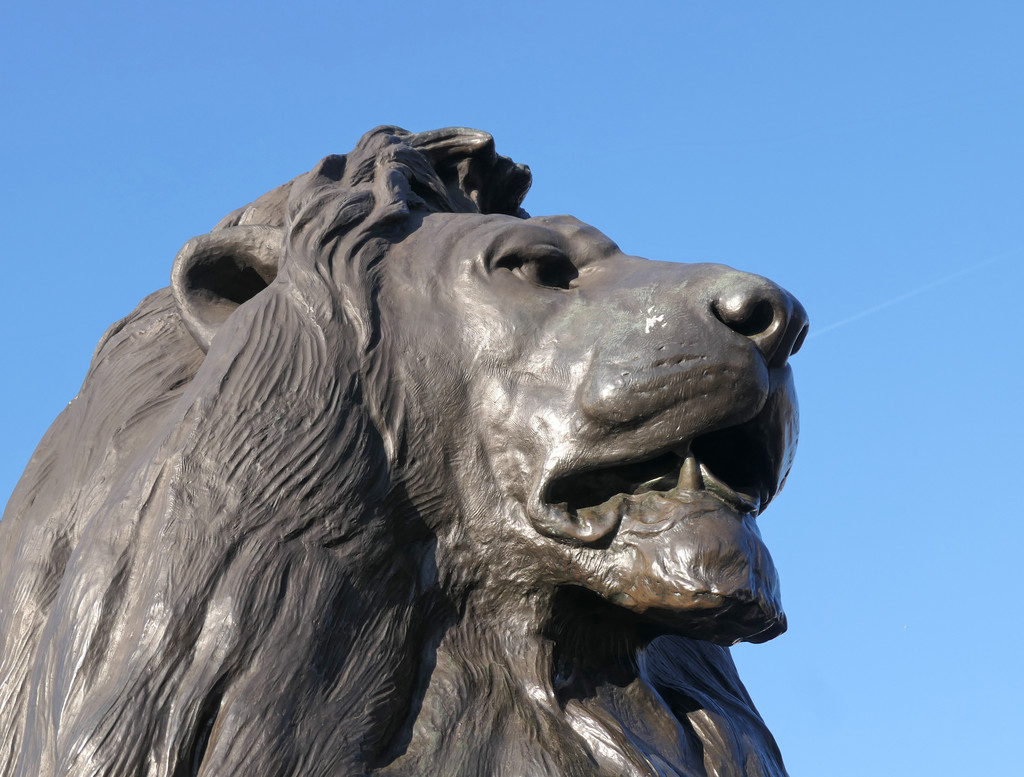
- Navigation image, One of the bronze lions at Nelson’s Column: modelled by Edwin Landseer and cast by Carlo Marochetti. Photograph by Amanda Slater. CC BY-SA 2.0. Image source. CC BY-SA 2.0. Resized.