by Tom Gurney
Tom Gurney BSc (Hons) is an art history expert with over 20 years experience
Email: tomgurney1@gmail.com / Phone: +44 7429 011000
Lion Defending Its Prey: Introduction
Edwin Landseer's Lion Defending its Prey compresses possession, hunger and danger into a small confrontation. A maned lion grips a dead horned animal while facing the raised head of a snake. The National Gallery of Art in Washington holds the work as an oil on paper on canvas, measuring 25.1 × 32.4 cm, accession 2004.166.26, Gift of Frank Anderson Trapp. Its current collection record dates it approximately 1840. [1]
The lion has already obtained a carcass, but the picture gives it no secure enjoyment of the prize. Its head turns towards a new antagonist while a paw remains hooked over the body beneath it. That divided action makes the scene more complicated than a demonstration of a predator's strength. The animal's power is visible in its mouth and claws, yet its continued possession requires another effort. The painting holds the advantage and the challenge together, leaving their eventual outcome beyond its borders. [2]
Landseer also gives the encounter two different kinds of immediacy. Teeth, eyes, scales and blood make the bodies sharply particular; the broad paint of ground and vegetation keeps the act of picturing them conspicuous. The result combines close animal description with a freely constructed setting. Its dramatic conviction comes from the way those elements cooperate, rather than from any assurance that the painter witnessed this conjunction of creatures in the wild. [2]
At a Glance
- ArtistEdwin Landseer [1]
- Datec. 1840 [1]
- Collection or siteNational Gallery of Art [1]
- Object2004.166.26 [1]
This work across Edwin Landseer’s career
The Cat's Paw
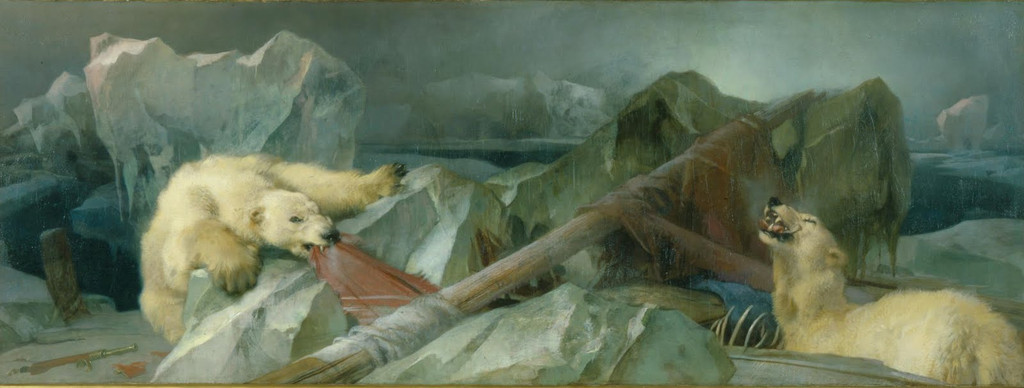
c. 1824 [4]The Hunting of Chevy Chase
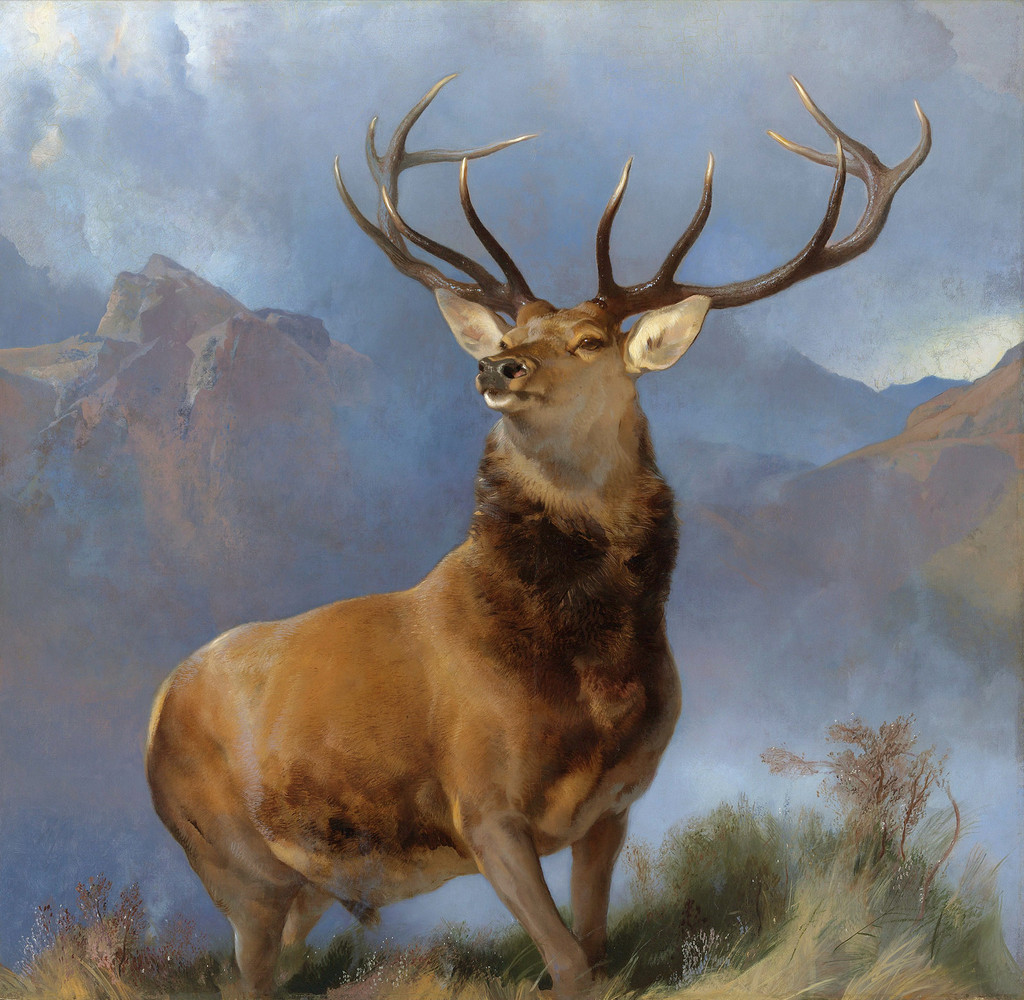
1825–26 [5]The Monarch of the Glen
about 1851 [10]Contents
- A claim made with claws
- The body beneath the struggle
- The snake's route through the setting
- Anatomy made visible through action
- Oil, paper and the unequal finish
- Menagerie observation and constructed encounters
- Two dates and a possible earlier purpose
- The ownership history that survives
- A lion subject with its own demands
A claim made with claws
The lion occupies the left half of the picture, but its attention crosses the centre. Its mane forms a dark, irregular mass around a much lighter face. The eye looks towards the snake, and the open mouth presents teeth and a curling pink tongue against a dark interior. Fine pale strokes around the muzzle sharpen the face without giving every surrounding area the same degree of definition. The animal appears capable of sudden action, although its body remains low and compressed. The force is concentrated in a head that has turned away from the food directly beneath it. [2]
The forelegs explain how the lion maintains that position. One reaches down and forwards, ending in a large paw braced on the ground; the other bends over the carcass. Dark points at the gripping paw and descending red marks bring the relationship between the two bodies into focus. The carcass becomes something held, rather than merely something lying close by. This is the picture's most concrete account of possession: a joint, a paw, a surface of flesh and a few strokes of blood make a claim that the open mouth alone could not establish. [2]
The two forelegs also give the body a divided task. The grounded leg supports the raised head and shoulders; the bent one secures the prey. Landseer distributes effort between them, allowing the viewer to understand weight through contact. We can follow the sloping limb towards the ground and then return along the other to the carcass. The pose has a pictorial logic even before it is translated into a story. A body organised around feeding has had to accommodate an interruption. [2]
The mane intensifies that interruption. Its long brown, black and gold strokes spread backwards from the face, giving the head an expansive surround. The muzzle projects from this mass towards the comparatively narrow form of the snake. Their unequal bulk makes the encounter surprising. A large feline has directed its conspicuous weapons towards an opponent whose force is suggested through a very different structure. The painting asks us to consider the relationship between them through the space separating their mouths, where no physical contact has yet occurred. [2]
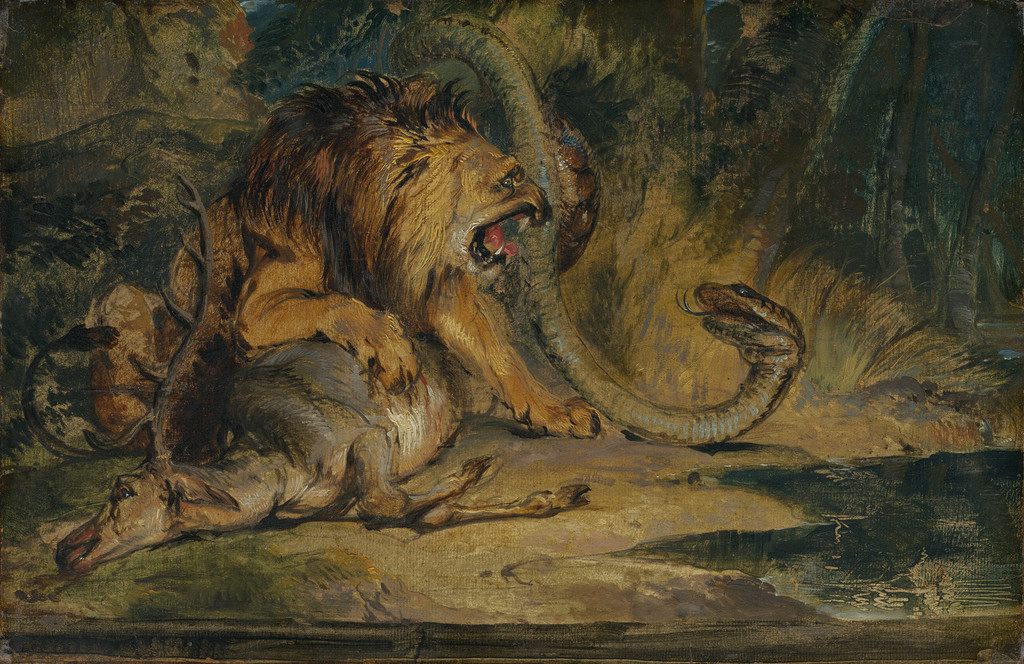
Lion Defending Its Prey. National Gallery of Art. Image source. CC0 / Public domain.
The body beneath the struggle
The dead animal supplies the composition with its longest low form. Its head lies near the lower left, with the muzzle close to the ground; curved horns rise behind it. The pale trunk passes under the lion's paw, and slender legs extend towards the middle. The exposed body catches more light than much of its surroundings. It remains readily visible even though the lion's manoeuvre and the snake's raised head attract attention above it. This third creature gives the encounter its object and its physical foundation. [2]
Landseer makes its stillness through arrangement. The head lies sideways, the legs stretch at different angles, and the broad trunk presents a surface over which another animal can press its weight. The lion's mouth and the snake's head seem directed towards a possible next movement; the carcass has been disposed across the ground. Its limbs lead the eye without promising that it will redirect itself. The distinction is carried by the whole configuration, rather than by a conventional emblem placed beside the animal. [2]
The head deserves attention because it brings the cost of the lion's possession close to the viewer. Its long muzzle extends towards the edge, below the prominent mane and threatening jaws. This creates an unequal distribution of height: the living predator rises from the body of its prey, while the snake lifts itself from the opposite side. The low animal remains the material connection between hunger and combat. Even a viewer chiefly interested in the lion's expression must look across the evidence of another creature's death. [2]
The curved horns give the fallen head a distinct outline, but the picture does not need a precise zoological label to make that relationship legible. The decisive details are the limp disposition, the exposed flank and the pressure of the gripping paw. They prevent the carcass from becoming a neutral stage on which two more impressive creatures perform. Its light colour binds the lion to the foreground, and its bodily vulnerability gives a harsher meaning to the possession being defended. [2]
The snake's route through the setting
The snake occupies more of the painting than its raised head initially suggests. A long patterned body descends around the central tree and continues towards the foreground before turning upwards. The lifted neck presents a pale, banded underside, while the darker upper surface carries irregular markings. Its mouth opens towards the lion. Following this extended route changes our sense of the antagonist: what first appears as a small head at the right belongs to a body threaded through the scene's vertical and horizontal spaces. [2]
The tree allows that body to mediate between background and encounter. Its descending length comes from above the lion's head and then enters the open ground between the animals. The movement of the eye along the snake therefore differs from the movement along the carcass. The dead animal spreads laterally across the front; the snake links the upper setting to the raised mouth; the lion turns between them. Three bodies organise three different directions within a very small surface. [2]
The lower right opens into dark water, picked out with thin, wavering reflections. Those pale marks offer a different rhythm from mane, fur and scales. The water's edge gives the animals a narrow piece of ground on which to confront one another, while the tree and vegetation crowd the space behind them. Small blue passages appear high in the background, but there is little invitation to travel into a broad distance. The setting encloses the confrontation and makes its opposing shapes available at close range. [2]
This enclosure has an imaginative force independent of any identifiable place. Landseer brings thick trunks, coarse grasses, dark foliage, water and warm earth together around the animals. The setting supplies shelter and obscurity, yet also enough light for the lion's mouth and snake's underside to register. It works as an arrangement of contrasts: dark behind light, upright behind curve, rough vegetation around sharply directed faces. A named location would explain less about the painting's effect than these relationships of colour and form. [2]
Anatomy made visible through action
The picture's anatomical interest lies especially in the connections between parts. The lion's face could have become an isolated display of ferocity, but the descending foreleg attaches it to the ground. The gripping paw attaches it to the carcass. The shoulders and mane carry the head above those points of support. We understand an animal body as something capable of bearing weight and changing direction, rather than as a collection of separately recognisable details. The knowledge is expressed through the coherence of the action. [2]
Different bodily coverings make that action easier to read. Long mane strokes surround the head; shorter marks follow the forelegs; pale broken touches model the carcass; repeated bands articulate the snake's underside. These variations distinguish surfaces without requiring each to be finished uniformly. They also preserve differences of mass. The lion's heavy front quarters, the thinner legs of the dead animal and the snake's continuous curve establish unlike possibilities of movement. Their conflict is persuasive partly because Landseer allows their bodies to remain structurally different. [2]
The exposed mouths provide the most emphatic signs of threat, but they do not certify an observed exchange of sounds or a particular sequence of behaviour. The painting supplies a visible challenge. It gives us no duration in which to establish whether the snake approached, the lion turned or either animal advanced. Its achievement is to make the selected arrangement intelligible enough that we imagine an encounter unfolding around it. Anatomical conviction supports that imagined action without turning the whole scene into a zoological demonstration. [2]
Oil, paper and the unequal finish
The National Gallery's description of the medium identifies a paper painting supported on canvas. It records the object's present material construction without dating the attachment of paper to fabric. [1] This distinction matters when looking at a work whose emphatic strokes can create a strong impression of immediacy. That impression is an effect of the painted surface; it supplies no secure timetable for how the object was made.
The foreground shows broad, differently directed marks of ochre, brown, pale grey and muted green. Some define the ground beneath the carcass; others allow one coloured area to pass into another with little intervening detail. Along the bottom, a dark horizontal band makes the lower edge unusually conspicuous. Above it, the carcass, lion and snake establish a far more concentrated field of incident. The eye moves between an explicitly marked surface and bodies that appear to occupy space, encountering both within a single view. [2]
Landseer gives the greatest descriptive emphasis to things that make the confrontation understandable. The eye, teeth, tongue and muzzle distinguish the lion's face. The snake receives enough pattern and light to separate head, upper body and underside. Blood below the paw clarifies the pressure on the carcass. Around these points, broader passages can suggest vegetation or ground without itemising every leaf and blade. The uneven finish is consequently purposeful in its effect: it establishes a hierarchy of attention that a uniformly polished surface might distribute differently. [2]
Calling the work a study is useful because it directs attention to this concentration of pictorial problems. The artist brings posture, animal surfaces, an antagonist and a setting into a compact relationship. The image can be considered as a complete proposition even while its handling remains open and abbreviated. Its small scale encourages us to take in the whole conjunction quickly, then return to a claw or mouth. That alternation between rapid comprehension and local scrutiny is central to the pleasure, and the discomfort, of looking at it. [2]
Menagerie observation and constructed encounters
Landseer's familiarity with lions had roots in the observation of captive animals. Richard Ormond's 1981 catalogue records his early visits to London's menageries and relays Thomas Christmas's recollection of sketching with him at Exeter 'Change. Christmas described their later study and dissection of a lion obtained after its death. Ormond also discusses Haydon's anatomical instruction. These accounts explain a foundation of sustained looking and bodily study; they do not identify the model for the Washington oil. [13]
Frederick G. Stephens's biography of 1880 preserves Haydon's own version of his teaching. Haydon recalled Edwin using his studies of lion dissection and described advising the young artist to acquire anatomical knowledge through dissection. Stephens's surrounding discussion recognises that the relationship needs qualification: Edwin's instruction differed from the weekly teaching arranged for his brothers, and Haydon's later claims were bound up with resentment about insufficient recognition. The testimony remains valuable, but it carries the teacher's wish to establish a share in a successful artist's formation. [14]
Stephens also connects the death of a lion at Exeter 'Change with Landseer's early large lion paintings. That retrospective connection concerns a group of works and a practice of study. It cannot attach a particular corpse to every later painted lion. [14] The Washington image itself makes the distinction easy to appreciate. Knowledge of a shoulder, paw or jaw could contribute to a scene assembled from several kinds of observation. The convincing contact of bodies does not require that those bodies once occupied this place together. [2]
Ormond discusses confrontation over dead game as a recurring concern in the early lion pictures, including the separate Lions at a Kill, dated by 1818. [13] Such subjects allowed animal knowledge to serve a concentrated drama. In the Washington work, that drama emerges from an unequal distribution of bodily capacities: the lion can grip, brace and bite; the snake can extend and raise its head; the carcass can only be held. The artist constructs a meaningful encounter by choosing the conjunction in which those differences become most evident. [2]
Two dates and a possible earlier purpose
The painting's date remains complicated. The National Gallery's current object record gives approximately 1840. [1] Its exhibition labels for Drawing in Britain, 1700–1900, in 2023, instead presented Lion Defending its Prey as approximately 1820. That label also connected the study with descriptions of an early major painting, A Lion Disturbed at His Repast, now lost. The differing dates place the work in substantially different phases of Landseer's career; neither should be treated as an exact year. [15]
The proposed early connection has a specific pictorial basis. The Royal Academy's winter exhibition catalogue of 1893 lists a large Landseer canvas as Lion Roused from His Repast. Its short description identifies a lion that has killed a deer and faces a large snake apparently disputing the carcass. The catalogue dates that painting 1820, gives its measurements as 60 × 77½ inches and records the lender as the Hon. Mrs Askew Robertson. This was a much larger object than the paper painting now in Washington. [16]
The correspondence of subject is striking: predator, dead animal and reptile are combined around a threatened meal. It makes an early compositional relationship worth considering. Yet a matching description establishes less than a complete visual comparison between two surviving objects. It does not tell us how closely the large canvas repeated the small work's tree, coils, paws or foreground. Nor does it supply the chain of ownership that would connect the Washington paper with a documented commission. The 1893 entry remains evidence about the large canvas exhibited under that title. [2] [16]
Historical accounts also use variant titles and approximate descriptions. Stephens calls an early painting A Lion disturbed at his Repast and describes it on a very large scale, within his discussion of Landseer's youthful production. [14] Such evidence helps explain why an association with an early painting has been proposed, but it cannot by itself reconcile every difference in date, title and measurement. [15]
An approximately 1820 date would place the work near Landseer's early ambitions in large animal subjects; an approximately 1840 date would make it a later return to a confrontation explored in his youth. [14] [15] Its divided attention, bodily contacts and opposing movements remain available to the viewer in either chronology. [2]
The ownership history that survives
The National Gallery records Michael Harvard in London before Frank Anderson Trapp purchased the work in the early 1970s. Trapp gave it to the museum in 2004. Its earlier ownership remains unestablished. [1]
The published ownership history establishes neither an original commissioner nor an intended recipient. Its early destination remains open. The picture's scale allows close looking, but supplies little evidence about a particular room or the circumstances of its first display. [1] [2]
A lion subject with its own demands
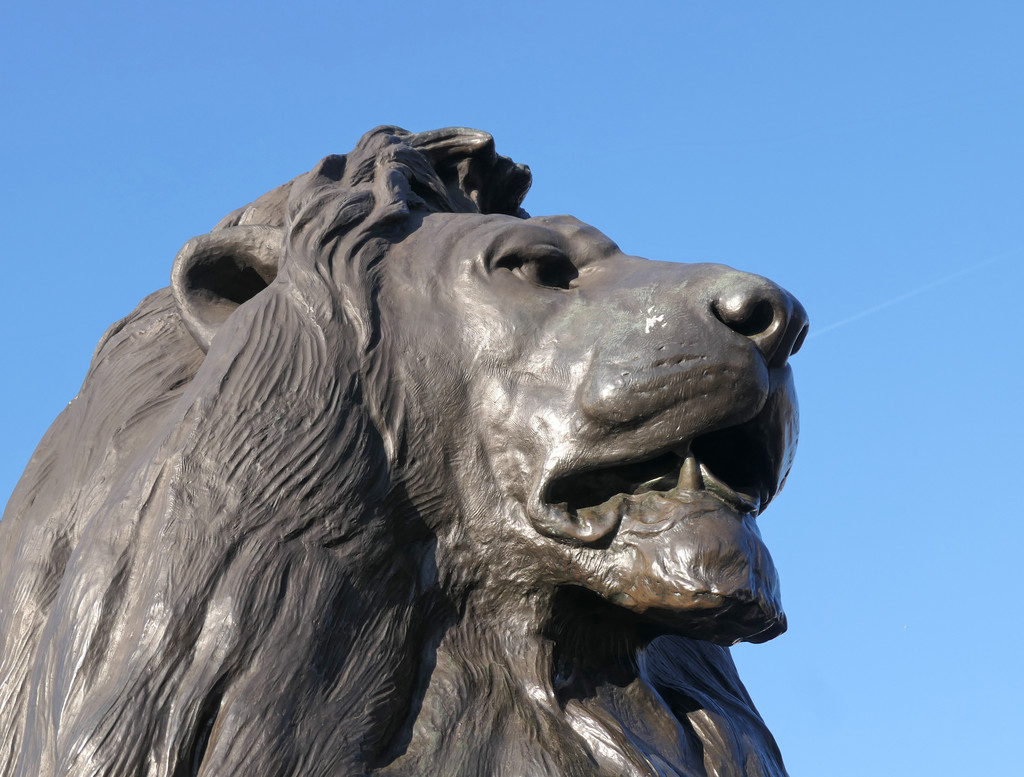
Landseer returned to lions in different media and settings. His much later work for the base of Nelson's Column involved new studies, modelling and the casting undertaken by Baron Carlo Marochetti. Ormond describes that commission separately, with evidence from the late 1850s and 1860s. [13] The Washington picture's concern is more immediate and particular: a meal has become the centre of another confrontation. Its braced paw, exposed teeth and dead prey belong to that problem. [2]
Treating this little oil chiefly as an anticipation of monumental sculpture would diminish what makes it distinctive. Its drama depends on a sequence of contacts and separations that the painted surface can sustain: claw against flesh, paw against earth, two mouths facing across a gap. The snake's long body extends the encounter into the tree above, while the fallen animal anchors it to the ground below. The setting and the bodies are composed together, giving predation a compact spatial form. [2]
The lion's strength therefore provides the beginning of the picture's argument rather than its resolution. Possession has exposed it to a further demand, and the carcass that demonstrates its success also fixes it in place. Around that predicament, Landseer's handling remains conspicuously mobile: long mane strokes, rough vegetation, light bands on the snake and wavering reflections keep the eye moving. A painted animal holds its prey while the whole surface communicates the instability of holding it. [2]
Read the exhibition evidence
The original 2023 National Gallery of Art exhibition labels survive in an archived copy. The Lion Defending its Prey label appears on PDF page 49, numbered 41 in the exhibition.
Drawing in Britain, 1700–1900: exhibition labels. National Gallery of Art, Washington, 2023. Archived 2 July 2024.
Compare the exhibition’s circa-1820 label with the current circa-1840 catalogue date discussed in the article. Read the archived labels (PDF).
Artworks directory
This directory gathers works discussed in the articles, including drawings, original etchings and prints after Landseer. It is not a complete catalogue of every drawing, version, plate or impression. Distinct media are kept separate; uncertain dates are left blank. Linked titles open individual articles.
| Name | Date | Medium |
|---|---|---|
| A Bellowing Stag | Drawing | |
| A Deerhound | 1826 | Painting |
| A Distinguished Member of the Humane Society | 1838 | Painting |
| A Highland Breakfast | 1834 | Painting |
| A Highland Landscape | c. 1830 | Painting |
| A Highland Shepherd's Home | Painting | |
| A Horse, Goat and Bull | 1811 | |
| A Hunting Horse | Drawing | |
| A Jack in Office | Painting | |
| A Lion Disturbed at His Repast | Painting | |
| A Random Shot | Painting | |
| A Scene at Abbotsford | Painting | |
| Adversity | Painting | |
| Alexander and Diogenes | exhibited 1848 | Painting |
| Alpine Mastiffs Reanimating a Distressed Traveler | 1820 | Painting |
| Contending Group after Nature | Drawing | |
| Copy after Rubens's Wolf and Fox Hunt | c. 1824–26 | Painting |
| Dash | Painting | |
| Deer and Deer Hounds in a Mountain Torrent ('The Hunted Stag') | c. 1832 / exhibited 1833 | Painting |
| Deer Family | ||
| Dignity and Impudence | 1839 | Painting |
| Dog Resting Upon a Couch | Drawing | |
| Eos | 1841 | Painting |
| Favourites, the Property of H.R.H. Prince George of Cambridge | 1834–35 | Painting |
| Her Majesty Sketching at Loch Laggan | ||
| High Life | 1829 / exhibited 1831 | Painting |
| Highland Lassie | Drawing | |
| Isaac van Amburgh and his Animals | 1839 | Painting |
| Lady Godiva's Prayer | Painting | |
| Laying Down the Law | 1840 | Painting |
| Lion Defending Its Prey | c. 1840 | Painting |
| Lioness | Drawing | |
| Little Strollers | ||
| Low Life | 1829 / exhibited 1831 | Painting |
| Man Proposes, God Disposes | 1864 | Painting |
| Nell Gwynne / Diana Vernon | Painting | |
| Neptune | ||
| No Hunting Till the Weather Breaks | Painting | |
| Otterhounds | Drawing | |
| Peace | Painting | |
| Pensioners | Painting | |
| Portrait of a Mule | Painting | |
| Portrait of Mr Van Amburgh, as He Appeared with His Animals at the London Theatres | 1846–47 | Painting |
| Portraits of a Pointer Bitch and Puppy | Painting | |
| Pray Let Me Out | ||
| Prosperity | Painting | |
| Ptarmigan in a Landscape | by 1833 | Painting |
| Queen Victoria and Prince Albert at the Bal Costumé of 12 May 1842 | 1842–46 | Painting |
| Queen Victoria at Loch Laggan | Painting | |
| Queen Victoria at Osborne | 1865–67 | Painting |
| Queen Victoria landing at Loch Muick | Painting | |
| Rat-catching | 1823 | |
| Reclining Lion | Drawing | |
| Reclining Lion, From Back | Drawing | |
| Rent-day in the Wilderness | 1855–68 | Painting |
| Return from Deer Stalking | 1839 | |
| Royal Sports on Hill and Loch | Painting | |
| Sam Lovill, Porter at the Royal Academy | Drawing | |
| Scene from A Midsummer Night's Dream | 1848–51 | Painting |
| Scene in the Highlands, with portraits of the Duchess of Bedford, the Duke of Gordon and Lord Alexander Russell | Painting | |
| Scottish Highlands, Lochs and Figures | Drawing | |
| Shoeing | exhibited 1844 | Painting |
| Sleeping Bloodhound | exhibited 1835 | Painting |
| Spaniel and Rabbit | Painting | |
| Stag at Bay | 1866 | Sculpture |
| Stag at Bay | 1846 | Painting |
| Studies of a staghound and the head of a stag for painting ‘The Hunting of Chevy Chase’ | Drawing | |
| Study for Alpine Mastiffs Reanimating a Distressed Traveler | Drawing | |
| Study for the Monkey in The Cat's Paw | Drawing | |
| Study of a Dog | Drawing | |
| Study of a herding dog facing right | Drawing | |
| Study of the horse of Selene, from the East pediment of the Parthenon | Drawing | |
| Suspense | Painting | |
| Taking a Buck | ||
| The Arab Tent | c. 1865–66 | Painting |
| The Barn | Drawing | |
| The Best Run of the Season | ||
| The Cat's Paw | c. 1824 | Painting |
| The Cavalier’s Pets | ||
| The Challenge | Painting | |
| The Chase | Drawing | |
| The Connoisseurs: Portrait of the Artist with Two Dogs | 1865 | Painting |
| The Death of a Stag in Glen Tilt | Painting | |
| The Drive—Shooting Deer in the Pass | Painting | |
| The Drover's Departure | Painting | |
| The Highland Shepherd’s Dog | 1824; portfolio issue 1848 | |
| The Honourable Mrs Norton | Painting | |
| The Hunting of Chevy Chase | 1825–26 | Painting |
| The Illicit Highland Whisky Still | Painting | |
| The Keeper John Crerar with his Pony | Painting | |
| The Larder Invaded | ||
| The Lion-Dog of Malta | ||
| The Lions at the Base of Nelson's Column | 1867 | Sculpture |
| The Monarch of the Glen | about 1851 | Painting |
| The Mountain Torrent | ||
| The Old Shepherd's Chief Mourner | 1837 | Painting |
| The Sanctuary | 1842 | Painting |
| The Stricken Deer | Painting | |
| The Twa Dogs | Painting | |
| Time of Peace | ||
| Two stags running | Drawing | |
| Victoria, Princess Royal, with Eos | Painting | |
| View of Glenfeshie | Painting | |
| War | Painting | |
| White Horse in a Stable | Painting | |
| Windsor Castle in Modern Times | 1841–43 | Painting |
| Woburn Abbey Game Card | 1825; portfolio issue 1848 |
Discussion
Use the article’s images and evidence to develop your own reading of Lion Defending Its Prey.
Reader Insights
Which detail is most revealing when you consider “A claim made with claws”?
How does the evidence in “The body beneath the struggle” affect your reading of Lion Defending Its Prey?
What further question would you bring to “A lion subject with its own demands”?
Join the Conversation
Share a detail, comparison or question about Lion Defending Its Prey below.
References
- National Gallery of Art, Washington, Lion Defending its Prey, currently dated c. 1840, oil on paper on canvas, Gift of Frank Anderson Trapp, 2004.166.26, including dimensions and provenance. Collection record. Accessed 31 October 2026. View source.
- Edwin Landseer, Lion Defending its Prey, National Gallery of Art, Washington. Complete colour photograph supplied by the institution, 2,000 × 1,297 pixels. Institutional image. Accessed 31 October 2026. View source.
- National Gallery of Art, Alpine Mastiffs Reanimating a Distressed Traveler. View source.
- Minneapolis Institute of Art, The Cat's Paw. View source.
- Birmingham Museums Trust, The Hunting of Chevy Chase. View source.
- Victoria and Albert Museum, The Old Shepherd's Chief Mourner. View source.
- Tate, Dignity and Impudence. View source.
- National Gallery of Art, Lion Defending Its Prey. View source.
- Royal Collection, Eos. View source.
- National Galleries of Scotland, The Monarch of the Glen. View source.
- Royal Holloway, University of London, Man Proposes, God Disposes. View source.
- Trafalgar Square / Greater London Authority, The Lions at the Base of Nelson's Column. View source.
- Richard Ormond, Sir Edwin Landseer, exhibition catalogue, Philadelphia Museum of Art and Tate Gallery, 1981, pp. 3–4, 47 and 205–206; early practice, the distinct Lions at a Kill and later monument commission. Digitised catalogue. Accessed 31 October 2026. View source.
- Frederick G. Stephens, Sir Edwin Landseer (London: Sampson Low, Marston, Searle & Rivington, 1880), pp. 32–33 and 48, with Haydon's teaching recollections and discussion of early lion pictures. Digitised volume. Accessed 31 October 2026. View source.
- National Gallery of Art, Drawing in Britain, 1700–1900: New Additions to the Collection, exhibition wall labels, 2023, label 41, Lion Defending its Prey, dated c. 1820, with proposed connection to A Lion Disturbed at His Repast. Institutional label document. Indexed institutional text; accessed 31 October 2026. View source.
- Royal Academy of Arts, Exhibition of Works by the Old Masters, and by Deceased Masters of the British School ... Winter Exhibition, Twenty-fourth Year (London: William Clowes and Sons, 1893), p. 7, no. 14, Lion Roused from His Repast. Digitised original catalogue. Accessed 31 October 2026. View source.
- Splash image, Lion Defending Its Prey. National Gallery of Art. Image source. CC0 / Public domain.
- Navigation image, One of the bronze lions at Nelson’s Column: modelled by Edwin Landseer and cast by Carlo Marochetti. Photograph by Amanda Slater. CC BY-SA 2.0. Image source. CC BY-SA 2.0. Resized.