 by Tom Gurney
Tom Gurney BSc (Hons) is an art history expert with over 20 years experience
Email: tomgurney1@gmail.com / Phone: +44 7429 011000
Laying Down the Law: Introduction
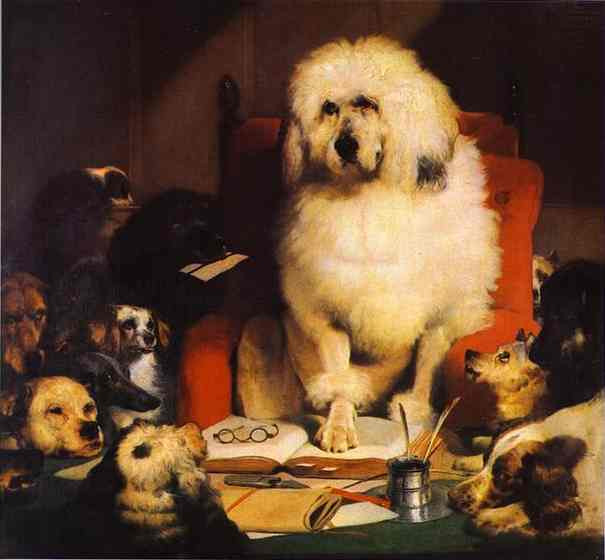
A large white poodle presides over a gathering of dogs, its paw planted on an open book. Around it, faces press towards the table, a black dog holds a letter, and a small rough-haired listener presents the back of its head to the spectator. Edwin Landseer's Laying Down the Law, also known as Trial by Jury, makes an institution recognisable through its furnishings and the differences among its occupants. The dogs supply the solemnity, impatience and self-importance that a human courtroom would ordinarily contain. Exhibited at the Royal Academy in 1840 and subsequently acquired by the 6th Duke of Devonshire, the oil painting remains in the Devonshire Collections at Chatsworth.[1][2]
Its humour depends on an unstable resemblance. The poodle's coat can suggest a judicial wig while continuing to look like an animal's fur; a muzzle can recall an argumentative lawyer without becoming a human face. This double reading was available to the first viewers. In May 1840, the Athenaeum discussed both canine individuality and judicial absurdity, while the Examiner associated the surrounding dogs with public personalities. Neither review supplied a complete, authoritative list of human counterparts.[3][4] The picture's later history adds another complication: the Duke asked Landseer to insert his own spaniel, Boney. A satire intended for public exhibition thereby acquired a private family presence, and that alteration left consequences in the paint itself.[2][5]
At a Glance
- ArtistEdwin Landseer [1]
- Date1840 [1]
- Collection or siteChatsworth / Devonshire Collections [1]
- ObjectChatsworth painting [1]
This work across Edwin Landseer’s career
The Cat's Paw
c. 1824 [7]The Hunting of Chevy Chase
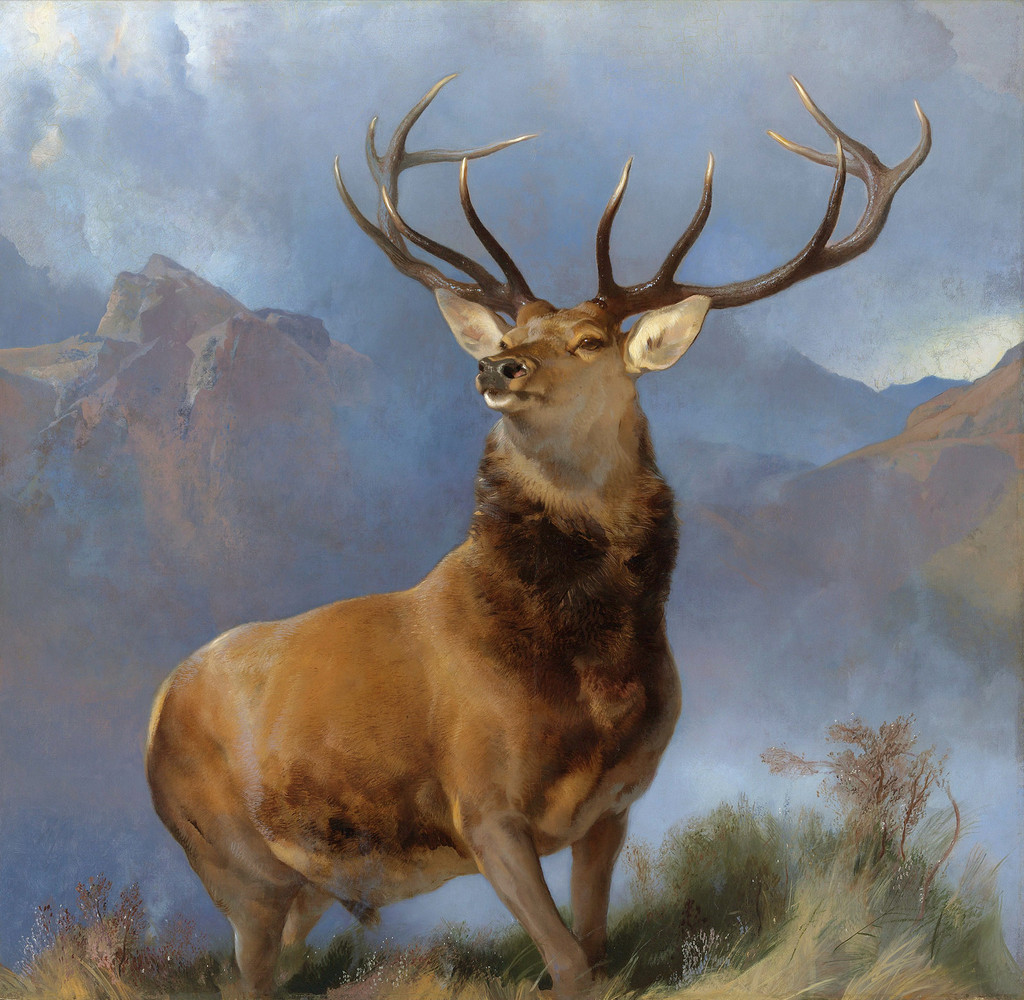
1825–26 [8]The Monarch of the Glen
about 1851 [13]Contents
- The title and the picture exhibited in 1840
- A poodle's claim to authority
- The paperwork of a canine court
- Differences within the company
- The real poodle and the story of the Chancellor
- Why the joke belonged to Chancery
- What the first critics admired
- Hood's poem and the limits of a single moral
- Devonshire's spaniel changes the gathering
- The engraving preserves a different stage
The title and the picture exhibited in 1840
Laying Down the Law was already the title used during the painting's first exhibition. The Examiner named it on 3 May 1840, and the Athenaeum identified it as Royal Academy number 311 later that month. Richard Ormond's 1981 catalogue likewise records that exhibition number and gives Trial by Jury as an alternative title.[2][3][4] Calling the work by the latter name is therefore legitimate, but it should not obscure the early evidence for the familiar phrase. The phrase puts emphasis on the person pronouncing a judgement: to lay down the law is to speak with a confidence that may exceed one's entitlement. That idiomatic force makes the poodle's commanding position immediately relevant, even before the other dogs have been assigned possible functions.
The work was complete enough for exhibition by 1840, although its present composition includes a subsequent addition. Ormond records an oil on canvas measuring 120.7 by 130.8 centimetres, a substantial, nearly square painting whose crowded assembly would have had considerably more bodily presence than a small illustration.[2] The dimensions belong to that scholarly catalogue; Chatsworth's current account confirms the painting's identity and exhibition history without supplying measurements.[1] The format allows the central animal to tower over the company while the table establishes a broad horizontal foreground. Rank becomes a question of height, lighting and access to the book, rather than of an explanatory label placed beside each dog.
The two titles also direct attention differently. Trial by Jury encourages a viewer to look for a legal proceeding and its assembled participants. Laying Down the Law makes the presiding figure's manner the principal event. The image provides no legible account of an offence, dispute or verdict. Its papers signal business without disclosing a case that the spectator can reconstruct. The absence of a particular lawsuit gives the comedy room to circulate among the faces: a viewer can recognise the performance of legal authority without first learning who has sued whom. This is one reason that the institutional satire survives the loss of any private jokes shared by Landseer and his acquaintances.[2][4]
A poodle's claim to authority
The poodle occupies the brightest and most elevated part of the assembly. Its white coat expands around its head and chest, contrasting with the red upholstery immediately behind it and the darker dogs at either side. The face is relatively small within that spreading pale mass. Beneath it, the foreleg descends towards the book, giving the composition a firm vertical connection between the seat of authority and the supposed authority of the written word.[1][2] Landseer has made a dog's ordinary physical equipment unusually serviceable to a human analogy: heavy ears frame the face, abundant hair enlarges the head, and the planted paw acquires the emphasis of a judicial gesture.
The animal wears no complete judicial costume. The effect of a wig arises largely from its own hair, which is essential to the visual joke. Ormond describes the ears and fluffy front as equivalents for the wig and ceremonial dress of a judge; the red chair supplies a further association with the robes of the bench.[2] Because these effects are distributed between animal and furniture, they do not depend on a simple fancy-dress substitution. The poodle remains plausible as a dog installed in an improbable place. Its bodily weight and the particular arrangement of its coat give substance to a role that would become much thinner if conveyed only by a wig perched on an otherwise anonymous animal.
The paw on the book is especially economical. It can be read as an assertion, an interruption or an insistence upon a point, although no one action is conclusively specified. The spectacles lie on the open pages, displaced from the face that supposedly needs them. Together, book, paw and spectacles provide the apparatus of learned concentration while withholding any evidence that the presiding animal can use it.[2] This makes the authority both impressive and vulnerable. The poodle dominates the room through size and presentation; the objects that legitimise it also expose the distance between possessing the signs of knowledge and demonstrating knowledge.
The paperwork of a canine court
The table is covered with the means by which a court conducts and records its business. An open book lies beneath the poodle, loose documents spread across the green surface, and quills rise from a small metal inkstand near the foreground. Sealing wax and other writing equipment occupy the space between the watching animals.[2] These details prevent the setting from becoming a vague gathering of pets. The equipment supplies a shared occupation, and it gives the animals a reason to assemble around a surface from which they would normally be excluded. Through these ordinary objects, the comedy moves from a remarkable individual dog to an organised profession.
The writing implements also produce a disparity between activity and capacity. The black retriever at the left of the poodle carries a folded paper in its mouth, a task an animal could conceivably perform. The spectacles and book ask for an altogether different kind of participation. Between those two extremes, the painted court moves easily from a familiar canine action to the pretence of human deliberation.[2] The letter therefore helps anchor the fantasy. A viewer can recognise a dog holding an object while accepting that, in this company, the object makes it look like a messenger or an official arriving with business. An exact occupational identity is less secure than the action on which the analogy rests.
At the near edge, a long-eared spaniel faces away from the spectator towards the judge. Ormond identifies this animal as the clerk of the court.[2] Its position creates a useful entrance into the scene: the viewer looks past a smaller, subordinate figure towards the centre of authority. The book and documents occupy the interval between them, making the court's relationship to paperwork visible as a spatial arrangement. Yet the table is also a barrier. Heads crowd its edges, bodies are partially concealed, and very little room remains for independent movement. The institution feels densely populated before it has been shown to accomplish anything. That impression arises from the compressed arrangement rather than from any depiction of an actual delay.
Differences within the company
Landseer varies the shapes and directions of the surrounding heads instead of producing a uniform semicircle of attentive witnesses. At the lower left, a broad-faced bulldog rests close to the table edge; beside and above it, the narrow greyhound head introduces a striking change of proportion. The black letter-bearing retriever rises farther back. On the opposite side, a small, wiry-looking dog lifts its muzzle towards the poodle, while the head at the lower right projects into the foreground.[2] The company is held together by the table, but divided by the rhythms of its faces. Rounded and elongated skulls, pale and dark coats, lifted and lowered muzzles offer a succession of visual contrasts.
Ormond's account names a deerhound and bloodhound among the dogs behind the foreground group, and a mixture of terriers, mastiff and spaniels on the right.[2] Such breed language helps explain the variety Landseer and his first audience recognised. It should not be mistaken for a complete set of authenticated portraits or modern pedigree records. The painting supplies many different animal appearances, while the documentation securely attaches particular ownership histories to only some of them. Nor does a breed establish a moral character. The impression of indifference, sharpness or hauteur comes from a position within this composition and from a human comparison brought to it, rather than from proof that all dogs of that kind behave in the same way.
The small raised muzzle on the right creates one of the strongest suggestions of speech. No words are supplied, but its upward angle makes a counterpart to the poodle's downward-reaching foreleg. James Dafforne, writing in 1873, imagined a terrier pressing an argument hard enough to risk the bench's displeasure; his account shows how readily later commentators could turn the silent gathering into a dramatic exchange.[16] The painting itself remains less specific. Its achievement lies in providing the visual conditions for such a story without settling every participant's part. A viewer can move among several relationships rather than follow a single illustrated conversation from beginning to end.
The real poodle and the story of the Chancellor
Count d'Orsay's poodle is more securely documented than the identity of the person it supposedly caricatures. The Examiner in 1840 said that the animal belonged to d'Orsay, although it phrased the identification as information reported to the reviewer.[3] Ormond also cites an undated letter in which Landseer told d'Orsay that he was ready for the poodle and suggested that its present appearance might make it more comic.[2] Known through the catalogue's account of that letter, this is a valuable indication of an actual model behind the invented official. It places an individual animal within the making of the picture without requiring the spectator to believe that a courtroom full of dogs ever posed together.
The often repeated origin story comes through a different kind of document. In 1857, Cuthbert Bede reproduced in Notes and Queries a passage from the subscriber circular issued by Thomas McLean for Thomas Landseer's engraving. According to this promotional account, d'Orsay's poodle was resting on a table when a learned lord remarked that it could serve admirably as Lord Chancellor; Landseer then developed the picture from that suggestion.[17] The story gives the painting a pleasingly spontaneous beginning, but it is an account circulated to help sell a print, subsequently transcribed years later. It carries neither the immediacy of an eyewitness diary nor the status of Landseer's own explanation of his purpose.
The circular leaves the learned lord unnamed. Later attempts to provide a name should therefore be kept separate from what this earlier text actually says.[2][17] More significantly, the role of the person making the remark need not be identical with the person represented by the poodle. A joke about a possible Chancellor does not establish a portrait of a particular Chancellor. The Examiner could already see an echo of Eldon in the poodle's brows while distributing other political names across its response to the company.[3] The evidence supports a suggestive overlap between canine appearance and public office; it leaves a complete key to the supposed human originals out of reach.
Why the joke belonged to Chancery
The first reception connected the image with Chancery, the court associated with the Lord Chancellor. The Athenaeum called the scene “Dog-Chancery” and compared its force to the legal comedy of Pickwick. This association is contemporary, rather than a later attempt to find a topical subject for a gathering of dogs.[4] The journal's response gives the painting an edge beyond the mockery of a solemn face. A court can look dignified while its proceedings become a spectacle of professional self-importance. The animals' concentration upon one another, and their accumulation around papers, make that possibility visually available without requiring a literal reconstruction of Chancery procedure.
Thomas Hood's response makes the question of delay explicit. His poem moves from the judge's appearance to the experience of a client whose suit becomes trapped in hesitation and repeated doubts. A sequence of possible identifications follows, only for the poet to allow that the animal may represent no particular lord at all.[18] This keeps the accusation mobile: the target can be a recognisable individual, a professional habit or an entire structure of proceedings. The uncertainty is productive because the painting offers an image of deliberation without its outcome. One can keep looking for signs that a decision is about to be made and still find the same paw resting upon the same open pages.
Chatsworth's present interpretation emphasises the expense and exhaustion associated with prolonged Chancery litigation, using Dickens's Bleak House as a later point of comparison.[1] The order of events matters: Landseer's 1840 painting and the contemporary Pickwick reference belong to its early setting, while Bleak House helps a later audience recognise the kind of institutional criticism involved. The novel need not be made a source for the picture. Equally, the alternative title Trial by Jury does not turn the scene into a technically exact diagram of one court. It is the language of satire, in which legal offices, furniture and professional manners can be assembled for their recognisability rather than their procedural completeness.[2][4]
What the first critics admired
The Examiner greeted Landseer's contributions to the 1840 exhibition with extraordinary enthusiasm. Its praise of Laying Down the Law begins with the poodle's apparent majesty and then passes through the faces of the surrounding dogs. The critic calls attention to the confidence of one animal, the wrinkled or snarling nose of another, and the exclusiveness it finds in the greyhound.[3] These are acts of interpretation, using the vocabulary of class and personality to animate painted heads. They show that the picture's early appeal already depended on a viewer's movement between animal form and human social judgement. A merely accurate collection of dog portraits would not explain the specificity of the reviewer's response.
The same review praises the combination of fluent execution and fine finish. Its admiration is directed towards an apparent ease that has not sacrificed the particularity of the animals.[3] This is an important complement to the satire. Landseer needed each head to carry enough visual information for the invented community to remain a group of distinct dogs. If all the animals had been reduced to a shared caricatural formula, their differences would have become less persuasive. The reviewer saw a painter who could preserve that differentiation while making the result appear unforced. It is a judgement about the finished image, however, rather than a timed account of how rapidly the canvas was painted.
The Athenaeum was more qualified. It admired the work while saying that it preferred some of Landseer's human compositions to these animal groups. Its discussion then treated the different coats as a comic equivalent for a painter's rendering of drapery, deliberately shifting its language from human figures to fur and bristles.[4] That verbal correction captures the picture's double operation particularly well: the critic can apply the conventions of figure painting, then notice that the supposed figures are dogs. The journal also considered this canvas more substantially painted than certain earlier works whose durability it doubted. That observation records a contemporary judgement of appearance; it cannot by itself tell us the composition or future stability of particular paint layers.[4]
Hood's poem and the limits of a single moral
Hood addressed Landseer as a maker of painted fables and asked what moral the assembly was meant to convey. His poem, entitled Laying Down the Law, was associated with the engraving's promotional material according to Bede's 1857 account; the text is also preserved in the later collected Comic Poems.[17][18] It is a response to the image rather than a set of instructions for producing it. The poem's first proposed lesson imagines dogs renouncing physical violence in favour of law and reason. From there, it turns towards the possibility that lawyers have been transformed into animals. The same picture can apparently support a hopeful account of civilisation and a much less flattering account of those who administer it.
The poem repeatedly adjusts its position instead of supplying one decisive explanation. A meditation on delay leads to a list of potential judicial likenesses, followed by the concession that the picture may contain no precise personal references. Its later jokes translate canine aptitudes into legal practice: tracking, carrying and persistent pursuit become analogies for finding heirs, conveyancing and following precedents.[18] These verbal inventions are Hood's, and they need not all be visible in the paint. Their value lies in showing how the mixed company could generate further associations. The picture offered a framework in which an informed viewer could continue making jokes after recognising the central poodle's role.
Hood's ending changes the balance once more. It asks whether access to justice can be affordable, bringing the anxiety of the litigant back into a poem that has spent much of its energy enjoying the lawyers' resemblance to dogs.[18] The result is sharper than a simple assertion that legal people look ridiculous. A profession may display learning, dignity and intricate procedures while remaining inaccessible to those who need it. The painted dogs do not visibly present a bill or disclose a client's losses; the poem supplies that social consequence. Reading the two together preserves the difference between Landseer's arrangement and a contemporary writer's elaboration, while showing how readily the image could sustain criticism of the institution represented.
Devonshire's spaniel changes the gathering
The 6th Duke of Devonshire acquired the painting after its appearance at the Royal Academy, and subsequently asked for his Blenheim spaniel to be included. Chatsworth calls the animal Boney; Ormond uses the spelling Bony and lists a letter of 26 December 1842 in which the Duke urged Landseer to paint the dog.[1][2][5] This sequence matters because Boney was an addition to an already established composition. The canvas should not be described as though every face had been planned from the outset as part of a single commission for the Duke. Exhibition, acquisition and alteration were separate moments in its history.
Boney is the brown-and-white spaniel on the viewer's left of the judge's chair, above the narrow greyhound head. The position is identified by the holder's conservation report and agrees with Ormond's account and the earlier print circular.[2][17][5] It distinguishes the Duke's dog from the larger spaniel head close to the lower right edge. The small insertion is easy to lose within the busy company, yet it changes the relationship between the picture and its owner. The Duke could now encounter a recognisable household favourite inside a public comedy of legal manners. Chatsworth's description assigns Boney the role of a young reporter, giving the late arrival a place in the institutional fiction.[1]
The request introduces an element of patronal preference into an image about rank and professional importance. A favoured dog gains admission because the picture's owner wants it there. This does not make the alteration an intended further satire, but it does create a revealing overlap between the depicted world and the canvas's history. Within the painting, position confers identity and importance; outside it, ownership enabled a new position to be made.[2][5] Landseer accommodated the request within a crowded assembly, where the spaniel's small face could join an existing tier of heads. The result retains the central hierarchy while adding a private point of recognition that later viewers need documentation to recover.
The engraving preserves a different stage
Thomas Landseer's reproductive print is a separate object with its own evidence. The National Trust's impression at Blickling Hall records publication by Thomas McLean on 1 February 1843 and a dedication to John Singleton Copley, Lord Lyndhurst, as Lord High Chancellor.[19] Edwin supplied the painted composition and Thomas made the engraving. The dedication is a definite association with a named legal officeholder, but it does not settle the identity of the painted poodle. Dedication, caricature and the alleged source of an initial conversational joke are different relationships. Collapsing them into one story would give the documentary evidence a certainty it does not possess.
Ormond illustrates an early outline etching by Thomas, dated about 1841–42, in which the Duke's spaniel is absent. He distinguishes this preliminary state from the completed reproductive work published in 1843.[2] The comparison gives the small change unusual historical visibility. In the finished canvas, Boney belongs to the company so comfortably that a viewer might assume the dog was always present. The earlier print stage interrupts that assumption. It records a configuration of the image before the added portrait and thereby helps to connect the written accounts of the Duke's request with a visible difference between representations.
The 1857 transcription of McLean's circular explicitly draws attention to the additional spaniel and locates it above the greyhound.[17] This means the alteration was itself part of the story offered to print buyers. A private favour became something that could be pointed out to strangers looking at a reproduction. The history of the picture consequently travelled with the image, though in a selective and commercially appealing form. The circular's neat anecdote of inspiration and its explanation of the Duke's favourite made the composition easier to talk about. They should be read as part of that public presentation, rather than treated as a transparent record of every decision made during the painting's development.
A family possession with an exhibition history
Ormond records the painting's provenance from the 6th Duke of Devonshire through descent. His exhibition list places it at Leeds in 1868, at the London Landseer exhibition in 1874, at Nottingham University's Victorian exhibition in 1959 and in London again in 1961.[2] These entries establish that a picture associated with Chatsworth could also be encountered away from the house. They do not provide a continuous account of its location in every intervening year, or prove that it always occupied one particular room. The distinction is useful because the painting has had both a stable family association and a more intermittent public exhibition life.
The difference between a house collection and a temporary exhibition also changes what the inserted spaniel can mean to viewers. In a family setting, Boney belongs to the history of the Cavendishes' animals and collecting. In an exhibition of Landseer's work, the same face becomes evidence of the painter's accommodation of a patron and of the relationship between portraiture and satire. Both readings are supported by the object's history, without requiring a change to the image itself.[2][5][20] The painting can be approached as a legal joke, a study of differentiated dogs, or a family possession whose appearance was altered after purchase. None of those approaches exhausts the others.
Chatsworth returned to this layered identity in The Dog: A Celebration at Chatsworth in 2019. Co-curated by the Duchess of Devonshire and Tessa Wild, the exhibition placed animals within a long history of the estate and its collections. The annual review specifically invited renewed attention to Laying Down the Law and repeated the acquisition-and-Boney story.[20] This was a deliberate reframing of an already familiar collection picture. The event did not require the work to cease being satire; it asked visitors to consider how the family attachment preserved within it belonged to a much larger history of dogs in the house.
Cracking, colour and the conservation of 2015
Concern about the surface has a nineteenth-century documentary witness. The Devonshire archive catalogue describes a letter dated 24 March 1871 to Lord Edward Cavendish whose postscript discusses cracking in Landseer's large dog picture, identified by the cataloguer as Laying Down the Law. The writer is signed R.C.; the catalogue tentatively associates the initials with Richard Cavendish and notes an earlier attribution to Hal Lascelles.[21] The record establishes a report of cracking while Landseer was alive, but it does not reproduce the whole letter or locate the affected passages. It cannot show that the nineteenth-century observer saw precisely the damage later discussed by conservators.
Chatsworth's 2015 annual review gives a more specific account. The painting had yellowed, its colours had become dulled, earlier restoration was increasingly conspicuous, and shrinkage of the canvas had contributed to paint flaking. The Victorian frame also required attention.[5] These are different kinds of deterioration, involving the appearance of the image, the security of the paint and the condition of its surrounding frame. The report's description makes clear why a familiar picture could require substantial care even when its composition remained recognisable. It also warns against using the colour of an undated reproduction as straightforward evidence of what Landseer originally intended.
The same report connects the later insertion of Boney with additional oil-paint layers used to rebalance the work. It attributes pronounced cracking in that later layer to resinous paint beneath and describes retouching and treatment of the affected areas.[5] This is a material consequence of a documented historical change, rather than a general claim that Landseer used one unstable method throughout his career. The brief account does not identify a resin, solvent or complete treatment sequence. Its intention to prevent further damage should be understood as the aim reported in 2015, not a guarantee about the canvas's condition indefinitely. The announced North Entrance Hall display in 2016 is likewise a dated plan, rather than evidence of its present room.[5]
An image that could be argued with again
The arrangement was adaptable enough to support later satire. A wood engraving by Edward Linley Sambourne, catalogued by Wellcome as dating from about 1884 and belonging to Punch, reworked Landseer's composition around Richard Owen. Wellcome identifies a dog in the left background as bearing the features of Thomas Henry Huxley.[22] This is a distinct print, with different people and a different argument. Its connection to Landseer lies in the reusable structure of a presiding authority addressing a canine company. The composition could be recognised and redirected beyond the legal profession without every detail of the original joke being carried over.
Such reuse helps explain the picture's particular kind of durability. The first reviewers could see public personalities in the dogs; Hood could test several morals; the Duke could add a private favourite; later caricature could substitute another field of authority. Those are documented responses and changes rather than one continuous, unchanging meaning.[3][4][17][18][22] The book, elevated chair and surrounding heads form a pattern of institutional life that remains available for reinterpretation. At the same time, Boney and the altered paint tie that pattern to one specific canvas, preventing its history from being reduced to a freely floating emblem of officiousness.
Returning to the painting after those histories, the poodle's position becomes more complicated. Its bodily presence supports the comedy, its supposed learning invites doubt, and the company around it turns difference into professional character. Beneath that coherent surface, a patron's request has changed the membership of the court and introduced a later material vulnerability.[2][5] Laying Down the Law brings together the apparent permanence of an institution and the contingent decisions that make a picture. The assembly may seem fixed in an endless judicial pause, but the canvas itself has been enlarged in meaning by acquisition, alteration, reproduction and repair.
Artworks directory
This directory gathers works discussed in the articles, including drawings, original etchings and prints after Landseer. It is not a complete catalogue of every drawing, version, plate or impression. Distinct media are kept separate; uncertain dates are left blank. Linked titles open individual articles.
| Name | Date | Medium |
|---|---|---|
| A Bellowing Stag | Drawing | |
| A Deerhound | 1826 | Painting |
| A Distinguished Member of the Humane Society | 1838 | Painting |
| A Highland Breakfast | 1834 | Painting |
| A Highland Landscape | c. 1830 | Painting |
| A Highland Shepherd's Home | Painting | |
| A Horse, Goat and Bull | 1811 | |
| A Hunting Horse | Drawing | |
| A Jack in Office | Painting | |
| A Lion Disturbed at His Repast | Painting | |
| A Random Shot | Painting | |
| A Scene at Abbotsford | Painting | |
| Adversity | Painting | |
| Alexander and Diogenes | exhibited 1848 | Painting |
| Alpine Mastiffs Reanimating a Distressed Traveler | 1820 | Painting |
| Contending Group after Nature | Drawing | |
| Copy after Rubens's Wolf and Fox Hunt | c. 1824–26 | Painting |
| Dash | Painting | |
| Deer and Deer Hounds in a Mountain Torrent ('The Hunted Stag') | c. 1832 / exhibited 1833 | Painting |
| Deer Family | ||
| Dignity and Impudence | 1839 | Painting |
| Dog Resting Upon a Couch | Drawing | |
| Eos | 1841 | Painting |
| Favourites, the Property of H.R.H. Prince George of Cambridge | 1834–35 | Painting |
| Her Majesty Sketching at Loch Laggan | ||
| High Life | 1829 / exhibited 1831 | Painting |
| Highland Lassie | Drawing | |
| Isaac van Amburgh and his Animals | 1839 | Painting |
| Lady Godiva's Prayer | Painting | |
| Laying Down the Law | 1840 | Painting |
| Lion Defending Its Prey | c. 1840 | Painting |
| Lioness | Drawing | |
| Little Strollers | ||
| Low Life | 1829 / exhibited 1831 | Painting |
| Man Proposes, God Disposes | 1864 | Painting |
| Nell Gwynne / Diana Vernon | Painting | |
| Neptune | ||
| No Hunting Till the Weather Breaks | Painting | |
| Otterhounds | Drawing | |
| Peace | Painting | |
| Pensioners | Painting | |
| Portrait of a Mule | Painting | |
| Portrait of Mr Van Amburgh, as He Appeared with His Animals at the London Theatres | 1846–47 | Painting |
| Portraits of a Pointer Bitch and Puppy | Painting | |
| Pray Let Me Out | ||
| Prosperity | Painting | |
| Ptarmigan in a Landscape | by 1833 | Painting |
| Queen Victoria and Prince Albert at the Bal Costumé of 12 May 1842 | 1842–46 | Painting |
| Queen Victoria at Loch Laggan | Painting | |
| Queen Victoria at Osborne | 1865–67 | Painting |
| Queen Victoria landing at Loch Muick | Painting | |
| Rat-catching | 1823 | |
| Reclining Lion | Drawing | |
| Reclining Lion, From Back | Drawing | |
| Rent-day in the Wilderness | 1855–68 | Painting |
| Return from Deer Stalking | 1839 | |
| Royal Sports on Hill and Loch | Painting | |
| Sam Lovill, Porter at the Royal Academy | Drawing | |
| Scene from A Midsummer Night's Dream | 1848–51 | Painting |
| Scene in the Highlands, with portraits of the Duchess of Bedford, the Duke of Gordon and Lord Alexander Russell | Painting | |
| Scottish Highlands, Lochs and Figures | Drawing | |
| Shoeing | exhibited 1844 | Painting |
| Sleeping Bloodhound | exhibited 1835 | Painting |
| Spaniel and Rabbit | Painting | |
| Stag at Bay | 1866 | Sculpture |
| Stag at Bay | 1846 | Painting |
| Studies of a staghound and the head of a stag for painting ‘The Hunting of Chevy Chase’ | Drawing | |
| Study for Alpine Mastiffs Reanimating a Distressed Traveler | Drawing | |
| Study for the Monkey in The Cat's Paw | Drawing | |
| Study of a Dog | Drawing | |
| Study of a herding dog facing right | Drawing | |
| Study of the horse of Selene, from the East pediment of the Parthenon | Drawing | |
| Suspense | Painting | |
| Taking a Buck | ||
| The Arab Tent | c. 1865–66 | Painting |
| The Barn | Drawing | |
| The Best Run of the Season | ||
| The Cat's Paw | c. 1824 | Painting |
| The Cavalier’s Pets | ||
| The Challenge | Painting | |
| The Chase | Drawing | |
| The Connoisseurs: Portrait of the Artist with Two Dogs | 1865 | Painting |
| The Death of a Stag in Glen Tilt | Painting | |
| The Drive—Shooting Deer in the Pass | Painting | |
| The Drover's Departure | Painting | |
| The Highland Shepherd’s Dog | 1824; portfolio issue 1848 | |
| The Honourable Mrs Norton | Painting | |
| The Hunting of Chevy Chase | 1825–26 | Painting |
| The Illicit Highland Whisky Still | Painting | |
| The Keeper John Crerar with his Pony | Painting | |
| The Larder Invaded | ||
| The Lion-Dog of Malta | ||
| The Lions at the Base of Nelson's Column | 1867 | Sculpture |
| The Monarch of the Glen | about 1851 | Painting |
| The Mountain Torrent | ||
| The Old Shepherd's Chief Mourner | 1837 | Painting |
| The Sanctuary | 1842 | Painting |
| The Stricken Deer | Painting | |
| The Twa Dogs | Painting | |
| Time of Peace | ||
| Two stags running | Drawing | |
| Victoria, Princess Royal, with Eos | Painting | |
| View of Glenfeshie | Painting | |
| War | Painting | |
| White Horse in a Stable | Painting | |
| Windsor Castle in Modern Times | 1841–43 | Painting |
| Woburn Abbey Game Card | 1825; portfolio issue 1848 |
Discussion
Use the article’s images and evidence to develop your own reading of Laying Down the Law.
Reader Insights
Which detail is most revealing when you consider “The title and the picture exhibited in 1840”?
How does the evidence in “A poodle's claim to authority” affect your reading of Laying Down the Law?
What further question would you bring to “An image that could be argued with again”?
Join the Conversation
Share a detail, comparison or question about Laying Down the Law below.
References
- Chatsworth, Laying down the Law (or Trial by Jury), current collection account and painting detail. Accessed 31 October 2026. View source.
- Richard Ormond, Sir Edwin Landseer (Philadelphia Museum of Art and Tate Gallery, 1981), pp. 191–194, catalogue entries 140–141 and full colour plate p. 192. Unpublished correspondence is cited through Ormond's descriptions. View source.
- The Examiner, The Exhibition of the Royal Academy, 1840, no. 1683, 3 May 1840, pp. 277–278, especially p. 278. View source.
- The Athenaeum, Royal Academy: Fourth Notice, no. 657, 30 May 1840, p. 435. View source.
- Chatsworth House Trust, Annual Review 2015, pp. 20–21, Conservation & Restoration: Fine Arts, painting account and caption on p. 20. View source.
- National Gallery of Art, Alpine Mastiffs Reanimating a Distressed Traveler. View source.
- Minneapolis Institute of Art, The Cat's Paw. View source.
- Birmingham Museums Trust, The Hunting of Chevy Chase. View source.
- Victoria and Albert Museum, The Old Shepherd's Chief Mourner. View source.
- Tate, Dignity and Impudence. View source.
- Chatsworth / Devonshire Collections, Laying Down the Law. View source.
- Royal Collection, Eos. View source.
- National Galleries of Scotland, The Monarch of the Glen. View source.
- Royal Holloway, University of London, Man Proposes, God Disposes. View source.
- Trafalgar Square / Greater London Authority, The Lions at the Base of Nelson's Column. View source.
- James Dafforne, Pictures by Sir Edwin Landseer, Royal Academician (London: Virtue, 1873), p. 20, paragraph on the 1840 Royal Academy exhibits. The terrier's imagined argument is Dafforne's reading. View source.
- Cuthbert Bede, The Accidental Origin of Celebrated Pictures, Notes and Queries, second series, vol. 3, no. 77, 20 June 1857, pp. 482–483; McLean circular transcribed on p. 482. View source.
- Thomas Hood, Laying Down the Law, in The Comic Poems (London: Moxon, 1876), pp. 150–152. View source.
- National Trust Collections, Laying Down the Law, after Sir Edwin Henry Landseer, Thomas Landseer engraving, 1843, NT 354064, Blickling Hall. Accessed 31 October 2026. View source.
- Chatsworth House Trust, Annual Review 2019, pp. 18–19, The Dog: A Celebration at Chatsworth. View source.
- Devonshire Collections Archives, DF18: Papers of Lord Edward Cavendish, catalogue p. 8, entry DF18/2/1/6, letter dated 24 March 1871. The catalogue description, rather than the original letter, is the evidence cited. View source.
- Wellcome Collection, Sir Richard Owen: wood engraving by L. Sambourne, about 1884, after Sir E. Landseer, reference 7550i. Accessed 31 October 2026. View source.
- Splash image, Laying Down the Law (or Trial by Jury). Chatsworth / Devonshire Collections. Image source. Public domain.
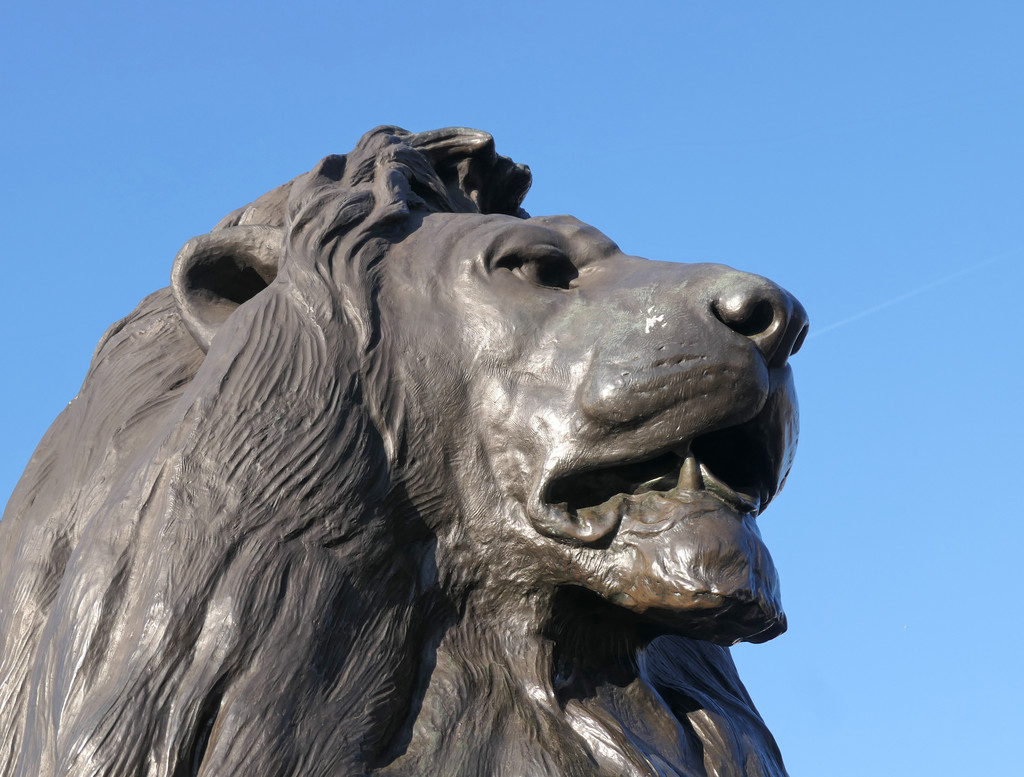
- Navigation image, One of the bronze lions at Nelson’s Column: modelled by Edwin Landseer and cast by Carlo Marochetti. Photograph by Amanda Slater. CC BY-SA 2.0. Image source. CC BY-SA 2.0. Resized.