by Tom Gurney
Tom Gurney BSc (Hons) is an art history expert with over 20 years experience
Email: tomgurney1@gmail.com / Phone: +44 7429 011000
Queen Victoria at Osborne: Introduction
Queen Victoria sits on a dark pony outside Osborne, reading a letter. John Brown holds the bridle, dogs occupy the path below her, and two princesses sit on a bench nearby. The scene contains the people, animals and communications of a working household, yet the queen remains withdrawn within its arrangement. In Queen Victoria at Osborne, Edwin Landseer makes an apparently ordinary pause carry the weight of royal bereavement.[1][2]
The oil painting belongs to the Royal Collection, RCIN 403580, which currently dates it 1865–67. Its support measures 147.8 × 211.9 cm.[1] The familiar historical title Her Majesty at Osborne in 1866 names the subject as it appeared at the Royal Academy in 1867.[3] That difference between the represented year and the period of making helps explain the picture's carefully assembled character. Landseer did not simply encounter a passing moment: he developed an image of the widowed sovereign whose public display would itself become controversial.
At a Glance
This work across Edwin Landseer’s career
The Cat's Paw
c. 1824 [5]The Hunting of Chevy Chase
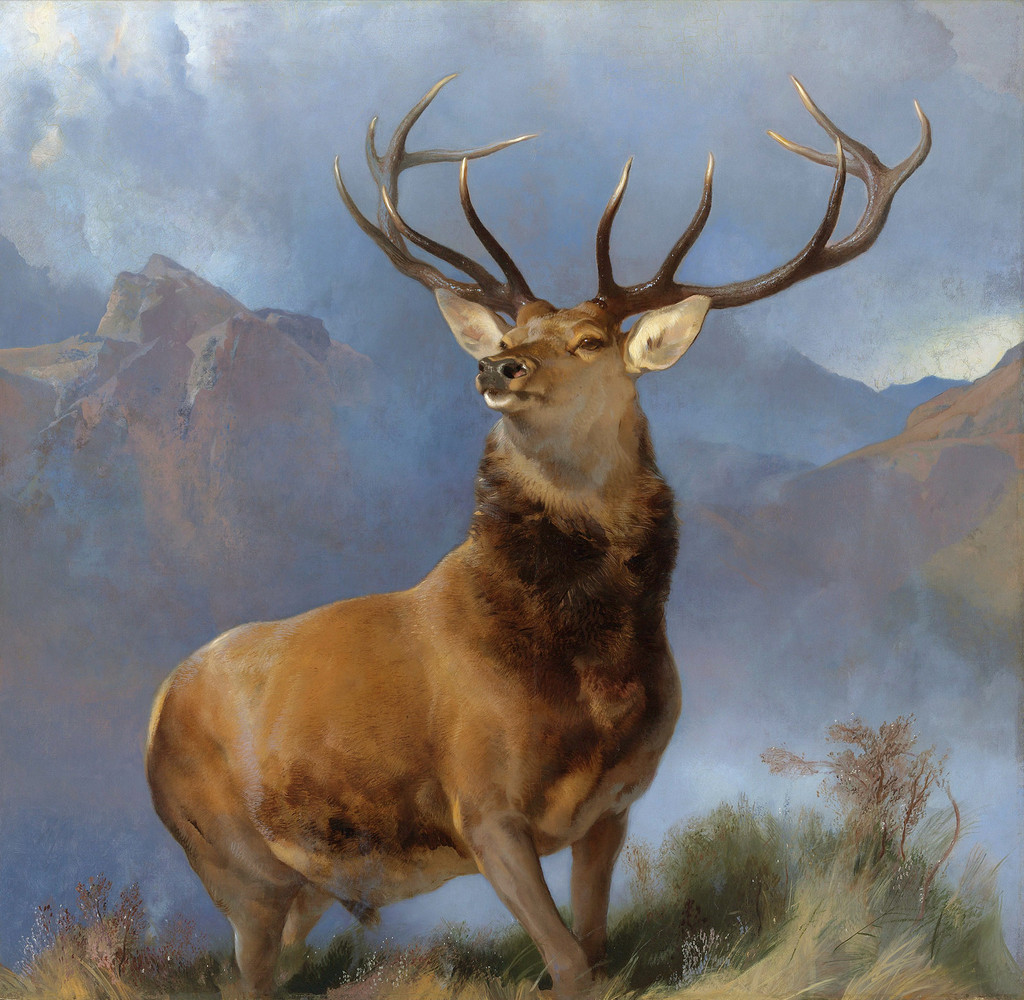
1825–26 [6]The Monarch of the Glen
about 1851 [10]Contents
- The queen and the pony
- Brown's place beside the bridle
- Three dogs and several kinds of attention
- The princesses and the bench
- Osborne behind the figures
- Letters, gloves and the red box
- From a pair of drawings to an oil painting
- At the Royal Academy in 1867
- A subject critics could approach differently
- The painting's later presence
The queen and the pony
Victoria's black clothes form the dominant human shape, rising above the pony's broad body. The hood frames a pale face bent towards the letter, while the riding habit spreads across the animal's side in a long, uninterrupted fall. Its lower edge hangs close to the foreground, extending the queen's presence far beyond the small area occupied by her face and hands. The pale cuffs and opened paper interrupt this dark expanse without breaking its overall gravity.[2]
The letter gives the figure an action that can be read immediately. One hand supports the sheet while the other steadies its lower part; the paper opens across the lap rather than being held up towards another person. Victoria's lowered eyes keep the action contained within her own space. Nothing in the gesture invites a response from Brown or the seated women. The composition therefore provides a form of absorption that is visible even though the contents of the letter remain unknown.[2]
The pony is Flora.[1] Its lowered head occupies the interval between Brown and the queen, joining the two human figures through an animal whose body also separates them. The ears, mane and long muzzle give the head a more broken contour than the broad mass of the queen's skirt. Farther right, the rounded hindquarters and tail complete the composition's largest dark shape. Landseer gives the animal enough bodily weight to support the rider convincingly while allowing the dark clothing to read as a distinct surface laid over it.[2]
The handling of black is especially important. Light catches the pony's neck, shoulder and flank in broad, cool passages, whereas the skirt gathers into softer folds. The queen and her mount share a restricted range of colour, but they do not merge into an unreadable silhouette. Changes of sheen and direction make the animal's anatomy legible beside the fabric. The portrait depends on this discrimination: a painter known for animals must make the physical presence of the pony serve the representation of a sovereign without reducing either to an accessory.[2]
Flora's planted feet bring the scene to a halt. The picture offers no open stride and no imminent surge forwards. The queen's reading occupies a pause that could belong within a ride, but the arrangement gives that pause unusual duration. The pony holds the central space as firmly as a piece of architecture, while the paper introduces a small activity above it. Movement is possible, yet attention has settled on the moment before it resumes.[2]
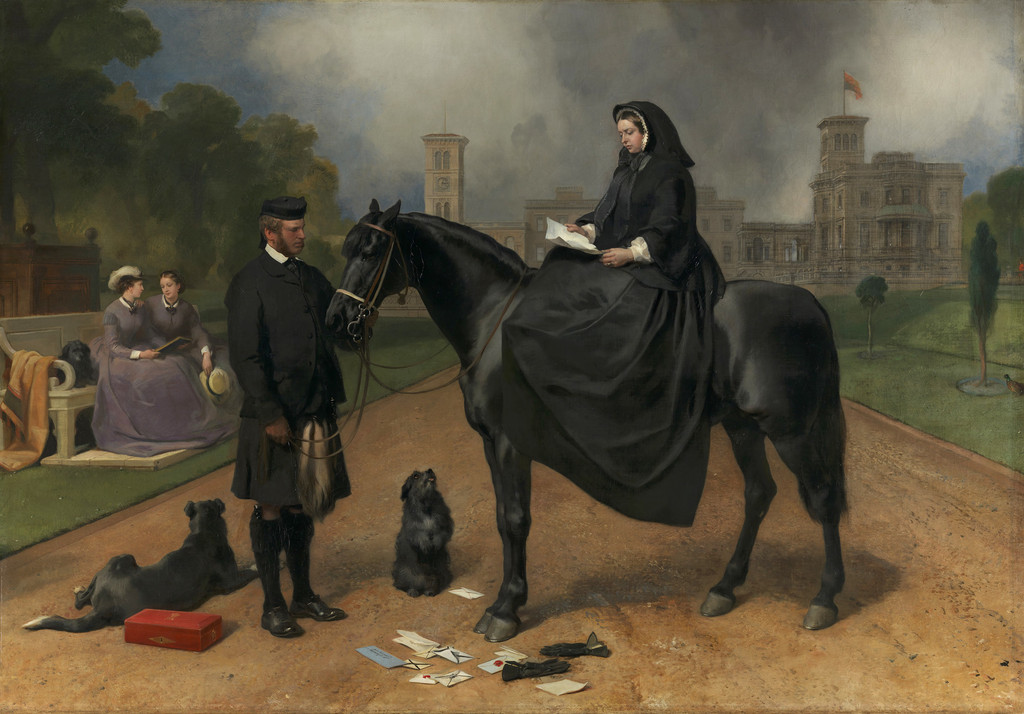
Queen Victoria at Osborne. Royal Collection. Image source. Public domain.
Brown's place beside the bridle
John Brown stands to the left of Flora's head, holding the bridle.[1] His upright body establishes a second dark vertical beside the pony's bent neck. The white collar and small area of visible face distinguish his head from the surrounding foliage, while the kilt and lower legs divide his figure into more varied shapes than the queen's continuous habit. His placement makes him prominent without placing him on the same elevated level as the rider.[2]
The bridle supplies the clearest practical relationship between the figures. Its lines cross the animal's head and curve towards Brown's hands, showing why he occupies this particular position. He is close enough to guide or steady Flora, yet the queen's letter directs her attention elsewhere. Landseer builds the scene around differentiated tasks: holding, waiting and reading can occur together without becoming a conversation.[2]
Brown's face is turned towards the central group rather than out towards the spectator. His position closes one side of the composition, guiding the eye back to the horse and rider. The dark clothing also connects him with the foreground dogs, creating a series of forms across the path. His shoes stand among the papers and animals, while the queen is physically raised above them. This difference of level contributes to the painting's account of attendance and rank.[2]
The figure is therefore essential to the picture's structure as well as its subject. Without him, the pony's head would project into a much emptier space; with him, the pause has a human support and a defined edge. The closeness is expressed through service and placement. The painting provides no exchange of looks or words from which to reconstruct a private conversation. Its force lies in the exact task that can be seen and in the contrasting directions of attention within the group.[2]
Three dogs and several kinds of attention
Two dogs occupy the foreground. The Royal Collection identifies the reclining Border collie as probably Sharp and the upright Skye terrier as Prince.[1] The qualification attached to Sharp matters: the name should retain the uncertainty of the collection's identification. A third dark dog sits on the bench beside the princesses. Together, the animals extend Landseer's subject beyond an equestrian portrait, but they do so through different positions rather than a uniform display of affection.[2]
The reclining dog stretches along the lower left, its body nearly parallel to the painting's bottom edge. Its head turns back towards Brown and the central group, giving the long horizontal shape an answering upward movement. The tail reaches towards the corner, while the forepart lies near Brown's feet. The animal connects the attendant's standing figure with the breadth of the foreground, helping to fill an area that might otherwise become an empty strip of path.[2]
Prince sits much closer to Flora's forelegs, with the muzzle raised towards the mounted figure. The dog's shaggy outline differs from both the pony's smooth body and the large folds of the habit. Its small size makes the upward direction especially conspicuous: a compact animal at ground level addresses the tallest figure in the scene. The queen continues to read. That separation of attention gives the terrier a distinct pictorial role without requiring us to invent what either creature or rider feels.[2]
On the bench, the third dog's dark head and body are contained within the princesses' quieter group. It belongs to another level of the household, away from the bridle and scattered papers. Its presence prevents the left-hand bench from becoming an exclusively human counterpart to the animals in front. Landseer distributes dogs through the family setting, allowing them to occupy furniture, ground and the spaces between people.[2]
The three animals also establish different bodily rhythms. One reclines, one sits upright, and one is partly sheltered within the bench arrangement. These differences help the eye move through a scene in which the principal figures remain still. The dogs give the household a sense of occupation: the path and bench are places where particular creatures have settled, rather than an empty stage cleared for the sovereign.[2]
Their dark coats participate in the picture's sombre colour, yet their individual forms resist being absorbed into a single emblem of mourning. Gloss, shaggy hair, bent limbs and the direction of a muzzle remain specific. This is one reason the painting's emotional subject cannot be separated from Landseer's animal painting. The animals make the setting convincing at the same time as their arrangement contributes to its gravity.[2]
The princesses and the bench
The seated women are Princess Louise and Princess Helena.[1] They occupy the far left of the foreground group, lower than the queen and farther from the picture's centre. Their dresses introduce muted purples into the broad field of blacks and browns. Pale collars, faces and hands give this corner a concentration of small lights, but the colour remains sufficiently restrained to belong within the same overall scheme.[2]
Their shared bench creates a compact social space. One head turns towards the other figure, and a flat, dark object with a bright edge rests across the nearer lap. The group thus has its own object of attention, answering the queen's letter at a smaller scale. Looking can bring the seated figures together, while the elevated queen's paper holds her apart. The two arrangements coexist within a single household view.[2]
The bench itself offers another contrast with Flora. Its pale curved ends and horizontal seat make a fixed, architectural support for the seated women, whereas the queen is supported by a living animal. A warm-coloured wrap hangs over the left end, softening the bench's outline and bringing a brighter note near the edge. These details make the corner seem occupied beyond the demands of formal portraiture: garments, a dog and objects share the space with the princesses.[2]
The family is present, but its members do not form a closely interlocking conversational group. The distance between the bench and the queen is traversed by Brown and the pony's head rather than by an exchanged gesture. Victoria's prominence depends partly on this separation. Landseer can show attendance and companionship while preserving the solitary direction of her reading. The painting's representation of bereavement operates through relationships among figures, not through an empty setting.[2]
Osborne behind the figures
The house stretches across the background, its towers rising on either side of the mounted queen. The architecture supplies a setting large enough to identify the scene as royal without bringing a throne, crown or ceremonial interior into the foreground. Its pale stone and repeated openings remain distinct, but the building is softened by distance and the cloudy atmosphere. The people and animals retain the stronger contours and closer material presence.[2]
The path broadens towards the spectator, giving the foreground group room to stand. Its warm earth colour counters the dark figures and the cooler green of the lawns. The diagonal edges lead backwards towards the house and terrace, so that a seemingly simple pause on a ride becomes part of an ordered estate. The low viewpoint lets the pony occupy much of the picture while allowing Osborne to remain visible above its back.[2]
Trees darken the left edge and rise into the upper corner, enclosing the princesses' side of the scene. To the right, the lawn and clipped forms open a more measured space beside the building. Landseer does not give both sides identical weight. The contrast between leafy enclosure and architectural order helps hold the central group in place, with Brown nearer the trees and the queen's outline set against the changing sky.[2]
The building's pictorial work is concrete. It locates the figures within a royal home, establishes the scale of the grounds and balances the large dark body of the pony with a broad structure behind it. The architecture gives the household a setting that can be recognised from outside: an extensive residence opens behind people occupied by much smaller actions.[2]
Letters, gloves and the red box
The scattered correspondence creates a second concentration of activity below the queen. White and cream envelopes lie across the ochre path, with a blue sheet among them and dark gloves closer to Flora's feet. Their sharp corners differ from the rounded bodies of the animals. Small red seals introduce further points of colour, drawing attention to objects that might otherwise be lost beneath the more imposing figures.[2]
The red dispatch box sits near the reclining dog, distinctly separated from the central scatter.[14][15] Its rectangular body gives the foreground a compact, strongly coloured form. The lid and small metal details make it appear closed and substantial beside the loose papers. The contrast between box and scattered correspondence suggests two states of the same activity: something contained and organised, and something opened for attention.[2]
The papers also change the relationship between the queen and the ground. Her reading is elevated above the path, but its materials extend downwards among the dogs and Brown's feet. The letter in her hands therefore belongs to a larger visible field of communications. Landseer links the small gesture at the centre of the portrait with the unusually detailed foreground, rather than leaving the documents as isolated symbols.[2]
Their presence permits a reading of royal work continuing within bereavement. The portrait does not supply the text of the letter, however, or identify a particular governmental decision. Its emphasis is on the act of attending to a communication, set against the signs of mourning. The queen's role remains active at the level of looking and handling, even though the overall composition is still.[2]
The gloves add another kind of interruption. Lying on the path, they belong to the equipment of a person who could resume a ride, while their placement among the papers makes that activity feel suspended. The picture need not describe an actual accident in which a box spilled and gloves fell. Objects can be arranged to make a pause readable. Here their differing colours and shapes give the foreground a sequence that returns the eye to the letter above.[2]
From a pair of drawings to an oil painting
Victoria proposed contrasting chalk sketches on 6 May 1865: Albert at Highland sport and her present bereavement on a pony at Osborne with Brown. Ormond records this conception from her journal.[14] Happiness remembered and bereavement experienced were conceived as companion images.
Ormond's paired entries concern coloured chalk on paper. The related oil was Landseer's initiative, apparently intended as a pendant to Royal Sports before its size was reduced.[14] The oil developed from a project whose first medium and intended pairing were different. Its later appearance as a large public painting changed the circumstances in which the queen's conception would be seen.
The finished image makes that transformation visible through scale and setting. The queen's grief becomes the subject of a composition broad enough to contain an estate view, a family group and a richly articulated foreground. The painting does not depend on the viewer having its companion beside it. The contrast between loss and remembered happiness is embodied instead in the occupied household around a figure whose attention remains separate.[2]
Life sittings and photographs contributed to its construction; the Royal Collection records photographic aids for the queen on horseback, the princesses, Brown and Prince.[1] Ormond reproduces Victoria mounted with Brown in a photograph of 8 May 1865.[14] Such material helped make particular figures available to a composition that brought them together in a more elaborate arrangement.
The photographic connection is useful because the painting's apparent immediacy can otherwise be misleading. A rider reading on a stationary pony looks like something that might have been caught quickly. Landseer's broad foreground, carefully spaced figures and balanced architecture operate on another timescale. Individual appearances could be studied separately, then made to belong to a single imagined interval. The resulting scene is convincing without being an unmediated record of one encounter.[2]
In his letter of 23 April 1867, as recorded by Ormond, Landseer sought a truthful representation of Victoria's continuing grief.[14] That intention explains why the painting's stillness matters. The queen's lowered gaze, the enclosing black habit and the separation among the figures translate an enduring condition into an arrangement that can be seen.[2]
At the Royal Academy in 1867
The painting was exhibited at the Royal Academy in 1867 as number 72.[3] Public display placed a personal conception of mourning before viewers whose expectations were not confined to the royal household. The subject could be approached as a portrait, an animal painting, a statement about the sovereign's public presence or an invitation to sympathise with a widow. Those possibilities did not produce a single critical response.
The Saturday Review of 18 May questioned the wisdom of exhibiting it. Its critic treated the accumulation of dark clothing, animals and sky as an excessively comprehensive performance of mourning. The objection was directed beyond colour: a private choice, the review argued, took on another significance when brought into the crowded rooms of an exhibition.[15]
The review imagined a future in which Victoria's prolonged grief might become an admired example of conjugal devotion. It contrasted that distant historical judgement with the supposed impatience of people living under her rule. The critic thus made the painting a test of the relationship between the sovereign and her subjects. The queen's loyalty to Albert's memory was set against the consolation that, in the writer's view, national affection ought to provide.[15]
This was a pointed political interpretation of a picture without ceremonial insignia or an explicit public event. Its importance lies partly in the way it converted domestic objects into public arguments. Black animals ceased to be particular companions and became evidence within a complaint about royal withdrawal. A painted sky was made to participate in the same accusation. The critic's rhetoric shows how difficult it could be to keep a royal household image within the category of private feeling.[15]
The writer claimed that listening to spectators would reveal the damage done by the picture's exhibition. That claim belongs to the review's argument; it does not establish a unanimous verdict among the people who saw it. Nor was the criticism an uncomplicated dismissal of Landseer's ability. The same paragraph insisted that his technique had not declined, praised the pony's coat and acknowledged the painting's success within the artist's range.[15]
The coexistence of those judgements is revealing. Landseer could be admired for the very qualities that intensified the critic's unease. The convincing gloss of the animal made its dark presence more emphatic; a skilfully unified scene could appear to extend the royal mood across people, animals and weather. The objection was not that the painter had failed to make his subject legible. It was that he had made this particular subject so publicly legible.[15]
The review's account of colour also shows the pressure of its argument. It presented the sky as if it contained no blue at all, whereas the colour image includes a blue opening at the left.[2][15] That discrepancy does not remove the painting's sombre effect. It shows a critic compressing a varied surface into a sharper verbal claim. The review is evidence of reception, including its exaggerations, rather than a substitute for looking at the painting.
A subject critics could approach differently
The Art-Journal adopted a markedly different course. In its Royal Academy review, it identified Landseer's Her Majesty at Osborne in 1866, number 72, declared the subject unsuitable for criticism and moved on.[3] The brief notice offers no full explanation of that decision. It nevertheless records an editorial boundary: here was a painting that the journal chose to acknowledge without submitting it to the detailed judgement given to neighbouring portraits.
The contrast with the Saturday Review is substantial. One critic made the public exposure of mourning the centre of a long argument; another declined to proceed. Both responses suggest that the subject carried demands beyond ordinary assessment of resemblance, drawing or colour. They do not tell us that every viewer shared the same discomfort or that respect necessarily produced silence. They show two specific ways in which the portrait complicated the work of reviewing.[15][3]
James Dafforne supplied a further perspective in 1873. Looking back on the 1867 exhibition, he remembered the picture drawing sympathetic spectators.[16] His retrospective account does not cancel the hostile remarks reported in the Saturday Review. Together, the sources preserve a more varied reception than a simple narrative of public rejection would allow. A painting of mourning could attract sympathy while also prompting criticism of the circumstances in which that mourning was displayed.
Modern art historian Kate Nichols places the controversy within the pressures of a mass exhibition audience, where images of private life entered a space of competing judgements and public scrutiny.[17] Landseer's portrait makes that problem unusually visible. Its intimacy depends on particular companions, a familiar task and a domestic setting, but its subject is a sovereign. The scene's quietness could not determine how loudly spectators or critics would respond.
The painting's later presence
Dafforne also recalled seeing the painting again a year or two before his book appeared. He thought it had lost much of its colour, while observing that it had never been brilliant.[16] This is a dated judgement by an earlier viewer, not a description of its condition today. It belongs to the work's historical reception alongside the very different emphasis that the Saturday Review placed on the pony's gloss and the picture's strong technical effect.
The Royal Collection continues to hold the painting and lists it in the Horn Room at Osborne.[1] That location reconnects the surviving work with the residence represented behind its figures. The public controversy of 1867 remains part of its history, but the image also retains the smaller relationships through which it was made: hand and paper, bridle and attendant, dog and bench, pony and rider.[2]
Those relationships give Queen Victoria at Osborne its lasting complexity. The queen is surrounded by a household, yet the composition preserves the separate direction of her attention. The animals have individual bodies and positions, yet their colour helps establish a collective gravity. Letters suggest continuing activity within an image of suspended movement. Landseer makes the private and public dimensions of royal life meet in details that remain physically exact, even when their meaning becomes contested.[2]
Artworks directory
This directory gathers works discussed in the articles, including drawings, original etchings and prints after Landseer. It is not a complete catalogue of every drawing, version, plate or impression. Distinct media are kept separate; uncertain dates are left blank. Linked titles open individual articles.
| Name | Date | Medium |
|---|---|---|
| A Bellowing Stag | Drawing | |
| A Deerhound | 1826 | Painting |
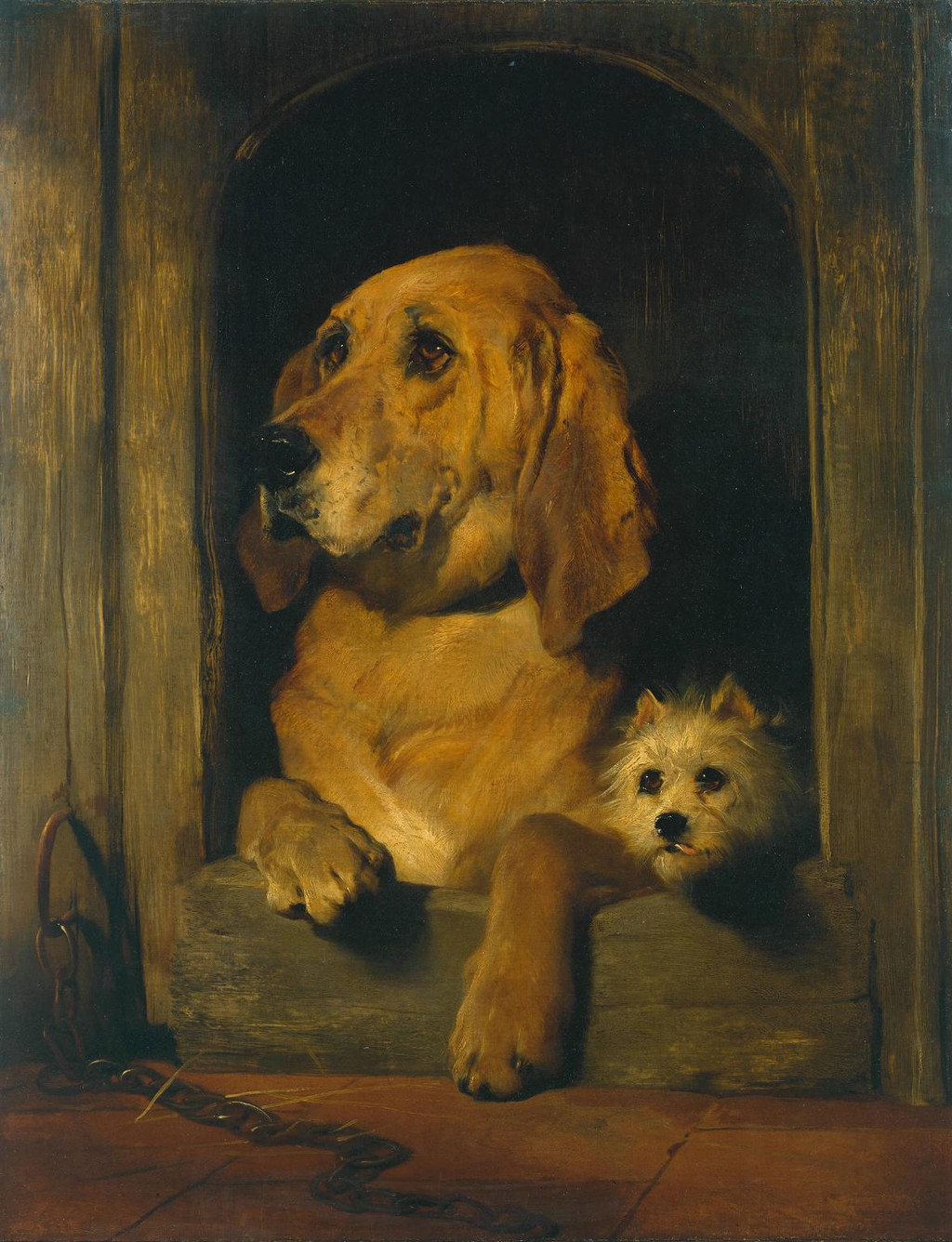
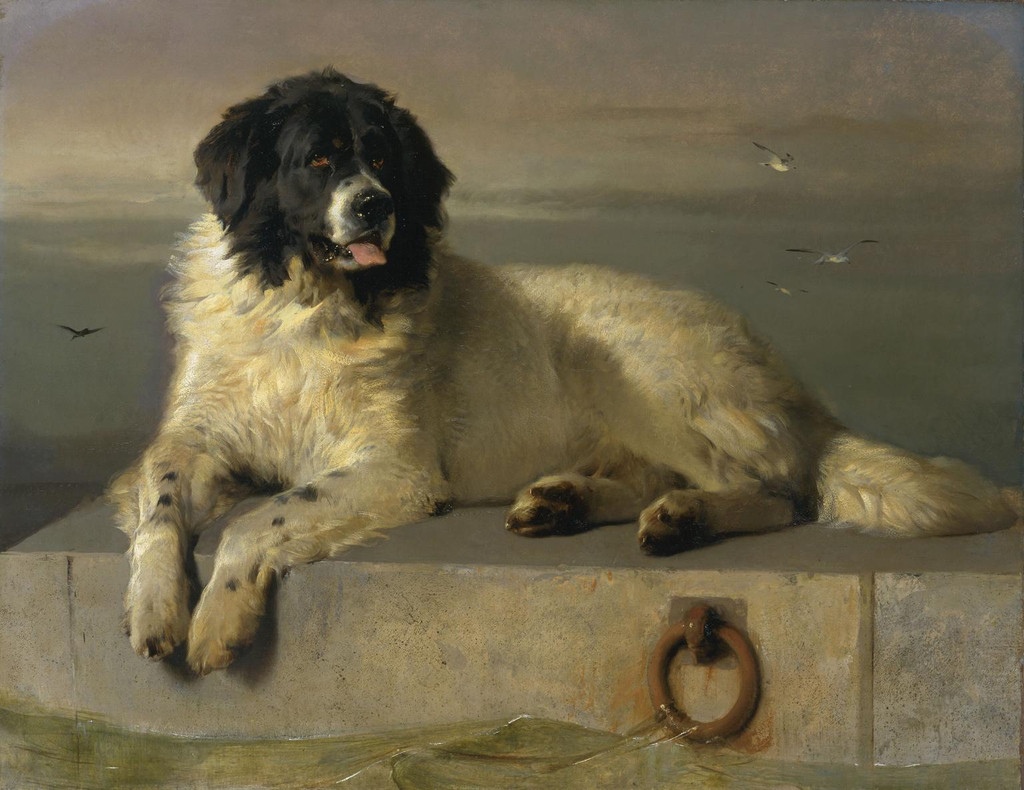
| A Distinguished Member of the Humane Society | 1838 | Painting |
| A Highland Breakfast | 1834 | Painting |
| A Highland Landscape | c. 1830 | Painting |
| A Highland Shepherd's Home | Painting | |
| A Horse, Goat and Bull | 1811 | |
| A Hunting Horse | Drawing | |
| A Jack in Office | Painting | |
| A Lion Disturbed at His Repast | Painting | |
| A Random Shot | Painting | |
| A Scene at Abbotsford | Painting | |
| Adversity | Painting | |
| Alexander and Diogenes | exhibited 1848 | Painting |
| Alpine Mastiffs Reanimating a Distressed Traveler | 1820 | Painting |
| Contending Group after Nature | Drawing | |
| Copy after Rubens's Wolf and Fox Hunt | c. 1824–26 | Painting |
| Dash | Painting | |
| Deer and Deer Hounds in a Mountain Torrent ('The Hunted Stag') | c. 1832 / exhibited 1833 | Painting |
| Deer Family | ||
| Dignity and Impudence | 1839 | Painting |
| Dog Resting Upon a Couch | Drawing | |
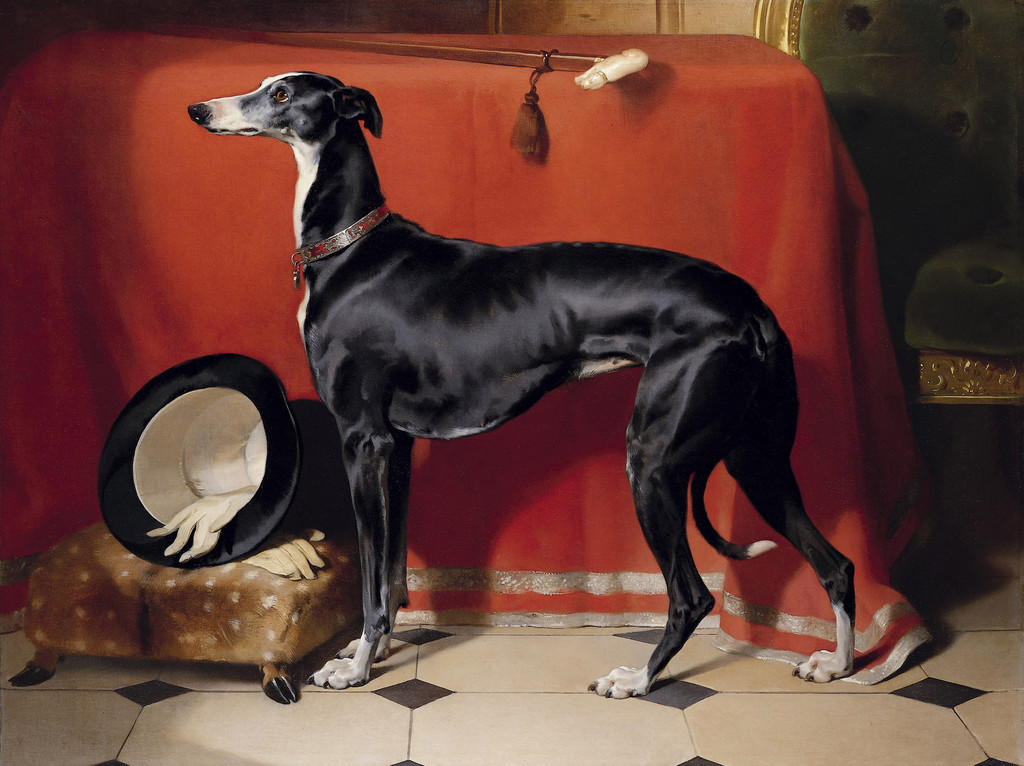
| Eos | 1841 | Painting |
| Favourites, the Property of H.R.H. Prince George of Cambridge | 1834–35 | Painting |
| Her Majesty Sketching at Loch Laggan | ||
| High Life | 1829 / exhibited 1831 | Painting |
| Highland Lassie | Drawing | |
| Isaac van Amburgh and his Animals | 1839 | Painting |
| Lady Godiva's Prayer | Painting | |
| Laying Down the Law | 1840 | Painting |
| Lion Defending Its Prey | c. 1840 | Painting |
| Lioness | Drawing | |
| Little Strollers | ||
| Low Life | 1829 / exhibited 1831 | Painting |
| Man Proposes, God Disposes | 1864 | Painting |
| Nell Gwynne / Diana Vernon | Painting | |
| Neptune | ||
| No Hunting Till the Weather Breaks | Painting | |
| Otterhounds | Drawing | |
| Peace | Painting | |
| Pensioners | Painting | |
| Portrait of a Mule | Painting | |
| Portrait of Mr Van Amburgh, as He Appeared with His Animals at the London Theatres | 1846–47 | Painting |
| Portraits of a Pointer Bitch and Puppy | Painting | |
| Pray Let Me Out | ||
| Prosperity | Painting | |
| Ptarmigan in a Landscape | by 1833 | Painting |
| Queen Victoria and Prince Albert at the Bal Costumé of 12 May 1842 | 1842–46 | Painting |
| Queen Victoria at Loch Laggan | Painting | |
| Queen Victoria at Osborne | 1865–67 | Painting |
| Queen Victoria landing at Loch Muick | Painting | |
| Rat-catching | 1823 | |
| Reclining Lion | Drawing | |
| Reclining Lion, From Back | Drawing | |
| Rent-day in the Wilderness | 1855–68 | Painting |
| Return from Deer Stalking | 1839 | |
| Royal Sports on Hill and Loch | Painting | |
| Sam Lovill, Porter at the Royal Academy | Drawing | |
| Scene from A Midsummer Night's Dream | 1848–51 | Painting |
| Scene in the Highlands, with portraits of the Duchess of Bedford, the Duke of Gordon and Lord Alexander Russell | Painting | |
| Scottish Highlands, Lochs and Figures | Drawing | |
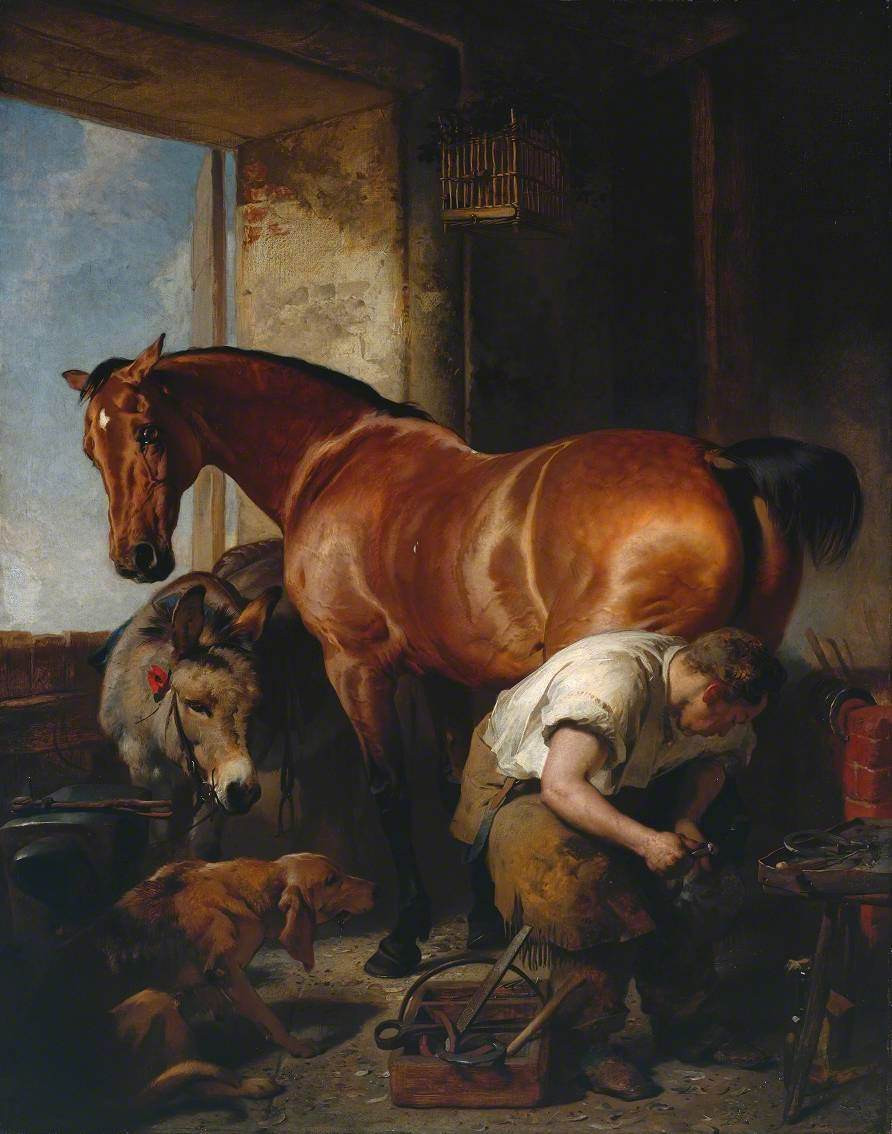
| Shoeing | exhibited 1844 | Painting |
| Sleeping Bloodhound | exhibited 1835 | Painting |
| Spaniel and Rabbit | Painting | |
| Stag at Bay | 1866 | Sculpture |
| Stag at Bay | 1846 | Painting |
| Studies of a staghound and the head of a stag for painting ‘The Hunting of Chevy Chase’ | Drawing | |
| Study for Alpine Mastiffs Reanimating a Distressed Traveler | Drawing | |
| Study for the Monkey in The Cat's Paw | Drawing | |
| Study of a Dog | Drawing | |
| Study of a herding dog facing right | Drawing | |
| Study of the horse of Selene, from the East pediment of the Parthenon | Drawing | |
| Suspense | Painting | |
| Taking a Buck | ||
| The Arab Tent | c. 1865–66 | Painting |
| The Barn | Drawing | |
| The Best Run of the Season | ||
| The Cat's Paw | c. 1824 | Painting |
| The Cavalier’s Pets | ||
| The Challenge | Painting | |
| The Chase | Drawing | |
| The Connoisseurs: Portrait of the Artist with Two Dogs | 1865 | Painting |
| The Death of a Stag in Glen Tilt | Painting | |
| The Drive—Shooting Deer in the Pass | Painting | |
| The Drover's Departure | Painting | |
| The Highland Shepherd’s Dog | 1824; portfolio issue 1848 | |
| The Honourable Mrs Norton | Painting | |
| The Hunting of Chevy Chase | 1825–26 | Painting |
| The Illicit Highland Whisky Still | Painting | |
| The Keeper John Crerar with his Pony | Painting | |
| The Larder Invaded | ||
| The Lion-Dog of Malta | ||
| The Lions at the Base of Nelson's Column | 1867 | Sculpture |
| The Monarch of the Glen | about 1851 | Painting |
| The Mountain Torrent | ||
| The Old Shepherd's Chief Mourner | 1837 | Painting |
| The Sanctuary | 1842 | Painting |
| The Stricken Deer | Painting | |
| The Twa Dogs | Painting | |
| Time of Peace | ||
| Two stags running | Drawing | |
| Victoria, Princess Royal, with Eos | Painting | |
| View of Glenfeshie | Painting | |
| War | Painting | |
| White Horse in a Stable | Painting | |
| Windsor Castle in Modern Times | 1841–43 | Painting |
| Woburn Abbey Game Card | 1825; portfolio issue 1848 |
Discussion
Use the article’s images and evidence to develop your own reading of Queen Victoria at Osborne.
Reader Insights
Which detail is most revealing when you consider “The queen and the pony”?
How does the evidence in “Brown's place beside the bridle” affect your reading of Queen Victoria at Osborne?
What further question would you bring to “The painting's later presence”?
Join the Conversation
Share a detail, comparison or question about Queen Victoria at Osborne below.
References
- Royal Collection Trust, Queen Victoria at Osborne, RCIN 403580, current collection record, dated 1865–67. Accessed 31 October 2026. View source.
- Royal Collection Trust, colour photograph of Queen Victoria at Osborne, RCIN 403580, preserved on Wikimedia Commons. Accessed 31 October 2026. View source.
- Royal Academy exhibition review, The Art-Journal, June 1867, p. 144. Accessed 31 October 2026. View source.
- National Gallery of Art, Alpine Mastiffs Reanimating a Distressed Traveler. View source.
- Minneapolis Institute of Art, The Cat's Paw. View source.
- Birmingham Museums Trust, The Hunting of Chevy Chase. View source.
- Victoria and Albert Museum, The Old Shepherd's Chief Mourner. View source.
- Tate, Dignity and Impudence. View source.
- Royal Collection, Eos. View source.
- National Galleries of Scotland, The Monarch of the Glen. View source.
- Royal Holloway, University of London, Man Proposes, God Disposes. View source.
- Royal Collection, Queen Victoria at Osborne. View source.
- Trafalgar Square / Greater London Authority, The Lions at the Base of Nelson's Column. View source.
- Richard Ormond, Sir Edwin Landseer, Philadelphia Museum of Art and Tate Gallery, 1981, pp. 163–165, entries 116–117 and related oil painting. Includes extracts and accounts of Queen Victoria's journal and Landseer's correspondence. Accessed 31 October 2026. View source.
- “Pictures of the Year”, Saturday Review, 18 May 1867, p. 629. Accessed 31 October 2026. View source.
- James Dafforne, Pictures by Sir Edwin Landseer, Royal Academician: With Descriptions and a Biographical Sketch of the Painter, London: Virtue & Co., 1873, p. 61. Accessed 31 October 2026. View source.
- Kate Nichols, “1867: The Pains of a Mass Audience”, in The Royal Academy of Arts Summer Exhibition: A Chronicle, 1769–2018, edited by Mark Hallett, Sarah Victoria Turner and Jessica Feather, London: Paul Mellon Centre for Studies in British Art, 2018. Accessed 31 October 2026. View source.
- Splash image, Queen Victoria at Osborne. Royal Collection. Image source. Public domain.
- Navigation image, One of the bronze lions at Nelson’s Column: modelled by Edwin Landseer and cast by Carlo Marochetti. Photograph by Amanda Slater. CC BY-SA 2.0. Image source. CC BY-SA 2.0. Resized.