by Tom Gurney
Tom Gurney BSc (Hons) is an art history expert with over 20 years experience
Email: tomgurney1@gmail.com / Phone: +44 7429 011000
Rent-day in the Wilderness: Introduction
In Rent-day in the Wilderness, Edwin Landseer turns the collection of money into a scene of concealed resistance. Colonel Donald Murchison attends to papers and an account book while armed men watch the water beyond him. The landscape offers cover, the redcoats remain at a distance, and a transaction that might ordinarily take place indoors continues among rocks, roots and heather. Painted between 1855 and 1868, the panoramic canvas measures 122 × 265 cm and belongs to the National Galleries of Scotland as NG 586.[1][2]
The picture was commissioned by the geologist Sir Roderick Impey Murchison, who posed for the colonel. It commemorates the collection of rents for the Jacobite Earl of Seaforth after his estates had been forfeited and he had gone into exile.[1][3] Family memory, disputed authority and the practical business of property meet in an image whose foreground is unusually close to the spectator. Landseer's animals and Highland scenery remain essential, but here they share the space with an act of accounting that defies the government represented on the opposite shore.[2]
At a Glance
- ArtistEdwin Landseer [1]
- Date1855–68 [1]
- Collection or siteNational Galleries of Scotland [1]
- ObjectNG 586 [1]
This work across Edwin Landseer’s career
The Cat's Paw
c. 1824 [5]The Hunting of Chevy Chase
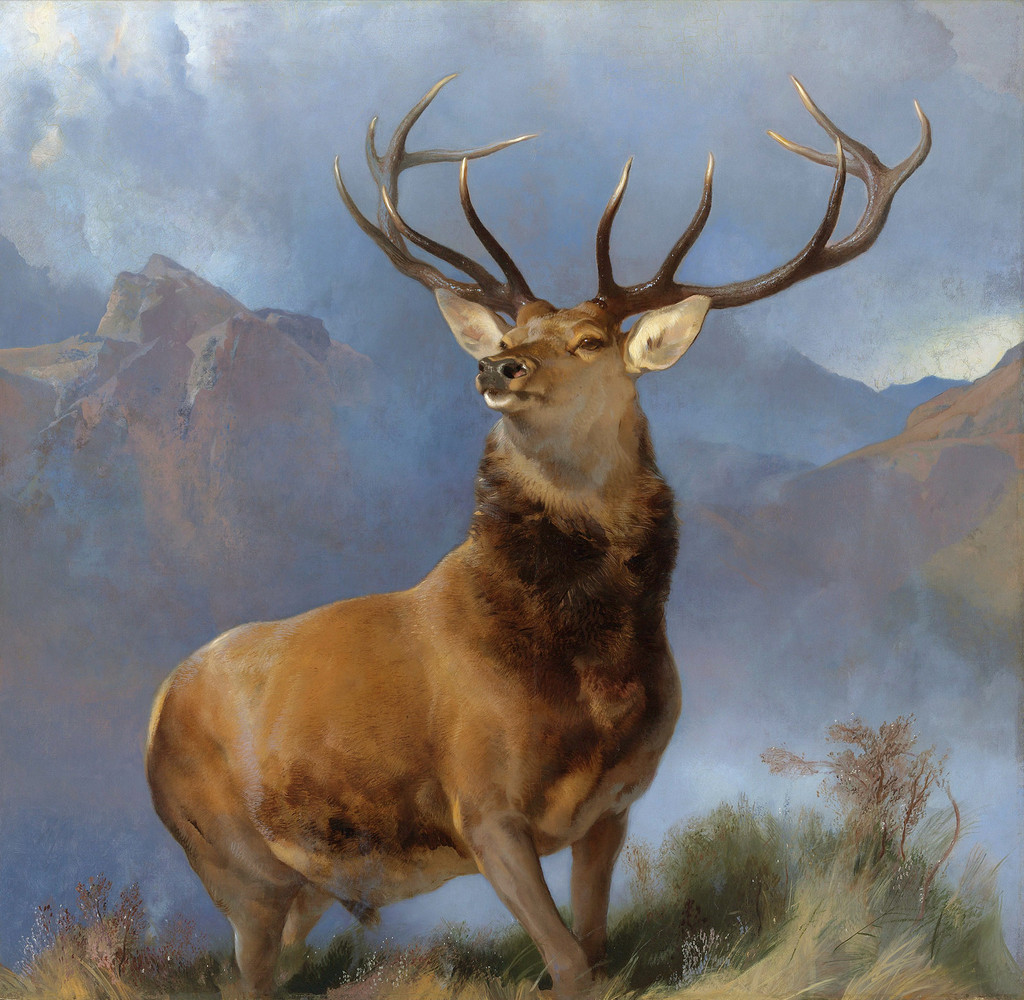
1825–26 [6]The Monarch of the Glen
about 1851 [10]Contents
- The business at the centre
- Watching from the ground
- Dogs, ponies and interrupted repose
- A landscape divided by visibility
- Why these rents were disputed
- A history larger than one encounter
- The commissioner enters the past
- Thirteen years between request and exhibition
- Costume and the credibility of history
- The first viewers and the crowded design
The business at the centre
Donald Murchison stands towards the right, wearing a brown coat over a bright breastplate. The metal spreads a broad pale shape across his chest, distinguishing him from the dark-cloaked man beside him and the smaller figure approaching from the edge. His head is raised sufficiently to give his face a clear profile, but his hands keep attention on the business below. One indicates the open book; the other holds a sheet of paper. The arrangement makes his authority depend on an action that can continue even while others prepare for danger.[2]
The foreground has the character of a temporary office assembled on the ground. Books, loose papers, a pen and an inkpot occupy a spread of checked fabric, with small bags and other possessions close by. These objects are organised for use rather than shown as an isolated still life. The open pages answer the colonel's gesture, while the incoming paper held by the boy suggests another item about to enter the transaction. The landscape has not displaced administration: it has become the place where administration is performed.[2]
Across the low central space, an older bearded man leans forward beside a young woman. Their proximity to the papers connects them with the colonel's work, while their faces make the exchange personal rather than anonymous. William Michael Rossetti, describing the picture at its 1868 exhibition, understood this pair as a clansman paying rent, accompanied by his daughter.[14] That reading explains the gathering without requiring every visible person to be identified by name. Landseer gives the payer a face and a place in the scene, while withholding the kind of expansive gesture that might turn the payment into a public ceremony.
The hooded man beside the colonel creates another kind of emphasis. His dark clothing gathers into a large continuous mass, against which his pale beard and hands stand out. Rossetti called him a friar; Landseer's placement makes him an attentive participant close to the papers.[2][14] He contributes to the scene's gravity without supplying a separate, fully explained episode. The difference between his wrapped body and the colonel's exposed breastplate also divides two adjacent figures through texture and light, so that the principal group remains readable within the crowded canvas.
At the right, the boy holds his document while looking towards the colonel. His white shirt, red kilt and green shoulder straps introduce smaller, sharper areas of colour beside the adult's brown coat. Unlike the men farther back, he does not aim a weapon or scan the landscape. His task belongs to the continuing circulation of information. Placed near the lower edge, he also gives the spectator an accessible route into the central group: his attention directs ours towards the person who will receive what he carries.[2]
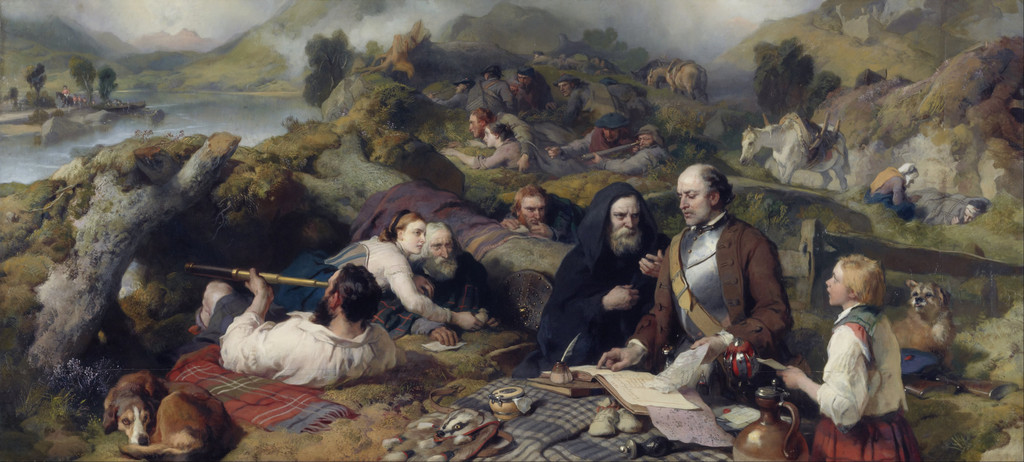
Rent-day in the Wilderness. National Galleries of Scotland. Image source. Public domain.
Watching from the ground
The most conspicuous lookout lies across the left foreground. Seen partly from behind, with his white shirt spread over his shoulders, he raises a long brass telescope towards the distant shore. The instrument makes his purpose unmistakable. His body remains low, conforming to the hollow in which the group has gathered, while the telescope projects horizontally towards the landscape beyond. Landseer gives observation a physical form: a man must keep himself sheltered while extending his vision through an object that reaches towards the open space.[2]
This figure establishes a different rhythm from the colonel's. The rent collector handles records close to his body; the lookout uses an elongated instrument to examine something far away. The contrast joins two kinds of knowledge within a single composition. One concerns names, obligations and payments, the other the movements of a possible enemy. Neither activity can be treated as incidental decoration. Together they explain how a rent day can continue under the conditions represented, with some people attending to the transaction while others monitor the danger that surrounds it.[2]
More watchers appear in the middle distance. Several figures lie or crouch behind the irregular ridge, and a long firearm follows the line of the ground. Heads emerge at different heights from the shelter of roots, stones and vegetation. Their postures are less ceremonious than those of the principal group, but they are crucial to the picture's tension. The spectator discovers them successively, much as the defenders use the broken terrain to prevent themselves from being seen all at once. Concealment becomes a way of composing a crowd.[2]
The earthwork also brings the foreground figures very close. Their lower bodies are partly hidden by the ground and by the painting's edge, so that faces, hands and upper torsos occupy most of the immediate human space. The effect is intimate but awkward. We see enough to understand each person's activity without being given an easy view of everyone standing on a common floor. The device makes the gathering feel improvised, pressed into the shape of a particular piece of land, rather than arranged in a spacious historical chamber.[2]
Dogs, ponies and interrupted repose
A brown dog curls at the lower left, its head lowered towards the spectator and its body fitted into a small patch of ground. It is visually separate from the white-shirted lookout above it. The contrast is striking: the man's attention travels across the loch through the telescope, while the dog remains compact and close, with no comparable outward action. Its curved body gives the lower corner a resting form beneath the angled roots and the man's extended instrument. Quietness belongs within the scene even as the watchers prepare for movement.[2]
A second, smaller rough-haired dog stands behind the boy on the right. Its face looks outward from among the scattered possessions, bringing an alert animal presence into the space beside the incoming document. Landseer does not make the two dogs perform identical roles. One is curled into the ground; the other is upright and more exposed. Their difference adds to the variety of attention across the gathering, without requiring a story about a named pet, a particular breed or a signal that the animals have detected before the people.[2]
The white pony on the track above the colonel supplies a larger pale shape within the middle distance. Its lowered head and laden or equipped back connect it with the practical movement of people and possessions through this country. Farther up, other pack animals diminish towards the rocky passage. The track helps the eye move behind the principal group, showing that the gathering occupies a route as well as a refuge. These animals make the scene usable: the people have reached this place with belongings, weapons and the means to continue their business.[2]
The animals also prevent the historical subject from becoming exclusively a confrontation between two bodies of men. They occupy the same ground but respond through different postures and scales. A dog can curl under a lookout's elbow while a pony waits on the path above him; the picture can contain a moment of stillness and the possibility of sudden action at once. Landseer integrates these presences into the organisation of the gathering. They contribute to the sense of an inhabited landscape whose ordinary uses persist beneath its military significance.[2]
A landscape divided by visibility
The distant redcoats occupy a small area at the far left. Their bright colour helps them remain legible against the muted shore, while the stretch of water keeps them separate from the much larger foreground figures. A boat and the shore beyond give their approach a direction. The threat is therefore spatial before it becomes dramatic: the defenders can see the soldiers, yet the soldiers' access to the near group is obstructed by water, distance and the broken ground in which the tenants have gathered.[2]
Nearer the spectator, a fallen or broken tree and its roots form an irregular screen. Their heavy shapes cut across the view and make the hidden gathering seem embedded in the site. The land rises behind the colonel, opening into a path on the right and a sequence of hills beyond. This is a landscape that alternately reveals and conceals. The open loch gives the lookout something to survey; the roots and low ridge make it possible for the people being protected to remain difficult to detect.[2]
The wide format is essential to that relationship. Landseer can place a very close group beside a distant military presence without making the two appear to share a single stage. The spectator must travel across the picture to connect them, passing from papers and faces through the lookout's instrument to the red marks on the shore. Distance becomes part of the narrative. The meaning of the foreground exchange changes once the soldiers have been noticed, even though no one at its centre makes an expansive gesture of alarm.[2]
The mountains and low cloud extend the scene beyond the reach of either group. Their broad forms contain routes, cover and obstacles, rather than serving only as a magnificent backdrop. Nothing in the composition requires the loch to stand for an abstract religious division. Its immediate work is concrete: it separates, exposes and delays. Landseer builds the historical conflict out of the uses people make of this terrain, with the gathering's protected position and the soldiers' visible approach giving the landscape a particular political force.[2]
Why these rents were disputed
The incident belongs to the aftermath of the Jacobite rising of 1715, not to the later campaign of Bonnie Prince Charlie in 1745. Seaforth had supported the Stuart cause and lost the legal possession of his estates. Donald Murchison continued to collect their rents for him in defiance of the government. Robert Chambers's nineteenth-century account, one of the texts associated with the painting, describes a territory in which official forfeiture had not produced effective control. The Commissioners for the Forfeited Estates could assert a claim from Edinburgh while their agents struggled to enforce it in the west.[3]
Chambers makes geography central to that difficulty. Narrow paths, demanding passes and the limited approaches to Kintail and Lochalsh obstructed the government's agents, while local support allowed money to continue reaching the exiled earl. His account describes Donald as trained in legal business at Edinburgh as well as capable of armed command.[3] That combination is especially relevant to Landseer's subject. The figure at the centre is neither simply a warrior resting between battles nor an ordinary collector caught by chance outdoors. His administrative competence is one of the means through which resistance continues.
The competing claims placed the tenants in a difficult position. To pay Seaforth's collector was to maintain an established relationship while refusing the authority of those legally charged with the forfeited property. Chambers records that the tenants continued their payments despite the risk that the commissioners might demand payment again.[3] The picture gives this conflict a tangible form through books, receipts and money. What might look like a routine exchange becomes a decision about whose authority will be recognised, even before a shot is fired.
This resistance should not be confused with a rejection of rent itself. The money in the picture is being gathered for an absent landlord, and the central figure's authority rests on his service to that landlord. The scene's sympathy for the people under cover coexists with that hierarchy. Its loyalty is directed towards a particular chief and a particular relationship to the land. Reading it solely as a timeless image of national freedom would lose the specificity of the act that Landseer has placed so prominently before us.[2][3]
Chambers's narrative is itself a Victorian construction of the earlier struggle. It combines documentary material with local recollections and openly admires Donald's devotion. In his notes he distinguishes a memorial submitted by the rival factors from a traditional account communicated by a local correspondent; those accounts do not describe every detail in the same way.[3] This matters to the painting's historical character. Landseer was working with a past already selected, narrated and morally interpreted, rather than translating an unambiguous eyewitness record directly into paint.
A history larger than one encounter
The historical background includes more than one attempt to take possession of Seaforth's estates. Chambers describes the armed expedition that advanced towards Kintail in 1721 and was checked near Loch Affric. His account follows negotiations as well as firing: the rival factor surrendered papers and undertook not to continue his office. A separate expedition in 1722 approached by another route and was turned back after an encounter at Coille Bhan.[3] These were different operations, and neither should be reduced to a single battle taking place exactly as Landseer presents it.
The canvas combines the collection of rents with the expectation of armed interference. Its foreground book and the approaching soldiers bring activities together that the historical narrative can describe at separate moments. James Dafforne printed a scene label assigning the setting to the head of Loch Affric in 1722, while Ormond later noted a date of 1721 on the painted account book.[15][16] These details help explain the historical world being evoked. They do not make the image a precise diagram of one encounter or resolve every chronological element into a single instant.
An especially revealing part of Chambers's account concerns the documents that supported Donald's authority. He reproduces General Wade's 1725 report that the collector issued receipts as a deputy to the Commissioners for the Forfeited Estates, having extracted that authority from the factor sent against him. Wade complained that Donald had subsequently carried a substantial sum to Edinburgh for transmission to Seaforth and remained there unmolested.[3] The report gives a government view of an arrangement that Chambers otherwise describes with admiration. It also shows that resistance could appropriate official forms, rather than existing entirely outside them.
Landseer's papers consequently deserve as much attention as the weapons. A book can preserve the obligation owed to the chief; a receipt can claim a legal status that the government disputes; a carried letter can join local business to distant authority. The colonel's gesture towards the page gives these small objects a prominence appropriate to that history. The image does not abandon conflict when it turns from the soldiers to the writing materials. It shows another medium through which the same struggle is conducted.[2][3]
The commissioner enters the past
Sir Roderick Impey Murchison's role went beyond paying for the picture. By posing for Donald, he lent his own appearance to the historical figure he wished to commemorate.[1] The modern commissioner and the Jacobite collector thus meet within the colonel's face. This is a form of historical portraiture in which resemblance bridges the interval between generations. The figure's calm command belongs to the painted past, while his features also carry the presence of a nineteenth-century man engaged in shaping the memory of that past.
The exact family relationship is less secure than that visual identification. The present National Galleries account calls Donald the geologist's great-grandfather. Chambers described Roderick as the great-grandson of Donald's brother John. Geikie's 1875 biography was more cautious: it said that Roderick could not accurately establish the connection, had regarded Donald as a great-granduncle, and was more distantly related through a grandfather who was the colonel's third cousin.[1][3][17] These incompatible descriptions make it wiser to speak of a claimed family connection than to treat one simple line of descent as settled.
The uncertainty does not erase the commission's commemorative purpose. Geikie recorded the geologist's admiration for Donald and the raising of a monument in his memory, while also preserving the doubtful genealogy in a footnote.[17] The painting belongs to that same act of remembrance. The patron could value Donald as a model of loyalty even when the exact degree of kinship was difficult to establish. His decision to take the colonel's place as a model gave that attachment an unusually direct pictorial expression.
There is a further complication in the story the commission celebrates. Geikie's account describes Donald's eventual treatment by Seaforth as unjust and his end as impoverished; Chambers similarly presents the chief as unworthy of his defender's devotion.[3][17] These are retrospective accounts, including inherited tradition, rather than explanations visible within the canvas. They nevertheless prevent the relationship between loyalty and reward from appearing straightforward. Landseer's scene isolates a moment of sustained authority, before the unhappy conclusion through which those writers understood the collector's service.
Thirteen years between request and exhibition
Ormond records Murchison's request in December 1855 for a Highland scene commemorating Donald's devotion. In January 1860 Landseer apologised for delay, citing illness and other commissions; in July 1867 Murchison sent the family snuffbox while urging completion.[16] These letters, preserved through the catalogue's account, give the long interval a human scale. The painting was a desired memorial that its patron had to pursue over years, rather than a canvas known to have occupied the artist continuously throughout the period indicated by its dates.
The borrowed object linked the commission to something the patron possessed. Geikie's biography describes a large ivory snuff-mull associated with Donald, records its appearance in the painting and traces it into the keeping of the geologist's heir after his death. The story that it had carried a commission sent by the Stuart claimant belongs to the historical family tradition Geikie repeated.[17] Its significance here does not depend on accepting every part of that tradition as independently proved. A tangible heirloom could give the projected historical image a particular claim on the patron's attention.
In the foreground, the round container belongs among implements of writing, money and personal equipment. It has been brought into the same visual space as the colonel's work, joining an object preserved by the later family to the earlier scene being reconstructed.[2][17] Such a detail could carry two times at once. Within the story it is a possession of the historical collector; in the making of the picture it was something sent to the artist by the modern commissioner, with the hope that it would help bring the memorial to completion.
Costume and the credibility of history
The colonel's breastplate immediately separates his role from a modern business transaction. At the same time, it is worn beneath an ordinary-looking brown coat, allowing martial protection and practical dress to occupy the same body. Around him, plaid fabrics, firearms and edged weapons establish a historical environment through things that can be seen and handled. The scene's authority is built cumulatively. No single accessory has to explain the whole past when the surrounding objects, gestures and setting reinforce one another.[2]
Material differences are carefully distributed. Bright armour catches the eye near the principal face; dark cloth gives the hooded man weight; patterned fabric lies beneath the books and the reclining watcher. The brass telescope extends across the left, while the brown jug and pale papers establish smaller contrasts on the right. These changes help the spectator distinguish uses within a crowded surface. Looking at the painting involves moving between fabrics, metal, skin, wood and paper, each attached to an activity or a person's place in the gathering.[2]
Anne MacLeod has related the work's period detail to the tradition of antiquarian illustration: surviving things could make a recreated past appear materially convincing. She also reads this subject within Landseer's treatment of Highland codes of conduct that conflicted with official definitions of legality.[18] The two observations belong together here. Detailed possessions make the historical world tangible, while the rent collection supplies the conflict that gives those possessions meaning. A convincing object is part of the picture's argument, though it cannot by itself authenticate every incident or costume choice.
The distinction between a plausible historical setting and a complete reconstruction remains essential. The painted group is organised to make certain actions readable, with the colonel prominently lit and the hidden defenders arranged behind him. Its materials serve that design as well as its period associations. Landseer invites belief through a concentration of particular things, but he also selects how those things will be encountered. The result is history painting: a shaped interpretation of the past whose visual coherence is an achievement separate from the verification of each individual detail.[2][3]
The first viewers and the crowded design
At the Royal Academy in 1868, Rent-day in the Wilderness appeared as no. 123. Rossetti found its concealed, crouching gathering distinctive and interesting, while also registering discomfort in the effect of the crowded figures.[14] His response recognises something still evident in the picture. The spectator is asked to understand a large number of people from partial views, and the ground that protects them also obscures the ordinary continuity of their bodies. The device makes their situation immediate, but it complicates the clarity expected of a major historical composition.
Rossetti's criticism was not simply a failure to notice the narrative. His account accurately connected the rent payment with the soldiers across Loch Affric and described the principal participants in the exchange.[14] The unease arose alongside that understanding. Landseer's arrangement could communicate stealth and urgency while remaining difficult as an arrangement of figures. This is a useful distinction because it allows the painting's narrative force and its compositional awkwardness to be considered together, rather than making one cancel the other.
Dafforne's 1873 account was more dismissive. He judged the work well below Landseer's best and contrasted it unfavourably with the smaller picture of a wounded stag and a hound exhibited in the same year.[15] His preference placed a concentrated animal subject above the extensive historical gathering. The comparison reveals a critical expectation as much as a verdict: the painter's strengths could appear most persuasive when confined to a simpler relation between a few figures, rather than distributed across a panoramic scene with many competing claims on attention.
Those responses help explain the canvas's unusual position within Landseer's work. The colonel's bookkeeping, the lookout's telescope, the crouching defenders and the distant redcoats ask for different speeds of looking. Some details can be understood immediately, while others acquire significance only after the historical situation is known. The picture's density is therefore both its difficulty and its method. It brings the practical life of resistance into view through an accumulation of actions, rather than through a single commanding gesture that explains the whole event.[2][3][14]
A national collection and a material history
Murchison bequeathed the painting to the Scottish collection in 1871, bringing the privately commissioned memorial into public ownership.[1][17] That transfer changed its setting and audience. A work made for a patron's attachment to a claimed family past could now be encountered as a representation of Scottish history by viewers with no personal stake in the genealogy. The canvas retains the commission's particular loyalties, but its public life makes those loyalties available for scrutiny as well as admiration.
Its physical history also qualifies the idea of a single finished surface. Ormond's 1981 catalogue recorded added canvas strips along the bottom and right, and shrivelling in the paint.[16] These are dated observations, not a description of its condition today. They establish that the object has a material history alongside the narrative it represents. The lower edge that brings the possessions so close to the spectator and the right-hand continuation of the scene are parts of a canvas whose construction deserves attention in its own right.
The painting's final effect rests on the persistence of ordinary business under extraordinary conditions. Its people carry papers, keep accounts, wait, watch and pay; its dogs and ponies inhabit the same terrain without becoming emblems with a single fixed meaning. Across the water, a small company of soldiers gives those actions their danger. Landseer makes the wilderness a place of organised relationships, where possession is recorded as well as defended and where the landscape's shelter allows an authority denied by the government to continue acting.[2][3]
Artworks directory
This directory gathers works discussed in the articles, including drawings, original etchings and prints after Landseer. It is not a complete catalogue of every drawing, version, plate or impression. Distinct media are kept separate; uncertain dates are left blank. Linked titles open individual articles.
| Name | Date | Medium |
|---|---|---|
| A Bellowing Stag | Drawing | |
| A Deerhound | 1826 | Painting |
| A Distinguished Member of the Humane Society | 1838 | Painting |
| A Highland Breakfast | 1834 | Painting |
| A Highland Landscape | c. 1830 | Painting |
| A Highland Shepherd's Home | Painting | |
| A Horse, Goat and Bull | 1811 | |
| A Hunting Horse | Drawing | |
| A Jack in Office | Painting | |
| A Lion Disturbed at His Repast | Painting | |
| A Random Shot | Painting | |
| A Scene at Abbotsford | Painting | |
| Adversity | Painting | |
| Alexander and Diogenes | exhibited 1848 | Painting |
| Alpine Mastiffs Reanimating a Distressed Traveler | 1820 | Painting |
| Contending Group after Nature | Drawing | |
| Copy after Rubens's Wolf and Fox Hunt | c. 1824–26 | Painting |
| Dash | Painting | |
| Deer and Deer Hounds in a Mountain Torrent ('The Hunted Stag') | c. 1832 / exhibited 1833 | Painting |
| Deer Family | ||
| Dignity and Impudence | 1839 | Painting |
| Dog Resting Upon a Couch | Drawing | |
| Eos | 1841 | Painting |
| Favourites, the Property of H.R.H. Prince George of Cambridge | 1834–35 | Painting |
| Her Majesty Sketching at Loch Laggan | ||
| High Life | 1829 / exhibited 1831 | Painting |
| Highland Lassie | Drawing | |
| Isaac van Amburgh and his Animals | 1839 | Painting |
| Lady Godiva's Prayer | Painting | |
| Laying Down the Law | 1840 | Painting |
| Lion Defending Its Prey | c. 1840 | Painting |
| Lioness | Drawing | |
| Little Strollers | ||
| Low Life | 1829 / exhibited 1831 | Painting |
| Man Proposes, God Disposes | 1864 | Painting |
| Nell Gwynne / Diana Vernon | Painting | |
| Neptune | ||
| No Hunting Till the Weather Breaks | Painting | |
| Otterhounds | Drawing | |
| Peace | Painting | |
| Pensioners | Painting | |
| Portrait of a Mule | Painting | |
| Portrait of Mr Van Amburgh, as He Appeared with His Animals at the London Theatres | 1846–47 | Painting |
| Portraits of a Pointer Bitch and Puppy | Painting | |
| Pray Let Me Out | ||
| Prosperity | Painting | |
| Ptarmigan in a Landscape | by 1833 | Painting |
| Queen Victoria and Prince Albert at the Bal Costumé of 12 May 1842 | 1842–46 | Painting |
| Queen Victoria at Loch Laggan | Painting | |
| Queen Victoria at Osborne | 1865–67 | Painting |
| Queen Victoria landing at Loch Muick | Painting | |
| Rat-catching | 1823 | |
| Reclining Lion | Drawing | |
| Reclining Lion, From Back | Drawing | |
| Rent-day in the Wilderness | 1855–68 | Painting |
| Return from Deer Stalking | 1839 | |
| Royal Sports on Hill and Loch | Painting | |
| Sam Lovill, Porter at the Royal Academy | Drawing | |
| Scene from A Midsummer Night's Dream | 1848–51 | Painting |
| Scene in the Highlands, with portraits of the Duchess of Bedford, the Duke of Gordon and Lord Alexander Russell | Painting | |
| Scottish Highlands, Lochs and Figures | Drawing | |
| Shoeing | exhibited 1844 | Painting |
| Sleeping Bloodhound | exhibited 1835 | Painting |
| Spaniel and Rabbit | Painting | |
| Stag at Bay | 1866 | Sculpture |
| Stag at Bay | 1846 | Painting |
| Studies of a staghound and the head of a stag for painting ‘The Hunting of Chevy Chase’ | Drawing | |
| Study for Alpine Mastiffs Reanimating a Distressed Traveler | Drawing | |
| Study for the Monkey in The Cat's Paw | Drawing | |
| Study of a Dog | Drawing | |
| Study of a herding dog facing right | Drawing | |
| Study of the horse of Selene, from the East pediment of the Parthenon | Drawing | |
| Suspense | Painting | |
| Taking a Buck | ||
| The Arab Tent | c. 1865–66 | Painting |
| The Barn | Drawing | |
| The Best Run of the Season | ||
| The Cat's Paw | c. 1824 | Painting |
| The Cavalier’s Pets | ||
| The Challenge | Painting | |
| The Chase | Drawing | |
| The Connoisseurs: Portrait of the Artist with Two Dogs | 1865 | Painting |
| The Death of a Stag in Glen Tilt | Painting | |
| The Drive—Shooting Deer in the Pass | Painting | |
| The Drover's Departure | Painting | |
| The Highland Shepherd’s Dog | 1824; portfolio issue 1848 | |
| The Honourable Mrs Norton | Painting | |
| The Hunting of Chevy Chase | 1825–26 | Painting |
| The Illicit Highland Whisky Still | Painting | |
| The Keeper John Crerar with his Pony | Painting | |
| The Larder Invaded | ||
| The Lion-Dog of Malta | ||
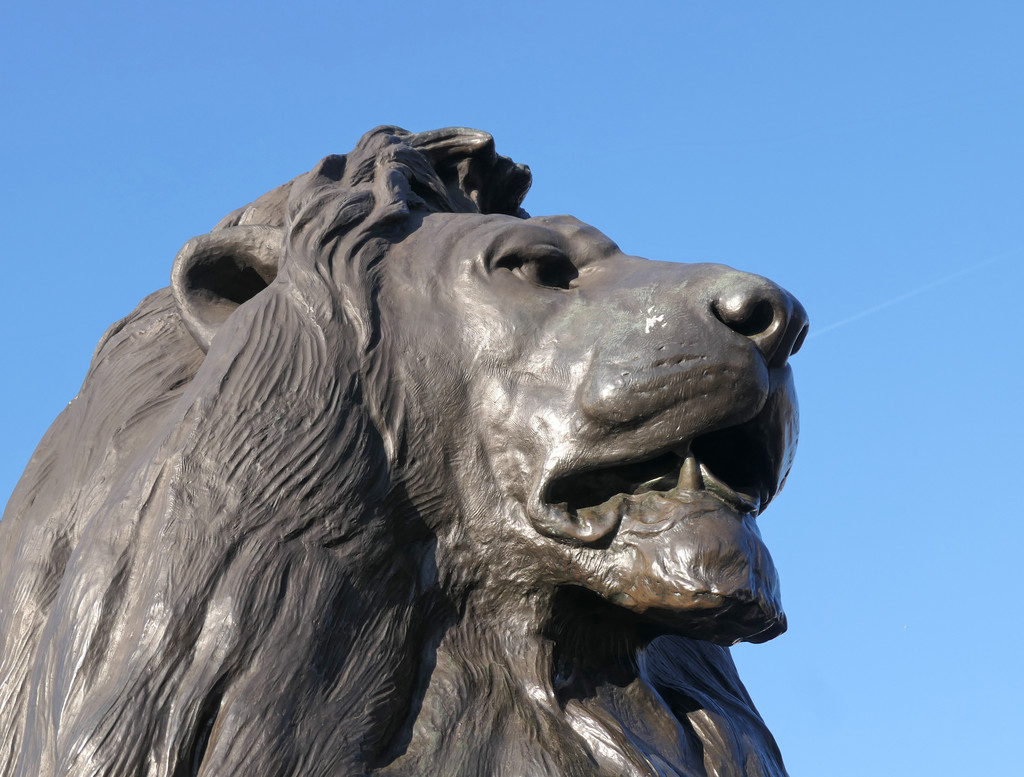
| The Lions at the Base of Nelson's Column | 1867 | Sculpture |
| The Monarch of the Glen | about 1851 | Painting |
| The Mountain Torrent | ||
| The Old Shepherd's Chief Mourner | 1837 | Painting |
| The Sanctuary | 1842 | Painting |
| The Stricken Deer | Painting | |
| The Twa Dogs | Painting | |
| Time of Peace | ||
| Two stags running | Drawing | |
| Victoria, Princess Royal, with Eos | Painting | |
| View of Glenfeshie | Painting | |
| War | Painting | |
| White Horse in a Stable | Painting | |
| Windsor Castle in Modern Times | 1841–43 | Painting |
| Woburn Abbey Game Card | 1825; portfolio issue 1848 |
Discussion
Use the article’s images and evidence to develop your own reading of Rent-day in the Wilderness.
Reader Insights
Which detail is most revealing when you consider “The business at the centre”?
How does the evidence in “Watching from the ground” affect your reading of Rent-day in the Wilderness?
What further question would you bring to “A national collection and a material history”?
Join the Conversation
Share a detail, comparison or question about Rent-day in the Wilderness below.
References
- National Galleries of Scotland, Rent-day in the Wilderness, NG 586, current collection record. Accessed 31 October 2026. View source.
- National Galleries of Scotland, Rent-day in the Wilderness, colour photograph, Google Arts & Culture institutional collection; high-resolution photograph. Accessed 31 October 2026. View source 1. View source 2.
- Robert Chambers, Domestic Annals of Scotland from the Revolution to the Rebellion of 1745, Edinburgh and London: W. & R. Chambers, 1861, pp. 459–464, 468–471 and notes 547–562. Accessed 31 October 2026. View source.
- National Gallery of Art, Alpine Mastiffs Reanimating a Distressed Traveler. View source.
- Minneapolis Institute of Art, The Cat's Paw. View source.
- Birmingham Museums Trust, The Hunting of Chevy Chase. View source.
- Victoria and Albert Museum, The Old Shepherd's Chief Mourner. View source.
- Tate, Dignity and Impudence. View source.
- Royal Collection, Eos. View source.
- National Galleries of Scotland, The Monarch of the Glen. View source.
- National Galleries of Scotland, Rent-day in the Wilderness. View source.
- Royal Holloway, University of London, Man Proposes, God Disposes. View source.
- Trafalgar Square / Greater London Authority, The Lions at the Base of Nelson's Column. View source.
- William Michael Rossetti, Notes on the Royal Academy Exhibition, 1868, Part I, London: John Camden Hotten, 1868, p. 6. Accessed 31 October 2026. View source.
- James Dafforne, Pictures by Sir Edwin Landseer, Royal Academician, with Descriptions and a Biographical Sketch of the Painter, London: Virtue, 1873, pp. 63 and 82. Accessed 31 October 2026. View source.
- Richard Ormond, Sir Edwin Landseer, Philadelphia Museum of Art and Tate Gallery, 1981, entry 155, pp. 213–214. Includes transcriptions and accounts of correspondence between Murchison and Landseer. Accessed 31 October 2026. View source.
- Archibald Geikie, Life of Sir Roderick I. Murchison, volume I, London: John Murray, 1875, pp. 4–8, especially notes on pp. 5 and 8. Accessed 31 October 2026. View source.
- Anne Margaret MacLeod, The Idea of Antiquity in Visual Images of the Highlands and Islands c. 1700–1880, PhD thesis, University of Glasgow, 2006, volume I, pp. 83 and 169. Accessed 31 October 2026. View source.
- Splash image, Rent-day in the Wilderness. National Galleries of Scotland. Image source. Public domain.
- Navigation image, One of the bronze lions at Nelson’s Column: modelled by Edwin Landseer and cast by Carlo Marochetti. Photograph by Amanda Slater. CC BY-SA 2.0. Image source. CC BY-SA 2.0. Resized.