 by Tom Gurney
Tom Gurney BSc (Hons) is an art history expert with over 20 years experience
Email: tomgurney1@gmail.com / Phone: +44 7429 011000
High Life: Introduction
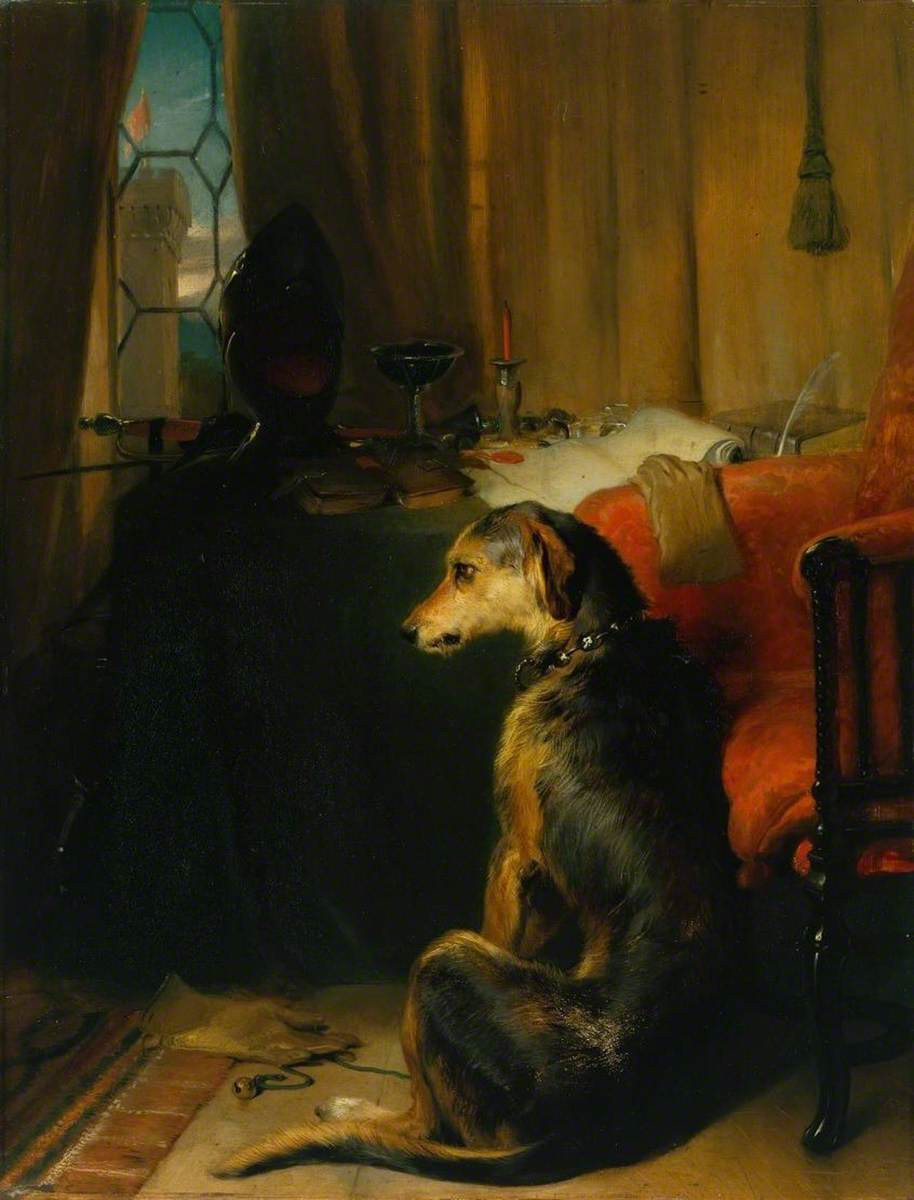
A deerhound sits between an upholstered chair and a table crowded with the possessions of someone who never appears. Its head turns towards a tall window on the left. Beyond the glass, a castellated tower rises into a strip of sky. Inside, armour, weapons, hawking equipment, books and writing materials summon a human world of ancestry and privilege. Edwin Landseer called the picture High Life, but nothing in the dog's body can possess a social class by itself. The room has to teach viewers how to read it.[1]
Landseer painted the panel in 1829 and exhibited it in 1831. Tate holds it as A00703. It is oil paint on mahogany and measures only 45.7 by 34.9 centimetres. Robert Vernon presented it to the nation in 1847.[1] These facts identify a compact, portable object rather than a life-size canine portrait or the faithful record of a named great house.
The picture was conceived with Low Life, in which a scarred dog called Jack sits at a butcher's threshold. Both owners are absent. Each animal acquires a social identity from posture, place and belongings. Tate relates the pairing to older schemes of good and evil or virtue and vice, yet describes Landseer's result as a difference of character more than a moral judgement.[1][2]
That distinction is essential. The deerhound's long profile, ornamental collar and calm seat can look refined, while the armour and red chair make refinement seem to surround it naturally. Yet the dog did not inherit the room, read the books or select the weapons. Human viewers coordinate animal and objects, then call the fit aristocratic. High Life is compelling because it makes that act of social classification both persuasive and visible.
At a Glance
This work across Edwin Landseer’s career
The Cat's Paw
c. 1824 [4]The Hunting of Chevy Chase
1825–26 [5]High Life (current article)
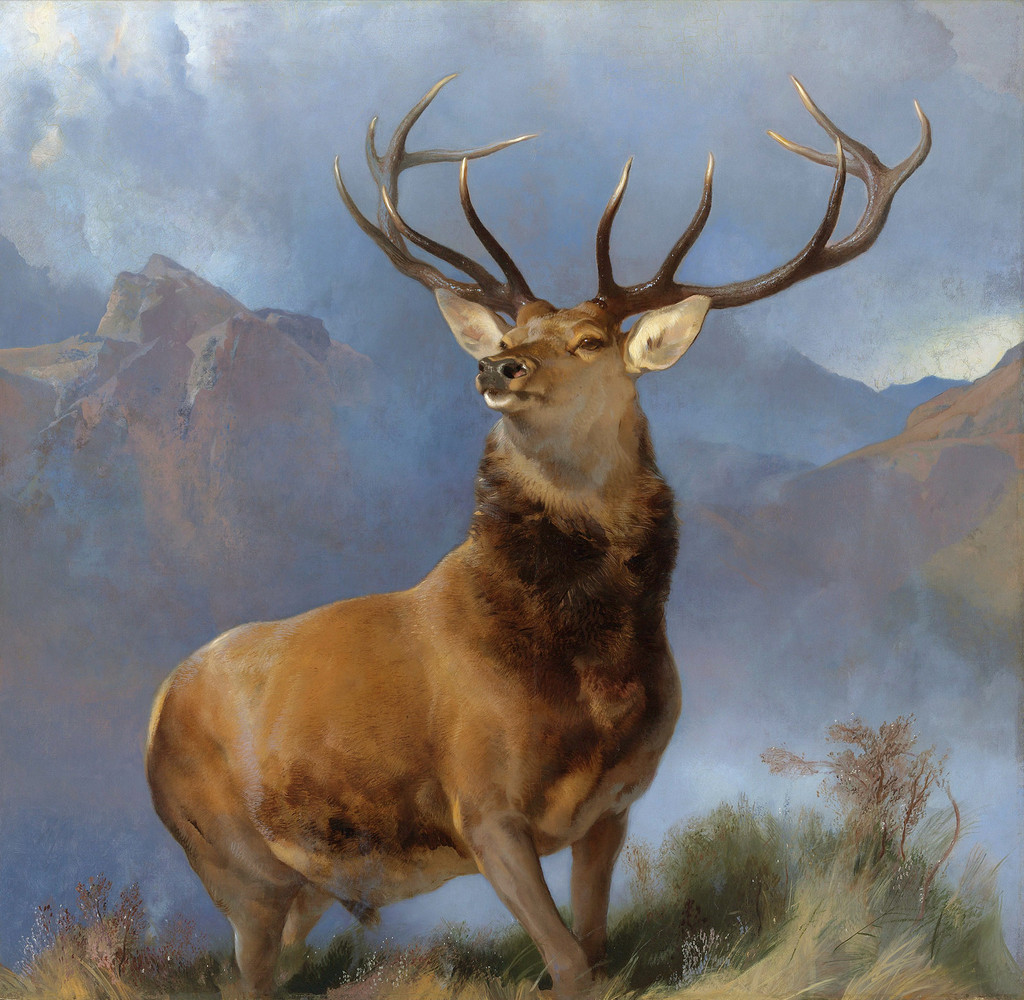
1829 / exhibited 1831 [6]The Monarch of the Glen
about 1851 [10]Contents
- What Tate's record establishes
- The deerhound in profile
- Chair, table and window
- A master assembled from possessions
- A Walter Scott atmosphere without Abbotsford
- Maida and the younger deerhound
- What Low Life changes—and does not
- The British Institution audience
- Burns and canine class comparison
- The room travels into print
What Tate's record establishes
Tate dates High Life “1829, exhibited 1831”. The comma separates two events. Landseer made the oil in the first year; the public pairing and surviving press responses belong to the second. Describing it only as an 1831 picture would erase its production date, while giving 1829 alone would detach the panel from the exhibition at which its social argument became public.[1][13][14]
The accession number A00703 keeps this physical painting distinct from its companion, from later prints and from other deerhound studies by Landseer. The support is mahogany, not canvas. That knowledge does not reveal how the wood was prepared, which pigments were used or how the paint layers were built. A digital photograph can support close looking, but it is not a technical examination.
Scale is more revealing. A panel less than half a metre high contains a dog, substantial furniture, a window view and an unusually dense collection of things. Landseer did not need a procession of human figures to represent wealth and rank. He concentrated the social work into a room small enough for the viewer to take in as a single designed field.
The current credit reads “Presented by Robert Vernon 1847”. The exact verb matters because the transfer happened during Vernon's lifetime. Tate is the present holder, but any temporary room or display status can change and adds little to the object's lasting history.[1]
The deerhound in profile
The dog occupies the lower centre and right of the panel. Its torso rises almost upright, while the hindquarters fold into a seated curve and the long tail rests along the boards towards the left. A foreleg catches warmer light; the flank recedes into grey-brown shadow. The head projects in profile from the darker body, its narrow muzzle pointing towards the window.[1]
That head turn animates an otherwise settled pose. The dog does not face the viewer and does not return our gaze. It attends to a space outside the painted field, but the image gives no sound or event to explain the attention. Someone may be approaching, a noise may have occurred or the animal may simply be looking towards the light. None can be promoted from possibility to fact.
Dropped ears and rough, varied fur prevent the profile from becoming a polished geometric sign. Warm tan and cream gather around the muzzle, eye, throat and chest, while darker hair carries the body into the room's shadow. The animal looks observed as an individual even while its setting recruits it as a social type.
An elaborate metal collar makes that double role tangible. Repeated pale links or ornaments stand out against the neck. They confirm possession and refinement without supplying a readable coat of arms. No current record identifies the devices, so they cannot name a family or turn the deerhound into a documented heraldic animal.
The collar also complicates the impression of command. The dog may seem to preside over the room, but it is itself owned. It can represent an absent master precisely because human authority has already been fastened around its neck. Elegance and subjection coexist in the same bright chain.
Chair, table and window
The warm red-orange chair rises behind the deerhound, its dark wooden arm and leg framing the animal's right side. The dog sits beside it rather than on it. That distinction preserves canine scale and bodily contact with the floor, even as the upholstery lends warmth, comfort and colour to the figure.
Across the left side, a table covered in a very dark cloth forms a second mass. Its shadow nearly merges with the dog's flank. Above that darkness, metal, paper and the narrow red taper catch small areas of light. The composition therefore has two kinds of centre: a living body below and an accumulation of human possessions above.
Window and dog point in the same direction. The muzzle extends left; the leaded panes climb upwards; the tower beyond supplies a distant vertical answer. A small coloured pane breaks the grey-blue opening. The view is narrow enough to feel selected, like another object in the owner's collection rather than an expansive landscape.
At upper right, a tasselled bellpull hangs against the wall. Its ordinary function implies a household in which assistance can be summoned, although no servant appears. At lower left, a patterned strip of textile borders the bare boards. The room joins comfort and service with floor-level contact: chair, cloth and bellpull belong to human convenience, while the deerhound's tail remains stretched across the wood.
Light does not flood the interior. It picks out the dog's face, the document and a few reflective objects while allowing table, armour and flank to join in a subdued brown-black field. The social world is displayed, but not with the clarity of a catalogue. Viewers have to search it, letting individual things gradually assemble an owner.
A master assembled from possessions
Tate identifies hawking gloves, two rapiers, a sixteenth-century-style helmet and breastplate, a standing cup, old leather-bound books, a partly unrolled document, a quill, a candlestick made from an eagle's talon and the bellpull. Together they give the impression that the unseen master is a knight.[1] “Impression” is the safe word. No biography, name or commission turns that imagined figure into a documented person.
The objects divide into overlapping forms of privilege. Hawking gloves evoke a field sport that requires land, training and specialised equipment. Rapiers and armour project martial identity. The qualifier “style” matters for the helmet and breastplate: the picture borrows the appearance of the sixteenth century without authenticating the painted objects as antiquities of a known date.
Books, document and quill establish another kind of authority. They suggest reading, writing and possession of records, but their content cannot be recovered from the image. The pages do not prove scholarship, a legal title or a particular family history. Their power is more general. They make literacy and written memory part of the social environment.
Cup and candlestick turn use into display. The cup stands high against the dim field, and the candle's red shaft provides one of the sharpest colour accents in the room. Tate's description of an eagle's talon gives the candlestick a trophy-like strangeness. It joins hunting and collecting without requiring the bird itself to be present.
The open paper and candle encourage a miniature fiction: perhaps work has been interrupted and the master will return. The panel never confirms that sequence. What it shows is readiness—the chair available, the writing exposed, the bell within reach, the dog attentive. Human absence feels temporary because the things remain arranged for human use.
This arrangement produces rank through accumulation. No single rapier, book or glove is enough. Their agreement matters. Sport, warfare, literacy, comfort, command and an ancestral-looking view all converge on the dog. The deerhound becomes the only living witness to a life that the room claims has just moved beyond our sight.
It is tempting to say the animal guards these possessions. The pose supports watchfulness, yet the deeper relation is less simple. Collar makes the dog one possession among the rest; alertness makes it the only possession able to respond. The panel grants delegated authority to a creature whose own freedom remains bounded.
A Walter Scott atmosphere without Abbotsford
Tate compares the interior to a scene from a Walter Scott novel.[1] The phrase describes atmosphere, not address. Armour, leather-bound books, tower and hawking gear create a historical world familiar from Romantic fiction, in which the past can be entered through accumulated relics and signs.
The room is imaginary. It should not be presented as a measured view of Abbotsford, Scott's house in the Scottish Borders, or as evidence for how an identified aristocrat furnished a real residence. Even the tower beyond the window participates in the invention. It completes the fiction of an old fortified world without locating it on a map.
This distinction makes the painting more, rather than less, revealing. A documentary room would tell us how one place looked. Landseer's invented interior shows how readily a social past could be fabricated from recognisable components. History appears here as a style of ownership: weapons that imply ancestors, records that imply continuity and a dog whose body seems fitted to both.
The arrangement also moves between periods. The armchair, bellpull and interrupted-looking desk belong to a habitable present. Armour and tower turn that present backwards. The owner can therefore seem contemporary and ancestral at once. He does not have to appear because the room performs his pedigree for him.
An 1831 reviewer would translate this Scott-like fiction into very current terms. Instead of treating the master only as a medieval knight, the writer imagined fashionable London and a cavalry officer. The old-looking room was flexible enough to communicate present privilege.[14]
Maida and the younger deerhound
The High-side dog was once identified as Maida, Sir Walter Scott's celebrated deerhound. Tate no longer accepts that identification without qualification. Its current account says the pose and colouring are closer to Landseer's own deerhound, seen beside Maida in A Scene at Abbotsford, exhibited in 1827 and now Tate N01532.[1][15]
The earlier painting is a useful control because it really is an Abbotsford subject. Landseer had visited Scott's home from 1824. In N01532, sporting trophies and antiquarian objects surround two dogs. Tate's caption identifies the ageing Maida as the animal lying down with a younger companion. The work was shown at the British Institution in 1827, where the Duke of Bedford bought it.[15]
In the image, a large black-and-white dog stretches across the foreground with its head resting low. Behind it sits or stands a lighter, rough-coated animal, tan and cream in colour, wearing an ornamental collar. Read with Tate's caption, the reclining dog is Maida. Read with Tate's High Life account, the upright younger companion is Landseer's own deerhound.[1][15]
That comparison corrects more than a name. The A00703 dog is not the black-and-white, recumbent Maida of the Abbotsford picture. Its upright pose, warmer colouring and collar relate more closely to the animal behind him. At the same time, “closer” does not mean identical in every feature or documented through an unbroken chain of sittings.
The younger deerhound's name is not supplied by either current record. Nor does A00703 establish the model's sex, age, breeder or pedigree. The strongest conclusion is therefore deliberately limited: Tate associates High Life with Landseer's own deerhound rather than Scott's Maida. Any more specific biography would fill a catalogue silence with folklore.
The old mistake remains instructive. Landseer created an imaginary Scott-like setting around a deerhound already connected in his work with Abbotsford. Atmosphere and model encouraged viewers to collapse fiction into location. Separating them restores the painting's design: the room invokes Scott's world, but it is built to express a class category, not to record his house or dog.
What Low Life changes—and does not
The companion panels are almost the same size. Both are 45.7 centimetres high and painted on mahogany; Low Life is 35.2 centimetres wide, only three millimetres broader than High Life.[1][2] Their near-match makes comparison a physical invitation, not merely a similarity noticed after the fact.
In A00702, Jack sits where a butcher's dark workplace opens onto the street. In A00703, the deerhound is enclosed by upholstery, paper, armour and a narrow window. One dog controls a threshold exposed to public passage; the other occupies a private room whose historical staging protects it from the everyday present.[2]
The object vocabularies differ as strongly as the architecture. Butcher's block, tankard, pipe and boots speak of trade, bodily use and pause from labour. Hawking glove, rapier, book and standing cup speak of sport, martial display, literacy and collection. Because no owner appears in either panel, each dog has to make those belongings seem like character.
Yet the deerhound is not simply “better”. Jack's grounded alertness can look more direct than the High-side animal's composed reserve. The elaborate room may impress, but it is openly theatrical. Tate's preference for character over morality prevents material advantage from becoming ethical merit.[1][2]
Both animals are collared. The detail cuts across the hierarchy: whatever social freedom they represent for absent men, both remain subject to human ownership. The pair makes rank appear in canine form, then leaves enough evidence of its construction for viewers to question the apparent naturalness.
High Life also survives separation from its pendant. The deerhound's turn towards the window, the ready chair and the interrupted-looking table create a complete relation between animal and absent person. Low Life exposes the larger system, but A00703 does not become an incomplete fragment when viewed alone.
The British Institution audience
The pair was first exhibited at the British Institution in 1831. The venue is sometimes confused with the Royal Academy, perhaps because Landseer became a full Royal Academician that year. Contemporary notices are unambiguous about the Institution.[1][13][14]
On 5 February, The Athenaeum praised Landseer's close observation and power of character in another dog picture, then extended that approval to High Life and Low Life. It called the animals dogs of different “orders”.[13] The word slips between canine classification and social rank, capturing the pictures' central trick: a human hierarchy becomes legible as a difference between animal bodies.
The notice was not indiscriminate enthusiasm. Elsewhere the writer criticised the exhibition's hanging and what was regarded as limited imaginative ambition. Landseer's pair earned a specific commendation within a more sceptical survey. That context prevents one sentence from becoming a claim of universal acclaim.
A longer notice in The Literary Gazette appeared on 12 February. Under catalogue no. 248, the writer placed Low Life before High Life and credited E. Landseer, A.R.A. The pictures were compared with Burns's The Twa Dogs and described through democracy and aristocracy. For the High side, the critic saw a dog of the chase, admired the turn of its head and found in the face the “nonchalance of Grosvenor Square”.[14]
The phrase relocates the dog's social meaning into fashionable London. The writer also read sword, belt and cuirass through a Life Guards officer—a butcher of another, military kind—and described the surrounding decoration as suited to a fashionable drawing room. The room's historical props therefore communicated contemporary privilege as readily as medieval romance.[14]
Effect, colour and execution were praised. More important for interpretation, the review shows that early viewers did not simply recognise expensive objects. They coordinated expression, breed function, military analogy and address. “High” life emerged from the way all those signs agreed.
That language is evidence about reception, not a factual key to the model. The deerhound did not live in Grosvenor Square because a critic invoked it, and no Life Guards officer becomes the owner. The review records the speed and confidence with which social assumptions attached themselves to Landseer's animal.
Burns and canine class comparison
In Robert Burns's The Twa Dogs, Caesar belongs to a gentleman's household and Luath to a ploughman. Their conversation moves across tenants' hardships, labour, hunger, the ease of landowners and the pleasures people find despite unequal conditions. The animals can compare their masters' worlds because they meet as fellow dogs.[16]
The Literary Gazette used that poem to help readers understand Landseer's pair.[14] The analogy is illuminating but not exact. Burns gives Caesar and Luath speech, allowing them to examine human society. Landseer removes both human owners and canine dialogue. Setting, posture and possessions have to do the argumentative work.
Canine fellowship in the poem also guards against a crude reading. Caesar is not simply a villain and Luath is not only a victim. Their ability to converse creates a shared animal perspective from which human inequality looks strange. Landseer's dogs do not meet inside either panel, but the pendant format asks viewers to create an equivalent encounter.
No evidence used here shows that Landseer set out to illustrate Burns. The comparison belongs to a critic writing after the pictures entered public view. It tells us which literary structure one contemporary found useful, not which poem lay open in Landseer's studio.
The same limit applies to political words. “Democracy” and “aristocracy” reveal the period's willingness to make the dogs socially representative. They do not turn the deerhound into a party emblem. Its supposed rank remains a human interpretation generated by room, title and comparison.
The room travels into print
The exhibited design entered reproduction quickly. The Metropolitan Museum of Art catalogues Richard James Lane's High Life as a lithograph on chine collé dated August 1834. Lane was the lithographer, Graf and Soret the printers and Ackermann & Co. the publisher. The chine measures 45.7 by 34 centimetres; the full paper sheet is 68 by 50.5 centimetres.[17]
Those facts introduce several hands between Landseer's oil and a later viewer. Painted colour and mahogany surface had to become a lithographic image on mounted paper. The Met's current record offers no downloadable image, so exact changes of tone, direction, inscription or cropping should not be invented. What it securely establishes is that the deerhound and complete chivalric room were translated for print only three years after exhibition.
Christopher C. Hollyer's High Life, dated 17 October 1873, demonstrates renewed reproduction much later. Its medium is mixed-method engraving printed on chine collé; the Met names Henry Graves & Co. and William Schaus as publishers in London and Washington, DC. The plate measures 59 by 45 centimetres, and the whole sheet 67.5 by 57.4 centimetres—substantially larger than the painted support.[18]
Size and publishing places do not tell us how many impressions were sold or who owned them. They do show the small British panel serving as the source for a large paper object with publishers named in two capitals. The imaginary room could acquire a material life far beyond the original mahogany without becoming the same physical thing.
By 1911, the dog could travel without most of that room. The Met's Head of a Deerhound, after Landseer by S. W. Hall is a pastel-and-graphite drawing that repeats the profile and linked ornamental collar of High Life. The museum considers an engraved reproduction a likely intermediary, because a print would have been more accessible than the painting.[19]
This later extraction changes what carries identity. Lane and Hollyer preserved an environment in which class was built from numerous objects. Hall's study reduced the connection to head, pose and collar. The deerhound became recognisable enough to detach from armour, books, chair and tower, even though those things had originally taught viewers how to read it.
The sequence is representative rather than complete: oil in 1829, lithograph in 1834, mixed engraving in 1873, head study in 1911. It establishes persistence and transformation, not edition totals, prices or a measurable audience.
Robert Vernon's lifetime gift
Tate says Vernon later acquired High Life with Low Life.[1] “Later” preserves a genuine gap. The current record does not name an original commissioner or first purchaser, state when Vernon obtained the panels or record a price. A smooth ownership story before 1847 would therefore be invented.
The transfer to public ownership is much firmer. The National Gallery archive catalogues an instrument dated 22 December 1847 as Vernon's deed of gift to the institution. An 11 December letter had already thanked him for the pictures he was giving. He lived until 1849.[20]
The transaction was consequently a presentation made during his life, not a bequest activated by death. Tate's credit line gets that distinction right. It also places the pair within a much larger gift of British painting rather than treating them as isolated donations.
Space shaped what happened next. The National Gallery explains that the Vernon collection was shown first at Vernon's house and later at Marlborough House because its own rooms were overcrowded. It then moved with British works associated with Turner to South Kensington and returned to Trafalgar Square after the Gallery's 1876 enlargement.[20]
The separate display of British pictures established a precedent. The Millbank gallery opened in 1897 under the formal name National Gallery of British Art, receiving most British works from the national collection. It became known as the Tate Gallery and was later established independently as Tate.[20]
That is collection history, not an item-by-item travel diary. It cannot locate A00703 in a particular room on every date. Its secure chronology runs from production in 1829 and public debut in 1831 through Vernon's later ownership and lifetime presentation of 1847 to present Tate custody.
There is an apt reversal in that route. Landseer represented privilege through an imaginary private interior packed with exclusive possessions. Vernon's gift placed the panel within a public institution, where the room itself became an object to be looked at, catalogued and compared.
How to look at High Life now
Begin with the dog's outline before reading the title. Follow the tail across the floor, the folded hindquarters, the upright chest and the muzzle pointing left. Notice how much of the pose is settled and how little is frontal. The deerhound offers attention without offering itself directly to the viewer.
Then examine the collar. Its shining links distinguish the animal, but their devices resist identification. This is a useful limit. Ownership is plainly visible; owner identity is not. The painting gives status a material sign while withholding the name that would make the sign biographical.
Move next to the table in groups rather than trying to inventory everything at once. Sport appears through the hawking gloves; martial display through armour and rapiers; literacy through books, document and quill; comfort and service through chair, candle and bellpull. Ask what each group contributes and how little any single object could prove alone.
Finally look through the window. The tower seems to verify the chivalric room, yet Tate's account identifies the whole setting as imaginary. The view does not confirm the fiction; it is another part of it. Landseer extends social staging into the landscape so that rank appears to occupy an entire world.
The deerhound remains the point at which these meanings meet. Period critics saw grace, fashionable unconcern and the character of a dog bred for the chase. Later catalogues connected the model with Landseer's own deerhound rather than Maida. Prints carried the complete setting, while a later artist could retain only head and collar.
None of those readings cancels the animal. Rough fur, dropped ear, long muzzle and folded body stay particular. The dog is not merely a knight in disguise. It is a living creature made to bear a human category through the objects placed around it.
That is the productive uncertainty inside High Life. The painting makes aristocratic character seem coherent, then shows exactly how the coherence has been manufactured. Chair, armour, paper, bell and tower agree so completely that the deerhound appears born to them. The collar gives the game away: what looks like nature is also ownership, arrangement and interpretation.
Artworks directory
This directory gathers works discussed in the articles, including drawings, original etchings and prints after Landseer. It is not a complete catalogue of every drawing, version, plate or impression. Distinct media are kept separate; uncertain dates are left blank. Linked titles open individual articles.
| Name | Date | Medium |
|---|---|---|
| A Bellowing Stag | Drawing | |
| A Deerhound | 1826 | Painting |
| A Distinguished Member of the Humane Society | 1838 | Painting |
| A Highland Breakfast | 1834 | Painting |
| A Highland Landscape | c. 1830 | Painting |
| A Highland Shepherd's Home | Painting | |
| A Horse, Goat and Bull | 1811 | |
| A Hunting Horse | Drawing | |
| A Jack in Office | Painting | |
| A Lion Disturbed at His Repast | Painting | |
| A Random Shot | Painting | |
| A Scene at Abbotsford | Painting | |
| Adversity | Painting | |
| Alexander and Diogenes | exhibited 1848 | Painting |
| Alpine Mastiffs Reanimating a Distressed Traveler | 1820 | Painting |
| Contending Group after Nature | Drawing | |
| Copy after Rubens's Wolf and Fox Hunt | c. 1824–26 | Painting |
| Dash | Painting | |
| Deer and Deer Hounds in a Mountain Torrent ('The Hunted Stag') | c. 1832 / exhibited 1833 | Painting |
| Deer Family | ||
| Dignity and Impudence | 1839 | Painting |
| Dog Resting Upon a Couch | Drawing | |
| Eos | 1841 | Painting |
| Favourites, the Property of H.R.H. Prince George of Cambridge | 1834–35 | Painting |
| Her Majesty Sketching at Loch Laggan | ||
| High Life | 1829 / exhibited 1831 | Painting |
| Highland Lassie | Drawing | |
| Isaac van Amburgh and his Animals | 1839 | Painting |
| Lady Godiva's Prayer | Painting | |
| Laying Down the Law | 1840 | Painting |
| Lion Defending Its Prey | c. 1840 | Painting |
| Lioness | Drawing | |
| Little Strollers | ||
| Low Life | 1829 / exhibited 1831 | Painting |
| Man Proposes, God Disposes | 1864 | Painting |
| Nell Gwynne / Diana Vernon | Painting | |
| Neptune | ||
| No Hunting Till the Weather Breaks | Painting | |
| Otterhounds | Drawing | |
| Peace | Painting | |
| Pensioners | Painting | |
| Portrait of a Mule | Painting | |
| Portrait of Mr Van Amburgh, as He Appeared with His Animals at the London Theatres | 1846–47 | Painting |
| Portraits of a Pointer Bitch and Puppy | Painting | |
| Pray Let Me Out | ||
| Prosperity | Painting | |
| Ptarmigan in a Landscape | by 1833 | Painting |
| Queen Victoria and Prince Albert at the Bal Costumé of 12 May 1842 | 1842–46 | Painting |
| Queen Victoria at Loch Laggan | Painting | |
| Queen Victoria at Osborne | 1865–67 | Painting |
| Queen Victoria landing at Loch Muick | Painting | |
| Rat-catching | 1823 | |
| Reclining Lion | Drawing | |
| Reclining Lion, From Back | Drawing | |
| Rent-day in the Wilderness | 1855–68 | Painting |
| Return from Deer Stalking | 1839 | |
| Royal Sports on Hill and Loch | Painting | |
| Sam Lovill, Porter at the Royal Academy | Drawing | |
| Scene from A Midsummer Night's Dream | 1848–51 | Painting |
| Scene in the Highlands, with portraits of the Duchess of Bedford, the Duke of Gordon and Lord Alexander Russell | Painting | |
| Scottish Highlands, Lochs and Figures | Drawing | |
| Shoeing | exhibited 1844 | Painting |
| Sleeping Bloodhound | exhibited 1835 | Painting |
| Spaniel and Rabbit | Painting | |
| Stag at Bay | 1866 | Sculpture |
| Stag at Bay | 1846 | Painting |
| Studies of a staghound and the head of a stag for painting ‘The Hunting of Chevy Chase’ | Drawing | |
| Study for Alpine Mastiffs Reanimating a Distressed Traveler | Drawing | |
| Study for the Monkey in The Cat's Paw | Drawing | |
| Study of a Dog | Drawing | |
| Study of a herding dog facing right | Drawing | |
| Study of the horse of Selene, from the East pediment of the Parthenon | Drawing | |
| Suspense | Painting | |
| Taking a Buck | ||
| The Arab Tent | c. 1865–66 | Painting |
| The Barn | Drawing | |
| The Best Run of the Season | ||
| The Cat's Paw | c. 1824 | Painting |
| The Cavalier’s Pets | ||
| The Challenge | Painting | |
| The Chase | Drawing | |
| The Connoisseurs: Portrait of the Artist with Two Dogs | 1865 | Painting |
| The Death of a Stag in Glen Tilt | Painting | |
| The Drive—Shooting Deer in the Pass | Painting | |
| The Drover's Departure | Painting | |
| The Highland Shepherd’s Dog | 1824; portfolio issue 1848 | |
| The Honourable Mrs Norton | Painting | |
| The Hunting of Chevy Chase | 1825–26 | Painting |
| The Illicit Highland Whisky Still | Painting | |
| The Keeper John Crerar with his Pony | Painting | |
| The Larder Invaded | ||
| The Lion-Dog of Malta | ||
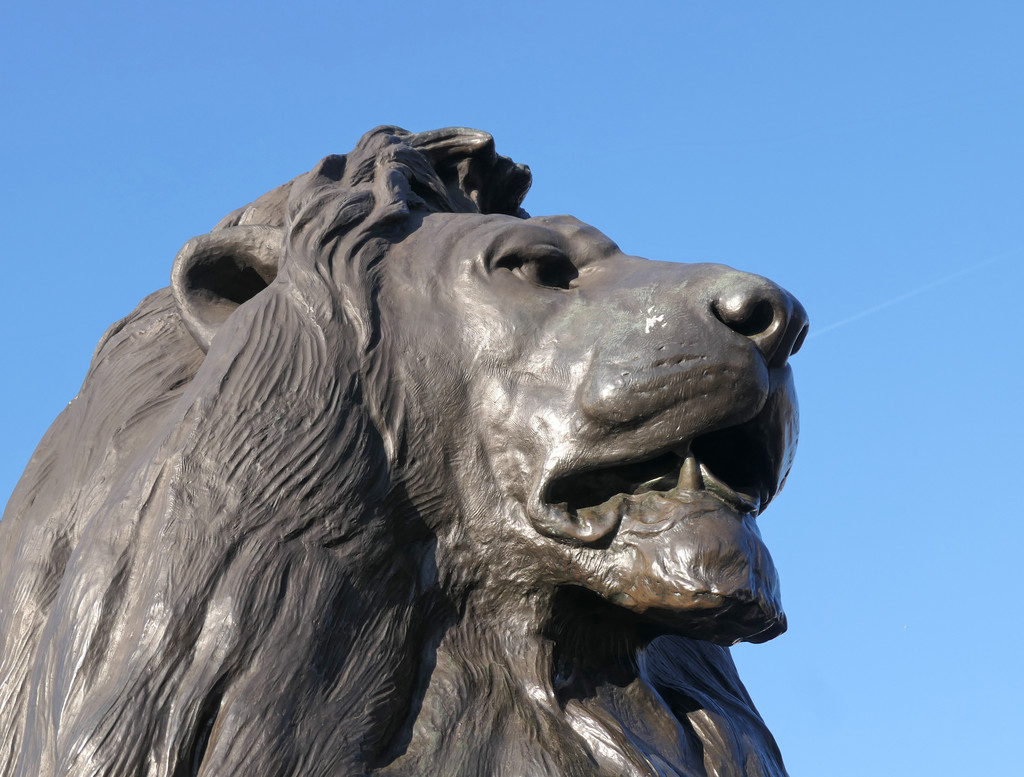
| The Lions at the Base of Nelson's Column | 1867 | Sculpture |
| The Monarch of the Glen | about 1851 | Painting |
| The Mountain Torrent | ||
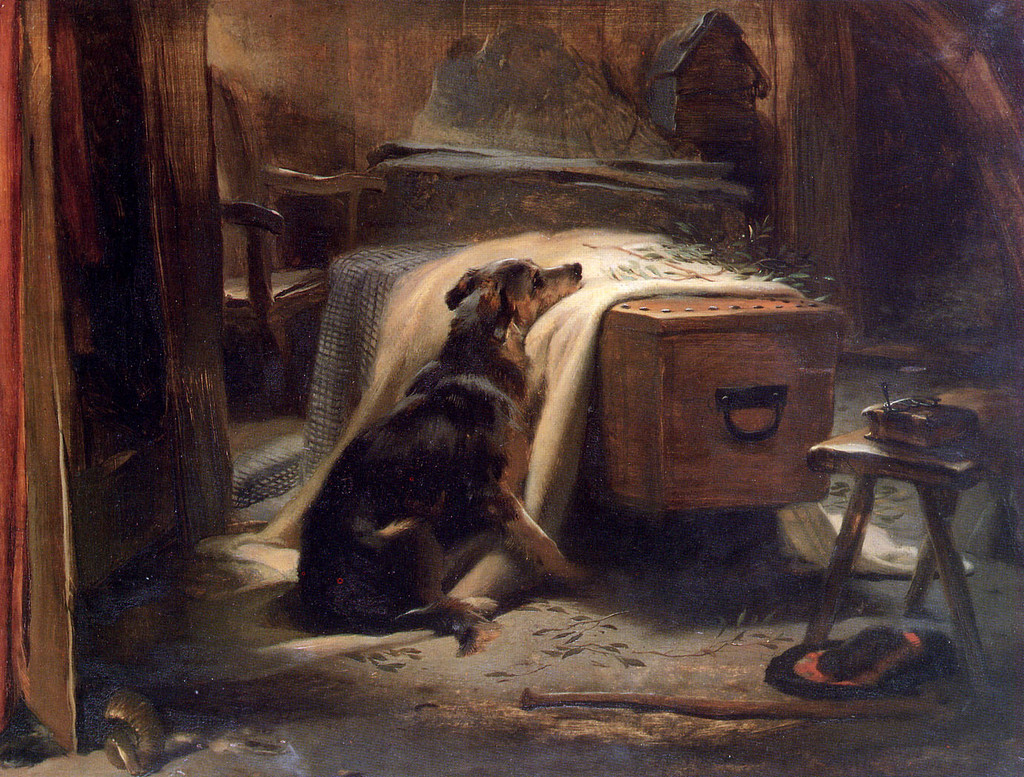
| The Old Shepherd's Chief Mourner | 1837 | Painting |
| The Sanctuary | 1842 | Painting |
| The Stricken Deer | Painting | |
| The Twa Dogs | Painting | |
| Time of Peace | ||
| Two stags running | Drawing | |
| Victoria, Princess Royal, with Eos | Painting | |
| View of Glenfeshie | Painting | |
| War | Painting | |
| White Horse in a Stable | Painting | |
| Windsor Castle in Modern Times | 1841–43 | Painting |
| Woburn Abbey Game Card | 1825; portfolio issue 1848 |
Discussion
Use the article’s images and evidence to develop your own reading of High Life.
Reader Insights
Which detail is most revealing when you consider “What Tate's record establishes”?
How does the evidence in “The deerhound in profile” affect your reading of High Life?
What further question would you bring to “How to look at High Life now”?
Join the Conversation
Share a detail, comparison or question about High Life below.
References
- Tate, Edwin Landseer, High Life, 1829, exhibited 1831, A00703, current object record, API data and principal digital image: and and View source 1. View source 2. View source 3.
- Tate, Edwin Landseer, Low Life, 1829, exhibited 1831, A00702, current companion-object record and API data: and View source 1. View source 2.
- National Gallery of Art, Alpine Mastiffs Reanimating a Distressed Traveler. View source.
- Minneapolis Institute of Art, The Cat's Paw. View source.
- Birmingham Museums Trust, The Hunting of Chevy Chase. View source.
- Tate, High Life. View source.
- Victoria and Albert Museum, The Old Shepherd's Chief Mourner. View source.
- Tate, Dignity and Impudence. View source.
- Royal Collection, Eos. View source.
- National Galleries of Scotland, The Monarch of the Glen. View source.
- Royal Holloway, University of London, Man Proposes, God Disposes. View source.
- Trafalgar Square / Greater London Authority, The Lions at the Base of Nelson's Column. View source.
- The Athenaeum, no. 171, 5 February 1831, p. 92, review of the British Institution: View source.
- The Literary Gazette, no. 734, 12 February 1831, p. 106, “British Institution—Third Notice”: View source.
- Tate, Edwin Landseer, A Scene at Abbotsford, exhibited 1827, N01532, current object record, API data and digital image: and and View source 1. View source 2. View source 3.
- Robert Burns, The Twa Dogs. A Tale., authoritative text at the Scottish Poetry Library: View source.
- Metropolitan Museum of Art, Richard James Lane after Edwin Landseer, High Life, August 1834, lithograph on chine collé, 59.600.254: View source.
- Metropolitan Museum of Art, Christopher C. Hollyer after Edwin Landseer, High Life, 17 October 1873, mixed-method engraving on chine collé, 47.30.64: View source.
- Metropolitan Museum of Art, S. W. Hall after Edwin Landseer, Head of a Deerhound, after Landseer, 1911, 50.620.3: View source.
- National Gallery, London, Deed of Gift of Robert Vernon Esq of Pictures to the National Gallery, 22 December 1847, NG5/70/1; letter to Vernon, 11 December 1847, NG6/1/507; Robert Vernon person record; and collection history: and and and View source 1. View source 2. View source 3. View source 4.
- Splash image, High Life. Tate. Image source. Public domain.
- Navigation image, One of the bronze lions at Nelson’s Column: modelled by Edwin Landseer and cast by Carlo Marochetti. Photograph by Amanda Slater. CC BY-SA 2.0. Image source. CC BY-SA 2.0. Resized.