 by Tom Gurney
Tom Gurney BSc (Hons) is an art history expert with over 20 years experience
Email: tomgurney1@gmail.com / Phone: +44 7429 011000
What is A Highland Breakfast?
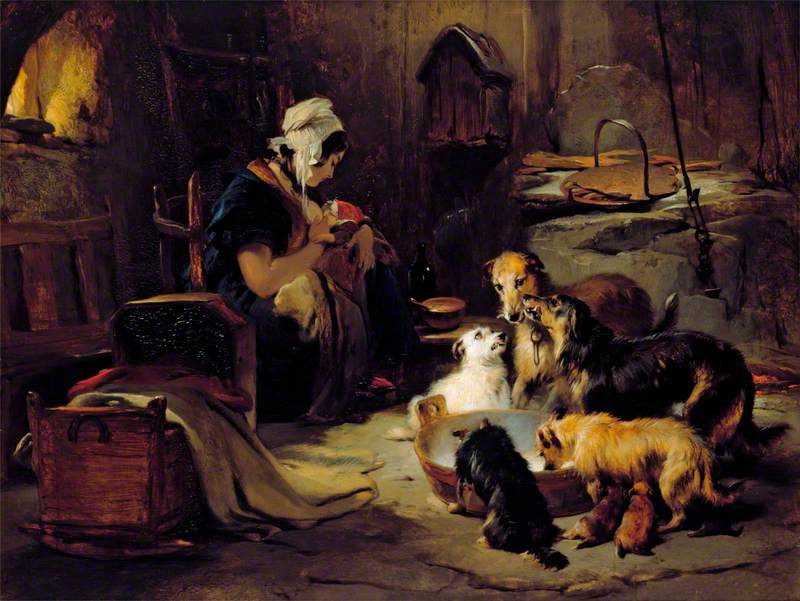
Sir Edwin Henry Landseer painted A Highland Breakfast in about 1834. It is an oil painting on panel in the Victoria and Albert Museum, accession FA.87[O]. The museum records the title as one assigned by the artist and gives the painting's estimated dimensions as 43.2 × 54 centimetres. John Sheepshanks presented it to the nation in 1857.[1]
The scene is contained within a dark cottage interior. At the left, a young woman sits in a wooden chair and breastfeeds a swaddled infant. At the right, five adult dogs crowd around a broad wooden tub, eating or drinking. One of those dogs also nurses two puppies below her. A hearth glows at the edge of the room; rough masonry, hanging cloth, vessels and cooking equipment enclose the figures. No landscape view is needed to make this a Highland subject. The title and the material language of the interior establish the setting.[1]
Landseer's arrangement joins two kinds of nourishment without making them identical. The woman gives milk directly to a child. The puppies feed from an adult dog. The remaining dogs press around a common container whose contents cannot be securely identified. Human tenderness, animal appetite and domestic provision occupy one field, but the painting offers no written key that reduces them to a single moral.
That uncertainty is central to looking well. The woman's name, the child's identity, the dogs' names and the cottage's location are not known. Painted coats cannot certify modern breeds, and a photograph cannot reveal the animals' thoughts. Yet the picture is not short of information. It makes bodies, food, care, heat, furniture and differing textures unusually close. The task is to follow those relationships without filling every gap with anecdote.
The picture entered public view early. It appeared as no. 96 at the Royal Academy in 1834, where a contemporary critic immediately noticed both the feeding dogs and the nursing mother.[2] John Outrim engraved the composition in 1840; it was shown in Paris in 1855 under the title Le Déjeuner; and Sheepshanks's gift placed it in a purpose-built public gallery in 1857.[3][4] Its history therefore moves from a compact painted interior to exhibition, print and museum, while the intimate action at its centre remains unresolved.
At a Glance
- ArtistEdwin Landseer [1]
- Date1834 [1]
- Collection or siteVictoria and Albert Museum [1]
- ObjectFA.87[O] [1]
This work across Edwin Landseer’s career
The Cat's Paw
c. 1824 [6]The Hunting of Chevy Chase
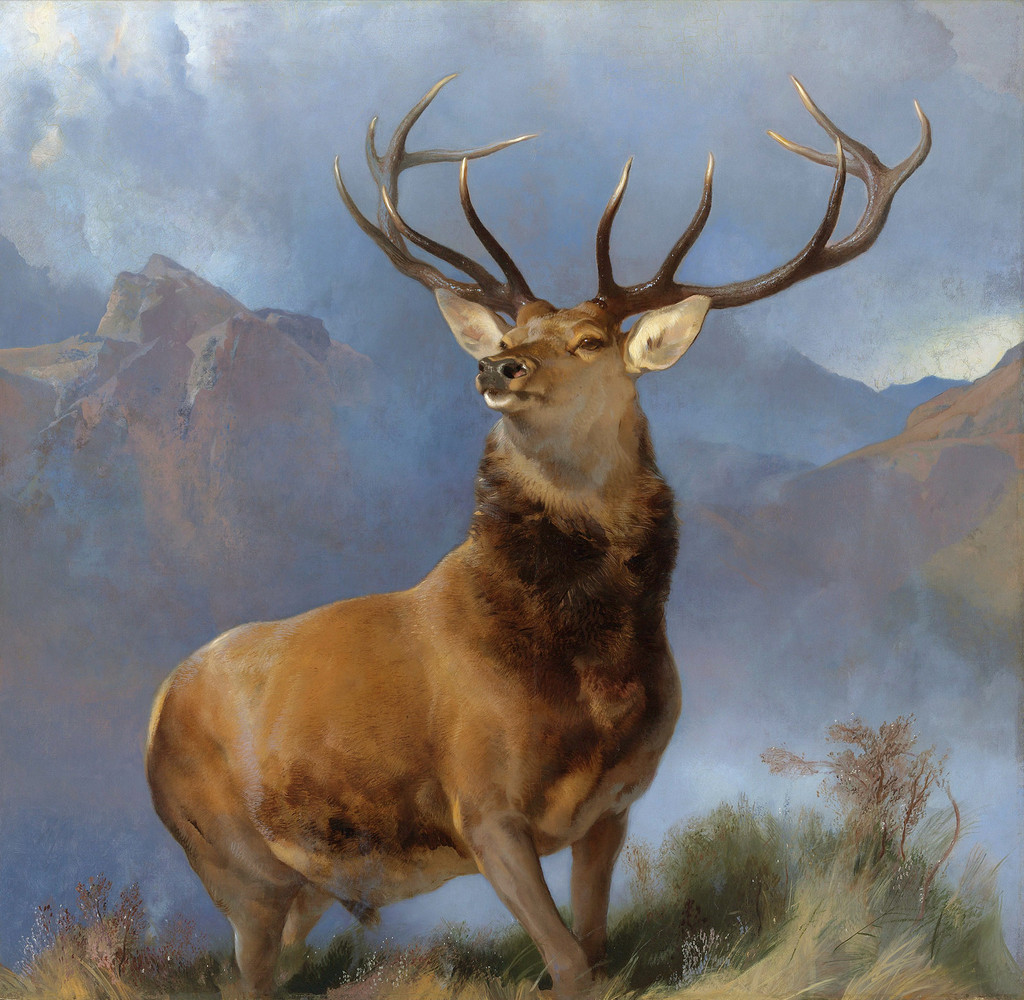
1825–26 [7]The Monarch of the Glen
about 1851 [12]Contents
- What is A Highland Breakfast?
- A panel with two recorded sizes
- A mother and infant at the left
- Five adult dogs and two puppies
- Two acts of nursing in one room
- The wooden tub and the limits of a meal
- A cottage built from things
- Light across a crowded interior
- Why call the setting Highland?
- No. 96 at the Royal Academy in 1834
A panel with two recorded sizes
The current V&A record describes A Highland Breakfast as oil on panel, not oil on canvas. That distinction matters because the support is part of the object's identity. “Oil painting” names the broad type; “oil on panel” specifies the surface on which the paint was laid. The catalogue does not identify the wood species or publish a construction analysis, so there is no basis for calling the panel oak, mahogany or any other particular timber.[1]
The museum's current figures are qualified as estimates: 43.2 centimetres high by 54 centimetres wide. An older catalogue of the National Gallery of British Art records the picture as “Panel, 20 by 26”.[15] Converted directly, that historical measurement is about 50.8 × 66 centimetres—substantially larger than the present estimate.
The discrepancy should remain visible rather than be smoothed away. The checked records do not say that the panel was cut down, that one measurement includes a frame, that a cataloguer transposed a figure or that the two institutions measured different boundaries. Any of those explanations would exceed the evidence. The safest account is also the most useful: the current V&A catalogue gives an estimated 43.2 × 54 centimetres, while an older museum catalogue records 20 × 26 inches.
Both sets of figures describe a relatively compact object. The scene's density does not depend on monumental scale. Landseer brings several bodies into a panel small enough for the viewer to register as an interior encounter, then differentiates the group through direction, colour and texture. Small changes—a pale muzzle among dark coats, a warm edge of cloth, the downward turn of the mother's face—carry more weight because the room is so closely packed.
A mother and infant at the left
The mother is seated in profile, her head inclined towards the child. A white bonnet or headcloth catches the light around her face, while her clothing is predominantly deep blue-black. A red-brown passage near the neck warms the meeting of pale skin and dark fabric. The infant is wrapped in light cloth and held close to her exposed breast. The V&A's description supplies the plain action: a young mother is breastfeeding her baby.[1]
Landseer does not turn the pair out towards the spectator. Their attention is inward. The woman's arms, the infant's body and the pale folds around them make a compact knot within the larger upright of the chair. This concentration differentiates their part of the room from the dogs' outward-spreading cluster. The human group is small, still and vertically organised; the animal group expands laterally around the tub.
A low wooden object stands in the lower-left foreground, partly covered by draped textile. It may be read as a cradle or box, but the image does not make its precise construction certain. Nor does it tell us that the infant has just been lifted from it. The object helps build a field of daily care without supplying a sequence of events.
The woman's anonymity is not a deficiency that should be repaired by invention. No checked source identifies her, the child or a specific family. Her clothes cannot establish an exact regional costume, and the furniture does not prove her household's wealth or poverty. She is specific in paint—pose, colour, touch and relation—but not in biography.
This distinction guards against two opposite errors. The pair should not be reduced to a generic emblem called “motherhood”, because the painted body and surrounding objects are particular. But neither should facial angle or clothing be made to yield a recoverable life. Landseer gives the viewer closeness without documentary identification.
Five adult dogs and two puppies
The V&A describes five dogs eating or drinking from a bowl, with puppies feeding from one of them. The Met's catalogue for Outrim's print specifies a mother dog nursing two pups.[1][3] The image confirms the count: five adult dogs and two puppies, seven canine bodies in all.
The adults can be separated by position without being forced into modern breed categories. A dark dog occupies the immediate foreground with its back towards the viewer, creating a broad silhouette at the base of the composition. A rough-coated tan dog stands at the right edge of the tub; beneath her, two small brown puppies nurse. A larger dark animal rises behind them at the upper right. Near the centre, a smaller pale dog reaches into the group, while another brown dog is partly screened by its companions.
Overlap makes the cluster lively and difficult to count at first glance. Heads converge around the container, backs cross one another, and the puppies are tucked below the adult mass. The arrangement rewards a slow inventory. It also prevents one animal from becoming the sole protagonist. Each coat or head is distinct enough to register, yet every dog depends compositionally on the crowd.
The foreground animal is particularly important. Seen largely from behind, it gives the viewer no expressive face to interpret. Its dark body places us almost within the ring around the tub. The pale central dog then acts as a small visual opening, while the tan nursing adult links the upper feeding group to the puppies below. Landseer organises attention through coat, direction and scale rather than through a chain of human-like facial expressions.
An anonymous Athenaeum reviewer in 1834 called the group “terriers and hounds”.[2] Decades later, Frederic G. Stephens described sheep dogs and terriers and distributed distinct personalities among them.[16] These descriptions belong to the history of response. They show how readily viewers turned Landseer's varied coats into types and characters. They do not provide a present-day pedigree record. For the painting itself, “dogs” is both accurate and appropriately precise.
Two acts of nursing in one room
The strongest relation in the picture is not a shared glance. The mother looks towards her infant, and most of the adult dogs concentrate on the tub. Connection arises through repeated action. At one side a woman nurses a baby; at the other an adult dog nurses puppies while other dogs feed nearby. Care and appetite take different forms but occur simultaneously.
Landseer makes the parallel easy to see without arranging it as a diagram. The mother and child occupy the left third, the dogs the right two-thirds. A strip of shadowed floor and the rim of the tub sit between them. Light touches both groups, while the enclosing brown interior prevents either from becoming a separate vignette. The viewer must move between species to understand the whole.
This structure permits an interpretation of gendered care, though it needs careful limits. The only nursing bodies shown are female: the young woman and the adult dog. Each supports dependent young within a wider domestic economy of food and heat. The picture can therefore make reproductive care visible as work, not merely as sentiment. What it cannot do is stand as a census of Highland households or prove a universal division of labour.
Nor does the pairing make human and animal relationships equivalent. The mother cradles one infant against her body. The puppies feed below an adult dog whose head and attention are caught within the larger canine group. The human pair is secluded by pose; the animal nursing is embedded within a collective meal. Similarity initiates comparison, while differences prevent the comparison from closing.
The Athenaeum review shows that this doubled structure was recognised almost immediately. Its writer placed the dogs' energetic feeding beside the “innocence” of the mother and child, praising “truth and nature” in the animal group.[2] Those are the critic's evaluative terms, not labels embedded in the paint. They demonstrate that a viewer in 1834 found the juxtaposition meaningful; they do not establish Landseer's one intended message.
The wooden tub and the limits of a meal
The large tub is the animal group's practical and compositional centre. Its curved wooden side spans the lower middle of the panel, partially hidden by the dogs but still broad enough to hold the cluster together. Heads descend towards it from several directions. The rim creates a shared boundary around which the animals' differing bodies can be arranged.
What lies inside is less certain. The V&A deliberately says that the dogs are “either eating or drinking”.[1] Stephens later imagined hot milk cooling as the dogs waited and assigned some of them impatience or restraint.[16] Other later accounts have proposed meal or porridge. None of those substances can be securely identified in the ordinary-light image.
The title A Highland Breakfast encourages the viewer to treat the tub as part of a morning meal, but a title is not a recipe. “Food”, “meal” or “contents” keeps the interpretation open; “hot milk”, “porridge”, “oatmeal” or “scraps” would turn later narrative into material fact. The difference is small in wording and large in method.
Uncertainty about the contents does not make the tub visually empty. Its size indicates provision for several animals. Its position draws bodies inward and contrasts with the direct, bodily feeding of infant and puppies. The human child and young dogs receive milk through nursing; the adult animals rely on a prepared communal container. Domestic nourishment appears as both intimate contact and distributed resource.
A cottage built from things
The room is made legible through objects rather than architectural description. At the far left, an open hearth or fire glows behind the mother's chair. The walls and large right-hand structure read as rough masonry or stone, though a painting cannot provide a building survey. Fabric or clothing hangs above the middle of the scene. The low tub, chair and cradle-like container bring wood into the foreground.
At the right, a heavy cooking platform supports a flat metal pan or girdle-like object with a long handle. A hook or chain hangs near the outer edge. Closer to the centre are a dark bottle and a smaller bowl or vessel. Landseer does not isolate these things as an inventory; some are partly obscured or absorbed into shadow. Together they establish a working interior in which heat, food, storage and care are materially connected.
Surface differences keep the brown room from becoming undifferentiated gloom. Masonry appears granular and weighty. Wood carries curved rims and straight structural edges. Metal catches smaller, sharper highlights. Cloth folds, fur breaks into rough or smooth passages, and the infant's wrapping provides a pale, soft concentration near the woman's hands. These are visible contrasts, not scientific identifications of material composition.
The room also refuses a neat division between background and subject. The hearth's warmth participates in the human group. The tub shapes the dogs. The cooking platform rises behind the puppies and adult dog. Hanging fabric interrupts the wall above. Domestic things are not stage dressing added after the figures; they make the relations among feeding, warmth and enclosure intelligible.
Even so, their exact functions should not be overnamed. The bottle's contents are unknown. The hanging object does not disclose a particular cooking technique. The lower-left box cannot securely recount the baby's previous position. Landseer's specificity is visual rather than documentary: enough is present to understand a lived-in interior, but not enough to reconstruct an address or routine.
Light across a crowded interior
Warm illumination enters the room from the left and gathers across the mother, child and nearer dogs. The hearth contributes a visible glow, but the painting does not prove that it is the only source. There is no sharply bounded ray passing through the woman's head. Instead, light changes by degrees across fabric, skin, fur, wood and stone.
The mother's white head covering and the infant's wrapping create the brightest human accents. Dark blue-black clothing then connects her to the shadowed interior, while the warm red-brown at her neck prevents the figure from becoming cold or remote. On the opposite side, pale coats and muzzles interrupt the denser mass of brown and black dogs. The tub catches enough light to remain structurally clear beneath them.
This distribution binds rather than separates. If the mother alone were illuminated, the scene might become a human vignette observed by animals. If only the dogs were bright, the nursing pair might recede into setting. Landseer lets light circulate unevenly through both sides, allowing the eye to compare actions before settling on individual coats or objects.
The V&A's 2,500 × 1,768 IIIF image makes such relationships easier to inspect.[17] It clarifies the puppies below the tan dog, the pale animal at the centre and small domestic objects in the half-light. Resolution, however, is not technical examination. The image does not establish pigments, panel species, ground, underdrawing, glazes, varnish, alterations, treatment history or condition. It improves close looking by showing where certainty ends as well as where detail begins.
Why call the setting Highland?
No mountain, loch or stag appears. Highland identity comes through the title, the V&A's description of an intimate Scottish setting and a nineteenth-century visual vocabulary of cottage life.[1] This makes the work unlike an exterior landscape that locates itself through topography. The room bears the burden of place.
That burden should not be confused with transparent social evidence. The picture does not name a glen, island, estate or settlement. It does not identify the inhabitants or prove that every object was copied from one dwelling. A metropolitan Royal Academy audience saw a carefully composed interior labelled A Highland Breakfast, not an independently verified ethnographic record.
Landseer's choice of an enclosed domestic space matters because it changes the terms on which the Highlands become visible. The setting is not panoramic or sublime. Attention falls on nursing, feeding, heat and material provision. Highland life is encountered at the scale of a chair, tub, hearth and crowded floor. The title extends those ordinary things into a regional subject.
There is a tension here. The intimate grouping can dignify care by bringing it close, yet it can also make hardship picturesque by offering the room to distant viewers as a self-contained scene. The panel does not resolve that tension. It shows few possessions and a rough interior, but it supplies no statement from the woman and no economic record. Any account of idealisation or deprivation must therefore remain an interpretation of what the representation includes and omits.
This page need not turn into a general history of Landseer in Scotland. The picture's own evidence is narrower and more unusual: a Highlands imagined through interspecies domestic life, where human and animal bodies share warmth and food but remain differently organised.
A Highland Breakfast was not Landseer's only cottage interior of the period. The Government Art Collection dates A Highland Shepherd's Home to about 1836 and describes it as one of several early- to mid-1830s scenes in which he painted domestic Highland life. Its record compares the two works and cautiously suggests that the same models may recur in related pictures.[18]
The word “may” is essential. A resemblance between painted figures can indicate studio continuity without recovering a name or proving that one actual family inhabited every room. Landseer could reuse models, poses and domestic motifs while altering the relation among them. Repetition is evidence of an artistic programme, not automatic evidence of documentary identity.
The comparison helps define what is distinctive here. A Highland Breakfast places the nursing mother beside a canine meal and a second act of nursing. Its energy comes from a densely compressed animal group rather than from a broad account of shepherding. Related interiors show that the cottage setting was reusable; this panel's exact interspecies structure remains its own.
No. 96 at the Royal Academy in 1834
The Royal Academy exhibition of 1834 opened on 5 May and closed on 19 July. The Royal Academy Chronicle records 556 exhibiting artists and 1,121 works.[19] A Highland Breakfast appeared as no. 96, a number secured by the contemporary Athenaeum review.[2]
The scale of the exhibition explains the competitive field in which visitors first encountered the picture, but it does not measure the picture's success. A total of 1,121 works says nothing by itself about hanging height, crowd behaviour, sale, prize or critical consensus. No checked source establishes those details for no. 96.
Numbering can also mislead because a later museum catalogue lists A Highland Breakfast as no. 87.[15] That is the National Gallery of British Art catalogue sequence, reflected in the numerical element of FA.87[O], not the Royal Academy entry. The two numbers belong to different institutional moments: 96 identifies the work in the 1834 exhibition; 87 identifies it within the later Sheepshanks collection and museum catalogue.
The Academy context connects this intimate panel with Landseer's larger public presence. The 1834 Chronicle gives particular attention to another work, Bolton Abbey. The Athenaeum also linked the two pictures, calling A Highland Breakfast by the same hand and almost equal in merit.[2] That comparison is page-specific evidence. Broader praise directed at Bolton Abbey cannot simply be transferred across the catalogue.
What The Athenaeum noticed
The Athenaeum review appeared on 10 May 1834, only days after the exhibition opened. On printed page 355, the anonymous critic moved quickly from the canine group to the young mother. The dogs were described through the memorable phrase “socially toiling with their teeth”; the maternal pair through “innocence”; the animals through “truth and nature”.[2]
The wording reveals a double response. First, the reviewer treated the dogs' crowded meal as comic social action. “Socially” gives their proximity a human register, while “toiling” turns appetite into work. Second, the writer did not allow the joke to displace the mother and child. The two sides were praised in different terms and then held together as equally striking.
This is valuable evidence because it shows the composition working on an early spectator. The reviewer noticed precisely the juxtaposition that still organises the panel: animals feeding as a group, a woman feeding an infant, and different ideas of nature attached to each. The passage does not prove that every visitor read the scene in the same way, but it gives a dated instance of how Landseer's arrangement could generate comparison.
The critic's nouns and adjectives also need boundaries. “Terriers and hounds” records period looking; it does not settle modern breeds. “Innocence” is an evaluation, not a verified mental state. “Truth and nature” praises representation, not canine anatomy assessed by scientific method. Even “socially” belongs to rhetorical personification rather than observed cooperative behaviour.
Keeping those limits does not weaken the review. It lets the historical voice remain recognisably historical. Instead of borrowing the critic's phrases as neutral captions, we can ask what work they performed in 1834: turning animal appetite into wit, maternal care into moral feeling and Landseer's close observation into a claim about natural truth.
John Outrim's 1840 engraving
By 1840 the composition had entered print. The Metropolitan Museum of Art catalogues The Highland Breakfast, dated 9 May 1840, as an etching and engraving on chine collé after Landseer. John Outrim is identified as engraver and Francis Graham Moon as publisher. The plate measures 43.5 × 51 centimetres; the complete sheet, 52.2 × 68 centimetres.[3]
Those measurements belong to the paper object, not the panel. The print is a translation of the painting into another medium, with its own scale, surface and history. Chine collé involves a thin paper adhered to a heavier support during printing, allowing the printed field to differ from the surrounding sheet. The Met's current record does not provide a primary image, so detailed claims about the appearance of this particular impression would be unsafe.
Graves's 1874 catalogue likewise lists Outrim's engraving under 1840.[4] Together the records establish a reproductive object without revealing its edition size, subscription terms, sales or full state history. It is reasonable to say that engraving enabled the composition to circulate beyond the painted panel; it is not reasonable to convert that possibility into an audience total.
The print history also sharpens a distinction already present in the painting. Colour is central to the oil's warm room, dark garments and varied coats. An engraved version must create separation through line and tone. That broad fact about translation can be recognised without pretending that the unillustrated Met record shows us exactly how every passage was converted.
Paris in 1855 and the Sheepshanks Gift
Graves records two later facts in the same catalogue entry. The original was exhibited in Paris in 1855 as Le Déjeuner, and John Sheepshanks presented it to the nation in 1857.[4] The French title—simply The Breakfast—identifies the same work under a translated exhibition name. It does not reveal the exact venue, hanging position or French critical response.
The V&A's object history confirms the gift: “Given by John Sheepshanks, 1857.”[1] That concise line is the secure provenance endpoint. It does not explain how or when Sheepshanks acquired the panel, whether he commissioned it, what he paid or where he kept it before the gift.
An older museum catalogue places the work within the Sheepshanks Gift and preserves its panel support, Royal Academy year and larger recorded dimensions.[15] Its entry demonstrates how private collecting, exhibition history and museum cataloguing converged around the object. The panel was no longer known only through its Academy title or engraved reproduction; it had become part of a national collection with a numbered institutional identity.
From private collection to a public gallery
Sheepshanks was a wealthy Leeds manufacturer whose collection concentrated on modern British painting. V&A histories explain that he offered the collection to the nation in 1856 and that it comprised roughly 233 paintings.[20][21] A purpose-built Sheepshanks Gallery opened at South Kensington in June 1857, the year A Highland Breakfast entered the public collection.
The gallery was part of the museum's early architectural and educational identity. The V&A had been founded in 1852 and moved to its present South Kensington site in 1857. Its account of the building describes the Sheepshanks Gallery as a space created specifically for the offered paintings.[20] Another V&A history gives 22 June 1857 as the opening date and explains that gaslight enabled evening access.[22]
That institutional change altered the conditions under which the panel could be seen. At the Royal Academy it had belonged to a temporary exhibition of more than a thousand works. In the Sheepshanks Gallery it joined a sustained public display of recent British art. Artificial lighting and evening hours extended access beyond daylight, although no source recovered here records how individual visitors responded to this particular painting.
The transition is important without needing a heroic museum narrative. A private collector's gift did not make every question disappear. The painting's earlier ownership remains incomplete, and its current measurement differs from the older catalogue. Public custody preserves evidence while also producing new catalogues, numbers and viewing conditions that must be read historically.
A later writer invents personalities
Frederic G. Stephens's later nineteenth-century account demonstrates how readily A Highland Breakfast attracted animal biography. He imagined hot milk cooling in the tub and assigned different attitudes to the waiting dogs: impatience, prudence, dignity and deference among them.[16]
As object evidence, this is unreliable. The food cannot be identified as hot milk, and the dogs' inner states are not recoverable. As reception evidence, it is revealing. Stephens converted small variations of pose, distance and attention into a miniature society. His prose extends the instinct already visible in the 1834 review's word “socially”, but turns a momentary joke into a fuller cast of characters.
The comparison across time helps explain Landseer's reputation without asking the painting to verify every story told about it. Varied coats and directions encourage viewers to individuate the dogs. The crowded tub encourages a social reading. The safest modern account can acknowledge that invitation while returning character labels to the writers who supplied them.
What the painting allows us to know
The secure object is precise. A Highland Breakfast is a circa-1834 oil on panel by Landseer in the V&A, accession FA.87[O]. The current catalogue estimates 43.2 × 54 centimetres; an older catalogue records 20 × 26 inches. The picture shows a young mother breastfeeding an infant, five adult dogs around a tub and two puppies nursing from one adult dog. It was Royal Academy no. 96 in 1834, was engraved by John Outrim in 1840, appeared in Paris as Le Déjeuner in 1855 and entered the Sheepshanks Gift in 1857.[1][2][3][4][15]
Its limits are just as concrete. The woman, child, dogs and cottage are unnamed. The exact food is unknown. Period words such as terriers, hounds, innocence and social toil belong to reception, not neutral classification. The two surviving measurements do not explain their own difference. Sheepshanks's acquisition and any commission arrangement remain unrecorded in the checked evidence. The V&A's image supports close looking but carries the museum's attribution and terms, not an inferred open licence.[17]
Within those bounds, the panel offers a remarkably complex account of provision. The mother and nursing dog create a relation across species without exchanging glances. The puppies and infant depend on bodies; the adult dogs depend on a shared vessel; every group depends visually on the heat and material enclosure of the room. Care appears neither purely private nor purely sentimental. It is embodied, repetitive and surrounded by things that have to be used.
Look first at the pale knot of mother and child, then at the tan adult and puppies below the right-hand group. Only afterwards follow the other dogs around the tub. That route makes the doubled nursing structure visible before the crowd becomes comic. Then let the eye move outward—to chair, hearth, hanging cloth, pan, bottle, stone and wood. The Highland setting accumulates through these relationships rather than through scenery.
The painting's historical viewers wanted to animate every animal. Their language remains part of the work's afterlife, from the Athenaeum's quick social joke to Stephens's elaborate personalities. The panel itself is more disciplined. It gives posture, texture, appetite and dependence, but withholds names and thoughts. Its intimacy comes from that combination: bodies are close enough to compare, while evidence remains open enough to make careful looking necessary.
Artworks directory
This directory gathers works discussed in the articles, including drawings, original etchings and prints after Landseer. It is not a complete catalogue of every drawing, version, plate or impression. Distinct media are kept separate; uncertain dates are left blank. Linked titles open individual articles.
| Name | Date | Medium |
|---|---|---|
| A Bellowing Stag | Drawing | |
| A Deerhound | 1826 | Painting |
| A Distinguished Member of the Humane Society | 1838 | Painting |
| A Highland Breakfast | 1834 | Painting |
| A Highland Landscape | c. 1830 | Painting |
| A Highland Shepherd's Home | Painting | |
| A Horse, Goat and Bull | 1811 | |
| A Hunting Horse | Drawing | |
| A Jack in Office | Painting | |
| A Lion Disturbed at His Repast | Painting | |
| A Random Shot | Painting | |
| A Scene at Abbotsford | Painting | |
| Adversity | Painting | |
| Alexander and Diogenes | exhibited 1848 | Painting |
| Alpine Mastiffs Reanimating a Distressed Traveler | 1820 | Painting |
| Contending Group after Nature | Drawing | |
| Copy after Rubens's Wolf and Fox Hunt | c. 1824–26 | Painting |
| Dash | Painting | |
| Deer and Deer Hounds in a Mountain Torrent ('The Hunted Stag') | c. 1832 / exhibited 1833 | Painting |
| Deer Family | ||
| Dignity and Impudence | 1839 | Painting |
| Dog Resting Upon a Couch | Drawing | |
| Eos | 1841 | Painting |
| Favourites, the Property of H.R.H. Prince George of Cambridge | 1834–35 | Painting |
| Her Majesty Sketching at Loch Laggan | ||
| High Life | 1829 / exhibited 1831 | Painting |
| Highland Lassie | Drawing | |
| Isaac van Amburgh and his Animals | 1839 | Painting |
| Lady Godiva's Prayer | Painting | |
| Laying Down the Law | 1840 | Painting |
| Lion Defending Its Prey | c. 1840 | Painting |
| Lioness | Drawing | |
| Little Strollers | ||
| Low Life | 1829 / exhibited 1831 | Painting |
| Man Proposes, God Disposes | 1864 | Painting |
| Nell Gwynne / Diana Vernon | Painting | |
| Neptune | ||
| No Hunting Till the Weather Breaks | Painting | |
| Otterhounds | Drawing | |
| Peace | Painting | |
| Pensioners | Painting | |
| Portrait of a Mule | Painting | |
| Portrait of Mr Van Amburgh, as He Appeared with His Animals at the London Theatres | 1846–47 | Painting |
| Portraits of a Pointer Bitch and Puppy | Painting | |
| Pray Let Me Out | ||
| Prosperity | Painting | |
| Ptarmigan in a Landscape | by 1833 | Painting |
| Queen Victoria and Prince Albert at the Bal Costumé of 12 May 1842 | 1842–46 | Painting |
| Queen Victoria at Loch Laggan | Painting | |
| Queen Victoria at Osborne | 1865–67 | Painting |
| Queen Victoria landing at Loch Muick | Painting | |
| Rat-catching | 1823 | |
| Reclining Lion | Drawing | |
| Reclining Lion, From Back | Drawing | |
| Rent-day in the Wilderness | 1855–68 | Painting |
| Return from Deer Stalking | 1839 | |
| Royal Sports on Hill and Loch | Painting | |
| Sam Lovill, Porter at the Royal Academy | Drawing | |
| Scene from A Midsummer Night's Dream | 1848–51 | Painting |
| Scene in the Highlands, with portraits of the Duchess of Bedford, the Duke of Gordon and Lord Alexander Russell | Painting | |
| Scottish Highlands, Lochs and Figures | Drawing | |
| Shoeing | exhibited 1844 | Painting |
| Sleeping Bloodhound | exhibited 1835 | Painting |
| Spaniel and Rabbit | Painting | |
| Stag at Bay | 1866 | Sculpture |
| Stag at Bay | 1846 | Painting |
| Studies of a staghound and the head of a stag for painting ‘The Hunting of Chevy Chase’ | Drawing | |
| Study for Alpine Mastiffs Reanimating a Distressed Traveler | Drawing | |
| Study for the Monkey in The Cat's Paw | Drawing | |
| Study of a Dog | Drawing | |
| Study of a herding dog facing right | Drawing | |
| Study of the horse of Selene, from the East pediment of the Parthenon | Drawing | |
| Suspense | Painting | |
| Taking a Buck | ||
| The Arab Tent | c. 1865–66 | Painting |
| The Barn | Drawing | |
| The Best Run of the Season | ||
| The Cat's Paw | c. 1824 | Painting |
| The Cavalier’s Pets | ||
| The Challenge | Painting | |
| The Chase | Drawing | |
| The Connoisseurs: Portrait of the Artist with Two Dogs | 1865 | Painting |
| The Death of a Stag in Glen Tilt | Painting | |
| The Drive—Shooting Deer in the Pass | Painting | |
| The Drover's Departure | Painting | |
| The Highland Shepherd’s Dog | 1824; portfolio issue 1848 | |
| The Honourable Mrs Norton | Painting | |
| The Hunting of Chevy Chase | 1825–26 | Painting |
| The Illicit Highland Whisky Still | Painting | |
| The Keeper John Crerar with his Pony | Painting | |
| The Larder Invaded | ||
| The Lion-Dog of Malta | ||
| The Lions at the Base of Nelson's Column | 1867 | Sculpture |
| The Monarch of the Glen | about 1851 | Painting |
| The Mountain Torrent | ||
| The Old Shepherd's Chief Mourner | 1837 | Painting |
| The Sanctuary | 1842 | Painting |
| The Stricken Deer | Painting | |
| The Twa Dogs | Painting | |
| Time of Peace | ||
| Two stags running | Drawing | |
| Victoria, Princess Royal, with Eos | Painting | |
| View of Glenfeshie | Painting | |
| War | Painting | |
| White Horse in a Stable | Painting | |
| Windsor Castle in Modern Times | 1841–43 | Painting |
| Woburn Abbey Game Card | 1825; portfolio issue 1848 |
Discussion
Use the article’s images and evidence to develop your own reading of A Highland Breakfast.
Reader Insights
Which detail is most revealing when you consider “What is A Highland Breakfast?”?
How does the evidence in “A panel with two recorded sizes” affect your reading of A Highland Breakfast?
What further question would you bring to “What the painting allows us to know”?
Join the Conversation
Share a detail, comparison or question about A Highland Breakfast below.
References
- Victoria and Albert Museum, “A Highland Breakfast”, O133291 / FA.87[O]; object identity, title, medium, estimated dimensions, descriptions and gift. View source.
- “Fine Arts: Exhibition of the Royal Academy”, The Athenaeum, no. 341 (10 May 1834), p. 355. View source.
- Metropolitan Museum of Art, “The Highland Breakfast”, 47.30.14. View source.
- Algernon Graves, Catalogue of an Exhibition of the Engraved Works of the Late Sir Edwin Landseer (London: Henry Graves & Co., 1874), p. 12, entry 197. View source.
- National Gallery of Art, Alpine Mastiffs Reanimating a Distressed Traveler. View source.
- Minneapolis Institute of Art, The Cat's Paw. View source.
- Birmingham Museums Trust, The Hunting of Chevy Chase. View source.
- Victoria and Albert Museum, A Highland Breakfast. View source.
- Victoria and Albert Museum, The Old Shepherd's Chief Mourner. View source.
- Tate, Dignity and Impudence. View source.
- Royal Collection, Eos. View source.
- National Galleries of Scotland, The Monarch of the Glen. View source.
- Royal Holloway, University of London, Man Proposes, God Disposes. View source.
- Trafalgar Square / Greater London Authority, The Lions at the Base of Nelson's Column. View source.
- Victoria and Albert Museum, The National Gallery of British Art catalogue, p. 76, no. 87. View source.
- Frederic G. Stephens, Sir Edwin Landseer. View source.
- Victoria and Albert Museum, IIIF manifest and image information for O133291 / asset 2006AP8080. and View source 1. View source 2.
- Government Art Collection, “A Highland Shepherd's Home”, object 2619. View source.
- Mark Hallett, “1834: Look on Those Trout!”, The Royal Academy of Arts Summer Exhibition: A Chronicle, 1769–2018, Royal Academy of Arts and Paul Mellon Centre, 2018. View source.
- Victoria and Albert Museum, “Building the Museum”. View source.
- Victoria and Albert Museum, “John Constable: an introduction”. View source.
- Victoria and Albert Museum, “Let there be light: illuminating the V&A in the nineteenth century”. View source.
- Splash image, A Highland Breakfast. Victoria and Albert Museum. Image source. Public domain.
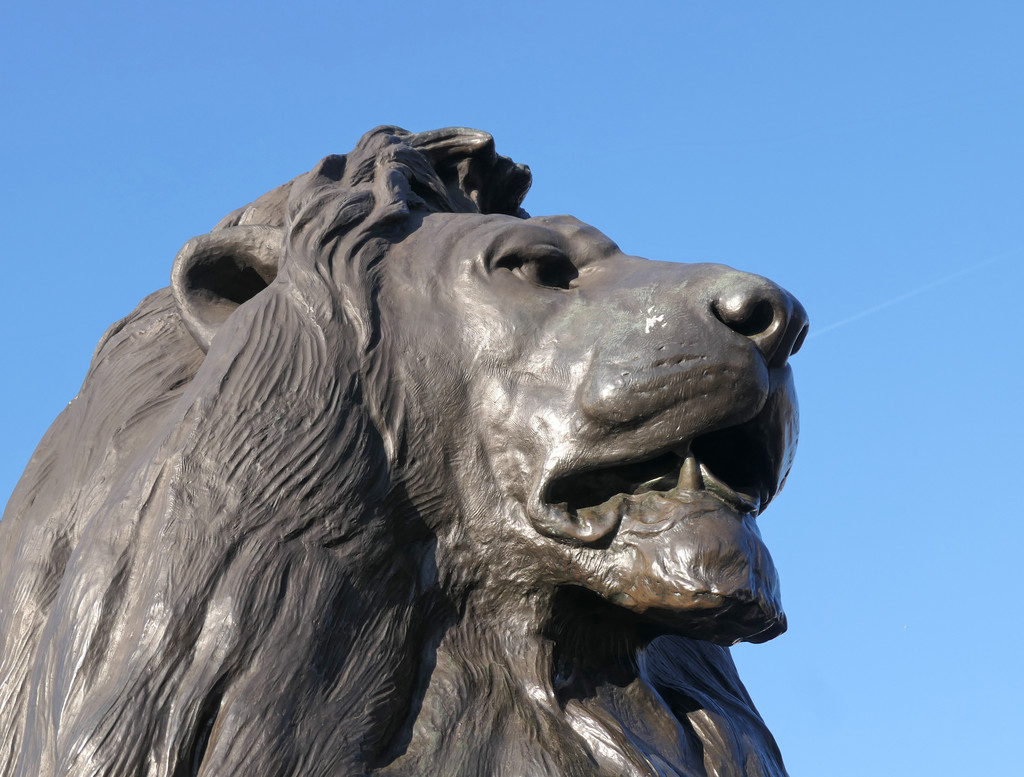
- Navigation image, One of the bronze lions at Nelson’s Column: modelled by Edwin Landseer and cast by Carlo Marochetti. Photograph by Amanda Slater. CC BY-SA 2.0. Image source. CC BY-SA 2.0. Resized.