 by Tom Gurney
Tom Gurney BSc (Hons) is an art history expert with over 20 years experience
Email: tomgurney1@gmail.com / Phone: +44 7429 011000
Technique Anatomy and Studio Practice: Introduction
Landseer’s animals can look as though they arrived on the canvas in a single act of recognition: the turn of a head, a damp muzzle, a weight-bearing paw and a particular kind of coat seem to have been understood at once. That impression helped to create the legend of an artist who needed only a live model, a brush and an astonishing memory. The surviving objects tell a more interesting story. His practice joined anatomical study, observation of living animals, copying from sculpture and earlier painting, experiments on paper, choices of support, compositional rehearsal, rapid execution and prolonged revision. No one stage explains the result by itself.[1][2]
Technique, in this sense, is not a secret formula. It is the sequence of decisions that turns knowledge into a visible effect. A bone may be understood without being outlined; a few chalk marks may make a dog alert; a broad oil passage may suggest weather while a fine accent fixes an eye. Paper, panel, board and canvas offer different resistances and opportunities. A small picture can be highly resolved, while a large one may preserve open or altered passages. Even the surface in a gallery is historical: varnish changes, canvas moves, additions age differently and treatment modifies what can be seen.[3][4]
This broader account also changes the meaning of speed. Landseer was repeatedly praised for fast performances, and some accounts are specific enough to matter. But the time taken to put paint on a support is not the same as the time taken to learn anatomy, study an animal, invent a grouping, prepare materials, wait for layers, respond to a patron or return to a picture years later. Fluency can be real without being effortless. The studio was where accumulated knowledge met the unpredictable facts of bodies, materials, collaborators and commissions.[5][6]
At a Glance
- PracticeDrawing, anatomical study and oil painting [1][2]
- MaterialsCanvas, panel and works on paper [1]
- EvidenceSurviving works, technical records and contemporary accounts [1][7]
Contents
- Training the hand and eye
- Anatomy beneath the skin
- Returning to the living animal
- What a drawing could do
- Learning from other art
- Paper, wood, board and canvas
- What the brush can show
- The theatre of speed
- From observation to composition
- The studio as a place and a network
Training the hand and eye
On 9 August 1816, at fourteen, Landseer became a student in the Royal Academy Schools, although he had already exhibited at the Academy in 1815. The date matters because it places formal study within an education that had begun at home. His father, the engraver John Landseer, encouraged drawing and gave his sons access to a culture in which pictures were translated, reproduced and judged through line. Edwin’s brothers Thomas and Charles also became artists. Training was therefore both institutional and familial, with skills, subjects and materials circulating among people who worked closely together.[1][8]
The Academy offered a progression based on drawing from established models before independent invention. Study from casts and the antique taught proportion, contour and the organisation of bodies into legible forms. A graphite drawing in the British Museum of the horse associated with the east pediment of the Parthenon records Landseer looking at ancient sculpture, probably through a cast. The horse is not a substitute for observation of a living animal. It is a different problem: how to understand a compressed, monumental form already interpreted by another maker, and how to translate volume into marks on a flat sheet.[9]
Benjamin Robert Haydon added another, more practical emphasis. He urged young artists to combine study of the antique with anatomy and dissection, and he later claimed a decisive role in Landseer’s development. Frederick Stephens preserved Haydon’s account that Edwin copied anatomical drawings and dissected animals under his supervision. That testimony is valuable, but it is not disinterested. Haydon was defending his teaching and complained that the successful artist had not sufficiently acknowledged it. The safest conclusion is substantial rather than heroic: Landseer received anatomical instruction in Haydon’s circle, and surviving early drawings confirm that it was pursued seriously.[7][5]
Copying also extended beyond casts and anatomical diagrams. Stephens describes the Landseer brothers working from Raphael’s Cartoons, while an oil copy after Rubens’s Wolf and Fox Hunt, made about 1824–26, shows Edwin attending to violent action, illuminated fur and forceful brushwork. The Metropolitan Museum links that small oil on wood to preparations for The Hunting of Chevy Chase. Copying here was not passive submission to authority. It isolated pictorial problems—how bodies collide, how light breaks across moving forms, how an animal group can carry a larger drama—that could be tested in new work.[5][10]
This combination unsettles a familiar opposition between nature and art. Landseer did not first learn convention and then escape it by looking at animals. He moved repeatedly among bodies, casts, drawings, prints and paintings. Later, he owned anatomical drawings of the horse by George Stubbs, another artist for whom bodily structure and pictorial invention were inseparable. An artist’s collection could continue the education of the eye long after formal schooling ended.[11]
Training was therefore cumulative but not mechanical. The line learned from engraving, the measured contour of a cast, the exposed muscle of an anatomical sheet and the movement studied in Rubens offered different kinds of knowledge. None dictated a finished picture. Their value lay in giving Landseer more ways to select, simplify and recombine what he saw.
Anatomy beneath the skin
The strongest physical evidence for Landseer’s anatomical training is a group of eleven écorché drawings of dogs and cats acquired by the Victoria and Albert Museum. Dated to about 1817–21, they show bodies with skin removed so that muscles and elements of bone structure can be studied. Susan Owens’s specialist account places these sheets within the young artist’s work around Haydon and treats them as sustained investigation rather than macabre curiosities. The V&A’s acquisition record likewise identifies them as evidence of anatomical work undertaken in Landseer’s teens.[7][12]
Écorché study changes the question asked of an animal. A drawing of a pelt records an outer boundary, pattern and texture; a flayed body exposes the structures that create that boundary and make movement possible. Shoulder blades shift beneath skin. Tendons carry force to paws. Joints constrain the directions in which a leg can turn. Knowledge of those relations can help a painter make a pose convincing even when fur hides the mechanics. It can also help identify the difference between weight resting through a limb and a limb lifted free of the ground.
Yet anatomy is not a synonym for exact likeness. A diagram may clarify a muscle by isolating it; a painting may conceal that muscle to make the animal readable as a mass, a rhythm or an emotional presence. Landseer’s mature animals are selected constructions. He could enlarge a head within a composition, suppress distracting detail, sharpen the direction of a gaze or arrange limbs for narrative clarity. Anatomical knowledge makes those adjustments more plausible; it does not make them neutral.[1][2]
Attribution adds a further warning. Edwin and Charles Landseer sometimes studied side by side, using the same black, red and white chalks on similar paper. The Metropolitan Museum now attributes its 1821 A Full Size Écorché Study of a Hound to Charles. The sheet had an Edwin-related history, but close comparison and current scholarship support the brother’s authorship. An old label or famous family name cannot settle which hand made every anatomical drawing.[13]
That difficulty is instructive rather than inconvenient. It replaces the image of a solitary prodigy with a shared environment in which brothers used comparable methods and sometimes addressed the same subject. It also shows why technical evidence must be object-specific. Three-colour chalk identifies materials in a particular sheet; it is not a signature unique to Edwin. Similarity can record common training just as readily as single authorship.
Later biographies added vivid stories to the early record. James Manson described Landseer obtaining the carcass of a lion from Exeter Change and examining it at leisure. The episode may preserve a real encounter, but the account appeared in 1902, decades after the event, and should remain a reported case rather than proof that every species was dissected in the studio.[6] Haydon’s assertions, the V&A group and the attributed family sheets together establish a meaningful anatomical practice. They do not establish an uninterrupted career of systematic dissection.
Nor did knowledge of the dead body reduce the living animal to machinery. Anatomy could explain how a jaw opened or a shoulder carried weight, but not how attention moved between dog, handler and stimulus. For that, Landseer had to return to behaviour, timing and the changing surface of a live subject.
Returning to the living animal
The Metropolitan Museum’s Study of a Dog makes observation look like a relationship rather than an isolated stare. Landseer used black chalk heightened with white and red on a small sheet. The marks concentrate on the animal’s head and bodily structure, but a lightly drawn human hand appears nearby holding a cloth. The device seems to keep the dog’s attention. What looks at first like a direct meeting between artist and animal therefore includes a third participant and a practical prompt.[14]
That hand is easy to overlook because it is not the ostensible subject. Technically, however, it is crucial. Animals do not hold an expression in the manner of a professional human sitter. Their ears turn, muscles tense, noses follow scent and eyes track movement. A handler, food, fabric, sound or familiar person can produce a temporary attitude. The artist must decide which instant to preserve and which changes to discard. Observation from life is thus staged without becoming false: the conditions are arranged so that genuine behaviour can be seen.[14]
An early pencil sheet at the Rhode Island School of Design, Dog Resting Upon a Couch, dated 1817, offers another kind of encounter. Its medium encourages linear description and tonal pressure rather than the coloured accents of the Met drawing. The resting pose gives time to examine how a body settles into upholstery. Even between these two examples, “drawing from life” does not produce one uniform appearance. Material, posture, duration and purpose change what is recorded.[15]
The contrast with the écorché sheets is equally important. A flayed specimen reveals structures unavailable to ordinary sight, while a resting or alert dog presents fur, expression and behaviour. The first can inform the second, but the relationship is not one of tracing. When Landseer suggests the rise of a brow beneath hair or the load carried through a foreleg, bodily knowledge and visible appearance meet in a selective mark.
Living observation could also be fragmentary. A head, paw or turn of the spine might be studied without designing the whole picture. Conversely, a complete animal group might be invented from many encounters rather than copied from one sustained arrangement. The National Gallery of Art’s Contending Group after Nature, made in 1822 with pen, black and brown inks, grey and brown wash over graphite, shows several big cats locked together. Its title asserts a relation to nature, but the layered media and organised collision reveal a pictorial problem as much as a witnessed event.[16]
The phrase “from life” must therefore be used carefully. It can mean that a live animal supplied crucial evidence, not that every contour in the final work was copied simultaneously from a stationary model. The same artist who watched a dog’s attention could study a carcass, copy an antique horse and absorb Rubens’s hunt scenes. These sources did not cancel one another. They gave him different access to structure, action and visual memory.
This helps explain why Landseer’s animals can feel present without behaving like specimens. The viewer receives a compressed account of physical possibility and a chosen instant of attention. The convincing result may conceal the many occasions, materials and human interventions that made it possible.
What a drawing could do
The word “study” can imply a subordinate object waiting to become a painting. Landseer’s surviving works on paper resist that simple hierarchy. Some sheets investigate anatomy, some copy sculpture, some arrange a future composition, some record travel and some develop colour and movement to a degree that allows them to stand independently. Their function has to be established one at a time.[2]
The British Museum’s horse of Selene is a study after ancient art. The V&A écorché group is anatomical. The Met dog concentrates on an alert living head. RISD’s couch study describes rest in pencil. Each involves looking, but each directs attention differently. Contour may measure; chalk may model a form with coloured heightening; an exposed muscle may explain mechanics; a loosely stated human hand may record the device that caused an expression.[7][14][15][9]
Landseer could also build drawings through several stages of liquid and dry media. Contending Group after Nature combines graphite planning with pen, two colours of ink and two washes. The graphite can establish positions before darker decisions sharpen bodies and wash separates overlapping masses. The presence of several media does not prove a fixed order for all his drawings, but it demonstrates that apparent immediacy can be constructed through successive kinds of mark.[16]
A dated 1824 sheet in the Morgan Library, Scottish Highlands, Lochs and Figures, uses transparent and opaque watercolour, with gum arabic selectively increasing glaze and depth. It carries information on both sides and an inscription associating it with Sir Walter Scott. The mixture of transparency, opacity and local gloss makes the sheet more than a colourless memorandum. At the same time, its travel identity does not prove that every passage was completed outdoors in one sitting. Field observation and later adjustment can coexist unless the object record establishes otherwise.[17]
The Frick Collection’s Otterhounds, dated about 1838–44, goes further in watercolour and gouache. Graphite framing lines contain a dense, animated pack. Fine marks differentiate heads, eyes and coats while the grouping keeps many bodies legible within a compressed field. Paper here supports a highly worked colour image rather than a cursory beginning. Anatomical knowledge is visible through the articulation of heads and bodies, but so is social behaviour: animals press, turn and respond as a pack.[18]
Albums introduce another function. The British Museum’s Redleaf album contains varied papers and media and contributions from numerous identified hands. Such a volume belongs to sociability, exchange and collection as well as solitary preparation. An individual Landseer drawing within it may be quick or informal, but the album context does not make every mark careless. It shows a draughtsman operating in rooms where artistic performance and social participation overlapped.[9]
Preparatory function is clearest when a relation to a painting survives. The double-sided 1820 sheet for Alpine Mastiffs Reanimating a Distressed Traveler places graphite with pen and brown ink on one face and graphite studies on the other. It explores a group before the large oil on canvas. Yet even this unusually direct connection does not license a rule that every drawing points forward. It proves that this composition developed through paper, while other sheets kept different purposes.[16]
Drawing was therefore not a single preliminary language. It allowed Landseer to separate structure from colour, test a grouping cheaply, preserve a fleeting attitude, learn from another artwork, carry landscape information or make an accomplished object for circulation. The very range that built his fluency prevents technique from being reduced to one celebrated line.
Learning from other art
Landseer’s reputation for animal observation has often encouraged the idea that his best knowledge came unmediated from nature. The objects instead show a continuous traffic between direct study and inherited art. This matters because every representation begins with prior ways of seeing. An ancient horse, a Renaissance figure group, a Rubens hunt or a Stubbs anatomical sheet could direct attention to possibilities that a living model alone would not organise.[5][9][10][11]
The Parthenon horse offered concentrated form. Its head, neck and open mouth had already been shaped for a pedimental composition and weathered through time. Drawing it meant studying how sculptural mass survives compression and damage. Raphael’s Cartoons supplied monumental human grouping and clear gesture. Whether Landseer copied every form with equal intensity is less important than the habit implied: he learned to analyse how another artist made complex action readable.[5][9]
Rubens presented animal conflict at a very different pitch. Landseer’s small oil-on-wood copy after Wolf and Fox Hunt attends to the old master’s subject, brushwork and bursts of light. Because the Metropolitan Museum connects the copy with The Hunting of Chevy Chase, it can be understood as active preparation: the younger painter took apart a model of pursuit and violence while developing his own ambitious scene.[10] The hard wood support also allowed an oil exercise at a scale and material register unlike a monumental exhibition canvas.
Copying does not mean that Landseer surrendered invention. It gave him a controlled problem. He could follow an existing arrangement closely enough to discover how highlights energise fur or how diagonals carry pursuit, then transfer those lessons without reproducing the source wholesale. The distinction between motif and method is important. A painter may borrow a way of organising attention even when the finished subject changes.
The later ownership of Stubbs’s anatomical horse drawings brings the relation full circle. Landseer could collect the investigative work of an earlier British animal painter and examine how structure had been translated into line. The National Gallery’s account of its 2018–19 display used such earlier works alongside material related to The Monarch of the Glen to show development rather than instantaneous invention.[11] Collection became another working archive.
These encounters also complicate the word originality. Landseer’s originality did not depend on never looking at other art. It lay partly in the choices made among available traditions: anatomical analysis, old-master energy, cast study, portrait attention and contemporary narrative. The specificity of a living dog could meet a compositional intelligence trained on objects made centuries earlier.
This is why “lifelike” is an incomplete technical description. A picture may convince because the animal’s joints and weight are plausible, but also because the pose has been clarified by sculptural study, the action intensified through Rubens and the light arranged for drama. Nature supplies evidence; art supplies tested structures of attention. Landseer’s method grew through their exchange.
Paper, wood, board and canvas
Medium labels can hide as much as they reveal. “Oil painting” sounds like one material category, yet Landseer’s oils survive on wood, panel, board, paper attached to canvas and canvas itself. Those supports vary in size, flexibility, absorbency and later behaviour. They also correspond to different practical purposes without creating a rigid law.[16][10][3][19][20]
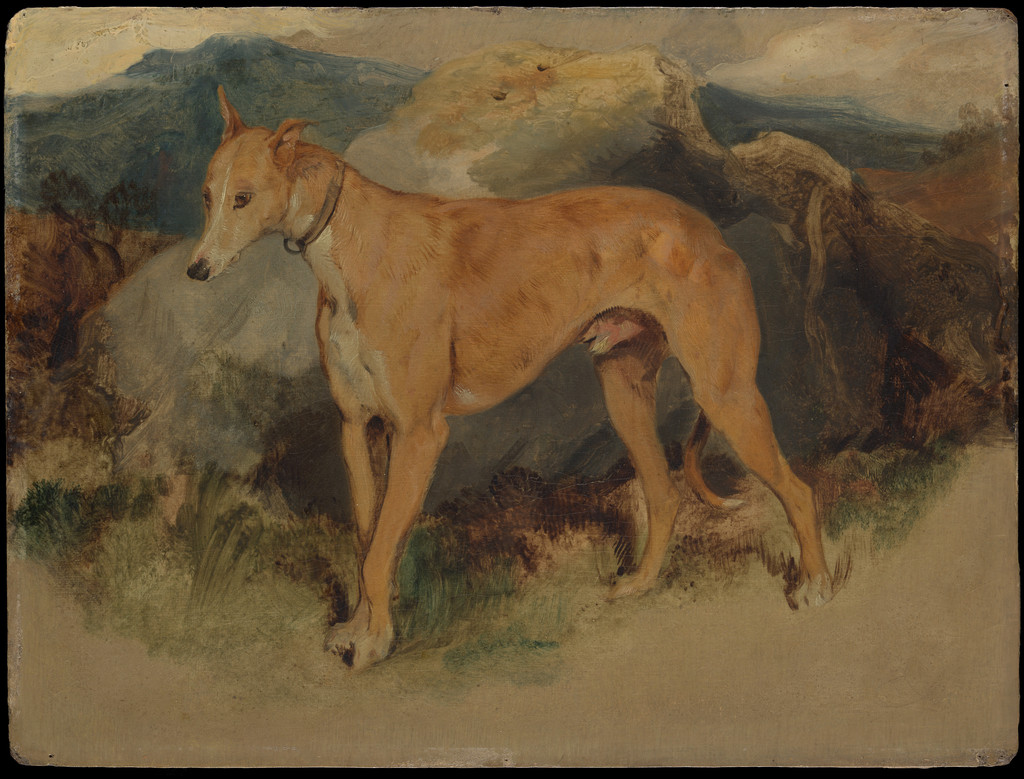
The copy after Rubens is oil on wood, while A Deerhound of 1826 is oil on board. Both are compact objects on firm carriers, but one investigates another painter and the other presents an animal portrait. The Cat’s Paw, about 1824, uses oil on panel for an intimate narrative; A Highland Landscape, about 1830, uses oil on board for atmosphere; Ptarmigan in a Landscape, made by 1833, uses oil on panel to join bird and habitat. A rigid support could serve copying, portraiture, satire, weather or natural-history attention.[10][19]
Firmness may permit direct handling and easy portability, but the catalogue entry alone cannot reveal ground preparation, exact brushes or the sequence of layers. Nor should panel, wood and board be treated as interchangeable simply because all resist bending more than loose canvas or paper. Each object has its own construction, and later mounting or framing may alter how that construction behaves.
The National Gallery of Art’s Lion Defending Its Prey, about 1840, is catalogued as oil on paper attached to canvas. That description preserves two moments in its physical life: paint was carried by paper, and the paper is now supported by canvas. The visible object cannot be discussed as though it were simply an untouched sheet or an ordinary canvas. Its present structure includes the relation between original carrier and later attachment.[16]
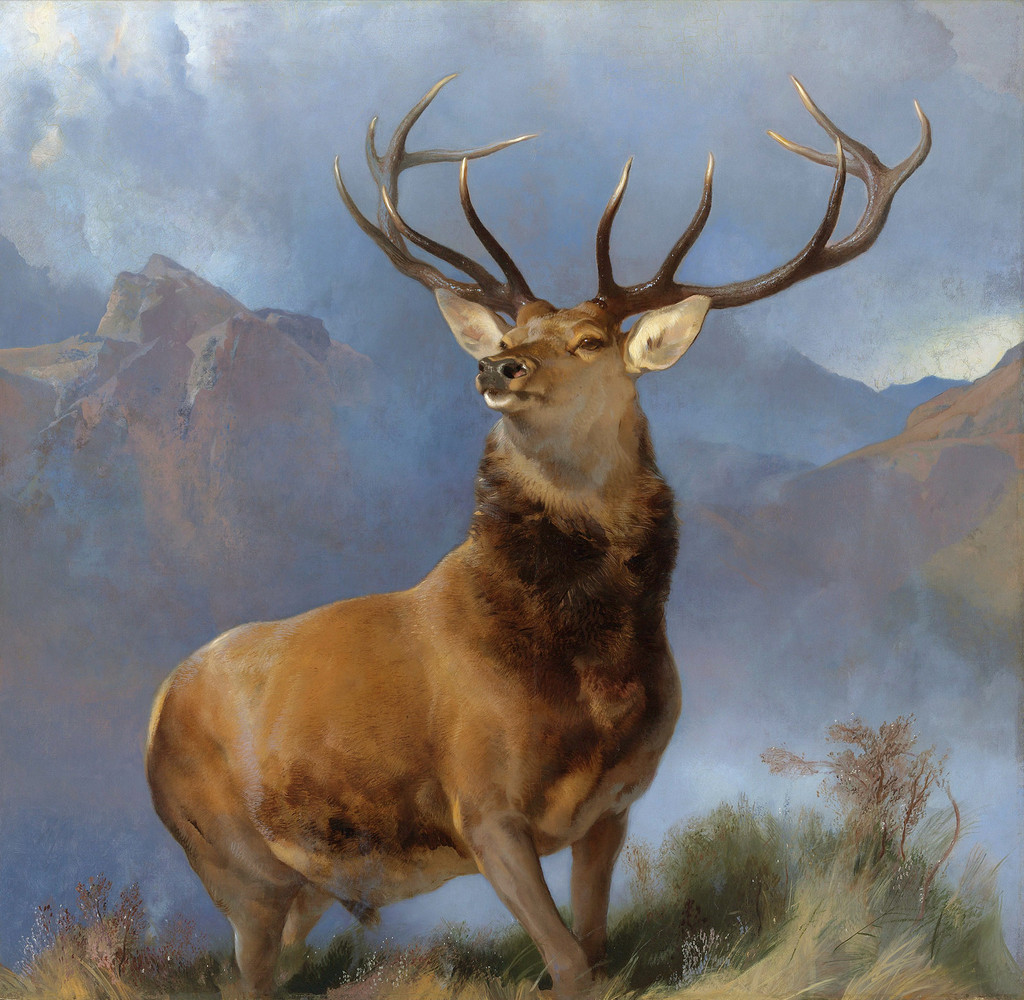
Large public pictures often required canvas. The Sanctuary of 1842 spreads a stag and evening landscape across a wide horizontal field, while The Monarch of the Glen, about 1851, gives a single animal commanding scale within a highly organised setting. The current National Galleries of Scotland account distinguishes Landseer’s meticulous drawings and bravura oil sketches from large, highly finished pictures. That distinction describes a useful range, but it is not an absolute equation of size with finish. A large canvas can contain broad passages, and a small support can be minutely resolved.[3][20]
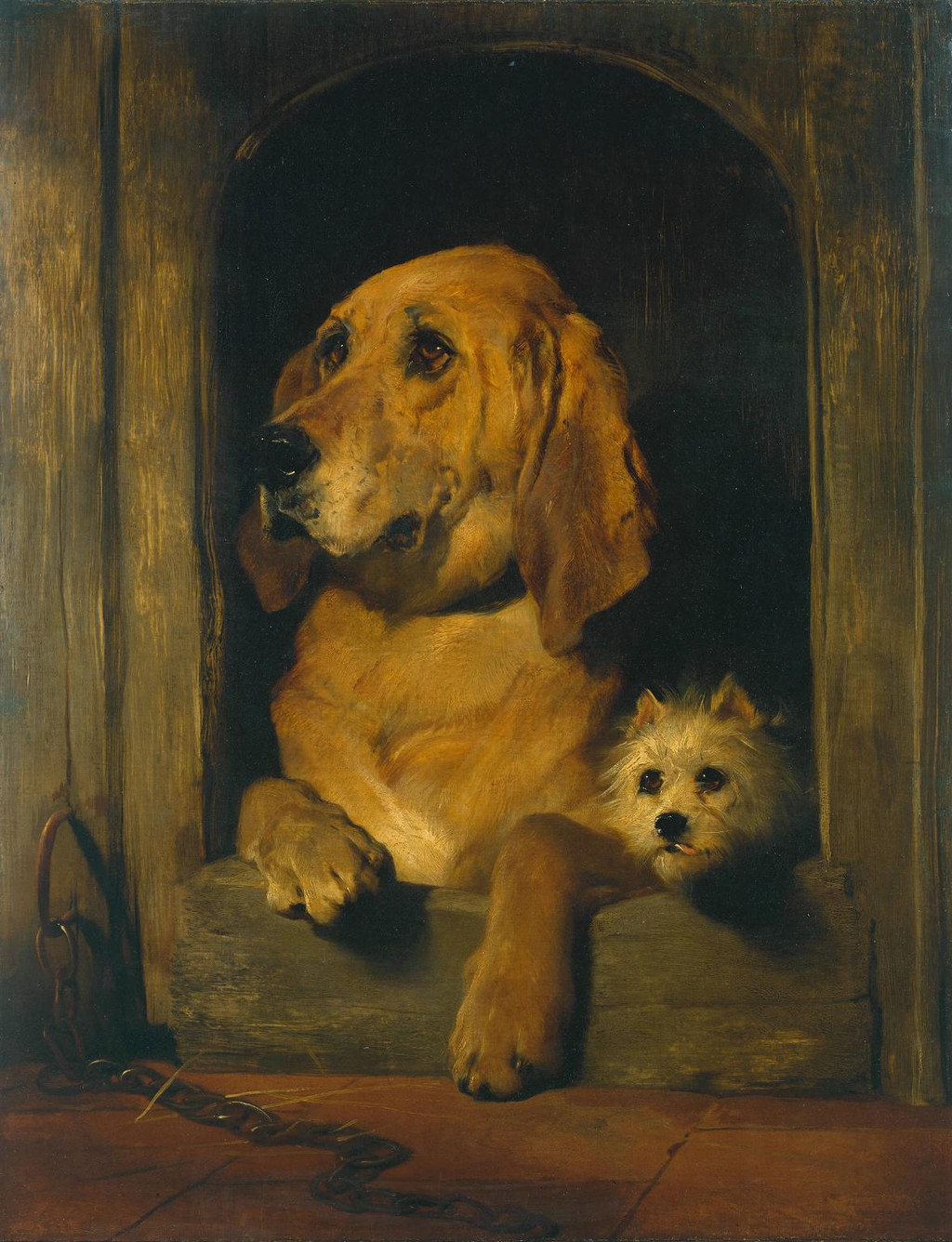
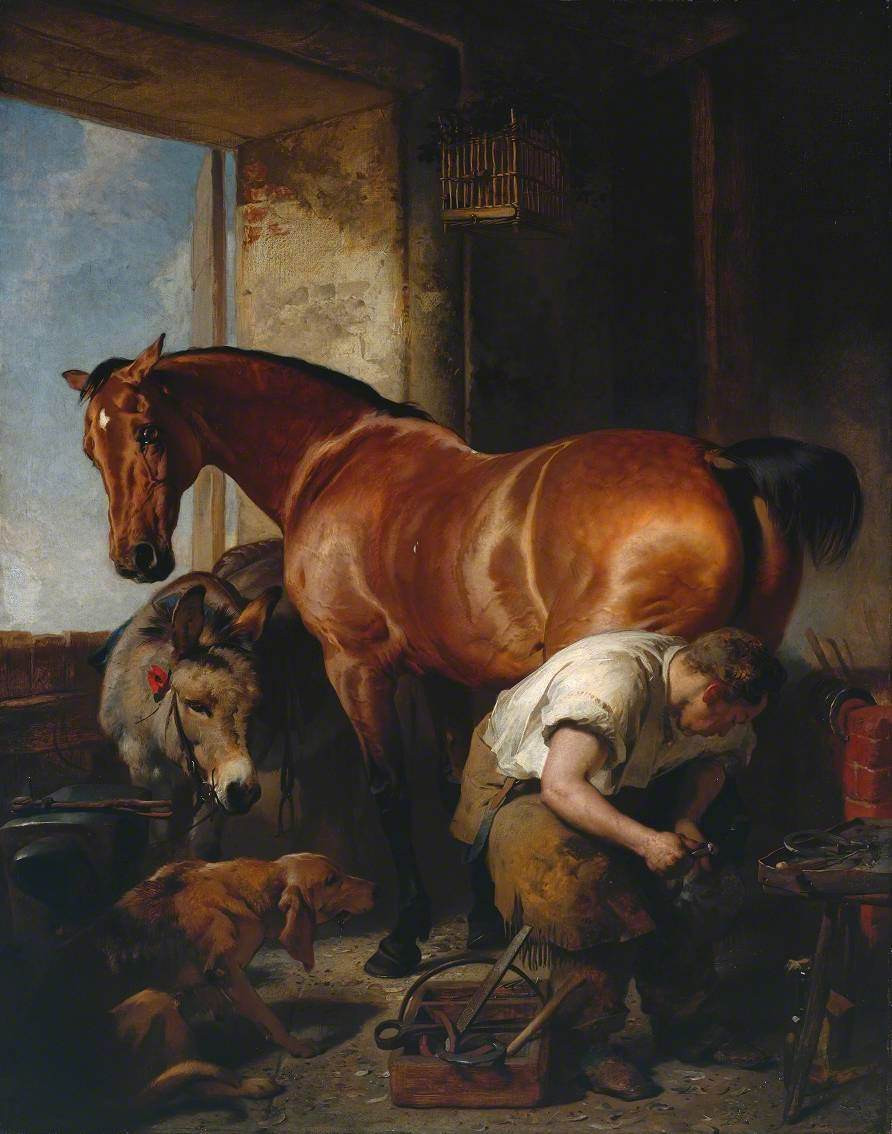
The Tate group likewise prevents a single material profile from standing for the career. Pictures as different in scale and purpose as Low Life, High Life, The Hunted Stag, Sleeping Bloodhound, A Distinguished Member of the Humane Society, Dignity and Impudence, Shoeing and Alexander and Diogenes belong to the same painter without sharing one surface logic.[21] Current titles, dates, dimensions and support records establish difference; thumbnails cannot supply missing technical evidence.
Support is not a neutral platform beneath an idea. It shapes working scale, portability, resistance and future condition. Yet it does not determine quality or meaning on its own. Landseer could use paper for a highly developed watercolour, wood for an old-master exercise and canvas for both panoramic landscape and unresolved royal ambition. The choice created possibilities that subsequent handling either exploited or resisted.
What the brush can show
Landseer’s handling is most useful when described passage by passage. A brush may pull a continuous contour, break into touches, drag across an underlying layer, deposit opaque light or leave a softer transition around a form. These actions direct attention. They can make the viewer sense wiry hair without receiving every strand, or see moisture in an eye through a small accent surrounded by quieter paint.[1][5]
Stephens preserved Richard Redgrave’s admiration for a method in which the brush was drawn through passages of fur and more solid pigment was placed into a richer, more fluid layer. The language belongs to nineteenth-century observation, not modern laboratory analysis, and it should not be converted into a universal recipe.[5] It nevertheless points to a key visual principle: texture can emerge from the interaction of a moving tool with paint already present, rather than from drawing thousands of individual hairs.
The small Rubens copy helps explain why such handling mattered. The Metropolitan Museum identifies bravura brushwork and sparkling effects of light among Landseer’s interests in the source. A bright touch can separate a muzzle from shadow, catch the ridge of an animal’s back or make a collision feel sudden. The force of the mark belongs to the illusion; energetic handling can carry energetic action.[10]
Fine and broad work need not be opposites. In The Monarch of the Glen, the stag’s antlers, face and body must remain legible against a large atmospheric setting. Resolution concentrates authority in the animal, while surrounding space establishes distance and scale.[3] In the wide Sanctuary, the arc of land and evening effect create a setting in which the animal is both focal presence and part of a larger world.[20] The distinction lies in where precision is concentrated, not in whether the entire surface is uniformly polished.
Works on paper reveal related choices by other means. The Met dog uses dark chalk, coloured heightening and spared paper; Otterhounds combines watercolour and opaque gouache; the Morgan landscape varies transparency, opacity and selected gloss.[14][17][18] These are not lesser versions of oil. They show Landseer controlling density, edge and emphasis across materials with different behaviours.
Nor should a highly resolved surface be confused with photographic neutrality. Paint can make some structures emphatic and others disappear. It can sharpen an eye while merging a flank with shadow, separate a white chest from a dark ground or simplify landscape so that a silhouette dominates. The result may feel immediate because the hierarchy is strong, not because everything has received equal description.
The most responsible language therefore begins with what can be seen and what the current holder has established. Broad and fine, opaque and translucent, firm and broken, exposed and covered: these contrasts can be attached to named passages. Exact pigments, binding proportions, drying times and underlayers require technical evidence that a catalogue photograph cannot supply. Admiration becomes more precise when it does not invent a formula.
The theatre of speed
Stories of Landseer working at extraordinary speed circulated because they turned professional skill into an event. Friends and patrons could watch a recognisable animal emerge while ordinary social time continued around it. The story then became part of the object’s value: the picture was evidence not only of what Landseer saw but of how quickly he seemed able to make others see it. Stephens and Manson preserve several such accounts, but they do not all deserve equal confidence.[5][6]
The strongest frequently repeated case concerns a small picture known through the tradition of Spaniel and Rabbit or Trim. Stephens reports a completion time of two and a half hours and says that the claim was attached to Landseer’s own inscription. That is more specific than anonymous praise, yet it still does not amount to a modern reconstruction of the session. The object’s preparation, any earlier observation and the exact meaning of “painted” remain outside the clock.[5]
Another account describes a life-size fallow deer completed while the surrounding company attended church, in roughly three hours. The story comes through recollection associated with the patronal circle and may retain a genuine demonstration of fluency. Odin was likewise said to have been painted in twelve hours or a single sitting. Neither case should expand into a claim that Landseer habitually completed all animal pictures at such speed. A memorable performance is likely to be remembered precisely because it was exceptional.[5][6]
Stephens himself supplies the best warning. When he encounters the claim that a picture of rabbits was made in three-quarters of an hour, he states that he cannot verify it from memory. Repeating the number without his doubt would turn a cautious historical source into false certainty. The unresolved claim is valuable because it shows speed legend forming even while a near-contemporary writer tried to discriminate among versions.[5]
The most theatrical feat involved no paint at all. Solomon Hart recalled Landseer drawing the head of a stag with one hand and a horse with the other, using two pencils simultaneously before company. The account may describe a practised entertainment and unusual coordination. It does not prove that the artist normally drafted or painted ambidextrously, still less that both images received equal attention at every instant. A social demonstration has different conditions from sustained work on an exhibition picture.[5]
Speed can nevertheless be a genuine technical capacity. Long practice allows a draughtsman to compress decisions, recognise a useful contour quickly and place an accent without repeated correction. Anatomical knowledge reduces uncertainty about what lies beneath fur. Familiarity with materials makes their response more predictable. Memory preserves arrangements that cannot be held before the eye. What appears spontaneous may therefore be accumulated judgement operating efficiently.
The decisive distinction is between execution time and total labour. A two-hour passage may rest on years of training and several earlier studies. Canvas preparation, compositional thought, drying, later adjustment, framing and patronal review may fall outside the narrated sitting. The surviving double-sided study for Alpine Mastiffs proves that at least one early monumental composition had a life on paper before oil settled its final scale.[16] Fast handling and preparation are not rivals. Preparation is one of the conditions that can make fast handling possible.
From observation to composition
A finished picture is not a window cut from one moment before the artist. Landseer assembled bodies, settings, gestures and intervals into arrangements that had to work when no model remained present. The 1820 study for Alpine Mastiffs Reanimating a Distressed Traveler is especially clear because both sides of the sheet preserve alternatives and the related large painting survives. Graphite and brown ink helped to test the group before it occupied canvas.[16]
The Alpine setting also exposes the role of invention. Landseer had not yet travelled to Switzerland when he made the picture. The scene could therefore draw on reports, existing imagery, general landscape knowledge and imagined topography rather than direct experience of the exact place. That does not make the picture fraudulent. It shows how a painter can make a convincing pictorial world by assembling different kinds of evidence.[1][16]
Animal observation supplied parts of that world. A dog’s head could be studied closely, a handler could prompt attention, and anatomical work could establish how a body bore weight.[7][14] Composition then altered the status of those observations. Scale might increase; separate animals might become a coordinated rescue group; snow and mountain space might intensify danger; a human figure might be arranged so that the dogs’ actions read immediately. The work moves from what was seen to what must be made legible.
Memory entered this transition, but not as a magical recording device. Manson reports the Earl of Wemyss using “photographic” as a metaphor for Landseer’s visual recall.[6] The comparison belongs to a friend’s retrospective language. It cannot establish a clinically exact or infallible faculty. Visual memory is better understood as trained selection: an artist retains useful relations of movement, silhouette, colour and expression, then reshapes them as the picture requires.
The Morgan landscape sheet demonstrates another kind of stored information. Transparent colour, opaque touches and selective gum-arabic glazing record Highland lochs, figures and effects in a portable form.[17] Such a sheet could preserve more than an outline without becoming a full account of every later painting. Travel study, memory and studio invention remain linked possibilities rather than a single proved sequence.
Landseer’s ownership of Stubbs’s horse anatomy drawings similarly made another artist’s investigations available for renewed attention.[11] The working store was not only internal memory. It included drawings, copied paintings, collected sheets and the knowledge of family and colleagues. A composition could emerge from this distributed archive while still depending on Landseer’s decisions about what to use.
This is why naturalism should not be measured by the absence of construction. A plausible body in an invented setting can communicate danger more strongly than an unedited observation. The question is not whether art intervened, because intervention is unavoidable. It is how the intervention organises evidence. In Landseer’s strongest arrangements, physical credibility gives an imagined event enough authority to sustain narrative.
The studio as a place and a network
The studio was a room, but it was also a network of access. Animals had to be brought within view or encountered elsewhere. Patrons supplied commissions, settings and sometimes models; handlers helped to hold attention; family members shared training; dealers and exhibition institutions affected deadlines; framers and other makers completed the object’s public form. Technique operated through these relations even when Landseer alone applied the decisive marks.[1][2]
The faint hand beside the Met dog is the smallest surviving sign of this network. Somebody occupies the space just outside the principal image, using cloth to direct the animal.[14] The helper need not be identified for the relation to matter. The pose depends on contact among dog, stimulus, handler and artist. What viewers later experience as Landseer’s penetrating observation was enabled by a practical arrangement.
Family participation was more extensive. John Landseer’s instruction and print knowledge shaped the early environment; Thomas became a reproductive engraver closely associated with Edwin’s images; Charles shared anatomical study closely enough to create later attribution problems.[1][13][9] None of these facts transfers Edwin’s paintings wholesale to a family firm. They show that expertise was exchanged and that authorship has to be defined by task rather than protected through a fiction of isolation.
The same principle applies to models. Landseer could work from pets known within a household, sporting animals associated with an estate, or specimens available under unusual circumstances. A live dog’s familiarity with its owner might affect behaviour; a carcass allowed prolonged anatomical examination but no response; wild animals could require indirect knowledge or managed access. “The studio animal” is therefore not one category. Each situation offers some evidence and withholds other kinds.
John Ballantyne’s portrait of Landseer in a studio adds a useful caution. It shows the artist modelling while the sculptor Carlo Marochetti is associated with casting the bronze. The National Portrait Gallery’s extended history explains that Ballantyne’s composition was constructed and revised and became entangled with publicity.[22] The image is evidence of how studio identity was represented, not a transparent photograph of one uninterrupted working session.
That distinction helps interpret the familiar spectacle of artistic labour. Tools, models and unfinished forms can make skill visible to an audience, while the image suppresses waiting, negotiation and failed attempts. Ballantyne’s painted studio and Hart’s two-pencil anecdote both place Landseer’s dexterity before observers.[5][22] They belong to the social life of technique as well as its practical history.
There is no secure basis for turning this network into a permanent factory of unnamed assistants. The evidence is stronger when roles remain particular: a brother engraves, a handler prompts, a collaborator supplies landscape, a sculptor casts, a patron requests a change. Naming those tasks enlarges rather than diminishes the account of Landseer’s work, because it shows exactly where his choices met the labour and authority of others.
Collaboration without vanished authorship
Collaboration becomes confusing when it is treated as the opposite of authorship. In practice, Landseer could remain the principal inventor while another artist supplied a substantial part of the visible object. The question is not whether a work is entirely solitary but who did what, how the contributions were coordinated and how the resulting object was credited.[1]
Frederick Richard Lee provides the clearest painting partnership. In a documented group of pictures, Lee supplied landscape while Landseer added animals and figures. That division joined two specialisms within one composition. It did not make the setting merely decorative: terrain, light and distance establish the conditions in which Landseer’s animals act. Nor did it turn every Highland landscape into a collaboration. The shared authorship has to be attached only to works for which evidence supports it.[1][2]
Reproductive engraving created a different relation. Thomas Landseer translated many of Edwin’s designs into printed lines. An engraving is not simply the painting multiplied. Tone, edge and texture have to be reconstructed in another medium, and the plate may determine how a far larger public knows the image. Edwin remains responsible for the source design; Thomas is responsible for the engraved interpretation. Collapsing the two hands hides the technical intelligence required by both.[9]
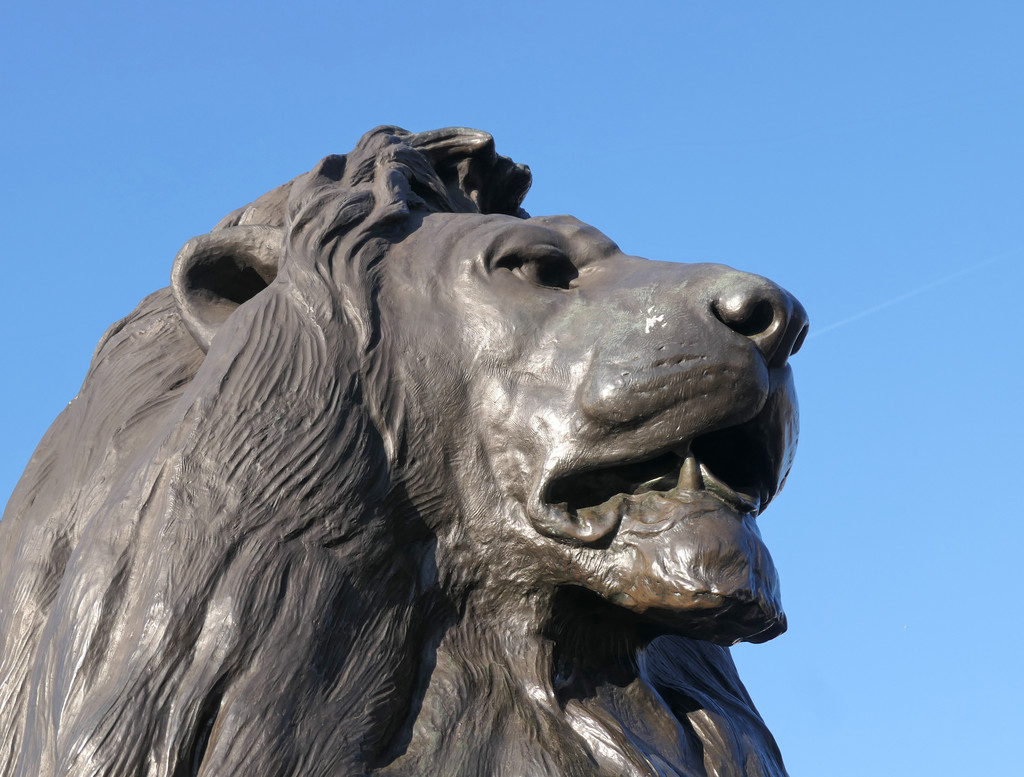
Sculpture divided labour again. Landseer could model an animal form, while an experienced foundry and sculptor such as Marochetti managed the demanding passage into bronze. Ballantyne’s portrait makes that relation visible through its studio fiction.[22] Model and cast are connected but materially distinct objects. The authority to shape and the expertise to translate shape into durable metal need not reside in the same person.
Patronal intervention belongs to the same spectrum even when it is not co-authorship. A commissioner might determine subject, supply an animal or demand alteration. Those instructions constrain the field within which Landseer works, yet they do not specify every line and colour. The Chatsworth history of Laying Down the Law records a particularly visible intervention: after the picture’s 1840 Academy exhibition, its owner requested the addition of another dog, Boney. Landseer changed his own exhibited composition in response.[4]
Collaboration can thus occur before, during or after the principal act of painting. Shared study forms an early visual vocabulary; a handler enables observation; another painter provides landscape; an engraver converts the image; a patron sends it back for revision; a caster changes a model’s material existence. These relations affect technique because each introduces new constraints and possibilities.
Precise attribution prevents two opposite errors. One is the solitary-genius story in which every condition disappears behind Landseer’s name. The other is a vague collective account that dissolves his decisions into context. The surviving evidence supports neither. His authority is clearest when it is located: in the animal group he designed, the passage he handled, the revision he accepted, or the model whose casting required another specialist.
Revision and the unresolved work
The idea of effortless finish is challenged most forcefully by pictures that changed or never reached an agreed end. Laying Down the Law had already been exhibited at the Royal Academy in 1840 when the Duke of Devonshire asked for Boney to be added. The new dog required more than insertion into empty space. Landseer had to rebalance an existing group and integrate fresh paint with a surface that already possessed its own history.[4]
That sequence makes finish a negotiated state. Academy exhibition did not close the work; ownership reopened it. Landseer’s later intervention remained his own, yet it answered another person’s wish. The episode also complicates a viewer’s desire to identify one original moment. The picture’s authorised form includes at least two Landseer campaigns separated by display and patronal response.
The Alpine mastiff sheet presents revision at an earlier stage. Marks on both sides show that bodies and relations could be tested before the final oil composition.[16] Such visible alternatives are normal instruments of invention, not signs of indecision. A study permits the artist to discover which arrangement communicates action most clearly before committing to the expense and scale of canvas.
Royal projects reveal more difficult outcomes. Vanessa Remington’s account follows an ambitious equestrian portrait of Queen Victoria that did not advance beyond a surviving oil sketch and the much longer history of Royal Sports on Hill and Loch. The latter expanded from a compelling smaller conception into a large commission burdened by multiple likenesses, detailed corrections and public expectation. It was shown at the Royal Academy in 1854 as unfinished and continued to trouble Landseer.[23]
These cases resist diagnosis by appearance alone. An open passage may be intentional abbreviation, an interrupted state, a later loss or a section awaiting revision. Delay can arise from scale, access to sitters, changing instructions, drying, dissatisfaction or competing work. Landseer’s documented health difficulties belong to his biography, but neither loose handling nor an incomplete commission can by itself establish a medical cause.
The unresolved work also reveals that virtuosity has limits. Rapid animal painting could not automatically solve a royal face or organise a growing accumulation of requested detail. Status and access did not guarantee closure. A celebrated artist might retain a project for years without finding a form acceptable to patron and painter alike.[23]
Revision is therefore not the opposite of fluency. Both are responses to a changing problem. Landseer could place a persuasive animal mark quickly and still reconsider the larger structure. He could finish a picture for exhibition, then alter it at a patron’s request. He could also leave an ambition unrealised. The complete technical history includes all three conditions: decision, return and refusal to settle.
The surface after Landseer
No viewer now sees a painting at the instant Landseer put down his brush. Oil paint changes as it dries and ages; varnishes yellow; supports move; old repairs become visible; dirt and environmental conditions alter relationships of colour and gloss. Conservation can stabilise and clarify an object, but it also becomes a documented intervention in the object’s continuing life.[4][24]
Chatsworth’s 2015 treatment of Laying Down the Law provides unusually detailed evidence. Before work began, the picture had yellowed, its colours appeared distorted and dull, earlier restoration was evident, and shrinkage of the canvas had contributed to flaking paint. The Victorian frame had also deteriorated. These are not merely cosmetic faults. A yellow surface can warm and flatten contrasts; poor adhesion places original and later paint at physical risk; the frame affects protection as well as presentation.[4]
The history of Boney made the condition more complex. The dog was a later addition by Landseer, and the resinous paint beneath that altered passage developed large cracks. Different campaigns within the same authorised picture could therefore age differently. Treatment and retouching addressed the affected areas, but the resulting surface is not a simple return to 1840 or to the date of the addition. It is a stabilised historical object carrying work from several moments.[4]
The Wallace Collection records conservation of The Arab Tent, a large oil on canvas of about 1865–66, in 2017.[24] Without published technical findings, the responsible conclusion stops there. The fact of treatment confirms that the picture’s present condition has been actively cared for; it does not permit claims about pigments, hidden changes or recovered intentions.
Even catalogue support descriptions require historical awareness. Lion Defending Its Prey is now oil on paper attached to canvas.[16] The attachment affects how the object is handled and may not belong to the first painting event. Board, panel and wood can warp or split; canvas can slacken or shrink; paper can respond to moisture. General possibilities should not be mistaken for an object diagnosis, but they explain why the carrier matters to what survives.
Condition language should avoid moral judgement. Cracking does not automatically prove careless technique, especially where a later resinous campaign and moving support interact. Cleaning does not peel away history to uncover untouched truth. Retouching does not become Landseer’s hand simply because it is visually integrated. Conservators distinguish materials and campaigns so that viewers can understand both image and object without pretending that time has been cancelled.
This perspective changes close looking. A darkened passage may reflect original choice, accumulated surface change or both. A contrast may have strengthened or softened. The aim is not to distrust everything visible, but to recognise that technique extends into material history. Landseer made the work; ageing, alteration and care helped determine the form in which it now meets us.
How to look at Landseer’s technique
Begin with the whole body before counting hairs. Ask where the animal’s weight falls, which joints bend and whether the silhouette makes the action clear. Anatomical knowledge is often most powerful where it is least diagrammatic: in the credible compression of a shoulder, the relation between ribcage and flank, or the way a paw receives the body. The écorché sheets show that such knowledge was deliberately acquired, while the living studies show it being redirected towards attention and behaviour.[7][12][14]
Then notice the hierarchy of marks. Which edge is firm, which dissolves, and where does opacity interrupt a darker or more fluid passage? A bright touch in an eye or along a muzzle can carry more perceptual weight than a large area of carefully modulated fur. Compare the chalk economy of the Met dog with the layered colour of the Morgan sheet or Otterhounds. Different media solve emphasis differently.[14][17][18]
Look next at the carrier and scale. A small oil on wood made after Rubens supports a different kind of encounter from the wide canvas of The Sanctuary or the commanding format of The Monarch of the Glen.[10][3][20] Do not assume that small means preparatory, paper means unfinished or large means uniformly polished. Identify the current material record, then ask what the artist did within those conditions.
Composition requires attention beyond the individual animal. Trace how bodies direct the eye, how empty space creates danger or calm, and how landscape changes the meaning of a pose. The Alpine Mastiffs study and painting show invention moving between paper and canvas.[16] The Met dog reveals a moment selected through a handler’s prompt.[14] Together they demonstrate that observation supplies evidence while composition decides its order.
Treat speed claims as historical performances with sources. An inscription-related two-and-a-half-hour picture, a patronal recollection and an explicitly unverifiable forty-five-minute claim do not carry equal weight.[5] Even the best-supported execution time excludes education, preparatory looking and possible return. Admire fluency without converting it into magic.
Finally, look for other hands and other times. A landscape collaborator, engraver, caster, patron or conservator may be part of the object’s history without erasing Landseer’s authorship.[1][4][22] A later addition may be entirely by Landseer yet materially different from the first campaign. A treated surface can make a picture safer and more legible without becoming an untouched original.
Landseer’s achievement lies not in one trick but in coordination. Anatomical inquiry gave him structures; living animals supplied unpredictable behaviour; earlier art offered compositional intelligence; drawing separated and combined problems; supports established material possibilities; brushwork organised attention; memory connected encounters; collaborators extended what could be made; revision tested whether a picture had truly settled. The speed admired by contemporaries was one visible moment within that longer chain.[1][2][5]
Seen this way, virtuosity becomes more rather than less impressive. It is not an inexplicable gift hovering above labour. It is the capacity to bring many kinds of knowledge to bear on a particular mark, while accepting that animals move, patrons intervene and surfaces change. Landseer made immediacy through preparation. The pictures continue to look alive because their decisions remain active even when their making was neither instantaneous nor solitary.
Artworks directory
This directory gathers works discussed in the articles, including drawings, original etchings and prints after Landseer. It is not a complete catalogue of every drawing, version, plate or impression. Distinct media are kept separate; uncertain dates are left blank. Linked titles open individual articles.
| Name | Date | Medium |
|---|---|---|
| A Bellowing Stag | Drawing | |
| A Deerhound | 1826 | Painting |
| A Distinguished Member of the Humane Society | 1838 | Painting |
| A Highland Breakfast | 1834 | Painting |
| A Highland Landscape | c. 1830 | Painting |
| A Highland Shepherd's Home | Painting | |
| A Horse, Goat and Bull | 1811 | |
| A Hunting Horse | Drawing | |
| A Jack in Office | Painting | |
| A Lion Disturbed at His Repast | Painting | |
| A Random Shot | Painting | |
| A Scene at Abbotsford | Painting | |
| Adversity | Painting | |
| Alexander and Diogenes | exhibited 1848 | Painting |
| Alpine Mastiffs Reanimating a Distressed Traveler | 1820 | Painting |
| Contending Group after Nature | Drawing | |
| Copy after Rubens's Wolf and Fox Hunt | c. 1824–26 | Painting |
| Dash | Painting | |
| Deer and Deer Hounds in a Mountain Torrent ('The Hunted Stag') | c. 1832 / exhibited 1833 | Painting |
| Deer Family | ||
| Dignity and Impudence | 1839 | Painting |
| Dog Resting Upon a Couch | Drawing | |
| Eos | 1841 | Painting |
| Favourites, the Property of H.R.H. Prince George of Cambridge | 1834–35 | Painting |
| Her Majesty Sketching at Loch Laggan | ||
| High Life | 1829 / exhibited 1831 | Painting |
| Highland Lassie | Drawing | |
| Isaac van Amburgh and his Animals | 1839 | Painting |
| Lady Godiva's Prayer | Painting | |
| Laying Down the Law | 1840 | Painting |
| Lion Defending Its Prey | c. 1840 | Painting |
| Lioness | Drawing | |
| Little Strollers | ||
| Low Life | 1829 / exhibited 1831 | Painting |
| Man Proposes, God Disposes | 1864 | Painting |
| Nell Gwynne / Diana Vernon | Painting | |
| Neptune | ||
| No Hunting Till the Weather Breaks | Painting | |
| Otterhounds | Drawing | |
| Peace | Painting | |
| Pensioners | Painting | |
| Portrait of a Mule | Painting | |
| Portrait of Mr Van Amburgh, as He Appeared with His Animals at the London Theatres | 1846–47 | Painting |
| Portraits of a Pointer Bitch and Puppy | Painting | |
| Pray Let Me Out | ||
| Prosperity | Painting | |
| Ptarmigan in a Landscape | by 1833 | Painting |
| Queen Victoria and Prince Albert at the Bal Costumé of 12 May 1842 | 1842–46 | Painting |
| Queen Victoria at Loch Laggan | Painting | |
| Queen Victoria at Osborne | 1865–67 | Painting |
| Queen Victoria landing at Loch Muick | Painting | |
| Rat-catching | 1823 | |
| Reclining Lion | Drawing | |
| Reclining Lion, From Back | Drawing | |
| Rent-day in the Wilderness | 1855–68 | Painting |
| Return from Deer Stalking | 1839 | |
| Royal Sports on Hill and Loch | Painting | |
| Sam Lovill, Porter at the Royal Academy | Drawing | |
| Scene from A Midsummer Night's Dream | 1848–51 | Painting |
| Scene in the Highlands, with portraits of the Duchess of Bedford, the Duke of Gordon and Lord Alexander Russell | Painting | |
| Scottish Highlands, Lochs and Figures | Drawing | |
| Shoeing | exhibited 1844 | Painting |
| Sleeping Bloodhound | exhibited 1835 | Painting |
| Spaniel and Rabbit | Painting | |
| Stag at Bay | 1866 | Sculpture |
| Stag at Bay | 1846 | Painting |
| Studies of a staghound and the head of a stag for painting ‘The Hunting of Chevy Chase’ | Drawing | |
| Study for Alpine Mastiffs Reanimating a Distressed Traveler | Drawing | |
| Study for the Monkey in The Cat's Paw | Drawing | |
| Study of a Dog | Drawing | |
| Study of a herding dog facing right | Drawing | |
| Study of the horse of Selene, from the East pediment of the Parthenon | Drawing | |
| Suspense | Painting | |
| Taking a Buck | ||
| The Arab Tent | c. 1865–66 | Painting |
| The Barn | Drawing | |
| The Best Run of the Season | ||
| The Cat's Paw | c. 1824 | Painting |
| The Cavalier’s Pets | ||
| The Challenge | Painting | |
| The Chase | Drawing | |
| The Connoisseurs: Portrait of the Artist with Two Dogs | 1865 | Painting |
| The Death of a Stag in Glen Tilt | Painting | |
| The Drive—Shooting Deer in the Pass | Painting | |
| The Drover's Departure | Painting | |
| The Highland Shepherd’s Dog | 1824; portfolio issue 1848 | |
| The Honourable Mrs Norton | Painting | |
| The Hunting of Chevy Chase | 1825–26 | Painting |
| The Illicit Highland Whisky Still | Painting | |
| The Keeper John Crerar with his Pony | Painting | |
| The Larder Invaded | ||
| The Lion-Dog of Malta | ||
| The Lions at the Base of Nelson's Column | 1867 | Sculpture |
| The Monarch of the Glen | about 1851 | Painting |
| The Mountain Torrent | ||
| The Old Shepherd's Chief Mourner | 1837 | Painting |
| The Sanctuary | 1842 | Painting |
| The Stricken Deer | Painting | |
| The Twa Dogs | Painting | |
| Time of Peace | ||
| Two stags running | Drawing | |
| Victoria, Princess Royal, with Eos | Painting | |
| View of Glenfeshie | Painting | |
| War | Painting | |
| White Horse in a Stable | Painting | |
| Windsor Castle in Modern Times | 1841–43 | Painting |
| Woburn Abbey Game Card | 1825; portfolio issue 1848 |
Discussion
Use the article’s images and evidence to develop your own reading of Technique Anatomy and Studio Practice.
Reader Insights
Which detail is most revealing when you consider “Training the hand and eye”?
How does the evidence in “Anatomy beneath the skin” affect your reading of Technique Anatomy and Studio Practice?
What further question would you bring to “How to look at Landseer’s technique”?
Join the Conversation
Share a detail, comparison or question about Technique Anatomy and Studio Practice below.
References
- Richard Ormond, with Joseph Rishel and Robin Hamlyn, Sir Edwin Landseer, Philadelphia Museum of Art / Tate Gallery / Rizzoli, 1981, ISBN 0-87633-044-8.
- Richard Ormond, Edwin Landseer: The Private Drawings, Norwich, 2009.
- National Galleries of Scotland, Edwin Landseer, The Monarch of the Glen, about 1851, and acquisition account. and View source 1. View source 2.
- Chatsworth, Edwin Landseer, Laying Down the Law, and Chatsworth House Trust, Annual Review 2015. and View source 1. View source 2.
- Frederick G. Stephens, Sir Edwin Landseer, 1880. View source.
- James A. Manson, Sir Edwin Landseer, R.A., 1902. View source.
- Susan Owens, “Écorché drawings by Edwin Landseer”, The Burlington Magazine, vol. 154, no. 1310, May 2012, pp. 337–44. View source.
- Royal Academy of Arts, “Edwin Landseer RA”, artist and collection record. View source.
- British Museum, Edwin Landseer authority record, Horse of Selene study and Redleaf album. and and View source 1. View source 2. View source 3.
- Metropolitan Museum of Art, Edwin Landseer, Copy after Rubens’s “Wolf and Fox Hunt”, c. 1824–26, and A Deerhound, 1826. and View source 1. View source 2.
- National Gallery, Annual Review 2018–19, account of Landseer’s The Monarch of the Glen. View source.
- Victoria and Albert Museum, Annual Report and Accounts 2010–11, acquisition account for eleven écorché drawings of dogs and cats. View source.
- Metropolitan Museum of Art, Charles Landseer, A Full Size Écorché Study of a Hound, 1821, 2013.108. View source.
- Metropolitan Museum of Art, Edwin Landseer, Study of a Dog, 1820–73, 1979.135.9. View source.
- Rhode Island School of Design Museum, Edwin Landseer, Dog Resting Upon a Couch, 1817, 72.022. View source.
- National Gallery of Art, Edwin Landseer, Contending Group after Nature, Study for Alpine Mastiffs Reanimating a Distressed Traveler, Alpine Mastiffs Reanimating a Distressed Traveler and Lion Defending Its Prey. and and and View source 1. View source 2. View source 3. View source 4.
- Morgan Library & Museum, Edwin Landseer, Scottish Highlands, Lochs and Figures, 1824, 2002.73. View source.
- Frick Collection, Edwin Landseer, Otterhounds, 1838–44. View source.
- Minneapolis Institute of Art, The Cat’s Paw; Yale Center for British Art, A Highland Landscape; and Philadelphia Museum of Art, Ptarmigan in a Landscape. and and View source 1. View source 2. View source 3.
- Royal Collection Trust, Edwin Landseer, The Sanctuary, 1842, RCIN 403195. View source.
- Tate, current collection records for Low Life, High Life, The Hunted Stag, Sleeping Bloodhound, A Distinguished Member of the Humane Society, Dignity and Impudence, Shoeing and Alexander and Diogenes. and and and and and and and View source 1. View source 2. View source 3. View source 4. View source 5. View source 6. View source 7. View source 8.
- National Portrait Gallery, John Ballantyne, Sir Edwin Landseer, NPG 835, current and extended records. and View source 1. View source 2.
- Vanessa Remington, “Queen Victoria, Prince Albert and their relations with artists”, Royal Collection Trust, Victoria & Albert: Art & Love, 2012. View source.
- Wallace Collection, Edwin Landseer, The Arab Tent, about 1865–66, and Annual Report and Accounts 2017–18. and View source 1. View source 2.
- Splash image, A Deerhound. Metropolitan Museum of Art. Image source. Public domain.
- Navigation image, One of the bronze lions at Nelson’s Column: modelled by Edwin Landseer and cast by Carlo Marochetti. Photograph by Amanda Slater. CC BY-SA 2.0. Image source. CC BY-SA 2.0. Resized.