by Tom Gurney
Tom Gurney BSc (Hons) is an art history expert with over 20 years experience
Email: tomgurney1@gmail.com / Phone: +44 7429 011000
The Sanctuary: Introduction
In The Sanctuary, an exhausted stag reaches an island shore while a flock of ducks scatters across the evening light. The violence that drove him into the water has disappeared beyond the frame, but his arrival creates another disturbance. Painted by Edwin Landseer and exhibited in 1842, the picture makes refuge both a physical place and a difficult promise: one creature finds security by interrupting the security of others. Its broad expanse of still water offers release from pursuit without erasing the memory of it.[1][2]
The painting belongs to the Royal Collection, where it is numbered RCIN 403195. Queen Victoria acquired it from William Wells as a birthday gift for Prince Albert in 1842. Its royal ownership is therefore part of the work's early history, although the image was not simply devised as an illustration of the royal couple's Scottish life. Victoria bought it before her first visit to Scotland as Queen, and Wells's prior ownership complicates the convenient description of it as a royal commission.[1][2]
Landseer places the stag close enough for the viewer to notice the effort of its step, while allowing the loch to extend far beyond it. That combination gives an animal subject the breadth of a landscape and the emotional concentration of a solitary figure. The ducks carry the eye away from the stag towards the distance, linking bodily action with the atmosphere through which it passes. Human spectators remain outside the scene, yet the title and exhibition verse invite them to recognise the cost of being hunted.[2][3]
At a Glance
This work across Edwin Landseer’s career
The Cat's Paw
c. 1824 [5]The Hunting of Chevy Chase
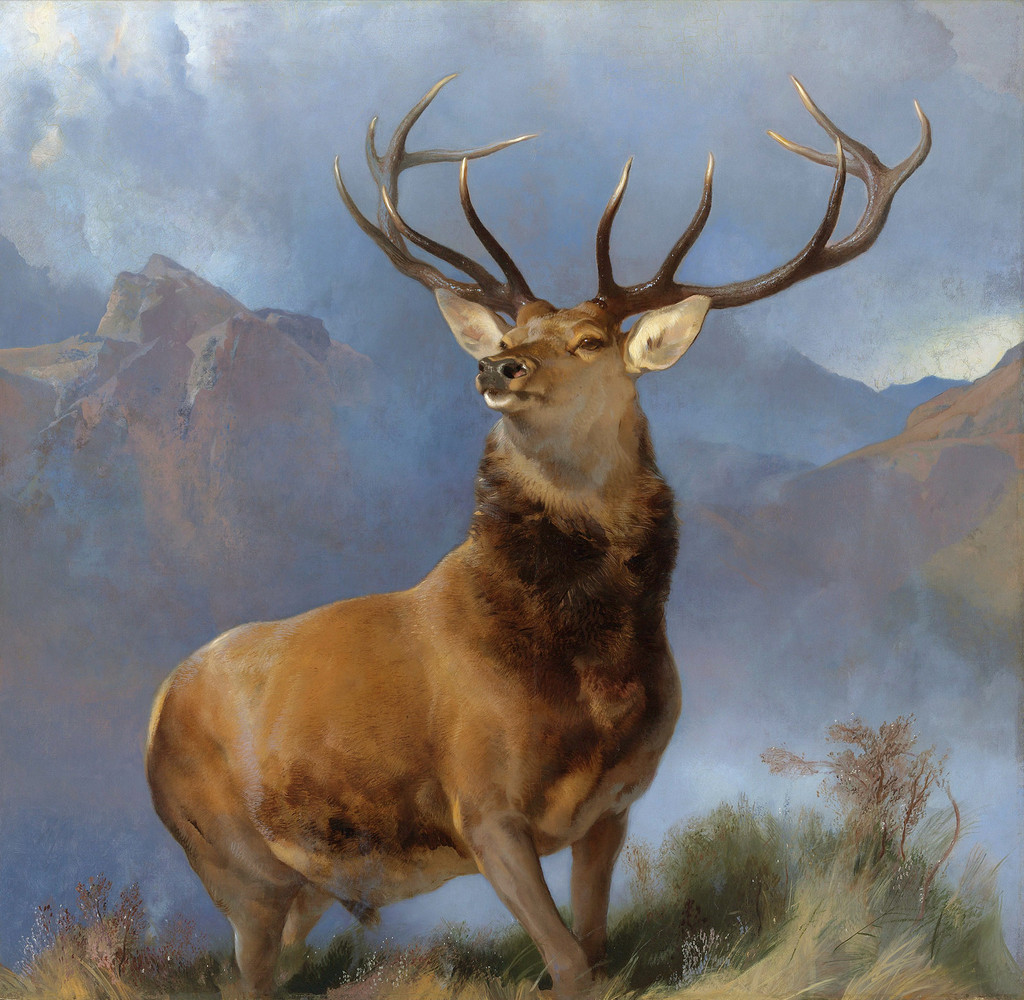
1825–26 [6]The Monarch of the Glen
about 1851 [11]Contents
- A long canvas and an interrupted shore
- The effort contained in one step
- The ducks have a claim to refuge too
- Light makes peace seem possible
- A title reinforced by poetry
- Loch Maree without a named island
- Dating a picture of recovery
- A public success with divided responses
- Ruskin tests the evening sky
- William Wells and Victoria's birthday gift
A long canvas and an interrupted shore
The Royal Collection records an oil painting on canvas measuring 61.3 by 152.7 centimetres. It is about two and a half times as wide as it is high, a proportion that makes lateral movement fundamental to the composition. The shoreline spreads across the lower edge, the distant hills form a second horizontal band, and the sky opens above them. Against these long divisions, the stag's legs and antlers provide a concentration of upright and branching shapes. Its body occupies the left part of the painting without closing off the landscape around it.[1]
The format offers more than a panoramic setting for an animal portrait. A compressed vertical picture could have isolated the head and antlers, making the stag's expression the principal subject. Here the space to the right gives consequences room to unfold. Reeds, rising ducks and retreating hills form an extended field of response. The animal is the largest living presence, but the picture asks the eye to travel beyond it before deciding what its arrival means. The empty-looking water is as necessary as the figure that interrupts it.[2]
At the front, dark rocks make the spectator conscious of a nearby edge. Their angular forms contrast with the loch's smooth surface, while reeds replace stone along much of the right-hand shore. The stag stands between those zones, neither deep in open water nor fully withdrawn into land. This threshold matters to the narrative. Safety is not represented by an enclosed shelter already possessed, but by the difficult act of gaining a foothold. The composition retains the moment of transition rather than showing an animal settled comfortably after danger.
The wide landscape also limits the stag's apparent power. Its antlers spread impressively, yet the expanse behind it remains larger than the body. Landseer grants the creature pictorial dignity without turning the surrounding water into a mere pedestal. The contrast between its substantial silhouette and the extensive, luminous setting allows vulnerability and grandeur to coexist. The animal has survived a journey, but the place into which it arrives does not become its exclusive territory.
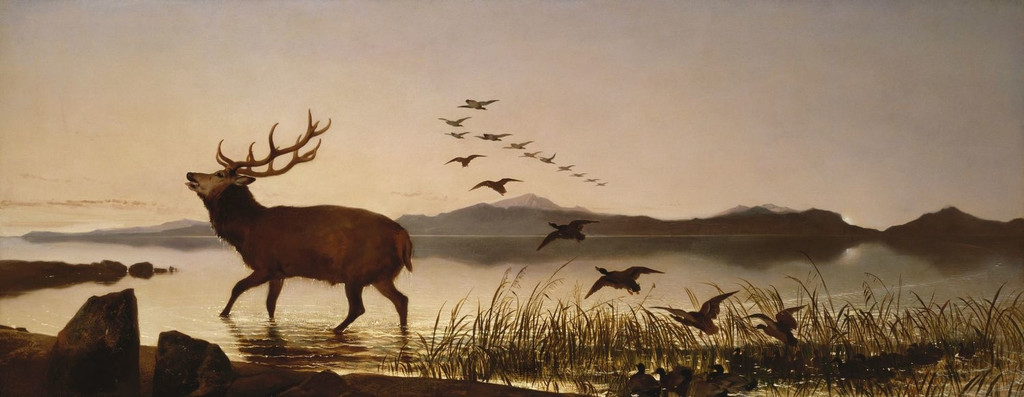
The Sanctuary. Royal Collection. Image source. Public domain.
The effort contained in one step
The stag faces left, with its body presented largely broadside and one foreleg raised. Its head lifts above a dark neck, and the antlers are sharply separated from the pale background. The open mouth and extended muzzle intensify the impression of exertion, while the hind legs remain involved with the water. These particulars make its movement legible without requiring a visible hunter or a sequence of earlier events. The title supplies refuge; the body supplies the difficulty of reaching it.[2]
Landseer does not give the stag the upright, commanding stance familiar from The Monarch of the Glen. Here the step is unfinished. The lifted leg briefly separates from the repeated lines of reflected light below it, and the position of the body makes forward movement seem laborious rather than effortless. The animal's grandeur depends on endurance. Its antlers have not diminished, but their visual authority belongs to a creature whose strength has been tested. Heroic scale and bodily fatigue are held together within the same silhouette.
Richard Ormond describes moisture clinging to the coat and the surviving curve of the stag's passage across the loch.[2] These details connect the foreground figure to a journey already made. The wake is a trace rather than a second episode: the viewer does not see the animal swimming through the middle distance, but can read the water as a surface on which motion has left evidence. Landseer compresses elapsed time into a present arrangement of light, ripples and stance.
The image does not disclose a wound, a bullet or a pursuing pack. Exhaustion is central to its interpretation, but the exact medical condition of the animal cannot be read from the pose. Nor does the open mouth allow a particular cry to be reconstructed. The stag communicates through its visible bearing and through the poem associated with the painting. Its vulnerability becomes persuasive because Landseer gives it a coherent physical presence, rather than because the viewer is furnished with an invented account of every sensation it experiences.
The ducks have a claim to refuge too
The birds prevent the stag's rescue from becoming an entirely private triumph. Some remain close to the reeds, while others rise into a sweeping diagonal and diminish towards the centre of the sky. The largest dark shapes are nearest the spectator; the more distant birds become small interruptions in the pale atmosphere. Their changing scale gives the composition a movement through depth that answers the stag's movement across the shallows. Grounded exertion and airborne flight are made parts of one event.[2][3]
In a simpler sporting narrative, wildfowl might supply scenery or demonstrate abundance. Here their departure is causally linked to the new arrival. They occupied the shoreline before the stag entered it, and their startled movement reveals that the sanctuary was already inhabited. The reeds are therefore more than a decorative frame. They identify a sheltered margin whose existing life is disturbed by the refugee. The painting's ethical complication emerges from this exchange of places, not from an abstract emblem added elsewhere in the landscape.[2]
Ormond draws attention to an 1842 Athenaeum response that understood the ducks as the price of the stag's safety: relief for one creature could bring trouble to another.[2] That interpretation recognises something the title alone might conceal. The word sanctuary seems to promise an absolute division between violence and peace, but the picture shows movements passing across that division. The stag has escaped one danger; the ducks respond to a new alarm. Their experiences overlap without becoming identical.
The fleeing birds need not be assigned a definite fatal destination. Ormond tentatively connects their flight towards the sunset with mortality and oblivion, a symbolic reading rather than an event visibly completed in the painting.[2] What can be seen is departure. The ducks are not shown being shot or captured, and the stag is not deliberately attacking them. Their disturbance is enough to complicate the scene. The picture's emotional range depends on allowing different degrees of fear, relief and uncertainty to remain together.
Light makes peace seem possible
The stag's dark body is placed against a luminous band of water and sky. Warm light is strongest towards the left, while the upper and right-hand atmosphere becomes cooler and less saturated. Across the middle, low hills interrupt the brightness and are repeated in the water beneath them. This alternation of dark land and reflective surface makes distance visible without filling it with incident. The loch appears extensive because the eye can follow its light between the foreground shore and the far ridges.[2]
Ormond interprets the atmosphere as a mingling of evening sunlight with pale moonlight, and regards the picture as an important development in Landseer's symbolic deer imagery.[2] His account identifies an intensity that goes beyond a record of an animal in a recognisable place. The light appears to welcome the exhausted stag into a world temporarily removed from pursuit. Yet that effect is achieved through differences of tone and temperature, not through a visible supernatural figure or an explicitly religious event.
The water is especially important to this transformation. It has been an obstacle requiring a swim, but it now carries light around the animal's legs and separates the island from the absent hunt. A material that exhausted the stag also helps protect it. Landseer allows that double function to remain visible: the foreground ripples record effort, while the broad reflected brightness suggests respite. The same surface holds the physical history of escape and the pictorial promise of calm.
Colour should nevertheless be distinguished from claims about materials or condition. A photograph and the ordinary appearance of the work reveal a warm horizon, dark silhouettes and cooler upper air; they do not identify individual pigments, a glazing sequence or the effects of an undocumented treatment. Historical viewers themselves disagreed about the success of the colour. The atmosphere that made the painting seem poetic to some could appear insufficiently harmonious to others. Its apparent serenity did not prevent close scrutiny of how it was painted.[2][14]
A title reinforced by poetry
The Royal Academy exhibition placed The Sanctuary before the public in 1842 as catalogue number 431. Landseer accompanied the painting with verse describing frightened wildfowl, a weary swimmer and an island beyond the reach of pursuit. The words directed spectators towards a particular understanding of the still scene: the stag had been hunted, the shore offered protection, and the birds' flight belonged to its arrival. The text supplied the preceding danger that the canvas kept out of sight.[2][3]
The verse has a more complicated bibliographical history than a single familiar title suggests. Dafforne printed an eight-line passage under the heading Loch Maree and did not identify its author. Ormond, following Campbell Lennie, attributed the poem to Landseer's friend William Russell and named it The Stricken Deer. The Royal Collection also uses the latter title and attribution.[1][2][3] These records establish the relationship between verse and painting without requiring the differently labelled excerpts to be treated as separate literary commissions.
One brief phrase, “Nor hound nor hunter”, makes the imagined protection explicit.[3] Neither pursuer appears within the frame. The verse therefore speaks about a boundary that the image can suggest but cannot enforce. Water and island shore separate the animal from the violence beyond, while the spectator remains free to wonder how secure such a refuge can be. Read beside the ducks, the promise also becomes selective: the stag's rest has begun with the displacement of other inhabitants.
Poetry changes the way time works in the picture. Without it, a viewer might see an impressive deer moving through evening water and remain uncertain about the preceding action. With it, the lifted leg becomes the continuation of a painful journey, and the empty distance becomes a space from which danger has been left behind. The picture retains its visual independence, however. Rocks, reeds, reflected light and the birds' changing size make an intelligible scene even when the catalogue is closed. Words concentrate an argument that the composition can sustain through looking.
Loch Maree without a named island
Both the Royal Collection and Ormond identify the setting as Loch Maree in the Scottish Highlands.[1][2] The attribution gives the scene a geographical foundation, but it does not turn every contour into a secure topographical label. Landseer presents water, islands and surrounding hills as a connected refuge. The painting does not provide a map, a route through the loch or an inscription naming the exact strip of shore beneath the stag. A recognised setting and an identifiable viewpoint are different kinds of knowledge.
The island matters first as a place that water has made difficult to reach. Its separation from the far shore allows an absence of visible hunters to become plausible within the story. The foreground land is nevertheless close to the spectator, so the viewer occupies the side of refuge rather than following the animal from the hunting ground. This is an effective reversal of a sportsman's viewpoint. The stag approaches the part of the landscape from which it can be watched sympathetically, with the pursuit excluded behind it.
Ormond mentions the early Christian associations of islands in Loch Maree, including the historical traditions connected with Isle Maree.[2] Those associations can enrich the resonance of a title such as The Sanctuary, but they do not identify the painted island or prove that Landseer intended a specific Christian allegory. There is no church, saint or ruined chapel within the composition. The visible shelter is the shore itself. The picture's spiritual suggestiveness remains a quality of light, separation and release rather than a documented sacred narrative.
The absence of buildings and human figures also needs to be read carefully. It creates pictorial remoteness without establishing that the surrounding country was beyond ownership or human use. The hunt named by the verse already implies a human presence outside the image. Landseer can remove the sportsman from sight while retaining the consequences of sport in the animal's fatigue. This is a landscape organised around the experience of the quarry, even though the social world of hunting remains necessary to explain why the stag has come there.
Dating a picture of recovery
The current Royal Collection date is 1842; Ormond more cautiously catalogued the painting as made by that year. The exhibition supplies a firm public endpoint, while the beginning of the work is less certain. Ormond notes Landseer's presence in Scotland during autumn 1841 but allows for an earlier start.[1][2] It would therefore be misleading to assign the finished canvas to one documented excursion or to describe it as the product of a single evening witnessed from the shore.
That uncertainty is important because the painting can look like an immediate response to a fleeting effect. The stag appears caught between steps, the ducks are still rising, and light seems suspended before it changes. Such concentration does not reveal the duration of making. A picture may organise several kinds of observation into a scene whose action lasts only seconds. Neither the ease of the arrangement nor the impression of a transient sky establishes how quickly the canvas was executed.
The work also belongs near a difficult period in Landseer's life. Ormond records his brief Scottish visit in 1839 and his travel abroad in 1840 while recovering from a breakdown.[2] Those circumstances help explain caution about the chronology, but they should not become a diagnosis hidden inside the stag. The animal's fatigue is an element of the represented story. A biographical parallel between an artist seeking recovery and a creature reaching refuge may be suggestive, but the surviving evidence does not make the painting a literal self-portrait.
The distinction preserves the power of the image. Its emotional appeal does not depend on decoding private symptoms or treating every dark passage as autobiographical confession. The painter's recent difficulties and the public appearance of the work are historical circumstances; the stag's escape is a pictorial construction. Their proximity invites thought without cancelling the independence of either. Landseer's command lies in making an animal's passage towards safety intelligible to people whose own experience of danger or exhaustion may have taken very different forms.
A public success with divided responses
The Royal Academy gave the painting a public existence before it became a royal possession. In that setting, the narrow shore and isolated stag belonged to a crowded exhibition of many kinds of painting. A visitor could turn from animal pictures to portraiture, historical narratives, landscape or marine subjects, carrying expectations from one genre into another. Martin Postle's account of the 1842 exhibition places Landseer's work beside the controversial contributions of Turner, making clear how differently contemporary writers could understand a painter's fidelity to nature.[15]
One comparison was especially revealing. Postle cites a North of England Magazine critic who treated Turner's Snow Storm as a dangerous excess of genius while praising the emotional and natural force of The Sanctuary.[15] The pairing did not simply oppose a careful painter to a careless one. It placed two highly constructed experiences of weather, water and atmosphere under competing definitions of credibility. Landseer's plainly legible animal and intelligible narrative could seem trustworthy even where his luminous evening was emphatically arranged for poetic effect.
Other praise focused on the economy of means. Ormond records the Art-Union response to the painting's ability to create poetry from a small number of elements, and Dafforne later repeated that admiration.[2][3] The claim has a precise visual basis. There is one stag, a flock, a margin of land and a great deal of open water and sky. The narrative does not require a crowd of human actors or a visible climax of the chase. Movement through the scene, rather than an accumulation of episodes, carries the feeling.
Favourable notices did not make the reception uniform. Ormond also records criticism of the relation between the cool, strongly coloured land and water and the brilliant orange atmosphere.[2] A viewer could accept the subject's emotional appeal while questioning its colour, just as a literary response to the ducks could differ from admiration for the stag. These were overlapping judgements about a single picture. They show how Landseer's apparent accessibility still left room for disagreement over natural truth, pictorial harmony and the obligations of an animal painter.
Ruskin tests the evening sky
Ruskin's criticism gives that disagreement a sharper form. In Modern Painters, he referred to Landseer's unsuccessful handling of an evening sky in 1842, within a discussion of tone and the means by which oil painting could convey light. The passage does not name The Sanctuary; Ormond identifies it as the picture at issue.[2][14] That distinction matters because Ruskin's remark is brief and embedded in a larger comparison of painters. It is evidence of a particular objection, not a comprehensive account of everything he thought about the work.
For Ruskin, tone involved the relationship between illuminated things and the colours that represented them. Bright pigment alone could not guarantee the effect of light. A passage might be intensely coloured yet fail to establish the harmony that made objects seem to exist under a shared illumination. His discussion moves among Landseer, Callcott, Stanfield, Etty and Turner, treating difficulties of colour as problems of artistic knowledge and purpose.[14] Landseer's evening entered that argument as an example of ambition whose execution could be challenged.
The criticism brings the sky back into the foreground of interpretation. It is easy to concentrate on the stag's head and read the rest as an attractive setting. Yet the atmosphere makes the island seem to offer a different order of experience from the absent hunt. If the relations of colour fail, the promised peace risks becoming theatrical or artificial. Ruskin's criterion therefore touches the painting's emotional mechanism even though his sentence addresses its pictorial means rather than its moral story.
The image can sustain this criticism without losing its other achievements. The birds' recession, the placement of the stag and the contrast between solid shore and reflective distance still organise a compelling encounter. At the same time, the critical dispute discourages a passive acceptance of sunset as a ready-made guarantee of profundity. The atmosphere has work to do. It must connect separate surfaces, make space convincing and allow a weary body to belong within it. The Sanctuary was admired partly because viewers felt that connection; its colour remained a point at which others resisted it.
William Wells and Victoria's birthday gift
William Wells of Redleaf was the painting's first owner. The Royal Collection identifies him as Landseer's most prolific individual patron and records Victoria's purchase after she saw the work at the Academy. Her journal entry of 26 August 1842 described the stag moving through water and disturbing wild ducks, and explained that Wells had relinquished the picture to her. She gave it to Albert as her principal birthday present.[1] The acquisition joined public exhibition, private patronage and royal collecting within the painting's first year of recorded display.
This chain corrects a common shortening of its history. Dafforne later called the work a picture painted for the Prince Consort, but his account omits Wells's intervening ownership.[3] The royal gift is secure; a commission conceived from the outset for Albert is not established by that phrase. Remembering Wells restores the agency of another collector and avoids making royal possession the inevitable destination of the canvas. Victoria's own description preserves the sense that she obtained something already valued by somebody else.
Ormond cites the Queen's private picture accounts for a price of £215, a figure also given by Postle.[2][15] A separate 1875 Art-Journal account, invoking Algernon Graves, reported that Wells had paid the artist 100 guineas.[16] Those amounts belong to different reported transactions and to evidence of different kinds. They should not be combined into a speculative calculation of commission, profit or resale terms. The first is presented through modern scholarship's archival citation; the second survives as a retrospective period statement about the earlier patronage.
The painting was placed in Albert's Writing Room at Windsor.[1] Its long strip of evening landscape thus entered an interior associated with the Prince's private daily life. The purchase preceded the royal Scottish journey of September 1842, so it offered a Highland image before Victoria could compare such scenery with her own experience. It would later sit within a much wider royal engagement with Scotland, but in its initial form it was a personal gift: an expansive view of refuge transferred from an exhibition and a patron's collection into a room used by a named recipient.
A sportsman's picture of the quarry
Albert's ownership did not resolve the ethical tension of the subject. He was an enthusiastic shot, and Landseer also participated in Highland deer sport. The Royal Collection places their sporting interests beside the painting's sympathy for a hunted animal.[1] This combination is historically revealing. Affection for the natural world, admiration for a stag's courage and participation in the chase could coexist. The image gives its fullest attention to the quarry without proving that either its maker or its recipient rejected hunting as a practice.
The emotional position offered to a viewer is nevertheless unusual. The stag is encountered after the sportsman's presence has fallen out of sight. Its value is no longer measured by a successful shot or by the presentation of a trophy. What commands attention is its continued movement towards land. The spectator has time to dwell on effort and on the possibility of survival. By withholding the hunter, Landseer changes the distribution of interest within a sporting story, even if he does not supply an explicit programme of reform.
The picture also refuses to make the quarry's refuge entirely innocent. Ducks scatter from the very shore that promises relief. They give a second scale to the consequences of arrival: a powerful animal that has been vulnerable can itself become an alarming presence. The stag need not intend injury for its movement to unsettle others. This makes the work more searching than a simple reversal in which the hunter is cruel and the hunted creature wholly free of effects upon surrounding life.
Sympathy here can therefore be understood as an expansion of attention. The exhausted body receives recognition, and the disturbed birds retain their own place in the scene. Ormond's account of the Athenaeum critic shows that this complication was available to an early viewer, rather than being solely a later moral imposed upon the canvas.[2] The painting permits a spectator to feel relief without allowing relief to end the act of looking. Its calm includes the small disorder by which the stag has entered it.
A chalk head behind the finished stag
An 1875 Art-Journal article identified a large, lightly worked black-chalk Stag's Head, then belonging to Algernon Graves, as a study for The Sanctuary. The following page reproduced it and labelled it 1842.[16] This is a historical witness to a preparatory relationship, preserved after Landseer's death. It links the finished animal's expressive centre with a separate drawing, while leaving the exact sequence of studies and revisions incompletely documented.
The relationship is valuable because a head study and a panoramic canvas ask different things of an animal form. In a separate sheet, the angle of the muzzle, the weight of the head and the branching antlers can command attention without a full setting. In the painting, those forms must also relate to the raised leg, the body's position in water, the distant hills and the flight of the ducks. A concentrated study of expression becomes one part of a larger organisation of space and movement.
The reproduced drawing shows the head more steeply lowered than it appears in the finished painting.[16] Its association with the canvas should therefore invite comparison rather than an assumption of exact transfer. A study may explore a possibility that changes when the complete composition takes shape. The printed label does not explain when that decision occurred, or whether other drawings intervened. What survives here is a related investigation of the stag's bearing, rather than a complete visual record of each stage in making the picture.
The article's language is itself instructive. It treated the sketched head as a convincing expression of fatigue and imagined the continuing alarm of pursuit.[16] Such commentary records how readily nineteenth-century viewers converted visible posture into an inward narrative. The claimed preparatory connection and the critic's imagined sensations should be kept distinct. A drawing can establish the artist's interest in a particular form without giving direct access to what the represented animal hears or remembers.
Nor does the reproduction establish every material property of the original drawing. The period text names black chalk, while the printed image translates the sheet into another medium. Its marks reach the reader through an engraver and the journal's production. That mediation is part of its usefulness: the study was not merely stored in a private collection but presented to a reading public as evidence of Landseer's working imagination. The article invited attention to a rapidly indicated head alongside the already familiar finished composition.[16]
Exhibitions, engravings and a second life
The painting continued to travel after its acquisition. Ormond lists its appearance at the Royal Scottish Academy in Edinburgh in 1851, the Paris Exposition Universelle of 1855, London's International Exhibition of 1862 and the 1874 Landseer memorial exhibition.[2] Royal ownership did not remove it permanently from public comparison. At each exhibition, the canvas could encounter a different arrangement of neighbouring works and a different audience. Its private significance as Albert's gift and its public status as an example of British painting developed alongside one another.
The Paris showing did not simply repeat its British success. Ormond observes that The Sanctuary attracted less attention from French critics than some of Landseer's other contributions.[2] This difference does not amount to proof of rejection. It shows that a work admired for its poetry and sentiment at home did not necessarily occupy the same place in another critical setting. The international exhibition placed the picture within a broader account of national schools and pictorial achievement, where its particular balance of animal narrative and landscape could be valued differently.
Engraving created further changes of setting and scale. Ormond records plates by Charles George Lewis in 1850 and 1859, George Zobel in 1867, Thomas Landseer in 1869 and W. H. Simmons in 1871, as well as a later Library Edition plate by J. C. Webb.[2] Graves's 1874 exhibition catalogue also distinguishes several sizes and makers, identifying Thomas's version while noting earlier Lewis plates and subsequent reworking.[17] These records describe a family of reproductive objects. They should not be collapsed into one engraving credited automatically to the artist's brother.
The National Trust's impression at Blickling Hall provides a surviving object through which that history becomes concrete. Its catalogue names Charles George Lewis as engraver, Edwin Landseer as the source artist and F. G. Moon as publisher. The dedication addresses Prince Albert and identifies the original as belonging to the Royal Collection.[18] The print thus carried royal ownership into its own presentation: the source painting's prestigious location became part of the information offered to a purchaser or viewer elsewhere.
The same record describes paper and gives dimensions of 760 by 1085 millimetres.[18] Those are the catalogued print object's measurements, not the proportions of the original painted support. Text, margins and the physical sheet belong to the reproductive work's separate existence. Even when an engraving repeats the principal arrangement, it changes the relation between image and surrounding material. Colour gives way to engraved tone, while dedication and publication lettering can attach the peaceful island to a network of makers, owners and sellers.
Multiplicity does not by itself establish how many impressions were sold or how every audience responded. It does establish sustained efforts to make the composition available in more than one form. A long oil painting held in a royal collection could enter other rooms as a differently sized work on paper. The stag and birds survived that movement, but the experience of light, scale and surface changed. The image's afterlife depended on skilled translation rather than on an unchanged original simply multiplying itself.[2][17][18]
The sanctuary remains inhabited
Landseer gives the painting two movements with different emotional directions. The stag advances towards the near shore and towards the possibility of rest. The birds rise away from that shore, carrying disturbance into the air and distance. The loch links them through its light, while the composition keeps their bodies and experiences separate. This arrangement allows a single place to be both an arrival and a departure, a refuge gained and a shelter interrupted.
The poem promises protection from the chase, and the luminous atmosphere makes that promise felt. Yet the foreground will not become an empty stage reserved for the stag's deliverance. Reeds, waterfowl and the uneven shore retain their own claims upon it. The animal enters a living margin rather than a space cleared for its comfort. The painting's stillness is therefore active: it holds the consequences of movement long enough for the spectator to notice who is resting and who must move again.
That tension could speak to a royal collector, an Academy visitor, a critic interested in colour or a reader encountering an engraving. None needed to see the same thing first. The antlers might announce dignity, the raised leg exhaustion, the distant light release or the ducks a troubling qualification. Landseer binds those readings into a composition whose calm is never entirely vacant of alarm. The sanctuary is persuasive because it admits vulnerability; it becomes memorable because another creature is already living there.
Artworks directory
This directory gathers works discussed in the articles, including drawings, original etchings and prints after Landseer. It is not a complete catalogue of every drawing, version, plate or impression. Distinct media are kept separate; uncertain dates are left blank. Linked titles open individual articles.
| Name | Date | Medium |
|---|---|---|
| A Bellowing Stag | Drawing | |
| A Deerhound | 1826 | Painting |
| A Distinguished Member of the Humane Society | 1838 | Painting |
| A Highland Breakfast | 1834 | Painting |
| A Highland Landscape | c. 1830 | Painting |
| A Highland Shepherd's Home | Painting | |
| A Horse, Goat and Bull | 1811 | |
| A Hunting Horse | Drawing | |
| A Jack in Office | Painting | |
| A Lion Disturbed at His Repast | Painting | |
| A Random Shot | Painting | |
| A Scene at Abbotsford | Painting | |
| Adversity | Painting | |
| Alexander and Diogenes | exhibited 1848 | Painting |
| Alpine Mastiffs Reanimating a Distressed Traveler | 1820 | Painting |
| Contending Group after Nature | Drawing | |
| Copy after Rubens's Wolf and Fox Hunt | c. 1824–26 | Painting |
| Dash | Painting | |
| Deer and Deer Hounds in a Mountain Torrent ('The Hunted Stag') | c. 1832 / exhibited 1833 | Painting |
| Deer Family | ||
| Dignity and Impudence | 1839 | Painting |
| Dog Resting Upon a Couch | Drawing | |
| Eos | 1841 | Painting |
| Favourites, the Property of H.R.H. Prince George of Cambridge | 1834–35 | Painting |
| Her Majesty Sketching at Loch Laggan | ||
| High Life | 1829 / exhibited 1831 | Painting |
| Highland Lassie | Drawing | |
| Isaac van Amburgh and his Animals | 1839 | Painting |
| Lady Godiva's Prayer | Painting | |
| Laying Down the Law | 1840 | Painting |
| Lion Defending Its Prey | c. 1840 | Painting |
| Lioness | Drawing | |
| Little Strollers | ||
| Low Life | 1829 / exhibited 1831 | Painting |
| Man Proposes, God Disposes | 1864 | Painting |
| Nell Gwynne / Diana Vernon | Painting | |
| Neptune | ||
| No Hunting Till the Weather Breaks | Painting | |
| Otterhounds | Drawing | |
| Peace | Painting | |
| Pensioners | Painting | |
| Portrait of a Mule | Painting | |
| Portrait of Mr Van Amburgh, as He Appeared with His Animals at the London Theatres | 1846–47 | Painting |
| Portraits of a Pointer Bitch and Puppy | Painting | |
| Pray Let Me Out | ||
| Prosperity | Painting | |
| Ptarmigan in a Landscape | by 1833 | Painting |
| Queen Victoria and Prince Albert at the Bal Costumé of 12 May 1842 | 1842–46 | Painting |
| Queen Victoria at Loch Laggan | Painting | |
| Queen Victoria at Osborne | 1865–67 | Painting |
| Queen Victoria landing at Loch Muick | Painting | |
| Rat-catching | 1823 | |
| Reclining Lion | Drawing | |
| Reclining Lion, From Back | Drawing | |
| Rent-day in the Wilderness | 1855–68 | Painting |
| Return from Deer Stalking | 1839 | |
| Royal Sports on Hill and Loch | Painting | |
| Sam Lovill, Porter at the Royal Academy | Drawing | |
| Scene from A Midsummer Night's Dream | 1848–51 | Painting |
| Scene in the Highlands, with portraits of the Duchess of Bedford, the Duke of Gordon and Lord Alexander Russell | Painting | |
| Scottish Highlands, Lochs and Figures | Drawing | |
| Shoeing | exhibited 1844 | Painting |
| Sleeping Bloodhound | exhibited 1835 | Painting |
| Spaniel and Rabbit | Painting | |
| Stag at Bay | 1866 | Sculpture |
| Stag at Bay | 1846 | Painting |
| Studies of a staghound and the head of a stag for painting ‘The Hunting of Chevy Chase’ | Drawing | |
| Study for Alpine Mastiffs Reanimating a Distressed Traveler | Drawing | |
| Study for the Monkey in The Cat's Paw | Drawing | |
| Study of a Dog | Drawing | |
| Study of a herding dog facing right | Drawing | |
| Study of the horse of Selene, from the East pediment of the Parthenon | Drawing | |
| Suspense | Painting | |
| Taking a Buck | ||
| The Arab Tent | c. 1865–66 | Painting |
| The Barn | Drawing | |
| The Best Run of the Season | ||
| The Cat's Paw | c. 1824 | Painting |
| The Cavalier’s Pets | ||
| The Challenge | Painting | |
| The Chase | Drawing | |
| The Connoisseurs: Portrait of the Artist with Two Dogs | 1865 | Painting |
| The Death of a Stag in Glen Tilt | Painting | |
| The Drive—Shooting Deer in the Pass | Painting | |
| The Drover's Departure | Painting | |
| The Highland Shepherd’s Dog | 1824; portfolio issue 1848 | |
| The Honourable Mrs Norton | Painting | |
| The Hunting of Chevy Chase | 1825–26 | Painting |
| The Illicit Highland Whisky Still | Painting | |
| The Keeper John Crerar with his Pony | Painting | |
| The Larder Invaded | ||
| The Lion-Dog of Malta | ||
| The Lions at the Base of Nelson's Column | 1867 | Sculpture |
| The Monarch of the Glen | about 1851 | Painting |
| The Mountain Torrent | ||
| The Old Shepherd's Chief Mourner | 1837 | Painting |
| The Sanctuary | 1842 | Painting |
| The Stricken Deer | Painting | |
| The Twa Dogs | Painting | |
| Time of Peace | ||
| Two stags running | Drawing | |
| Victoria, Princess Royal, with Eos | Painting | |
| View of Glenfeshie | Painting | |
| War | Painting | |
| White Horse in a Stable | Painting | |
| Windsor Castle in Modern Times | 1841–43 | Painting |
| Woburn Abbey Game Card | 1825; portfolio issue 1848 |
Discussion
Use the article’s images and evidence to develop your own reading of The Sanctuary.
Reader Insights
Which detail is most revealing when you consider “A long canvas and an interrupted shore”?
How does the evidence in “The effort contained in one step” affect your reading of The Sanctuary?
What further question would you bring to “The sanctuary remains inhabited”?
Join the Conversation
Share a detail, comparison or question about The Sanctuary below.
References
- Royal Collection Trust, “The Sanctuary”, 1842, RCIN 403195; text adapted from Victoria and Albert: Art & Love (2010). View source.
- Richard Ormond, Sir Edwin Landseer (Philadelphia Museum of Art and Tate Gallery, 1981), no. 121, pp. 170–171; no. 122, pp. 171–172 for the adjacent deer composition. View source.
- James Dafforne, Pictures by Sir Edwin Landseer, Royal Academician (London: Virtue, 1873), p. 22 and exhibition list, p. 81. View source.
- National Gallery of Art, Alpine Mastiffs Reanimating a Distressed Traveler. View source.
- Minneapolis Institute of Art, The Cat's Paw. View source.
- Birmingham Museums Trust, The Hunting of Chevy Chase. View source.
- Victoria and Albert Museum, The Old Shepherd's Chief Mourner. View source.
- Tate, Dignity and Impudence. View source.
- Royal Collection, Eos. View source.
- Royal Collection, The Sanctuary. View source.
- National Galleries of Scotland, The Monarch of the Glen. View source.
- Royal Holloway, University of London, Man Proposes, God Disposes. View source.
- Trafalgar Square / Greater London Authority, The Lions at the Base of Nelson's Column. View source.
- John Ruskin, Modern Painters, vol. I, part II, section II, chapter II, “Of Truth of Colour”, discussion of tone and Landseer's 1842 evening sky. View source.
- Martin Postle, “1842: Snowstorm and Sanctuary”, in The Royal Academy Summer Exhibition: A Chronicle, 1769–2018, edited by Mark Hallett, Sarah Victoria Turner and Jessica Feather (Paul Mellon Centre, 2018). View source.
- “Studies and Sketches by Sir Edwin Landseer, R.A.”, The Art-Journal, November 1875, pp. 321–324, particularly pp. 321–322; text and reproduced study also transcribed by George P. Landow on The Victorian Web. View source 1. View source 2.
- Algernon Graves, Catalogue of an Exhibition of the Engraved Works of the Late Sir Edwin Landseer (London: Henry Graves & Co., 1874), p. 17, no. 298. View source.
- National Trust Collections, “The Sanctuary (after Sir Edwin Henry Landseer)”, Charles George Lewis, NT 354061, Blickling Hall, Norfolk. View source.
- Splash image, The Sanctuary. Royal Collection. Image source. Public domain.
- Navigation image, One of the bronze lions at Nelson’s Column: modelled by Edwin Landseer and cast by Carlo Marochetti. Photograph by Amanda Slater. CC BY-SA 2.0. Image source. CC BY-SA 2.0. Resized.