 by Tom Gurney
Tom Gurney BSc (Hons) is an art history expert with over 20 years experience
Email: tomgurney1@gmail.com / Phone: +44 7429 011000
A rescue held at its most uncertain moment
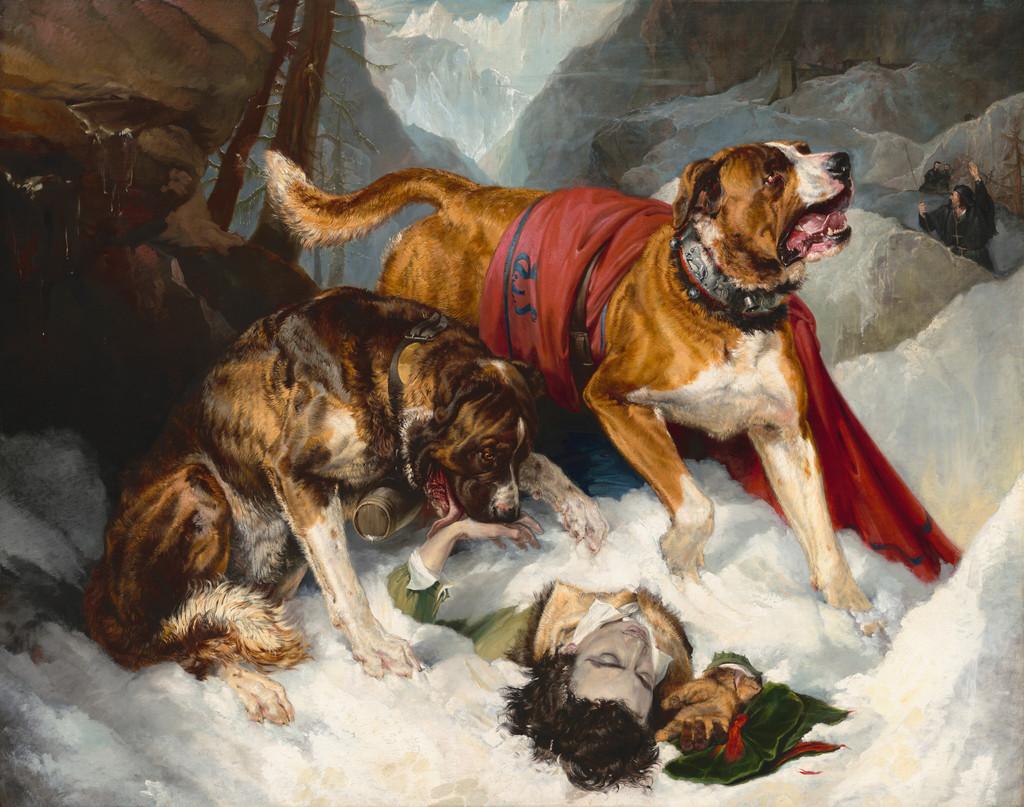
Two dogs have found a man almost swallowed by snow. One stays low beside him, pressing its muzzle to his bare hand. The other stands over the drift, paws forward and head thrown towards help. High across the mountain pass, three tiny figures are beginning to descend from a block-like hospice. They have been alerted, but they are still far away. The traveller's eyes remain closed. Nothing in the painting discloses whether he will live.
Edwin Landseer built Alpine Mastiffs Reanimating a Distressed Traveler around that interval between discovery and recovery. Painted in 1820, when he was eighteen, it was the largest and most ambitious picture he had yet attempted. The oil measures 189 by 237 centimetres, large enough to make the dogs' response carry the gravity more often granted to heroic human action. It is now in the National Gallery of Art in Washington, accession 2019.120.1, having entered the collection through the Patrons' Permanent Fund in 2019.[1][2]
The National Gallery uses the American spelling “Traveler” in the title. The address of this page retains the previously established British “traveller”; the difference is deliberate rather than a sign that two pictures are involved. The work has in any case moved through several names. It was later shown as The Dogs of St. Bernard, sold as St. Bernard Dogs, and translated by Landseer's brother John into an engraving called Alpine Mastiffs Reanimating a Traveller. Those variations register changing emphasis—from breed, to action, to legend—around one large canvas.[1][3]
“Reanimating” sounds strange now because popular culture has pulled the word towards supernatural revival. Here it means trying to restore animation: warmth, movement and consciousness. The title asserts an effort, not an outcome. It asks viewers to recognise rescue in gestures that remain materially incomplete. The dogs can touch, dig and call; the human party can approach; the picture can hold out hope. It cannot show the next minute.
That unresolved structure is one reason the image lasted. Another is a much smaller detail. The darker dog carries a wooden cask at its neck, the source of the irresistible story that Saint Bernards delivered brandy to people stranded in the Alps. The practice is folklore, not documented rescue procedure, but Landseer's picture made the equipped, cask-bearing dog visually convincing. Eleven years later, John's explanatory pamphlet explicitly filled the vessel with brandy. Modern institutional histories correct the claim, yet the correction reveals rather than diminishes the painting's power: a prop only a few inches wide helped to equip an entire breed in the popular imagination.[4][5][6]
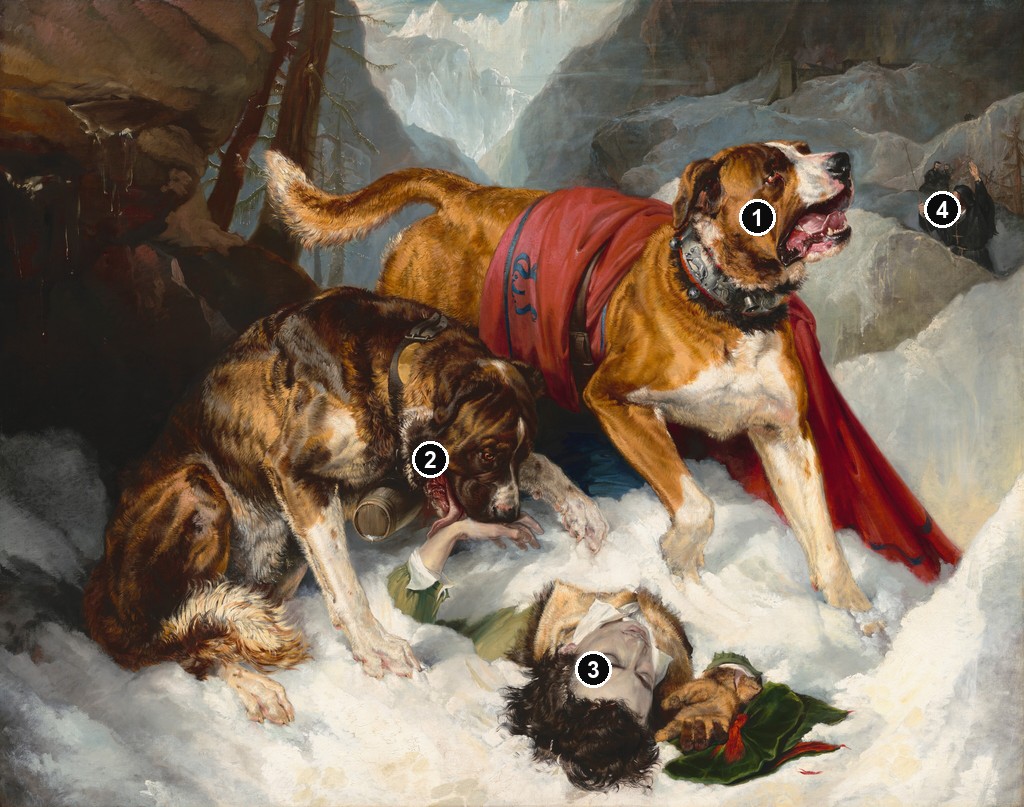
Annotated Details from Alpine Mastiffs Reanimating a Distressed Traveler
The numbered points identify visible features discussed in this article. Return from each detail to the whole composition. Alpine Mastiffs Reanimating a Distressed Traveler. National Gallery of Art. National Gallery of Art, Patrons’ Permanent Fund, 2019.120.1. Image source. CC0 / Public domain.
Details from ALPINE MASTIFFS REANIMATING A DISTRESSED TRAVELER
Compare the dogs’ different actions, the traveller’s low position and the distant human figures.
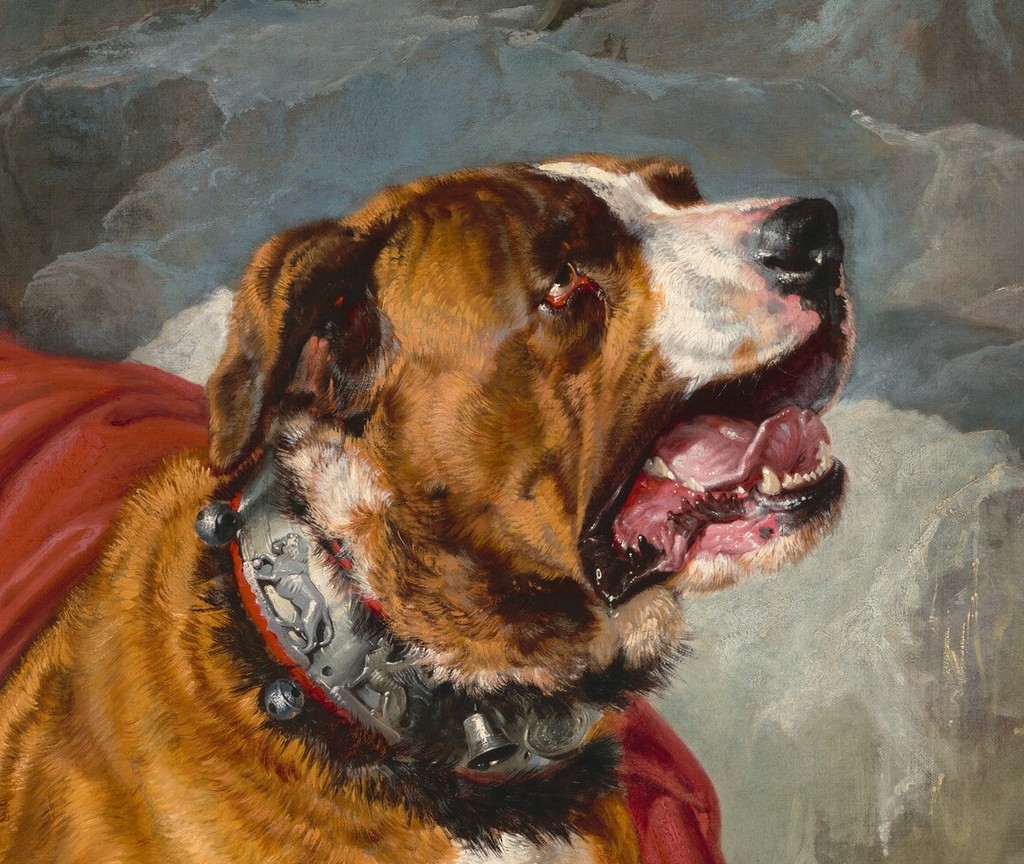
The dog calling outward
The raised head and open mouth direct attention out of the immediate rescue group. The red cloth makes this upright dog a strong vertical presence.
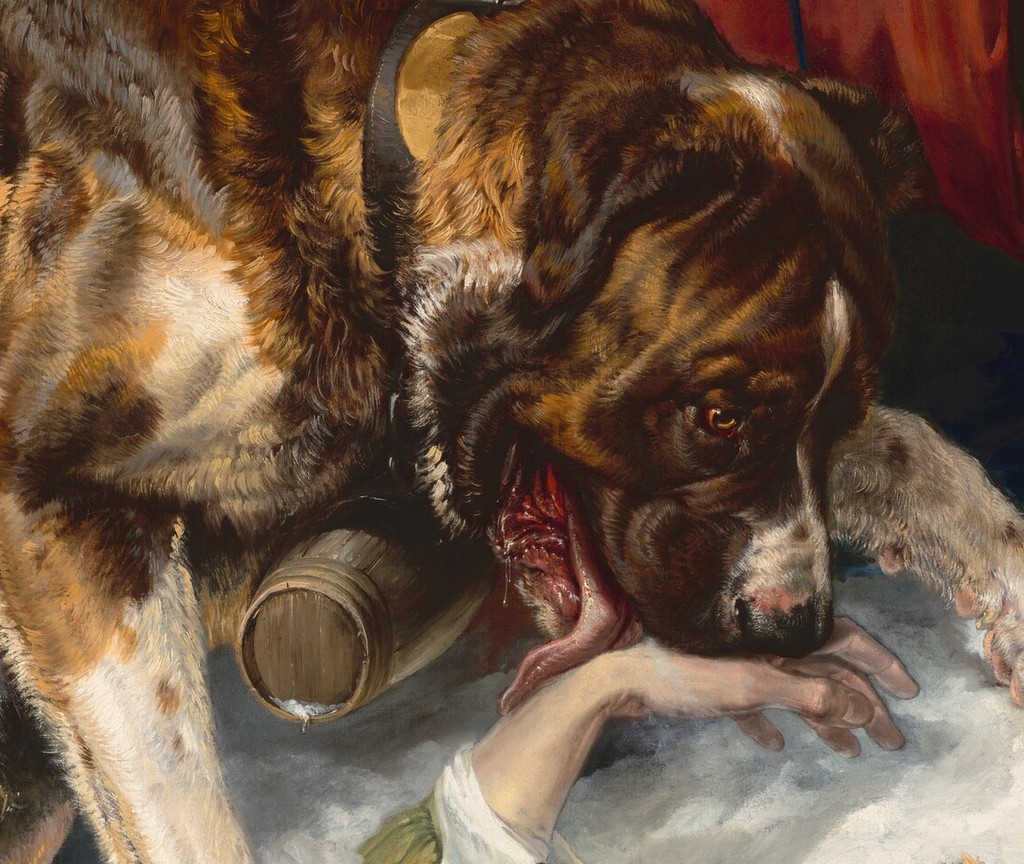
The barrel and the lowered head
The small barrel hangs beneath the lowered dog’s neck. Its position joins the dog’s head, the traveller’s hand and the snow in one closely packed passage.
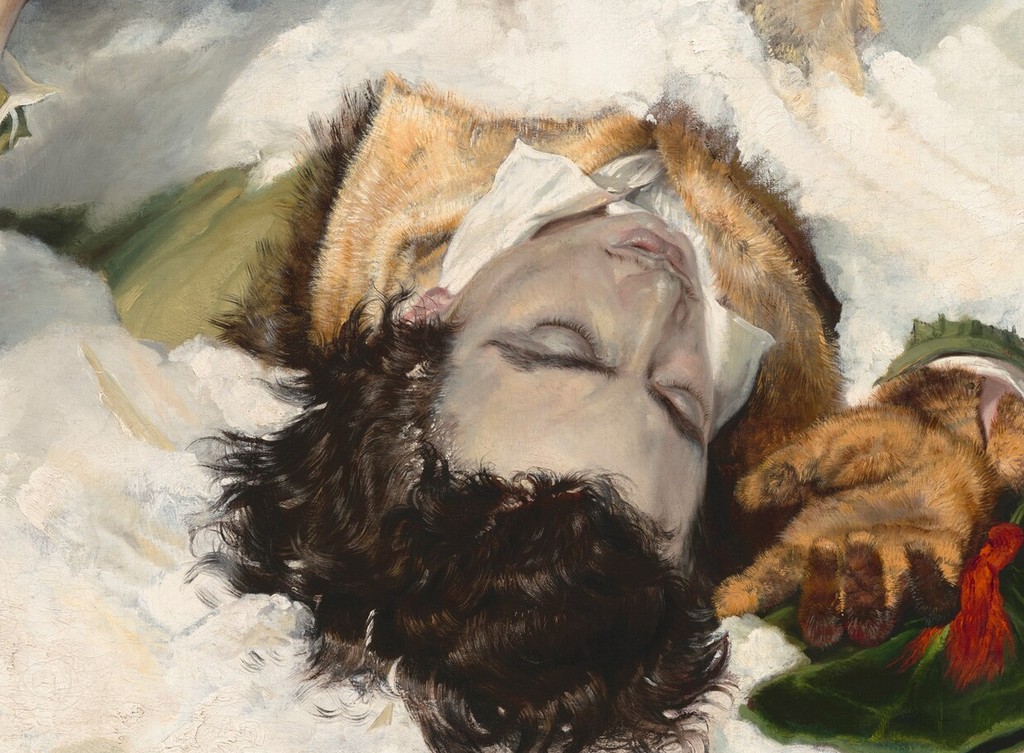
The traveller beneath the dogs
The pale face lies low in the composition, beneath the more active animals. Dark hair, pale skin and surrounding snow make the human body both visible and vulnerable.
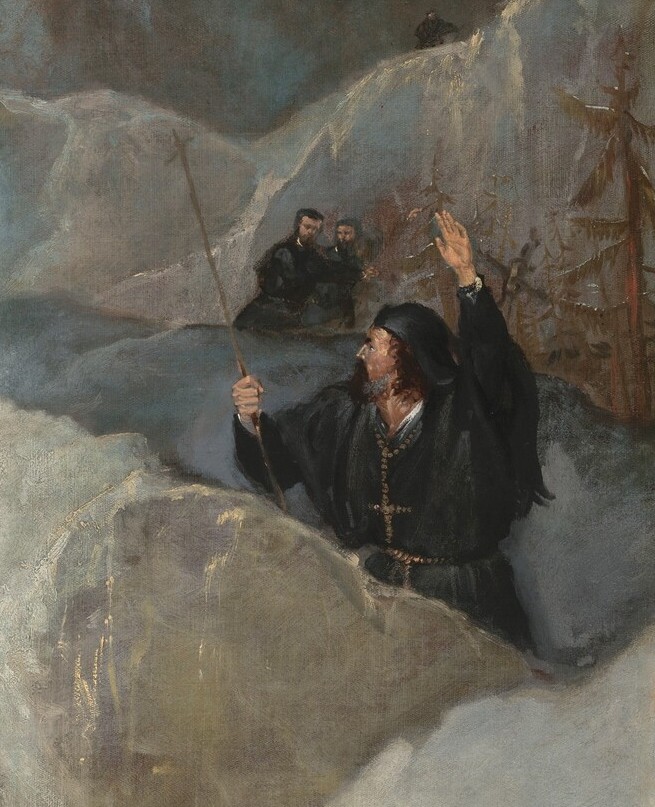
The distant figures
Small dark figures appear at the right, beyond the foreground animals. Their reduced scale stretches the distance between immediate aid and the wider mountain setting.
At a Glance
- ArtistEdwin Landseer [1]
- Date1820 [1]
- Collection or siteNational Gallery of Art [1]
- Object2019.120.1 [1]
This work across Edwin Landseer’s career
The Cat's Paw
c. 1824 [8]The Hunting of Chevy Chase
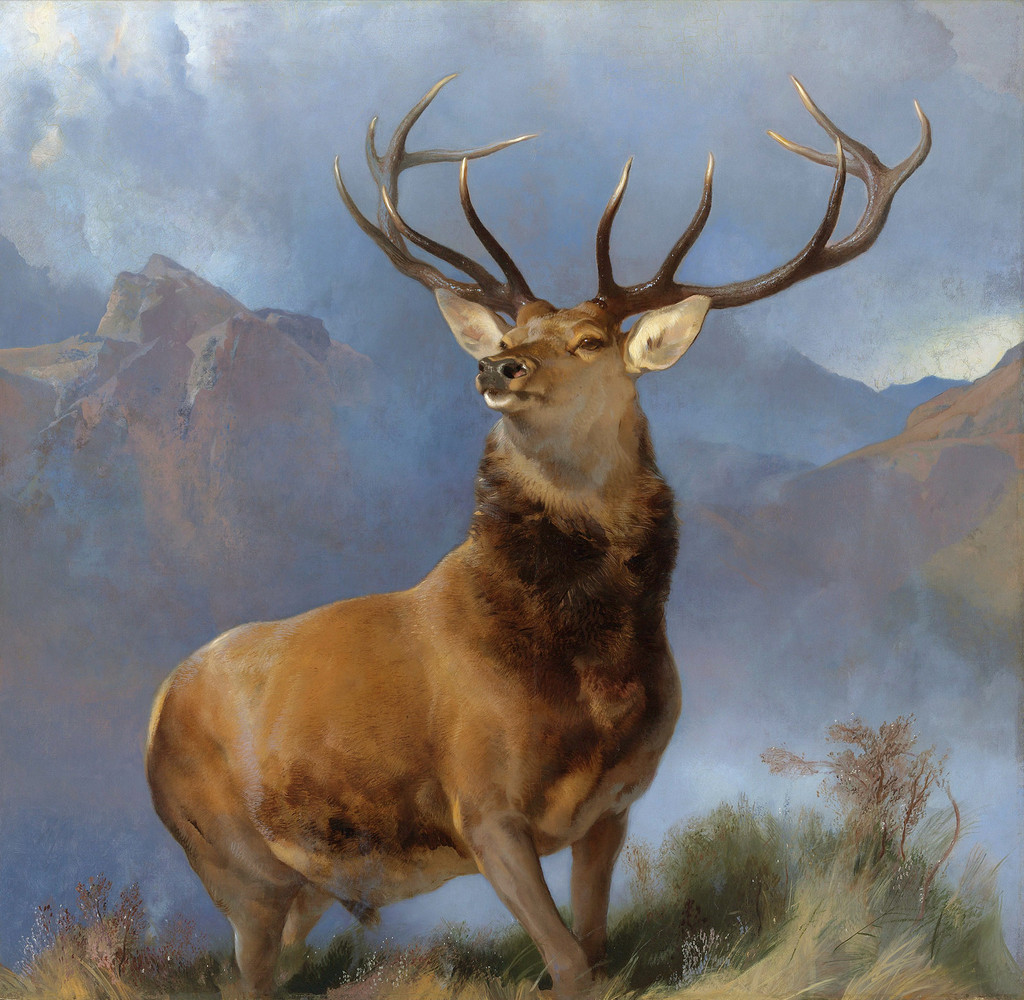
1825–26 [9]The Monarch of the Glen
about 1851 [13]Contents
- A rescue held at its most uncertain moment
- What is visible before the story takes over
- Two dogs, two forms of action
- The traveller and the promise contained in a title
- A mountain history picture made in London
- The real hospice behind the painted refuge
- Alpine mastiffs before the modern Saint Bernard
- The dogs Landseer actually knew
- How a small cask became the largest story
- Barry between animal history and heroic legend
What is visible before the story takes over
The picture is broad, cold and immediately legible at a distance. Snow fills most of the foreground and opens into a pale corridor between steep mountain forms. Dark rock, trunks and branches gather at the left, creating a shadowed pocket from which the nearer dog seems to emerge. On the right the ground and peaks are lighter. The pass narrows towards the small hospice high above, while three figures descend in single file. The nearest carries a tall staff topped by a cross. They are recognisable as the human answer to the alarm, but Landseer makes them minute enough that their help still feels delayed.[1]
The standing dog occupies the centre like a living signal tower. Its body is tan and white, set broadside against the snow, with forelegs planted close to the place where the traveller has disappeared. A deep red blanket crosses its back. Blue letters, `S.T.B`, stand out near the centre, and a wide fur-lined collar is ornamented with metal reliefs and bells. The animal turns its neck sharply. Open mouth, raised muzzle and fixed direction turn its body away from the victim and towards the approaching party.[1]
The second dog performs the opposite movement. Brindled brown, black and white, it crouches into the shadowed left foreground. Its head drops to the traveller's exposed hand. A leather strap carries a small wooden cask beneath its throat. Where the standing animal enlarges the emergency by sending a call across space, this one closes distance until animal muzzle and human skin meet. John Landseer later described the dog as licking the hand and watching for the slightest response, but the visible contact is already enough to establish intimacy without pretending that paint can demonstrate a medical effect.[5]
The traveller enters the scene as fragments. An olive-green coat lined with pale fur emerges from the snow, with a glimpse of white shirt. One ungloved hand extends towards the dog; another, darker hand or glove lies near a fallen green velvet cap with a red tassel. His face is pallid, his dark hair untidy, his eyes closed. The body forms a low diagonal across the foreground, so close to the snow's colour that it takes time to assemble him. He is not lifted into a conventional heroic pose. He is heavy, horizontal and almost absorbed by the environment that has defeated him.[1]
These details should be seen before their meanings are settled. The building is read as the Great Saint Bernard hospice because the subject, early accounts and exhibition history establish that setting; it is not a measured portrait of the architecture. The distant people belong to the hospice community, but their individual identities are unknown. The cask is certainly painted, while its contents are not. The red covering and bells make one dog look purposefully equipped, though they do not prove a standard uniform. Landseer's visual argument is powerful precisely because observation, invention and expectation have become difficult to prise apart.
Colour manages that fusion. The red blanket is the largest warm accent and the clearest sign of organised service. Green clothing and cap lead the eye down to the traveller, while the tassel answers the blanket on a much smaller scale. Blue lettering, brindled fur and metal ornaments interrupt the white field. The scene is not monochrome, but its colour is rationed. Snow connects dogs, victim, pass and distant building; the few saturated notes tell viewers where to search for narrative information.
Two dogs, two forms of action
Landseer divides rescue between the two animals. The nearer dog is concerned with the body: finding it, uncovering it and maintaining contact. The central dog is concerned with distance: clearing snow, raising its head and converting discovery into an alarm. One action is tactile and almost private; the other is public. Together they make a sequence that a single animal could not display simultaneously.
The division is compositional before it is historical. A still picture cannot prove the precise routines followed by hospice dogs in 1820. It can, however, arrange different kinds of agency so that viewers understand them at once. The lowered muzzle carries attention inward towards the traveller's hand and face. The lifted muzzle throws attention outward towards the hospice party. Landseer turns the dogs into a hinge between an insensible human being below and responsive human beings above.
John Landseer's 1831 pamphlet made the relationship explicit. He described the dogs as going out in pairs and called them “living life-boats”. In his account, one has helped to expose the traveller and remains close, while its companion barks to bring assistance. He interprets the nearer animal's licking and gaze as a search for a returning sign of life. This is valuable early evidence for how the Landseer family explained the image, but it appeared eleven years after the oil. It should not be mistaken for a field manual copied before Edwin painted.[5]
What the canvas does establish is a hierarchy of scale without a hierarchy of moral worth. The dogs are enormous relative to the distant people because they are close to us, yet the arrangement also grants them the immediate burden of the event. The human figures carry institutional authority—the hospice, the staff and the promise of shelter—but they cannot act until the dog's raised head reaches them. Animal attention becomes the first link in a chain that remains completed by human response.
That collaboration is more interesting than the later fantasy of a lone canine paramedic. Neither dog is shown carrying the man, administering a visible drink or completing the rescue unaided. Their equipment makes them agents of a system. The building on the ridge, the descending party, the bells and blanket all imply organisation. Landseer gives the animals initiative without erasing the people and infrastructure that make survival possible.
The distinction also keeps sentiment from becoming softness. The crouching dog supplies tenderness, but the standing dog's strained turn makes the rescue noisy and urgent. Snow clings to the scene as physical resistance. Distance remains measurable. The traveller's slack body offers no grateful response. Affection is one element in an image whose deeper structure is communication under pressure.
The traveller and the promise contained in a title
John Landseer supplied a fuller biography for the fallen figure. The 1831 pamphlet imagines him as a young student of science, a naturalist or mineralogist crossing the pass before an avalanche or violent snowstorm overwhelms him. That story suits the scattered cap, practical coat and solitary journey, but it is an interpretation designed to accompany the engraving. The paint offers no name, profession, route or dated accident. There is no reason to turn the figure into a real person whose case could be found in hospice records.[5]
The distinction matters because the image works by giving very little. The face is visible enough to register pallor, but not expressive enough to tell us what the man last saw. His hand enables contact, while the rest of his body nearly disappears. Snow has removed his upright identity. Clothing and cap suggest an individual life, yet the painting holds him at the threshold of anonymity: any traveller exposed to weather, distance and exhaustion.
The title does the hopeful work that the body cannot. “Distressed” places the figure in extreme danger without declaring him dead. “Reanimating” converts the dogs' gestures into an attempt to bring him back. It also directs viewers to treat the hand contact, digging and barking as consecutive parts of that attempt. Without the title, the central uncertainty would be darker. With it, the stillness becomes a condition against which action may yet prevail.
John stated that only an indication of possible revival was intended. Landseer therefore avoids the final convention of rescue painting: there is no opened eye, raised torso, arriving stretcher or relieved embrace. The lack of resolution keeps attention on the interval in which care must be offered without any guarantee that it will succeed. The dogs behave as though the stranger matters before he can answer them.
Walter Scott's hostile reaction later in 1820 shows how risky the body was. He conceded merit to the picture but called the traveller's livid appearance “disgusting”.[16] What one viewer could read as the necessary evidence of danger, another could experience as an intrusion of corpse-like colour into an animal subject. The man's pallor is thus not a passive detail. It pushes the painting close enough to death that the title's promise has something real to overcome.
A mountain history picture made in London
The canvas's dimensions alter the status of everything it contains. At nearly two metres high and well over two metres wide, it does not present the dogs as a domestic vignette. Landseer gives an animal rescue the physical presence of an ambitious narrative painting. The National Gallery's 2019 annual report described the result as an individual “monument of European Romantic painting”, an institutional judgement that recognises how weather, danger, feeling and scale exceed simple breed portraiture.[2]
The composition is built from connected diagonals. The traveller lies low across the snow. The standing dog's body lifts the line, and its turned head sends it farther up the pass. The descending figures answer from the distance. At the same time, dark trees and rock close the left edge while pale mountains open the right. The viewer moves from enclosure, through the dogs, towards a possible route of escape. That visual passage never becomes easy; the figures remain tiny and the peaks beyond the hospice continue to rise.
Landseer had not been to Switzerland. John admitted as much in 1831 and even complained that Edwin had made the monks too old.[5] The terrain was assembled in Britain from verbal reports, existing imagery and the needs of the story. Richard Ormond's analysis, quoted in Christie's catalogue, calls the landscape theatrical and unconvincing as Alpine geography.[17] Yet theatricality is not the same as failure. The setting accomplishes what the narrative requires: remoteness, lethal exposure, a narrow passage, an institution at the edge of reach and a difficult descent between danger and refuge.
The result belongs to a Romantic imagination of extreme place, but it resists the pleasure of an empty sublime. Mountains do not invite solitary contemplation here. Their scale has immediate bodily cost. Snow is both the field that makes the dogs legible and the matter that conceals the traveller. Distance is not an aesthetic abstraction; it is the time help will take. The landscape becomes a machine for delaying rescue.
The animals nevertheless retain the authority of close observation. Their coats, weight, neck turns, paws and equipment are much more specific than the invented setting. That contrast is productive. Landseer could make an imagined mountain credible by placing within it bodies studied at close range. London models anchor an Alps constructed in the studio.
The real hospice behind the painted refuge
The Great Saint Bernard Pass crosses the western Alps between present-day Switzerland and Italy at about 2,472 metres. Around 1050, Bernard of Aosta, also known as Bernard of Montjoux, founded a hospice there to shelter and protect people using the dangerous route. The community of Augustinian canons that succeeded him made hospitality in a severe environment its defining work. The institution still receives travellers throughout the year.[18]
Dogs became part of that history long before Landseer painted. Fondation Barry traces a visual record at the hospice to 1695 and a written reference to 1707. Robust local dogs accompanied travellers, helped people find routes through mist or deep snow and became associated with searches after bad weather. Accounts by visitors and by soldiers who crossed the pass with Napoleon's army in 1800 carried their reputation well beyond the Alps.[19]
The work was collective. Modern Bern museum interpretation cautions against imagining the historic dogs as today's specialist avalanche teams acting independently at a buried person's precise location. Guides connected with the hospice went out with the animals. Dogs helped to break paths, recover a route when visibility collapsed, alert companions and find the way back. Their sense of direction and ability to move through conditions that defeated a traveller mattered, but so did trained human judgement, shelter and an organised response.[6]
Landseer's painting compresses that network into one suspended instant. The hospice is visible, guides or canons are coming, and the dogs carry signs of belonging. Yet the distance separating these elements remains the subject. The picture does not simply celebrate an institution already functioning perfectly. It dramatises the dangerous gap its people and animals had to cross.
This history also corrects a tempting simplification in the word “rescue”. Finding a route through a whiteout, accompanying a vulnerable traveller, sounding an alarm and leading people towards refuge may not resemble the spectacular recovery stories later attached to named dogs. They could nevertheless make the difference between movement and fatal disorientation. Landseer's half-buried figure intensifies that reality into a single readable crisis, while the actual work was often preventive, repetitive and shared.
Alpine mastiffs before the modern Saint Bernard
Landseer's title calls the animals Alpine mastiffs. It should not be read as a modern pedigree certificate. The working dogs kept around the pass were descended from strong farm dogs of the region and varied more in size, coat and head shape than the Saint Bernard fixed by later breeders. The familiar show standard emerged through nineteenth-century registration and organised breeding: Fondation Barry dates early pedigree certificates to 1867, Swiss registration and club formation to 1884, and official recognition of the Swiss breed to 1887.[19][20]
That chronology helps explain why the painted animals can surprise viewers. The standing dog is large and powerful, but its outline is more athletic than the massive, heavy-headed type popularised later. The crouching female has a brindled coat and a different profile again. Their difference is not evidence that one of them is an impostor. It reflects a period before visual diversity had been narrowed into an exhibition ideal.
Michael Worboys has argued that British fanciers helped manufacture the modern cultural and physical identity of the Saint Bernard from these earlier working populations. Even Barry's preserved body was remodelled in 1923 so that the celebrated animal looked closer to what later visitors expected.[21] The change does not erase continuity with hospice dogs. It does warn against looking backwards through a breed standard and treating Landseer as though he failed to paint an animal that did not yet exist in its later form.
The old phrase also carries social meaning. “Mastiff” promised mass, courage and protective force to British viewers; “Alpine” placed those qualities in an extreme landscape. Landseer could therefore join careful canine observation to a loose category already rich in expectation. The title describes an imagined function and place as much as a controlled bloodline.
The dogs Landseer actually knew
John Landseer's account brings the studio much closer. He says the standing animal was the second Alpine dog to reach England. Its real collar, lined with fur and decorated with embossed ornaments and bells, furnished the conspicuous equipment in the painting. The nearer dog was a large brindled-and-white female owned by Thomas Christmas. According to John, she struggled with a warm London summer and died not long afterwards.[5]
These details are more secure than the names attached by later writers. The closest account does not give settled names to both painted models, and later catalogues do not agree. Calling them Lion and Caesar would create confidence the evidence cannot support. It is enough to know that one model brought a remarkable piece of Alpine equipment into the studio and that the other was a female dog living in England.
John also separates them from an earlier Alpine dog that Edwin had drawn at thirteen and that later lived at Leasowe Castle. That memory is a reminder of how rapidly a rare imported animal could become a subject, a social curiosity and an artistic opportunity. It does not prove that the adolescent study supplied one of the bodies in the 1820 canvas.
The model history clarifies Landseer's method without requiring a romantic fiction of direct encounter on the pass. He could observe different dogs at close quarters, study the rotation of a heavy neck, distinguish soft and coarse fur, and record how a collar changed the silhouette. He could then place those particulars inside an environment he knew indirectly. The dogs are empirical anchors in a synthetic scene.
That combination helps the animals escape mere heraldry. Although blanket, bells and cask make them emblematic, they do not become symmetrical badges. One stands and twists; the other folds down and forwards. Their different coats and sexes, separate owners and contrasting poses survive the demand that they symbolise organised rescue. Landseer turns two specific bodies into a pair without making them identical.
How a small cask became the largest story
The wooden vessel hangs beneath the nearer dog's throat, just behind its muzzle and above the snow. It is easy to overlook when the full canvas is seen at reduced size. Once noticed, it is difficult to forget. It seems to answer the crisis with perfect economy: a dog has found a cold, insensible person and carries a portable restorative. The object makes animal care look provisioned and immediate.
Paint alone does not disclose what the cask contains. John Landseer's pamphlet removed that ambiguity in 1831. Describing the equipment “as depicted” in the engraving, he says one dog carries a small keg or flask of brandy, while the other bears bells and warm drapery. He thereby presented the prop not as an imaginative symbol but as ordinary rescue apparatus.[5] Because the pamphlet accompanied an engraving published by John himself, its claim is evidence for the family's promotion of the story, not independent confirmation from hospice accounts.
The distinction is decisive. The National Gallery now identifies Landseer's image as the source of the famous belief that Saint Bernards wore brandy kegs, and current Bern museum material treats such barrels as fantasy rather than rescue practice.[4][6] The picture is not proof that the custom happened. It is evidence of how convincingly an invented custom could be made to happen in culture.
Landseer need not have created every ingredient from nothing for his canvas to be pivotal. Stories about cordial, portable provisions and heroic Alpine dogs already circulated. John's own pamphlet repeats a Barry tale involving a small flask, attributed through earlier printed accounts. The 1820 picture's achievement was to join those expectations to one sharply legible object on a monumental, widely admired canvas. The 1831 engraving and text then repeated the combination in a form that could travel.
The cask works because it bridges two kinds of rescue. It is materially attached to the dog's body, like the decorated collar, yet its imagined contents promise direct action upon the human body. Bells communicate; a blanket warms; a drink revives. The ensemble divides a complicated institution into portable signs, each assigned to an animal. That is superb visual storytelling even where it is poor operational history.
Correcting the myth therefore should not end with the flat sentence that Saint Bernards never carried brandy barrels. The more revealing question is why so many viewers wanted the claim to be true. The cask turns instinctive loyalty into prepared benevolence. It makes the dog seem not only brave and sensitive but equipped with exactly what a stranger needs. In that fantasy, humane organisation has become an attribute worn at the neck.
The painting also shows the danger of allowing later familiarity to overwrite looking. A modern viewer may notice “the Saint Bernard barrel” before seeing that the cask belongs to the lower, darker dog rather than the red-blanketed animal commanding the centre. The famous symbol can cause the pair to collapse into a single generic dog. Returning to the canvas restores the division: contact at the hand, alarm across the pass, two bodies and two tasks.
Barry between animal history and heroic legend
Barry was the most famous dog associated with the hospice. He lived there during the early nineteenth century, retired to Bern and died in 1814. Tradition credits him with saving more than forty people. His preserved body was displayed in Bern from 1815, giving visitors a material focus for stories already accumulating around his name.[22][6]
The qualification “tradition credits” is essential. The hospice archives did not keep individual rescue files that would allow forty cases to be checked. Stories of a child carried on Barry's back, a traveller restored by cordial and other precisely staged feats belong to the legend's growth rather than a complete documentary biography. Barry's fame expresses genuine respect for generations of working dogs, but it concentrates a collective history into one exemplary hero.[6]
Landseer's dogs are not Barry. No surviving evidence identifies either model with him, and Barry had already died before the painting was made. The connection is cultural instead. The painter worked at the moment when accounts of Alpine dogs, Napoleonic crossings and Barry's supposed rescues were turning local working animals into European celebrities. His large canvas gave that fame an image designed for memory.
The later Saint Bernard emerged through the same process of selection. Working populations were standardised; diverse appearances narrowed; an individual dog's mounted body was adjusted to match expectation; the cask became customary in representation while remaining absent from practice.[19][21] History and legend cannot simply be separated into a worthy truth and a worthless fiction. The legends affected breeding, collecting, tourism and the way real animals were seen. Landseer's painting is one of the places where that transformation becomes visible.
An eighteen-year-old painter at the British Institution
The British Institution exhibited the painting in 1820 as number 277. Landseer had already attracted attention as a prodigy: he studied animal anatomy, received recognition while still a child and first showed at the Royal Academy as a young teenager. This canvas nevertheless represented a substantial escalation. Its exceptional size, complex mountain setting and crisis narrative asked viewers to judge more than his accuracy with fur.[1][4]
The Annals of the Fine Arts responded enthusiastically. Its reviewer invoked Frans Snyders, the seventeenth-century Flemish master of large animal compositions, and praised the dogs' heads, the traveller and the elevation Landseer had brought to his subject.[23] The comparison located a British teenager within an established European tradition while suggesting that close animal study could support serious narrative art.
Such approval was not universal. Scott's recoil from the pallid body establishes a fault line in the image's first reception.[16] The very passage that raised the stakes could look excessive. If the traveller appeared too healthy, the dogs' urgency would seem theatrical; if he approached the colour of a corpse, rescue might become unpleasant spectacle. Landseer chose the dangerous side of that balance.
The work's subsequent exhibition titles show how the dogs gradually overtook the anonymous victim. It appeared at the Birmingham Society of Artists in 1842. At Manchester's vast Art Treasures Exhibition in 1857 it was listed as The Dogs of St. Bernard, a shorter name that turned the animals and institution into the entire subject.[1][24] The Philadelphia Museum of Art and Tate included it in their 1981–82 Landseer retrospective, returning it to a career narrative after decades of private ownership.[1]
Those appearances do not prove a single stable response. In 1820 the work could demonstrate precocious ambition and test the limits of physical distress. By 1857 its breed association had grown more familiar, and the cask-bearing rescuer was on the way to becoming an icon. In a modern museum, the same canvas is both a major Romantic narrative and evidence of how pictures manufacture supposedly ancient traditions.
Drawing, small canvas and the problem of sequence
Landseer did not arrive at the large composition in a single surviving act. In 2023 the National Gallery acquired a double-sided study dated 1820. The recto combines graphite with pen and brown ink on laid paper; the verso is in graphite. The sheet measures only 21 by 31.3 centimetres and carries an `IPING / 1802` watermark. Its accession is 2023.29.1.a-b.[25]
The drawing establishes a working process on paper but not an exact chronology of every idea. It may have appeared in Landseer's posthumous studio sale in 1874, although the early ownership is not certain. Its later history—from the Carroll Gallery through repeated sales and dealers—belongs to the sheet, not to the oil. That warning sounds elementary, yet the several versions of Alpine Mastiffs have repeatedly attracted one another's data.[25]
A separate finished canvas makes the sequence more complicated. Christie's sold an 18-by-24-inch oil called St. Bernard Dogs in 1996. The essential arrangement is already present, but the smaller picture lacks the `S.T.B` lettering, bells and elaborate collar detail of the Washington canvas. Its cask has a cork, branches change, and the standing dog's tail differs. The catalogue considered it a finished preparatory version, probably made before the monumental work, but “probably” must remain. No recovered dated note fixes the order beyond doubt.[26]
Its ownership history is clearer. The gunmaker and collector Joseph Gillott possessed the small painting. At his 1872 sale Samuel Addington bought it for 1,740 guineas; Agnew acquired it at Addington's sale in 1886 for 440 guineas. The object's recorded 18-by-24-inch size is crucial. A 1975 sale catalogue imported the Addington connection into the provenance of the great Washington canvas, but the measurements and Gillott history identify the smaller oil instead.[1][26]
Comparison reveals how Landseer amplified an already economical design. The large version does not merely enlarge figures. It increases the signalling power of the red textile, adds letters, collar ornaments and bells, and gives the equipment greater narrative specificity. The changes make the dogs look more firmly attached to a named institution. They also strengthen the very process by which pictorial invention later passed for documentary custom.
The family engraving fixes the story in words
On 3 June 1831, John George Landseer published his mixed-method engraving after the painting. Thomas Landseer partly engraved it. The Metropolitan Museum's impression, printed on chine collé, has a plate measuring 48.6 by 58 centimetres and a larger sheet measuring 55 by 70.4 centimetres. Its title, Alpine Mastiffs Reanimating a Traveller, keeps the action but drops the adjective “distressed”.[3]
The print is not a photograph in black and white. Red blanket, green coat and blue letters become tonal relationships; engraved marks translate paint and surface; scale changes from monumental canvas to an object that can be handled, collected and viewed at close range. The family resemblance remains strong, but the medium directs attention differently. It also allows text to attach itself to the image.
John's accompanying book had the expansive title Some Account of the Dogs and of the Pass of the Great Saint Bernard. It gathers travel descriptions, monastic history, dog lore and an explanation of the represented event. The publication gives the traveller a scientific vocation, assigns complementary work to the animals and names the cask's contents. It also records the London models and admits that Edwin had not seen the pass.[5]
That mixture makes the pamphlet more than a caption and less than neutral documentation. John was Edwin's brother, an engraver of the picture and its publisher. He had access to family memory, but he also had an interest in making the reproduction intelligible and desirable. By explaining what each prop meant, he reduced some of the oil's uncertainty. An open mouth became a purposeful alarm; contact with a hand became a test for life; a wooden vessel became brandy.
The family reproduction therefore extended the painting in two directions. Engraving increased its visual reach, while prose stabilised the rescue story. Later viewers did not have to stand before the huge canvas to encounter the paired dogs, insensible traveller and mountain refuge. They could possess a smaller image whose intended meaning arrived in the same publication campaign. The cask legend was not carried by paint alone.
From Ilam Hall to Washington
Jesse Watts Russell bought the painting directly from Landseer in 1820. An annotation cited by Christie's records a price of 160 guineas. The work went to Russell's Ilam Hall in Staffordshire. There is no firm evidence that he commissioned the canvas before it was painted; “bought from the artist” is the accurate relationship.[1][17]
After Russell's death, his estate offered it at Christie, Manson & Woods on 3 July 1875 as St. Bernard Dogs, lot 29. Thomas Agnew & Sons bought it and sold it five days later to Richard Peacock of Gorton Hall. Peacock's executors tried to sell it in May 1889 as Alpine Mastiffs. Bidding reached 1,850 guineas but failed to meet a reserve of 2,000, so that appearance was not a sale.[1]
The canvas was offered again in March 1892 and passed within the family to Richard's son, Colonel Ralph Peacock. It reappeared in Ralph's estate sale in October 1928. The next part of its route is less secure. Wildenstein & Co. of New York has been associated with the painting, but the firm's archive could not confirm the transaction. Geraldine Rockefeller Dodge later owned it, although the date and source of her acquisition remain unresolved.[1]
Dodge's estate sold the work in 1975 to Jonathan Westervelt Warner, known as Jack Warner. Sotheby's offered it again in June 1993, after which it entered a private collection in Mexico City. Christie's London presented it in December 2017, and Matthiesen Gallery handled it before the National Gallery of Art purchased it in November 2019.[1][17]
The chain is unusually instructive because its errors explain why physical description matters. The Gillott–Addington history looked plausible when attached to a composition with the same dogs and cask, but dimensions expose the merger: an 18-by-24-inch picture cannot be the canvas measuring 189 by 237 centimetres. Titles alone could not keep the versions apart. Scale, sale lot and owner have to travel together.
The NGA acquisition restored broad public access to a picture that had spent most of its history in private collections. It also joined related evidence within one institution when the Gallery acquired the double-sided study four years later. Under the NGA's Open Access policy, the high-resolution photograph of the painting is public domain, allowing the image that spread a false account of rescue equipment to be examined and reused with unusual precision.[27]
Public ownership does not close the history. The Wildenstein and Dodge gaps remain; the smaller oil's present location is not supplied by its 1996 sale page; new scrutiny may refine the study's early provenance. A responsible account marks those limits instead of filling them with the nearest familiar name. That restraint is especially appropriate for a painting whose cultural force arose from making an attractive invention look like remembered fact.
Looking again after the legend has been corrected
Return first to the traveller's hand. The darker dog touches it, but no response is visible. Move to the standing dog, whose neck turn directs the eye away from that intimate contact. Follow its bark towards the distant staff and the tiny party above. Then look back at the space between them. The rescue resides in those connections, not in the cask alone.
The famous vessel deserves a double reading. It is a real painted object and a false historical witness. Its position, strap and scale are observable; its supposed use is a story promoted around the image and rejected by modern institutional history. Holding both facts at once is more illuminating than either credulity or ridicule. Landseer understood that equipment makes compassion visible.
He also understood suspense. Red blanket, bells, exposed hand and descending figures promise an organised answer, while snow, pallor and distance resist it. The dogs possess urgency but not omnipotence. Their actions matter because the outcome has not been granted in advance.
At eighteen, Landseer transformed close knowledge of dogs he could study in England into a mountain drama he had never witnessed. The landscape is constructed, the traveller imagined and the brandy equipment unhistorical. Yet the painting's central ethical proposition remains exact: a vulnerable stranger has been found, and other beings respond before he can ask. Its myths should be corrected. Its account of attention under pressure still asks to be seen.
Artworks directory
This directory gathers works discussed in the articles, including drawings, original etchings and prints after Landseer. It is not a complete catalogue of every drawing, version, plate or impression. Distinct media are kept separate; uncertain dates are left blank. Linked titles open individual articles.
| Name | Date | Medium |
|---|---|---|
| A Bellowing Stag | Drawing | |
| A Deerhound | 1826 | Painting |
| A Distinguished Member of the Humane Society | 1838 | Painting |
| A Highland Breakfast | 1834 | Painting |
| A Highland Landscape | c. 1830 | Painting |
| A Highland Shepherd's Home | Painting | |
| A Horse, Goat and Bull | 1811 | |
| A Hunting Horse | Drawing | |
| A Jack in Office | Painting | |
| A Lion Disturbed at His Repast | Painting | |
| A Random Shot | Painting | |
| A Scene at Abbotsford | Painting | |
| Adversity | Painting | |
| Alexander and Diogenes | exhibited 1848 | Painting |
| Alpine Mastiffs Reanimating a Distressed Traveler | 1820 | Painting |
| Contending Group after Nature | Drawing | |
| Copy after Rubens's Wolf and Fox Hunt | c. 1824–26 | Painting |
| Dash | Painting | |
| Deer and Deer Hounds in a Mountain Torrent ('The Hunted Stag') | c. 1832 / exhibited 1833 | Painting |
| Deer Family | ||
| Dignity and Impudence | 1839 | Painting |
| Dog Resting Upon a Couch | Drawing | |
| Eos | 1841 | Painting |
| Favourites, the Property of H.R.H. Prince George of Cambridge | 1834–35 | Painting |
| Her Majesty Sketching at Loch Laggan | ||
| High Life | 1829 / exhibited 1831 | Painting |
| Highland Lassie | Drawing | |
| Isaac van Amburgh and his Animals | 1839 | Painting |
| Lady Godiva's Prayer | Painting | |
| Laying Down the Law | 1840 | Painting |
| Lion Defending Its Prey | c. 1840 | Painting |
| Lioness | Drawing | |
| Little Strollers | ||
| Low Life | 1829 / exhibited 1831 | Painting |
| Man Proposes, God Disposes | 1864 | Painting |
| Nell Gwynne / Diana Vernon | Painting | |
| Neptune | ||
| No Hunting Till the Weather Breaks | Painting | |
| Otterhounds | Drawing | |
| Peace | Painting | |
| Pensioners | Painting | |
| Portrait of a Mule | Painting | |
| Portrait of Mr Van Amburgh, as He Appeared with His Animals at the London Theatres | 1846–47 | Painting |
| Portraits of a Pointer Bitch and Puppy | Painting | |
| Pray Let Me Out | ||
| Prosperity | Painting | |
| Ptarmigan in a Landscape | by 1833 | Painting |
| Queen Victoria and Prince Albert at the Bal Costumé of 12 May 1842 | 1842–46 | Painting |
| Queen Victoria at Loch Laggan | Painting | |
| Queen Victoria at Osborne | 1865–67 | Painting |
| Queen Victoria landing at Loch Muick | Painting | |
| Rat-catching | 1823 | |
| Reclining Lion | Drawing | |
| Reclining Lion, From Back | Drawing | |
| Rent-day in the Wilderness | 1855–68 | Painting |
| Return from Deer Stalking | 1839 | |
| Royal Sports on Hill and Loch | Painting | |
| Sam Lovill, Porter at the Royal Academy | Drawing | |
| Scene from A Midsummer Night's Dream | 1848–51 | Painting |
| Scene in the Highlands, with portraits of the Duchess of Bedford, the Duke of Gordon and Lord Alexander Russell | Painting | |
| Scottish Highlands, Lochs and Figures | Drawing | |
| Shoeing | exhibited 1844 | Painting |
| Sleeping Bloodhound | exhibited 1835 | Painting |
| Spaniel and Rabbit | Painting | |
| Stag at Bay | 1866 | Sculpture |
| Stag at Bay | 1846 | Painting |
| Studies of a staghound and the head of a stag for painting ‘The Hunting of Chevy Chase’ | Drawing | |
| Study for Alpine Mastiffs Reanimating a Distressed Traveler | Drawing | |
| Study for the Monkey in The Cat's Paw | Drawing | |
| Study of a Dog | Drawing | |
| Study of a herding dog facing right | Drawing | |
| Study of the horse of Selene, from the East pediment of the Parthenon | Drawing | |
| Suspense | Painting | |
| Taking a Buck | ||
| The Arab Tent | c. 1865–66 | Painting |
| The Barn | Drawing | |
| The Best Run of the Season | ||
| The Cat's Paw | c. 1824 | Painting |
| The Cavalier’s Pets | ||
| The Challenge | Painting | |
| The Chase | Drawing | |
| The Connoisseurs: Portrait of the Artist with Two Dogs | 1865 | Painting |
| The Death of a Stag in Glen Tilt | Painting | |
| The Drive—Shooting Deer in the Pass | Painting | |
| The Drover's Departure | Painting | |
| The Highland Shepherd’s Dog | 1824; portfolio issue 1848 | |
| The Honourable Mrs Norton | Painting | |
| The Hunting of Chevy Chase | 1825–26 | Painting |
| The Illicit Highland Whisky Still | Painting | |
| The Keeper John Crerar with his Pony | Painting | |
| The Larder Invaded | ||
| The Lion-Dog of Malta | ||
| The Lions at the Base of Nelson's Column | 1867 | Sculpture |
| The Monarch of the Glen | about 1851 | Painting |
| The Mountain Torrent | ||
| The Old Shepherd's Chief Mourner | 1837 | Painting |
| The Sanctuary | 1842 | Painting |
| The Stricken Deer | Painting | |
| The Twa Dogs | Painting | |
| Time of Peace | ||
| Two stags running | Drawing | |
| Victoria, Princess Royal, with Eos | Painting | |
| View of Glenfeshie | Painting | |
| War | Painting | |
| White Horse in a Stable | Painting | |
| Windsor Castle in Modern Times | 1841–43 | Painting |
| Woburn Abbey Game Card | 1825; portfolio issue 1848 |
Discussion
Use the article’s images and evidence to develop your own reading of Alpine Mastiffs Reanimating a Distressed Traveler.
Reader Insights
Which detail is most revealing when you consider “A rescue held at its most uncertain moment”?
How does the evidence in “What is visible before the story takes over” affect your reading of Alpine Mastiffs Reanimating a Distressed Traveler?
What further question would you bring to “Looking again after the legend has been corrected”?
Join the Conversation
Share a detail, comparison or question about Alpine Mastiffs Reanimating a Distressed Traveler below.
References
- National Gallery of Art, Alpine Mastiffs Reanimating a Distressed Traveler, accession 2019.120.1. View source.
- National Gallery of Art, Annual Report 2019. View source.
- Metropolitan Museum of Art, John Landseer after Edwin Landseer, Alpine Mastiffs Reanimating a Traveller, 3 June 1831, accession 47.30.61. View source.
- National Gallery of Art, “Who Was Sir Edwin Landseer? 10 Things to Know”. View source.
- John Landseer, Some Account of the Dogs and of the Pass of the Great Saint Bernard, 1831. View source.
- Museumsquartier Bern, “Barry”, and Natural History Museum Bern, Barry historical brochure. and View source 1. View source 2.
- National Gallery of Art, Alpine Mastiffs Reanimating a Distressed Traveler. View source.
- Minneapolis Institute of Art, The Cat's Paw. View source.
- Birmingham Museums Trust, The Hunting of Chevy Chase. View source.
- Victoria and Albert Museum, The Old Shepherd's Chief Mourner. View source.
- Tate, Dignity and Impudence. View source.
- Royal Collection, Eos. View source.
- National Galleries of Scotland, The Monarch of the Glen. View source.
- Royal Holloway, University of London, Man Proposes, God Disposes. View source.
- Trafalgar Square / Greater London Authority, The Lions at the Base of Nelson's Column. View source.
- H. J. C. Grierson, editor, The Letters of Sir Walter Scott, volume 6, letter of 1820, p. 286. View source.
- Christie's, Alpine Mastiffs Reanimating a Distressed Traveller, lot 36, 7 December 2017. View source.
- Great Saint Bernard Hospice, institutional history and visitor information. and View source 1. View source 2.
- Fondation Barry, “History”. View source.
- Fondation Barry, Fédération Cynologique Internationale standard for the Saint Bernard. View source.
- Michael Worboys, “The St. Bernard: Alpine Rescue Dog or Manchester Manufacture?”, Johns Hopkins University Press, 2018. View source.
- Fondation Barry, “About Us” and Barry history. View source.
- Annals of the Fine Arts, volume 5, 1820. View source.
- A Handbook to the Gallery of British Paintings in the Art Treasures Exhibition, Manchester, 1857. View source.
- National Gallery of Art, Study for “Alpine Mastiffs Reanimating a Distressed Traveler” (recto); Study for “Alpine Mastiffs Reanimating a Distressed Traveler” (verso), accession 2023.29.1.a-b. View source.
- Christie's, St. Bernard Dogs, lot 68, 6 December 1996. View source.
- National Gallery of Art, “Open Access Policy for Images of Works of Art Presumed in the Public Domain”. View source.
- Splash image, Alpine Mastiffs Reanimating a Distressed Traveler. National Gallery of Art. National Gallery of Art, Patrons’ Permanent Fund, 2019.120.1. Image source. CC0 / Public domain.
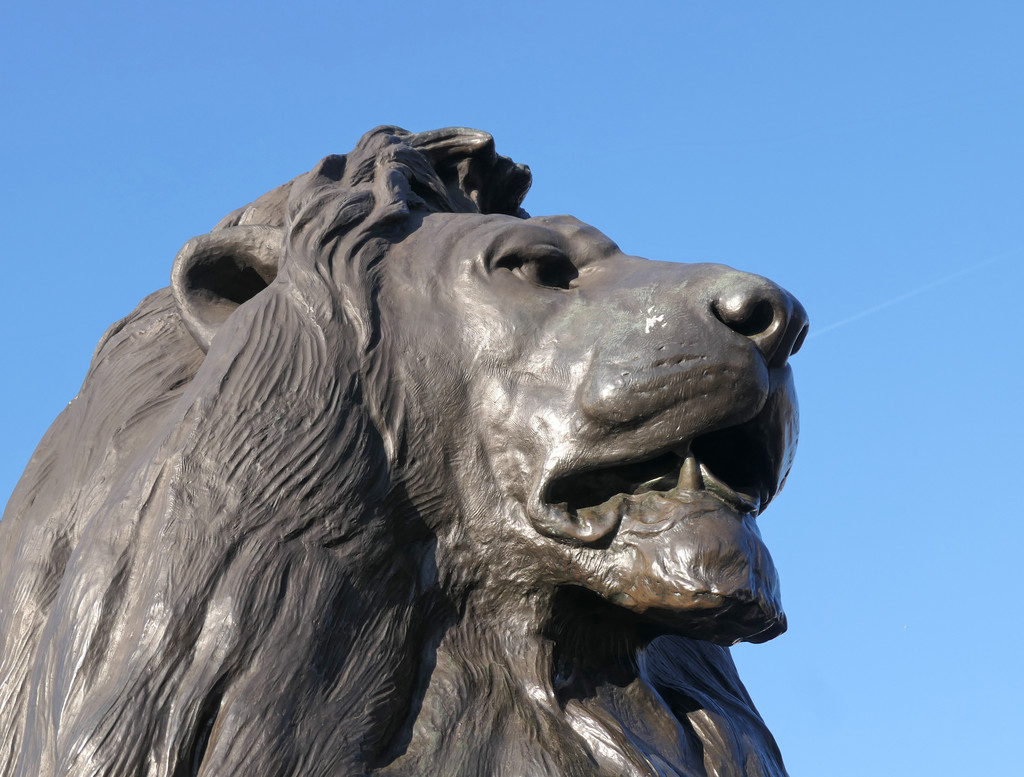
- Navigation image, One of the bronze lions at Nelson’s Column: modelled by Edwin Landseer and cast by Carlo Marochetti. Photograph by Amanda Slater. CC BY-SA 2.0. Image source. CC BY-SA 2.0. Resized.