 by Tom Gurney
Tom Gurney BSc (Hons) is an art history expert with over 20 years experience
Email: tomgurney1@gmail.com / Phone: +44 7429 011000
Landseer and Animal Painting: Introduction
Calling Edwin Landseer an animal painter identifies his most persistent field, but it does not yet explain what he did there. An animal might be a named sitter, a working body, a partner in a household, quarry in a hunt, a captive performer, a creature in a fable or an actor in a human institution recast as comedy. It might carry the main action while people remain visible, or make absent people felt through their possessions. The same painter could describe a dog's weight at rest, arrange legal satire around canine breeds and imagine polar bears among the remains of an expedition.
These differences matter because one familiar term—“anthropomorphic”—has often been asked to account for all of them. It fits pictures in which animals take on human roles, but becomes evasive when applied automatically. A bloodhound sleeping is not necessarily a person in disguise. A stag trying to escape hounds is already doing something meaningful as a deer. A pet portrait records ownership and attachment before it becomes a general moral about loyalty. Even an overt fable depends upon the animal bodies through which the analogy is staged.
Landseer's achievement developed within a wider British culture that was deeply divided about animals. People admired animal beauty while capturing and displaying wild species; kept companions while ranking breeds; promoted measures against cruelty while depending upon animal labour and enjoying hunting. Diana Donald and Harriet Ritvo have shown that sympathy and control were not successive stages in which one simply displaced the other. They existed together, sometimes within the same institution, household or image.[1][2]
The task, then, is not to decide whether Landseer saw animals “as they really were” or turned them into humans. Neither alternative is adequate. His pictures combine bodily knowledge with invention. They ask viewers to notice an animal and to read a story, status or ethical pressure through it. A responsible interpretation must keep both operations visible: the creature's represented form and action, and the human relations assembled around that creature.
At a Glance
- ObservationAnatomy and animal behaviour [3][1]
- NarrativePortraiture, humour, grief and rescue [3][1]
- ContextSport, welfare and captivity [1]
Contents
- What counts as animal painting?
- Anatomy is knowledge, not a finished meaning
- Observation after selection
- Animal portrait, owner and type
- When anthropomorphism is exact
- Feeling without a shortcut
- Welfare in a culture of use
- The hunted animal and the predator
- Captivity, performance and looking
- How a painter's name became a dog term
What counts as animal painting?
Animal painting was never one narrow subject category. Portraiture could centre a particular horse or dog belonging to a patron. Sporting art could organise pursuit, capture or the display of valued animals. Genre painting could place animals within labour and domestic life. A literary or historical picture might make animals essential to an episode without excluding people. Fable and satire could use species difference to examine human conduct. Landseer's practice crossed all of these modes, which is why institutional summaries describe pet portraits and hunting scenes alongside explicit parodies of human behaviour.[3][4]
The category was broad enough to matter differently within a collection. The Royal Collection's survey of its paintings singles out Victoria's admiration for Landseer's animal subjects, but places them amid portraiture, landscape, ceremony and scenes of everyday life.[5] That context guards against two reductions. His animals were not a sealed specialist interest detached from the rest of British painting, and royal enthusiasm was not the only public through which the work acquired meaning. An animal subject could function as an intimate gift, an exhibition attraction, a comic invention or part of a dynastic interior. The label names what commands attention; it does not by itself name the picture's destination, audience or use.
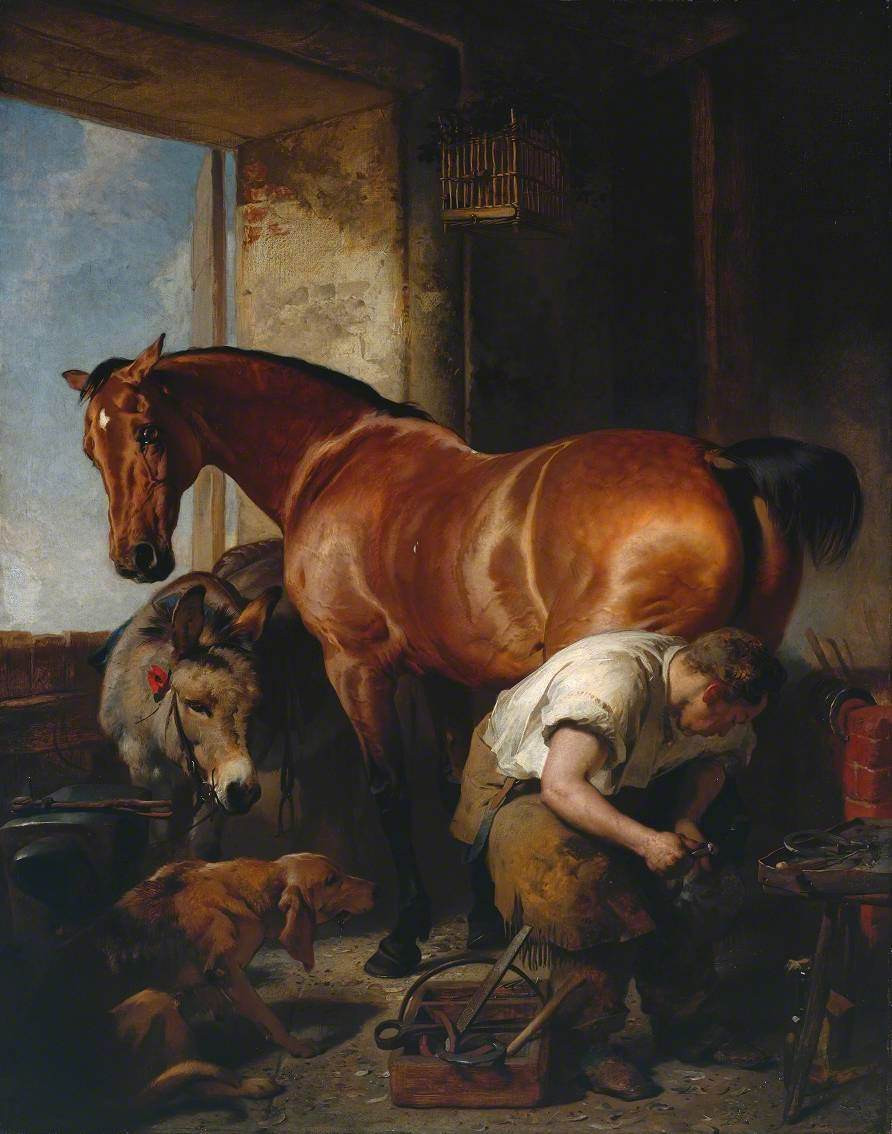
The identity of the principal actor is only one test. In Shoeing, the mare's body and the farrier's work are inseparable. In Isaac van Amburgh and his Animals, captive big cats, performer, bars and spectators create one system of display. Scene from A Midsummer Night's Dream uses rabbits and the ass-headed Bottom within Shakespearean transformation. In each case, calling the work an animal picture can be useful, provided the phrase does not make the people, labour, literature or confinement disappear.[3][6][7]
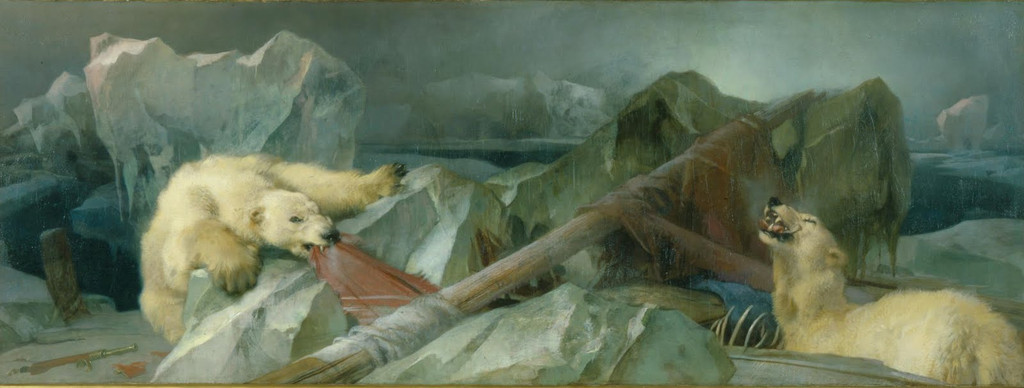
Nor does the absence of a person remove human organisation. A commissioned portrait can evoke an owner through title and destination. A pursued stag remains inside a sporting practice even if hunters stand beyond the frame. Polar bears among broken equipment encounter the material consequences of human exploration. Landseer repeatedly made human power visible through what it had arranged, owned or left behind.
This broader definition also prevents a hierarchy in which the most “pure” animal work is the one with the least cultural content. A small dog study and an elaborate satire answer different pictorial questions. One can concentrate attention upon structure and alertness; the other coordinates multiple bodies, objects and an institution. The first is not merely raw material for the second, and the second is not corrupted observation. Each selects what an animal can make legible.
The word “animal” itself covers unequal relations. Pets receive names and private rooms. Sporting dogs are trained to pursue other species. Horses work under human handling. Menagerie animals are transported, caged and exhibited. Wild quarry can be converted into estate property or national image. Donald's history is especially useful here because it places visual representation beside the actual use and abuse of animals rather than treating images as an insulated realm.[1]
Landseer's pictures therefore belong to animal painting when animals bear a substantial part of their visual and conceptual work. That formula is deliberately broad. It shifts attention from counting species to asking what relation is being constructed: likeness, possession, cooperation, comedy, sympathy, violence or control. A single picture may hold several at once.
Anatomy is knowledge, not a finished meaning
Landseer's early anatomical work gives material force to his reputation for animal observation. Eleven écorché drawings of dogs and cats, made around 1817–21 and acquired by the Victoria and Albert Museum, study muscles and bones with the outer covering removed or imagined away. Susan Owens's specialist account places these sheets within the young artist's sustained inquiry into animal structure.[8] They are difficult evidence, not a charming story of effortless talent.
The group also changes the scale at which looking should begin. Fur can disguise the transition from shoulder to ribcage or make the contour of a leg appear continuous where several structures are working together. An écorché sheet reverses that priority. It asks first how a limb attaches, where tension gathers and how mass is supported, then allows the outer appearance to be reconsidered. This does not make the drawings a universal key to every later animal. They concern particular dog and cat bodies, belong to an early phase, and survive as a bounded group rather than as proof of an identical procedure throughout Landseer's career.[8] Their importance is methodological: they show that convincing surfaces could rest upon questions pursued beneath the surface.
Écorché study asks how a body is constructed beneath fur and skin. It can clarify how a shoulder carries weight, where a leg bends, how tendons cross a joint and what happens when a torso twists. Such knowledge may make a painted stance convincing, but it does not decide what the stance means. An exposed muscle group contains no instruction to turn a dog into a mourner, a judge or a rescuer. Narrative arrives through later choices.
The distinction is visible in the Metropolitan Museum's Study of a Dog. Black chalk, heightened with white and touched with red, gives sustained attention to the animal, while a nearby hand and cloth are more lightly indicated.[9] The sheet does not distribute finish evenly. It selects. The dog's response to the human presence matters, even though the human elements remain abbreviated. Observation is already relational rather than an inventory of isolated parts.
The surviving study for Alpine Mastiffs Reanimating a Distressed Traveler makes another point. A monumental rescue picture required more than accurate dogs. Landseer had to decide how two animals would differ in action, how much of the endangered traveller would remain visible, where human assistance would appear and how a mountain pass would prolong suspense. The preparatory sheet confirms that the event was organised through drawing before its large painted form.[10]
Anatomical credibility can also serve an invented scene. The National Gallery of Art's Contending Group after Nature brings a lion, tiger and leopard into a highly dramatic encounter whose grouping is implausible as a neutral record. Its bodies can still display informed structure and foreshortening.[10] The phrase “after Nature” in a historical title does not guarantee that the depicted event was witnessed. It may announce a claim about bodily authority inside a composition that is openly constructed.
Lion Defending Its Prey sharpens the difference between study and spectacle. The small work is oil on paper later attached to canvas, not a monumental exhibition object. A lion crouches over a carcass while confronting a snake.[10] Knowledge of feline tension supports the conflict, yet the opposition of curved bodies, mouths and possession is designed. It would be as misleading to call the picture zoological documentation as to deny that careful looking at animals made its fiction persuasive.
Anatomy is thus one layer of evidence. It helps viewers test pressure, balance and possible movement. It also protects against empty praise of “lifelike fur”, because a body is more than its surface. But anatomical study cannot certify every pose, determine species behaviour or reveal an animal's mind. It becomes artistically consequential only when joined to scale, medium, timing and relation.
Observation after selection
Every represented action contains a chosen moment. A dog can be shown before it springs, while it works, after it tires or in deep rest. A stag can be caught amid attack or after reaching temporary safety. The painter selects an interval and supplies enough information for viewers to imagine what precedes and follows it. That temporal construction is one reason a still animal picture can feel active.
In Alpine Mastiffs, the dogs do not repeat one response. One works at the snow and directs attention outwards; another attends to the exposed human hand. Help remains at a distance.[10] The different actions distribute knowledge through the scene. Viewers understand the emergency by moving between animal bodies, buried person and approaching figures. The painting's famous small barrel is a depicted object, not proof that such dogs historically carried restorative drink or that Landseer originated a rescue custom.
Sleeping Bloodhound removes public emergency and concentrates upon a large recumbent body. Rest has observable features: released limbs, supported weight, closed or lowered attention, and the possibility of waking. Yet a picture of sleep is not simply an animal caught unawares. Cropping, light and surrounding darkness make the body occupy a calculated field.[6] A dramatic anecdote about the model is unnecessary unless independently established. The visible state already supplies a demanding subject.
Pursuit changes the terms. In Deer and Deer Hounds in a Mountain Torrent, the stag and dogs struggle within rushing water. The uneven ground destabilises attacker and quarry alike.[6] Calling the animals accurately drawn would miss the humanly organised hunt that has brought them together. Conversely, interpreting the scene only as a social symbol would discard the represented difficulty of bodies finding purchase in a torrent.
The Sanctuary selects the aftermath of flight. The Royal Collection describes an exhausted stag that has reached an island on Loch Maree, with displaced birds marking its arrival. Landseer participated in deer shooting, and the holder also records moral conflict over blood sports.[11] The painting cannot be reduced either to an endorsement of sport or to a complete rejection of hunting. Its force lies in the interval it makes visible: immediate pursuit has stopped, fatigue persists, and the apparent safety is bounded.
Observation is therefore not a claim that a painter copied an uninterrupted incident. An animal may have been studied across many moments, then placed within a setting assembled to make one action intelligible. The final pose can be credible without being documentary. The proper questions are concrete: where is the weight, what resists movement, what attracts attention, what has just changed and what human arrangement makes this action possible?
This approach also limits overconfident mind-reading. A raised head may invite words such as alert, proud or anxious, but those terms should be tested against ears, limbs, surrounding objects and the source of attention. The aim is not to deny that animals feel. It is to distinguish what the picture shows from the mental script a viewer supplies.
Animal portrait, owner and type
Animal portraiture begins with particularity but requires more than detailed appearance. Evidence may identify a name, owner, commission, gift or known relationship. Those facts turn a represented body into a sitter within a social history. Without them, a specific-looking dog may remain a study or an idealised type rather than a securely named portrait.
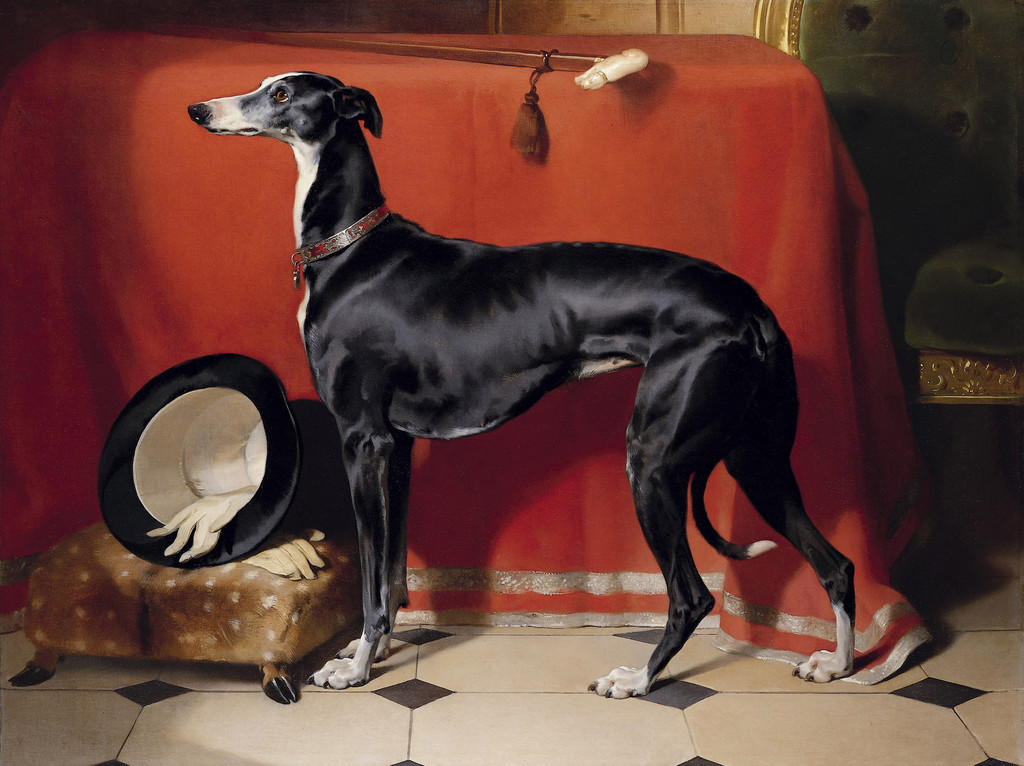
Eos provides an unusually complete case. The greyhound belonged to Prince Albert and came with him to Britain. Victoria commissioned the life-size painting as a Christmas present in 1841, and it hung in Albert's dressing room at Buckingham Palace.[12] Breed, individual identity, marriage, gift and room all contribute. The animal is neither a generic emblem of loyalty nor a detachable royal accessory.
The private destination changes how the portrait works. A named companion could be recognised by the recipient through features and habits unavailable to a public viewer. Landseer nevertheless organised the body for pictorial presence. A successful likeness within a household still involves choices of posture, scale and surroundings. Intimacy does not cancel construction.
A Deerhound, an 1826 oil on board at the Metropolitan Museum, offers a more concentrated problem. The alert single animal is associated with a similar dog beside the Duke of Gordon in a larger Scottish composition, but the compact object retains its own identity.[13] It can be read through aristocratic hunting culture without being made to stand for every deerhound or every estate.
Yale dates the group called Favourites, the Property of H.R.H. Prince George of Cambridge to 1834–35.[13] Its title joins emotional preference to legal and social possession in a single formula. Those terms do not have to cancel one another: valued animals could be companions, status-bearing bodies and commissioned subjects at the same time.
Titles supply evidence here, but they must be handled at the right level. “Favourites” tells a viewer how the group was presented; it cannot disclose the daily experience of every animal. “Property” establishes a relation more securely, yet even that word says little about who fed, trained or handled the dogs. Visual likeness, documentary identity and household history answer different questions. A portrait becomes richer when they converge, while any gap among them should remain visible rather than being filled with an ideal story of devotion.
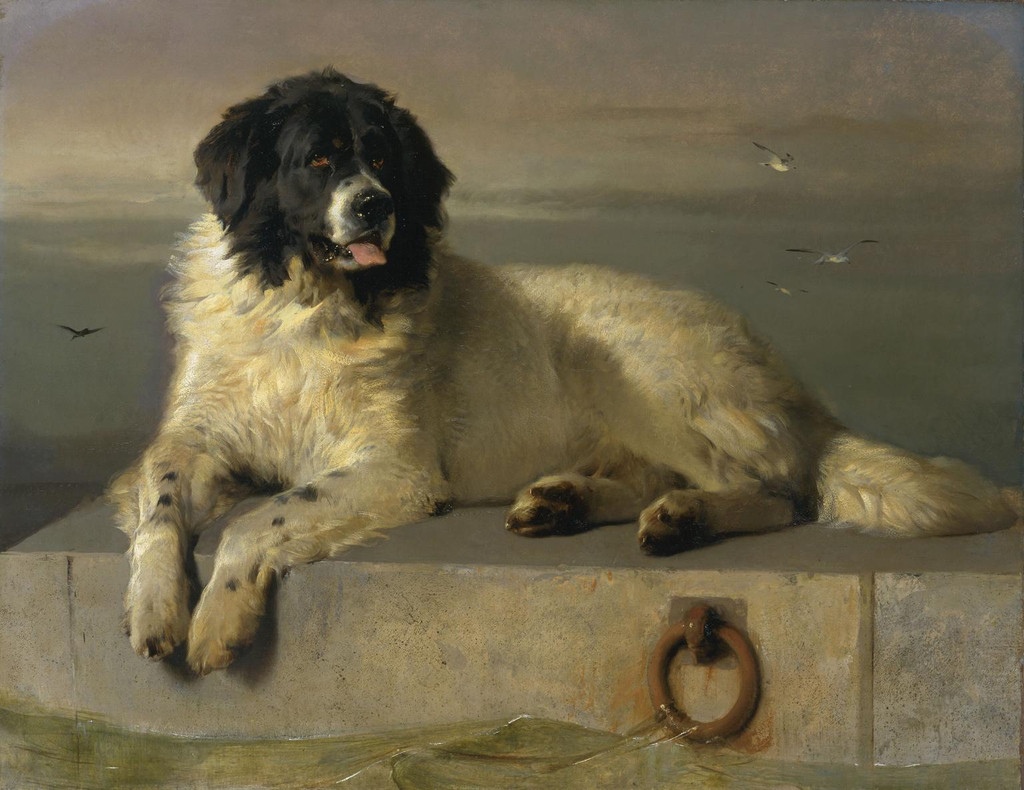
Paul Pry, the black-and-white Newfoundland in A Distinguished Member of the Humane Society, demonstrates why archives matter. A repeated story identified the picture with a lifesaving dog called Bob who supposedly lived at the Royal Humane Society. The Society's review instead identifies Paul Pry, owned by Newman Smith, and states that the painted dog never resided at its premises.[14] The title creates an honour, but it does not turn fiction into sitter biography.
This correction does not empty the portrait of humane associations. The recumbent dog appears by water, and the institutional title encourages viewers to imagine rescue and public service. What changes is the level of claim. Paul Pry is the model; the “distinguished member” is a pictorial role. A different dog may have been kept at the Receiving House, but the Society has no evidence that its image survives in Landseer's painting. It also states that its awards were for people, not animals.[14]
Breed terms require similar caution. Nineteenth-century dogs were recognised through work, locality, appearance and emerging notions of type, but modern pedigree categories were consolidated through Victorian shows, standards and governing bodies. Worboys, Julie-Marie Strange and Neil Pemberton trace how form, coat, descent and competitive exhibition gradually remade “breed” into a regulated system.[15] Present labels can assist identification; they cannot be projected unchanged onto every historical sitter.
Animal portraiture is consequently a relation among body, name, owner, purpose and later classification. It can preserve individuality while revealing possession. It can make affection visible without proving a universal breed temperament. The strongest reading neither dissolves the sitter into a symbol nor imagines that a portrait exists outside human property and memory.
When anthropomorphism is exact
Anthropomorphism is most useful when a picture demonstrably assigns a human role, institution or social characteristic to an animal. The word then identifies a structure rather than a vague sense that a creature looks expressive. Landseer's satires show several distinct mechanisms.
Laying Down the Law, exhibited in 1840 as Trial by Jury, constructs a canine legal assembly. Chatsworth identifies its satire with the Court of Chancery, whose delays and costs were a public grievance. A white poodle occupies the judge's place, its ears contributing to the visual parody of a legal wig, while other breeds fill professional roles.[16] Here the dogs do not merely seem human. Institution, seating, title and costume-like anatomy organise them as a court.
The painting's later alteration makes the human system still clearer. After acquisition, the Duke of Devonshire asked Landseer to add his spaniel. The requested favourite entered an already functioning satire and required compositional adjustment.[16] Individual portrait, a patron's possession and institutional parody meet in one object. “Anthropomorphic” is accurate, but incomplete unless it names those layers.
High Life and Low Life construct class through a paired design. An elegant deerhound inhabits an aristocratic interior; a compact dog occupies a materially modest working environment. The meanings arise from furniture, tools, armour, food, scale, breed associations and titles as much as from faces.[1][6] The pair does not discover a natural class system among dogs. It makes canine difference carry a human social comparison.
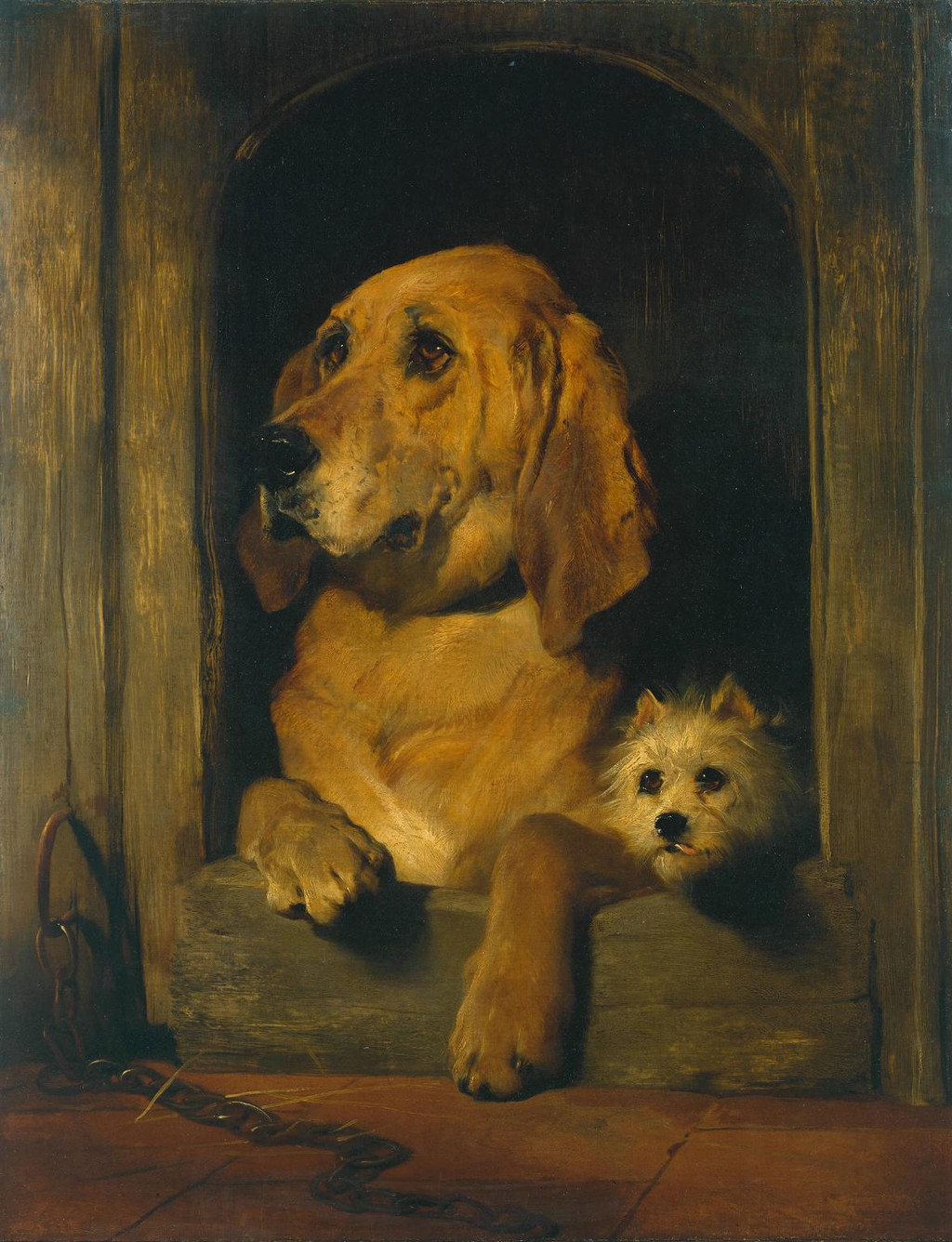
Dignity and Impudence uses fewer props but still relies on pictorial arrangement. A large bloodhound and smaller terrier meet the viewer from unequal positions around an architectural opening.[6] The title directs the contrast towards social character. Remove that title and the bodies would remain differently scaled and placed, but “dignity” and “impudence” would no longer arrive as ready names for their attitudes.
Fable works differently. In The Cat's Paw, a monkey uses a cat to retrieve chestnuts from a fire. The story of manipulation existed before Landseer's panel, and the phrase “cat's paw” came to describe a duped agent.[17] The human analogy is not inferred only from expression. It is built into the inherited action. The animals make exploitation visible precisely because their species and unequal positions remain recognisable.
Alexander and Diogenes borrows a classical encounter. Dogs occupy relations associated with a ruler and a philosopher who refuses deference.[6] The title activates the analogy, while pose and group structure make hierarchy readable. No claim about canine philosophy is involved. Landseer uses animal bodies to re-stage a cultural story whose human source an informed viewer could recognise.
These examples reveal at least four kinds of anthropomorphism: institutional role, social type, proverbial fable and named literary or historical analogy. They should not be merged. A poodle judge, aristocratic deerhound, manipulated cat and canine Diogenes do not all embody the same theory of animals. The human frame changes, and so does what the animal contributes.
The device also involves the spectator. A legal parody assumes some recognition of professional order; a class pair depends upon distinctions in furnishing, work and comportment; a classical allusion rewards prior knowledge. The animal does not carry the whole analogy inside its face. Meaning is distributed among body, setting, title and what an audience is prepared to recognise. That distribution explains why the same creature may be read differently when a title is lost, changed or translated, or when the institution being mocked is no longer familiar. It also keeps interpretation testable: a proposed human role should point to visible or documented machinery, not rest on the claim that an animal simply “looks like” a type of person.
Some pictures are better served by other language. A sleeping dog displays a bodily state. A named pet sits for a portrait. A mourning scene prompts an inference about attachment. Calling each anthropomorphic may be defensible in the broad sense that viewers recognise traits across species, but it provides too little information. Description should specify what has been borrowed from human life and where that borrowing is located.
The term also carries an ethical risk. Human analogy can bring an animal closer to a viewer, making vulnerability or attention legible. It can equally replace animal needs with a reassuring moral character. A faithful dog may become admirable because it serves, waits or suffers for people. Donald and Ritvo both make such hierarchy part of the history of animal representation.[1][2] Anthropomorphism is therefore neither inherently humane nor inherently false. Its value depends on what it reveals and what it makes disappear.
Feeling without a shortcut
Landseer's emotional pictures have often been gathered under the verdict of sentimentality. That label can identify a directed appeal to feeling, but it has also carried a later assumption that Victorian narrative art was aesthetically inferior because it was accessible or moving. Nicola Bown argues that modernist condemnation has shaped how Victorian sentiment is discussed and that affective involvement deserves analysis rather than embarrassment.[18] The point is not that every emotional work succeeds. It is that dismissal should follow examination, not replace it.
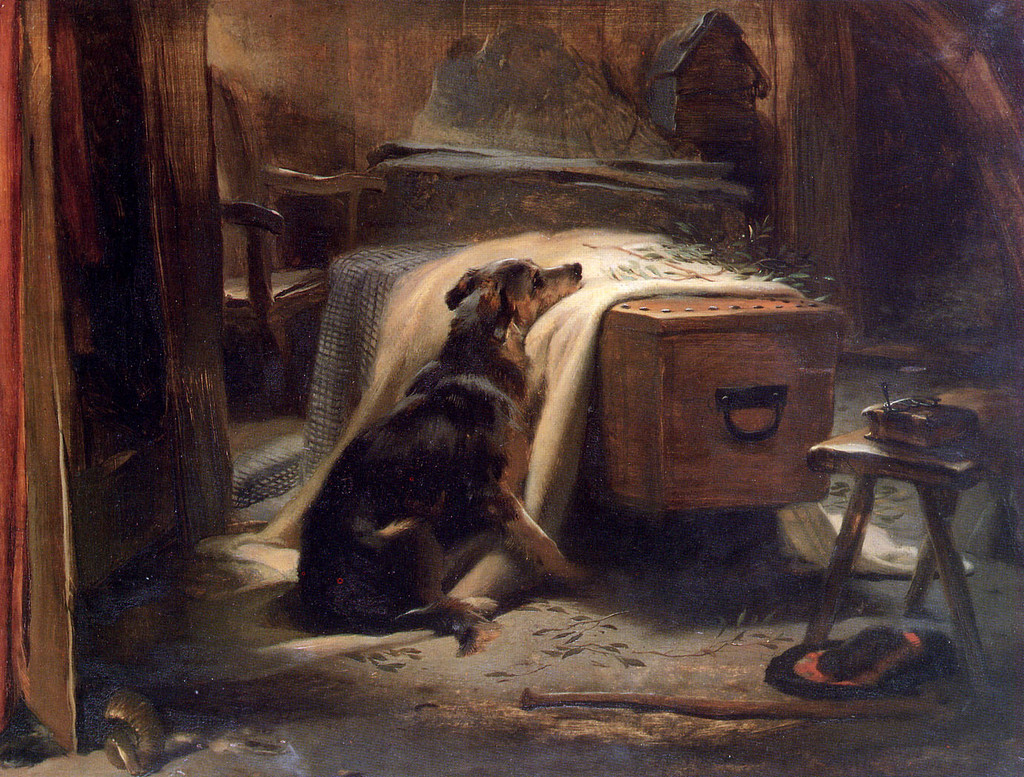
The Old Shepherd's Chief Mourner offers a stringent test. A dog remains beside a dead shepherd's effects. The human body is absent, so the room must establish loss through belongings, enclosure and the animal's continuing proximity. The V&A treats it as an especially emotive example of Victorian animal painting.[19] Its force does not depend upon a speaking animal or an elaborate facial grimace.
Calling the dog a mourner is already an interpretive act prompted by the title. The low body, withheld human presence and material remains make grief available to the viewer. That does not prove that every dog experiences bereavement in an identical way, nor does it reduce the posture to empty projection. The picture organises a credible attachment into a human ritual of mourning while leaving the creature silent.
This silence distinguishes the work from overt satire. The legal dogs become funny because their roles are conspicuous. The shepherd's dog becomes affecting because the represented relationship has been interrupted. One mode amplifies human institutions; the other uses absence and restraint. To call both anthropomorphic without further description would erase the difference in emotional tempo.
Rescue pictures direct sympathy by another route. Alpine Mastiffs places animals between a threatened person and delayed human assistance. The dogs appear to recognise need first, which grants them narrative initiative.[10] Yet the scene's later power to nourish St Bernard legends warns that sympathy can harden into folklore. A compelling image may become evidence for a custom it only depicts.
Vigilance in A Distinguished Member is similarly entangled with title and afterlife. The Royal Humane Society eventually requested an engraving and permitted copies to support fundraising, even while its secretary repeated an incorrect belief about the sitter. The Society's later archival correction separates that institutional use from Paul Pry's actual identity.[14] The episode shows how an image can acquire humane public work after it was painted without proving that its original portrait was a documentary record of rescue.
Emotion also depends on what the composition excludes. A loyal pet portrait may not show servants who cared for the animal. A shepherd's interior can direct grief away from material hardship. A rescue scene may centre heroic dogs but leave the breeding and training of rescue types unexplained. These omissions do not automatically invalidate the work. They define the limits within which its feeling operates.
A useful response to sentiment is therefore double. First, allow the picture to move, amuse or disturb. Second, locate the mechanisms: title, posture, scale, light, absence, possession and anticipated outcome. Feeling becomes evidence about the encounter between work and viewer, while historical sources test the story attached to it. Neither cold refusal nor unquestioning identification is enough.
Welfare in a culture of use
Landseer's career coincided with major changes in the public regulation of cruelty. Martin's Act of 1822 addressed cruel treatment of specified cattle. The Society for the Prevention of Cruelty to Animals was formed in 1824. Legislation in 1835 broadened protection and prohibited such practices as bull-baiting and cockfighting, and Victoria authorised the “Royal” prefix in 1840.[20] These dates establish an institutional context in which animal suffering became newly organised as a public and legal question.
They do not describe a completed moral transformation. Animals continued to pull loads, provide food, support war and transport, serve as companions, enter scientific and commercial systems, perform for crowds and become quarry. Hunting remained culturally powerful. Breed display increasingly judged animals against human standards of form. Donald's central finding is not a simple rise of kindness but persistent ambivalence: admiration and domination could occupy the same culture.[1]
Ritvo likewise places humane reform beside social discipline, pedigree, zoological display and imperial hierarchy.[2] Compassion could protect animals while also valuing them according to service, obedience or resemblance to an ideal type. A “good” animal was often one whose conduct fitted human needs. Animal painting both reflected and helped viewers imagine those classifications.
Five evidentiary levels need separation. An animal can be visibly injured or exhausted. A painting can direct sympathy towards that body. A public debate can condemn a practice. An organisation can use an image in advocacy. An artist can express an intention. These are connected possibilities, not interchangeable facts. The first two may be evident in an object; the others require documents.
That ladder helps prevent both celebration and accusation from outrunning the record. Visible strain may justify a description of bodily difficulty without proving that a picture opposed the activity represented. A sympathetic arrangement can make suffering hard to ignore without establishing what every contemporary viewer felt. Later institutional use documents reception, not necessarily original purpose. A letter or recorded remark may clarify intention, but even intention does not exhaust what a work makes available. Ethical reading becomes stronger as each assertion is attached to its proper witness: the pictured body, the composition, a dated public source, a traceable afterlife or a statement by the artist. Where only one level is documented, the others should remain questions.
The Sanctuary demonstrates the value of that separation. The picture shows fatigue after pursuit and offers temporary safety. The Royal Collection records Landseer's own participation in deer shooting together with moral unease about cruelty.[11] That combination gives the ethical reading historical support, but it does not turn the painting into a programme for abolishing hunting. Patron, sport and compassion remain uneasily joined.
The Royal Humane Society and RSPCA must also remain separate. The former began in 1774 to recover people apparently drowned and rewarded acts of human lifesaving. The latter emerged fifty years later to prevent cruelty to animals.[14][20] Landseer's title A Distinguished Member of the Humane Society depends upon the prestige of human rescue. Mistaking the organisations makes the joke simpler and the history wrong.
Animal labour requires equal care. Shoeing can draw attention to coordinated bodies, skilled handling and the vulnerability of a raised hoof.[6] It neither condemns nor romanticises all farriery by existing. The painting records a relation of necessary management. Ethical interpretation becomes useful when it asks how control is represented, whether strain is visible, whose skill receives recognition and what alternatives the historical setting allowed.
The same discipline applies to pets. Affection can be genuine while ownership remains unequal. An animal portrait may preserve a beloved individual and advertise status. A breed ideal may celebrate form while narrowing acceptable bodies. Sympathy is not exposed as hypocrisy merely because power persists; nor does feeling erase power. The picture becomes historically legible when those conditions are allowed to coexist.
The hunted animal and the predator
Sporting pictures make human absence particularly deceptive. In The Hunted Stag, no prominent hunter is needed to explain the hounds, quarry and turbulent terrain. The pursuit has already installed human purpose in animal action.[6] The stag's struggle can create identification, but the scene also offered a sporting subject to viewers familiar with the chase. Vulnerability and spectacle are not mutually exclusive.
The Sanctuary moves to the pause after escape. The stag has reached an island, birds rise, and the surface quiets around exhaustion.[11] Its title promises protection more strongly than the object can guarantee. Comparing the two works makes an ethical difference without forcing a verdict: attack and refuge ask viewers to occupy different moments within the same system of pursuit.
Predation without visible hunters changes the frame again. In Lion Defending Its Prey, a lion guards a carcass against a snake.[10] The action concerns possession and threat among animals, but the scene is still humanly invented, titled and collected. It should not be moralised as wickedness, nor romanticised as unmediated nature. The animal's agency exists within a composition made for human looking.
Man Proposes, God Disposes binds animal action to a recent human catastrophe. Polar bears encounter remains associated with the lost Franklin expedition. Royal Holloway's object history anchors the 1864 painting in public knowledge about Arctic exploration.[21] The animals do not need to become judges of empire for the work to unsettle human command. Living bodies occupy a field where human agents survive only through objects and implication.
These scenes reveal several meanings of agency. An animal may initiate represented action, resist another body, exploit an opportunity or outlast a human project. None of that makes it free from the painting's title and historical use. Agency in an image is a compositional fact about what the creature is allowed to do, not a declaration that human framing has vanished.
The ethical pressure of such works comes partly from unstable identification. A viewer may follow the hounds' force, the stag's fear, the lion's defence or the bears' possession of wreckage. Landseer does not assign one permanent moral position to predator, prey and spectator. The shifts demand a question more precise than whether he “loved animals”: whose action carries the scene, whose suffering becomes visible and which human system remains just outside view?
Captivity, performance and looking
Wildness in nineteenth-century art was often encountered through captivity. Menageries, zoological gardens, private collections and theatres brought animals into metropolitan view through capture, transport and enclosure. Donald and Ritvo place these institutions within histories of commerce, classification and empire.[1][2] An artist could study a living lion closely because other people had made that lion accessible under coercive conditions.
The 1839 painting of Isaac van Amburgh makes display explicit. The American performer appears inside a cage among lions and other animals, while spectators watch through the bars. Victoria attended his act seven times during six weeks, and the picture became her first commission to Landseer.[7] Repeated royal attendance demonstrates fascination and publicity. It does not verify the methods by which the animals were trained or establish that the performance was humane.
The cage divides several kinds of gaze. Spectators inspect the performer and animals. Van Amburgh presents control to them. The animals look, turn or occupy positions within that act. Viewers of the painting stand beyond another boundary, able to see both enclosure and audience. Captivity is therefore not background architecture; it makes the spectacle intelligible.
The later Yale portrait of Van Amburgh, made in 1846–47, rearranges the performer and animals under a different commission.[3] The two objects should never be merged into a single record of an act. Their difference also warns against treating a painted arrangement as documentary proof of one actual performance. Theatre, portraiture and animal display overlap, but composition remains deliberate.
The Arab Tent, painted about 1865–66, gathers a mare, foal, greyhounds and monkeys in an Orientalist setting. The Wallace Collection preserves both the present identity and the longer historical exhibition title.[22] It is a late assemblage shaped by human collecting and imagined cultural difference, not a report from a coherent “Eastern period”. The relation among species is staged for a British art public.
Terms such as wild, tame, pet, performer and quarry thus describe human arrangements as well as animals. A lion in a cage remains a lion, but “performer” names what a commercial system requires it to do. A deer in a managed landscape is wild in a different sense from an animal beyond property. A dog can be companion and trained worker simultaneously. The categories are useful when they expose relations; they mislead when treated as permanent essences.
Captivity also sets a limit on easy empathy. A viewer may admire the big cat's body or fear its power while overlooking the bars that make prolonged looking possible. Landseer's command of animal form can intensify that attraction. Close attention should turn admiration back towards the conditions of access: who transported the animal, who controlled the space, what audience paid to see it and how the composition represents or suppresses resistance.
How a painter's name became a dog term
Landseer's afterlife entered animal classification itself. His repeated pictures of black-and-white Newfoundlands became so closely associated with that visible type that “Landseer” attached to it. The American Kennel Club's archive for the Newfoundland Club of America explicitly connects the name with the artist's preference for the black-and-white variety.[23] This is a remarkable case of images helping to shape how people describe animals, but it needs careful dating.
The painter did not design a breed. Modern pedigree breeds were standardised through nineteenth-century and later practices of selection, show competition, written ideals and institutional registration. Before that consolidation, words such as kind, race, strain and breed could refer less consistently to use, locality, descent or appearance. The history reconstructed by Worboys, Strange and Pemberton makes coat terminology part of a changing human system rather than a timeless biological label.[15]
Present usage is not uniform. In the United Kingdom, the Royal Kennel Club's Newfoundland standard lists “Landseer (white and black)” as a permitted colour, predominantly white with black markings.[24] Within that framework, Landseer designates a colour variety of the Newfoundland rather than a separate breed.
The Fédération Cynologique Internationale takes another approach. Its Standard No. 226 separately recognises the Landseer (European Continental Type), assigns Germany and Switzerland as countries of origin and records final recognition in 1960.[25] The full qualifier matters. It prevents a current European breed category from being confused automatically with every historical black-and-white Newfoundland or with UK terminology.
These standards answer present institutional needs; they do not retrospectively classify Paul Pry with certainty. The Royal Humane Society correction establishes his name and owner, not his conformity to a twentieth- or twenty-first-century ideal.[14] Nor should the false story of Bob be used to explain breed naming. The safe conclusion is narrower: Landseer's images and reputation attached his surname to a black-and-white canine type, and later kennel systems formalised that legacy differently.
The naming afterlife also exposes a feedback loop. A painter selected certain visible animals; reproductions made those images familiar; viewers associated a coat pattern with the artist; breeders and governing organisations then used the name to order living dogs. Art did not merely reflect an already finished taxonomy. It participated in the cultural environment from which classification drew authority.
That influence must not be mistaken for an endorsement of current breeding practice. The history explains a word. It supplies no advice about acquiring, breeding or judging a dog. Its value for understanding Landseer is interpretive: the transformation of a surname into animal terminology shows how far images can travel beyond canvas, and how later institutions can make one visual association appear natural.
A method for reading animal pictures
Begin by identifying the object. Establish title, date, medium, support, size and current holder. Determine whether the image is the painting, a study, a version, a copy or a print after it. A graphic reproduction may preserve the composition while changing colour, scale, texture and authorship. Without this first step, interpretation can attach to the wrong object.
Then look at the body before naming a character. Where does weight fall? Which joints are loaded or released? Is the animal moving, resting, resisting, watching or being handled? What action seems physically possible next? Anatomical study makes these questions especially productive in Landseer, but the purpose is not to award marks for correctness.[8][9]
Next locate the source of attention. Follow eyes, ears, muzzle, hands, tools and lines of approach. One dog may look towards a person while another addresses danger outside the immediate group. A stag may turn against hounds while the water redirects every body. Attention creates a sequence within a still picture.
Read the environment as a set of permissions and barriers. A room can indicate ownership; a threshold can rank two animals; snow can delay rescue; water can hinder pursuit; a cage can transform a living animal into a performer. If the surroundings disappeared, what could no longer happen? This question turns background detail into structure.
Ask whether the animal is particular. Is a name known? Who owned it? Was the picture commissioned, given or made for exhibition? Which breed or type did contemporaries recognise, and how stable was that category? If evidence is absent, retain uncertainty rather than inventing a sitter. A portrait reading grows stronger when identity and visual particularity support one another.
Only then test human analogy. What characteristic has been assigned—class, office, philosophy, fidelity, grief or heroism? Does it come from the body, title, props, paired composition or prior story? In The Cat's Paw, the fable controls the role; in Laying Down the Law, institutional arrangement does; in Eos, named portraiture is more exact than generic personification.[17][16][12]
Notice the feeling directed towards the animal. Sympathy may arise through vulnerability, restrained movement, an anticipated rescue or a surviving attachment. Ask what evidence supports the story and what the emotional focus excludes. A strong response is not a factual error, but it should not be mistaken for proof about sitter biography, historical custom or social effect.[18][19][14]
Reconstruct the human system around the scene. Ownership, training, labour, breeding, hunting, capture, display, patronage and print circulation can remain active even when no person appears. Which relation gives the animal access to the picture, and which relation gives the viewer access to the animal? This is often where a seemingly transparent image becomes historically complex.
Finally, follow the afterlife. Was the picture engraved, used by an institution, renamed, restored or drawn into breed terminology? Later meanings do not overwrite the original object, but they explain why some interpretations became familiar. Paul Pry's mistaken identity and subsequent correction show how even a beloved image can carry a durable false story.[14]
Comparison should then be used as a control rather than as a shortcut. Place a named portrait beside an unidentified study and ask what documentary particularity adds. Put an overt fable beside a resting animal and identify exactly where human analogy enters. Compare pursuit with refuge, or a captive performance with a predator acting outside a visible cage. Differences in setting, title and temporal moment often explain more than a general claim about Landseer's “way with animals”. Comparison is most useful when it preserves what is unlike: no single dog stands for all dogs, no one hunt supplies the ethics of every sporting picture, and no royal commission represents the whole audience for animal art.
At the end of the sequence, return to the animal. Human analogies may be indispensable, but the represented creature still has species, body, action and vulnerability. If interpretation has converted it entirely into a judge, servant, aristocrat, patriot or moral lesson, something important has been lost. Landseer's strongest pictures make the return necessary because their animals do more than illustrate the stories placed upon them.
Animals are not one argument
Landseer's animal painting cannot be reduced to natural accuracy, human disguise or Victorian sentiment. Anatomical sheets disclose disciplined inquiry beneath the visible surface. Portraits bind individual animals to owners, gifts and rooms. Fables and satires assign human roles through carefully constructed devices. Scenes of grief and rescue direct emotion. Hunts and captive performances reveal systems of use that sympathy does not dissolve. Later kennel institutions show representation feeding back into the language applied to living bodies.
No single moral gathers those practices. Affection can coexist with possession; humane reform with labour and sport; admiration with captivity; bodily truth with narrative invention. This does not make the images evasive. It makes them precise records of relations that were already conflicted.
The phrase “animal painter” becomes meaningful when it opens those relations instead of closing them. Landseer studied how creatures stood, moved, watched and endured. He also arranged them for patrons and publics who brought stories, hierarchies and desires to their bodies. To see only the human analogy is to lose the animal. To see only the animal is to overlook the world that placed it in the picture.
Artworks directory
This directory gathers works discussed in the articles, including drawings, original etchings and prints after Landseer. It is not a complete catalogue of every drawing, version, plate or impression. Distinct media are kept separate; uncertain dates are left blank. Linked titles open individual articles.
| Name | Date | Medium |
|---|---|---|
| A Bellowing Stag | Drawing | |
| A Deerhound | 1826 | Painting |
| A Distinguished Member of the Humane Society | 1838 | Painting |
| A Highland Breakfast | 1834 | Painting |
| A Highland Landscape | c. 1830 | Painting |
| A Highland Shepherd's Home | Painting | |
| A Horse, Goat and Bull | 1811 | |
| A Hunting Horse | Drawing | |
| A Jack in Office | Painting | |
| A Lion Disturbed at His Repast | Painting | |
| A Random Shot | Painting | |
| A Scene at Abbotsford | Painting | |
| Adversity | Painting | |
| Alexander and Diogenes | exhibited 1848 | Painting |
| Alpine Mastiffs Reanimating a Distressed Traveler | 1820 | Painting |
| Contending Group after Nature | Drawing | |
| Copy after Rubens's Wolf and Fox Hunt | c. 1824–26 | Painting |
| Dash | Painting | |
| Deer and Deer Hounds in a Mountain Torrent ('The Hunted Stag') | c. 1832 / exhibited 1833 | Painting |
| Deer Family | ||
| Dignity and Impudence | 1839 | Painting |
| Dog Resting Upon a Couch | Drawing | |
| Eos | 1841 | Painting |
| Favourites, the Property of H.R.H. Prince George of Cambridge | 1834–35 | Painting |
| Her Majesty Sketching at Loch Laggan | ||
| High Life | 1829 / exhibited 1831 | Painting |
| Highland Lassie | Drawing | |
| Isaac van Amburgh and his Animals | 1839 | Painting |
| Lady Godiva's Prayer | Painting | |
| Laying Down the Law | 1840 | Painting |
| Lion Defending Its Prey | c. 1840 | Painting |
| Lioness | Drawing | |
| Little Strollers | ||
| Low Life | 1829 / exhibited 1831 | Painting |
| Man Proposes, God Disposes | 1864 | Painting |
| Nell Gwynne / Diana Vernon | Painting | |
| Neptune | ||
| No Hunting Till the Weather Breaks | Painting | |
| Otterhounds | Drawing | |
| Peace | Painting | |
| Pensioners | Painting | |
| Portrait of a Mule | Painting | |
| Portrait of Mr Van Amburgh, as He Appeared with His Animals at the London Theatres | 1846–47 | Painting |
| Portraits of a Pointer Bitch and Puppy | Painting | |
| Pray Let Me Out | ||
| Prosperity | Painting | |
| Ptarmigan in a Landscape | by 1833 | Painting |
| Queen Victoria and Prince Albert at the Bal Costumé of 12 May 1842 | 1842–46 | Painting |
| Queen Victoria at Loch Laggan | Painting | |
| Queen Victoria at Osborne | 1865–67 | Painting |
| Queen Victoria landing at Loch Muick | Painting | |
| Rat-catching | 1823 | |
| Reclining Lion | Drawing | |
| Reclining Lion, From Back | Drawing | |
| Rent-day in the Wilderness | 1855–68 | Painting |
| Return from Deer Stalking | 1839 | |
| Royal Sports on Hill and Loch | Painting | |
| Sam Lovill, Porter at the Royal Academy | Drawing | |
| Scene from A Midsummer Night's Dream | 1848–51 | Painting |
| Scene in the Highlands, with portraits of the Duchess of Bedford, the Duke of Gordon and Lord Alexander Russell | Painting | |
| Scottish Highlands, Lochs and Figures | Drawing | |
| Shoeing | exhibited 1844 | Painting |
| Sleeping Bloodhound | exhibited 1835 | Painting |
| Spaniel and Rabbit | Painting | |
| Stag at Bay | 1866 | Sculpture |
| Stag at Bay | 1846 | Painting |
| Studies of a staghound and the head of a stag for painting ‘The Hunting of Chevy Chase’ | Drawing | |
| Study for Alpine Mastiffs Reanimating a Distressed Traveler | Drawing | |
| Study for the Monkey in The Cat's Paw | Drawing | |
| Study of a Dog | Drawing | |
| Study of a herding dog facing right | Drawing | |
| Study of the horse of Selene, from the East pediment of the Parthenon | Drawing | |
| Suspense | Painting | |
| Taking a Buck | ||
| The Arab Tent | c. 1865–66 | Painting |
| The Barn | Drawing | |
| The Best Run of the Season | ||
| The Cat's Paw | c. 1824 | Painting |
| The Cavalier’s Pets | ||
| The Challenge | Painting | |
| The Chase | Drawing | |
| The Connoisseurs: Portrait of the Artist with Two Dogs | 1865 | Painting |
| The Death of a Stag in Glen Tilt | Painting | |
| The Drive—Shooting Deer in the Pass | Painting | |
| The Drover's Departure | Painting | |
| The Highland Shepherd’s Dog | 1824; portfolio issue 1848 | |
| The Honourable Mrs Norton | Painting | |
| The Hunting of Chevy Chase | 1825–26 | Painting |
| The Illicit Highland Whisky Still | Painting | |
| The Keeper John Crerar with his Pony | Painting | |
| The Larder Invaded | ||
| The Lion-Dog of Malta | ||
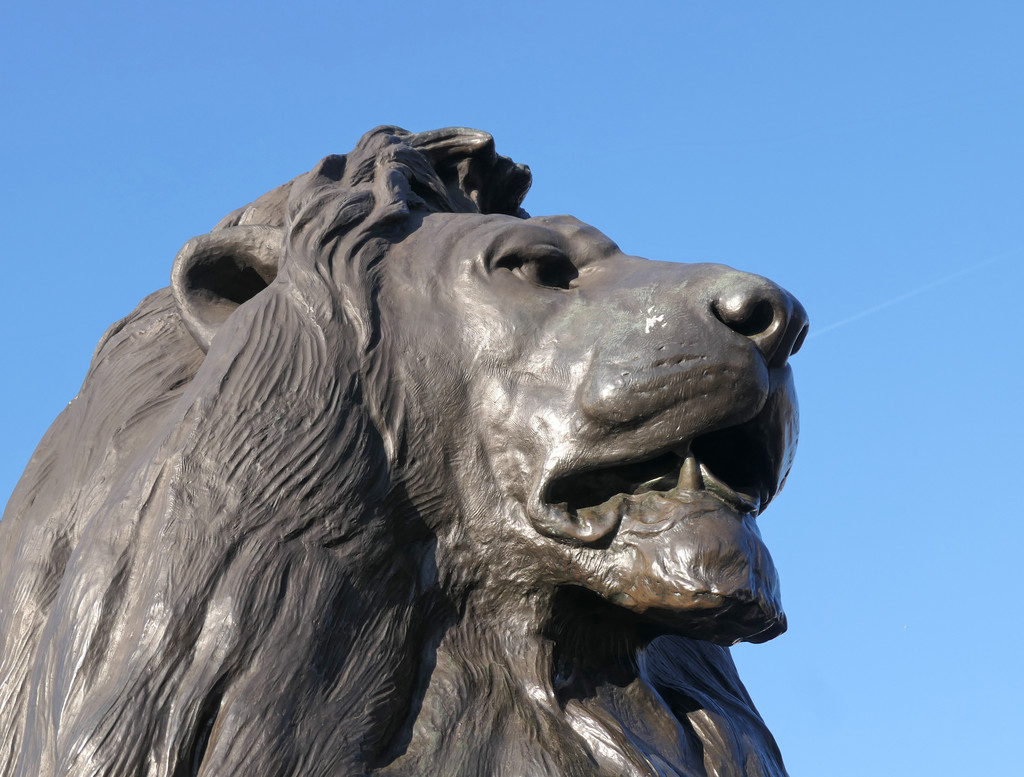
| The Lions at the Base of Nelson's Column | 1867 | Sculpture |
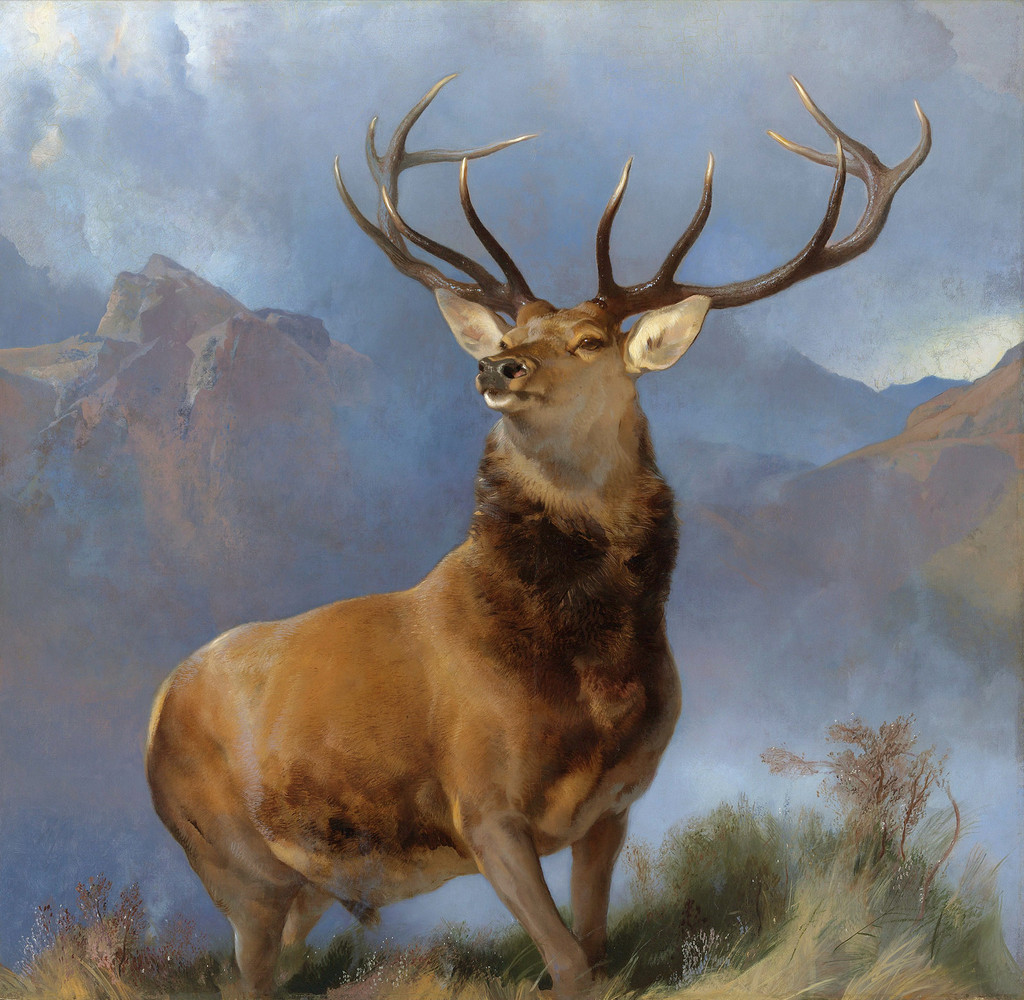
| The Monarch of the Glen | about 1851 | Painting |
| The Mountain Torrent | ||
| The Old Shepherd's Chief Mourner | 1837 | Painting |
| The Sanctuary | 1842 | Painting |
| The Stricken Deer | Painting | |
| The Twa Dogs | Painting | |
| Time of Peace | ||
| Two stags running | Drawing | |
| Victoria, Princess Royal, with Eos | Painting | |
| View of Glenfeshie | Painting | |
| War | Painting | |
| White Horse in a Stable | Painting | |
| Windsor Castle in Modern Times | 1841–43 | Painting |
| Woburn Abbey Game Card | 1825; portfolio issue 1848 |
Discussion
Use the article’s images and evidence to develop your own reading of Landseer and Animal Painting.
Reader Insights
Which detail is most revealing when you consider “What counts as animal painting?”?
How does the evidence in “Anatomy is knowledge, not a finished meaning” affect your reading of Landseer and Animal Painting?
What further question would you bring to “Animals are not one argument”?
Join the Conversation
Share a detail, comparison or question about Landseer and Animal Painting below.
References
- Diana Donald, Picturing Animals in Britain, c. 1750–1850, Paul Mellon Centre / Yale University Press, 2007, especially “The Elephant in the Bookseller's Shop”, “Landseer's Dogs”, “Captives from Mountain and Forest” and the chapters on hunting. and View source 1. View source 2.
- Harriet Ritvo, The Animal Estate: The English and Other Creatures in the Victorian Age, Harvard University Press, 1987, ISBN 9780674037076. View source.
- Richard Ormond, with Joseph Rishel and Robin Hamlyn, Sir Edwin Landseer, Philadelphia Museum of Art / Tate Gallery / Rizzoli, 1981, ISBN 0-87633-044-8.
- National Portrait Gallery, John Ballantyne, Sir Edwin Landseer, NPG 835, artist and portrait record. View source.
- Royal Collection Trust, “Paintings”, Royal Collection overview. View source.
- Tate, Sir Edwin Landseer, High Life, Low Life, Sleeping Bloodhound, A Distinguished Member of the Humane Society, Dignity and Impudence, Deer and Deer Hounds in a Mountain Torrent (“The Hunted Stag”), Shoeing and Alexander and Diogenes. View source.
- Royal Collection Trust, Sir Edwin Landseer, Isaac van Amburgh and his Animals, 1839, RCIN 406346; “Highlights of St James's Palace”. and View source 1. View source 2.
- Susan Owens, “‘Écorché’ drawings by Edwin Landseer”, The Burlington Magazine, 154/1310, May 2012, pp. 337–44; Victoria and Albert Museum, Annual Report and Accounts 2010–11. and View source 1. View source 2.
- Metropolitan Museum of Art, Sir Edwin Landseer, Study of a Dog, 1979.135.9. View source.
- National Gallery of Art, Sir Edwin Landseer, Alpine Mastiffs Reanimating a Distressed Traveler, 1820, 2019.120.1; Study for “Alpine Mastiffs”, 1820, 2023.29.1.a-b; Contending Group after Nature, 1822, 2021.27.1; Lion Defending Its Prey, c. 1840, 2004.166.26. and and View source 1. View source 2. View source 3.
- Royal Collection Trust, Sir Edwin Landseer, The Sanctuary, 1842, RCIN 403195. View source.
- Royal Collection Trust, Sir Edwin Landseer, Eos, 1841, RCIN 403219; Sophie Gordon, Noble Hounds and Dear Companions. and View source 1. View source 2.
- Metropolitan Museum of Art, Sir Edwin Landseer, A Deerhound, 1826, 2018.289.4; Yale Center for British Art, Favourites, the Property of H.R.H. Prince George of Cambridge, 1834–35, B2001.2.273. and View source 1. View source 2.
- Royal Humane Society, “Notable Dates” and Annual Report 2021, archive account of A Distinguished Member of the Humane Society. and View source 1. View source 2.
- Michael Worboys, Julie-Marie Strange and Neil Pemberton, The Invention of the Modern Dog: Breed and Blood in Victorian Britain, Johns Hopkins University Press, 2018 / 2022. View source.
- Chatsworth, “Laying Down the Law (or Trial by Jury)”; Chatsworth House Trust, Annual Review 2015. and View source 1. View source 2.
- Minneapolis Institute of Art, Sir Edwin Landseer, The Cat's Paw, c. 1824, 82.47; “Seeing Ourselves in Animals: An Unnatural History”. and View source 1. View source 2.
- Nicola Bown, “Tender Beauty: Victorian Painting and the Problem of Sentimentality”, Journal of Victorian Culture, 16/2, 2011, pp. 214–25. View source.
- Victoria and Albert Museum, Sir Edwin Landseer, The Old Shepherd's Chief Mourner, 1837, FA.93[O], and Cathrin Yarnell, “Paw Prints”. and View source 1. View source 2.
- RSPCA, “Our History” and “For better or worse?”; UK Parliament, “Ill-Treatment of Cattle Bill”, 24 May 1822. and and View source 1. View source 2. View source 3.
- Royal Holloway, University of London, Sir Edwin Landseer, Man Proposes, God Disposes, 1864, THC0032. View source.
- Wallace Collection, Sir Edwin Landseer, The Arab Tent, c. 1865–66, P376. View source.
- American Kennel Club Archives, “Newfoundland Club of America Collection”. View source.
- Royal Kennel Club, “Newfoundland: Breed Standard”, updated 1 April 2025. View source.
- Fédération Cynologique Internationale, FCI Standard No. 226: Landseer (European Continental Type). View source.
- Splash image, Dignity and Impudence. Tate. Image source. Public domain.
- Navigation image, One of the bronze lions at Nelson’s Column: modelled by Edwin Landseer and cast by Carlo Marochetti. Photograph by Amanda Slater. CC BY-SA 2.0. Image source. CC BY-SA 2.0. Resized.