by Tom Gurney
Tom Gurney BSc (Hons) is an art history expert with over 20 years experience
Published on July 14, 2026 / Updated on July 16, 2026
Email: tomgurney1@gmail.com / Phone: +447429011000
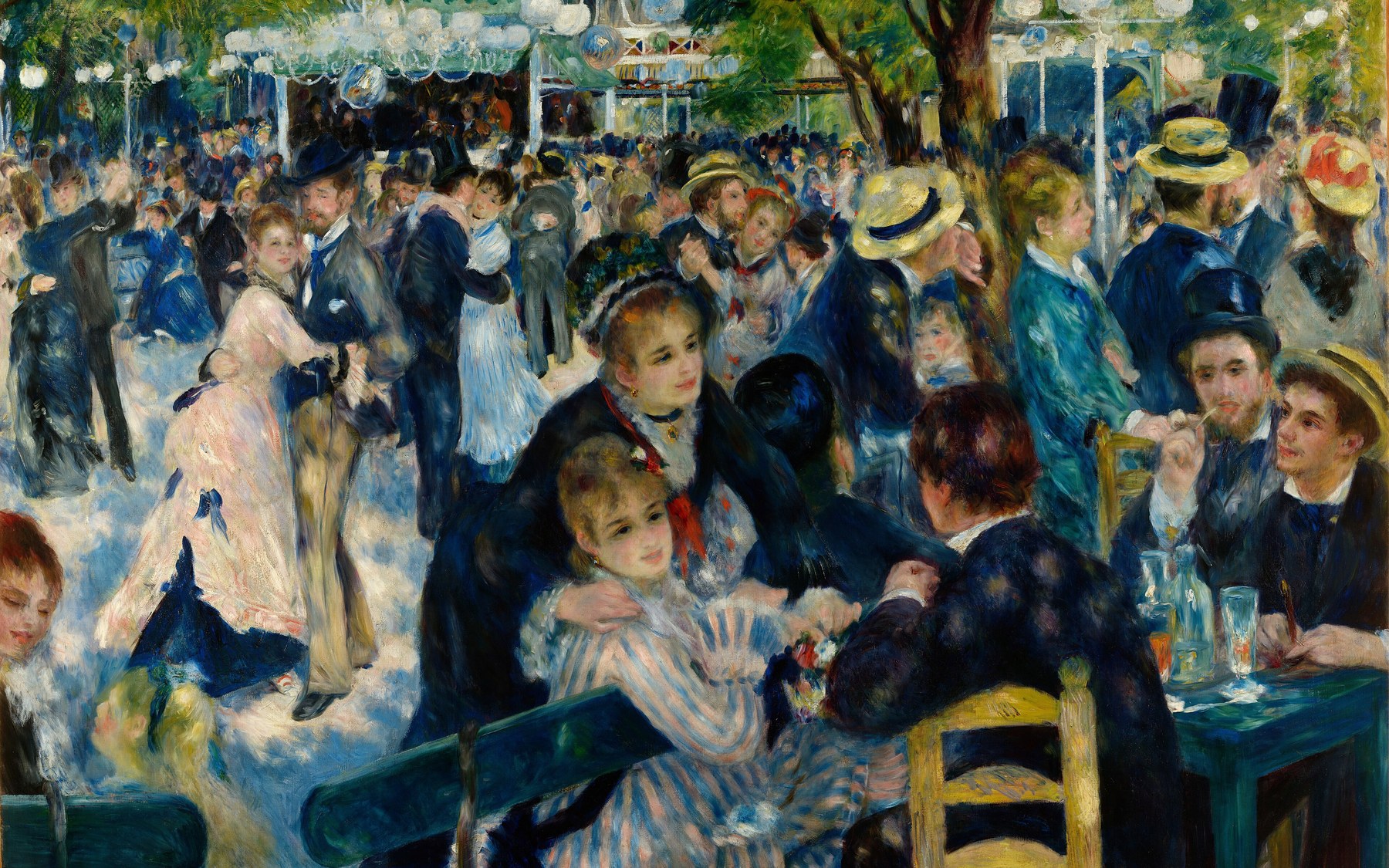
Pierre-Auguste Renoir, Bal du moulin de la Galette, 1876; public-domain image via Wikimedia Commons · Image source
What to expect
Renoir and Love is an upcoming Museum of Fine Arts Boston exhibition, scheduled by MFA from 28 February to 13 June 2027 in the Ann and Graham Gund Gallery, Gallery LG31. MFA describes Boston as the only US venue for this once-in-a-generation exhibition, co-organized with the Musée d'Orsay in Paris and the National Gallery in London. The exhibition brings together 40 paintings by Pierre-Auguste Renoir from collections in the United States and abroad.
The subject is love in a deliberately broad sense: friendship, family, flirtation, sociability, courtship, camaraderie and tenderness in modern settings. MFA frames Renoir as an artist who stood apart from his Impressionist peers because of his focus on joyful human connection in the modern environment. Gardens, streets, cafés, restaurants, theaters, studios and dance spaces are not background only. They are the places where emotional life becomes visible.
The exhibition focuses on the mid-1860s to the mid-1880s, when Renoir made many of his most admired works. MFA names major anchors including Dance at Moulin de la Galette from 1876, the MFA's own Dance at Bougival from 1883, Dance in the Country from the Musée d'Orsay, At Renoir's Home from 1876 and Madame Monet and Her Son from 1874. That gives the Boston page a strong reason to be more than a duplicate of the London stop: the MFA's own Renoir collection and audience make the US presentation a distinct visit.
Why go
The strongest reason to go is that Renoir is so popular he can become hard to see. His images of pleasure, dancing, conversation and leisure are often reproduced as easy charm. MFA's framing asks for a more serious kind of looking. What looks joyful may also be formally daring: figures cropped by crowds, bodies caught mid-turn, social spaces compressed, light broken into colour, and relationships suggested through glance, gesture and distance.
The exhibition is also valuable because it treats love as modern rather than sentimental. Renoir's couples, families and friends occupy the new spaces of nineteenth-century Paris and its suburbs. Cafés, restaurants, riverbanks, gardens and studios were not timeless settings. They belonged to a changing city, with new forms of leisure, class mixing, public entertainment and private feeling. The subject of love therefore sits inside the wider history of modern life.
MFA's own Dance at Bougival should be a major Boston draw. The painting places an embracing couple in motion, with the surrounding world softened by the energy of the dance. Seen beside related works from Paris and international collections, it can help visitors compare Renoir's different versions of sociability: crowded public pleasure in Moulin de la Galette, rural dance, city dance, intimate studio friendship, family quiet and flirtation in public space.
What to look for
Begin with touch and distance. Renoir's subject is often human closeness, but closeness is not always simple. A couple may embrace while remaining socially ambiguous; friends may sit together without a clear story; a family scene may feel tender and staged at once. Ask how much the painting tells you, and how much it leaves suspended. MFA's page notes the intriguing ambiguities that animate relationships between people and the spaces they inhabit.
Then look at setting. Renoir's love is not only in faces. It is in the way a body turns in a dance hall, how a figure leans at a café table, how a mother and child occupy a garden, or how a crowd creates pressure around a private exchange. Modern love in these works is environmental. It happens in public, semi-public and domestic spaces that shape what can be felt and seen.
Colour and light are another route. Renoir's great subject was not love instead of light; love and light often work together. Sunlight can make affection seem fleeting. Broken brushwork can make social life feel unstable and alive. Soft focus can protect intimacy or blur social detail. A visitor should ask whether the handling of paint clarifies a relationship or makes it more elusive.
Finally, compare the exhibition with the usual Impressionist story. Renoir is often grouped with Monet, Degas, Pissarro and Cassatt through style and exhibitions. Here the question is thematic: how did he imagine human connection? That can make familiar Impressionist concerns feel newly specific. The modern city is not only a place to paint light and leisure. It is a place where people test friendship, attraction, family feeling and social performance.
How it fits MFA Boston
This page strengthens the MFA Boston cluster because it gives the museum a major upcoming European-painting anchor after the current Rembrandt and Judaica page. Together, those two records make MFA Boston feel more distinctive: Rembrandt and Dutch visual culture on one side, Renoir and modern love on the other. The museum becomes a place where European painting can be approached through social history rather than only through famous names.
For Boston planning, the exhibition is likely to be one of MFA's major spring 2027 draws. It can pair naturally with the museum's Impressionist holdings, European paintings, prints, decorative arts and broader collection route. Readers should still check MFA's official source before travelling for ticketing, member access, gallery location, related talks and any changes. MFA's own schedule currently lists 28 February to 13 June 2027, while some partner materials use slightly different Boston opening wording, so the museum's current source should guide practical planning.
The page also has future reader value for Renoir, Impressionism, modern Paris, dance in art, family imagery, courtship, cafés, theatre, leisure and the relationship between emotion and setting. Because Renoir died in 1919, the underlying works are generally more promising for clearly licensed sourcing than modern and contemporary material, although exhibition photography and lender images still require careful review.
Image and rights note
The image prospects are promising because Renoir's underlying works are historic and many public-domain reproductions exist. The safest future image review should still distinguish between a public-domain representative Renoir image and a confirmed exhibition checklist image. MFA, Musée d'Orsay, National Gallery and lender photographs may carry specific credit and usage terms. This page remains image-free until a source and credit route is explicitly approved.
How to use this page
Because Renoir and Love is upcoming, the page should help a reader decide whether to plan a future trip or watch for reviews and final venue details. The most reliable fixed details are the venue, dates, broad subject, media and official source link. The interpretive notes help place the exhibition in art-historical context: what kind of show it is, why it may matter, and which artists or topics are worth exploring next.
It is marked as a major exhibition in this guide, so it should be useful for readers choosing between several possible museum visits. If the exhibition travels, use this page alongside the official venue dates to compare the stop that is easiest to reach.
Looking notes
For a visitor, the most useful approach is to look for patterns rather than isolated highlights. With Pierre-Auguste Renoir, Impressionism, friendship, family, flirtation, modern Paris, Musée d'Orsay, National Gallery London, ask how the exhibition frames the subject: as biography, period survey, focused theme, collection display or reassessment. With media such as painting, impressionist painting, figure painting, dance scenes, modern-life painting, pay attention to changes of scale, surface, lighting, material and display sequence, because those details are often lost in online listings.
The guide avoids over-specific claims where the public source does not yet support them. If a museum has not published a full object list, it is better to stay clear about what is confirmed than to imply certainty.
Who it is best for
Renoir and Love is most likely to help readers who are already interested in Pierre-Auguste Renoir, Impressionism, friendship, family, flirtation, modern Paris, Musée d'Orsay, and National Gallery London, but it may also be useful for visitors building a wider route around Museum of Fine Arts Boston in Boston. If time is limited, use this page to decide whether the subject fills a gap in your knowledge, whether it connects to artists you already follow, and whether the official venue information makes the visit practical.
Explore the artists
Also on this tour
- The National Gallery · 3 October 2026–31 January 2027
- Musée d'Orsay · 17 March 2026–19 July 2026