by Tom Gurney
Tom Gurney BSc (Hons) is an art history expert with over 20 years experience
Published on July 14, 2026 / Updated on July 16, 2026
Email: tomgurney1@gmail.com / Phone: +447429011000
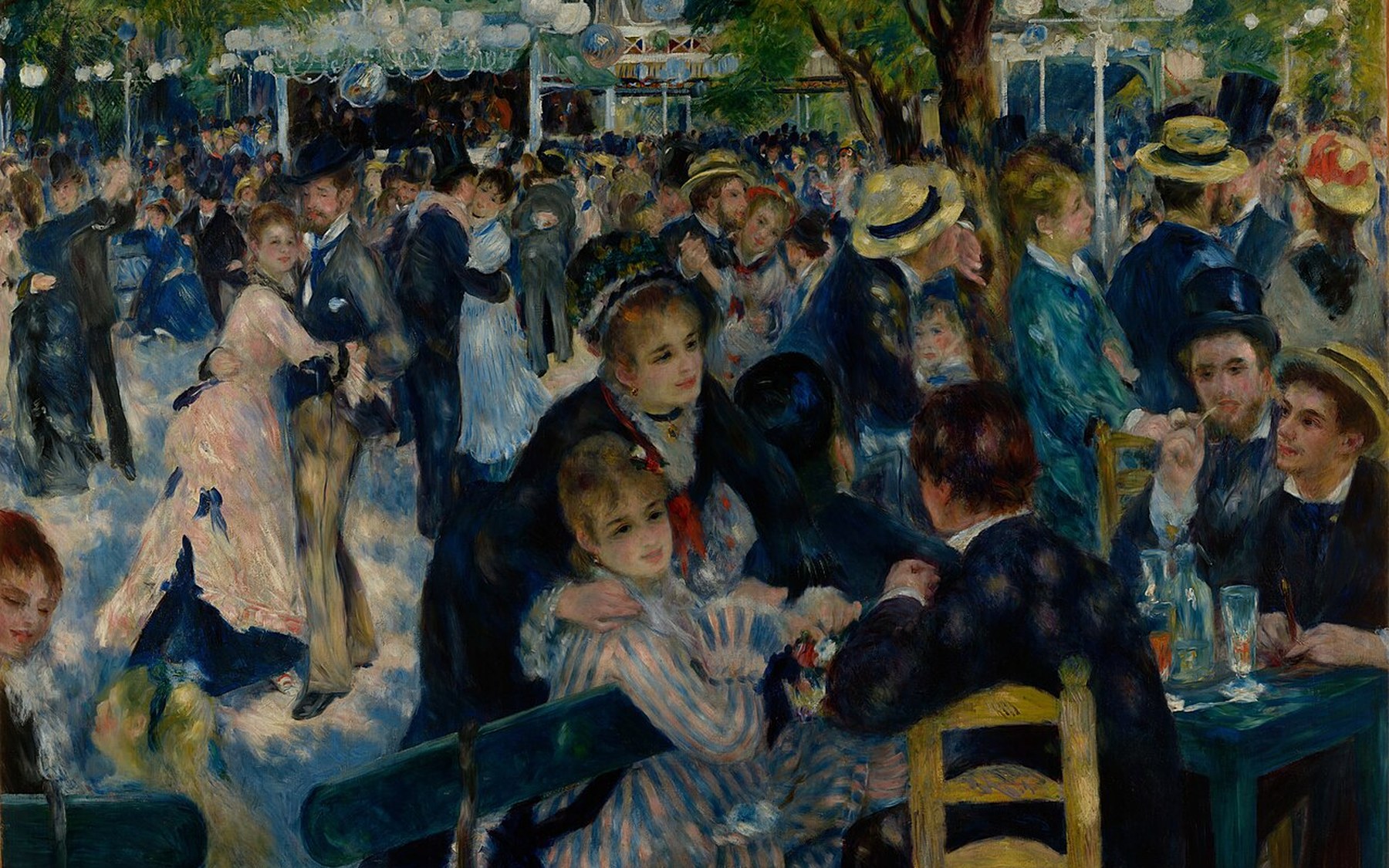
Auguste Renoir - Dance at Le Moulin de la Galette - Google Art Project.jpg by Pierre-Auguste Renoir; Public domain via Wikimedia Commons. Cropped for TheHistoryOfArt.org. · Image source
What to expect
Renoir and Love: A Joyful Modernity (1865-1885) was a Musée d'Orsay exhibition in Paris, shown from 17 March to 19 July 2026. Because it has now closed, this page is an archive record rather than a current visit-planning page. It remains valuable because it was the Paris stop of a major international Renoir project, co-organized with the National Gallery in London and the Museum of Fine Arts in Boston, and because Orsay is the natural home for a question that sits at the centre of Renoir's reputation: can modern painting be joyful without becoming shallow?
Orsay framed Renoir as one of the nineteenth century's great painters of modern life, alongside figures such as Manet, Degas, Monet and Caillebotte. The exhibition focused on the period between the mid-1860s and the 1880s, when Renoir developed new subjects around relationships between men and women in theatres, restaurants, guinguettes, boulevards, gardens and other modern social spaces. The title's idea of love should therefore be read broadly. It covers courtship, friendship, sociability, tenderness, family feeling, pleasure, looking and the fragile public performance of intimacy.
The Paris version matters because Renoir's art is deeply entangled with the city and its leisure culture. Works such as Dance at the Moulin de la Galette, Luncheon of the Boating Party, Mother Anthony's Cabaret and The Umbrellas belong to a world of crowds, movement, weather, music, food, conversation and negotiated closeness. Orsay's exhibition asked visitors to see those pictures not as simple images of happiness, but as ambitious modern paintings that turned human connection into a formal and social problem.
Why it mattered
The strongest reason to preserve this record is that it argues for joy as a serious modern subject. Renoir's popularity can work against him. Reproductions, decorations and sentimental readings have made some of his images feel too familiar, almost too agreeable. Orsay's page pushes back against that flattening. It asks viewers to recover the radical nature of works whose happy faces and tender gestures may now seem softened by repetition.
The exhibition also made an art-historical claim about modernity. Modern painting is often introduced through alienation, urban anxiety, irony, melancholy, fragmentation or social critique. Renoir does not ignore modern urban life, but he answers it differently. Orsay describes his scenes of conviviality as protests against the growing loneliness of urban existence. That is a sharp idea. A dance, a lunch, a promenade or a garden encounter can become a counter-image to isolation, not merely a decorative pleasure.
At the same time, the page needs to hold the difficulty of the subject. Orsay's own description notes that Renoir largely avoided darker realities such as poverty, alcoholism, prostitution, bourgeois male predation on working-class women, unmarried mothers and abandoned children, except perhaps through discreet allusions. That caveat matters. The exhibition's joyful modernity should not be treated as a complete picture of nineteenth-century life. It is a chosen vision, and the exclusions are part of its meaning.
What to look for in the archive record
Begin with setting. Renoir's love is rarely abstract. It happens in public or semi-public environments: a dance hall, a river restaurant, a street, a garden, a theatre, a café, a room full of social pressure. The setting shapes what kind of intimacy is possible. A couple seen in a crowd is different from a family in a garden or a group of friends at lunch. Modern life provides the stage, but it also creates the conditions of looking.
Then watch how Renoir handles bodies. His figures often lean, turn, touch, glance or settle into shared space. The paint does not simply describe those actions; it softens edges, warms surfaces and lets colour bind figures to their surroundings. In the best works, affection is not just an iconographic theme. It becomes a compositional structure: bodies and colours echo one another, forms overlap, and the scene holds together through rhythm rather than narrative certainty.
The Umbrellas is especially useful as an archive anchor because Orsay's presentation treats it as Renoir's last major urban subject and the final work in which his ideal of romantic and happy modernity is fully expressed. It brings together crowd, couple, family, weather and public space in a dense composition. Despite rain and urban compression, the painting searches for harmony. That makes it a hinge between the earlier modern-life works and the later turn toward drawing, bathers and more timeless figure subjects.
Finally, compare this page with the Orsay Renoir Drawings record. The two exhibitions overlapped in spring 2026 and together they show two sides of the same artist. One recovers the social Renoir of love, modern leisure and public life. The other recovers the graphic Renoir of line, doubt, preparation and reinvention. Read together, they make Renoir less easy and more interesting.
How it fits Orsay, London and Boston
This page strengthens the Musée d'Orsay cluster because it gives Paris its own Renoir and Love stop rather than letting the London or Boston records stand in for the entire tour. Orsay is not simply another venue here. It is the museum whose permanent collection and Paris setting make the exhibition's subject feel local: Impressionism, modern leisure, the city, the Salon world and the later canon of nineteenth-century French painting all converge there.
The travelling structure is useful for readers. The London page can emphasize the National Gallery's upcoming UK presentation and major international loans. The Boston page can emphasize MFA's only-US-venue status and its own Dance at Bougival context. The Orsay page records the Paris origin point, where the show ran alongside Renoir Drawings and formed part of the museum's fortieth-anniversary season. Those differences prevent the tour from becoming duplicate content.
For Paris planning, the exhibition has ended, so the page's value is retrospective and contextual. It can help readers understand why Renoir still belongs near the centre of the Orsay story, and why future exhibitions about Impressionism, modern life, leisure, intimacy or public space may be worth watching. It also gives the Paris and France location pages another substantial archived record built around pre-1950 art and comparatively manageable image prospects.
Image and rights note
The underlying Renoir works are historic because he died in 1919, and many public-domain reproductions exist. The exhibition's official Orsay image of La Promenade is credited to the J. Paul Getty Museum, and other tour images may involve Orsay, Getty, National Gallery, MFA, lender or press terms. This page remains image-free until a reviewed source and credit route is selected. A representative Renoir image should not be described as an exhibited work unless the official page, object record or checklist supports it.
How to use this page
Because Renoir and Love: A Joyful Modernity (1865-1885) has ended, the page should function as an archive record and a route into related artists, works and venues. The most reliable fixed details are the venue, dates, broad subject, media and official source link. The interpretive notes help place the exhibition in art-historical context: what kind of show it is, why it may matter, and which artists or topics are worth exploring next.
It is marked as a major exhibition in this guide, so it should be useful for readers choosing between several possible museum visits. If the exhibition travels, use this page alongside the official venue dates to compare the stop that is easiest to reach.
Looking notes
For a visitor, the most useful approach is to look for patterns rather than isolated highlights. With Pierre-Auguste Renoir, Manet, Degas, Monet, Caillebotte, modern life, love, relationships, public space, theaters, restaurants, guinguettes, boulevards, gardens, Dance at the Moulin de la Galette, Luncheon of the Boating Party, The Umbrellas, ask how the exhibition frames the subject: as biography, period survey, focused theme, collection display or reassessment. With media such as painting, impressionist painting, figure painting, modern-life painting, dance scenes, landscape, genre scene, pay attention to changes of scale, surface, lighting, material and display sequence, because those details are often lost in online listings.
The guide avoids over-specific claims where the public source does not yet support them. If a museum has not published a full object list, it is better to stay clear about what is confirmed than to imply certainty.
Who it is best for
Renoir and Love: A Joyful Modernity (1865-1885) is most likely to help readers who are already interested in Pierre-Auguste Renoir, Manet, Degas, Monet, Caillebotte, modern life, love, relationships, public space, theaters, restaurants, guinguettes, boulevards, gardens, Dance at the Moulin de la Galette, Luncheon of the Boating Party, and The Umbrellas, but it may also be useful for visitors building a wider route around Musée d'Orsay in Paris. If time is limited, use this page to decide whether the subject fills a gap in your knowledge, whether it connects to artists you already follow, and whether the official venue information makes the visit practical.
Explore the artists
Also on this tour
- The National Gallery · 3 October 2026–31 January 2027
- Museum of Fine Arts Boston · 28 February 2027–13 June 2027