by Tom Gurney
Tom Gurney BSc (Hons) is an art history expert with over 20 years experience
Published on June 19, 2020 / Updated on November 5, 2026
Email: tomgurney1@gmail.com / Phone: +44 7429 011000
The Acrobats in the Circus
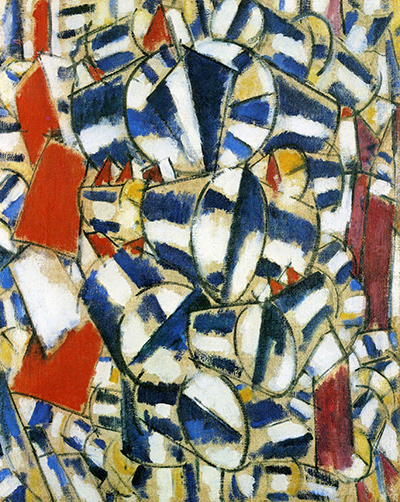
A blue head emerges from a crowded world of striped fingers, shining cylinders and brightly coloured panels. Beside it, an upright brown pole seems almost reassuringly ordinary. Everything else in Fernand Léger’s Acrobats in the Circus turns, overlaps or breaks apart. Painted in 1918, this is a circus seen from within its bustle, where a performer’s body and the apparatus around it share the same hard, gleaming forms. The finished painting belongs to the Kunstmuseum Basel; a smaller preparatory oil painting survives at the Metropolitan Museum of Art in New York. [1] [2]
The pleasure of looking comes partly from that uncertainty. A hand suddenly becomes legible, then disappears into a pattern of stripes. A curved shape suggests a limb but also resembles a piece of machinery. Léger gives us enough human detail to recognise an acrobatic encounter, while making the surrounding spectacle just as insistent as the performers themselves.
At a Glance
Two moments in Léger’s career
Contents
A suspended figure group
Start with the head near the centre. Its rounded blue upper half catches a pale light, while the long dark shape beneath it narrows towards a point. A small eye, placed close to the right edge, gives this otherwise massive geometric construction a human alertness. The face appears almost tucked into the larger assembly of arms and curved surfaces. It is present without becoming a conventional portrait.
Now follow the hands. At the left of the head, pale fingers stretch across reddish and grey forms. Higher on the right, another striped hand meets a sloping, greenish cylinder. The fingers are remarkably economical: parallel dark strokes are enough to distinguish a grip from all the other repeated lines. They briefly anchor our reading in the physical work of holding, supporting and balancing.
Yet following a hand into an arm does not lead to an easily reconstructed body. Léger interrupts the connection with changes of colour, abrupt edges and overlapping shapes. The large curved forms feel solid individually, but their combination resists the continuous anatomy we expect. This makes looking unusually active. We assemble a possible movement, lose it, and begin again somewhere else.
The pole running down the left side of the central group offers another way into the painting. Its long, relatively uninterrupted vertical contrasts with the broken forms behind it. It also crosses in front of the scene, bringing the circus apparatus close to the viewer. Instead of watching from a comfortable distance across an open ring, we seem to look past an obstruction into a dense arrangement of bodies and equipment.
The 1918 painting in Basel
The museum records the painting’s French title as Les Acrobates dans le cirque, with Acrobats in the Circus and Akrobaten im Zirkus as its English and German translations. It is oil on canvas, measuring 97.3 by 117.1 centimetres. Léger signed it at the lower right; the reverse carries the title, his signature and the date 1918. These details identify a particular finished work within his much wider interest in circus subjects. [1]
The canvas entered the Kunstmuseum Basel in 1952 as a gift from Raoul La Roche, and has inventory number 2302. Its exhibition history also extends beyond Switzerland: the work appears in the checklist for the Museum of Modern Art’s 1998 Léger exhibition, which lists its dimensions in rounded form as 97 by 117 centimetres. The same checklist separately includes Les deux acrobates, another painting of 1918. Similar titles therefore need careful attention: they do not all refer to this composition. [1] [3]
The horizontal format matters to our experience of the scene. The central figure group occupies much of the height, but small incidents keep drawing attention towards the edges. On the right, a pale upright panel carries black signs resembling an eight above a fraction. On the left, a circular red-and-white accent interrupts a dark shape. These scraps have the abrupt visibility of things glimpsed while attention is already occupied elsewhere.
How the spectacle is built
Léger sets several kinds of looking against one another. Some surfaces swell into light and shadow, giving them the apparent weight of metal. Others remain flat: a yellow panel, a green rectangle, a band of red. The eye moves between these two conditions without settling into a single, consistent depth. A curved volume can appear to project towards us, then suddenly read as a coloured shape fitted into the surrounding pattern.
Look particularly at the lower half. Pale highlights travel along broad, rounded forms, but dark outlines and sharp cuts keep them from dissolving into atmospheric space. Behind and beside them are dots, grids and short horizontal bands. The small marks make the larger shapes feel larger still. Léger gains scale through contrast inside the image, even where the actual space between the elements remains difficult to measure.
The repeated stripes are equally important. They can belong to a hand, a piece of equipment or a background fragment. Their recurrence draws the picture together across differences of subject. A tiny striped patch answers a much larger cylindrical form, and the viewer’s attention travels between them. The circus becomes a pattern of visual correspondences as well as a place where people perform.
There is little empty space in which the action can unfold. Instead, the pressure of one form against another supplies the sense of energy. The image feels busy without depending on blurred outlines or a sequence of repeated bodies. It holds a collection of sharp, almost tangible pieces in a state of restless proximity.
The study and the finished canvas
The Metropolitan Museum’s Sketch for “The Acrobats in the Circus” is also dated 1918. Despite the word “sketch”, it is an oil painting on canvas, 33 by 41 centimetres, rather than a quick drawing on paper. The museum describes it as a highly finished preparatory study for the larger Basel painting. Pencil lines divide its composition into squares, providing a means of transferring the arrangement to a larger scale. [2]
That practical detail changes how we understand the apparent commotion. The crowded encounter was something Léger could plan, divide and enlarge. The Met also connects the squared arrangement to Cubism’s enduring grid structure. A tool for organising the transfer of an image thus echoes the formal order within it: measured divisions underlie an experience that initially seems unruly. [2]
Study and finished work reward different questions. The small canvas offers evidence of preparation and enlargement. In the larger composition, the relationship between the forceful human shapes and the multitude of surrounding fragments becomes the central experience. The distinction allows us to appreciate the planning without reducing the finished picture to a demonstration of a method.
Bodies, light and machinery
The metallic appearance of the performers belongs to a larger problem in Léger’s painting: how to give modern experience a compelling visual form. Discussing the separate Basel painting Mechanical Elements, dated 1918–23, the curator John Elderfield observes that Léger’s contrasting forms gained a more specific mechanical identity after 1917. He also explains how rounded, modelled shapes remain integrated with a flat decorative surface. [4]
That comparison helps illuminate the acrobats without turning them into literal robots. Their curved limbs and blue-grey highlights resemble engineered parts, but the small eye and gripping fingers keep human activity in view. The fascination lies in how little separates flesh from apparatus within this painted world. Both can be shaped by the same contrast between a bright surface and a dark edge.
Elderfield quotes Léger recalling “the magic of light on white metal” after encountering artillery during the war. This is a retrospective statement about the development of his painting, rather than a specific explanation of Acrobats in the Circus. It nevertheless offers a useful point of contact with the canvas’s hard highlights and emphatic volumes. Here the brilliance associated with machinery enters an image of physical performance and entertainment. [4]

The circus in Léger’s career
The Met associates the Basel composition with the Cirque Médrano in Montmartre and places Léger’s renewed enjoyment of Paris after his recuperation from a wartime injury in 1917. The circus offered a subject in which bodies, lights and equipment could be encountered together. [2] Another painting from 1918, Le Cirque Médrano, belongs to the Centre Pompidou. Its separate title and much wider proportions—58 by 94.5 centimetres—remind us that Léger approached the subject through more than one composition. [5]
His enthusiasm is documented during the year itself. A Museum of Modern Art archival exhibition described a letter to his dealer Léonce Rosenberg, dated 23 August 1918, in which Léger expressed excitement about his acrobats and discussed an ambitious circus project. The archival description does not establish that the project became this particular canvas, but it places the subject firmly among his active concerns. [6]
Circus imagery continued to matter long afterwards. The same archival exhibition traced the later circulation of Le Cirque, a book of lithographs, through twenty-three venues between 1951 and 1955. That later history gives the 1918 painting a longer horizon: the acrobats belong to an interest that continued across different moments and media. [6]
Returning to the painting, its distinctive achievement is the way it keeps physical contact inside an almost overwhelming spectacle. The fingers still grip, the eye still looks, and the large forms still seem to carry weight. But none of these human signs commands the picture alone. Léger asks us to feel the energy passing between performers and surroundings, finding the circus in their inseparable arrangement of colour, pressure and light.
Artworks directory
A selection of paintings and works on paper documented in collection records and catalogues. Similar titles identify different objects: the Basel and Met Mechanical Elements, the two Mechanic paintings and the Indianapolis painting and Städel drawing have separate entries. This is not a complete catalogue of Léger’s work. Additional entries labelled “Tate” come from the museum’s October 2014 catalogue. They retain its historical titles, dates and attributions; newer collection records are used where available. The list brings together selected records from these sources. [8]
| Name | Date | Medium |
|---|---|---|
| La Couseuse (The Sewing Woman) | about 1910 | Painting |
| Nude Figures in a Forest | 1909–11 | Painting |
| The Acrobats in the Circus (Basel) | 1918 | Painting |
| Sketch for The Acrobats in the Circus | 1918 | Painting |
| Two Acrobats | 1918 | Painting |
| Le Cirque Médrano | 1918 | Painting |
| Mechanical Elements (Basel) | 1918–23 | Painting |
| The Mechanic (LaM) | 1918 | Painting |
| The Mechanic (Ottawa) | 1920 | Painting |
| Mechanical Elements (Met) | 1920 | Painting |
| Man and Woman (Newfields) | 1921 | Painting |
| Woman with a Cat | 1921 | Painting |
| The Fishermen | 1921 | Painting |
| Homme et femme (Städel drawing) | 1921 | Drawing |
| Three Women | 1921–22 | Painting |
| Two Women | 1922 | Painting |
| Leaves and Shell (Tate N05907) | 1927 | Painting |
| Keys (Composition) (Tate N05990) | 1928 | Painting |
| Playing Card and Pipe (Tate N05991) | 1928 | Painting |
| The King of Hearts (Tate P01711) | 1949 | |
| Les Objets à Réaction Poetique (Tate P80180) | 1931–6 | Photograph |
| Two Women Holding Flowers (Tate T00246) | 1954 | Painting |
| Still Life with a Beer Mug (Tate T02035) | 1921–2 | Painting |
| The Acrobat and his Partner (Tate T03118) | 1948 | Painting |
| Mechanical Elements (Tate T06798) | 1926 | Drawing |
| ABC (Tate T06799) | 1927 | Drawing |
| Three Bottles (Tate T06800) | 1954 | Painting |
| Trees (Tate T06801) | 1923 | Drawing |
Frequently Asked Questions
The 1918 finished painting is in the Kunstmuseum Basel, inventory number 2302. Raoul La Roche gave it to the museum in 1952. [1]
Léger gives their bodies cylindrical shapes and strongly contrasting highlights and shadows. These visible features connect with the mechanical vocabulary of his painting in the years around 1918, discussed by John Elderfield in relation to Mechanical Elements. [4]
Discussion
Follow the suspended figures and the sharp intervals between bodies, lights and geometric forms.
Which detail first makes the acrobats feel human to you: the eye, the fingers, or the relationship between the bodies?
Reader Insights
Which shape first reads as a person?
How do the bright areas organise the spectacle?
What changes between the study and the final canvas?
Join the Conversation
Share a detail, comparison or question about The Acrobats in the Circus below.
References
- Kunstmuseum Basel, Les Acrobates dans le cirque, collection record, inventory 2302: title translations, date, material, dimensions, provenance, credit line and inscriptions (in German). Consulted 28 October 2026. View source.
- The Metropolitan Museum of Art, Sketch for “The Acrobats in the Circus”, 1918, object 2025.616.23: introductory curatorial text and Artwork Details. Consulted 28 October 2026. View source.
- Museum of Modern Art, Fernand Léger, exhibition checklist, 11 February–12 May 1998, p. 2, entries for Les deux acrobates and Les Acrobates dans le cirque. Consulted 28 October 2026. View source.
- John Elderfield, European Master Paintings from Swiss Collections: Post-Impressionism to World War II, foreword by William Rubin (New York: Museum of Modern Art, 1976), p. 108, commentary on Mechanical Elements, and p. 167, notes 2–3 to p. 108. Léger’s retrospective statement is quoted there from Katharine Kuh, Léger (1953), pp. 22–23. Consulted in MoMA’s digitised catalogue, PDF pp. 111 and 170, 28 October 2026. View source.
- Centre Pompidou, Le Cirque Médrano, 1918, inventory AM 4316 P: Informations détaillées, title, date, technique and dimensions (in French). Consulted 28 October 2026. View source.
- Museum of Modern Art Archives, From the Archives: Léger, archival exhibition, 26 February–12 May 1998, item 10 (Léger to Rosenberg, 23 August 1918), PDF p. 4, and item 15 (Le Cirque travelling exhibition), PDF p. 5. Consulted 28 October 2026. View source.
- Centre Pompidou, La Couseuse, about 1910, AM 1984-578. Collection record and interpretation; accessed 28 October 2026. View source.
- Tate, Tate Collection metadata, artwork_data.csv, October 2014 snapshot, released under CC0. Repository readme states that this dataset is no longer maintained. Downloaded and artist rows inspected 28 October 2026. View source.