by Tom Gurney
Tom Gurney BSc (Hons) is an art history expert with over 20 years experience
Published on June 19, 2020 / Updated on November 1, 2026
Email: tomgurney1@gmail.com / Phone: +44 7429 011000
The Mechanic: Introduction
A muscular man pauses with a cigarette between his fingers. His head turns to the left, his arms fold across his chest, and a small cloud of smoke curls beside his raised hand. Everything about him feels solid: the rounded shoulder, the heavy forearm, the neatly fitted pieces of his face. Yet the space behind him breaks into hard black bars, brilliant rectangles and fragments of circles. In The Mechanic, Fernand Léger brings a recognisable working man into the same visual world as the machine.
Painted in 1920, this oil on canvas belongs to the National Gallery of Canada in Ottawa. Its French title is Le mécanicien. At 116 by 88.8 centimetres, the canvas gives the half-length figure a substantial presence without requiring the scale of a public mural. The gallery identifies it as an emblematic expression of Léger's vision of modern life. [1]
At a Glance
This work across Fernand Léger’s career
Nudes in the Forest
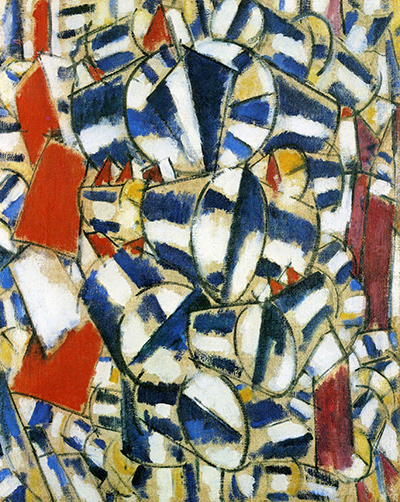
1909–1911 [2]Contrast of Forms
1913 [3]Three Women
1921–22 [6]Contents
- A worker at rest
- Flesh shaped like machinery
- A background without a fixed address
- After the war
- The earlier Mechanic
- A modern monument
A worker at rest
The man's occupation comes from the title rather than an action. He is neither repairing an engine nor demonstrating a tool. His black undershirt exposes arms that could perform heavy work, but the activity we actually see is smoking. This little interval matters. Léger allows the worker to occupy the centre of a painting simply by being there, with a composure usually associated with a formal portrait.
Look first at the arm crossing diagonally from the lower left towards the hand. Its broad sweep joins the rounded shoulder to an enlarged palm, creating a strong movement across the upright canvas. The other arm bends beneath it and returns towards the right edge. Together they make a compact arrangement that seems almost self-supporting. There is no need for furniture or an elaborate interior to hold the figure in place.
The hand deserves a closer look. Thick fingers are carefully separated by dark contours and patches of light. Their joints have the clarity of assembled pieces, yet the gesture remains immediately familiar. The cigarette offers a delicate contrast to all this weight. Its narrow diagonal and the smoke's small loops introduce a momentary, everyday action into an otherwise remarkably still image.
On the exposed upper arm is an anchor-like tattoo. It adds a distinctive mark to skin that might otherwise look uniformly polished. The motif invites associations with physical labour and popular masculine culture, but it does not identify the sitter or prove a particular trade. Léger supplies enough individual detail to make the man engaging while keeping his identity open.
Flesh shaped like machinery
The shoulder appears almost spherical. The forearms taper like tubes, while the neck rises as a broad column from the dark vest. On the head, separate zones of hair, cheek, nose and jaw fit together with emphatic precision. Rather than dissolving these forms in soft transitions, Léger makes their edges easy to follow.
Nevertheless, this is a warm body. The yellowish flesh changes from pale highlights to deep olive shadows, and the dark hair has a carefully arranged sheen. Against the brilliant white and black of the surroundings, these changes make the skin feel dense and touchable. The National Gallery of Canada's interpretation stresses precisely this contrast between a sculpturally modelled person and the crisp geometry behind him. [1]
The eye, moustache and ear bring a different scale of detail. The eye looks out towards something beyond the left edge, giving the figure a direction without introducing a story. His neatly curled moustache offers a slight touch of humour, while the ear's nested curves repeat, in miniature, the larger rounded shapes of the body. The face is both readable and constructed. We recognise a man without being invited into an intimate account of his thoughts.
This balance helps explain why calling him a robot feels insufficient. His body borrows the regularity and firmness of manufactured forms, but his cigarette, hair and tattoo keep returning us to ordinary human appearance. The painting's interest lies in that exchange: a person acquires the presence of a machine while remaining unmistakably a person.
A background without a fixed address
Behind the mechanic, black uprights and horizontal bands cut the space into sharply defined compartments. White areas open between them; yellow and red blocks give the arrangement sudden intensity. At the upper right, part of a white circle enters a black field. Elsewhere, little ladder-like marks and nested outlines suggest pieces of equipment without explaining what they do.
It is tempting to turn these fragments into a complete workshop. The painting resists that reconstruction. There is no clear floor to stand on, no continuous wall receding into depth, and no reliable route through the setting. The backdrop makes an industrial world imaginable through its rhythm and structure rather than describing one particular place.
A useful comparison is Léger's Mechanical Elements, also dated 1920, in the Metropolitan Museum of Art. The Met explains that the geometric elements in such pictures evoke machinery without reproducing identifiable machine parts. This distinction also helps us approach the Ottawa painting: its background communicates a modern environment while remaining a freely organised design. [10]
The figure and that design do not simply repeat one another. Against the angular bars, his arms appear all the rounder; against his shaded skin, the coloured rectangles seem flatter. Even the smoke participates in the exchange. Its pale loops belong to a human action, but they also echo the circles scattered through the setting. Small connections hold the picture together without making every part look alike.
After the war
The Mechanic belongs to the years following Léger's military service in the First World War. In her 1953 exhibition catalogue, Katharine Kuh connected his wartime experience with his sustained attention to metal, machines and the people around them. She reproduced his recollection of being struck by sunlight on an artillery gun: “the magic of light on white metal.” This is a retrospective statement about an artistic encounter during war, rather than a description of The Mechanic itself. [11]
The context gives the picture an additional tension. Machinery had become inseparable from destruction, yet here the human figure appears intact, composed and physically powerful. It is possible to read his stability as reassuring after the upheaval of war. The painting does not, however, tell us that he represents a specific veteran, or that his polished limbs have a single psychological meaning. Its postwar significance grows from the relation between the date, the worker and the language of industrial forms.
The Met places Léger's mechanical period approximately between 1918 and 1923. Seen within that span, this painting marks a fruitful meeting of recognisable figures and a vocabulary of cylinders, disks and emphatic colour. The person can command attention without requiring the artist to abandon the forms developed in more abstract compositions. [10]

Fernand Léger, Soldier with a Pipe. The wartime single figure supplies a comparison for the worker’s rounded solidity.
The earlier Mechanic
There is another Le mécanicien, painted in 1918 and now deposited at the LaM in Villeneuve d'Ascq. It is a separate, smaller canvas measuring 65 by 54 centimetres. Its museum record identifies it as a first state; it must be distinguished from the 1920 painting in Ottawa. [12]
The LaM's interpretation makes the comparison particularly useful. It points to the warmer skin, undershirt and cigarette smoke in the Canadian version as changes that give the figure a stronger sense of ordinary reality. The museum regards the earlier image as more radical, with the later version softening that effect. This is a curatorial judgement about the relationship between two works, rather than a reason to treat one as merely a repetition of the other. [12]
In the Ottawa picture, those small additions matter disproportionately. The smoke makes time perceptible: the man may look monumental, but he is spending a few seconds with a cigarette. The undershirt places an ordinary garment between skin and geometric background. The warmer colouring allows us to feel the body's difference from its surroundings even while the two share an orderly construction.
A modern monument
Writing in 1953, Kuh detected the presence of Henri Rousseau in The Mechanic, particularly in the directness of the enlarged figure. She also compared its magnification to a cinematic close-up. Both observations draw attention to the painting's unusual mixture of simple legibility and imposing scale. [11]
A close-up brings us near without necessarily making a character emotionally available. That is what happens here. The arm and hand come forward with striking force, while the turned face withholds a direct meeting of eyes. The man feels near enough to touch and sufficiently self-contained to remain apart. Léger makes the ordinary figure memorable by controlling the space around him and the proportion of each part.
The painting's later history confirms its place in Léger's public reputation. Kuh's 1953 exhibition catalogue lists The Mechanic as number 20, lent by Galerie Louis Carré in Paris, and reproduces it on page 30. The National Gallery of Canada purchased the work in 1966; its accession number is 14985. [11] [1]
Its force still depends on a wonderfully direct encounter. A smoking man, a tattoo, an oversized hand and a framework of colour are enough to make a picture of modern life. Each remains easy to see, yet their combination unsettles the boundary between flesh and manufacture. The mechanic rests, but the carefully balanced contrasts around him keep the eye moving.

Fernand Léger, Construction Workers Final State. The late builders turn work into a task shared by several monumental figures.
Léger in video
Explore abstraction, monumental painting and cinema through films from MoMA and the Centre Pompidou. These videos offer context for Léger’s wider work; the restoration film is in French.
Restaurer un… Fernand Léger
Follow conservation of Composition with Two Parrots, 1935–39, and look at painting on a monumental scale. French-language film.
Watch on YouTubeFernand Léger artworks directory
Works covered in these articles and further documented works. Studies and finished works have separate entries; alternate titles share an entry. This is not a catalogue raisonné.
| Name | Date | Medium |
|---|---|---|
| Acrobats and Clowns from Le Cirque | 1950 | |
| Adieu New York | 1946 | Painting |
| Ballet mécanique | 1924 | Film |
| Big Julie | 1945 | Painting |
| Builders with Aloe | 1951 | Painting |
| Charlot cubiste | 1924 | Sculpture |
| Chimneys on Rooftops | 1911 | Painting |
| Cirque (artist’s book) | 1950 | |
| Composition | 1929 | Painting |
| Composition (Study for Nude Model in the Studio) | 1912 | Drawing |
| Composition of Three Figures | 1932 | Painting |
| Composition with Two Parrots | 1935–39 | Painting |
| Construction Workers Final State | 1950 | Painting |
| Contrast of Forms | 1913 | Painting |
| Derrière le miroir, nos.121–122 (posthumous publication, includes a lithograph after Léger) | 1960 | |
| Drawing for The Card Game | 1917 | Drawing |
| Drawing for The Staircase | 1913 | Drawing |
| En attendant le départ | 1914 | Drawing |
| Grand Parade with Red Background | 1953 | Painting |
| J’ai tué (illustrated book) | 1918 | |
| La Cocarde, l’avion brisé | About 1916 | Drawing |
| La Couseuse | about1910 | Painting |
| La Fin du monde filmée par l’Ange N.-D. (illustrated book) | 1919 | |
| Les Femmes au bouquet (Women with a Bouquet) | 1921 | Painting |
| Man and Woman | 1921 | Painting |
| Man in Profile with Rope: Study for The Constructors | 1950/1 | Drawing |
| Man in the Blue Hat | 1937 | Painting |
| Matinée d’ivresse, from Les Illuminations | 1949 | |
| Mechanical Elements | 1918–23 | Painting |
| Mechanical Elements (Metropolitan Museum) | 1920 | Painting |
| Men in the City | 1919 | Painting |
| Mes voyages (posthumous illustrated book) | 1960 | |
| Mona Lisa with the Keys | 1930 | Painting |
| Nude Model in the Studio | 1912–13 | Painting |
| Nudes in the Forest | 1909–1911 | Painting |
| Propellers Second State | 1918 | Painting |
| Reading | 1924 | Painting |
| Soldier with a Pipe | 1916 | Painting |
| Soldiers Playing Cards | 1917 | Painting |
| Soldiers Playing Cards (front drawing) | 1916 | Drawing |
| Standing Nude, Rear View | 1911 | Drawing |
| Still Life with a Beer Mug | 1921–2 | Painting |
| Still Life with Tankard | 1921 | Drawing |
| Study for The Aviator | 1920 | Drawing |
| The Acrobat and his Partner | 1948 | Painting |
| The Acrobats in the Circus | 1918 | Painting |
| The Alarm Clock | 1914 | Painting |
| The Chalices and the Sponge, stained-glass model | 1950 | Drawing |
| The City | 1919 | Painting |
| The Disks in the City | 1920 | Painting |
| The Mechanic | 1920 | Painting |
| The Railway Crossing | 1919 | Painting |
| The Three Musicians | 1944, after a 1924–25 drawing | Painting |
| The Wheels | 1945 | Drawing |
| Three Women | 1921–22 | Painting |
| Two Women Holding Flowers | 1954 | Painting |
| Umbrella and Bowler | 1926 | Painting |
| Verdun, dessin du front | About 1915 | Drawing |
| Woman with a Book | 1923 | Painting |
| Woman: Costume Design for La Création du monde | c.1922–23 | Drawing |
Frequently Asked Questions
The 1920 oil painting belongs to the National Gallery of Canada in Ottawa, which purchased it in 1966. It measures 116 by 88.8 centimetres. [1]
He holds a cigarette between the fingers of his raised hand. Small rounded curls of smoke rise beside it; this everyday gesture contrasts with the firmness of his body and the rigid background.
Discussion
Look again at the images and ideas explored in The Mechanic. These editorial prompts invite your observations.
Which detail makes this figure feel most human to you: the smoking gesture, the tattoo, the turned face or the warmth of his skin?
Reader Insights
What becomes easier to notice in The Mechanic when you compare it with Soldier with a Pipe?
Where does the comparison with Construction Workers Final State reveal the clearest change in Léger’s approach?
Which detail would you follow first when returning to the work, and why?
Join the Conversation
Share a detail, comparison or question about The Mechanic below.
References
- National Gallery of Canada, The Mechanic, 1920, accession 14985, collection details and interpretive paragraph; French collection record, Le mécanicien. Consulted in English and French. View source 1. View source 2.
- Kröller-Müller Museum, Nus dans la forêt / Nude Figures in a Forest, collection record KM 101.045. Current date, medium, identifier, curatorial sections “Distinctive cubist style”, “Geometric shapes” and “‘Battle of volumes’”, and museum reproduction. View source.
- Fondation Beyeler, Contraste de formes, Fernand Léger, current collection record, Inv.90.6: date, medium, dimensions, collection and signature on reverse. View source.
- Philadelphia Museum of Art, The City, 1919, collection record and interpretation; A. E. Gallatin Collection, 1952-61-58. View source.
- National Gallery of Canada, The Mechanic, 1920, accession 14985, collection details and interpretive paragraph; French collection record, Le mécanicien. View source.
- The Museum of Modern Art, Fernand Léger. Three Women. 1921–22, collection record, object 189.1942: artwork image, metadata, 2021 gallery label, publication excerpt, installation history and provenance. View source.
- Musée national Fernand Léger, La Joconde aux clés, collection record and museum commentary (French): object data, owning museum image, artist recollection, sardine tin and symbolic interpretations. The artist’s recollection is consulted as reproduced by the museum; the page does not date it. View source.
- Musée national Fernand Léger, “Les années 50, les constructeurs”, complete Les Constructeurs (définitif) entry and accompanying museum image: title, 1950 date, oil on canvas, 300 × 228 cm, inventory MNFL 94001, 1969 donation and museum-mediated Renault-canteen recollection. View source.
- Musée national Fernand Léger, La Grande Parade sur fond rouge, complete object record and displayed reproduction: 1953, oil on canvas, 114.5 × 156.2 cm, inventory MNFL 96006; donation of Nadia Léger and Georges Bauquier. View source.
- Metropolitan Museum of Art, Mechanical Elements, 1920, object 1999.363.36, collection record and curatorial overview of Léger's mechanical period. Consulted in English. View source.
- Katharine Kuh, Léger (Art Institute of Chicago, 1953), pp. 8, 22–23 and 30; checklist p. 85, no. 20. Exhibition organised with the Museum of Modern Art, New York, and the San Francisco Museum of Art. Consulted in English; artist's recollection reproduced in English on p. 23. View source.
- LaM, Le mécanicien, 1918, AM 1994-421, object details, inscriptions and interpretive “Notice,” including the comparison with the Canadian painting. Consulted in French. View source.