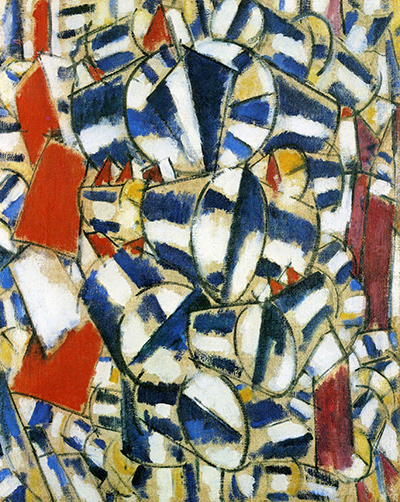
Acrobats and Clowns, colour lithograph associated with Le Cirque, 1950. The reproduced impression is not separately identified. [1]
Buy Art Prints Nowfrom Amazon
* As an Amazon Associate I earn from qualifying purchases.
 by Tom Gurney
Tom Gurney BSc (Hons) is an art history expert with over 20 years experience
Published on June 19, 2020 / Updated on November 1, 2026
Email: tomgurney1@gmail.com / Phone: +44 7429 011000
Acrobats and Clowns from Le Cirque: Introduction
One performer hangs upside down while another lifts a ring above the group. At either edge, a pointed-hat clown faces us. Between them, large pale limbs bend and overlap against an intense blue ground. Fernand Léger’s Acrobats and Clowns belongs to Le Cirque, the artist’s book published in 1950. It is a colour lithograph, rather than an oil painting: the dealer Martinez D identifies this particular composition as a sheet printed by Mourlot for Tériade’s Éditions Verve. [1]
The scene is immediately cheerful, but following its movements takes concentration. A hand reaches across a neighbour; a raised leg interrupts another body; an orange band passes over both flesh and costume. The performers form a tightly connected ensemble whose shapes seem to continue into one another. Léger turns the physical complications of a circus act into a puzzle of outlines, patches and repeated curves.
At a Glance
- ArtistFernand Léger
- SubjectAcrobats and Clowns from Le Cirque
- Date1950 [1]
- CollectionEdition-specific print [1]
This work across Fernand Léger’s career
Nudes in the Forest
1909–1911 [2]Contrast of Forms
1913 [3]The Mechanic
1920 [5]Three Women
1921–22 [6]Contents
- Following the performers
- Colour that crosses the outlines
- A print within an artist’s book
- Léger, Tériade and the written voice
- Why the catalogue totals differ
- The circus and the circle
- A book that travelled
Following the performers
Begin with the inverted acrobat at the left. His head points towards the bottom of the image, beneath a checked costume. A very broad pale limb curves overhead, while a long arm extends across the lower half towards the centre. The pose reverses the ordinary relationship between head and feet. Yet the dark enclosing line keeps the individual parts conspicuous, giving us something to follow through the surrounding bustle.
Near the centre, a round face looks out from a body folded into an unlikely arrangement of arms and knees. One hand grips the ring above the head. Another pale limb arches in from the right, crossing close to the face. These overlaps are essential to the scene’s energy. The figures do not occupy separate compartments; their gestures take place inside a shared, crowded field.
The woman at the right provides a more upright counterweight. Her head, dark hair and small facial features are relatively compact, while her skirt spreads into long pointed segments. A curved leg beneath it makes standing look almost as precarious as hanging. She appears to steady the composition without bringing its motion to a stop.
The two clowns frame this encounter differently. Their hats, collars and patterned clothes make them recognisable at a glance. They stand closer to the edges and look more directly towards us than some of the twisted central figures. Their frontal presence gives the spectacle a public face, as though the intricate balancing act also requires someone to present it to an audience.
Small props and shapes complicate any neat inventory. At the lower left is an object with strings and a long neck, suggestive of musical accompaniment. Dark irregular forms lie close to the performers’ feet and hands. It is not necessary to identify every mark to recognise how such details make the scene feel full: the eye keeps encountering another incident beyond the main cluster of bodies.
Colour that crosses the outlines
The blue field gives the pale figures their strongest contrast. It is not a deep, realistically described circus interior. There are no receding rows of spectators to establish a secure viewpoint. Instead, the blue presses forwards around arms, legs and costumes, making the spaces between the performers as prominent as the bodies themselves.
Yellow, orange and green behave differently. They sometimes sit inside a shape, but elsewhere they cross an outline or appear to continue from one figure to another. The broad orange passage through the lower centre is particularly noticeable. We can follow it as a band of colour even while the black drawing asks us to distinguish an arm from a leg or a skirt.
This creates two simultaneous rhythms. The drawing carries the poses; the colour establishes connections across them. Black checks, circles and short marks supply a third, smaller scale of activity. They prevent the broad limbs from becoming ponderous. Looking moves between large sweeping gestures and small patterned interruptions, much as a spectator’s attention might shift between a daring movement and a clown’s fleeting expression.
The result is lively without relying on naturalistic speed. We cannot reconstruct a single frozen instant with complete anatomical certainty. What we can feel is the pressure of one curve against another, and the way a dark line can briefly unite several otherwise independent parts.
A print within an artist’s book
Le Cirque was published in Paris by Tériade in 1950 and printed by Mourlot. MoMA records an edition of 300 and identifies Léger as the book’s author as well as its artist. Those details place the circus image within a collaborative publishing project, rather than treating it as an isolated painting reproduced in a book. [10]
The distinction matters materially. A lithograph is a print, and impressions of the same design can exist in separate collections. Martinez D describes its sheet of Clowns et acrobates as an original colour lithograph on Arches paper, with a central vertical fold. The measurements and condition in that description belong to the offered impression; they do not establish the size or ownership of every example of the design. [1]
The fold also invites a different kind of looking. On a double-page image, a reader encounters a wide scene while handling a book. Turning a page changes what surrounds it and how long it remains in view. A separate sheet preserves the composition, but the book adds a sequence of encounters, interruptions and returns.
Léger, Tériade and the written voice
The Toledo Museum of Art recounts an earlier plan for Léger to illustrate a text by Henry Miller. According to its collection label, Tériade rejected Miller’s story of a disenchanted clown, later published as The Smile at the Foot of the Ladder, and asked Léger to supply the writing himself. The label places Cirque alongside Tériade’s earlier circus-related projects with Rouault and Matisse. [11]
The finished book therefore gives Léger responsibility for more than a succession of images. The Musée national Fernand Léger describes his own text alternating with the illustrations. [12] The Musée Fernand Léger–André Mare in Argentan adds that gouache models for the lithographs preceded the text. Its account suggests a project whose visual invention helped shape its eventual written form. [13]
The Goulandris Foundation’s record also credits the collaboration of Tériade and Marguerite Lang in the text’s conception, while naming Mourlot Frères as printer and Tériade as publisher for Verve. Léger’s authorial presence belongs within this network of practical and editorial collaboration. The book’s unity does not require us to imagine that every stage was carried out by one person working alone. [14]
Why the catalogue totals differ
Museum descriptions of Cirque do not all give the same number of lithographs or illustrations. MoMA records eighty-three lithographs, explicitly including the front and back wrappers. Toledo likewise records eighty-three, divided into forty-nine in black and thirty-four in colour, and separately describes the printed text. [10] [11]
The museum in Biot describes sixty-three illustrations, while the Goulandris Foundation calls its copy an album of sixty-three lithographs, thirty-four coloured. Argentan gives sixty-five lithographs, thirty-one in colour. These descriptions should not be silently reduced to one universal total, particularly when an image, a printed element and an illustrated book are being catalogued at different levels. [12] [13] [14]
For this composition, the secure distinction is simpler: it is one colour lithographic design associated with the 1950 book. An individual impression, a complete copy of the book and an institutional inventory covering its printed parts are related objects, but their dimensions, numbering and catalogue descriptions are not interchangeable.
The circus and the circle
In a passage quoted by Toledo, Léger urges readers to “quit your rectangles” for the “land of circles in action”. The invitation links an everyday change of surroundings to a change in visual experience. A circus offers rings, wheels and turning bodies, but also a way of seeing movement replace the stable boundaries of ordinary rooms and windows. [11]
The round forms in Acrobats and Clowns give that idea a visible life. The lifted ring is the clearest example, yet the repeated elbows, knees, shoulders and arched limbs carry circular movement throughout the composition. Even where a body is sharply bent, the enclosing line tends to sweep onwards into another curve.
Biot’s account of the book describes a journey through the countryside before entering the circus tent. It interprets the succession of images in relation to cinema and the sensory excitement of modern experience. The circus, in this reading, condenses varied movements and sensations into one spectacle. [12]
Other spreads approach the subject through different arrangements. In its educational discussion of Cirque, pages 44–45, the Baltimore Museum of Art directs attention to the gripping fingers, muscular limbs and crossed outlines of airborne acrobats. That is a useful comparison within the book, rather than an identification of the particular sheet reproduced here. Across these images, the pleasure of watching depends partly on sensing the effort that makes an apparently weightless performance possible. [15]

Fernand Léger, The Acrobat and his Partner. A painted circus group provides a comparison for the printed performers and their linked contours.
A book that travelled
The circus was a long-standing interest. MoMA’s Archives described a letter of 23 August 1918 in which Léger expressed excitement about acrobats to his dealer Léonce Rosenberg. That earlier interest does not make Cirque a 1918 publication; it shows the persistence of a subject that he returned to in a different medium and at a later moment. [16]
The same archival exhibition documented the subsequent reach of the book. An exhibition of Le Cirque, organised through MoMA’s Circulating Exhibitions Department, travelled to twenty-three venues between 1951 and 1955. The printed project could therefore meet audiences through exhibition as well as through the private handling of a book. [16]
Returning to this blue-ground scene, its appeal lies in how firmly it holds its unstable bodies together. The inverted performer does not disappear into confusion, nor do the frontal clowns impose complete order. Each outline gives us a route through the group, while the colour opens another route across it. The spectacle remains compact, readable and full of movement, inviting repeated discoveries rather than a single final explanation.

Fernand Léger, Grand Parade with Red Background. The later parade brings a wider company together around the same enduring spectacle.
Léger in video
Explore abstraction, monumental painting and cinema through films from MoMA and the Centre Pompidou. These videos offer context for Léger’s wider work; the restoration film is in French.
Restaurer un… Fernand Léger
Follow conservation of Composition with Two Parrots, 1935–39, and look at painting on a monumental scale. French-language film.
Watch on YouTubeFernand Léger artworks directory
Works covered in these articles and further documented works. Studies and finished works have separate entries; alternate titles share an entry. This is not a catalogue raisonné.
| Name | Date | Medium |
|---|---|---|
| Acrobats and Clowns from Le Cirque | 1950 | |
| Adieu New York | 1946 | Painting |
| Ballet mécanique | 1924 | Film |
| Big Julie | 1945 | Painting |
| Builders with Aloe | 1951 | Painting |
| Charlot cubiste | 1924 | Sculpture |
| Chimneys on Rooftops | 1911 | Painting |
| Cirque (artist’s book) | 1950 | |
| Composition | 1929 | Painting |
| Composition (Study for Nude Model in the Studio) | 1912 | Drawing |
| Composition of Three Figures | 1932 | Painting |
| Composition with Two Parrots | 1935–39 | Painting |
| Construction Workers Final State | 1950 | Painting |
| Contrast of Forms | 1913 | Painting |
| Derrière le miroir, nos.121–122 (posthumous publication, includes a lithograph after Léger) | 1960 | |
| Drawing for The Card Game | 1917 | Drawing |
| Drawing for The Staircase | 1913 | Drawing |
| En attendant le départ | 1914 | Drawing |
| Grand Parade with Red Background | 1953 | Painting |
| J’ai tué (illustrated book) | 1918 | |
| La Cocarde, l’avion brisé | About 1916 | Drawing |
| La Couseuse | about1910 | Painting |
| La Fin du monde filmée par l’Ange N.-D. (illustrated book) | 1919 | |
| Les Femmes au bouquet (Women with a Bouquet) | 1921 | Painting |
| Man and Woman | 1921 | Painting |
| Man in Profile with Rope: Study for The Constructors | 1950/1 | Drawing |
| Man in the Blue Hat | 1937 | Painting |
| Matinée d’ivresse, from Les Illuminations | 1949 | |
| Mechanical Elements | 1918–23 | Painting |
| Mechanical Elements (Metropolitan Museum) | 1920 | Painting |
| Men in the City | 1919 | Painting |
| Mes voyages (posthumous illustrated book) | 1960 | |
| Mona Lisa with the Keys | 1930 | Painting |
| Nude Model in the Studio | 1912–13 | Painting |
| Nudes in the Forest | 1909–1911 | Painting |
| Propellers Second State | 1918 | Painting |
| Reading | 1924 | Painting |
| Soldier with a Pipe | 1916 | Painting |
| Soldiers Playing Cards | 1917 | Painting |
| Soldiers Playing Cards (front drawing) | 1916 | Drawing |
| Standing Nude, Rear View | 1911 | Drawing |
| Still Life with a Beer Mug | 1921–2 | Painting |
| Still Life with Tankard | 1921 | Drawing |
| Study for The Aviator | 1920 | Drawing |
| The Acrobat and his Partner | 1948 | Painting |
| The Acrobats in the Circus | 1918 | Painting |
| The Alarm Clock | 1914 | Painting |
| The Chalices and the Sponge, stained-glass model | 1950 | Drawing |
| The City | 1919 | Painting |
| The Disks in the City | 1920 | Painting |
| The Mechanic | 1920 | Painting |
| The Railway Crossing | 1919 | Painting |
| The Three Musicians | 1944, after a 1924–25 drawing | Painting |
| The Wheels | 1945 | Drawing |
| Three Women | 1921–22 | Painting |
| Two Women Holding Flowers | 1954 | Painting |
| Umbrella and Bowler | 1926 | Painting |
| Verdun, dessin du front | About 1915 | Drawing |
| Woman with a Book | 1923 | Painting |
| Woman: Costume Design for La Création du monde | c.1922–23 | Drawing |
Frequently Asked Questions
The composition discussed here is a colour lithograph from Léger’s 1950 artist’s book Le Cirque. It should be distinguished from his many oil paintings of circus subjects. [1]
Tériade published the book in Paris in 1950 for Éditions Verve, and Mourlot printed it. Léger created both text and images, working within a publishing collaboration. [14]
MoMA records an edition of 300. That number describes the publication, rather than proving that any particular reproduced impression carries a specified number. [10]
Discussion
Look again at the images and ideas explored in Acrobats and Clowns from Le Cirque. These editorial prompts invite your observations.
Which holds the group together most strongly for you: the black outlines, the blue surrounding field, or the bands of colour that cross between performers?
Reader Insights
What becomes easier to notice in Acrobats and Clowns from Le Cirque when you compare it with The Acrobat and his Partner?
Where does the comparison with Grand Parade with Red Background reveal the clearest change in Léger’s approach?
Which detail would you follow first when returning to the work, and why?
Join the Conversation
Share a detail, comparison or question about Acrobats and Clowns from Le Cirque below.
References
- Martinez D, Clowns et acrobates (Le Cirque). 1950, primary dealer’s object description and photograph, in French: colour lithography, Mourlot, Arches paper, Tériade/Verve and the described impression’s fold and dimensions. Consulted 28 October 2026. View source.
- Kröller-Müller Museum, Nus dans la forêt / Nude Figures in a Forest, collection record KM 101.045. Current date, medium, identifier, curatorial sections “Distinctive cubist style”, “Geometric shapes” and “‘Battle of volumes’”, and museum reproduction. View source.
- Fondation Beyeler, Contraste de formes, Fernand Léger, current collection record, Inv.90.6: date, medium, dimensions, collection and signature on reverse. View source.
- Philadelphia Museum of Art, The City, 1919, collection record and interpretation; A. E. Gallatin Collection, 1952-61-58. View source.
- National Gallery of Canada, The Mechanic, 1920, accession 14985, collection details and interpretive paragraph; French collection record, Le mécanicien. View source.
- The Museum of Modern Art, Fernand Léger. Three Women. 1921–22, collection record, object 189.1942: artwork image, metadata, 2021 gallery label, publication excerpt, installation history and provenance. View source.
- Musée national Fernand Léger, La Joconde aux clés, collection record and museum commentary (French): object data, owning museum image, artist recollection, sardine tin and symbolic interpretations. The artist’s recollection is consulted as reproduced by the museum; the page does not date it. View source.
- Musée national Fernand Léger, “Les années 50, les constructeurs”, complete Les Constructeurs (définitif) entry and accompanying museum image: title, 1950 date, oil on canvas, 300 × 228 cm, inventory MNFL 94001, 1969 donation and museum-mediated Renault-canteen recollection. View source.
- Musée national Fernand Léger, La Grande Parade sur fond rouge, complete object record and displayed reproduction: 1953, oil on canvas, 114.5 × 156.2 cm, inventory MNFL 96006; donation of Nadia Léger and Georges Bauquier. View source.
- The Museum of Modern Art, Cirque (Circus), 1950, illustrated book, 890.1964.1–83, The Louis E. Stern Collection: author, publisher, printer, edition and medium. Consulted 28 October 2026. View source.
- Toledo Museum of Art, Cirque, 1950, 1984.669: physical description and collection label on the Miller proposal, Tériade and Léger’s circular imagery. The short artist quotations are quoted through the museum label. Consulted 28 October 2026. View source.
- Musée national Fernand Léger, Les années 50, les loisirs et le cirque, entry Le Cirque, MNFL 96099, in French: book structure, text, imagery and museum interpretation. Consulted 28 October 2026. View source.
- Musées d’Argentan, Cirque, Fernand Léger, 1950, MFL.2019.8.1, in French: book description and gouache models preceding the text. Consulted 28 October 2026. View source.
- Basil and Elise Goulandris Foundation, Cirque, 1950, album numbered 36/280: publication and collaboration credits, paper and catalogue description. English version consulted 28 October 2026. View source.
- Baltimore Museum of Art, Drawing the Circus, May 2011, educational essay concerning Cirque, pages 44–45, BMA 2006.92.25. Used for a comparison within the book, not to identify the reproduced impression of Acrobats and Clowns. Consulted 28 October 2026. View source.
- The Museum of Modern Art Archives, From the Archives: Léger, archival exhibition, 26 February–12 May 1998, items 10 and 15, PDF pages 4–5: the 1918 Rosenberg letter and the 1951–55 circulating exhibition. Consulted 28 October 2026. View source.