 by Tom Gurney
Tom Gurney BSc (Hons) is an art history expert with over 20 years experience
Published on June 19, 2020 / Updated on November 5, 2026
Email: tomgurney1@gmail.com / Phone: +44 7429 011000
La Couseuse
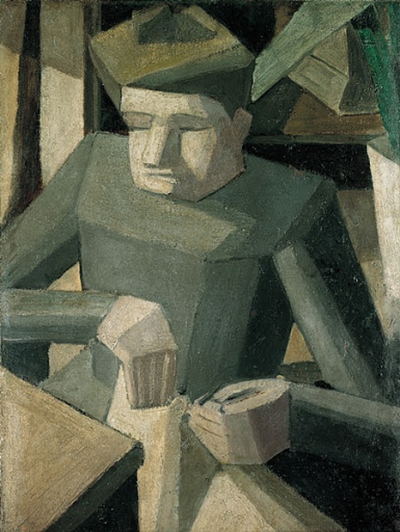
A woman bends her head towards the work in her hands. Her shoulders fill the picture, her forearms reach across its lower half, and the room presses close around her. In La Couseuse, or The Sewing Woman, Fernand Léger turns this familiar activity into a compact arrangement of angular masses. The face looks almost carved, yet the downward gaze and absorbed posture remain immediately human.
Painted around 1910, this oil on canvas belongs to the Centre Pompidou’s Musée national d’art moderne collection. Measuring 73 by 54 centimetres, it achieves a striking sense of weight within a relatively modest rectangle. The museum also records the title La mère de l’artiste, or The Artist’s Mother. [1] The painting offers an unusually approachable way into Fernand Léger’s work: begin with the woman and her hands, then follow the shapes through which he makes them visible.
At a Glance
Two moments in Léger’s career
Contents
A woman built from planes
Start with the face. A broad, pale strip crosses the forehead; beneath it, the nose projects as a long wedge. Light and shadow divide the cheeks into separate surfaces. The dark eyes are narrow horizontal marks, and the mouth sits within a compressed lower face. These features give us enough information to recognise a person, but their construction is emphatic. We notice the join between one plane and another almost as readily as we notice an eye or cheek.
The head rests above a body that seems exceptionally broad and firm. A wide collar spreads across the chest like a shallow shelf. Below it, the torso forms a dark, tapering mass. At the right, the upper arm slopes towards the picture’s edge, enclosing a deep shadow between arm and body. Nothing feels light or incidental. Each large shape supports the next, giving the seated figure something of the presence of a structure assembled to bear weight.
The room does not open comfortably behind her. Vertical bands at the left establish an upright boundary, while diagonal forms at the upper right tilt towards her head. A tabletop pushes in from the lower left. These elements create a narrow enclosure, with little empty space in which the eye can rest. Follow the strong diagonals and they repeatedly bring you back to the figure. Her apparent size comes partly from this crowding: she occupies nearly all the space available.
Hands and cloth
The hands bring that formidable body back to an ordinary task. At the lower left of the figure, one hand hangs down from an angular wrist, its fingers indicated by long, close vertical strokes. The other hand curves towards it from the right. Pale material falls between and below them, opening into a broad triangular shape towards the bottom edge. Against the dark clothing, this lighter passage gives the activity a clear centre.
There is a quiet contrast between the two hands. One is narrow and downward-pointing, the other wider and more rounded. Their different directions prevent the lower half of the picture from becoming a rigid repetition of the shoulders. They also encourage the eye to move across the work, from the table’s sharp corner to the fingers, across the pale cloth and towards the second forearm. Even in this heavily constructed body, the small movement of work remains legible.
The title supplies a useful guide, but it need not persuade us that every implement is visible. A fine thread or needle is not clearly resolved in this reproduction. The painting’s force lies in the relationship between head, hands and material, rather than in an inventory of sewing equipment. We understand an absorbed action through its posture and arrangement. Léger makes the gesture recognisable while withholding much of the incidental detail that might usually explain a domestic scene.
Sewing and the sitter
The museum’s alternate title identifies the figure as the artist’s mother, and the Comité Léger’s biography likewise describes La Couseuse as her portrait. [1] [2] This gives the picture a personal setting, but it does not tell us what either mother or son felt during its making. The lowered head may suggest concentration; the large, immobile body may suggest patience or endurance. Those are responses to the image, rather than documented statements about her character.
What matters visually is how little the painting depends on an expressive face. The mouth is closed, the eyes lowered, and the hands occupied. There is no exchange of glances with the viewer. Instead, the relationship between the different parts of the body carries the picture. Head and hands create a downward rhythm, while the broad shoulders hold the composition steady. The woman’s attention seems directed towards something within the picture, allowing us to observe without being directly addressed.
That balance helps the painting retain an intimacy which its angular forms might initially conceal. The figure is imposing, but her activity is small and concentrated. The close view brings us near her work without supplying an anecdote. A domestic subject has become an occasion to look carefully at how a body occupies space.
Cézanne and the weight of things
The Comité Léger places the artist’s encounter with Cézanne’s work at the Salon d’Automne in 1907 among the decisive events of his early development. Its account connects La Couseuse with a study of volume and with forms modelled by light in restrained colours. [2] In this painting, that interest can be followed from the projecting nose to the heavy collar and the contrasting faces of each arm. Shapes acquire substance because adjacent surfaces receive different tones.
Art historian Jean Arrouye offers a particularly useful distinction. In his lecture on Cézanne and Léger, he describes La Couseuse as an angular assembly of differently oriented and illuminated planes, while observing that a single light source still gives it a measure of realism. He also distinguishes Léger’s handling from Cézanne’s characteristic parallel, oblique touches. [3] The lesson was not simply a manner of applying paint to be copied. It opened a question about the structure of things.
Arrouye further cautions against treating Cézanne’s advice about cylinders, spheres and cones as a straightforward recipe for making Cubist pictures. [3] That caution makes looking more rewarding. We do not need to label every portion of the woman as a particular solid. The repeated turn from a lit surface to a shaded one makes these volumes tangible. The body remains convincing as a weighty presence even where its outlines become unexpectedly abrupt.
Colour, light and contour
The colour is quiet, but far from uniform. Grey-green clothing stands against warmer ochres and browns. Pale areas of the face and cloth interrupt the darker body, while near-black passages deepen the gaps beside the arms. Because the palette is restricted, relatively small changes in tone carry considerable force. A narrow dark boundary can make a wrist seem to hinge; a light plane can bring a cheek or forearm forward.
Look also at the way edges change their role. The line of the collar clearly marks one part of the clothing against another. Elsewhere, a dark band might describe an object, a shadow or a division in the space behind the figure. The background therefore shares some of the body’s visual language. Both are organised through wedges, strips and sloping surfaces. Yet the woman does not disappear into them: her head, collar and hands hold together as a recognisable whole.
The Centre Pompidou interprets this geometric figure as approaching an automaton, anticipating Léger’s later engagement with a mechanical world. [1] It is a helpful reading of the painting’s firmly articulated parts. There is also something resistant to easy movement here. The arms seem jointed, but they are heavy; the hands are active, but the torso remains anchored. The tension between a living task and an almost built body gives the picture much of its distinctive character.
From the sewing room to later figures
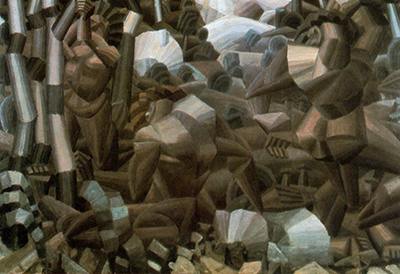
A close contemporary comparison is Nus dans la forêt, dated 1909–1911 by the Kröller-Müller Museum. Its figures and landscape are constructed from geometric forms, with cylinders and tubes contributing to a crowded, dynamic whole. The museum quotes Léger’s description of that work as a “battle of volumes”. [4] The phrase concerns the forest painting, but it usefully directs attention to the competing masses in La Couseuse. Here the contest is compressed into a single figure and her immediate surroundings.
Alfred H. Barr Jr.’s 1936 Cubism and Abstract Art chronology places Léger’s association with Cubism in 1910 and the movement’s collective appearance at the Indépendants in 1911. [5] La Couseuse belongs to this moment of experimentation. It shows how a plainly recognisable person could become the basis for a searching reconstruction of space.
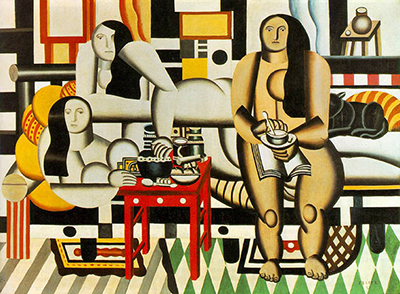
The domestic figure remained important in Léger’s paintings. In Three Women, now dated 1921–22 by MoMA, metallic-looking bodies inhabit an elaborate modern interior. The museum interprets their interlocking arrangement as part of Léger’s attempt to reconcile people and machinery. [6] Seen beside that later work, La Couseuse reveals an early version of a lasting problem: how can human bodies and their surroundings share the same forceful formal order while the figures remain unmistakably present?
The painting’s recorded history
The work also has a documented place in the history of Cubism’s presentation. Barr’s 1936 catalogue lists it as Seamstress, dated 1910, under the collection of Henry Kahnweiler in Paris, and directs readers to figure 32. [5] That entry records one historical point in its ownership and exhibition history; it does not by itself establish every intervening transfer. The Centre Pompidou records its acquisition through the donation of Louise and Michel Leiris in 1984. [1]
Return finally to the hands. Their angular shapes belong to the same constructed world as the face, furniture and background, but their position still suggests the familiar intimacy of working with cloth. That is the painting’s lasting invitation. It asks us to recognise an ordinary person and activity while becoming newly aware of the planes, shadows and intervals through which painting gives them form.
Artworks directory
A selection of paintings and works on paper documented in collection records and catalogues. Similar titles identify different objects: the Basel and Met Mechanical Elements, the two Mechanic paintings and the Indianapolis painting and Städel drawing have separate entries. This is not a complete catalogue of Léger’s work. Additional entries labelled “Tate” come from the museum’s October 2014 catalogue. They retain its historical titles, dates and attributions; newer collection records are used where available. The list brings together selected records from these sources. [7]
| Name | Date | Medium |
|---|---|---|
| La Couseuse (The Sewing Woman) | about 1910 | Painting |
| Nude Figures in a Forest | 1909–11 | Painting |
| The Acrobats in the Circus (Basel) | 1918 | Painting |
| Sketch for The Acrobats in the Circus | 1918 | Painting |
| Two Acrobats | 1918 | Painting |
| Le Cirque Médrano | 1918 | Painting |
| Mechanical Elements (Basel) | 1918–23 | Painting |
| The Mechanic (LaM) | 1918 | Painting |
| The Mechanic (Ottawa) | 1920 | Painting |
| Mechanical Elements (Met) | 1920 | Painting |
| Man and Woman (Newfields) | 1921 | Painting |
| Woman with a Cat | 1921 | Painting |
| The Fishermen | 1921 | Painting |
| Homme et femme (Städel drawing) | 1921 | Drawing |
| Three Women | 1921–22 | Painting |
| Two Women | 1922 | Painting |
| Leaves and Shell (Tate N05907) | 1927 | Painting |
| Keys (Composition) (Tate N05990) | 1928 | Painting |
| Playing Card and Pipe (Tate N05991) | 1928 | Painting |
| The King of Hearts (Tate P01711) | 1949 | |
| Les Objets à Réaction Poetique (Tate P80180) | 1931–6 | Photograph |
| Two Women Holding Flowers (Tate T00246) | 1954 | Painting |
| Still Life with a Beer Mug (Tate T02035) | 1921–2 | Painting |
| The Acrobat and his Partner (Tate T03118) | 1948 | Painting |
| Mechanical Elements (Tate T06798) | 1926 | Drawing |
| ABC (Tate T06799) | 1927 | Drawing |
| Three Bottles (Tate T06800) | 1954 | Painting |
| Trees (Tate T06801) | 1923 | Drawing |
Frequently Asked Questions
It means The Sewing Woman or The Seamstress. Barr’s 1936 MoMA catalogue uses the English title Seamstress. [5]
Léger constructs the figure through sharply differentiated planes and weighty geometric forms. The Centre Pompidou reads this treatment as an anticipation of his later mechanical imagery. [1]
Discussion
Begin with the woman’s hands, then follow the planes that give the body its weight.
Where do you first recognise the woman’s concentration: in her lowered face, the arrangement of her hands, or the way her body fills the room?
Reader Insights
Where does a geometric shape remain recognisably human?
How do the hands anchor the activity of sewing?
What changes in the later Three Women?
Join the Conversation
Share a detail, comparison or question about La Couseuse below.
References
- Centre Pompidou, La Couseuse, inventory AM 1984-578, introductory interpretation and “Informations détaillées” fields for title, alternate title, date, medium, dimensions and acquisition (in French). Consulted 28 October 2026. View source.
- Comité Léger, Fernand Léger: historical biography, “Les premiers pas” passage on Cézanne in 1907 and “L’émergence d’une grande personnalité / La révélation” passage on La Couseuse and 1909–1911 (in French). Consulted 28 October 2026. View source.
- Jean Arrouye, “Du village à la forêt – Cezanne et Léger”, lecture delivered at the Université de Chicoutimi, Québec, 1995; published by the Société Paul Cezanne, 13 November 2017. Opening discussion of Le Pont and La Couseuse, caption to La Couseuse, and paragraphs on Cézanne’s letter and Léger’s brushwork (in French). Consulted 28 October 2026. View source.
- Kröller-Müller Museum, Nus dans la forêt / Nude Figures in a Forest, KM 101.045, object date and sections “Distinctive cubist style”, “Geometric shapes” and “‘Battle of volumes’”. Consulted 28 October 2026. View source.
- Alfred H. Barr Jr., Cubism and Abstract Art (New York: The Museum of Modern Art, 1936), “Analytical Cubism” chronology, printed p. 31 (PDF p. 34), and catalogue no. 130, Seamstress, printed p. 214 (PDF p. 217). Consulted 28 October 2026. View source.
- The Museum of Modern Art, Fernand Léger, Three Women, 1921–22, object details, 2021 gallery label and excerpt from MoMA Highlights (2019). Consulted 28 October 2026. View source.
- Tate, Tate Collection metadata, artwork_data.csv, October 2014 snapshot, released under CC0. Repository readme states that this dataset is no longer maintained. Downloaded and artist rows inspected 28 October 2026. View source.