


 by Tom Gurney
Tom Gurney BSc (Hons) is an art history expert with over 20 years experience
Email: tomgurney1@gmail.com / Phone: +44 7429 011000
Fernand Léger: Style and Technique: Introduction
A curved arm can look as solid as a pipe. A red rectangle can seem to advance through a crowded arrangement of bodies. A patch of blue can hold the eye as firmly as a face. In Fernand Léger’s art, these encounters between different kinds of shape do much of the expressive work. Following them explains more than simply recognising his familiar cylinders and black outlines.
His style changes substantially: the densely packed, muted forms of his early Cubism give way to brilliant mechanical constructions, quieter figure groups and expansive compositions for public spaces. Across these changes, he keeps asking how a painting can organise our attention through the relationships between its parts. His materials and working procedures raise a separate question. The look of a polished machine is a painted effect; understanding how a particular picture was made requires evidence from that object.
At a Glance
- ArtistFernand Léger
- SubjectStyle and Technique
Contents
- Building bodies and surroundings together
- Curves, cuts and the approach to abstraction
- Mechanical forms and human presence
- When the figures become still
- Isolating an object, changing its importance
- Colour and contour taking separate roles
- Painting that addresses a room
- Preparation, revision and the material painting
Building bodies and surroundings together
In Nude Figures in a Forest, dated 1909–1911 by the Kröller-Müller Museum, three figures inhabit a landscape assembled from geometric masses. The museum connects this approach with Cézanne’s search for underlying structure and records Léger’s description of a “battle of volumes”. [1] The phrase fits the difficulty and pleasure of finding the bodies within the forest.
At the left, an upright figure raises its arms among the tall trunks. A lower, seated body occupies the middle, while another raised arm emerges towards the right. Yet the divisions between bodies and surroundings remain elusive. A pale curved surface might first suggest a shoulder, then look like one of the rounded sections of a tree. Dark joints separate the components without neatly separating the subjects.
The restricted colour makes these exchanges especially strong. Grey, brown and greenish passages allow a light edge or dark recess to carry considerable weight. We discover the composition by matching rounded surfaces and angular cuts across it. The landscape seems built from pieces comparable to those that construct the people.
This shared vocabulary also alters depth. Individual forms swell towards us, but the repetition of comparable shapes keeps drawing attention sideways across the surface. The eye has trouble opening a clear path into the forest because each apparent gap meets another emphatic solid. Léger makes volume palpable while making the space containing it uncertain. The human figure becomes something we continually recover from the pattern.

Fernand Léger, Nudes in the Forest. Bodies and landscape become interlocking pieces of solid form.
Curves, cuts and the approach to abstraction
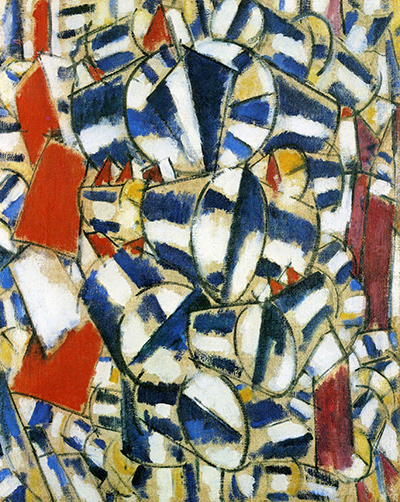
The same problem becomes sharper in Nude Model in the Studio, the Guggenheim painting of 1912–13. [2] In the visible composition, long pale curves rise through a broken arrangement of dark bars, red pieces and yellow wedges. These curves provide a possible route through the body, but each is interrupted. The figure remains substantial even as the surroundings claim parts of its silhouette.
Look at the large pale swell towards the left of the centre. Its dark edge gives it a rounded presence. Alongside it, a yellow triangle insists on its own flat, pointed shape. The juxtaposition makes both more forceful: the curve looks broader because the neighbouring angle is sharp. Elsewhere, black areas cut so decisively across the construction that they can seem like objects in their own right.
Nancy Spector’s Guggenheim essay places the painting’s curving planes within Léger’s development towards the abstract Contrast of Forms series. She describes a rhythmic surface in which bodily volume and surrounding space interact. In the Guggenheim’s own Contrast of Forms of 1913, accession 38.345, cylindrical, cubic and flat units become the principal elements. [3]
Abstraction makes the relationship itself available as a subject. A rounded form no longer needs to serve as someone’s arm before we can appreciate its pressure against a diagonal. A dark stroke can connect several areas while a coloured patch interrupts that connection. Looking becomes a succession of adjustments between what projects, what recedes and what holds the surface together.
Léger gave this kind of construction a theoretical foundation in his lecture of 5 May 1913. In the excerpt transcribed by the Centre Pompidou, he defines pictorial realism through the simultaneous ordering of lines, forms and colours, independent of imitative accuracy. [4] A convincing painting could establish its own reality through the force of those relationships.
Mechanical forms and human presence
War and its aftermath gave Léger’s geometric vocabulary new subjects and associations. Rachel Boate’s Metropolitan Museum essay describes his wartime drawings of soldiers and equipment and his subsequent development of a mechanical idiom. Her examples include The Bargeman of 1918 and the Met’s Mechanical Elements of 1920. [5] The cylinders and abrupt contrasts already present before the war acquired a more explicit connection with the engineered world.
That connection helps explain the particular tension in his machine-like bodies. A rounded limb can carry several suggestions at once: bodily mass, a manufactured component and a curved shape answering other curves. Its mechanical appearance does not settle its meaning. A grip or bent elbow can remain recognisably human while participating in an arrangement that makes no distinction between the visual importance of flesh and metal.
Nor does apparent movement require a naturalistic account of action. A sequence of curves can send the eye turning, while an upright bar arrests it. Overlapping shapes make us reconstruct possible connections, then interrupt that reconstruction. The energy belongs partly to our looking. Even where a figure’s action is legible, the surrounding construction determines how quickly or slowly we encounter it.
A mechanical form becomes most revealing when we follow what it does inside the picture. Does its hard highlight make a surface seem closer? Does its repeated curve connect a body with an object? Does its black boundary hold together a crowded passage? Such questions preserve the specificity of a painting that the general label “machine art” can obscure.
When the figures become still
The early 1920s also brought a greater emphasis on order and stable figure groups. Boate relates Woman with a Cat of 1921 to Léger’s association with Le Corbusier and Amédée Ozenfant and their interest in combining modernity with classical regularity. [5] The modern body could possess the weight and frontal assurance associated with older sculpture while retaining its hard, polished appearance.
Stillness changes the function of contrast. In a crowded early composition, adjacent pieces may pull the eye in competing directions. In a quieter group, repeated uprights and firmly contained curves can establish an almost measured pace. Broad bodies become anchors around which smaller objects and background divisions take their places.
The effect need not depend on expressive faces. A head’s direction, a hand’s placement or the angle of an arm can establish a relationship without detailed psychology. We attend to how one body occupies space beside another. Large, simplified limbs give an ordinary pose an unusual permanence, while the surroundings keep that solidity tied to the organisation of the whole picture.
This helps explain why Léger’s classicising figures can still feel unmistakably modern. Their gravity coexists with a surface that distributes attention among bodies, objects and geometric divisions. An apparently quiet scene remains an active arrangement of competing visual weights.
Isolating an object, changing its importance
Léger’s 1935 lecture at the Museum of Modern Art describes the freedom gained by isolating an object from an encompassing subject. In the passage reproduced by the Centre Pompidou, he explains how a tree can become a source of expressive bark, moving branches and decorative leaves. He also acknowledges the acceleration that cinematic close-ups brought to this way of seeing. [4]
Isolation changes our relationship with familiar things. An object that would normally be a small accessory can dominate a composition through size, position or the space around it. Once its customary surroundings disappear, its silhouette becomes newly conspicuous. We begin to follow the outline before considering its use.
This is also a way to build surprising relationships without a continuous setting. Separate objects can answer one another through a repeated curve, a shared colour or an unexpected difference of scale. A background becomes an active interval between them. The gaps matter as much as the solid shapes because they determine whether the objects seem crowded, suspended or sharply detached.
Cinema offered a related means of concentrating attention. Boate describes Ballet mécanique of 1924 in terms of montage, everyday objects and close-ups of body parts. [5] A cut can make one image answer another across time, much as two distant shapes answer each other across a canvas. On screen, that relationship unfolds through the very different experience of watching images replace one another.
Colour and contour taking separate roles
Strong colour and black drawing can organise a picture in different ways. An outline makes a hand or face recognisable, joins several shapes into a group and distinguishes one object from another. A coloured area can establish an independent rhythm through its size and placement. These functions become especially conspicuous when colour stops fitting neatly inside the drawing.
The Centre Pompidou identifies a dissociation of colour and drawing in Adieu New York of 1946. [4] This opens another possibility within Léger’s art: a figure can belong to one arrangement through its contour while a colour passing across it participates in another.
The viewer then follows two connected systems. Black lines preserve the continuity of a body; colour can unite parts of that body with surrounding space. Recognition remains possible while the colour changes where attention gathers. A patch crossing an outline may briefly flatten a volume that the drawing continues to describe.
This makes the familiar comparison with a colouring book inadequate. The relation between line and colour is itself a compositional decision. Sometimes they reinforce one another, sometimes their differing boundaries create a productive disturbance. Léger’s clarity accommodates this double reading: the parts are often immediately visible, while their relationships take longer to unfold.

Fernand Léger, Two Women Holding Flowers. Late colour areas move across the outlines instead of simply filling them.
Painting that addresses a room
The desire to organise an entire field of vision extends naturally towards architecture. Museum Ludwig’s exhibition Malerei im Raum, curated by Katia Baudin in 2016, examined Léger’s dialogue with built space from the early 1920s onwards. It placed murals beside designs, documents and work in film, textiles and performance, stressing the variety of his collaborations. [6]
A precise early example is Peinture murale, 1924, in the Museo Reina Sofía: an oil painting on canvas measuring 180 by 80 centimetres. Raúl Martínez Arranz’s museum text explains its vertical and horizontal colour bands in relation to modern architecture and records its presentation in Le Corbusier’s Pavillon de l’Esprit Nouveau in 1925. [7]
The architectural setting adds relationships beyond the painted rectangle. A vertical inside the work can answer a doorway; a broad colour can interrupt the visual continuity of a wall. Distance also changes the balance of detail and overall pattern. A painting intended to command attention across a room needs shapes whose relationships remain forceful before every small incident becomes legible.
The principle can operate within a large easel painting too. The Builders, final state, of 1950 measures 300 by 228 centimetres and belongs to the Musée national Fernand Léger. [8] Its scale gives the meeting of workers, beams and sky a physical presence quite different from a small reproduction.
In this canvas, the lower workers hold a red beam whose straight edge crosses their bodies. Above them, a seated man’s dangling legs interrupt the hard structural grid. Bright blue sky appears between the framework’s divisions, so that apparently empty intervals become strong coloured shapes. On the right, a curling rope supplies a looser rhythm; at the bottom, a piece of wood bends across the regular construction.
These differences keep the image open to successive discoveries. The red beam gives an immediate horizontal emphasis. The ladder draws attention upwards. The seated figure creates a pause within that ascent. We can recognise work and cooperation while enjoying a construction whose coloured intervals and curves make it compelling at a glance.
Preparation, revision and the material painting
Evidence of preparation survives in the Met’s Composition (Study for “Nude Model in the Studio”), 1912. Executed in oil paint, opaque watercolour and ink over graphite on brown paper, it measures 63.8 by 48.3 centimetres. The museum identifies it as a highly finished study for the larger Guggenheim painting. [2] Planning could itself produce an elaborate, substantial object.
Technical investigation reveals another side of the process. A 2005 study of the Thyssen-Bornemisza’s The Staircase (Second State), 1914, found compositional revisions through radiography and paint samples. Cross-sections showed a second calcium-carbonate preparation between an underlying black stroke and surface blue. Analysis indicated walnut oil in the sampled original preparations and paint layers. [9]
The original paint mixtures included additions such as lead and barium whites; some vermilion reds contained an organic colourant. The team distinguished overpaints with materials resembling the original from others with different materials. Similarity strengthened a hypothesis that Léger might have repaired wartime damage himself; it did not establish his authorship of those repairs. The study also identified an unevenly removed synthetic alkyd-and-beeswax coating among later surface materials. [9]
These findings belong to that canvas. They also distinguish the effect of a strong colour from the recipe producing it: a visually emphatic passage can contain several materials. The painting’s physical history proves more complex than the decisive appearance of its forms might suggest. A clearly bounded shape can conceal a reconsidered arrangement underneath. Preparation and adjustment can both contribute to an image whose final relationships appear exceptionally firm.
That distinction matters when looking at Léger’s polished volumes and crisp divisions. Their visual assurance is something he achieved. It does not tell us, by itself, how many stages of work produced them. The surface may give us the sensation of immediate order while the material object preserves a more complicated sequence of decisions.
Across his changing styles, Léger repeatedly gives viewers this combination of direct impact and continuing discovery. We see a bold colour, then follow its relationship with a curve; recognise a worker, then notice the structure crossing his body. His forms remain forceful because they keep acting on one another. Learning to follow those encounters makes even his most familiar images newly active.
Léger in video
Explore abstraction, monumental painting and cinema through films from MoMA and the Centre Pompidou. These videos offer context for Léger’s wider work; the restoration film is in French.
1913 | “Contrast of Forms” by Fernand Léger
MoMA looks at its own 1913 Contrast of Forms, including the painting’s rough surface. This is a different canvas from the Beyeler work covered in this cluster. English.
Watch on YouTubeFernand Léger artworks directory
Works covered in these articles and further documented works. Studies and finished works have separate entries; alternate titles share an entry. This is not a catalogue raisonné.
| Name | Date | Medium |
|---|---|---|
| Acrobats and Clowns from Le Cirque | 1950 | |
| Adieu New York | 1946 | Painting |
| Ballet mécanique | 1924 | Film |
| Big Julie | 1945 | Painting |
| Builders with Aloe | 1951 | Painting |
| Charlot cubiste | 1924 | Sculpture |
| Chimneys on Rooftops | 1911 | Painting |
| Cirque (artist’s book) | 1950 | |
| Composition | 1929 | Painting |
| Composition (Study for Nude Model in the Studio) | 1912 | Drawing |
| Composition of Three Figures | 1932 | Painting |
| Composition with Two Parrots | 1935–39 | Painting |
| Construction Workers Final State | 1950 | Painting |
| Contrast of Forms | 1913 | Painting |
| Derrière le miroir, nos.121–122 (posthumous publication, includes a lithograph after Léger) | 1960 | |
| Drawing for The Card Game | 1917 | Drawing |
| Drawing for The Staircase | 1913 | Drawing |
| En attendant le départ | 1914 | Drawing |
| Grand Parade with Red Background | 1953 | Painting |
| J’ai tué (illustrated book) | 1918 | |
| La Cocarde, l’avion brisé | About 1916 | Drawing |
| La Couseuse | about1910 | Painting |
| La Fin du monde filmée par l’Ange N.-D. (illustrated book) | 1919 | |
| Les Femmes au bouquet (Women with a Bouquet) | 1921 | Painting |
| Man and Woman | 1921 | Painting |
| Man in Profile with Rope: Study for The Constructors | 1950/1 | Drawing |
| Man in the Blue Hat | 1937 | Painting |
| Matinée d’ivresse, from Les Illuminations | 1949 | |
| Mechanical Elements | 1918–23 | Painting |
| Mechanical Elements (Metropolitan Museum) | 1920 | Painting |
| Men in the City | 1919 | Painting |
| Mes voyages (posthumous illustrated book) | 1960 | |
| Mona Lisa with the Keys | 1930 | Painting |
| Nude Model in the Studio | 1912–13 | Painting |
| Nudes in the Forest | 1909–1911 | Painting |
| Propellers Second State | 1918 | Painting |
| Reading | 1924 | Painting |
| Soldier with a Pipe | 1916 | Painting |
| Soldiers Playing Cards | 1917 | Painting |
| Soldiers Playing Cards (front drawing) | 1916 | Drawing |
| Standing Nude, Rear View | 1911 | Drawing |
| Still Life with a Beer Mug | 1921–2 | Painting |
| Still Life with Tankard | 1921 | Drawing |
| Study for The Aviator | 1920 | Drawing |
| The Acrobat and his Partner | 1948 | Painting |
| The Acrobats in the Circus | 1918 | Painting |
| The Alarm Clock | 1914 | Painting |
| The Chalices and the Sponge, stained-glass model | 1950 | Drawing |
| The City | 1919 | Painting |
| The Disks in the City | 1920 | Painting |
| The Mechanic | 1920 | Painting |
| The Railway Crossing | 1919 | Painting |
| The Three Musicians | 1944, after a 1924–25 drawing | Painting |
| The Wheels | 1945 | Drawing |
| Three Women | 1921–22 | Painting |
| Two Women Holding Flowers | 1954 | Painting |
| Umbrella and Bowler | 1926 | Painting |
| Verdun, dessin du front | About 1915 | Drawing |
| Woman with a Book | 1923 | Painting |
| Woman: Costume Design for La Création du monde | c.1922–23 | Drawing |
Discussion
Look again at the images and ideas explored in Fernand Léger: Style and Technique. These editorial prompts invite your observations.
Reader Insights
What becomes easier to notice in Style and Technique when you compare it with Nudes in the Forest?
Where does the comparison with Two Women Holding Flowers reveal the clearest change in Léger’s approach?
Which detail would you follow first when returning to the work, and why?
Join the Conversation
Share a detail, comparison or question about Fernand Léger: Style and Technique below.
References
- Kröller-Müller Museum, Nude Figures in a Forest, KM 101.045: object details and complete short commentary. Current museum date 1909–1911. Consulted 31 October 2026. View source.
- The Metropolitan Museum of Art, Composition (Study for “Nude Model in the Studio”), 1912, 2016.237.17: introductory text and Artwork Details, including the finished painting’s title, date and location. Consulted 31 October 2026. View source.
- Nancy Spector, Contrast of Forms, Solomon R. Guggenheim Museum, 1913, accession 38.345: complete essay and object details recovered through the indexed institutional page; direct page returned a JavaScript shell. Consulted 31 October 2026. View source.
- Vanessa Morisset, Fernand Léger, Centre Pompidou teaching dossier, April 2008, updated 2010: sections on early abstraction, figures and objects, Adieu New York, and “Textes de référence”. The 1913 and 1935 lecture excerpts are consulted through the museum’s transcription from Fonction de la peinture (Gallimard, 2004), pp. 25–26 and 187–188. Consulted 31 October 2026. View source.
- Rachel Boate, “Fernand Léger (1881–1955)”, Metropolitan Museum of Art, May 2018: complete essay, particularly its wartime, mechanical, Purist and film discussions. Consulted 31 October 2026. View source.
- Museum Ludwig, Fernand Léger. Malerei im Raum, exhibition overview, 9 April–3 July 2016, curator Katia Baudin: complete overview and captions (German). Exhibition catalogue not consulted. Consulted 31 October 2026. View source.
- Raúl Martínez Arranz, Peinture murale (Pintura mural), Museo Nacional Centro de Arte Reina Sofía, DE01377: complete object entry and commentary (Spanish). Consulted 31 October 2026. View source.
- Musée national Fernand Léger, “Les années 50, les constructeurs”: complete entry for Les Constructeurs (définitif), 1950, MNFL 94001, including its caption. Consulted 31 October 2026. View source.
- Ubaldo Sedano Espín, Andrés Sánchez Ledesma, Susana Pérez Pérez, Andrea Fernández Arcos, Hélène Desplechin, Alejandra Martos Figueroa and Juan Alberto Soler Miret, Apoyo analítico al estudio y proyecto de restauración de una obra de Fernand Léger de la Colección Thyssen Bornemisza, presentation to the II Congreso del GEIIC, Barcelona, 2005, 28 PDF pages: full extracted presentation text consulted; relevant findings pp. 14–28 (Spanish). The object studied is The Staircase (Second State), 1914. Consulted 31 October 2026. View source.


