by Tom Gurney
Tom Gurney BSc (Hons) is an art history expert with over 20 years experience
Email: tomgurney1@gmail.com / Phone: +44 7429 011000
Ballet mécanique: Introduction
A woman's mouth fills the screen. Dark lips make a sharply outlined shape against pale skin, while the rest of her face disappears beyond the image. Elsewhere, a straw hat offers another strongly defined contour: its brim and crown become circles within circles. These isolated things are ordinary enough to recognise immediately, yet their size gives them an unfamiliar authority. In Fernand Léger's Ballet mécanique, made in 1924, a face, a household object and a piece of machinery can each become the centre of attention. The Museum of Modern Art holds the film as object W591. [1] [2]
The title translates as Mechanical Ballet. Its dancers include objects, fragments of bodies and patterns of light. It dispenses with a conventional plot, finding its structure in the relationships between images. [3] Photography supplies their appearances; the arrangement of images supplies another kind of movement, carrying attention between things that would rarely share a stage. Looking closely at selected moments in MoMA's online presentation reveals how much this experiment depends on texture, framing and differences of scale, as well as on its rhythmic editing. [2]
At a Glance
This work across Fernand Léger’s career
Nudes in the Forest
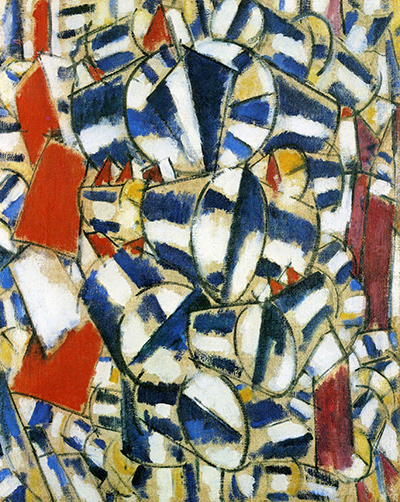
1909–1911 [4]Contrast of Forms
1913 [5]The Mechanic
1920 [7]Three Women
1921–22 [8]Contents
- A face becomes a shape
- Everyday objects under pressure
- Movement, pauses and repetition
- Words and numbers on screen
- Léger, Murphy and the musical project
- What cinema gave a painter
A face becomes a shape
The mouth is especially telling. At 1:40 in MoMA's presentation, the upper lip rises into two small peaks, while the lower lip rounds beneath it. The surrounding face gives little help in reading an individual personality. Instead, the contrast between dark cosmetic outline and light skin makes the mouth almost diagrammatic. It still belongs to someone, but the familiar sign of expression has become a visual construction with a centre, edges and a definite weight. [2]
At 4:00, an enlarged closed eye offers a different arrangement. A broad dark area occupies the left side; the visible eyelid and eyebrow occupy the right. The eyebrow curves above the shut lid, and the eyelashes make a second, more delicate boundary below. The image has an intimacy that a small face within a wider scene would lack. At the same time, the cropping frustrates the usual wish to look back into another person's eyes. An organ of looking becomes something to look at. [2]
These two details make fragmentation feel more complicated than simple dehumanisation. A mouth remains expressive even when isolated. An eyelid suggests rest or concealment even when detached from a narrative. Viewers bring those associations with them. The film can exploit a lip's outline or an eyebrow's arc without entirely cancelling the human meanings attached to either.
A later frontal face, visible at 11:00, changes that relationship again. Both eyes face the camera, and hands frame the head. After the concentration on detached features, such a direct gaze can feel unusually forceful. The eyes are still emphatic graphic forms, darkly edged and placed against pale skin, but they also seem to address the spectator. Recognition and formal pattern remain inseparable. [2]
Everyday objects under pressure
The hat at 1:30 has a comparable double identity. Its woven surface is clearly visible, so that a small item of clothing acquires a field of minute marks. The dark band distinguishes crown from brim, giving a familiar object a strong internal division. Against its darker background, the pale hat almost fills the available space. An accessory becomes a composition large enough to study. [2]
That change of scale is crucial. A hat seen on a head would help describe a person. Isolated and enlarged, it asks for attention on its own terms. The same act of framing can make a manufactured object appear as formally elaborate as a face. The film's visual world therefore extends beyond industrial machinery to the things handled, worn and used in everyday life.
MoMA's film catalogue identifies whisks, funnels, pots, lids and baking pans among its kitchenware. The museum credits Dudley Murphy with photographing the objects and emphasises their transformation through editing and juxtaposition. [1] The choice of such material gives the experiment a particular accessibility. Viewers need no specialised knowledge to recognise a utensil, even when its familiar function has temporarily dropped out of sight.
At 5:00, a large reflective, tapering metal form makes identification less secure. Bright streaks run down its surface; a row of small dark marks cuts across it. The shape reads at once as a substantial object and as an arrangement of light. Its curved surface complicates the image, producing bands of light that seem almost independent of the metal beneath them. [2]
At 10:00, a reflective sphere appears against a pale vertical field. Its light and dark patches seem to compress a surrounding world into its rounded surface. The sphere supplies a stable outline while its reflections complicate what is inside it. This is one reason the photographed objects reward more than quick recognition: their surfaces contain visual events of their own. [2]
Movement, pauses and repetition
The film's human activity includes a woman on a swing and another ascending a steep staircase. MoMA's educational account describes the swing near the beginning and the rapid succession of objects and body fragments that follows. [3] In the swing images at 1:20 and 1:25, the woman's hands hold the ropes on either side of her patterned dress. The ropes establish two persistent uprights, while the changed angle of her head and shoulders gives the figure a more variable presence between them. [2]
The comparison makes a simple pleasure visible: a repeated structure can hold changing gestures. Repetition gives the viewer something to recognise, while variation keeps that recognition from becoming inert. The still frames also show how the dress's busy pattern competes with foliage behind it. Even a recognisable outdoor setting becomes a dense surface of pale and dark marks.
The staircase introduces a heavier rhythm. At 7:00 and 7:05, a dark skirt occupies the centre between receding walls and steps. A hand gathering the fabric makes the act of climbing tangible. The passage narrows into the distance, yet the approaching body seems to press towards the screen. Repeated stone divisions provide a measure against which the figure's movement can be felt. [2]
MoMA's catalogue describes the woman carrying a heavy sack, her ascent repeatedly restarted, and compares her predicament to Sisyphus. [1] That account brings out the difference between an action and the treatment it receives in a film. A person can climb a staircase once before a camera; editing can turn the recorded effort into an apparently inexhaustible task. The repetition may produce humour, impatience, sympathy or some mixture of all three. Physical work remains visible inside the rhythmic device.
Machinery supplies another kind of encounter. At 6:00, a dark assembly of uprights, bolts and curved metal stands against a much lighter background. The contrast makes its outline immediately legible, even without identifying the machine's purpose. [2] Beside the staircase image, it invites a comparison between engineered repetition and bodily effort. Each depends on a structure through which movement must pass, but the woman carries signs of exertion and adjustment that a metal contour cannot provide.
Words and numbers on screen
The film also makes reading unstable. MoMA Learning identifies a newspaper headline about the theft of a pearl necklace worth five million, followed by the disintegration of its letters and numbers. [3] A headline ordinarily directs attention towards an event elsewhere. Here, the signs themselves enter the spectacle. Their shapes and changes compete with the story they are supposed to report.
An isolated pale zero visible at 8:00 shows how little is needed to create that shift. Surrounded by dark space, the numeral has the force of an abstract loop. We can recognise it as a number and still attend to the thickness of its stroke and the shape of its empty centre. [2] Reading supplies one kind of meaning; looking supplies another, and the image lets both remain active.
This makes the connection with advertising especially useful. The Philadelphia Museum of Art places the film within its discussion of Léger and advertising, alongside his interest in ordinary manufactured things. [12] A large sign must catch the eye before it can be read. Ballet mécanique repeatedly explores that interval, when something has seized our attention but has not yet settled into a single meaning.
Léger, Murphy and the musical project
The film brought Léger into collaboration with the American filmmaker Dudley Murphy. MoMA's catalogue gives Murphy a specific photographic role, while the museum's online film description cautiously mentions possible involvement by Man Ray. [1] [2] Selecting objects, photographing them and organising filmed material are related creative acts, each contributing to what viewers finally encounter.
George Antheil's composition bearing the same title has a connected but distinct history. IRCAM dates its composition to 1923 and a revision to 1926. The first version calls for sixteen mechanical pianos playing four different parts, alongside percussion, electric bells, a siren, aircraft propellers and two pianos. Its catalogue duration is twenty-seven minutes. These details describe a musical work and its instrumentation. [13]
IRCAM records a silent nineteen-minute film presentation in Vienna on 24 September 1924, then a revised musical version presented without the film at the Théâtre des Champs-Élysées in Paris on 19 June 1926. It also identifies a further revision in 1953. [13] The shared title thus connects works that developed through different practical circumstances and later revisions.
Modern combinations of film and music belong to that continuing history. The Philadelphia guide explains that the music could not be synchronised with the film at the time. It describes an excerpt synchronised in 1999 and distinguishes Bruce Posner's later film restoration from Paul D. Lehrman's musical adaptation and arrangement. [12] MoMA Learning lists a twelve-minute silent film, whereas MoMA's online upload runs 11:47 including introductory titles. [2] [3] A particular screening therefore has its own duration and sound presentation. The duration and accompaniment should be understood through the version being screened.
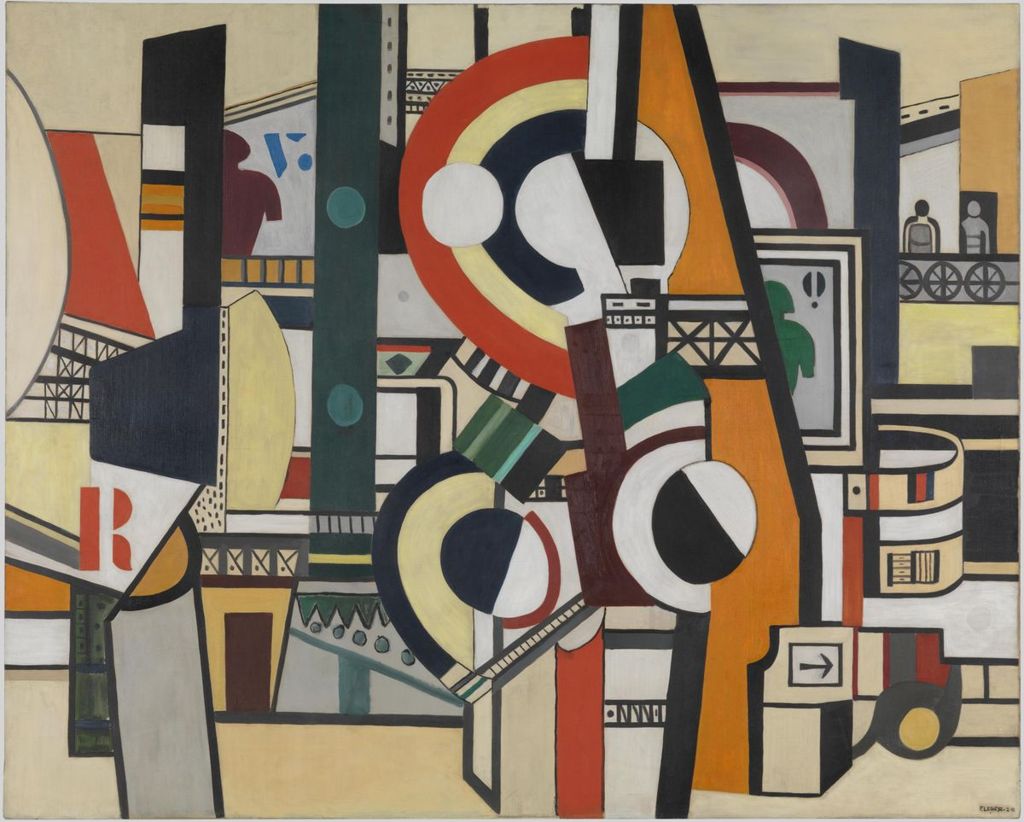
Fernand Léger, The Disks in the City, 1920. Oil on canvas. A painting shown for comparison: disks, signs and interruptions organise the modern city. Image source. Public domain.
What cinema gave a painter
The relationship with Léger's painting runs deeper than a shared taste for machines. In a statement of 1924–25 reproduced by the Centre Pompidou, Léger explained the film through the calculated movement and rhythm given to familiar objects, with contrasts of speed, pauses and intensity. In a later lecture at MoMA in 1935, also excerpted by the Pompidou, he connected cinematic close-ups with the artistic liberation of the object from its subordinate place within a subject. [14]
The two statements illuminate different aspects of the experiment. The earlier account concerns how filmed material can be organised over time. The later reflection concerns what isolation and enlargement allow an object to become. Together they help explain why a hat or an eyelid deserves sustained attention: the act of removing it from an expected setting releases other relationships of shape and scale.
Rachel Boate's account of Léger's career places the film after his development of a mechanical vocabulary in painting, including the compressed interlocking forms of Mechanical Elements. [15] Cinema offered another way to organise such encounters. On a canvas, neighbouring forms remain available together. In a film, an image can disappear before the viewer has finished examining it; a later return can make recognition part of the work.
The spectator consequently contributes a kind of labour. We retain one outline while another takes its place, discover resemblances and revise them. A dark mouth, a curved eyelid and a pale numeral need no common story to enter into a relationship. Their differences can become as compelling as their similarities.
MoMA selected Ballet mécanique among the early works entering its Film Library when the department was established in 1935. [3] Its place there recognises an experiment in what cinema itself can do. The film gives duration to a painter's concern with visual contrast, while the camera finds a complexity in everyday surfaces that painting need not reproduce by hand. Its lasting invitation is to grant ordinary things the intensity of attention usually reserved for extraordinary subjects.
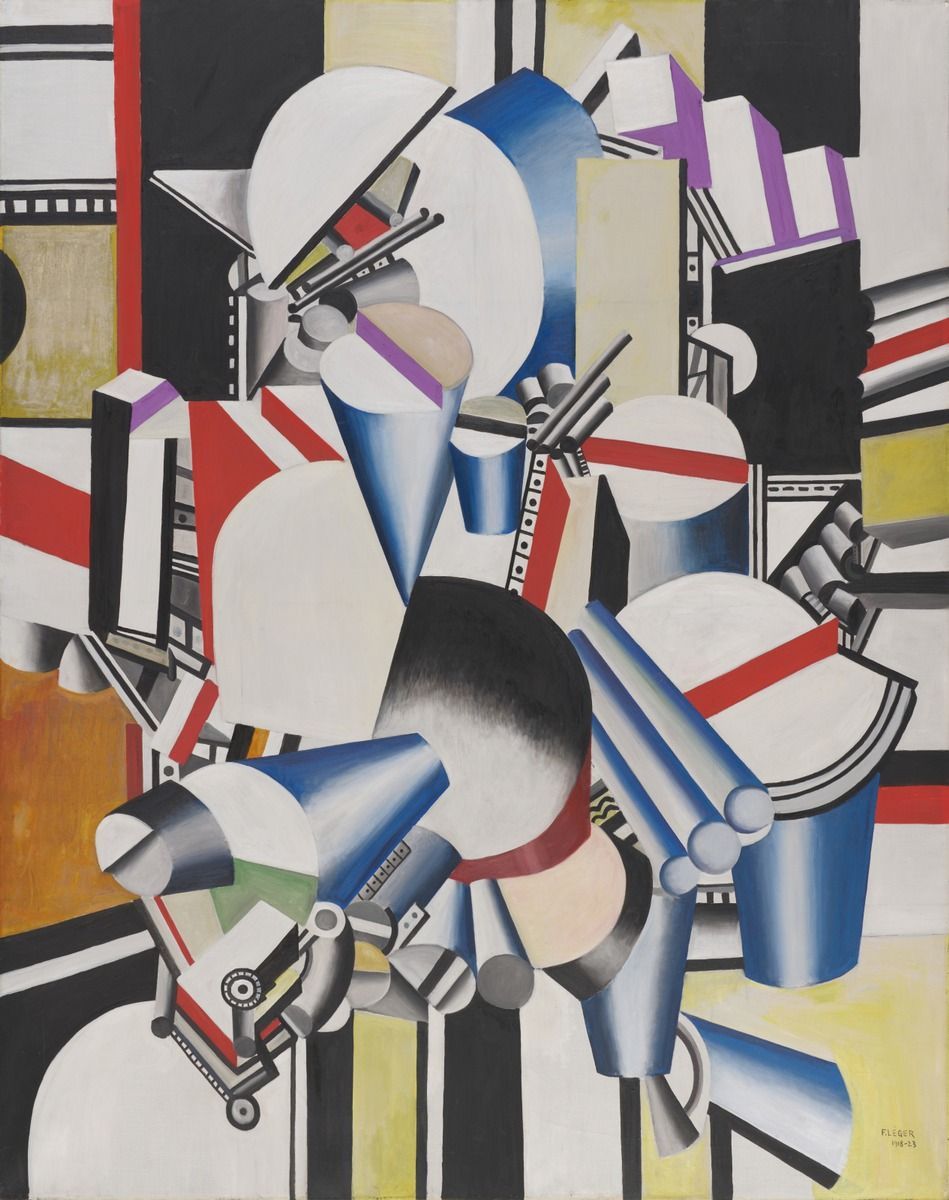
Fernand Léger, Mechanical Elements. A painting shown for comparison with the film: metal-like volumes make a rhythm without a working machine.
Léger in video
Explore abstraction, monumental painting and cinema through films from MoMA and the Centre Pompidou. These videos offer context for Léger’s wider work; the restoration film is in French.
Ballet mécanique (1924) | MoMA FILM VAULT SUMMER CAMP
MoMA’s Film Vault presentation offers a way to watch Léger and Dudley Murphy’s experiment with cinematic rhythm. This presentation is one viewing version, rather than evidence of a single synchronised 1924 film-and-score premiere.
Watch on YouTubeFernand Léger artworks directory
Works covered in these articles and further documented works. Studies and finished works have separate entries; alternate titles share an entry. This is not a catalogue raisonné.
| Name | Date | Medium |
|---|---|---|
| Acrobats and Clowns from Le Cirque | 1950 | |
| Adieu New York | 1946 | Painting |
| Ballet mécanique | 1924 | Film |
| Big Julie | 1945 | Painting |
| Builders with Aloe | 1951 | Painting |
| Charlot cubiste | 1924 | Sculpture |
| Chimneys on Rooftops | 1911 | Painting |
| Cirque (artist’s book) | 1950 | |
| Composition | 1929 | Painting |
| Composition (Study for Nude Model in the Studio) | 1912 | Drawing |
| Composition of Three Figures | 1932 | Painting |
| Composition with Two Parrots | 1935–39 | Painting |
| Construction Workers Final State | 1950 | Painting |
| Contrast of Forms | 1913 | Painting |
| Derrière le miroir, nos.121–122 (posthumous publication, includes a lithograph after Léger) | 1960 | |
| Drawing for The Card Game | 1917 | Drawing |
| Drawing for The Staircase | 1913 | Drawing |
| En attendant le départ | 1914 | Drawing |
| Grand Parade with Red Background | 1953 | Painting |
| J’ai tué (illustrated book) | 1918 | |
| La Cocarde, l’avion brisé | About 1916 | Drawing |
| La Couseuse | about1910 | Painting |
| La Fin du monde filmée par l’Ange N.-D. (illustrated book) | 1919 | |
| Les Femmes au bouquet (Women with a Bouquet) | 1921 | Painting |
| Man and Woman | 1921 | Painting |
| Man in Profile with Rope: Study for The Constructors | 1950/1 | Drawing |
| Man in the Blue Hat | 1937 | Painting |
| Matinée d’ivresse, from Les Illuminations | 1949 | |
| Mechanical Elements | 1918–23 | Painting |
| Mechanical Elements (Metropolitan Museum) | 1920 | Painting |
| Men in the City | 1919 | Painting |
| Mes voyages (posthumous illustrated book) | 1960 | |
| Mona Lisa with the Keys | 1930 | Painting |
| Nude Model in the Studio | 1912–13 | Painting |
| Nudes in the Forest | 1909–1911 | Painting |
| Propellers Second State | 1918 | Painting |
| Reading | 1924 | Painting |
| Soldier with a Pipe | 1916 | Painting |
| Soldiers Playing Cards | 1917 | Painting |
| Soldiers Playing Cards (front drawing) | 1916 | Drawing |
| Standing Nude, Rear View | 1911 | Drawing |
| Still Life with a Beer Mug | 1921–2 | Painting |
| Still Life with Tankard | 1921 | Drawing |
| Study for The Aviator | 1920 | Drawing |
| The Acrobat and his Partner | 1948 | Painting |
| The Acrobats in the Circus | 1918 | Painting |
| The Alarm Clock | 1914 | Painting |
| The Chalices and the Sponge, stained-glass model | 1950 | Drawing |
| The City | 1919 | Painting |
| The Disks in the City | 1920 | Painting |
| The Mechanic | 1920 | Painting |
| The Railway Crossing | 1919 | Painting |
| The Three Musicians | 1944, after a 1924–25 drawing | Painting |
| The Wheels | 1945 | Drawing |
| Three Women | 1921–22 | Painting |
| Two Women Holding Flowers | 1954 | Painting |
| Umbrella and Bowler | 1926 | Painting |
| Verdun, dessin du front | About 1915 | Drawing |
| Woman with a Book | 1923 | Painting |
| Woman: Costume Design for La Création du monde | c.1922–23 | Drawing |
Discussion
Look again at the images and ideas explored in Ballet mécanique. These editorial prompts invite your observations.
Reader Insights
What becomes easier to notice in Ballet mécanique when you compare it with The Disks in the City?
Where does the comparison with Mechanical Elements reveal the clearest change in Léger’s approach?
Which detail would you follow first when returning to the work, and why?
Join the Conversation
Share a detail, comparison or question about Ballet mécanique below.
References
- Museum of Modern Art, Ballet mécanique, 1924, object W591, including the complete excerpt from Circulating Film Library Catalogue (1984), p. 167. Consulted 31 October 2026. View source.
- Museum of Modern Art, Ballet mécanique (1924) | MoMA FILM VAULT SUMMER CAMP, uploaded 22 August 2020, presentation running 11:47. Selected frames inspected at 0:02, 0:15, 0:30, 1:00, 1:15, 1:20, 1:25, 1:30, 1:40, 1:45, 2:00, 3:00, 4:00, 5:00, 6:00, 7:00, 7:05, 8:00, 9:00, 10:00 and 11:00; description consulted. These timestamps refer to this upload, including introductory titles. Consulted 31 October 2026. View source.
- Museum of Modern Art, Fernand Léger. Ballet mécanique. 1924, MoMA Learning, work details, film discussion and “Ballet mécanique Helps Set MoMA's Film Collection on Its Course.” Consulted 31 October 2026. View source.
- Kröller-Müller Museum, Nus dans la forêt / Nude Figures in a Forest, collection record KM 101.045. Current date, medium, identifier, curatorial sections “Distinctive cubist style”, “Geometric shapes” and “‘Battle of volumes’”, and museum reproduction. View source.
- Fondation Beyeler, Contraste de formes, Fernand Léger, current collection record, Inv.90.6: date, medium, dimensions, collection and signature on reverse. View source.
- Philadelphia Museum of Art, The City, 1919, collection record and interpretation; A. E. Gallatin Collection, 1952-61-58. View source.
- National Gallery of Canada, The Mechanic, 1920, accession 14985, collection details and interpretive paragraph; French collection record, Le mécanicien. View source.
- The Museum of Modern Art, Fernand Léger. Three Women. 1921–22, collection record, object 189.1942: artwork image, metadata, 2021 gallery label, publication excerpt, installation history and provenance. View source.
- Musée national Fernand Léger, La Joconde aux clés, collection record and museum commentary (French): object data, owning museum image, artist recollection, sardine tin and symbolic interpretations. The artist’s recollection is consulted as reproduced by the museum; the page does not date it. View source.
- Musée national Fernand Léger, “Les années 50, les constructeurs”, complete Les Constructeurs (définitif) entry and accompanying museum image: title, 1950 date, oil on canvas, 300 × 228 cm, inventory MNFL 94001, 1969 donation and museum-mediated Renault-canteen recollection. View source.
- Musée national Fernand Léger, La Grande Parade sur fond rouge, complete object record and displayed reproduction: 1953, oil on canvas, 114.5 × 156.2 cm, inventory MNFL 96006; donation of Nadia Léger and Georges Bauquier. View source.
- James Stein, Léger: Modern Art and the Metropolis: A Guide for Students and Teachers, Philadelphia Museum of Art, 2013, pp. 9–11, especially “About This Film” and presentation credits, p. 11 (PDF p. 13). Consulted in the captured PDF text, 31 October 2026. View source.
- IRCAM, Ballet mécanique (1923), George Antheil, complete work record: composition and revision dates, duration, presentation history, instrumentation and observations. Consulted 31 October 2026. View source.
- Centre Pompidou, Fernand Léger, educational dossier, “Le cinéma,” “Le Ballet mécanique,” and reference-text excerpt “Un nouveau réalisme, la couleur pure et l'objet.” The dossier mediates Léger's 1924–25 statement and 1935 lecture. Consulted 31 October 2026. View source.
- Rachel Boate, “Fernand Léger (1881–1955)”, Heilbrunn Timeline of Art History, Metropolitan Museum of Art, May 2018, paragraphs on the postwar mechanical style and the 1924 film. Consulted 31 October 2026. View source.