 by Tom Gurney
Tom Gurney BSc (Hons) is an art history expert with over 20 years experience
Published on June 19, 2020 / Updated on November 1, 2026
Email: tomgurney1@gmail.com / Phone: +44 7429 011000
Man and Woman: Introduction
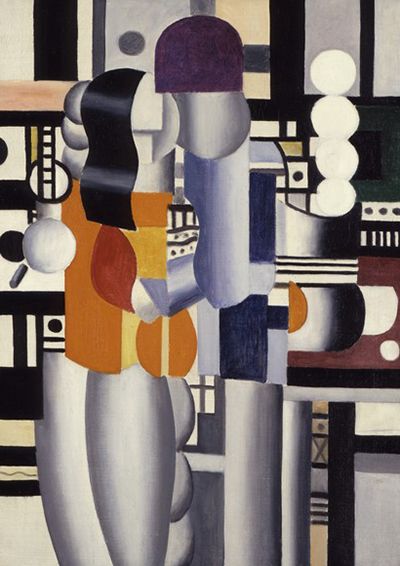
Two people lean together, their bodies built from gleaming cylinders, rounded masses and sharply bounded colour. Around them, black bars and pale rectangles divide the picture into a tightly packed construction. Fernand Léger's Man and Woman, dated 1921 and held by the Indianapolis Museum of Art at Newfields, makes an intimate subject look unexpectedly monumental. The museum identifies the painting as accession 52.28, with the credit Martha Delzell Memorial Fund. [1]
The first pleasure is the contrast between the apparent hardness of these bodies and the closeness of their pose. Nothing is softly dissolved. Hair, clothing and limbs remain distinct shapes, yet the figures fit together so closely that following one body leads the eye into the other. Léger gives the embrace a structure almost as emphatic as the surrounding architecture. What might initially seem a cold language of industrial forms becomes a way to make contact visible.
At a Glance
This work across Fernand Léger’s career
Nudes in the Forest
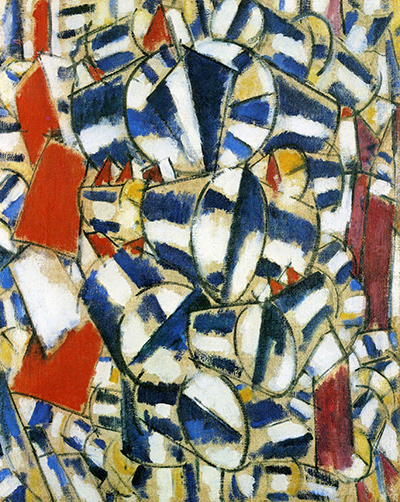
1909–1911 [2]Contrast of Forms
1913 [3]The Mechanic
1920 [5]Three Women
1921–22 [6]Contents
- Two figures in a constructed space
- Colour against volume
- Léger's mechanical period
- An embrace and domestic modernity
- A title shared with a drawing
Two figures in a constructed space
Begin with the heads. On the left, a glossy black shape curves down beside a pale face. On the right, a dark purple rounded cap sits above a smooth, shaded head. Their proximity establishes the encounter before the tangled arrangement below has become clear. Neither person has the descriptive individuality of a conventional portrait. Small facial details yield to the large relationship between curved surfaces, dark edges and patches of light.
The left figure's orange clothing is a useful guide through the centre. It stands out against the greys and pale blues, helping separate a torso from the closely fitted forms around it. A reddish oval interrupts the orange, while a pale, bent section reaches diagonally across the centre. Below, the broad, rounded lower body of the left figure contrasts with the longer vertical divisions of the figure on the right. Even so, the same smooth shading passes across both. Their bodies belong to a shared vocabulary.
The setting does little to ease the work of recognition. Thick verticals and horizontals establish a framework, but this is not a room that can be measured from a single, settled viewpoint. Near the upper right, four pale circles are stacked against a black vertical. Further down, narrow stripes, short bars and a dark red rectangle create little episodes of their own. These details behave like pieces of a patterned environment rather than explanatory props. They give the eye landmarks without spelling out a location.
A particularly telling detail occurs at the right edge of the central bodies. The rounded grey form beside the stripes resembles the shading of a limb, yet also seems to belong to the surrounding arrangement of objects. Léger makes it difficult to draw a firm boundary between a person and the world that contains them. The difficulty is productive: each return to the figures reveals another echo between their anatomy and the construction behind them.
Colour against volume
Léger uses two kinds of pictorial language side by side. The greys move gradually from dark to light, making a thigh, neck or arm appear rounded. Orange, purple and deep blue often behave more like pieces of coloured paper cut into decisive shapes. A shaded cylinder seems to project towards us; a flat patch insists on the surface of the painting. The eye alternates between the suggestion of solid bodies and the pleasure of an arrangement on canvas.
The black hair is especially effective. Its curved edge helps identify a head, while the light band across it gives an impression of reflected shine. Yet the large dark shape also has an independent role, balancing the darker cap and the black framework. A small descriptive cue can therefore do several jobs at once. Léger does not need to abandon the human subject to concentrate on composition.
Nor does the background remain passive. Pale rectangles and small circles attract attention with a brightness comparable to that of the figures. Black bars cut decisively across the upper field. Towards the bottom, alternating dark and light verticals reinforce the upward thrust of the bodies. The people are the subject, but the setting continually claims a share of our attention. Their embrace takes place inside a world of competing visual signals.
Calling these forms mechanical is useful if it directs attention to their precision and repeated shapes. It becomes less useful if it makes the figures seem literally assembled from identifiable machine parts. The picture does not require us to name an engine or a device. Its force lies in the way a simple rounded form can suggest flesh, polished metal and an abstract volume at the same moment.
Léger's mechanical period
The date places Man and Woman alongside several of Léger's most concentrated experiments with monumental figures. The Metropolitan Museum of Art describes its Woman with a Cat, also dated 1921, as an assemblage of spheres, cones and cylinders. It situates that painting within his mechanical period, from 1918 to 1923, and connects it with other imposing women shown reading or drinking tea. Everyday activity and emphatic geometry were developing together. [10]
This context helps explain why an intimate encounter could occupy the same pictorial world as bars, repeated discs and gleaming surfaces. Léger's formal language did not depend on an industrial subject. He could bring it to people and ordinary surroundings, giving both the clarity and weight associated with manufactured objects. In Man and Woman, the embrace remains legible because of the inclination of the heads and the convergence of the bodies, even as the details of anatomy become difficult to disentangle.
The Städel Museum's account of The Fishermen, another painting of 1921, describes a related method: anonymous figures, objects and space constructed from simple curves and tubes. The museum links this method with Léger's interest in modern industrial society. That wider setting matters, but it does not fix a single emotional response to the couple in Indianapolis. The painting allows both an impression of bodily warmth and an awareness of impersonal order. [11]
An embrace and domestic modernity
A close comparison is Two Women of 1922 in the National Gallery of Art, Washington. The Gallery describes Léger's engagement with Purism and the clean forms of modern production, while also drawing attention to the tenderness of the figures who hold one another. Its account shows why sharply defined bodies need not cancel affection. It also places his paintings of women within an idealised domestic sphere of leisure and tranquillity. [12]
Man and Woman brings a male figure into an equally concentrated encounter. The contrast makes it worth resisting a quick assumption that all the people in these compositions are interchangeable. Here the orange and cool blue divide the pair, while their shared greys pull them together. The differences help the viewer find two people; the repeated volumes make their closeness part of the design. Feeling emerges from their arrangement rather than an expressive glance or an easily read smile.
Three Women, painted in 1921–22 and now at the Museum of Modern Art, broadens this relationship between people and setting into a larger domestic scene. MoMA's interpretation stresses the metallic appearance of the bodies and their integration with a contemporary interior. Beside that expansive composition, Man and Woman feels compressed and upright: the couple occupies the centre with little breathing space, and the background presses close around them. This comparison clarifies how much of the Indianapolis picture's intimacy comes from its narrow organisation. [6]
It is tempting to turn the surrounding bars into a prison and the embrace into a story of escape. The visible evidence is less definite. Those same bars hold the composition together, and the bodies share the environment's rhythms. A more open reading preserves the tension: contact survives within a constructed world, but that world also supplies the very forms through which the contact is expressed.

Fernand Léger, Three Women. A related domestic group makes the balance of rounded bodies and ordinary things easier to compare.
A title shared with a drawing
Léger also made a pencil drawing called Homme et femme in 1921, now in the Städel Museum. Its record identifies pencil on brown paper, a sheet measuring 380 by 265 millimetres, and the monogram and date “FL / 21”. The museum leaves its classification as an autonomous drawing tentative. These details distinguish that sheet from the Indianapolis painting; the shared title and year alone do not establish that it was a preparatory study. [13]
The distinction is useful for anyone exploring Léger's drawings alongside his paintings. A recurring subject can move between media without every surviving work forming a documented sequence. Here, the Indianapolis composition deserves to be approached first as a complete painted construction: its warm orange, cool blue, purple and silver-grey create relationships that cannot be reduced to an outline of the couple.
Return finally to the small space between the heads. After the larger forms have occupied the eye, that meeting point becomes newly compelling. Léger has given the bodies an almost architectural stability, yet the picture's emotional centre remains a simple human inclination towards another person. The elaborate geometry makes that small action harder to read at first and more rewarding once found.

Fernand Léger, Composition of Three Figures. The 1932 figure group shows how far Léger subsequently moved from the constructed interior.
Léger in video
Explore abstraction, monumental painting and cinema through films from MoMA and the Centre Pompidou. These videos offer context for Léger’s wider work; the restoration film is in French.
Restaurer un… Fernand Léger
Follow conservation of Composition with Two Parrots, 1935–39, and look at painting on a monumental scale. French-language film.
Watch on YouTubeFernand Léger artworks directory
Works covered in these articles and further documented works. Studies and finished works have separate entries; alternate titles share an entry. This is not a catalogue raisonné.
| Name | Date | Medium |
|---|---|---|
| Acrobats and Clowns from Le Cirque | 1950 | |
| Adieu New York | 1946 | Painting |
| Ballet mécanique | 1924 | Film |
| Big Julie | 1945 | Painting |
| Builders with Aloe | 1951 | Painting |
| Charlot cubiste | 1924 | Sculpture |
| Chimneys on Rooftops | 1911 | Painting |
| Cirque (artist’s book) | 1950 | |
| Composition | 1929 | Painting |
| Composition (Study for Nude Model in the Studio) | 1912 | Drawing |
| Composition of Three Figures | 1932 | Painting |
| Composition with Two Parrots | 1935–39 | Painting |
| Construction Workers Final State | 1950 | Painting |
| Contrast of Forms | 1913 | Painting |
| Derrière le miroir, nos.121–122 (posthumous publication, includes a lithograph after Léger) | 1960 | |
| Drawing for The Card Game | 1917 | Drawing |
| Drawing for The Staircase | 1913 | Drawing |
| En attendant le départ | 1914 | Drawing |
| Grand Parade with Red Background | 1953 | Painting |
| J’ai tué (illustrated book) | 1918 | |
| La Cocarde, l’avion brisé | About 1916 | Drawing |
| La Couseuse | about1910 | Painting |
| La Fin du monde filmée par l’Ange N.-D. (illustrated book) | 1919 | |
| Les Femmes au bouquet (Women with a Bouquet) | 1921 | Painting |
| Man and Woman | 1921 | Painting |
| Man in Profile with Rope: Study for The Constructors | 1950/1 | Drawing |
| Man in the Blue Hat | 1937 | Painting |
| Matinée d’ivresse, from Les Illuminations | 1949 | |
| Mechanical Elements | 1918–23 | Painting |
| Mechanical Elements (Metropolitan Museum) | 1920 | Painting |
| Men in the City | 1919 | Painting |
| Mes voyages (posthumous illustrated book) | 1960 | |
| Mona Lisa with the Keys | 1930 | Painting |
| Nude Model in the Studio | 1912–13 | Painting |
| Nudes in the Forest | 1909–1911 | Painting |
| Propellers Second State | 1918 | Painting |
| Reading | 1924 | Painting |
| Soldier with a Pipe | 1916 | Painting |
| Soldiers Playing Cards | 1917 | Painting |
| Soldiers Playing Cards (front drawing) | 1916 | Drawing |
| Standing Nude, Rear View | 1911 | Drawing |
| Still Life with a Beer Mug | 1921–2 | Painting |
| Still Life with Tankard | 1921 | Drawing |
| Study for The Aviator | 1920 | Drawing |
| The Acrobat and his Partner | 1948 | Painting |
| The Acrobats in the Circus | 1918 | Painting |
| The Alarm Clock | 1914 | Painting |
| The Chalices and the Sponge, stained-glass model | 1950 | Drawing |
| The City | 1919 | Painting |
| The Disks in the City | 1920 | Painting |
| The Mechanic | 1920 | Painting |
| The Railway Crossing | 1919 | Painting |
| The Three Musicians | 1944, after a 1924–25 drawing | Painting |
| The Wheels | 1945 | Drawing |
| Three Women | 1921–22 | Painting |
| Two Women Holding Flowers | 1954 | Painting |
| Umbrella and Bowler | 1926 | Painting |
| Verdun, dessin du front | About 1915 | Drawing |
| Woman with a Book | 1923 | Painting |
| Woman: Costume Design for La Création du monde | c.1922–23 | Drawing |
Frequently Asked Questions
The Indianapolis Museum of Art at Newfields identifies it as a work of 1921. [1]
It belongs to the Indianapolis Museum of Art at Newfields, accession 52.28. [1]
No. The Städel's Homme et femme is a pencil drawing on brown paper, also dated 1921. Its record does not establish it as a preparatory study for the Indianapolis painting. [13]
Discussion
Look again at the images and ideas explored in Man and Woman. These editorial prompts invite your observations.
Does the couple seem most distinct from its surroundings at the heads, the orange torso or the joined arms? Follow that detail through the picture and notice where the distinction becomes uncertain.
Reader Insights
What becomes easier to notice in Man and Woman when you compare it with Three Women?
Where does the comparison with Composition of Three Figures reveal the clearest change in Léger’s approach?
Which detail would you follow first when returning to the work, and why?
Join the Conversation
Share a detail, comparison or question about Man and Woman below.
References
- Newfields and Koya Partners, Position Profile: President & Chief Executive Officer, Newfields, undated profile carrying 2024 image credits; institutional installation photograph on printed p. 10 and artwork identification/credit on printed p. 12. The image credits explicitly state that images were supplied courtesy of Newfields. View source.
- Kröller-Müller Museum, Nus dans la forêt / Nude Figures in a Forest, collection record KM 101.045. Current date, medium, identifier, curatorial sections “Distinctive cubist style”, “Geometric shapes” and “‘Battle of volumes’”, and museum reproduction. View source.
- Fondation Beyeler, Contraste de formes, Fernand Léger, current collection record, Inv.90.6: date, medium, dimensions, collection and signature on reverse. View source.
- Philadelphia Museum of Art, The City, 1919, collection record and interpretation; A. E. Gallatin Collection, 1952-61-58. View source.
- National Gallery of Canada, The Mechanic, 1920, accession 14985, collection details and interpretive paragraph; French collection record, Le mécanicien. View source.
- Museum of Modern Art, Three Women, 1921–22, object 189.1942; 2021 gallery label and MoMA Highlights (2019) excerpt. View source.
- Musée national Fernand Léger, La Joconde aux clés, collection record and museum commentary (French): object data, owning museum image, artist recollection, sardine tin and symbolic interpretations. The artist’s recollection is consulted as reproduced by the museum; the page does not date it. View source.
- Musée national Fernand Léger, “Les années 50, les constructeurs”, complete Les Constructeurs (définitif) entry and accompanying museum image: title, 1950 date, oil on canvas, 300 × 228 cm, inventory MNFL 94001, 1969 donation and museum-mediated Renault-canteen recollection. View source.
- Musée national Fernand Léger, La Grande Parade sur fond rouge, complete object record and displayed reproduction: 1953, oil on canvas, 114.5 × 156.2 cm, inventory MNFL 96006; donation of Nadia Léger and Georges Bauquier. View source.
- Metropolitan Museum of Art, La Femme au chat / Woman with a Cat, 1921, accession 1994.486; French collection commentary and object details. Paraphrased in English. View source.
- Städel Museum, The Fishermen, 1921, inventory 2132; “About the Work” and basic object data, English digital collection. View source.
- National Gallery of Art, Washington, Two Women, 1922, accession 1991.37.1; collection essay on Purism, the domestic subject and the embracing figures. View source.
- Städel Museum, Homme et femme, 1921, SG 3245 Z; German object data, inscription and qualified “Autonome Zeichnung?” classification. Paraphrased in English. View source.