King of Northumbria and Deira Ford Madox Brown.jpg)
 by
Tom Gurney
Tom Gurney BSc (Hons) is an art history expert with over 20 years experience
Email:
tomgurney1@gmail.com
/ Phone:
+44 7429 011000
Ford Madox Brown’s Manchester Murals: Introduction
In Manchester Town Hall, the history of a city becomes a succession of crowded encounters: soldiers build a fort, a queen inspects cloth, townspeople upset an invading army, and children watch a scientist investigate a muddy pond. Ford Madox Brown worked on the twelve pictures from the commission’s beginnings in 1878–79 to the completion of the last painting in 1893. They became the principal undertaking of his later career. Their subjects connect Manchester with religion, trade, education, invention and scientific inquiry, while their small incidents repeatedly draw attention away from the famous name in the title. [1]
The murals also embody a practical argument about public art. Brown wanted pictures that people could understand and care about, made for the particular demands of a wall. Seven were painted directly on the walls in spirit fresco; five were painted on canvas for attachment to the building. Calling the entire cycle “frescoes” conceals that important change of method. [2]
At a Glance
- Artist Ford Madox Brown.
- Setting the Great Hall, Manchester Town Hall. [1]
- Extent twelve historical compositions; the project developed from 1878–79 to 1893. [1]
- Materials seven wall paintings using the Gambier-Parry or spirit-fresco process, followed by five canvases attached to the walls. [2]
- Subjects Roman construction, Christianity, warfare, immigrant textile skills, religious controversy, commercial regulation, education, mechanical invention, transport and science. The historical events belong to different centuries; the paintings were made in the late nineteenth century. [1]
- Related objects preparatory drawings, full-size cartoons, small designs and later sale versions survive separately from the installed cycle. [1]
Contents
- A commission that became a second career
- How Brown painted for a wall
- Reading the twelve scenes
- Cartoons, small designs and later versions
- Civic pride and an unsettled picture of progress
A commission that became a second career
The architect Alfred Waterhouse and Manchester’s council planned historical murals for the new Town Hall. The painter Frederic Shields supported the choice of Brown, and the initial arrangement divided the twelve pictures between them, six apiece. The commission emerged in 1878–79. [3]
Brown’s grandson Ford Madox Hueffer supplies the fullest early narrative, including the artist’s letters. His account requires care: it defends Brown vigorously, and sometimes confuses historical facts or compresses the work’s material history. Nevertheless, the correspondence makes the difficulty of the undertaking unusually tangible. Brown arrived in a functioning municipal building, prepared wall surfaces, waited for medium, and worked in a movable enclosure raised to the level of the picture. He likened his working box to a box at the opera. It provided privacy but made it too easy to remain close to the surface without stepping back to judge the whole. [1]
There were immediate disagreements about what Manchester’s history should include. Some proposed episodes happened elsewhere; others depended on doubtful traditions. Brown acknowledged that Edwin had been baptised at York, yet insisted that the introduction of Christianity deserved representation. The council rejected his proposed Peterloo subject, and the opening of the Bridgewater Canal entered the scheme instead. That substitution mattered: civic history could accommodate the infrastructure of commercial growth more comfortably than a recent confrontation between political authority and a reform meeting. The rejection and Brown’s irritated response are documented in the correspondence; the contrast between the two possible subjects remains visible in the programme itself. [1]
The work also reorganised Brown’s household. He first travelled between London and Manchester before moving his household to the city in 1881. His letters connect the decision with living costs, working facilities and the hope of finding purchasers. He eventually returned to London in 1887 and completed the later canvases there. The story is more complicated than a celebrated artist simply receiving a prosperous civic commission. Brown hoped that the undertaking would support him, but repeatedly found that its demands exceeded its financial rewards. [1]
When Shields relinquished his six pictures, Brown took responsibility for the complete cycle. By the end of 1883 the negotiations had reached a decisive stage. Brown produced accounts showing how heavily the work had cost him and refused to continue at the original rate. The eventual compromise brought the payment to £375 per picture across the twelve, including retrospective additions for the earlier paintings. Hueffer also preserves Shields’s later explanation that he wanted the whole scheme to pass to Brown. Whatever the mixture of friendship, reluctance and negotiation behind the change, it gave the room a single painter’s sustained treatment. [1]
How Brown painted for a wall
Brown’s essay “Of Mural Painting,” published in 1893, provides the clearest account of his mature principles. A wall picture, he argued, should retain a sense of solidity rather than appear to make a hole through the building. He distrusted landscape decoration whose principal attraction was recession into distance, and warned against excessively dark subjects. Those opinions help explain the cycle’s emphasis on closely packed figures, emphatic gestures and clearly organised local incidents. They are principles expressed at the end of the project, rather than a recipe mechanically applied to every earlier design. He also insisted that, within a commission’s broad limits, the painter must choose and invent the actual subject: the artist knew which scenes could become effective pictures. [2]
His first method was spirit fresco, associated with Thomas Gambier Parry. It differs from buon fresco, in which pigment is applied to fresh plaster. Brown’s own testimony specifies seven Manchester works painted in the spirit-fresco system. Hueffer’s introductory footnote says that only the last four were canvases; that count conflicts with the seven wall paintings and with his subsequent narrative, which already identifies Chetham’s Life’s Dream as a canvas. The consistent division is seven wall paintings and five canvases, with Chetham beginning the canvas group. [2] [1]
Experience qualified Brown’s early enthusiasm. In July 1879 he complained that the medium continued drying and becoming paler for several weeks, making its eventual appearance hard to predict. The building also created changing conditions: projecting piers threw shadows across the painting, sunlight interfered, and gaslight was sometimes indispensable. The apparent assurance of the finished compositions therefore emerged from repeated adjustments to an awkward working environment. [1]
Canvas offered greater freedom. Brown could work in a studio, then have the completed painting adhered to the wall, a method called marouflage. His 1893 essay describes a white-lead-and-oil adhesive with a small addition of rosin, and explains that canvases could be painted in oil or prepared for the Gambier-Parry medium. These are the alternatives he discusses, rather than evidence that every Manchester canvas has precisely the same paint structure. He particularly valued the possibility of detaching a canvas if damp affected its attachment. [2]
The preparation combined historical reading with observed bodies and things. Hueffer records a bibliography for Wycliffe , an outdoor autumn study intended for Chetham , and Brown’s insistence on studying an unfamiliar brass instrument outdoors for the Roman scene. Within the hall he diffused light over models through oiled paper. Neither the historical subject nor the monumental setting removed his need to examine how an object caught light or how a person actually moved. [1]
Reading the twelve scenes
The following sequence follows the history represented, from Roman Manchester to Dalton’s investigations. It is not Brown’s order of execution. The making dates identify the installed pictures, rather than every drawing or smaller version associated with them. [1]
The Romans Building a Fort at Mancenion
The Roman scene was painted on the wall in 1880 , after the design had been worked out in 1879. Brown treats foundation as a construction site. The commanding figure holds a plan while men below shoulder, lift and place the heavy materials. A red cloak expands around the commander, but the bent backs in the foreground give the activity its physical weight. His own description distinguishes legionaries doing masonry from Britons compelled to carry stones and cement. [1]
Rank is acted out even in the subsidiary family group. The general’s wife has left her litter; their small son, dressed as a soldier, aims a kick at a bearer. Brown’s description identifies the bearer as an enslaved African. The action gives the child’s imitation of adult authority a disturbing edge. The city’s beginning is represented through unequal power as well as organised effort. Brown’s accompanying historical explanation contains an unreliable ancient chronology, so it should be read as evidence for his reconstruction, not used to date the Roman foundation independently. [1]
The Baptism of Edwin
The National Portrait Gallery dates the installed painting 1879–80 ; Hueffer records the main wall painting between April and July 1879. These statements concern the mural. The large paper cartoon has a separate, longer history. [4] [1]
Edwin kneels in a stone font, with his exposed body contrasting with the clothes and ceremonial equipment around him. Paulinus raises a hand, while the queen and her attendants watch from the other side. Behind the barrier, the congregation becomes a second subject: people peer, children fidget, and ceremony meets curiosity. Hueffer’s description draws attention to the incense-bearers’ imperfect solemnity and a child looking questioningly towards her mother. Brown’s crowd contains several degrees of attention rather than a single unanimous expression of belief. [1]
The baptism represented is at York in 627 , not Manchester. Brown explicitly acknowledged York in his explanation. The scene brings the city into a larger story of Christianisation through the kingdom to which it belonged. Even the imagined Roman pavement links this interior with the preceding Roman subject: the connection is Brown’s pictorial construction, not a surviving eyewitness record of the ceremony. [1]
The Expulsion of the Danes from Manchester
Painted in 1880–81 , this is the cycle’s most conspicuously unruly military scene. Brown describes a wounded young chief carried towards safety while his companions run a gauntlet of missiles. A woman throws a tile, an older inhabitant casts a spear, and boys pour water from above. Escaping pigs disrupt the retreat, bringing armed men down in a heap. [1]
The energy depends on collisions: the stretched body of the wounded man, shields held overhead, bodies falling below, and attacks arriving from windows. The defenders are not confined to soldiers. Household space itself becomes a position from which residents intervene. Yet the comedy of the pig is placed beside a potentially fatal injury; the invaders are also vulnerable young bodies attempting to escape. [1]
This imagined early medieval episode should not be treated as securely documented local reportage. In the correspondence Hueffer prints, Brown himself acknowledges the historical doubt attached to the Danes subject. The uncertainty is part of the cycle’s history, rather than a reason to mistake its vividness for proof. [1]
The Establishment of Flemish Weavers in Manchester
The wall painting was made in 1881–82 , following the cartoon of 1881. The familiar historical date 1363 belongs to the represented subject. Brown’s own account uses the language of tradition for Philippa’s connection with the weavers; the royal visit is an imagined embodiment of that relationship. [1] [5]
Queen Philippa examines green cloth held out by a weaving family. The touch of her hand joins royal patronage to a material whose quality has to be judged. Brown gives the queen’s attendants flowering hawthorn and describes them as returning from a spring outing. Across the composition, the presentation at the left is balanced by the shaded workshop at the right. [1]
As in the baptism, official attention is only one kind of looking. Brown describes a master watching for the queen while his apprentice watches the master’s daughter, who occupies herself with a kitten. Children imperfectly perform the deference expected of them. The composition’s larger proposition is that textile knowledge arrives with people; its smaller incidents insist that these people have affections and distractions beyond their assigned place in civic history. The Flemish Weavers picture also exists as a separate reduced design, discussed below. [1]
The Trial of Wycliffe
The wall painting belongs to 1885–86 . Brown transferred the design in 1885, interrupted the work to paint Chetham , and returned to it the following year. It represents Wycliffe’s appearance at Old St Paul’s in 1377 , defended by John of Gaunt: the action takes place in London, with the Lancaster connection bringing it into Manchester’s civic narrative. [1]
Brown sets opposing bodies and gestures against the church architecture. The seated ecclesiastical authority on one side confronts the cluster around Wycliffe and his protector. In the artist’s explanation, Constance restrains her husband by his mantle; other figures argue, read or observe. Chaucer is included taking notes. These are elements of Brown’s historical staging, and Chaucer’s presence in the painting is not proof that he witnessed the proceeding. [1]
The research was extensive, but the final encounter remains a designed drama. Brown also brought familiar contemporary faces into it: Hueffer identifies Shields as the model for Wycliffe and Brown himself as the Bishop of London. The latter identification is retained in the National Portrait Gallery’s iconography. The artist could embody the opponent of his sympathetic historical protagonist, a useful warning against treating every portrait likeness as a declaration of allegiance. [1] [4]
The Proclamation Regarding Weights and Measures
This wall painting was begun in 1883 and completed by the spring of 1884 . Its 1881 cartoon and an oil repetition finished in 1889 are separate stages and objects. [1]
The council identifies its subject as a 1556 order requiring Manchester’s weights and measures to be submitted for testing against the royal standard. [6]
Brown makes regulation into a public encounter. A speaker leans out above a parapet while people gather below; vessels, a large circular object and an extended measuring rod give the administrative subject a material vocabulary. The long diagonal across the foreground binds the two sides of the scene. Its relationship to the weavers is particularly useful: making a desirable commodity is one part of commercial life, while agreeing how quantities are checked is another. This reading follows the visible arrangement rather than identifying every depicted implement as a surviving historical instrument.
Crabtree Watching the Transit of Venus
Brown painted the mural in 1882–83 . Its subject is William Crabtree’s observation of the transit in 1639 . Brown’s description gives 24 November , the Old Style date. The important pictorial distinction is that Crabtree observes a projected solar image rather than staring directly at the sun; the reconstructed room and surrounding actions belong to Brown’s historical imagination. [1]
The familiar composition, also represented by a separate smaller painting, encloses the discovery in an ordinary interior. A narrow beam reaches the projection while Crabtree bends towards it, his raised hands arrested by what he sees. A family group gathers on the other side. The woman restrains a child whose movement might disturb the observation. Books, textiles, timber and domestic clutter share the room with the equipment. Brown described the setting as a storeroom above the draper’s business, imagined for the scene. [1]
Discovery therefore appears as an interruption within household life. The observer’s absorption is matched by the work of keeping the child back; two different kinds of vigilance occupy the picture. The Crabtree composition deserves close attention for this relationship between an exceptional observation and the people who make space for it.
Chetham’s Life’s Dream
The first of the five canvas murals was begun in 1885 and finished in February 1886 . The pastel made from its cartoon in 1889 is a different object. Brown represents the merchant Humphrey Chetham considering his will while imagining the boys who will benefit from his educational provision. [1]
The title is essential. This is an imagined future filling a garden, not a record of Chetham sitting among an already established school. The seated benefactor and his document occupy one side, while boys spread through the space in activities Brown names as reading, drilling, wrestling, leapfrog and a game of stools. The will becomes bodies in motion. [1]
The great tree and open ground allow the school’s imagined life to expand beyond the still figure contemplating it. Brown includes the practical support of a cook and anticipated provisions as well as the attractions of play. Education takes material form through food, supervision, books and room to move. It offers a different use of mercantile wealth from accumulation alone, while retaining the dependence of the children on a wealthy donor’s decision. [1]
Bradshaw’s Defence of Manchester
This was the final mural, painted on canvas in 1892–93 and completed in March 1893. Its place in the historical sequence is earlier: it represents Manchester’s defence in the Civil War. Hueffer’s account repeats the attribution of leadership to Bradshaw. [1]
That identification needs correction. Manchester City Council’s caption explicitly identifies Colonel Rosworm , rather than Bradshaw, as the defender against Lord Strange’s Royalist forces. The traditional title records the painting’s history; it should not determine the historical explanation. [7]
The composition brings battle down to a confined crossing, where a fallen horse and struggling men dominate the foreground. Smoke and fire interrupt the view along the bridge. Brown’s explanation gives the distant firing figure the role of Bradshaw, while the conspicuous unhorsed gentleman in front remains only tentatively identified even in that account. It is a scene of obstructed movement, difficult rescue and confused bodies rather than a commanding portrait of a victorious leader. The uncertainty over the foreground figure and the correction to the title should remain distinct: one concerns Brown’s identification within the picture, the other the history it claims to represent. [1]
John Kay, Inventor of the Fly Shuttle
Brown began the large canvas in 1888 . Hueffer records its painting as finished in November 1889 and the completed canvas exhibited in March 1890, so 1888–90 usefully preserves the work’s successive stages. The scene dramatises the traditional account of Kay being smuggled away from rioters in a woollen sheet. [1]
The invention does not produce an uncomplicated triumph. On one side, an intruder forces his way into the room; on the other, several people struggle with the awkward bundle containing the inventor. Kay reaches towards his wife for a kiss. The sheet simultaneously hides him and exposes his dependence on others. Brown gives the dramatic mechanism of escape a physical absurdity without removing the threat that makes escape necessary. [1]
The textile story has changed since Philippa’s visit. Incoming skill was welcomed there; here a device that increases output generates fear and violence. Brown’s written explanation also blames employers who resisted Kay’s royalties. He does not assign all the cost of invention to a single hostile crowd. The scene is built from a received story, however, and its theatrical detail should not be mistaken for a documented account of every movement in Kay’s house. [1]
The Opening of the Bridgewater Canal
The canvas was painted in 1891–92 , following the cartoon begun after John Kay . It represents the canal opening at Barton Aqueduct in 1761 . Brown had resisted this subject early in the commission, yet eventually turned it into a densely populated waterside event. [1]
The barges and their occupants bring engineering into the realm of movement and use. Brown’s account places the Duke of Bridgewater and James Brindley beside the working boat, while the bargee’s wife steers with two babies secured on the cabin roof. A small customer waiting for coal gives the transport system an everyday destination. The official party and the labour that makes the event happen remain within the same crowded field. [1]
Read beside Kay , the canal offers another picture of technological change. Instead of an isolated inventor threatened inside a house, it shows a network: designer, financier, crew, animals, boats and customers. Its celebratory appearance does not make it an impersonal diagram of progress. Brown continually restores the bodily and domestic details that infrastructure tends to hide. [1]
Dalton Collecting Marsh-Fire Gas
The canvas was begun in 1886 and completed in 1887 . Although it is the last subject in the historical arrangement, it was finished several years before the cycle’s final painting. Brown does not establish a precise date for the particular pond-side experiment he depicts. [1]
Dalton works with a long pole while a boy catches rising gas in an inverted vessel. Children look on from the bank; another child has interests of his own at the water’s edge. The strong horizontal bank and the overarching tree hold this scattered group together. Brown’s explanation makes the activity a demonstration of collecting bubbles disturbed from the mud, with a saucer ready to close the vessel underwater. [1]
The scene offers a particularly modest form of scientific monument. Dalton’s achievement is approached through bending, stirring, collecting and watching. Brown’s words connect the investigation of gases with the chemist’s larger work, but do not justify treating this as the exact instant when atomic theory was discovered. The Dalton composition ends the sequence with an open-air investigation in which practical assistance and youthful curiosity share the scientist’s space. [1]
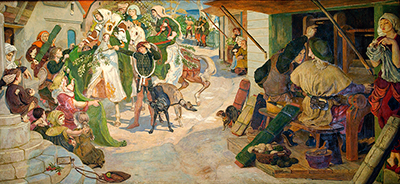
Ford Madox Brown, reduced design for The Establishment of the Flemish Weavers, begun 1881 and finished 1888. Tempera on panel. Manchester Art Gallery; separate from the wall painting.
Watch: Ford Madox Brown
Choose a film exploring the people, stories and visual details in two of Brown’s best-known paintings.
Pre-Raphaelites: Ford Madox Brown – Work
Curator Tim Barringer explores the figures and stories within Work.
Watch on YouTubeCartoons, small designs and later versions
A mural title can refer to several different physical works. The National Gallery of Victoria’s The Baptism of Edwin, King of Northumbria is a monumental paper cartoon , dated 1879–91 , in pastel, coloured chalks and grey gouache. It measures 146.5 × 318.5 cm and entered the Melbourne collection through the Felton Bequest in 1905 . It is not the Manchester wall painting removed from its setting. [8]
The date range belongs to that particular sheet. It does not mean Brown spent twelve years continuously painting the baptism on the Town Hall wall. The distinction is especially clear when the museum record is set beside his early mural chronology. Readers can explore the separate Baptism cartoon as a work with its own materials and later development. [8] [1]
Manchester Art Gallery similarly dates its small tempera-on-panel Flemish Weavers design 1881 and 1888 . The gallery explains that Brown prepared it before the mural, then completed it afterwards for sale. Those two dates describe the panel’s working history; the installed wall painting was completed in 1882. [9] [1]
Hueffer records comparable transformations elsewhere: the Weights and Measures cartoon became an oil repetition in December 1889, and the Chetham cartoon became a pastel that September. Brown’s July 1879 letter had already weighed the saleability of a smaller coloured design against a cumbersome cartoon. The preparatory object could be an instrument of making, a record of the invention and a potential source of income, with those functions changing over time. [1]
These distinctions also matter when looking at reproductions. A photograph of a smaller version can explain a composition without documenting the installed mural’s scale, surface or condition. A paper cartoon, a tempera panel and a wall painting should keep their own captions even when their figures look familiar.
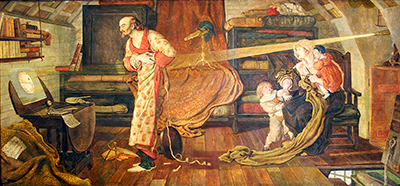
Ford Madox Brown, Crabtree Watching the Transit of Venus, 1639, reduced tempera panel. Manchester Art Gallery, 1947.87. A separate version of the Town Hall composition.
Civic pride and an unsettled picture of progress
The series grants Manchester a long past, but its history does not proceed through twelve uncontested achievements. Roman organisation includes compelled labour. The introduction of Christianity includes resistant or distracted spectators. Textile skill is welcomed in one picture, while mechanical innovation brings fear in another. Education depends on a benefaction, and scientific knowledge depends on patient manual activity. Those tensions arise within Brown’s subjects and their detailed staging. [1]
His activities outside the Town Hall sharpen the social context. In an April 1886 letter to Shields, Brown described addressing a large meeting of unemployed men at Pomona Gardens and helping to establish a labour bureau. Workers registered, he reported, but employers responded in far smaller numbers. He accused manufacturers of treating a reserve of hungry workers as necessary to cheap labour. This is Brown’s own contemporary statement, rather than a political position inferred solely from the paintings. [1]
Colin Trodd’s later interpretation places ordinary people’s encounters with larger powers at the centre of the cycle. In a University of Manchester account accompanying his 2022 book, he emphasises vitality, freedom and the combination of serious history with comedy. That account provides a useful critical alternative to reading the murals simply as municipal self-congratulation. [10]
Brown himself offered a revealing test of public response. In “Of Mural Painting” he recalled visitors mistaking the wounded Dane for someone who had fallen from a ladder and was being carried away by police. They had misunderstood the costume and event, yet grasped misfortune and assistance. He accepted that sympathetic recognition as a meaningful response. His insistence that publicly funded subjects should engage their audience coexisted with condescension towards that audience’s education; both attitudes belong to his account. He also separated the appeal of religious pictures from the piety of their makers or viewers, locating their force in “poetry and humanity.” The baptism and the religious dispute can therefore be approached through human responses as well as through the beliefs represented. [2]
The reception during his lifetime was mixed. Hueffer prints enthusiastic reports from Charles Rowley as well as complaints about hostile criticism. Brown’s own 1887 letter resists the idea that Manchester had simply refused him recognition: he lists honours, invitations and public introductions, even while worrying about a cooling response. Neither complete neglect nor universal civic acclaim adequately describes the evidence. [1]
Conservation has brought renewed attention to the pictures as parts of a building. A September 2024 council report records Hirst Conservation’s public lecture on its work on the Town Hall’s internal painted finishes, including the murals. The lecture formed part of a wider heritage programme documenting the building’s restoration and the skills involved. [11]
The cycle extends the crowded social vision of Work into an architectural setting. Its later place in Brown’s career should not make it an appendix to the earlier easel paintings. Here he sustained a public historical project through changing methods, negotiations and successive compositions, while keeping the small, difficult, funny business of being human in view. [1]
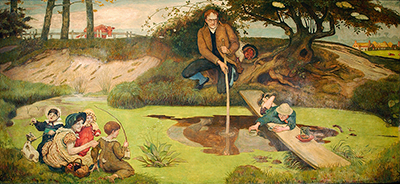
Ford Madox Brown, Dalton Collecting Marsh-Fire Gas. A related painted version of the composition; this reproduction does not document the installed mural’s surface.
Books for further study
These scholarly publications offer routes into more detailed study.
Ford Madox Brown: The Manchester Murals and the Matter of History. Colin Trodd. Manchester University Press, 2022.
A study of the Manchester mural cycle, historical interpretation and civic setting. Publisher information.
Artworks directory
Explore paintings, drawings, cartoons, illustrations and decorative designs documented in museum collections and specialist research. Distinct versions are listed separately; repeated print impressions are grouped. The coverage includes studies and works without a dedicated article and remains open to further research.
| Name | Date | Medium |
|---|---|---|
| Work (Manchester) | 1852–1865 | Oil on canvas |
| The Last of England (Birmingham) | 1852–1855 | Oil on panel |
| Jesus Washing Peter’s Feet | 1852–1856 | Oil on canvas |
| Pretty Baa-Lambs | 1851–1859 | Oil on panel |
| Take Your Son, Sir | ?1851–1892 | Oil on canvas |
| Lear and Cordelia | 1849–1854 | Oil on canvas |
| Cordelia’s Portion | 1867–1875 | Oil on canvas |
| Walton-on-the-Naze | 1859–1860 | Oil on canvas |
| Chaucer at the Court of Edward III (Tate) | 1856–1868 | Oil on canvas |
| Carrying Corn | 1854–1855 | Oil on mahogany |
| The Hayfield (The Hay Harvest) | 1855–1856 | Oil on mahogany |
| Stages of Cruelty | 1856–1890 | Oil on canvas |
| The Irish Girl | 1860 | Oil on canvas laid on board |
| Romeo and Juliet (Delaware) | 1869–1870 | Oil on canvas |
| The Seeds and Fruit of English Poetry | 1845–1853 | Oil on canvas |
| Self-Portrait | 1877 | Oil on canvas |
| The Bromley Children | Probably 1844 | Oil on canvas |
| The Bromley Family | 1844 | Oil on canvas |
| Byron’s Dream (Manchester) | 1874; worked on into 1875 | Oil on canvas |
| Cartoon for The Baptism of Edwin | 1879–1891 | Pastel, coloured chalks and grey gouache |
| The Coat of Many Colours | 1864–1866 | Oil on canvas |
| The Convalescent (Birmingham) | Dated October 1872 | Pastel |
| Crabtree Watching the Transit of Venus (reduced painting) | 1881–1888 | Tempera on panel |
| Cromwell on His Farm (Lady Lever) | Completed 1874 | Oil on canvas |
| Cromwell Protector of the Vaudois | 1877 | Oil on canvas |
| Dalton Collecting Marsh-Fire Gas (Town Hall mural) | 1886–1887 | Mural on canvas |
| The Establishment of the Flemish Weavers (reduced painting) | 1881; completed 1888 | Tempera on panel |
| The Finding of Don Juan by Haidée (NGV) | 1869–1870; later retouched | Watercolour and gouache over pencil |
| Henry and Millicent Fawcett | 1872 | Oil on canvas |
| Jacob and Joseph’s Coat (Ponce) | c.1868–1871 | Oil on canvas |
| James Leathart | 1863–1864; altered 1869 | Oil on canvas |
| King René’s Honeymoon (Tate watercolour) | 1864 | Graphite, watercolour, gouache and gum arabic on card |
| King René’s Honeymoon Cabinet (collaborative work) | 1861; exhibited 1862 | Oak, inlaid woods, painted panels and metal mounts; Brown designed Architecture |
| Manfred on the Jungfrau | 1841; retouched 1861 | Oil on canvas |
| Millie Smith | 1846 | Oil on paper laid on panel |
| William Michael Rossetti by Lamplight | 1856–1857 | Oil on panel |
| The Traveller (Manchester oil) | 1868–1884 | Oil on panel |
| Waiting: An English Fireside of 1854–55 | 1851–1855 | Oil on panel |
| An English Autumn Afternoon | 1852–1853; finished c.1854 | Oil on canvas |
| Alfred the Great: Sketch of Alfred drawing in the Sand | 1843–1845 | pencil |
| Historical Notes and Sketches of Alfred the Great | 1843–1850 | brown ink writing over pencil |
| Angels watching the Crown of Thorns: Study of clasped Hands | 1846 | black chalk |
| Architecture: Study of Gothic Arches and 14th Century Vaulting | c. 1847 | brown pen and ink over pencil on grey paper |
| The Ascension: Study of Angels and Hands | 1844 | brown pen and ink over pencil |
| The Ascension: Study of a Group of Angels | 1844 | brown pen and ink over pencil |
| The Ascension: Study of a Group of six flying Angels | 1844 | brown pen and ink over pencil |
| The Ascension: Two nude Angels holding onto each other | 1844 | brown brush and ink over pencil |
| The Ascension: Study for a kneeling Apostle | 1844 | black chalk touched with white on brown-toned paper |
| Head of a Child | c. 1844 | black chalk touched with white on brown toned paper |
| The Ascension: Drapery Study of a praying Apostle | 1844 | black chalk |
| The Spirit of Justice: Seated Figure in ecclesiastical Robes, gripping a Staff with left Hand raised in a Blessing | 1844 | black chalk |
| The Ascension: Study for an Apostle | 1844 | black chalk |
| The Spirit of Justice: Body of seated Figure in ecclesiastical Robes holding a Staff and a Book | 1844 | black chalk |
| The Ascension: Study of an Apostle | 1844 | black chalk on toned paper |
| Full-length Sketch of a standing, naked Child | 1844 | black chalk on toned paper |
| The Ascension: Study for Christ | 1844 | brown pen and ink over pencil |
| Caricature: Composite Drawing: A Stunner | 1861–1863 | pencil |
| A Victorian Woman in her Underwear | 1861–1863 | pencil |
| Caricature: Composite Drawing: Bewigged Head | 1861–1863 | pencil |
| Bowed Head of a bearded Man | 1861–1863 | pencil |
| Chaucer at the Court of Edward III: Early compositional Study | 1845 | pencil with brown pen and ink |
| Chaucer at the Court of Edward III: Study for Milton and two Designs for Tombstones | c.1845–c.1846 | pencil with brown frame outline |
| Chaucer at the Court of Edward III: Tracing of the Figure of Milton | c.1845–c.1849 | brown pen and ink with pencil on tracing paper |
| Chaucer at the Court of Edward III: Tracing of a Gothic Arch | c.1845–c.1849 | brown pen and ink with pencil on tracing paper |
| Chaucer at the Court of Edward III: Early compositional Study | 1845 | pencil with brown pen and ink |
| Chaucer at the Court of Edward III: Nude Studies of two Boys | 1845 | pencil, laid down |
| Chaucer at the Court of Edward III: Nude Studies of four Figures | 1845 | pencil |
| Chaucer at the Court of Edward III: Eight early Studies of Figures and Hands | 1845 | pencil |
| Chaucer at the Court of Edward III: Nude Studies for the Figures of Byron, Shakespeare and Burns | 1845 | black chalk |
| Chaucer at the Court of Edward III: Drapery Study for Burns | 1847 | black chalk |
| Chaucer at the Court of Edward III: Study of a right Leg and left Foot for Milton | 1847 | black chalk |
| Chaucer at the Court of Edward III: Study of a left Leg for Shakespeare | 1847 | black chalk |
| Chaucer at the Court of Edward III: Study of Drapery for Milton | 1847 | black chalk |
| Chaucer at the Court of Edward III: Drapery Study for Shakespeare | 1847 | black chalk |
| Chaucer at the Court of Edward III: Study of a Man in a medieval Hood | 1847 | black chalk |
| Chaucer at the Court of Edward III: Study for the Cardinal | 1847 | black chalk |
| Chaucer at the Court of Edward III: Drapery Study in Profile for Courtier | 1847 | black chalk |
| Chaucer at the Court of Edward III: Drapery Study | 1847 | black chalk |
| Chaucer at the Court of Edward III: Female Nude Study of a Muse holding onto a Rail | 1847 | pencil |
| Chaucer at the Court of Edward III: Female Nude: Study of a Muse | 1847 | pencil |
| Chaucer at the Court of Edward III: Nude Study for seated Lady | 1847 | pencil |
| Chaucer at the Court of Edward III: Nude Study of a Woman with right Arm raised | 1847 | pencil |
| Chaucer at the Court of Edward III: Two Studies of Back of a seated Woman's Head | 1847 | pencil |
| Chaucer at the Court of Edward III: Two Studies of a seated Woman in lost Profile Pose and from the Back | 1847 | pencil |
| Chaucer at the Court of Edward III: Nude Study of a Woman | 1847 | pencil |
| Chaucer at the Court of Edward III: Sketch of a Woman supporting another Figure | 1847 | pencil |
| Chaucer at the Court of Edward III: Study of the Heads and Shoulders of two Women | 1847 | pencil |
| Chaucer at the Court of Edward III: Drapery Study for Edward III with Outline of a Child | 1847 | black chalk |
| Chaucer at the Court of Edward III: Foreshortened Study for Head of a Jester | 1847 | pencil |
| Chaucer at the Court of Edward III: Head of Alexander Pope | 1847 | black chalk |
| Chaucer at the Court of Edward III: Two Hand Studies | 1847 | black chalk |
| Chaucer at the Court of Edward III: Study of Head of Milton copied from Sculpture | 1848 | black chalk |
| Chaucer at the Court of Edward III: Nude Studies for the Squire and the Courtier talking to Gower | 1848 | pencil |
| Chaucer at the Court of Edward III: Drapery Study for the Black Prince | 1848 | black chalk with touches of white |
| Chaucer at the Court of Edward III: Three Studies of Hands | 1848 | Black chalk |
| Chaucer at the Court of Edward III: Four Studies of Hands | 1848 | black chalk touched with white |
| Chaucer at the Court of Edward III: Study of a clasped right Hand for one of the Poets | 1848 | black chalk |
| Chaucer at the Court of Edward III: Study of a left Hand for Burns | 1848 | black chalk heightened with touches of white |
| Chaucer at the Court of Edward III: Study of Drapery for Burns | 1848 | black chalk |
| Chaucer at the Court of Edward III: Drapery Study | 1848 | black chalk |
| Chaucer at the Court of Edward III: Drapery Study for the Black Prince | 1851 | black and white chalks on brown-toned paper |
| Chaucer at the Court of Edward III: Study for Squire's Legs | 1851 | black chalk heightened with white |
| Chaucer at the Court of Edward III: Two Head Studies of an old Woman | 1851 | black chalk |
| Costume Study: Five Sketches of Armour and Costume | 1844 | brown pen and ink over pencil |
| Costume Study: Archbishop's Dress | 1845 | brown pen and ink on tracing paper |
| Costume Studies: French and Italian thirteenth and fourteenth-century Costumes (seven Drawings) | 1845 | brown pen and ink on tracing paper |
| Costume Study: Seigneur de Rimini | 1845 | brown pen and ink on tracing paper |
| Dalziels' Bible Gallery: The Death of Eglon | 1863–1865 | engraved woodblock; designed by Brown, engraved by the Dalziel Brothers |
| Dalziels' Bible Gallery: The Death of Eglon | 1881 | wood engraving; designed by Brown, engraved by the Dalziel Brothers |
| Dalziels' Bible Gallery: Elijah and the Widow's Son | 1863–1865 | engraved woodblock; designed by Brown, engraved by the Dalziel Brothers |
| Dalziels' Bible Gallery: Elijah and the Widow's Son | 1881 | wood engraving; designed by Brown, engraved by the Dalziel Brothers |
| Dalziels' Bible Gallery: Joseph’s Coat (Compositional Sketch and four Studies for Jacob's Granddaughter) | 1863–1865 | pencil on paper |
| Dalziels' Bible Gallery: Joseph's Coat | 1863–1865 | engraved woodblock; designed by Brown, engraved by the Dalziel Brothers |
| Dalziels' Bible Gallery: Joseph’s Coat | 1881 | wood engraving; designed by Brown, engraved by the Dalziel Brothers |
| Decorative Sketches: Venus Reclining on a Shell in the Midst of the Sea | 1848–1849 | brown pen and ink over pencil |
| Decorative Design: Ornamental Pattern | 1850 | watercolour and bodycolour over pen and ink, and pencil on two sheets of paper |
| Down Stream: Main Illustration (Last Year's First of May) | 1871 | wood engraving; designed by Brown, print execution by an engraver |
| Down Stream: Tailpiece to the Poem (This Year's First of June) | 1871 | wood engraving; designed by Brown, print execution by an engraver |
| The Establishment of Flemish Weavers in Manchester A.D. 1363: Four Studies of Parts of a Horse | 1879–1882 | black, white and red chalk on rough brown paper |
| Female: Two Studies of young Woman in eighteenth-century Costume | 1849 | pencil |
| Infant's Repast: Study of Mother and Child | 1848 | black and white chalk |
| Infant's Repast: Study of Mother and Child with separate Arm and Leg Studies of the Child | 1848 | black chalk with grey wash |
| King Lear: Sketch of Lear questioning Cordelia | 1844 | brown pen and ink over pencil |
| Alfred the Great: Compositional Sketches | 1843–1845 | pencil |
| King Lear: Sketches of Lear imagining his unfaithful Daughters’ Trial and Lear in the Storm | 1844 | brown pen and ink over pencil |
| Alfred the Great: Compositional Studies and Sketches and Chaucer at the Court of Edward III: Study of Cherubs | 1843–1849 | pencil |
| King Lear: Kent accuses Oswald | 1844 | brown pen and ink with pencil underneath |
| King Lear: Lear recounts his Wrongs to Regan | Undated | Brown pen and ink over pencil |
| King Lear: Cordelia at Lear's Bedside (Lear's Awakening) | 1844 | brown pen and ink over pencil |
| Cordelia Parting from Her Sisters (The Germ) | 1850; reprinted 1901 | Etching; designed by Brown, print execution by an engraver |
| King René's Honeymoon: Study for Architecture | 1861 | brush and brown ink, with watercolour, over pencil on brown paper |
| The Last of England: Cartoon | 1852 | pencil, image edged with brown ink |
| The Last of England: Portrait of Emma Hill | December 1852 | chalks with scratching out on two sheets of paper |
| Lear and Cordelia and The Infant’s Repast: Four Studies of Hands | 1849 | black chalk |
| Lyra Germanica - the Christian Life: Abraham and Isaac | 1868 | wood engraving; designed by Brown, print execution by an engraver |
| Lyra Germanica - the Christian Life: Finished Design for The Entombment | 1867 | black pen and ink |
| Lyra Germanica - the Christian Life: The Entombment | 1868 | wood engraving; designed by Brown, print execution by an engraver |
| Male: Sketch of Man reclining on Steps with Hands bound together | 1844 | brown pen and ink over pencil |
| Male: Academic nude Study, half-length with Moustache and Arms folded | 1846–1849 | black chalk |
| Male: Academic Study of Nude holding a Staff | 1847 | pencil |
| Male: Academic Study of Nude posed as a Sculptor | 1847 | chalk with grey wash |
| Male: Academic Study, three-quarter length Nude, with a Moustache and clenched Fists | 1847 | black chalk |
| Oure Ladye of Saturday Night: Seven Sketches | 1846 | pencil |
| Oure Ladye of Saturday Night: Four Studies for Angel holding Child | 1847 | pencil |
| Oure Ladye of Saturday Night: Study of Angel holding Child | 1847 | black chalk |
| Oure Ladye of Saturday Night: Study of Arm and Hands for Angel holding Bowl of Water | 1847 | black chalk |
| Oure Ladye of Saturday Night: Drapery Study for Angel holding Bowl of Water | 1847 | black chalk |
| Oure Ladye of Saturday Night: Study of Head for Angel holding Bowl of Water | 1847 | black chalk with rubbing and grey wash |
| Oure Ladye of Saturday Night: Study of Child seated on Knees of the Virgin and two separate Studies of the Child's Legs | 1847 | pencil on brown-toned paper |
| Oure Ladye of Saturday Night: Frieze Design | c. 1847 | pencil and black pen and ink |
| Oure Ladye of Saturday Night: Three Studies of Arms and Legs of Child | 1847 | pencil |
| Oure Ladye of Saturday Night: Three Studies of Child's Legs on Virgin's Knees | 1847 | pencil |
| Oure Ladye of Saturday Night: Studies of Right Foot and Left Hand of Child | 1847 | pencil on light brown paper |
| Oure Ladye of Saturday Night: Drapery Study for Virgin | 1847 | black chalk |
| Oure Ladye of Saturday Night: Study for Head of Virgin | 1847 | black chalk with wash |
| Parisina’s Sleep: Study for Prince Azo and Parisina | 1842 | black chalk with pencil side drawing |
| Parisina's Sleep: Study for Head of Prince Azo | 1842 | black chalk with grey wash |
| Parisina's Sleep: Study for the Head of Parisina | 1842 | black and white chalk with grey wash |
| Poets of the Nineteenth Century: The Prisoner of Chillon: Compositional Sketch | 1856 | pencil |
| Profile of a Man's left Eye and Nose | c.1856 | pencil |
| Poets of the Nineteenth Century: The Prisoner of Chillon: Study of a Corpse | 1856 | pencil |
| Designs for Decoration | c.1856 | pencil |
| Poets of the Nineteenth Century: The Prisoner of Chillon | 1857 | wood engraving; designed by Brown, print execution by an engraver |
| Portrait: Head Study of Daniel Casey (three-quarter view) | 1848 | black chalk |
| Portrait: Head Study of Daniel Casey (full-face) | 1848 | black chalk |
| Portrait: Miss Iza Duffus Hardy | 1872 | pastel and coloured chalks on brown paper |
| Portrait: Emma Hill (later Mrs Madox Brown) | 1848 | black chalk |
| Portrait: Emma Hill (later Mrs Madox Brown) | 1852 | pencil |
| Portrait: Mrs Madox Brown (neé Emma Hill) | 9 May 1854 | pencil |
| The Repose in Egypt: Compositional Sketch | 1847 | pencil |
| Study of a Statue of the Discobolus | 1845 | Black chalk |
| William Shakespeare: Study | 1849–1850 | pencil |
| William Shakespeare: Invitation Card | 1850 | wood engraving; designed by Brown, print execution by an engraver |
| The Spirit of Justice: Study for Baron and his Advisor, with Sketches of Erudition and Wisdom | 1844–1845 | brown pen and ink over pencil |
| The Spirit of Justice: Drapery Study for Erudition | 1844–1845 | black chalk |
| Drapery Study and Sketch of Two Legs | Undated | Black chalk |
| The Spirit of Justice: Study for Wisdom | 1844–1845 | black chalk with grey wash |
| The Spirit of Justice: Study for Head of the Baron | 1844–1845 | black chalk |
| The Spirit of Justice: Study for the Head of central Bishop | 1844–1845 | black chalk |
| The Spirit of Justice: Study for the Head of a Bishop | 1844–1845 | black chalk with grey wash |
| The Spirit of Justice: Study for the uplifted left Arm of Justice | 1844–1845 | black chalk |
| The Spirit of Justice: Study for Head of Counsellor in a Coronet | 1844–1845 | black chalk with touches of blue chalk |
| The Spirit of Justice: Study for Head of Counsellor | 1844–1845 | black chalk |
| The Spirit of Justice: Drapery Study for the Central Bishop | 1844–1845 | Black chalk |
| Part of a Drapery Study | 1844–1845 | black chalk |
| The Spirit of Justice: Study for Head of Widow | 1844–1845 | black chalk |
| Stages of Cruelty: Study for the Child (Catherine Madox Brown) | 1857 | black chalk on pale grey paper |
| Stained Glass Design: Cartoon for Zachariah, The High Priest | 1872 | black chalk |
| Stained Glass Design: Cartoon for The Young Milton | 1874 | black chalk |
| Stained Glass Design: Cartoon for St Simon | 1874 | black chalk |
| Sterne's 'Sentimental Journey': Study for Yorick and La Fleur talking to Maria’s Mother | 1842 | brown pen and ink over pencil |
| The Body of Harold brought before William the Conqueror: Eight Sketches of Figure Groups | c.1844 | pencil |
| Sterne's 'Sentimental Journey' : Yorick (Laurence Sterne) and Maria Walking | 1842 | pen and ink, watercolour and bodycolour over pencil |
| Study of Tree Trunk with Roots | c.1847 | black chalk, heightened with white chalk on buff paper |
| Two Studies of Tree Trunks | c.1846 | black chalk |
| Unknown Subject: Compositional Sketch | 1843–1850 | pencil |
| Wycliffe reading his Translation of the Bible: Nude Study for Chaucer | 1847 | pencil |
| Wycliffe reading his Translation of the Bible: Study for Chaucer | 1847 | pencil |
| Wycliffe reading his Translation of the Bible: Nude Study of Gower | 1847 | pencil |
| Wycliffe reading his Translation of the Bible: Study for Gower | 1847 | pencil |
| Wycliffe reading his Translation of the Bible: Nude Study for John of Gaunt and Chaucer's right Hand | 1847 | pencil and black chalk |
| Wycliffe reading his Translation of the Bible: Study of John of Gaunt and Chaucer's Left Hand | 1847 | pencil and black chalk |
| Wycliffe reading his Translation of the Bible: Study for Wycliffe | 1847 | black chalk |
| Wycliffe reading his Translation of the Bible: Nude Study for Wycliffe | 1847 | pencil |
| Wycliffe reading his Translation of the Bible: Drapery Study for Wycliffe | 1847 | black chalk |
| Wycliffe reading his Translation of the Bible: Drapery Study for Chaucer | 1848 | black chalk |
| Wycliffe reading his Translation of the Bible: Study of Legs for John of Gaunt and two Studies of Feet for Wycliffe | 1848 | black chalk |
| Wycliffe Reading his Translation of the Bible: Studies of Hands for John of Gaunt and Gower | 1847 | black chalk |
| Wycliffe reading his Translation of the Bible: Study for Head of Wycliffe | 1847 | pencil |
| Wycliffe reading his Translation of the Bible: Study for Constance and Child | 1847 | pencil |
| Wycliffe reading his Translation of the Bible: Unfinished Study for Head of Constance | 1847–48 | pencil |
| Wycliffe reading his Translation of the Bible: Portrait of Elizabeth Bamford modelling for Constance | 1848 | pencil |
| Wycliffe reading his Translation of the Bible: Study for Head of Constance | 1848 | chalk over pencil |
| Wycliffe reading his Translation of the Bible: Study for Head of Chaucer | 1848 | pencil |
| Wycliffe reading his Translation of the Bible: Study of Monk representing the Catholic Faith | 1848 | black chalk with brown pen and ink, squared up |
| Wycliffe reading his Translation of the Bible: Study of young Woman representing the Protestant Faith | 1848 | black chalk |
| Cathy Madox Brown at the Age of Three (Tate N01356) | 1853 | Graphite on paper |
| King René‘s Honeymoon (Tate N02409) | date not known | Ink on paper |
| Sheepshearing (Tate N02410) | c.1887 | Ink and graphite on paper |
| Studies for ‘Work’ (Tate N02411) | 1855 | Graphite and ink on paper |
| Design for Badge for Gillum’s Homes (Tate N02412) | date not known | Ink and graphite on paper |
| Arkwright’s Mill (Tate N02413) | 1878 | Graphite on paper |
| Study for ‘John Kay’ (Tate N02414) | 1889 | Graphite on paper |
| Study for ‘Southend’ (Tate N02415) | date not known | Graphite on paper |
| ‘Where are you going, my pretty maid?’ (Tate N02416) | date not known | Graphite on paper |
| Section of the Bridgewater Canal (Tate N02417) | 1890 | Ink on paper |
| A Barge on the Bridgewater Canal (Tate N02418) | 1890 | Graphite on paper |
| Study of the Tow-Path on the Bridgewater Canal (Tate N02419) | 1890 | Graphite on paper |
| Our Lady of Good Children (Tate N02684) | 1847–61 | Pastel, watercolour and gold paint on paper |
| Arkwright’s Mill (Tate N02791) | 1881 | Graphite on paper |
| The Bridgewater Canal (Tate N02792) | 1890 | Ink on paper |
| The Bridgewater Canal (Tate N02793) | date not known | Chalk and graphite on paper |
| The Last of England (Tate N03064) | 1864–6 | Watercolour on paper |
| Mauvais Sujet (Tate N03228) | 1863 | Watercolour on paper |
| Study of a Man Painting (Tate N03472) | 1839 | Graphite on paper |
| The Brent at Hendon (Tate N03528) | 1854–5 | Oil paint on board on mahogany |
| Study for the Dean in the ‘Execution of Mary Queen of Scots’ (Tate N04280) | c.1840 | Oil paint on paper |
| Sketch for ‘Jesus Washing Peter’s Feet’ (Tate N04281) | 1852 | Graphite on paper |
| Sketch for ‘Cromwell on his Farm’ (Tate N04282) | c.1853 | Graphite on paper |
| The Coat of Many Colours (Tate N04584) | 1867 | Watercolour and gouache on paper |
| Stages of Cruelty (Tate N04625) | c.1856 | Watercolour on paper |
| Head of a Girl (Tate N04803) | date not known | Oil paint on paper |
| Portrait of Dykes Barry as a Child (Tate N04866) | 1853 | Oil paint on mahogany |
| Jesus Washing Peter’s Feet (Tate N05301) | 1857–8 | Watercolour on paper |
| Platt Lane (Tate N05383) | 1884 | Oil paint on canvas |
| Study of F.G. Stephens for ‘Jesus Washing Peter’s Feet’. Verso: A Head Crowned with Laurels (Tate T00571) | 1852 | Graphite on paper. Verso: graphite on paper |
| Sketch for ‘Jesus Washing Peter’s Feet’ (Tate T01035) | c.1851 | Ink and graphite on paper |
| Chaucer at the Court of Edward III (Sydney) | 1845–1851 | Oil on canvas |
| Wycliffe Reading His Translation of the Bible to John of Gaunt (Bradford) | 1848 | Oil on canvas |
| Work (Birmingham replica) | 1859–1863 | Oil on canvas |
| The Spirit of Justice (Book of Art reproduction) | Published 1846 | Wood engraving after Brown’s cartoon; engraver unknown |
| The Execution of Mary Queen of Scots | 1840–1842 | Oil on canvas |
| The Prisoner of Chillon (Manchester oil) | 1843 | Oil on canvas |
| The Parting of Cordelia from Her Sisters (oil) | 1853 | Oil on canvas |
| Cordelia’s Portion (Lady Lever) | 1866–1872 | Watercolour, gouache and pastel |
| The Ascension | 1844–1845 | Oil on canvas |
| Manfred in the Chamois Hunter’s Hut (oil sketch) | 1840 | Oil on canvas |
| Dr Primrose and His Daughters (The Vicar of Wakefield) | 1840–1841 | Oil on canvas |
| The Body of Harold Brought before William the Conqueror | 1844–1861 | Oil on canvas |
| The Seeds and Fruits of English Poetry (Bedford cartoon) | 1845 | Black chalk on paper |
| Wycliffe Reading His Translation of the Bible (oil sketch) | 1847–1848 | Oil on board |
| Cromwell Discussing the Protection of the Vaudois (Nottingham) | 1877–1878 | Oil on canvas |
| Two Drawings of Men in Hoods | c.1845 | Pencil on paper |
| The Seeds and Fruits of English Poetry: Study of the Right Side | c.1845 | Brown pen and ink with pencil |
| Chaucer: A Man in a Hood with a Liripipe and Two Drapery Studies | 1848 | Oil on canvas |
| The Prisoner of Chillon Entreating His Jailors (Yale watercolour) | 1858 | Watercolour heightened with bodycolour |
| Elijah and the Widow’s Son (Birmingham oil) | 1864 | Oil on panel |
| He That Soweth (Lyra Germanica) | Published 1868 | Wood engraving by the Dalziel Brothers after Brown |
| The Entombment (NGV) | 1871–1878 | Watercolour, gouache, gold paint and gum arabic over pencil |
| The Sower (Morris firm tile) | c.1864–1873 | Tile; design by Brown, workshop execution |
| Childe Harold’s Pilgrimage (Byron illustration) | Published 1870 | Steel engraving by Herbert Bourne after Brown |
| The Two Foscari (Byron illustration) | Published 1870 | Steel engraving by Herbert Bourne after Brown |
| The Corsair (Byron illustration) | Published 1870 | Steel engraving by Herbert Bourne after Brown |
| Sardanapalus (Byron illustration) | Published 1870 | Steel engraving by Herbert Bourne after Brown |
| Don Juan (Byron illustration) | Published 1870 | Steel engraving by Herbert Bourne after Brown |
| Byron’s Dream (roundel title-page design) | Published 1870 | Steel engraving by Herbert Bourne after Brown |
| The Finding of Don Juan by Haidée (Birmingham oil) | 1870–1873 | Oil on canvas |
| The Dream of Sardanapalus (Delaware) | 1871–1872 | Watercolour on paper |
| The Traveller (Once a Week) | Published 1869 | Wood engraving by Joseph Swain after Brown |
| The Infant’s Repast | 1848 | Oil on board |
| Oliver Madox Brown Aged Four (Dwale Bluth frontispiece) | Published 1876 | Etching |
| Oliver Madox Brown as a Young Man (Dwale Bluth frontispiece) | Published 1876 | Etching |
| A Beggar and Other Fantasies: Title-page Illustration | Published 1889 | Photo-engraving after Brown |
| Dramas in Miniature: Title-page Illustration | Published 1891 | Photo-engraving after Brown |
| The Brown Owl: Frontispiece | Published 1892 | Photo-engraving after Brown |
| The Brown Owl: Central Illustration | Published 1892 | Photo-engraving after Brown |
| The Feather: Frontispiece | Published 1892 | Photo-engraving after Brown |
| The Ascension: Study for Christ | 1844 | Pen and ink |
| King Lear: Lear Questions Cordelia (Whitworth) | 1844 | Pencil, pen and brown ink |
| King Lear: France Claims the Dispossessed Cordelia (Whitworth) | 1844 | Pencil, pen and brown ink |
| King Lear: Cordelia Parts from Her Sisters (Whitworth) | 1844 | Pencil, pen and brown ink |
| King Lear: Goneril and Regan Together (Whitworth) | 1844 | Pencil, pen and brown ink |
| King Lear: Goneril Tells Oswald How to Treat Lear (Whitworth) | 1844 | Pencil, pen and brown ink |
| King Lear: Oswald’s Insolence to Lear (Whitworth) | 1844 | Pencil, pen and brown ink |
| King Lear: Lear Rebukes Oswald (Whitworth) | 1844 | Pencil, pen and brown ink |
| King Lear: Kent Trips Oswald (Whitworth) | 1844 | Pencil, pen and brown ink |
| King Lear: Goneril’s Complaint to Lear (Whitworth) | 1844 | Pencil, pen and brown ink |
| King Lear: Lear Curses Goneril’s Infidelity (Whitworth) | 1844 | Pencil, pen and brown ink |
| King Lear: Kent Challenges Oswald (Whitworth) | 1844 | Pencil, pen and brown ink |
| King Lear: Kent in the Stocks (Whitworth) | 1844 | Pencil, pen and brown ink |
| King Lear: Lear Recounts His Wrongs to Regan (Whitworth) | 1844 | Pencil, pen and brown ink |
| King Lear: Lear Parts from Regan and Goneril (Whitworth) | 1844 | Pencil, pen and brown ink |
| King Lear: Lear and the Fool in the Storm (Whitworth) | 1844 | Pencil, pen and brown ink |
| King Lear: Lear Mad on the Beach at Dover (Whitworth) | 1844 | Pencil, pen and brown ink |
| King Lear: Alternative Study: Lear Curses Goneril (Whitworth) | 1844 | Pencil, pen and brown ink |
| King Lear: Lear Imagines His Daughters’ Trial (Whitworth) | 1844 | Pencil |
| King Lear: Alternative Study: Lear in the Storm (Whitworth) | 1844 | Pencil, pen and brown ink |
| The Last of England (Fitzwilliam) | 1860 | Oil on canvas |
| The Convalescent (Metropolitan Museum) | Dated 1872 | Pastel |
| Self-Portrait (Walker drawing) | 1850; retouched 1853 | Black chalk |
| Byron’s Dream (Whitworth) | 1889 | Watercolour over graphite |
| Cordelia Parting from Her Sisters (Cleveland sketch) | 1854 | Pen and oil on paper mounted on panel |
| David and Goliath: Cartoon for Stained Glass Window at Jesus College, Cambridge | 1872 | Charcoal and graphite on Japanese paper |
| The Virgin Swooning (recto) | 1844 | Black chalk on laid paper |
| Two Drapery Studies (verso) | c.1844 | Black chalk |
| Architecture: King René’s Honeymoon (stained glass) | 1862 | Stained glass; designed by Brown, made by Morris, Marshall, Faulkner & Co. |
| The Romans Building a Fort at Mancenion (Town Hall mural) | 1880 | Spirit fresco |
| The Baptism of Edwin (Town Hall mural) | 1879–1880 | Spirit fresco |
| The Expulsion of the Danes (Town Hall mural) | 1880–1881 | Spirit fresco |
| The Establishment of the Flemish Weavers (Town Hall mural) | 1881–1882 | Spirit fresco |
| Crabtree Watching the Transit of Venus (Town Hall mural) | 1882–1883 | Spirit fresco |
| The Proclamation Regarding Weights and Measures (Town Hall mural) | 1883–1884 | Spirit fresco |
| Wycliffe on Trial (Town Hall mural) | 1885–1886 | Spirit fresco |
| Chetham’s Life’s Dream (Town Hall mural) | 1885–1886 | Mural on canvas |
| Bradshaw’s Defence of Manchester (Town Hall mural) | 1892–1893 | Mural on canvas |
| John Kay, Inventor of the Fly Shuttle (Town Hall mural) | 1888–1890 | Mural on canvas |
| The Opening of the Bridgewater Canal (Town Hall mural) | 1891–1892 | Mural on canvas |
Frequently Asked Questions
The twelve pictures belong to the Great Hall of Manchester Town Hall. They were conceived as a connected architectural cycle, so the installed works should be distinguished from related paintings and cartoons in museum collections. [1]
No. Seven were painted directly on the walls using spirit fresco, the Gambier-Parry process. The remaining five were made on canvas for attachment to the walls. Brown’s own 1893 essay explicitly records his seven spirit-fresco works in Manchester. [2]
The cycle combines historical research with invented staging and some doubtful or incorrect traditions. Edwin’s baptism happened at York, the Danes episode was questioned during the commission, and the traditional Bradshaw title misidentifies the defender. The council identifies Colonel Rosworm in its correction. [1] [7]
They create other centres of attention within the official story: children fidget during a ceremony, a pig disrupts a retreat, and an apprentice watches a young woman instead of a royal visitor. Brown’s own descriptions give these actions considerable space. They let viewers follow the event through recognisable behaviour as well as historical names. [1]
Discussion
Look again at the images and ideas explored in Ford Madox Brown’s Manchester Murals. These editorial prompts invite your observations.
Reader Insights
Compare the commanding Roman figure with the workers beneath him, then follow the people handling cloth, boats, food and scientific equipment elsewhere in the cycle. Which activities make the named achievement possible? How does the importance of those activities compare with the prominence of the people performing them?
The fleeing Danes are frightening, ridiculous and physically vulnerable. Consider whether the pig merely entertains, or changes the way victory feels. Does the comic detail strengthen sympathy, undermine military grandeur, or allow both responses at once?
Brown’s proposed Peterloo scene was rejected, while the canal opening was included. Think about what each subject would ask a public audience to remember. How different would the room’s account of progress feel if protest, rather than transport, occupied that place?
Join the Conversation
Share a detail, comparison or question about Ford Madox Brown’s Manchester Murals below.
References
- Ford Madox Hueffer. Ford Madox Brown: A Record of His Life and Work (Longmans, Green, 1896), pp. 326–389, including Brown’s scene descriptions and letters. View source .
- Ford Madox Brown. “Of Mural Painting,” in Arts and Crafts Essays (1893), materials, seven Manchester wall paintings, marouflage, wall solidity, subject choice and audiences. View source .
- Andrew Welch / Manchester Literary and Philosophical Society. “Ford Madox Brown,” 31 July 2026, opening account of Waterhouse, Shields and the commission. View source .
- Carol Blackett-Ord / National Portrait Gallery. “Ford Madox Brown: All Known Portraits,” Later Victorian Portraits Catalogue , 1879–80 and 1885–86 mural entries and associated works. View source .
- Wikimedia Commons. The Establishment of the Flemish Weavers in Manchester, 1363 , Manchester Art Gallery, 1947.86; title and object metadata linked to Art UK artwork 205518. View source .
- Manchester City Council. “The Proclamation Regarding Weights and Measures,” mural photograph and caption, uploaded 30 June 2016. View source .
- Manchester City Council. “Bradshaw’s Defence of Manchester,” mural photograph and caption, uploaded 30 June 2016, correcting the defender’s identity to Colonel Rosworm. View source .
- National Gallery of Victoria. The Baptism of Edwin, King of Northumbria , 1879–91, collection record, accession 216-2. View source .
- Manchester Art Gallery. “Design for The Establishment of the Flemish Weavers in Manchester,” collection narrative: tempera panel, 1881 and 1888, prepared before the mural and completed afterwards for sale. View source .
- Joe Stafford / University of Manchester. “12 stunning murals which reveal a remarkable Victorian vision of Manchester,” 8 November 2022, public report of Colin Trodd’s interpretation accompanying Ford Madox Brown: The Manchester Murals and the Matter of History . View source .
- Manchester City Council. “Our Town Hall project: Lecture series puts heritage crafts centre-stage,” 26 September 2024, account of the heritage lecture programme and Hirst Conservation’s contribution. View source .
- Laura MacCulloch, Ford Madox Brown: Works on Paper and Archive Material at Birmingham Museums and Art Gallery, 2009, volumeI; catalogue entries. View source.
- Laura MacCulloch, Ford Madox Brown: Works on Paper and Archive Material at Birmingham Museums and Art Gallery, 2009, volumeII; illustration lists, pp1–24. View source.
- Tate, official historical collection dataset; Ford Madox Brown accession records. View source.
- Ford Madox Hueffer, Ford Madox Brown: A Record of His Life and Work, 1896; selected career, object and mural passages. View source.
- Fitzwilliam Museum, The Last of England, M.Add.3. View source.
- Metropolitan Museum of Art, The Convalescent, 10.46. View source.
- The Whitworth / Art UK, Byron’s Dream, 1889 watercolour. View source.
- Cleveland Museum of Art, Cordelia Parting from Her Sisters, 2013.261. View source.
- Cleveland Museum of Art, David and Goliath: Cartoon for Stained Glass Window at Jesus College, Cambridge, 1872, 2013.247. View source.
- National Gallery of Art, The Virgin Swooning, recto, 1987.73.1.a. View source.
- National Gallery of Art, Two Drapery Studies, verso, object70237. View source.
- Victoria and Albert Museum, Architecture: King René’s Honeymoon, CIRC.516-1953. View source.
- Manchester City Council, The Ford Madox Brown Murals; cycle and individual scenes. View source.
- Splash image, Ford Madox Brown, The Baptism of Edwin, King of Northumbria, 1879–1891. Pastel, coloured chalks and grey gouache on paper. National Gallery of Victoria, 216-2. A separate cartoon for the Manchester mural.