



 by
Tom Gurney
Tom Gurney BSc (Hons) is an art history expert with over 20 years experience
Email:
tomgurney1@gmail.com
/ Phone:
+44 7429 011000
Ford Madox Brown’s Stained Glass and Decorative Arts: Introduction
Ford Madox Brown designed pictures that belonged to windows, furniture and the edges of other pictures. These commissions asked him to think about the shape of a useful object, the work of other makers and the movement of a design between materials. He was an original partner in Morris, Marshall, Faulkner & Co., founded in 1861, and supplied designs for stained glass alongside furniture and other decoration. [1]
The distinction between designing and making is essential here. A drawing by Brown, a window made by the Morris firm and a later copy of that window are different objects. Following those differences reveals a working practice in which invention could be individual while execution depended on several people.
At a Glance
- The partnership Brown joined Morris, Rossetti, Burne-Jones, Webb, Marshall and Faulkner in the decorative firm established in 1861. [1]
- Range Furniture, stained-glass cartoons and designs for tiles appear in the early account of his work. [1]
- A major change The firm's reorganisation in 1875 ended Brown's position as a principal supplier of cartoons; Burne-Jones became the dominant designer. [2]
- What survives Preparatory designs, workshop copies, finished objects and later records of windows require separate credits and dates.
Contents
- An Artist in a Commercial Partnership
- Furniture before and beside the Firm
- What a Glass Cartoon Does
- Windows within an Ensemble
- King René: A Programme Shared among Artists
- Architecture Moves into a Library Window
- Tiles, Books and the Life of a Design
- Frames as Part of the Work
- Decoration and the Wall
An Artist in a Commercial Partnership
Ford Madox Hueffer's 1896 biography describes the new firm as a cooperative venture supplying artistic furniture and surroundings both to its members and to the public. Partners contributed designs as demand arose and received payment for their work before any profits were divided. The account names several possible originators of the idea, recording Rossetti's claim and a competing recollection that Marshall had first suggested it to him. Even this family history resists reducing the business to one founding inspiration. [1]
The structure gave Brown a sustained outlet for design. Hueffer records an earlier window for Powell & Co., but identifies the Morris partnership as the opportunity that made stained-glass cartoons a substantial part of Brown's work. His catalogue places biblical figures, narrative scenes and secular subjects beside one another. The business could ask for a saint, a king, a poet or a labourer; Brown's task was to make a recognisable figure or incident within the required format. [1]
This was also a change of audience and setting. An easel painting could be moved between rooms or sold independently. A window had to occupy an opening in a building, while a painted cupboard panel belonged within a piece of furniture. The viewer encountered the image together with surrounding architecture or joinery. Its border was part of the problem from the beginning.
The names of William Morris , Edward Burne-Jones and Dante Gabriel Rossetti recur throughout this work, but partnership did not erase their individual contributions. An object's maker credit can refer to the firm while the design credit belongs to one artist. Conversely, a single commission may combine several artists' designs.
Furniture before and beside the Firm
Brown's furniture interests preceded the partnership. Hueffer describes designs for Brown's own household and requests from Holman Hunt for sketches of furnishings. He also records a substantial table with a barrel-shaped top and pierced lockers beneath. Furniture was already a field in which Brown could invent structure and form, rather than merely supply a painting to an existing object. [1]
According to the same account, Brown sent furniture designs to a Hogarth Club exhibition in 1859. Their rejection helped provoke his resignation. Hueffer thought the committee had probably objected to their status as fine art rather than their quality as designs. The committee later persuaded Brown to withdraw his resignation. Hueffer's explanation remains an inference, but the episode makes the contested boundary between exhibiting a picture and exhibiting a design unusually concrete. [1]
The Furniture History Society identifies a washstand and towel horse at Kelmscott Manor among Brown's early furnishings. It also discusses an Egyptian-style chair associated with him, while describing a round-seated Sussex chair as only a possible example. Those qualifications matter: the broad popularity of Morris furniture cannot establish Brown's authorship of every chair sold by the firm. The Society also distinguishes his role from Philip Webb's extensive furniture and architectural design work. [3]
Furniture therefore offers two different ways to encounter Brown. He could design a household article or contribute painted decoration to a structure conceived by someone else. The distinction becomes especially clear in the King René cabinet.
What a Glass Cartoon Does
A cartoon carries a composition towards another object. Brown's own account of historical painting, published in The Germ in 1850, already gives drawing that function. After research, imagined action, an oil sketch and model studies, he recommends an outline design. For a small painting it could be traced at full size; a larger one could be squared for transfer. This is a description of preparing paintings, rather than a glass-making manual, but it establishes how closely he connected invention with the practical passage from one surface to another. [4]
Laura MacCulloch catalogues Birmingham's Christ Blessing Little Children as an 1862 Morris-firm working copy after Brown, in brush, ink and wash over pencil, squared for transfer. She separately identifies three 1909 watercolours by Thomas Matthews Rooke after Brown's Tamworth windows. These require different credits from drawings executed by Brown. [2]
In the Christ Blessing Little Children sheet, the action gathers tightly around the central figure. Christ bends forward towards the small standing child while lifting his other hand above the surrounding heads. Adults lean in from both sides. A seated woman and an infant occupy the foreground, bringing the group almost to the lower edge. The picture communicates through the relationships between bodies: reaching, holding, turning and watching.
Compare that crowded group with the upright figures in the cartoons of Zachariah and The Young Milton , reproduced alongside it in MacCulloch's illustrated volume. One figure swings a censer beneath an elaborate outer garment; the other holds a book and hat. Large areas of clothing give each a clear silhouette, while a few hand movements explain the activity. The contrast between a many-figure story and a single standing person shows how varied the compositional task could be.
MacCulloch transcribes colour notes on Zachariah . A working drawing could carry practical instructions alongside its depiction of a figure. [2]
Hueffer's Appendix C, headed as designs for glass executed by Morris & Co., is explicitly incomplete. It was drawn from Brown's account with the firm, yet Hueffer knew other cartoons absent from it. Its entries are consequently evidence of recorded design work, not a complete census of surviving windows. Nor must an account date automatically become the installation date of the finished glass. [1]
The list nevertheless gives a vivid sense of range. It includes a David and Goliath design in 1866 and another specified for Jesus College in November 1872; it also records Homer, Newton, Roger Bacon, Aristotle and Cicero in 1870. Sacred history and secular learning could draw on the same designer's ability to give a figure a distinct pose, implement and presence. [1]
The Cleveland Museum of Art holds the 1872 David and Goliath cartoon for Jesus College. Its record identifies charcoal and graphite on Japanese paper, supported by wove paper, with a sheet measuring 52 × 41.7 cm. This is a drawing for the window, not a piece of the glass. [5]
David kneels across the giant's body and lifts the severed head by its hair. His other hand holds the enormous sword low across the foreground. The two arms stretch in different directions, binding together the head above and the body below. Behind that close encounter, small soldiers watch from the upper left and a shield-bearing figure runs towards the right.
The giant occupies much of the lower sheet, yet the lifted head becomes its point of greatest intensity. Broad curves of armour and limbs surround the smaller features of the face. Brown makes the story legible through a few strong relationships of scale and gesture before the viewer begins to examine the individual marks.
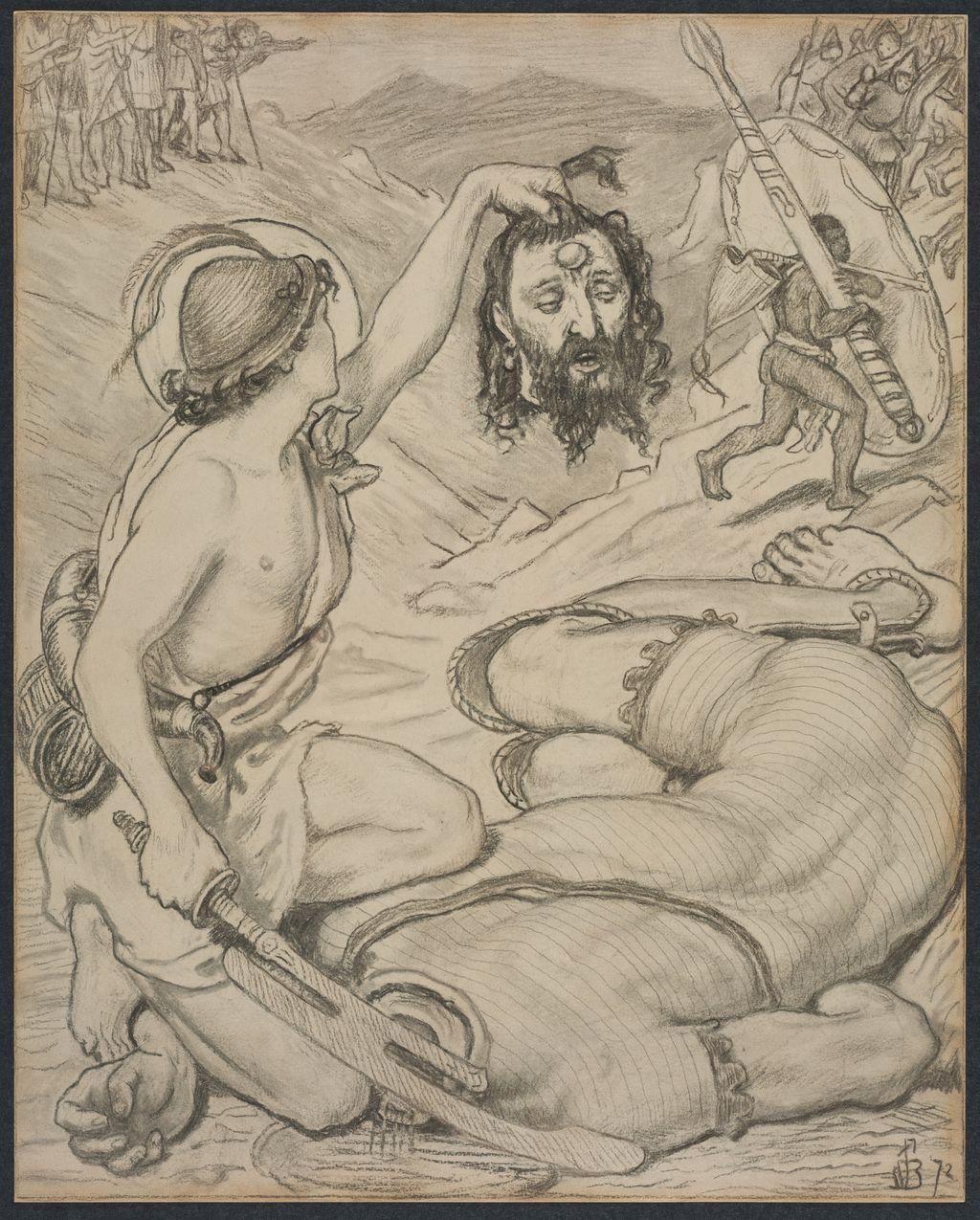
Ford Madox Brown, David and Goliath, cartoon for a stained-glass window at Jesus College, Cambridge, 1872. Charcoal and graphite on Japanese paper, supported by wove paper. Cleveland Museum of Art, 2013.247.
Image source
.
CC0 / Public domain
.
Windows within an Ensemble
Jesus College, Cambridge, dates the glazing of its Outer Chapel to 1867–78 and names Morris, Burne-Jones and Brown as designers. Its account describes a programme of virtues, Old Testament subjects, Evangelists and saints, and emphasises Burne-Jones's contribution. This shared setting does not make every light a Brown design. The College also records the later reuse of designs in new Anglican churches elsewhere, showing how a composition made for one commission could acquire another architectural setting. [6]
Hueffer provides a narrower connection to Brown himself: besides David and Goliath , his list specifies Noli me Tangere and The Incredulity of Thomas for Jesus College in July 1874. A named commission and a named design provide firmer ground than assigning the whole chapel to whichever artist interests us most. [1]
The ensemble also changes how one looks. A figure may be encountered from a distance, beside other figures, through the repeated divisions of the windows. Reading a single cartoon in isolation can clarify its gesture while concealing those relationships. Reading the installed scheme without asking who designed each part can conceal the collaboration.
Watch: Ford Madox Brown
Choose a film exploring the people, stories and visual details in two of Brown’s best-known paintings.
Pre-Raphaelites: Ford Madox Brown – Work
Curator Tim Barringer explores the figures and stories within Work.
Watch on YouTubeKing René: A Programme Shared among Artists
John Pollard Seddon designed King René's Honeymoon Cabinet in 1861 and exhibited it the following year. Writing in The Magazine of Art in 1897, he recalled commissioning the new Morris firm to paint four large panels representing architecture, painting, sculpture and music, with six smaller scenes of associated arts and crafts. Brown suggested the imaginary honeymoon programme: the royal couple would build and decorate a palace and then enjoy music within it. [7]
Brown painted Architecture at the left; Burne-Jones painted the two central scenes, Painting and Sculpture ; Rossetti painted Music at the right. Seddon describes the king considering a plan in Brown's panel, carving and drawing in Burne-Jones's pair, and working an organ's bellows while kissing his queen in Rossetti's scene. His account makes artistic labour and affection parts of the same invented domestic story. [7]
Seddon's family firm made the furniture. Morris designed the large panels' arched surrounds and the decorative backgrounds. Of the smaller panels, the V&A identifies Rossetti's Gardening and Val Prinsep's Embroidery , leaving Pottery , Weaving , Ironwork and Glass Blowing unattributed. Seddon's 1897 assignment of the small scenes other than Gardening to Burne-Jones should therefore be treated as a retrospective claim, rather than the current attribution. [8] [7]
Seen as a whole, the cabinet's long horizontal top holds together four upright pictures. The larger central doors project slightly beyond the outer pair. Patterned borders run around each scene and across the furniture, while the upper shelf supplies another, smaller sequence of pictures. Individual paintings invite close attention, but the repeated ornament keeps returning the eye to the entire structure.
David Kopp's discussion of Seddon's separate 1898 booklet quotes the architect's explanation that this was office furniture for his professional drawings. It also reproduces his account of the inlay and painted metalwork, including William Burges's contribution of the heraldic lion. These details place the famous painted scenes within a working architect's personally designed environment. [9]
Architecture Moves into a Library Window
The V&A's Architecture panel, CIRC.516-1953, names Brown as designer and Morris, Marshall, Faulkner & Co. as maker. It is stained and painted glass from Myles Birket Foster's library at The Hill in Surrey. Its individual record dates it 1862; the cabinet record describes the glass adaptation around 1863. Those differing dates should remain visible rather than be collapsed into a spurious certainty. [10] [8]
The related coloured King René's Honeymoon composition makes the subject easy to recognise. The king's compasses and the drawings at the couple's feet identify architecture, while their inclined heads turn professional discussion into a private exchange. Red clothing forms a strong mass on the left; the queen's pale, patterned dress spreads towards the lower right. A plan lies between the figures and the viewer.
Moving that invention from a cupboard door to a window changes its physical relationship to a room. The design can remain recognisable without the finished object being interchangeable with its predecessor. Brown's contribution is the pictorial invention; the maker's work and the new setting give it another material existence.

Ford Madox Brown, Architecture, known as King René’s Honeymoon. A coloured version of the composition related to the cabinet panel and glass adaptation.
Tiles, Books and the Life of a Design
Hueffer's list places tile designs among the earliest work for the firm: Lady with Hawk , Cutting Trees Down , Sowing and Sheep-shearing appear under 1862. Their inclusion in an appendix nominally about stained glass is revealing. The account records a designer working across several forms of decoration, rather than a career confined to one material. [1]
MacCulloch follows He that Soweth from a November tile design for Queens' College Hall to a Dalziel wood engraving in the 1868 Lyra Germanica . Joseph Swain and Thomas Bolton engraved Brown's other illustrations there. Reuse involved translation by named craftspeople. [2]
This traffic between materials makes “original” a difficult shorthand. The first design, a workshop drawing, a glass panel and an illustration may all preserve an artist's composition while recording different stages and different hands. The fuller histories of the drawings and their printed translations belong with Brown's drawings and prints and illustrations .
Frames as Part of the Work
Brown's involvement could continue around a painting's edge. Lynn Roberts reproduces his letters to James Leathart about the frame for Lear and Cordelia . In January 1863 Brown described combining his own design with Rossetti's pattern; in February he discussed allowing the maker Green to use his patterns more widely. Her account also quotes his July 1864 letter about Oure Ladye of Good Children : Brown had undertaken lettering, designed an angel for repeated circles and involved an assistant in completing the decoration. The letters document adjustment and shared labour, rather than a frame simply selected after the painting was finished. [11]
The National Portrait Gallery supplies a contrasting case. On 2 July 1872 Brown asked Charles Dilke if he could order the frame for the Fawcett double portrait. He proposed a Venetian pattern available from Green & Co., while inviting the patron to express a preference. Jacob Simon identifies the surviving frame as a Watts pattern in gilt pine with composition ornament. Brown's concern for framing could therefore involve choosing a suitable established pattern as well as designing a new one. [12]
These cases suggest a practical way to approach the boundary between painting and decoration. Look at what the frame does to the image: how it establishes an opening, gives the painted surface an edge, carries words or repeats a motif. Then ask who designed it, who made it and whether its present form is documented. An artist's strong involvement does not mean he personally carved, gilded or lettered every part.
 Ford Madox Brown.jpg)
Ford Madox Brown, Henry and Millicent Fawcett, 1872. National Portrait Gallery. Brown took an active role in choosing the portrait’s frame.
Decoration and the Wall
Brown returned to the relationship between images and buildings in his 1893 essay “Of Mural Painting”. He argued that the wall-picture should preserve the sense of a solid wall, rather than seem to open a hole through it. Whatever the limits of his dislike of landscape decoration, the argument shows him considering painting as something physically encountered within architecture. [13]
The same essay insists on subjects intelligible to a broad public. Brown connects the choice of incident with the people who will see it and questions the usefulness of obscure allegory for such an audience. This is his stated position late in life, not proof that every early decorative design followed a single theory. It nevertheless gives a voice to a concern visible across the work: a figure must communicate through its action, even when it belongs to a complex decorative whole. [13]
His Manchester murals develop that architectural relationship at another scale. Windows, cupboard doors, frames and walls each set different conditions. Brown's decorative practice is most rewarding when those conditions remain tangible: a drawing has to become glass, a picture has to share a cabinet, or a painted incident has to hold its place within a public building.
Artworks directory
Explore paintings, drawings, cartoons, illustrations and decorative designs documented in museum collections and specialist research. Distinct versions are listed separately; repeated print impressions are grouped. The coverage includes studies and works without a dedicated article and remains open to further research.
| Name | Date | Medium |
|---|---|---|
| Work (Manchester) | 1852–1865 | Oil on canvas |
| The Last of England (Birmingham) | 1852–1855 | Oil on panel |
| Jesus Washing Peter’s Feet | 1852–1856 | Oil on canvas |
| Pretty Baa-Lambs | 1851–1859 | Oil on panel |
| Take Your Son, Sir | ?1851–1892 | Oil on canvas |
| Lear and Cordelia | 1849–1854 | Oil on canvas |
| Cordelia’s Portion | 1867–1875 | Oil on canvas |
| Walton-on-the-Naze | 1859–1860 | Oil on canvas |
| Chaucer at the Court of Edward III (Tate) | 1856–1868 | Oil on canvas |
| Carrying Corn | 1854–1855 | Oil on mahogany |
| The Hayfield (The Hay Harvest) | 1855–1856 | Oil on mahogany |
| Stages of Cruelty | 1856–1890 | Oil on canvas |
| The Irish Girl | 1860 | Oil on canvas laid on board |
| Romeo and Juliet (Delaware) | 1869–1870 | Oil on canvas |
| The Seeds and Fruit of English Poetry | 1845–1853 | Oil on canvas |
| Self-Portrait | 1877 | Oil on canvas |
| The Bromley Children | Probably 1844 | Oil on canvas |
| The Bromley Family | 1844 | Oil on canvas |
| Byron’s Dream (Manchester) | 1874; worked on into 1875 | Oil on canvas |
| Cartoon for The Baptism of Edwin | 1879–1891 | Pastel, coloured chalks and grey gouache |
| The Coat of Many Colours | 1864–1866 | Oil on canvas |
| The Convalescent (Birmingham) | Dated October 1872 | Pastel |
| Crabtree Watching the Transit of Venus (reduced painting) | 1881–1888 | Tempera on panel |
| Cromwell on His Farm (Lady Lever) | Completed 1874 | Oil on canvas |
| Cromwell Protector of the Vaudois | 1877 | Oil on canvas |
| Dalton Collecting Marsh-Fire Gas (Town Hall mural) | 1886–1887 | Mural on canvas |
| The Establishment of the Flemish Weavers (reduced painting) | 1881; completed 1888 | Tempera on panel |
| The Finding of Don Juan by Haidée (NGV) | 1869–1870; later retouched | Watercolour and gouache over pencil |
| Henry and Millicent Fawcett | 1872 | Oil on canvas |
| Jacob and Joseph’s Coat (Ponce) | c.1868–1871 | Oil on canvas |
| James Leathart | 1863–1864; altered 1869 | Oil on canvas |
| King René’s Honeymoon (Tate watercolour) | 1864 | Graphite, watercolour, gouache and gum arabic on card |
| King René’s Honeymoon Cabinet (collaborative work) | 1861; exhibited 1862 | Oak, inlaid woods, painted panels and metal mounts; Brown designed Architecture |
| Manfred on the Jungfrau | 1841; retouched 1861 | Oil on canvas |
| Millie Smith | 1846 | Oil on paper laid on panel |
| William Michael Rossetti by Lamplight | 1856–1857 | Oil on panel |
| The Traveller (Manchester oil) | 1868–1884 | Oil on panel |
| Waiting: An English Fireside of 1854–55 | 1851–1855 | Oil on panel |
| An English Autumn Afternoon | 1852–1853; finished c.1854 | Oil on canvas |
| Alfred the Great: Sketch of Alfred drawing in the Sand | 1843–1845 | pencil |
| Historical Notes and Sketches of Alfred the Great | 1843–1850 | brown ink writing over pencil |
| Angels watching the Crown of Thorns: Study of clasped Hands | 1846 | black chalk |
| Architecture: Study of Gothic Arches and 14th Century Vaulting | c. 1847 | brown pen and ink over pencil on grey paper |
| The Ascension: Study of Angels and Hands | 1844 | brown pen and ink over pencil |
| The Ascension: Study of a Group of Angels | 1844 | brown pen and ink over pencil |
| The Ascension: Study of a Group of six flying Angels | 1844 | brown pen and ink over pencil |
| The Ascension: Two nude Angels holding onto each other | 1844 | brown brush and ink over pencil |
| The Ascension: Study for a kneeling Apostle | 1844 | black chalk touched with white on brown-toned paper |
| Head of a Child | c. 1844 | black chalk touched with white on brown toned paper |
| The Ascension: Drapery Study of a praying Apostle | 1844 | black chalk |
| The Spirit of Justice: Seated Figure in ecclesiastical Robes, gripping a Staff with left Hand raised in a Blessing | 1844 | black chalk |
| The Ascension: Study for an Apostle | 1844 | black chalk |
| The Spirit of Justice: Body of seated Figure in ecclesiastical Robes holding a Staff and a Book | 1844 | black chalk |
| The Ascension: Study of an Apostle | 1844 | black chalk on toned paper |
| Full-length Sketch of a standing, naked Child | 1844 | black chalk on toned paper |
| The Ascension: Study for Christ | 1844 | brown pen and ink over pencil |
| Caricature: Composite Drawing: A Stunner | 1861–1863 | pencil |
| A Victorian Woman in her Underwear | 1861–1863 | pencil |
| Caricature: Composite Drawing: Bewigged Head | 1861–1863 | pencil |
| Bowed Head of a bearded Man | 1861–1863 | pencil |
| Chaucer at the Court of Edward III: Early compositional Study | 1845 | pencil with brown pen and ink |
| Chaucer at the Court of Edward III: Study for Milton and two Designs for Tombstones | c.1845–c.1846 | pencil with brown frame outline |
| Chaucer at the Court of Edward III: Tracing of the Figure of Milton | c.1845–c.1849 | brown pen and ink with pencil on tracing paper |
| Chaucer at the Court of Edward III: Tracing of a Gothic Arch | c.1845–c.1849 | brown pen and ink with pencil on tracing paper |
| Chaucer at the Court of Edward III: Early compositional Study | 1845 | pencil with brown pen and ink |
| Chaucer at the Court of Edward III: Nude Studies of two Boys | 1845 | pencil, laid down |
| Chaucer at the Court of Edward III: Nude Studies of four Figures | 1845 | pencil |
| Chaucer at the Court of Edward III: Eight early Studies of Figures and Hands | 1845 | pencil |
| Chaucer at the Court of Edward III: Nude Studies for the Figures of Byron, Shakespeare and Burns | 1845 | black chalk |
| Chaucer at the Court of Edward III: Drapery Study for Burns | 1847 | black chalk |
| Chaucer at the Court of Edward III: Study of a right Leg and left Foot for Milton | 1847 | black chalk |
| Chaucer at the Court of Edward III: Study of a left Leg for Shakespeare | 1847 | black chalk |
| Chaucer at the Court of Edward III: Study of Drapery for Milton | 1847 | black chalk |
| Chaucer at the Court of Edward III: Drapery Study for Shakespeare | 1847 | black chalk |
| Chaucer at the Court of Edward III: Study of a Man in a medieval Hood | 1847 | black chalk |
| Chaucer at the Court of Edward III: Study for the Cardinal | 1847 | black chalk |
| Chaucer at the Court of Edward III: Drapery Study in Profile for Courtier | 1847 | black chalk |
| Chaucer at the Court of Edward III: Drapery Study | 1847 | black chalk |
| Chaucer at the Court of Edward III: Female Nude Study of a Muse holding onto a Rail | 1847 | pencil |
| Chaucer at the Court of Edward III: Female Nude: Study of a Muse | 1847 | pencil |
| Chaucer at the Court of Edward III: Nude Study for seated Lady | 1847 | pencil |
| Chaucer at the Court of Edward III: Nude Study of a Woman with right Arm raised | 1847 | pencil |
| Chaucer at the Court of Edward III: Two Studies of Back of a seated Woman's Head | 1847 | pencil |
| Chaucer at the Court of Edward III: Two Studies of a seated Woman in lost Profile Pose and from the Back | 1847 | pencil |
| Chaucer at the Court of Edward III: Nude Study of a Woman | 1847 | pencil |
| Chaucer at the Court of Edward III: Sketch of a Woman supporting another Figure | 1847 | pencil |
| Chaucer at the Court of Edward III: Study of the Heads and Shoulders of two Women | 1847 | pencil |
| Chaucer at the Court of Edward III: Drapery Study for Edward III with Outline of a Child | 1847 | black chalk |
| Chaucer at the Court of Edward III: Foreshortened Study for Head of a Jester | 1847 | pencil |
| Chaucer at the Court of Edward III: Head of Alexander Pope | 1847 | black chalk |
| Chaucer at the Court of Edward III: Two Hand Studies | 1847 | black chalk |
| Chaucer at the Court of Edward III: Study of Head of Milton copied from Sculpture | 1848 | black chalk |
| Chaucer at the Court of Edward III: Nude Studies for the Squire and the Courtier talking to Gower | 1848 | pencil |
| Chaucer at the Court of Edward III: Drapery Study for the Black Prince | 1848 | black chalk with touches of white |
| Chaucer at the Court of Edward III: Three Studies of Hands | 1848 | Black chalk |
| Chaucer at the Court of Edward III: Four Studies of Hands | 1848 | black chalk touched with white |
| Chaucer at the Court of Edward III: Study of a clasped right Hand for one of the Poets | 1848 | black chalk |
| Chaucer at the Court of Edward III: Study of a left Hand for Burns | 1848 | black chalk heightened with touches of white |
| Chaucer at the Court of Edward III: Study of Drapery for Burns | 1848 | black chalk |
| Chaucer at the Court of Edward III: Drapery Study | 1848 | black chalk |
| Chaucer at the Court of Edward III: Drapery Study for the Black Prince | 1851 | black and white chalks on brown-toned paper |
| Chaucer at the Court of Edward III: Study for Squire's Legs | 1851 | black chalk heightened with white |
| Chaucer at the Court of Edward III: Two Head Studies of an old Woman | 1851 | black chalk |
| Costume Study: Five Sketches of Armour and Costume | 1844 | brown pen and ink over pencil |
| Costume Study: Archbishop's Dress | 1845 | brown pen and ink on tracing paper |
| Costume Studies: French and Italian thirteenth and fourteenth-century Costumes (seven Drawings) | 1845 | brown pen and ink on tracing paper |
| Costume Study: Seigneur de Rimini | 1845 | brown pen and ink on tracing paper |
| Dalziels' Bible Gallery: The Death of Eglon | 1863–1865 | engraved woodblock; designed by Brown, engraved by the Dalziel Brothers |
| Dalziels' Bible Gallery: The Death of Eglon | 1881 | wood engraving; designed by Brown, engraved by the Dalziel Brothers |
| Dalziels' Bible Gallery: Elijah and the Widow's Son | 1863–1865 | engraved woodblock; designed by Brown, engraved by the Dalziel Brothers |
| Dalziels' Bible Gallery: Elijah and the Widow's Son | 1881 | wood engraving; designed by Brown, engraved by the Dalziel Brothers |
| Dalziels' Bible Gallery: Joseph’s Coat (Compositional Sketch and four Studies for Jacob's Granddaughter) | 1863–1865 | pencil on paper |
| Dalziels' Bible Gallery: Joseph's Coat | 1863–1865 | engraved woodblock; designed by Brown, engraved by the Dalziel Brothers |
| Dalziels' Bible Gallery: Joseph’s Coat | 1881 | wood engraving; designed by Brown, engraved by the Dalziel Brothers |
| Decorative Sketches: Venus Reclining on a Shell in the Midst of the Sea | 1848–1849 | brown pen and ink over pencil |
| Decorative Design: Ornamental Pattern | 1850 | watercolour and bodycolour over pen and ink, and pencil on two sheets of paper |
| Down Stream: Main Illustration (Last Year's First of May) | 1871 | wood engraving; designed by Brown, print execution by an engraver |
| Down Stream: Tailpiece to the Poem (This Year's First of June) | 1871 | wood engraving; designed by Brown, print execution by an engraver |
| The Establishment of Flemish Weavers in Manchester A.D. 1363: Four Studies of Parts of a Horse | 1879–1882 | black, white and red chalk on rough brown paper |
| Female: Two Studies of young Woman in eighteenth-century Costume | 1849 | pencil |
| Infant's Repast: Study of Mother and Child | 1848 | black and white chalk |
| Infant's Repast: Study of Mother and Child with separate Arm and Leg Studies of the Child | 1848 | black chalk with grey wash |
| King Lear: Sketch of Lear questioning Cordelia | 1844 | brown pen and ink over pencil |
| Alfred the Great: Compositional Sketches | 1843–1845 | pencil |
| King Lear: Sketches of Lear imagining his unfaithful Daughters’ Trial and Lear in the Storm | 1844 | brown pen and ink over pencil |
| Alfred the Great: Compositional Studies and Sketches and Chaucer at the Court of Edward III: Study of Cherubs | 1843–1849 | pencil |
| King Lear: Kent accuses Oswald | 1844 | brown pen and ink with pencil underneath |
| King Lear: Lear recounts his Wrongs to Regan | Undated | Brown pen and ink over pencil |
| King Lear: Cordelia at Lear's Bedside (Lear's Awakening) | 1844 | brown pen and ink over pencil |
| Cordelia Parting from Her Sisters (The Germ) | 1850; reprinted 1901 | Etching; designed by Brown, print execution by an engraver |
| King René's Honeymoon: Study for Architecture | 1861 | brush and brown ink, with watercolour, over pencil on brown paper |
| The Last of England: Cartoon | 1852 | pencil, image edged with brown ink |
| The Last of England: Portrait of Emma Hill | December 1852 | chalks with scratching out on two sheets of paper |
| Lear and Cordelia and The Infant’s Repast: Four Studies of Hands | 1849 | black chalk |
| Lyra Germanica - the Christian Life: Abraham and Isaac | 1868 | wood engraving; designed by Brown, print execution by an engraver |
| Lyra Germanica - the Christian Life: Finished Design for The Entombment | 1867 | black pen and ink |
| Lyra Germanica - the Christian Life: The Entombment | 1868 | wood engraving; designed by Brown, print execution by an engraver |
| Male: Sketch of Man reclining on Steps with Hands bound together | 1844 | brown pen and ink over pencil |
| Male: Academic nude Study, half-length with Moustache and Arms folded | 1846–1849 | black chalk |
| Male: Academic Study of Nude holding a Staff | 1847 | pencil |
| Male: Academic Study of Nude posed as a Sculptor | 1847 | chalk with grey wash |
| Male: Academic Study, three-quarter length Nude, with a Moustache and clenched Fists | 1847 | black chalk |
| Oure Ladye of Saturday Night: Seven Sketches | 1846 | pencil |
| Oure Ladye of Saturday Night: Four Studies for Angel holding Child | 1847 | pencil |
| Oure Ladye of Saturday Night: Study of Angel holding Child | 1847 | black chalk |
| Oure Ladye of Saturday Night: Study of Arm and Hands for Angel holding Bowl of Water | 1847 | black chalk |
| Oure Ladye of Saturday Night: Drapery Study for Angel holding Bowl of Water | 1847 | black chalk |
| Oure Ladye of Saturday Night: Study of Head for Angel holding Bowl of Water | 1847 | black chalk with rubbing and grey wash |
| Oure Ladye of Saturday Night: Study of Child seated on Knees of the Virgin and two separate Studies of the Child's Legs | 1847 | pencil on brown-toned paper |
| Oure Ladye of Saturday Night: Frieze Design | c. 1847 | pencil and black pen and ink |
| Oure Ladye of Saturday Night: Three Studies of Arms and Legs of Child | 1847 | pencil |
| Oure Ladye of Saturday Night: Three Studies of Child's Legs on Virgin's Knees | 1847 | pencil |
| Oure Ladye of Saturday Night: Studies of Right Foot and Left Hand of Child | 1847 | pencil on light brown paper |
| Oure Ladye of Saturday Night: Drapery Study for Virgin | 1847 | black chalk |
| Oure Ladye of Saturday Night: Study for Head of Virgin | 1847 | black chalk with wash |
| Parisina’s Sleep: Study for Prince Azo and Parisina | 1842 | black chalk with pencil side drawing |
| Parisina's Sleep: Study for Head of Prince Azo | 1842 | black chalk with grey wash |
| Parisina's Sleep: Study for the Head of Parisina | 1842 | black and white chalk with grey wash |
| Poets of the Nineteenth Century: The Prisoner of Chillon: Compositional Sketch | 1856 | pencil |
| Profile of a Man's left Eye and Nose | c.1856 | pencil |
| Poets of the Nineteenth Century: The Prisoner of Chillon: Study of a Corpse | 1856 | pencil |
| Designs for Decoration | c.1856 | pencil |
| Poets of the Nineteenth Century: The Prisoner of Chillon | 1857 | wood engraving; designed by Brown, print execution by an engraver |
| Portrait: Head Study of Daniel Casey (three-quarter view) | 1848 | black chalk |
| Portrait: Head Study of Daniel Casey (full-face) | 1848 | black chalk |
| Portrait: Miss Iza Duffus Hardy | 1872 | pastel and coloured chalks on brown paper |
| Portrait: Emma Hill (later Mrs Madox Brown) | 1848 | black chalk |
| Portrait: Emma Hill (later Mrs Madox Brown) | 1852 | pencil |
| Portrait: Mrs Madox Brown (neé Emma Hill) | 9 May 1854 | pencil |
| The Repose in Egypt: Compositional Sketch | 1847 | pencil |
| Study of a Statue of the Discobolus | 1845 | Black chalk |
| William Shakespeare: Study | 1849–1850 | pencil |
| William Shakespeare: Invitation Card | 1850 | wood engraving; designed by Brown, print execution by an engraver |
| The Spirit of Justice: Study for Baron and his Advisor, with Sketches of Erudition and Wisdom | 1844–1845 | brown pen and ink over pencil |
| The Spirit of Justice: Drapery Study for Erudition | 1844–1845 | black chalk |
| Drapery Study and Sketch of Two Legs | Undated | Black chalk |
| The Spirit of Justice: Study for Wisdom | 1844–1845 | black chalk with grey wash |
| The Spirit of Justice: Study for Head of the Baron | 1844–1845 | black chalk |
| The Spirit of Justice: Study for the Head of central Bishop | 1844–1845 | black chalk |
| The Spirit of Justice: Study for the Head of a Bishop | 1844–1845 | black chalk with grey wash |
| The Spirit of Justice: Study for the uplifted left Arm of Justice | 1844–1845 | black chalk |
| The Spirit of Justice: Study for Head of Counsellor in a Coronet | 1844–1845 | black chalk with touches of blue chalk |
| The Spirit of Justice: Study for Head of Counsellor | 1844–1845 | black chalk |
| The Spirit of Justice: Drapery Study for the Central Bishop | 1844–1845 | Black chalk |
| Part of a Drapery Study | 1844–1845 | black chalk |
| The Spirit of Justice: Study for Head of Widow | 1844–1845 | black chalk |
| Stages of Cruelty: Study for the Child (Catherine Madox Brown) | 1857 | black chalk on pale grey paper |
| Stained Glass Design: Cartoon for Zachariah, The High Priest | 1872 | black chalk |
| Stained Glass Design: Cartoon for The Young Milton | 1874 | black chalk |
| Stained Glass Design: Cartoon for St Simon | 1874 | black chalk |
| Sterne's 'Sentimental Journey': Study for Yorick and La Fleur talking to Maria’s Mother | 1842 | brown pen and ink over pencil |
| The Body of Harold brought before William the Conqueror: Eight Sketches of Figure Groups | c.1844 | pencil |
| Sterne's 'Sentimental Journey' : Yorick (Laurence Sterne) and Maria Walking | 1842 | pen and ink, watercolour and bodycolour over pencil |
| Study of Tree Trunk with Roots | c.1847 | black chalk, heightened with white chalk on buff paper |
| Two Studies of Tree Trunks | c.1846 | black chalk |
| Unknown Subject: Compositional Sketch | 1843–1850 | pencil |
| Wycliffe reading his Translation of the Bible: Nude Study for Chaucer | 1847 | pencil |
| Wycliffe reading his Translation of the Bible: Study for Chaucer | 1847 | pencil |
| Wycliffe reading his Translation of the Bible: Nude Study of Gower | 1847 | pencil |
| Wycliffe reading his Translation of the Bible: Study for Gower | 1847 | pencil |
| Wycliffe reading his Translation of the Bible: Nude Study for John of Gaunt and Chaucer's right Hand | 1847 | pencil and black chalk |
| Wycliffe reading his Translation of the Bible: Study of John of Gaunt and Chaucer's Left Hand | 1847 | pencil and black chalk |
| Wycliffe reading his Translation of the Bible: Study for Wycliffe | 1847 | black chalk |
| Wycliffe reading his Translation of the Bible: Nude Study for Wycliffe | 1847 | pencil |
| Wycliffe reading his Translation of the Bible: Drapery Study for Wycliffe | 1847 | black chalk |
| Wycliffe reading his Translation of the Bible: Drapery Study for Chaucer | 1848 | black chalk |
| Wycliffe reading his Translation of the Bible: Study of Legs for John of Gaunt and two Studies of Feet for Wycliffe | 1848 | black chalk |
| Wycliffe Reading his Translation of the Bible: Studies of Hands for John of Gaunt and Gower | 1847 | black chalk |
| Wycliffe reading his Translation of the Bible: Study for Head of Wycliffe | 1847 | pencil |
| Wycliffe reading his Translation of the Bible: Study for Constance and Child | 1847 | pencil |
| Wycliffe reading his Translation of the Bible: Unfinished Study for Head of Constance | 1847–48 | pencil |
| Wycliffe reading his Translation of the Bible: Portrait of Elizabeth Bamford modelling for Constance | 1848 | pencil |
| Wycliffe reading his Translation of the Bible: Study for Head of Constance | 1848 | chalk over pencil |
| Wycliffe reading his Translation of the Bible: Study for Head of Chaucer | 1848 | pencil |
| Wycliffe reading his Translation of the Bible: Study of Monk representing the Catholic Faith | 1848 | black chalk with brown pen and ink, squared up |
| Wycliffe reading his Translation of the Bible: Study of young Woman representing the Protestant Faith | 1848 | black chalk |
| Cathy Madox Brown at the Age of Three (Tate N01356) | 1853 | Graphite on paper |
| King René‘s Honeymoon (Tate N02409) | date not known | Ink on paper |
| Sheepshearing (Tate N02410) | c.1887 | Ink and graphite on paper |
| Studies for ‘Work’ (Tate N02411) | 1855 | Graphite and ink on paper |
| Design for Badge for Gillum’s Homes (Tate N02412) | date not known | Ink and graphite on paper |
| Arkwright’s Mill (Tate N02413) | 1878 | Graphite on paper |
| Study for ‘John Kay’ (Tate N02414) | 1889 | Graphite on paper |
| Study for ‘Southend’ (Tate N02415) | date not known | Graphite on paper |
| ‘Where are you going, my pretty maid?’ (Tate N02416) | date not known | Graphite on paper |
| Section of the Bridgewater Canal (Tate N02417) | 1890 | Ink on paper |
| A Barge on the Bridgewater Canal (Tate N02418) | 1890 | Graphite on paper |
| Study of the Tow-Path on the Bridgewater Canal (Tate N02419) | 1890 | Graphite on paper |
| Our Lady of Good Children (Tate N02684) | 1847–61 | Pastel, watercolour and gold paint on paper |
| Arkwright’s Mill (Tate N02791) | 1881 | Graphite on paper |
| The Bridgewater Canal (Tate N02792) | 1890 | Ink on paper |
| The Bridgewater Canal (Tate N02793) | date not known | Chalk and graphite on paper |
| The Last of England (Tate N03064) | 1864–6 | Watercolour on paper |
| Mauvais Sujet (Tate N03228) | 1863 | Watercolour on paper |
| Study of a Man Painting (Tate N03472) | 1839 | Graphite on paper |
| The Brent at Hendon (Tate N03528) | 1854–5 | Oil paint on board on mahogany |
| Study for the Dean in the ‘Execution of Mary Queen of Scots’ (Tate N04280) | c.1840 | Oil paint on paper |
| Sketch for ‘Jesus Washing Peter’s Feet’ (Tate N04281) | 1852 | Graphite on paper |
| Sketch for ‘Cromwell on his Farm’ (Tate N04282) | c.1853 | Graphite on paper |
| The Coat of Many Colours (Tate N04584) | 1867 | Watercolour and gouache on paper |
| Stages of Cruelty (Tate N04625) | c.1856 | Watercolour on paper |
| Head of a Girl (Tate N04803) | date not known | Oil paint on paper |
| Portrait of Dykes Barry as a Child (Tate N04866) | 1853 | Oil paint on mahogany |
| Jesus Washing Peter’s Feet (Tate N05301) | 1857–8 | Watercolour on paper |
| Platt Lane (Tate N05383) | 1884 | Oil paint on canvas |
| Study of F.G. Stephens for ‘Jesus Washing Peter’s Feet’. Verso: A Head Crowned with Laurels (Tate T00571) | 1852 | Graphite on paper. Verso: graphite on paper |
| Sketch for ‘Jesus Washing Peter’s Feet’ (Tate T01035) | c.1851 | Ink and graphite on paper |
| Chaucer at the Court of Edward III (Sydney) | 1845–1851 | Oil on canvas |
| Wycliffe Reading His Translation of the Bible to John of Gaunt (Bradford) | 1848 | Oil on canvas |
| Work (Birmingham replica) | 1859–1863 | Oil on canvas |
| The Spirit of Justice (Book of Art reproduction) | Published 1846 | Wood engraving after Brown’s cartoon; engraver unknown |
| The Execution of Mary Queen of Scots | 1840–1842 | Oil on canvas |
| The Prisoner of Chillon (Manchester oil) | 1843 | Oil on canvas |
| The Parting of Cordelia from Her Sisters (oil) | 1853 | Oil on canvas |
| Cordelia’s Portion (Lady Lever) | 1866–1872 | Watercolour, gouache and pastel |
| The Ascension | 1844–1845 | Oil on canvas |
| Manfred in the Chamois Hunter’s Hut (oil sketch) | 1840 | Oil on canvas |
| Dr Primrose and His Daughters (The Vicar of Wakefield) | 1840–1841 | Oil on canvas |
| The Body of Harold Brought before William the Conqueror | 1844–1861 | Oil on canvas |
| The Seeds and Fruits of English Poetry (Bedford cartoon) | 1845 | Black chalk on paper |
| Wycliffe Reading His Translation of the Bible (oil sketch) | 1847–1848 | Oil on board |
| Cromwell Discussing the Protection of the Vaudois (Nottingham) | 1877–1878 | Oil on canvas |
| Two Drawings of Men in Hoods | c.1845 | Pencil on paper |
| The Seeds and Fruits of English Poetry: Study of the Right Side | c.1845 | Brown pen and ink with pencil |
| Chaucer: A Man in a Hood with a Liripipe and Two Drapery Studies | 1848 | Oil on canvas |
| The Prisoner of Chillon Entreating His Jailors (Yale watercolour) | 1858 | Watercolour heightened with bodycolour |
| Elijah and the Widow’s Son (Birmingham oil) | 1864 | Oil on panel |
| He That Soweth (Lyra Germanica) | Published 1868 | Wood engraving by the Dalziel Brothers after Brown |
| The Entombment (NGV) | 1871–1878 | Watercolour, gouache, gold paint and gum arabic over pencil |
| The Sower (Morris firm tile) | c.1864–1873 | Tile; design by Brown, workshop execution |
| Childe Harold’s Pilgrimage (Byron illustration) | Published 1870 | Steel engraving by Herbert Bourne after Brown |
| The Two Foscari (Byron illustration) | Published 1870 | Steel engraving by Herbert Bourne after Brown |
| The Corsair (Byron illustration) | Published 1870 | Steel engraving by Herbert Bourne after Brown |
| Sardanapalus (Byron illustration) | Published 1870 | Steel engraving by Herbert Bourne after Brown |
| Don Juan (Byron illustration) | Published 1870 | Steel engraving by Herbert Bourne after Brown |
| Byron’s Dream (roundel title-page design) | Published 1870 | Steel engraving by Herbert Bourne after Brown |
| The Finding of Don Juan by Haidée (Birmingham oil) | 1870–1873 | Oil on canvas |
| The Dream of Sardanapalus (Delaware) | 1871–1872 | Watercolour on paper |
| The Traveller (Once a Week) | Published 1869 | Wood engraving by Joseph Swain after Brown |
| The Infant’s Repast | 1848 | Oil on board |
| Oliver Madox Brown Aged Four (Dwale Bluth frontispiece) | Published 1876 | Etching |
| Oliver Madox Brown as a Young Man (Dwale Bluth frontispiece) | Published 1876 | Etching |
| A Beggar and Other Fantasies: Title-page Illustration | Published 1889 | Photo-engraving after Brown |
| Dramas in Miniature: Title-page Illustration | Published 1891 | Photo-engraving after Brown |
| The Brown Owl: Frontispiece | Published 1892 | Photo-engraving after Brown |
| The Brown Owl: Central Illustration | Published 1892 | Photo-engraving after Brown |
| The Feather: Frontispiece | Published 1892 | Photo-engraving after Brown |
| The Ascension: Study for Christ | 1844 | Pen and ink |
| King Lear: Lear Questions Cordelia (Whitworth) | 1844 | Pencil, pen and brown ink |
| King Lear: France Claims the Dispossessed Cordelia (Whitworth) | 1844 | Pencil, pen and brown ink |
| King Lear: Cordelia Parts from Her Sisters (Whitworth) | 1844 | Pencil, pen and brown ink |
| King Lear: Goneril and Regan Together (Whitworth) | 1844 | Pencil, pen and brown ink |
| King Lear: Goneril Tells Oswald How to Treat Lear (Whitworth) | 1844 | Pencil, pen and brown ink |
| King Lear: Oswald’s Insolence to Lear (Whitworth) | 1844 | Pencil, pen and brown ink |
| King Lear: Lear Rebukes Oswald (Whitworth) | 1844 | Pencil, pen and brown ink |
| King Lear: Kent Trips Oswald (Whitworth) | 1844 | Pencil, pen and brown ink |
| King Lear: Goneril’s Complaint to Lear (Whitworth) | 1844 | Pencil, pen and brown ink |
| King Lear: Lear Curses Goneril’s Infidelity (Whitworth) | 1844 | Pencil, pen and brown ink |
| King Lear: Kent Challenges Oswald (Whitworth) | 1844 | Pencil, pen and brown ink |
| King Lear: Kent in the Stocks (Whitworth) | 1844 | Pencil, pen and brown ink |
| King Lear: Lear Recounts His Wrongs to Regan (Whitworth) | 1844 | Pencil, pen and brown ink |
| King Lear: Lear Parts from Regan and Goneril (Whitworth) | 1844 | Pencil, pen and brown ink |
| King Lear: Lear and the Fool in the Storm (Whitworth) | 1844 | Pencil, pen and brown ink |
| King Lear: Lear Mad on the Beach at Dover (Whitworth) | 1844 | Pencil, pen and brown ink |
| King Lear: Alternative Study: Lear Curses Goneril (Whitworth) | 1844 | Pencil, pen and brown ink |
| King Lear: Lear Imagines His Daughters’ Trial (Whitworth) | 1844 | Pencil |
| King Lear: Alternative Study: Lear in the Storm (Whitworth) | 1844 | Pencil, pen and brown ink |
| The Last of England (Fitzwilliam) | 1860 | Oil on canvas |
| The Convalescent (Metropolitan Museum) | Dated 1872 | Pastel |
| Self-Portrait (Walker drawing) | 1850; retouched 1853 | Black chalk |
| Byron’s Dream (Whitworth) | 1889 | Watercolour over graphite |
| Cordelia Parting from Her Sisters (Cleveland sketch) | 1854 | Pen and oil on paper mounted on panel |
| David and Goliath: Cartoon for Stained Glass Window at Jesus College, Cambridge | 1872 | Charcoal and graphite on Japanese paper |
| The Virgin Swooning (recto) | 1844 | Black chalk on laid paper |
| Two Drapery Studies (verso) | c.1844 | Black chalk |
| Architecture: King René’s Honeymoon (stained glass) | 1862 | Stained glass; designed by Brown, made by Morris, Marshall, Faulkner & Co. |
| The Romans Building a Fort at Mancenion (Town Hall mural) | 1880 | Spirit fresco |
| The Baptism of Edwin (Town Hall mural) | 1879–1880 | Spirit fresco |
| The Expulsion of the Danes (Town Hall mural) | 1880–1881 | Spirit fresco |
| The Establishment of the Flemish Weavers (Town Hall mural) | 1881–1882 | Spirit fresco |
| Crabtree Watching the Transit of Venus (Town Hall mural) | 1882–1883 | Spirit fresco |
| The Proclamation Regarding Weights and Measures (Town Hall mural) | 1883–1884 | Spirit fresco |
| Wycliffe on Trial (Town Hall mural) | 1885–1886 | Spirit fresco |
| Chetham’s Life’s Dream (Town Hall mural) | 1885–1886 | Mural on canvas |
| Bradshaw’s Defence of Manchester (Town Hall mural) | 1892–1893 | Mural on canvas |
| John Kay, Inventor of the Fly Shuttle (Town Hall mural) | 1888–1890 | Mural on canvas |
| The Opening of the Bridgewater Canal (Town Hall mural) | 1891–1892 | Mural on canvas |
Frequently Asked Questions
The V&A credits him as designer of Architecture and the Morris firm as its maker. Those are distinct roles. [10]
No. Hueffer's catalogue includes secular figures such as Homer, Newton and Aristotle alongside biblical subjects and saints. [1]
Discussion
Look again at the images and ideas explored in Ford Madox Brown’s Stained Glass and Decorative Arts. These editorial prompts invite your observations.
Reader Insights
Consider the King René scene as a picture on a cupboard, a coloured composition on paper and a window in a library. Which relationships survive the change of material? Which depend on the surrounding object or room?
Choose one decorated object and distinguish the person who devised its structure, the artist who designed its figures and the makers who carried out the work. How does naming those contributions change what you notice?
Compare the edge of a glass light, a cupboard door and a framed painting. Each supplies a limit for a figure or story. How does that boundary help the image communicate, and when does it become part of the subject?
Join the Conversation
Share a detail, comparison or question about Ford Madox Brown’s Stained Glass and Decorative Arts below.
References
- Ford Madox Hueffer , Ford Madox Brown: A Record of His Life and Work (1896), pp.161–162, 177–178, 416–419 and Appendix C, pp.445–447: furniture, partnership, design practice and incomplete account-derived list of designs executed by Morris & Co. View source .
- Laura MacCulloch , Ford Madox Brown: Works on Paper and Archive Material at Birmingham Museums and Art Gallery , PhD thesis (2009), vol.I, pp.174–179 and 284–287, catalogue nos.144–150; illustrations separately inspected in vol.II, PDF pp.138–141. View illustrations View source 1 . View source 2 .
- Furniture History Society , British and Irish Furniture Makers Online, “Morris, Marshall, Faulkner & Co., later Morris & Co. (1861–1944)”, Brown and Webb furniture sections; qualified chair attributions. View source .
- Ford Madox Brown , “On the Mechanism of a Historical Picture: Part I. The Design”, The Germ (1850), pp.70–73, in the digitised 1901 reprint. View source .
- Cleveland Museum of Art , David and Goliath, Cartoon for Stained Glass Window at Jesus College, Cambridge (1872), 2013.247; object record and reproduction. View source .
- Jesus College, Cambridge , “Stained glass”, institutional account of the Outer Chapel's glazing and reuse of designs. View source .
- John P. Seddon , “The ‘King René's Honeymoon’ Cabinet”, The Magazine of Art , vol.20 (1897), pp.323–324; original two-page article. View source .
- Victoria and Albert Museum , King René's Honeymoon Cabinet , W.10:1 to 28-1927, collection record O78937; maker roles, current panel attributions and glass adaptation. View source .
- David Kopp , “J. P. Seddon's 1898 Homage to the Artists Behind the Decoration of King René's Honeymoon Cabinet”, Useful and Beautiful , Summer 2020, pp.17–18, quoting the separate 1898 booklet. View source .
- Victoria and Albert Museum , Architecture , also titled King René's Honeymoon , CIRC.516-1953, collection record O11163; designer, maker, materials, date and library setting. View source .
- Lynn Roberts , “What artists, critics & collectors say about frames: Part 2”, The Frame Blog , 1 September 2013; Brown's letters to Leathart of 16 January and 8 February 1863 and 12 July 1864, quoted in the article. View source .
- National Portrait Gallery / Jacob Simon , Henry Fawcett; Dame Millicent Fawcett , NPG 1603, frame entry, including Brown's letter to Dilke of 2 July 1872. View source .
- Ford Madox Brown , “Of Mural Painting”, Arts and Crafts Essays (1893), complete essay. View source .
- Laura MacCulloch, Ford Madox Brown: Works on Paper and Archive Material at Birmingham Museums and Art Gallery, 2009, volumeI; catalogue entries. View source.
- Laura MacCulloch, Ford Madox Brown: Works on Paper and Archive Material at Birmingham Museums and Art Gallery, 2009, volumeII; illustration lists, pp1–24. View source.
- Tate, official historical collection dataset; Ford Madox Brown accession records. View source.
- Ford Madox Hueffer, Ford Madox Brown: A Record of His Life and Work, 1896; selected career, object and mural passages. View source.
- Fitzwilliam Museum, The Last of England, M.Add.3. View source.
- Metropolitan Museum of Art, The Convalescent, 10.46. View source.
- Carol Blackett-Ord / National Portrait Gallery, Ford Madox Brown: all known portraits. View source.
- The Whitworth / Art UK, Byron’s Dream, 1889 watercolour. View source.
- Cleveland Museum of Art, Cordelia Parting from Her Sisters, 2013.261. View source.
- National Gallery of Art, The Virgin Swooning, recto, 1987.73.1.a. View source.
- National Gallery of Art, Two Drapery Studies, verso, object70237. View source.
- Manchester City Council, The Ford Madox Brown Murals; cycle and individual scenes. View source.
- Splash image, King René’s Honeymoon Cabinet, designed by John Pollard Seddon in 1861, made by his family firm, with painted decoration by several artists of Morris, Marshall, Faulkner & Co. Brown painted Architecture.


