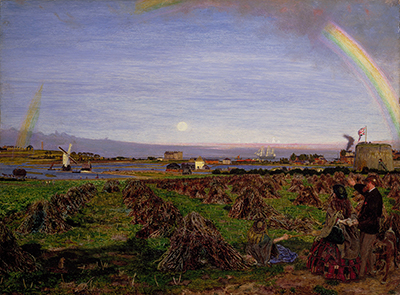
 by
Tom Gurney
Tom Gurney BSc (Hons) is an art history expert with over 20 years experience
Email:
tomgurney1@gmail.com
/ Phone:
+44 7429 011000
Ford Madox Brown’s Style and Technique: Introduction
A figure in a Ford Madox Brown painting can seem caught in the middle of an involuntary movement: Peter draws back from Christ, a labourer twists with his shovel, a child reaches towards an animal. Yet Brown’s advice to painters begins long before the model sits down. Research, imagined action, colour planning and rehearsal all help determine what the spectator will eventually see. In his 1850 essay on designing a historical picture, observation belongs within a deliberately constructed whole. [1]
That relationship between invention and looking runs through Brown’s art . It accommodates the theatrical energy of his literary scenes, the brightness of his outdoor pictures and the organised crowds of his public decorations. His practice changed with the subject and material. A small landscape painted on wood, an extensively revised canvas and a picture attached to a town-hall wall pose different problems; their vivid surfaces do not reveal a single recipe.
At a Glance
- Design Brown recommended researching the setting, imagining the action and planning colour and light before fixing the drawing. [1]
- Gesture acting before a mirror helped him test poses; studies from models developed their bodily and clothed appearance. [1]
- Light he organised different working conditions for sunlight, cold overcast weather and twilight. [2] [3]
- Revision his June 1856 diary describes cutting painted legs out of an already lined canvas while altering Jesus Washing Peter’s Feet . [2]
- Public decoration seven Manchester murals were painted on the walls in spirit fresco; the final five were painted on canvas. [4] [5]
Contents
- A Style That Kept Changing
- Research Before the First Fixed Design
- Acting, Drawing and the Living Model
- Organising the Light Outdoors
- Materials and Revision: The Evidence of Particular Pictures
- Frames as Part of the Picture
- Designing for Glass and Walls
A Style That Kept Changing
Brown’s education began on the Continent, at Bruges and Ghent and subsequently under Gustaf Wappers in Antwerp. Paris brought sustained study in the Louvre. Recalling his early painting Parisina’s Sleep in 1865, Brown located its style in Spanish painting and Rembrandt, while distancing himself from both his Belgian teaching and the Paris ateliers. His later account was selective and argumentative, but it establishes that the dark early pictures emerged from choices among different traditions. [2]
The contrast with his mature outdoor pictures is striking. In Manfred on the Jungfrau , the red-clad protagonist advances into an open space above the snow, while the hunter reaches towards him from the side. Cloth, arms and sloping ground combine into an urgent diagonal action. Brown described the original conception as an early attempt at outdoor light, but also admitted that glaciers had not been part of his studies. He further warned that retouching in 1861 had obliterated the original colour scheme of this youthful work. The surviving painting cannot simply be read as an untouched sample of his earliest palette. [2]
His interest in older art also extended beyond dark tones and dramatic contrast. Writing to George Rae in January 1865 about his Italian journey, Brown recalled the wall paintings of Giotto , Masaccio and Fra Angelico among the works that had stayed most strongly in his memory. He also named Holbein, Leonardo, Raphael, Michelangelo and Titian. This retrospective list records a broad visual education; it does not identify one master as the explanation for every subsequent change. [2]
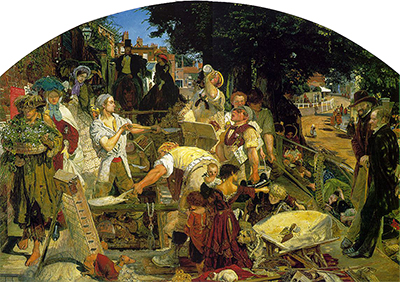
Compare the enclosed, costumed society of Chaucer at the Court of Edward III with the contemporary street of Work . In both, a principal activity gathers people whose bodies turn in different directions and whose attention is uneven. The modern subject brings digging, carrying and selling into the place occupied elsewhere by poetry or a historical encounter. The brighter street setting changes the visual language, while the problem of making a group readable persists.
Brown’s development is consequently easier to follow through recurring problems than through a sequence of sealed periods. Dramatic action continues into domestic subjects; concentrated observation serves imagined historical scenes; an old design can acquire a new surface. The paintings guide follows those comparisons across individual works.
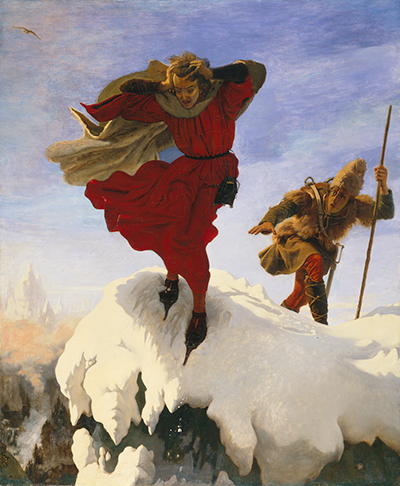
Ford Madox Brown, Manfred on the Jungfrau, conceived in 1840 and substantially repainted in 1861. Its surviving colour is not an untouched record of the early conception.
Research Before the First Fixed Design
Brown’s On the Mechanism of a Historical Picture , published in The Germ in 1850, addresses the beginner preparing a first picture. He allows other artists to follow different successful methods. His own sequence starts with understanding the period and people represented, then consulting evidence for costume, architecture, furniture, vegetation and landscape. These are decisions that can change the composition itself. A garment may prevent a gesture; an authentic piece of furniture may occupy space already promised to a figure. [1]
The practical danger, he explains, is becoming attached to an arrangement before learning whether it can work. Research must therefore precede that attachment. It is difficult to erase an idea that has already taken possession of the mind. His historical accuracy is inseparable from the effort to make an action credible. [1]
With the materials assembled, the artist should imagine the picture before reaching for paper. Brown asks for prominence to be given to the important actors and for incidents requiring a verbal explanation to be rejected. A historical painting must make its central event legible through bodies and their relations. His term “pantomimic art” makes that demand unusually clear. [1]
He divides the conception into interdependent concerns: the story’s dramatic truth and feeling; the arrangement of figures and lines; and the disposition of colour, light and dark. Colour enters at this early stage. In a footnote he questions the practice of designing entirely in outline and postponing the colour scheme, doubting whether it can then be arranged satisfactorily. The finished brightness of a Brown painting should be considered alongside the distribution of its strongest and quietest passages. [1]
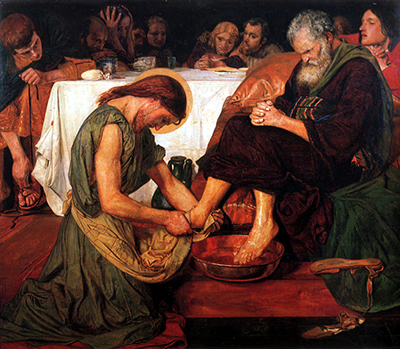
The white tablecloth in Jesus Washing Peter’s Feet offers a useful visual example. It stretches across the background behind the inclined figures, while dark heads collect above it. Christ’s lowered head and Peter’s hands occupy different positions within this structure. Local detail is held together by large relationships that remain apparent when the reproduction is viewed from a distance.
Acting, Drawing and the Living Model
The next stage in Brown’s essay is bodily rehearsal. With pencil and paper, the painter should sketch the figures separately while studying his own acting in a mirror, or that of a sympathetic friend. Brown thinks an unresponsive professional model can inhibit a first conception by making a possible action appear impossible. Only after the action has been discovered should the artist seek models close to the imagined characters. [1]
He asks the painter to work through each figure down to the fingers, the bending of a joint and the tension of a sinew, while avoiding exaggerated expression. Gesture needs both physical accuracy and a dramatic purpose. The distinction is visible in Jesus Washing Peter’s Feet : Peter’s joined hands and Christ’s hands enclosing the foot are separate kinds of contact. One gathers inward; the other reaches out to perform a task.
A later diary entry shows the mirror becoming a piece of working equipment. On 20 July 1856, while developing the lovers in Stages of Cruelty , Brown recorded designing them from himself and his daughter Lucy in a glass, with Lucy on top of the piano. This improvised arrangement made the unequal height of the figures testable in the room. It was one stage in constructing the scene, rather than evidence that the painted relationship describes the models’ lives. [2]
In the 1850 sequence, an oil sketch of the whole follows the determination of the actions. Studies from living models then investigate each figure nude and clothed. Brown recognises the practical awkwardness of costume: borrowed clothes may be needed briefly for a study and again months later for painting, while expensive material may be represented by only the portion visible, pinned to a lay figure. Loose drapery, however, should first be studied on a living body. [1]
Laura MacCulloch’s catalogue makes the different tasks tangible. The Chaucer material includes an early compositional study, separate hand studies and a black-chalk drapery study for the Black Prince, heightened with white. Her account of the Last of England cartoon identifies changes between drawing and painting, including the shawl and the surrounding passengers. A study of Emma’s head uses chalks with scratching out on two sheets. These are distinct objects made to solve different problems, rather than interchangeable examples of “preparatory drawing.” [6]
The final outline design in Brown’s essay establishes the figures’ sizes and places, the ground plan and architectural perspective. For a small painting, he recommends a full-size drawing that can be traced onto the canvas; for a large one, a smaller outline enlarged through squaring. Transfer carries a resolved arrangement into another material and scale. It does not remove the possibility of subsequent alteration. [1]
His closing advice is to continue adjusting a design while any figure, group or line could be placed better, subject to truth to nature. He calls the larger aim “constructive beauty”: a cultivated feeling for proportion which avoids both arbitrary symmetry and passive copying. The drawings guide explores the surviving works on paper in more detail. [1]
Organising the Light Outdoors
Outdoor observation also required construction. Brown’s retrospective diary account, resumed on 16 August 1854, describes Pretty Baa-Lambs as painted almost entirely in sunlight. Emma and Cathy modelled for the main group; a lay figure went out into the garden each morning and came indoors at night or when it rained. Sheep and lambs arrived from Clapham Common, where Brown painted the background. The apparently unified scene brought together repeated sessions and different locations. [3]
In the Birmingham picture, the white of the child’s clothes makes the folds conspicuous, while the patterned blue dress holds smaller variations of light. The sheep’s fleece offers another pale surface, broken into short textures. Grass, human skin, fabric and wool register the same illumination through different shapes. The low boundary of the distant landscape leaves the standing pair exposed against a broad sky.
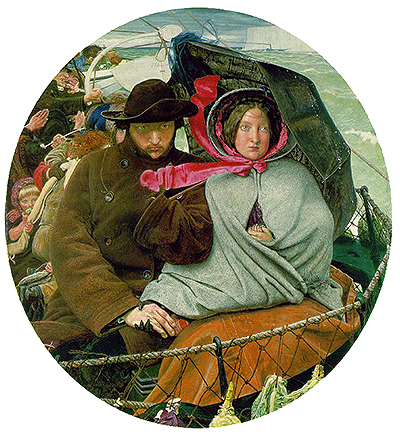
For The Last of England , Brown sought a quite different effect. His 1865 explanation describes the appearance of objects surrounded by light on a dull day at sea. He worked largely outdoors in overcast conditions and painted the flesh on cold days. In his diary for 2 September 1855, he welcomed weather that made his own hand look blue, because that was what the picture required. A particular colour depended on the physical situation of the model. [2] [3]
These sessions did not reproduce the shipboard scene in front of him. They supplied observations for an invented arrangement. The bowed heads, umbrella, bonnet ribbons and linked hands give the couple a compact structure within the oval. Observation provided the character of the light; design organised the pressures of the departure.
Brown’s account of The Hayfield is equally specific. Rain had delayed the second hay crop at Hendon, intensifying the contrast between green grass and brown hay. In twilight the hay appeared positively red or pink. The colour belongs to a relationship among neighbouring surfaces under changing illumination. [2]
The small scale of some landscapes is part of their physical character. Tate’s historical collection records describe The Hayfield , dated 1855–1856, and Carrying Corn , dated 1854–1855, as oil paintings on mahogany. Carrying Corn measures only 197 × 276 mm. [7] Its expanse of blue sky makes the distant yellow stacks and deeply green foreground feel emphatic even within that modest support. The working figure is low in the vegetation; landscape takes most of the picture’s space.
An outdoor subject could also be painted from indoors. In the retrospective diary, Brown describes beginning An English Autumn Afternoon from a bedroom in Hampstead, interrupting it when the room was needed, and returning to the view the following autumn. Access to a window and the recurrence of the season shaped its making. [3]
He also distinguished the light falling on his painting from the light represented in it. On 23 June 1856, working on the garden subject that became Stages of Cruelty , he erected a tent to shade the working surface. Without that protection, he found the colours seemed bright outdoors but looked flat and colourless when taken inside. On 9 July he scraped painted leaves with a razor, adjusted them indoors and went outside again. Observation included checking the picture under the conditions in which it would be seen. [2]
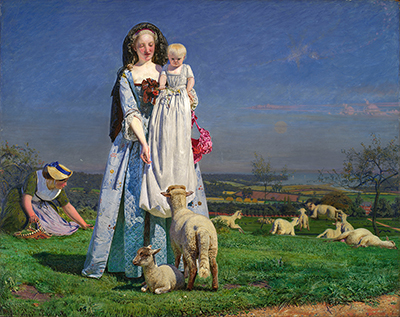
Ford Madox Brown, Pretty Baa-Lambs. Repeated sessions with models, a lay figure and animals helped construct the apparent immediacy of sunlight.
Watch: Ford Madox Brown
Choose a film exploring the people, stories and visual details in two of Brown’s best-known paintings.
Pre-Raphaelites: Ford Madox Brown – Work
Curator Tim Barringer explores the figures and stories within Work.
Watch on YouTubeMaterials and Revision: The Evidence of Particular Pictures
Brown’s diary gives unusually direct evidence for some materials, together with his changing opinion of them. In the 1854 retrospective account he names Roberson’s undrying copal in connection with Pretty Baa-Lambs . Discussing the first painting of Jesus Washing Peter’s Feet , he says the flesh was painted on wet white at Millais’s instigation and immediately expresses distrust of both the advice and the medium. This is testimony about named paintings, written in an irritated retrospective voice. It establishes neither a universal Brown method nor a modern conservation verdict. [3]
His record of revising Jesus Washing Peter’s Feet is more dramatic. On 30 June 1856, calculating the time before the Liverpool Academy exhibition, he decided he could clothe Christ. He thought the painted legs good enough to preserve, so cut them out of the picture, which was already lined, glued in another piece of canvas and filled it. Subsequent entries describe improving Peter’s green mantle. Revision involved the support and the colour relationships, as well as the represented costume. [2]
The diary does not tell us everything about the surviving joins or layers. It does tell us why it is unsafe to imagine the present picture as a single continuous execution. The kneeling Christ now has a strongly articulated clothed body: folds gather around his legs and spread towards the lower edge. That coherent appearance contains a history of substantial reconstruction.
Take your Son, Sir presents another kind of alteration. On 16 March 1857 Brown recorded drawing his infant son Arthur, then painting him onto an enlarged canvas already bearing a study of Emma’s head. He had sent it away to be enlarged a second time after making an error. The passage describes the growth of a composition from existing painted material. It does not explain the eventual unfinished state or warrant a confident account of the woman’s fictional circumstances. [2]
The visible contrast is extraordinary: the mother’s face, the baby and the circular mirror are worked out, while much of the lower dress remains a pale field crossed by drawn lines. Different degrees of completion occupy the same surface. An unfinished picture makes decisions visible that a fully painted surface usually conceals.
Even in the account of Work , Hueffer distinguishes the long process of collecting observations from the appearance of effortless coherence. He describes pits sought or dug for models and mortar repeatedly turned to obtain the right marks on a spade. These are the biographer’s descriptions of Brown’s working habits. Together with Brown’s own diary, they reveal a practice in which both finding a motif and rebuilding its circumstances could demand prolonged labour. [2]
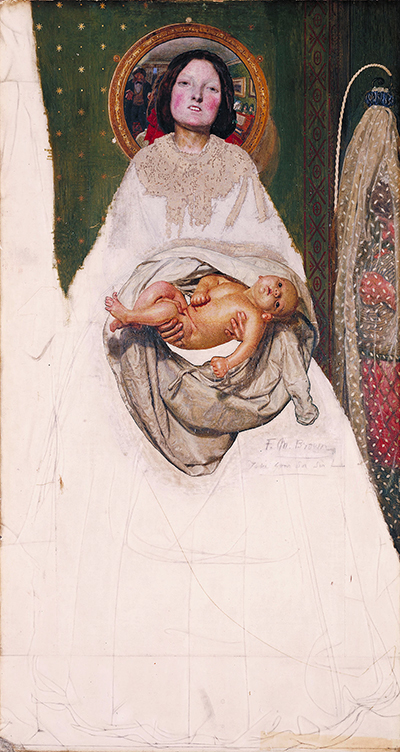
Ford Madox Brown, Take your Son, Sir. The worked heads and mirror contrast with the incompletely painted lower dress.
Frames as Part of the Picture
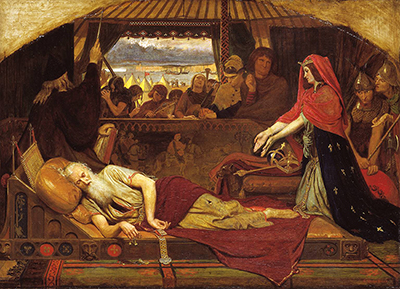
A picture’s material boundary could demand further invention. Lynn Roberts’s specialist study reproduces Brown’s letters to James Leathart about frames. On 16 January 1863 he described combining his design for Lear and Cordelia with “Rossetti’s thumb-mark pattern”; on 8 February he considered registering their best patterns. A letter of 12 July 1864 about Oure Ladye of Good Children records adjusting the gilding, adding lettering and filling twenty-two circles with angel outlines. These letters reach us through Roberts’s article. They show shared patterns and workshop labour continuing beyond the painted rectangle. [8]
The National Portrait Gallery’s catalogue offers a separate example. On 2 July 1872 Brown asked Sir Charles Dilke to let him order the frame for the Fawcett double portrait, proposing a Venetian pattern from Green’s business. Jacob Simon’s frame entry identifies the surviving gilt-pine frame with composition mouldings as apparently standard Watts construction, and regards it as presumably the pattern Brown meant. The letter documents Brown’s choice; the precise identification remains the specialist’s qualified conclusion. [9]
Frames could also carry language. Tim Barringer’s account of Work draws attention to the scriptural inscriptions on its frame and reads the painting in relation to Christian service and Jesus Washing Peter’s Feet . The border supplies a religious context for the modern street. This is Barringer’s interpretation of the relation between picture and inscription, rather than a complete explanation of every figure. [10]
 Ford Madox Brown.jpg)
Ford Madox Brown, Henry and Millicent Fawcett, 1872. A separate July 1872 letter records Brown’s proposed frame choice.
Designing for Glass and Walls
Work in other materials redistributed authorship. For King René’s Honeymoon Cabinet , the V&A identifies J. P. Seddon as the furniture designer and his father’s firm as the cabinet-maker. Brown suggested the theme and painted Architecture among panels supplied by several artists; Morris designed their decorative backgrounds. The related stained-glass Architecture panel adapted the subject for a library window at Myles Birket Foster’s house. Painted furniture and a window are separate objects, even where they share an invention. [11]
The transition makes the division between conception and execution particularly important. A designer’s drawn figure can become part of a collectively made object whose proportions and material boundaries are already determined. The stained-glass and decorative arts guide follows those collaborations and adaptations.
In his 1893 essay Of Mural Painting , Brown approached the wall as a distinct problem. He wanted the decoration to preserve the building’s solidity, “its not appearing to be a hole in the wall.” Landscape distance could conflict with that requirement. He also rejected very dark subjects for murals. These statements describe his preferences for architectural painting, although distance and darkness could serve him effectively elsewhere. [4]
The Manchester cycle comprises twelve paintings, begun in 1879 and completed in 1893. Manchester City Council distinguishes seven painted directly on the walls using the Gambier-Parry spirit-fresco process from the last five, painted on canvas after Brown returned to London. They are not twelve examples of traditional Italian fresco. [5]
Brown’s essay confirms his use of spirit fresco for seven Manchester works, then discusses canvas subsequently cemented to a wall. He gives alternative preparations and painting media, describes obtaining a matt surface, and values the possibility of detaching the canvas if damp causes trouble. This discussion belongs to mural construction: it is not a formula to transfer to his earlier easel paintings. His predictions of durability also remain an artist’s contemporary assessment. [4]
The public mattered as much as the support. Brown insisted that the artist should control the invention, while arguing that pictures paid for by the public should offer subjects people could understand and care about. His late architectural practice returns to the concern running through the 1850 essay: technical accomplishment must carry an intelligible human action. [4]
Artworks directory
Explore paintings, drawings, cartoons, illustrations and decorative designs documented in museum collections and specialist research. Distinct versions are listed separately; repeated print impressions are grouped. The coverage includes studies and works without a dedicated article and remains open to further research.
| Name | Date | Medium |
|---|---|---|
| Work (Manchester) | 1852–1865 | Oil on canvas |
| The Last of England (Birmingham) | 1852–1855 | Oil on panel |
| Jesus Washing Peter’s Feet | 1852–1856 | Oil on canvas |
| Pretty Baa-Lambs | 1851–1859 | Oil on panel |
| Take Your Son, Sir | ?1851–1892 | Oil on canvas |
| Lear and Cordelia | 1849–1854 | Oil on canvas |
| Cordelia’s Portion | 1867–1875 | Oil on canvas |
| Walton-on-the-Naze | 1859–1860 | Oil on canvas |
| Chaucer at the Court of Edward III (Tate) | 1856–1868 | Oil on canvas |
| Carrying Corn | 1854–1855 | Oil on mahogany |
| The Hayfield (The Hay Harvest) | 1855–1856 | Oil on mahogany |
| Stages of Cruelty | 1856–1890 | Oil on canvas |
| The Irish Girl | 1860 | Oil on canvas laid on board |
| Romeo and Juliet (Delaware) | 1869–1870 | Oil on canvas |
| The Seeds and Fruit of English Poetry | 1845–1853 | Oil on canvas |
| Self-Portrait | 1877 | Oil on canvas |
| The Bromley Children | Probably 1844 | Oil on canvas |
| The Bromley Family | 1844 | Oil on canvas |
| Byron’s Dream (Manchester) | 1874; worked on into 1875 | Oil on canvas |
| Cartoon for The Baptism of Edwin | 1879–1891 | Pastel, coloured chalks and grey gouache |
| The Coat of Many Colours | 1864–1866 | Oil on canvas |
| The Convalescent (Birmingham) | Dated October 1872 | Pastel |
| Crabtree Watching the Transit of Venus (reduced painting) | 1881–1888 | Tempera on panel |
| Cromwell on His Farm (Lady Lever) | Completed 1874 | Oil on canvas |
| Cromwell Protector of the Vaudois | 1877 | Oil on canvas |
| Dalton Collecting Marsh-Fire Gas (Town Hall mural) | 1886–1887 | Mural on canvas |
| The Establishment of the Flemish Weavers (reduced painting) | 1881; completed 1888 | Tempera on panel |
| The Finding of Don Juan by Haidée (NGV) | 1869–1870; later retouched | Watercolour and gouache over pencil |
| Henry and Millicent Fawcett | 1872 | Oil on canvas |
| Jacob and Joseph’s Coat (Ponce) | c.1868–1871 | Oil on canvas |
| James Leathart | 1863–1864; altered 1869 | Oil on canvas |
| King René’s Honeymoon (Tate watercolour) | 1864 | Graphite, watercolour, gouache and gum arabic on card |
| King René’s Honeymoon Cabinet (collaborative work) | 1861; exhibited 1862 | Oak, inlaid woods, painted panels and metal mounts; Brown designed Architecture |
| Manfred on the Jungfrau | 1841; retouched 1861 | Oil on canvas |
| Millie Smith | 1846 | Oil on paper laid on panel |
| William Michael Rossetti by Lamplight | 1856–1857 | Oil on panel |
| The Traveller (Manchester oil) | 1868–1884 | Oil on panel |
| Waiting: An English Fireside of 1854–55 | 1851–1855 | Oil on panel |
| An English Autumn Afternoon | 1852–1853; finished c.1854 | Oil on canvas |
| Alfred the Great: Sketch of Alfred drawing in the Sand | 1843–1845 | pencil |
| Historical Notes and Sketches of Alfred the Great | 1843–1850 | brown ink writing over pencil |
| Angels watching the Crown of Thorns: Study of clasped Hands | 1846 | black chalk |
| Architecture: Study of Gothic Arches and 14th Century Vaulting | c. 1847 | brown pen and ink over pencil on grey paper |
| The Ascension: Study of Angels and Hands | 1844 | brown pen and ink over pencil |
| The Ascension: Study of a Group of Angels | 1844 | brown pen and ink over pencil |
| The Ascension: Study of a Group of six flying Angels | 1844 | brown pen and ink over pencil |
| The Ascension: Two nude Angels holding onto each other | 1844 | brown brush and ink over pencil |
| The Ascension: Study for a kneeling Apostle | 1844 | black chalk touched with white on brown-toned paper |
| Head of a Child | c. 1844 | black chalk touched with white on brown toned paper |
| The Ascension: Drapery Study of a praying Apostle | 1844 | black chalk |
| The Spirit of Justice: Seated Figure in ecclesiastical Robes, gripping a Staff with left Hand raised in a Blessing | 1844 | black chalk |
| The Ascension: Study for an Apostle | 1844 | black chalk |
| The Spirit of Justice: Body of seated Figure in ecclesiastical Robes holding a Staff and a Book | 1844 | black chalk |
| The Ascension: Study of an Apostle | 1844 | black chalk on toned paper |
| Full-length Sketch of a standing, naked Child | 1844 | black chalk on toned paper |
| The Ascension: Study for Christ | 1844 | brown pen and ink over pencil |
| Caricature: Composite Drawing: A Stunner | 1861–1863 | pencil |
| A Victorian Woman in her Underwear | 1861–1863 | pencil |
| Caricature: Composite Drawing: Bewigged Head | 1861–1863 | pencil |
| Bowed Head of a bearded Man | 1861–1863 | pencil |
| Chaucer at the Court of Edward III: Early compositional Study | 1845 | pencil with brown pen and ink |
| Chaucer at the Court of Edward III: Study for Milton and two Designs for Tombstones | c.1845–c.1846 | pencil with brown frame outline |
| Chaucer at the Court of Edward III: Tracing of the Figure of Milton | c.1845–c.1849 | brown pen and ink with pencil on tracing paper |
| Chaucer at the Court of Edward III: Tracing of a Gothic Arch | c.1845–c.1849 | brown pen and ink with pencil on tracing paper |
| Chaucer at the Court of Edward III: Early compositional Study | 1845 | pencil with brown pen and ink |
| Chaucer at the Court of Edward III: Nude Studies of two Boys | 1845 | pencil, laid down |
| Chaucer at the Court of Edward III: Nude Studies of four Figures | 1845 | pencil |
| Chaucer at the Court of Edward III: Eight early Studies of Figures and Hands | 1845 | pencil |
| Chaucer at the Court of Edward III: Nude Studies for the Figures of Byron, Shakespeare and Burns | 1845 | black chalk |
| Chaucer at the Court of Edward III: Drapery Study for Burns | 1847 | black chalk |
| Chaucer at the Court of Edward III: Study of a right Leg and left Foot for Milton | 1847 | black chalk |
| Chaucer at the Court of Edward III: Study of a left Leg for Shakespeare | 1847 | black chalk |
| Chaucer at the Court of Edward III: Study of Drapery for Milton | 1847 | black chalk |
| Chaucer at the Court of Edward III: Drapery Study for Shakespeare | 1847 | black chalk |
| Chaucer at the Court of Edward III: Study of a Man in a medieval Hood | 1847 | black chalk |
| Chaucer at the Court of Edward III: Study for the Cardinal | 1847 | black chalk |
| Chaucer at the Court of Edward III: Drapery Study in Profile for Courtier | 1847 | black chalk |
| Chaucer at the Court of Edward III: Drapery Study | 1847 | black chalk |
| Chaucer at the Court of Edward III: Female Nude Study of a Muse holding onto a Rail | 1847 | pencil |
| Chaucer at the Court of Edward III: Female Nude: Study of a Muse | 1847 | pencil |
| Chaucer at the Court of Edward III: Nude Study for seated Lady | 1847 | pencil |
| Chaucer at the Court of Edward III: Nude Study of a Woman with right Arm raised | 1847 | pencil |
| Chaucer at the Court of Edward III: Two Studies of Back of a seated Woman's Head | 1847 | pencil |
| Chaucer at the Court of Edward III: Two Studies of a seated Woman in lost Profile Pose and from the Back | 1847 | pencil |
| Chaucer at the Court of Edward III: Nude Study of a Woman | 1847 | pencil |
| Chaucer at the Court of Edward III: Sketch of a Woman supporting another Figure | 1847 | pencil |
| Chaucer at the Court of Edward III: Study of the Heads and Shoulders of two Women | 1847 | pencil |
| Chaucer at the Court of Edward III: Drapery Study for Edward III with Outline of a Child | 1847 | black chalk |
| Chaucer at the Court of Edward III: Foreshortened Study for Head of a Jester | 1847 | pencil |
| Chaucer at the Court of Edward III: Head of Alexander Pope | 1847 | black chalk |
| Chaucer at the Court of Edward III: Two Hand Studies | 1847 | black chalk |
| Chaucer at the Court of Edward III: Study of Head of Milton copied from Sculpture | 1848 | black chalk |
| Chaucer at the Court of Edward III: Nude Studies for the Squire and the Courtier talking to Gower | 1848 | pencil |
| Chaucer at the Court of Edward III: Drapery Study for the Black Prince | 1848 | black chalk with touches of white |
| Chaucer at the Court of Edward III: Three Studies of Hands | 1848 | Black chalk |
| Chaucer at the Court of Edward III: Four Studies of Hands | 1848 | black chalk touched with white |
| Chaucer at the Court of Edward III: Study of a clasped right Hand for one of the Poets | 1848 | black chalk |
| Chaucer at the Court of Edward III: Study of a left Hand for Burns | 1848 | black chalk heightened with touches of white |
| Chaucer at the Court of Edward III: Study of Drapery for Burns | 1848 | black chalk |
| Chaucer at the Court of Edward III: Drapery Study | 1848 | black chalk |
| Chaucer at the Court of Edward III: Drapery Study for the Black Prince | 1851 | black and white chalks on brown-toned paper |
| Chaucer at the Court of Edward III: Study for Squire's Legs | 1851 | black chalk heightened with white |
| Chaucer at the Court of Edward III: Two Head Studies of an old Woman | 1851 | black chalk |
| Costume Study: Five Sketches of Armour and Costume | 1844 | brown pen and ink over pencil |
| Costume Study: Archbishop's Dress | 1845 | brown pen and ink on tracing paper |
| Costume Studies: French and Italian thirteenth and fourteenth-century Costumes (seven Drawings) | 1845 | brown pen and ink on tracing paper |
| Costume Study: Seigneur de Rimini | 1845 | brown pen and ink on tracing paper |
| Dalziels' Bible Gallery: The Death of Eglon | 1863–1865 | engraved woodblock; designed by Brown, engraved by the Dalziel Brothers |
| Dalziels' Bible Gallery: The Death of Eglon | 1881 | wood engraving; designed by Brown, engraved by the Dalziel Brothers |
| Dalziels' Bible Gallery: Elijah and the Widow's Son | 1863–1865 | engraved woodblock; designed by Brown, engraved by the Dalziel Brothers |
| Dalziels' Bible Gallery: Elijah and the Widow's Son | 1881 | wood engraving; designed by Brown, engraved by the Dalziel Brothers |
| Dalziels' Bible Gallery: Joseph’s Coat (Compositional Sketch and four Studies for Jacob's Granddaughter) | 1863–1865 | pencil on paper |
| Dalziels' Bible Gallery: Joseph's Coat | 1863–1865 | engraved woodblock; designed by Brown, engraved by the Dalziel Brothers |
| Dalziels' Bible Gallery: Joseph’s Coat | 1881 | wood engraving; designed by Brown, engraved by the Dalziel Brothers |
| Decorative Sketches: Venus Reclining on a Shell in the Midst of the Sea | 1848–1849 | brown pen and ink over pencil |
| Decorative Design: Ornamental Pattern | 1850 | watercolour and bodycolour over pen and ink, and pencil on two sheets of paper |
| Down Stream: Main Illustration (Last Year's First of May) | 1871 | wood engraving; designed by Brown, print execution by an engraver |
| Down Stream: Tailpiece to the Poem (This Year's First of June) | 1871 | wood engraving; designed by Brown, print execution by an engraver |
| The Establishment of Flemish Weavers in Manchester A.D. 1363: Four Studies of Parts of a Horse | 1879–1882 | black, white and red chalk on rough brown paper |
| Female: Two Studies of young Woman in eighteenth-century Costume | 1849 | pencil |
| Infant's Repast: Study of Mother and Child | 1848 | black and white chalk |
| Infant's Repast: Study of Mother and Child with separate Arm and Leg Studies of the Child | 1848 | black chalk with grey wash |
| King Lear: Sketch of Lear questioning Cordelia | 1844 | brown pen and ink over pencil |
| Alfred the Great: Compositional Sketches | 1843–1845 | pencil |
| King Lear: Sketches of Lear imagining his unfaithful Daughters’ Trial and Lear in the Storm | 1844 | brown pen and ink over pencil |
| Alfred the Great: Compositional Studies and Sketches and Chaucer at the Court of Edward III: Study of Cherubs | 1843–1849 | pencil |
| King Lear: Kent accuses Oswald | 1844 | brown pen and ink with pencil underneath |
| King Lear: Lear recounts his Wrongs to Regan | Undated | Brown pen and ink over pencil |
| King Lear: Cordelia at Lear's Bedside (Lear's Awakening) | 1844 | brown pen and ink over pencil |
| Cordelia Parting from Her Sisters (The Germ) | 1850; reprinted 1901 | Etching; designed by Brown, print execution by an engraver |
| King René's Honeymoon: Study for Architecture | 1861 | brush and brown ink, with watercolour, over pencil on brown paper |
| The Last of England: Cartoon | 1852 | pencil, image edged with brown ink |
| The Last of England: Portrait of Emma Hill | December 1852 | chalks with scratching out on two sheets of paper |
| Lear and Cordelia and The Infant’s Repast: Four Studies of Hands | 1849 | black chalk |
| Lyra Germanica - the Christian Life: Abraham and Isaac | 1868 | wood engraving; designed by Brown, print execution by an engraver |
| Lyra Germanica - the Christian Life: Finished Design for The Entombment | 1867 | black pen and ink |
| Lyra Germanica - the Christian Life: The Entombment | 1868 | wood engraving; designed by Brown, print execution by an engraver |
| Male: Sketch of Man reclining on Steps with Hands bound together | 1844 | brown pen and ink over pencil |
| Male: Academic nude Study, half-length with Moustache and Arms folded | 1846–1849 | black chalk |
| Male: Academic Study of Nude holding a Staff | 1847 | pencil |
| Male: Academic Study of Nude posed as a Sculptor | 1847 | chalk with grey wash |
| Male: Academic Study, three-quarter length Nude, with a Moustache and clenched Fists | 1847 | black chalk |
| Oure Ladye of Saturday Night: Seven Sketches | 1846 | pencil |
| Oure Ladye of Saturday Night: Four Studies for Angel holding Child | 1847 | pencil |
| Oure Ladye of Saturday Night: Study of Angel holding Child | 1847 | black chalk |
| Oure Ladye of Saturday Night: Study of Arm and Hands for Angel holding Bowl of Water | 1847 | black chalk |
| Oure Ladye of Saturday Night: Drapery Study for Angel holding Bowl of Water | 1847 | black chalk |
| Oure Ladye of Saturday Night: Study of Head for Angel holding Bowl of Water | 1847 | black chalk with rubbing and grey wash |
| Oure Ladye of Saturday Night: Study of Child seated on Knees of the Virgin and two separate Studies of the Child's Legs | 1847 | pencil on brown-toned paper |
| Oure Ladye of Saturday Night: Frieze Design | c. 1847 | pencil and black pen and ink |
| Oure Ladye of Saturday Night: Three Studies of Arms and Legs of Child | 1847 | pencil |
| Oure Ladye of Saturday Night: Three Studies of Child's Legs on Virgin's Knees | 1847 | pencil |
| Oure Ladye of Saturday Night: Studies of Right Foot and Left Hand of Child | 1847 | pencil on light brown paper |
| Oure Ladye of Saturday Night: Drapery Study for Virgin | 1847 | black chalk |
| Oure Ladye of Saturday Night: Study for Head of Virgin | 1847 | black chalk with wash |
| Parisina’s Sleep: Study for Prince Azo and Parisina | 1842 | black chalk with pencil side drawing |
| Parisina's Sleep: Study for Head of Prince Azo | 1842 | black chalk with grey wash |
| Parisina's Sleep: Study for the Head of Parisina | 1842 | black and white chalk with grey wash |
| Poets of the Nineteenth Century: The Prisoner of Chillon: Compositional Sketch | 1856 | pencil |
| Profile of a Man's left Eye and Nose | c.1856 | pencil |
| Poets of the Nineteenth Century: The Prisoner of Chillon: Study of a Corpse | 1856 | pencil |
| Designs for Decoration | c.1856 | pencil |
| Poets of the Nineteenth Century: The Prisoner of Chillon | 1857 | wood engraving; designed by Brown, print execution by an engraver |
| Portrait: Head Study of Daniel Casey (three-quarter view) | 1848 | black chalk |
| Portrait: Head Study of Daniel Casey (full-face) | 1848 | black chalk |
| Portrait: Miss Iza Duffus Hardy | 1872 | pastel and coloured chalks on brown paper |
| Portrait: Emma Hill (later Mrs Madox Brown) | 1848 | black chalk |
| Portrait: Emma Hill (later Mrs Madox Brown) | 1852 | pencil |
| Portrait: Mrs Madox Brown (neé Emma Hill) | 9 May 1854 | pencil |
| The Repose in Egypt: Compositional Sketch | 1847 | pencil |
| Study of a Statue of the Discobolus | 1845 | Black chalk |
| William Shakespeare: Study | 1849–1850 | pencil |
| William Shakespeare: Invitation Card | 1850 | wood engraving; designed by Brown, print execution by an engraver |
| The Spirit of Justice: Study for Baron and his Advisor, with Sketches of Erudition and Wisdom | 1844–1845 | brown pen and ink over pencil |
| The Spirit of Justice: Drapery Study for Erudition | 1844–1845 | black chalk |
| Drapery Study and Sketch of Two Legs | Undated | Black chalk |
| The Spirit of Justice: Study for Wisdom | 1844–1845 | black chalk with grey wash |
| The Spirit of Justice: Study for Head of the Baron | 1844–1845 | black chalk |
| The Spirit of Justice: Study for the Head of central Bishop | 1844–1845 | black chalk |
| The Spirit of Justice: Study for the Head of a Bishop | 1844–1845 | black chalk with grey wash |
| The Spirit of Justice: Study for the uplifted left Arm of Justice | 1844–1845 | black chalk |
| The Spirit of Justice: Study for Head of Counsellor in a Coronet | 1844–1845 | black chalk with touches of blue chalk |
| The Spirit of Justice: Study for Head of Counsellor | 1844–1845 | black chalk |
| The Spirit of Justice: Drapery Study for the Central Bishop | 1844–1845 | Black chalk |
| Part of a Drapery Study | 1844–1845 | black chalk |
| The Spirit of Justice: Study for Head of Widow | 1844–1845 | black chalk |
| Stages of Cruelty: Study for the Child (Catherine Madox Brown) | 1857 | black chalk on pale grey paper |
| Stained Glass Design: Cartoon for Zachariah, The High Priest | 1872 | black chalk |
| Stained Glass Design: Cartoon for The Young Milton | 1874 | black chalk |
| Stained Glass Design: Cartoon for St Simon | 1874 | black chalk |
| Sterne's 'Sentimental Journey': Study for Yorick and La Fleur talking to Maria’s Mother | 1842 | brown pen and ink over pencil |
| The Body of Harold brought before William the Conqueror: Eight Sketches of Figure Groups | c.1844 | pencil |
| Sterne's 'Sentimental Journey' : Yorick (Laurence Sterne) and Maria Walking | 1842 | pen and ink, watercolour and bodycolour over pencil |
| Study of Tree Trunk with Roots | c.1847 | black chalk, heightened with white chalk on buff paper |
| Two Studies of Tree Trunks | c.1846 | black chalk |
| Unknown Subject: Compositional Sketch | 1843–1850 | pencil |
| Wycliffe reading his Translation of the Bible: Nude Study for Chaucer | 1847 | pencil |
| Wycliffe reading his Translation of the Bible: Study for Chaucer | 1847 | pencil |
| Wycliffe reading his Translation of the Bible: Nude Study of Gower | 1847 | pencil |
| Wycliffe reading his Translation of the Bible: Study for Gower | 1847 | pencil |
| Wycliffe reading his Translation of the Bible: Nude Study for John of Gaunt and Chaucer's right Hand | 1847 | pencil and black chalk |
| Wycliffe reading his Translation of the Bible: Study of John of Gaunt and Chaucer's Left Hand | 1847 | pencil and black chalk |
| Wycliffe reading his Translation of the Bible: Study for Wycliffe | 1847 | black chalk |
| Wycliffe reading his Translation of the Bible: Nude Study for Wycliffe | 1847 | pencil |
| Wycliffe reading his Translation of the Bible: Drapery Study for Wycliffe | 1847 | black chalk |
| Wycliffe reading his Translation of the Bible: Drapery Study for Chaucer | 1848 | black chalk |
| Wycliffe reading his Translation of the Bible: Study of Legs for John of Gaunt and two Studies of Feet for Wycliffe | 1848 | black chalk |
| Wycliffe Reading his Translation of the Bible: Studies of Hands for John of Gaunt and Gower | 1847 | black chalk |
| Wycliffe reading his Translation of the Bible: Study for Head of Wycliffe | 1847 | pencil |
| Wycliffe reading his Translation of the Bible: Study for Constance and Child | 1847 | pencil |
| Wycliffe reading his Translation of the Bible: Unfinished Study for Head of Constance | 1847–48 | pencil |
| Wycliffe reading his Translation of the Bible: Portrait of Elizabeth Bamford modelling for Constance | 1848 | pencil |
| Wycliffe reading his Translation of the Bible: Study for Head of Constance | 1848 | chalk over pencil |
| Wycliffe reading his Translation of the Bible: Study for Head of Chaucer | 1848 | pencil |
| Wycliffe reading his Translation of the Bible: Study of Monk representing the Catholic Faith | 1848 | black chalk with brown pen and ink, squared up |
| Wycliffe reading his Translation of the Bible: Study of young Woman representing the Protestant Faith | 1848 | black chalk |
| Cathy Madox Brown at the Age of Three (Tate N01356) | 1853 | Graphite on paper |
| King René‘s Honeymoon (Tate N02409) | date not known | Ink on paper |
| Sheepshearing (Tate N02410) | c.1887 | Ink and graphite on paper |
| Studies for ‘Work’ (Tate N02411) | 1855 | Graphite and ink on paper |
| Design for Badge for Gillum’s Homes (Tate N02412) | date not known | Ink and graphite on paper |
| Arkwright’s Mill (Tate N02413) | 1878 | Graphite on paper |
| Study for ‘John Kay’ (Tate N02414) | 1889 | Graphite on paper |
| Study for ‘Southend’ (Tate N02415) | date not known | Graphite on paper |
| ‘Where are you going, my pretty maid?’ (Tate N02416) | date not known | Graphite on paper |
| Section of the Bridgewater Canal (Tate N02417) | 1890 | Ink on paper |
| A Barge on the Bridgewater Canal (Tate N02418) | 1890 | Graphite on paper |
| Study of the Tow-Path on the Bridgewater Canal (Tate N02419) | 1890 | Graphite on paper |
| Our Lady of Good Children (Tate N02684) | 1847–61 | Pastel, watercolour and gold paint on paper |
| Arkwright’s Mill (Tate N02791) | 1881 | Graphite on paper |
| The Bridgewater Canal (Tate N02792) | 1890 | Ink on paper |
| The Bridgewater Canal (Tate N02793) | date not known | Chalk and graphite on paper |
| The Last of England (Tate N03064) | 1864–6 | Watercolour on paper |
| Mauvais Sujet (Tate N03228) | 1863 | Watercolour on paper |
| Study of a Man Painting (Tate N03472) | 1839 | Graphite on paper |
| The Brent at Hendon (Tate N03528) | 1854–5 | Oil paint on board on mahogany |
| Study for the Dean in the ‘Execution of Mary Queen of Scots’ (Tate N04280) | c.1840 | Oil paint on paper |
| Sketch for ‘Jesus Washing Peter’s Feet’ (Tate N04281) | 1852 | Graphite on paper |
| Sketch for ‘Cromwell on his Farm’ (Tate N04282) | c.1853 | Graphite on paper |
| The Coat of Many Colours (Tate N04584) | 1867 | Watercolour and gouache on paper |
| Stages of Cruelty (Tate N04625) | c.1856 | Watercolour on paper |
| Head of a Girl (Tate N04803) | date not known | Oil paint on paper |
| Portrait of Dykes Barry as a Child (Tate N04866) | 1853 | Oil paint on mahogany |
| Jesus Washing Peter’s Feet (Tate N05301) | 1857–8 | Watercolour on paper |
| Platt Lane (Tate N05383) | 1884 | Oil paint on canvas |
| Study of F.G. Stephens for ‘Jesus Washing Peter’s Feet’. Verso: A Head Crowned with Laurels (Tate T00571) | 1852 | Graphite on paper. Verso: graphite on paper |
| Sketch for ‘Jesus Washing Peter’s Feet’ (Tate T01035) | c.1851 | Ink and graphite on paper |
| Chaucer at the Court of Edward III (Sydney) | 1845–1851 | Oil on canvas |
| Wycliffe Reading His Translation of the Bible to John of Gaunt (Bradford) | 1848 | Oil on canvas |
| Work (Birmingham replica) | 1859–1863 | Oil on canvas |
| The Spirit of Justice (Book of Art reproduction) | Published 1846 | Wood engraving after Brown’s cartoon; engraver unknown |
| The Execution of Mary Queen of Scots | 1840–1842 | Oil on canvas |
| The Prisoner of Chillon (Manchester oil) | 1843 | Oil on canvas |
| The Parting of Cordelia from Her Sisters (oil) | 1853 | Oil on canvas |
| Cordelia’s Portion (Lady Lever) | 1866–1872 | Watercolour, gouache and pastel |
| The Ascension | 1844–1845 | Oil on canvas |
| Manfred in the Chamois Hunter’s Hut (oil sketch) | 1840 | Oil on canvas |
| Dr Primrose and His Daughters (The Vicar of Wakefield) | 1840–1841 | Oil on canvas |
| The Body of Harold Brought before William the Conqueror | 1844–1861 | Oil on canvas |
| The Seeds and Fruits of English Poetry (Bedford cartoon) | 1845 | Black chalk on paper |
| Wycliffe Reading His Translation of the Bible (oil sketch) | 1847–1848 | Oil on board |
| Cromwell Discussing the Protection of the Vaudois (Nottingham) | 1877–1878 | Oil on canvas |
| Two Drawings of Men in Hoods | c.1845 | Pencil on paper |
| The Seeds and Fruits of English Poetry: Study of the Right Side | c.1845 | Brown pen and ink with pencil |
| Chaucer: A Man in a Hood with a Liripipe and Two Drapery Studies | 1848 | Oil on canvas |
| The Prisoner of Chillon Entreating His Jailors (Yale watercolour) | 1858 | Watercolour heightened with bodycolour |
| Elijah and the Widow’s Son (Birmingham oil) | 1864 | Oil on panel |
| He That Soweth (Lyra Germanica) | Published 1868 | Wood engraving by the Dalziel Brothers after Brown |
| The Entombment (NGV) | 1871–1878 | Watercolour, gouache, gold paint and gum arabic over pencil |
| The Sower (Morris firm tile) | c.1864–1873 | Tile; design by Brown, workshop execution |
| Childe Harold’s Pilgrimage (Byron illustration) | Published 1870 | Steel engraving by Herbert Bourne after Brown |
| The Two Foscari (Byron illustration) | Published 1870 | Steel engraving by Herbert Bourne after Brown |
| The Corsair (Byron illustration) | Published 1870 | Steel engraving by Herbert Bourne after Brown |
| Sardanapalus (Byron illustration) | Published 1870 | Steel engraving by Herbert Bourne after Brown |
| Don Juan (Byron illustration) | Published 1870 | Steel engraving by Herbert Bourne after Brown |
| Byron’s Dream (roundel title-page design) | Published 1870 | Steel engraving by Herbert Bourne after Brown |
| The Finding of Don Juan by Haidée (Birmingham oil) | 1870–1873 | Oil on canvas |
| The Dream of Sardanapalus (Delaware) | 1871–1872 | Watercolour on paper |
| The Traveller (Once a Week) | Published 1869 | Wood engraving by Joseph Swain after Brown |
| The Infant’s Repast | 1848 | Oil on board |
| Oliver Madox Brown Aged Four (Dwale Bluth frontispiece) | Published 1876 | Etching |
| Oliver Madox Brown as a Young Man (Dwale Bluth frontispiece) | Published 1876 | Etching |
| A Beggar and Other Fantasies: Title-page Illustration | Published 1889 | Photo-engraving after Brown |
| Dramas in Miniature: Title-page Illustration | Published 1891 | Photo-engraving after Brown |
| The Brown Owl: Frontispiece | Published 1892 | Photo-engraving after Brown |
| The Brown Owl: Central Illustration | Published 1892 | Photo-engraving after Brown |
| The Feather: Frontispiece | Published 1892 | Photo-engraving after Brown |
| The Ascension: Study for Christ | 1844 | Pen and ink |
| King Lear: Lear Questions Cordelia (Whitworth) | 1844 | Pencil, pen and brown ink |
| King Lear: France Claims the Dispossessed Cordelia (Whitworth) | 1844 | Pencil, pen and brown ink |
| King Lear: Cordelia Parts from Her Sisters (Whitworth) | 1844 | Pencil, pen and brown ink |
| King Lear: Goneril and Regan Together (Whitworth) | 1844 | Pencil, pen and brown ink |
| King Lear: Goneril Tells Oswald How to Treat Lear (Whitworth) | 1844 | Pencil, pen and brown ink |
| King Lear: Oswald’s Insolence to Lear (Whitworth) | 1844 | Pencil, pen and brown ink |
| King Lear: Lear Rebukes Oswald (Whitworth) | 1844 | Pencil, pen and brown ink |
| King Lear: Kent Trips Oswald (Whitworth) | 1844 | Pencil, pen and brown ink |
| King Lear: Goneril’s Complaint to Lear (Whitworth) | 1844 | Pencil, pen and brown ink |
| King Lear: Lear Curses Goneril’s Infidelity (Whitworth) | 1844 | Pencil, pen and brown ink |
| King Lear: Kent Challenges Oswald (Whitworth) | 1844 | Pencil, pen and brown ink |
| King Lear: Kent in the Stocks (Whitworth) | 1844 | Pencil, pen and brown ink |
| King Lear: Lear Recounts His Wrongs to Regan (Whitworth) | 1844 | Pencil, pen and brown ink |
| King Lear: Lear Parts from Regan and Goneril (Whitworth) | 1844 | Pencil, pen and brown ink |
| King Lear: Lear and the Fool in the Storm (Whitworth) | 1844 | Pencil, pen and brown ink |
| King Lear: Lear Mad on the Beach at Dover (Whitworth) | 1844 | Pencil, pen and brown ink |
| King Lear: Alternative Study: Lear Curses Goneril (Whitworth) | 1844 | Pencil, pen and brown ink |
| King Lear: Lear Imagines His Daughters’ Trial (Whitworth) | 1844 | Pencil |
| King Lear: Alternative Study: Lear in the Storm (Whitworth) | 1844 | Pencil, pen and brown ink |
| The Last of England (Fitzwilliam) | 1860 | Oil on canvas |
| The Convalescent (Metropolitan Museum) | Dated 1872 | Pastel |
| Self-Portrait (Walker drawing) | 1850; retouched 1853 | Black chalk |
| Byron’s Dream (Whitworth) | 1889 | Watercolour over graphite |
| Cordelia Parting from Her Sisters (Cleveland sketch) | 1854 | Pen and oil on paper mounted on panel |
| David and Goliath: Cartoon for Stained Glass Window at Jesus College, Cambridge | 1872 | Charcoal and graphite on Japanese paper |
| The Virgin Swooning (recto) | 1844 | Black chalk on laid paper |
| Two Drapery Studies (verso) | c.1844 | Black chalk |
| Architecture: King René’s Honeymoon (stained glass) | 1862 | Stained glass; designed by Brown, made by Morris, Marshall, Faulkner & Co. |
| The Romans Building a Fort at Mancenion (Town Hall mural) | 1880 | Spirit fresco |
| The Baptism of Edwin (Town Hall mural) | 1879–1880 | Spirit fresco |
| The Expulsion of the Danes (Town Hall mural) | 1880–1881 | Spirit fresco |
| The Establishment of the Flemish Weavers (Town Hall mural) | 1881–1882 | Spirit fresco |
| Crabtree Watching the Transit of Venus (Town Hall mural) | 1882–1883 | Spirit fresco |
| The Proclamation Regarding Weights and Measures (Town Hall mural) | 1883–1884 | Spirit fresco |
| Wycliffe on Trial (Town Hall mural) | 1885–1886 | Spirit fresco |
| Chetham’s Life’s Dream (Town Hall mural) | 1885–1886 | Mural on canvas |
| Bradshaw’s Defence of Manchester (Town Hall mural) | 1892–1893 | Mural on canvas |
| John Kay, Inventor of the Fly Shuttle (Town Hall mural) | 1888–1890 | Mural on canvas |
| The Opening of the Bridgewater Canal (Town Hall mural) | 1891–1892 | Mural on canvas |
Frequently Asked Questions
Strongly acted gestures, carefully organised groups and close attention to particular light effects provide useful points of entry. His early dark literary pictures, bright outdoor scenes and public decorations nevertheless differ considerably. Brown’s own account of Manfred warns that later retouching changed its original colours. [2]
He used outdoor sessions for particular effects, including the sunlight of Pretty Baa-Lambs and the cold overcast light of The Last of England . He also worked indoors, made studies and cartoons, and assembled observations into designed scenes. His retrospective diary describes painting an autumn view from a bedroom window. [3]
His diary mentions painting the flesh in Jesus Washing Peter’s Feet on wet white, with explicit reservations. That statement concerns a particular operation on a particular picture. His 1850 essay explains designing and transferring a composition, rather than prescribing that preparation for all his paintings. [3] [1]
Discussion
Look again at the images and ideas explored in Ford Madox Brown’s Style and Technique. These editorial prompts invite your observations.
Reader Insights
View Jesus Washing Peter’s Feet at a small size, then examine the hands. How do the large light and dark areas guide you towards actions that become clearer at close range? Brown’s essay asks the painter to consider both scales together. [1]
Compare the clothes, skin and fleece in Pretty Baa-Lambs . Brown’s diary describes models, a lay figure and animals brought together through repeated sessions. How does that knowledge change the apparent immediacy of the encounter? [3]
Compare the open, incompletely painted dress in Take your Son, Sir with a framed finished painting or a Manchester mural. What does the boundary allow the image to do? Brown’s enlargement of the first canvas and his later insistence on a wall’s solidity show how consequential that boundary could be. [2] [10]
Join the Conversation
Share a detail, comparison or question about Ford Madox Brown’s Style and Technique below.
References
- Ford Madox Brown , “On the Mechanism of a Historical Picture. Part I. The Design,” The Germ (1850), pp. 70–73. Complete essay, including footnotes, in Project Gutenberg’s transcription of the collected periodical; distinct from William Michael Rossetti’s later introduction. View source .
- Ford Madox Hueffer , Ford Madox Brown: A Record of His Life and Work (1896), pp. 14–16, 28–30, 41, 100–102, 129–131, 148–149 and 156–157. Family biography containing Brown’s 1865 statements, letter to George Rae and diary entries of June–July 1856 and March 1857; the biographer’s narration is distinguished from the artist’s words. View source .
- William Michael Rossetti, editor , Præraphaelite Diaries and Letters (1900), Brown’s retrospective diary resumed 16 August 1854, pp. 108–113, and entry of 2 September 1855, pp. 192–193. Project Gutenberg transcription. View source .
- Ford Madox Brown , “Of Mural Painting,” Arts and Crafts Essays (1893). Complete essay, Wikisource transcription. View source .
- Manchester City Council , “The Ford Madox Brown Murals,” current overview; chronology and distinction between seven wall paintings and five canvas paintings. View source .
- Laura MacCulloch , Ford Madox Brown: Works on Paper and Archive Material at Birmingham Museums and Art Gallery , PhD thesis, University of Birmingham (2009), volume I, pp. 209–210, 222–223 and 252–254; catalogue entries 15, 42, 45 and 89–90. View source .
- Tate , official historical collection dataset, N04735, Carrying Corn , and T01920, The Hayfield : dates, supports and measurements. View source .
- Lynn Roberts , “What artists, critics & collectors say about frames: Part 2,” The Frame Blog , 1 September 2013; Brown’s letters to James Leathart of 16 January and 8 February 1863 and 12 July 1864, as quoted by Roberts. View source .
- National Portrait Gallery , Henry Fawcett; Dame Millicent Fawcett , NPG 1603; Jacob Simon’s frame entry, including Brown’s letter to Sir Charles Dilke of 2 July 1872. View source .
- Tim Barringer , “Ford Madox Brown, Work,” MAVCOR, 2014; scriptural frame inscriptions and comparison with Jesus Washing Peter’s Feet . View source .
- Victoria and Albert Museum , King René’s Honeymoon Cabinet , W.10:1 to 28-1927, O78937, and Architecture , Circ.516-1953, O11163; object descriptions and divisions of design and making. View source 1 . View source 2 .
- Laura MacCulloch, Ford Madox Brown: Works on Paper and Archive Material at Birmingham Museums and Art Gallery, 2009, volumeI; catalogue entries. View source.
- Laura MacCulloch, Ford Madox Brown: Works on Paper and Archive Material at Birmingham Museums and Art Gallery, 2009, volumeII; illustration lists, pp1–24. View source.
- Tate, official historical collection dataset; Ford Madox Brown accession records. View source.
- Ford Madox Hueffer, Ford Madox Brown: A Record of His Life and Work, 1896; selected career, object and mural passages. View source.
- Fitzwilliam Museum, The Last of England, M.Add.3. View source.
- Metropolitan Museum of Art, The Convalescent, 10.46. View source.
- Carol Blackett-Ord / National Portrait Gallery, Ford Madox Brown: all known portraits. View source.
- The Whitworth / Art UK, Byron’s Dream, 1889 watercolour. View source.
- Cleveland Museum of Art, Cordelia Parting from Her Sisters, 2013.261. View source.
- Cleveland Museum of Art, David and Goliath: Cartoon for Stained Glass Window at Jesus College, Cambridge, 1872, 2013.247. View source.
- National Gallery of Art, The Virgin Swooning, recto, 1987.73.1.a. View source.
- National Gallery of Art, Two Drapery Studies, verso, object70237. View source.
- Victoria and Albert Museum, Architecture: King René’s Honeymoon, CIRC.516-1953. View source.
- Splash image, Ford Madox Brown, Jesus Washing Peter’s Feet. Brown’s June 1856 diary records substantial alterations to the already lined canvas.