


 by Tom Gurney
Tom Gurney BSc (Hons) is an art history expert with over 20 years experience
Published on June 19, 2020 / Updated on November 5, 2026
Email: tomgurney1@gmail.com / Phone: +44 7429 011000
Frederic Leighton Sculptures
Frederic Leighton’s sculptures bring the body into remarkably different states of motion. An athlete holds a python away from his throat; a young man stretches with the lingering heaviness of sleep; a girl recoils from a small creature at her feet. Each subject gives an ordinary physical response an unusually elaborate form. Straining, waking and starting back become ways of exploring how a figure occupies space.
Leighton’s reputation rests largely on painting, but these works give sculpture a distinct place in his career. His principal exhibition sculptures comprise three subjects: Athlete Wrestling with a Python, exhibited in 1877, and The Sluggard and Needless Alarms, exhibited in 1886. Around them survives a further history of studies, versions and casts. A small bronze in a museum may reproduce an earlier model, sometimes in an edition issued after Leighton’s death. Understanding that distinction helps explain both the intimacy and the influence of his sculpture. [1]
At a Glance
Contents
From a painter’s model to an independent figure
Sculpture grew out of Leighton’s work as a painter. He made small three-dimensional models to help compose paintings, giving himself bodies and groups that could be examined from different directions. Leighton House connects the beginnings of the Athlete with his work on models for Daphnephoria, painted in 1874–76, while treating the precise story of its origin cautiously. [2]
That background makes the change of medium especially interesting. A model made for a painting helps resolve an image that will eventually have a fixed viewpoint. An independent sculpture continues to offer new arrangements as the spectator moves. A bent arm can frame the face from one direction and obscure it from another. A turn through the waist becomes a changing relationship between the chest, shoulder and hip. Leighton’s sculptural figures reward this mobile attention: their poses unfold through several views.
The Athlete became a life-size bronze and was shown at the Royal Academy in 1877. Its success encouraged a sculptural reputation that was disproportionate to the number of subjects Leighton produced. The original bronze entered the national collection through the Chantrey Bequest and is now in Tate’s collection. [2]
Explore two museum casts
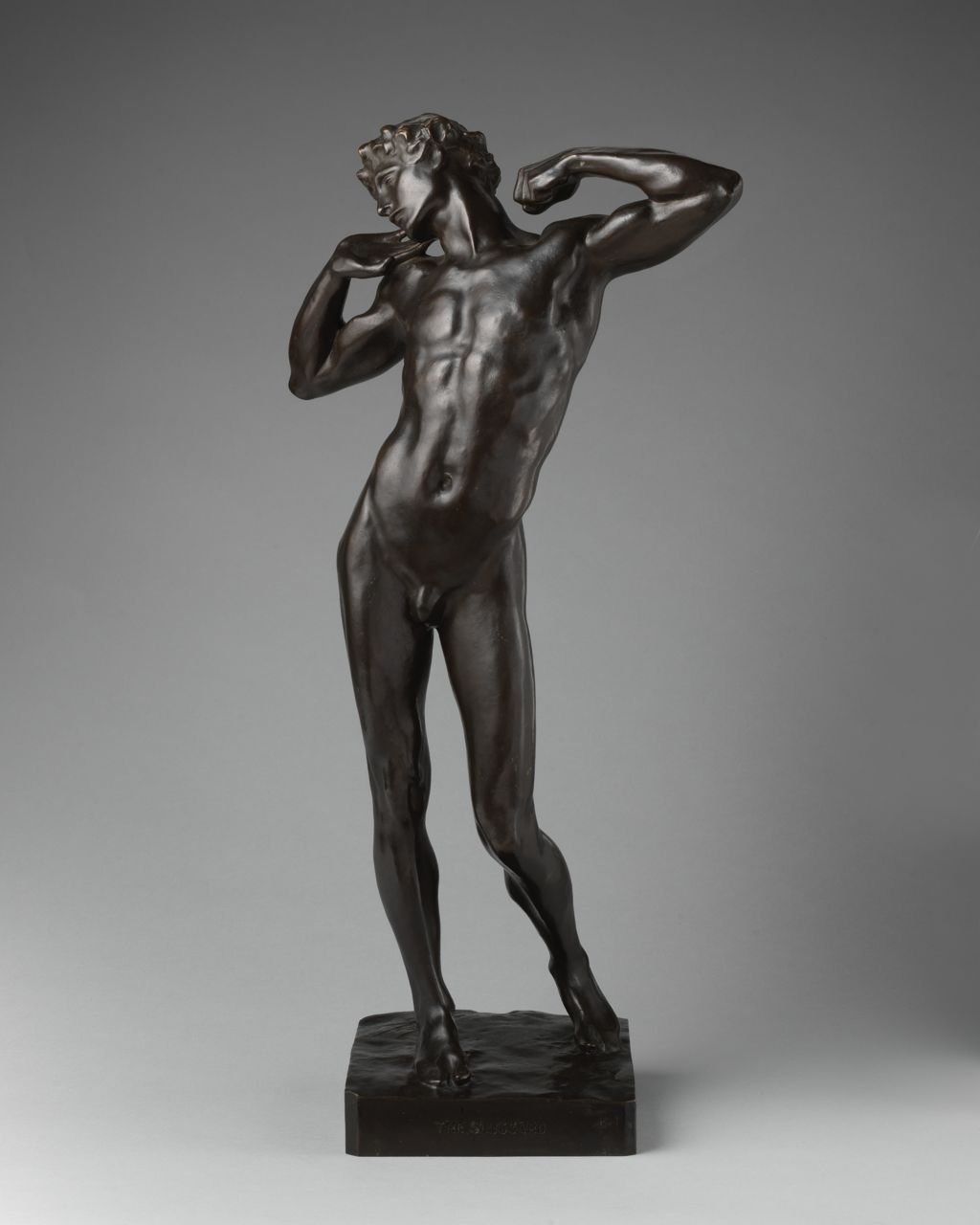
The Sluggard — Met cast
Modelled 1886; cast possibly before 1896. Met 06.936.
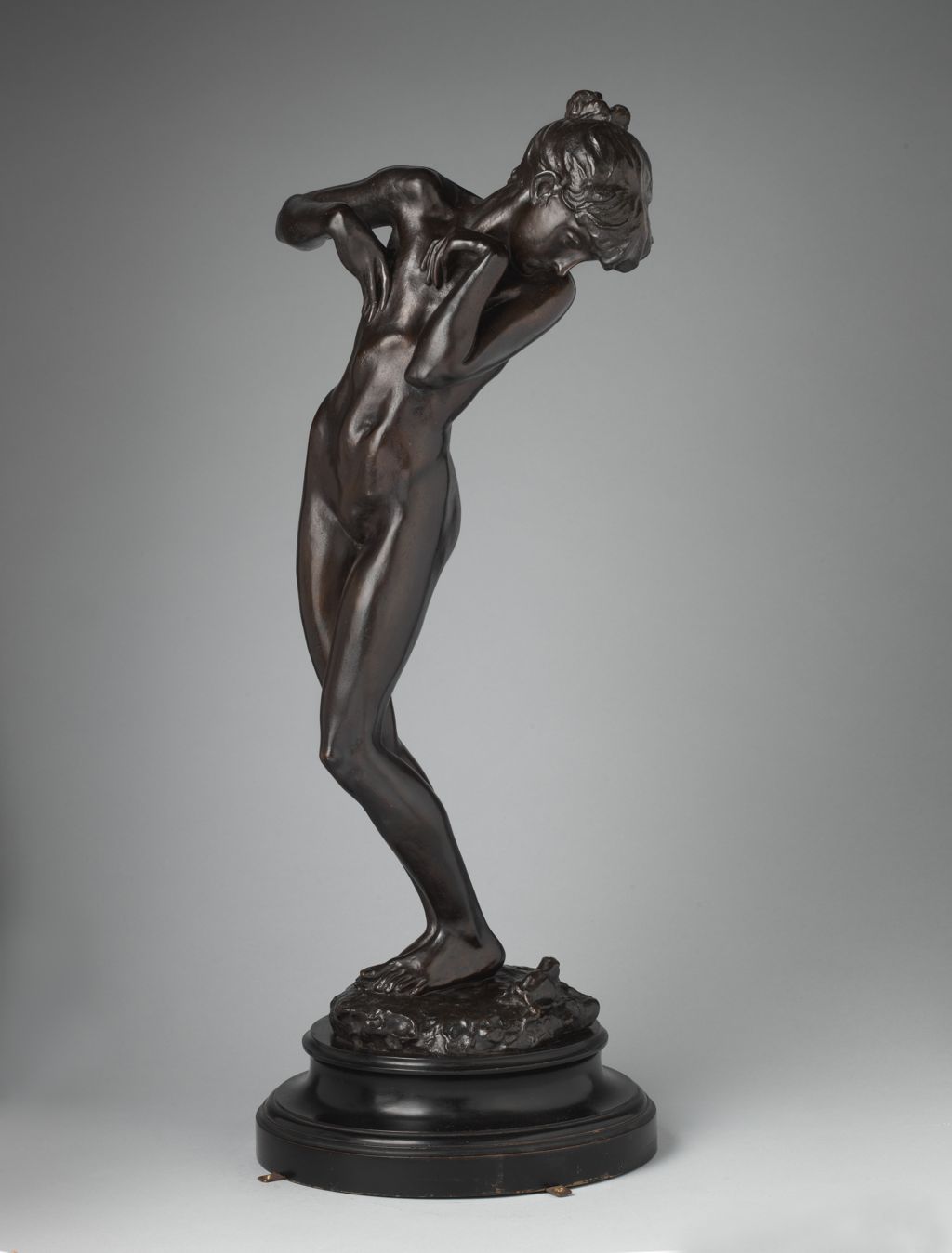
Needless Alarms — Met cast
Modelled 1886; nineteenth-century cast. Met 06.951.
Athlete Wrestling with a Python
The Athlete concentrates a violent encounter into the relationship between two bodies. The man’s extended hand restrains the python near its head, while the snake coils around his thigh and ankle. The struggle is already close: the animal occupies the same small area of ground and has reached the lower body, even as the athlete keeps its head at a distance. Saint Louis Art Museum describes its bronze as a reduced version of the life-size sculpture first exhibited in London in 1877. [3]
The subject directs attention along the figure. The outstretched arm carries the eye away from the torso, but the snake returns it towards the legs. Human and animal establish competing routes through the composition. The man’s limbs open out; the python folds back and encircles. Looking at their meeting points makes the encounter more absorbing than treating the sculpture as a general display of strength. The dangerous contact is distributed across the body, so that the action cannot be understood from the hand alone. [3]
The Hood Museum relates the subject to the ancient Laocoön group and emphasises its conception in the round. As a viewer circles the sculpture, the composition changes substantially. This classical connection helps place Leighton’s figure, but the single athlete has a concentrated identity of his own: the immediate subject is bodily effort, expressed through muscles, balance and the grip between the opponents. The Hood’s bronze, 52.1 centimetres high, makes that complex arrangement available at a scale very different from the original statue. [4]
The work also raises a fruitful question about looking at an ideal body. How much does the athlete seem to be responding to danger, and how much does the pose invite admiration for its arrangement? Both experiences can coexist. The threat supplies urgency, while the carefully extended limbs invite slow inspection. The spectator can linger over a configuration that, in life, would be changing from instant to instant. Sculpture holds that unstable moment open.
A landmark of the New Sculpture
Leighton House places the Athlete near the beginning of the New Sculpture movement, identifying its effect on Hamo Thornycroft and Alfred Gilbert. Its account stresses the combination of classical reference and physical realism, down to the vein on a foot and the surface of the snake’s scales. Bronze helped make possible an expansive figure that viewers could experience from all sides. [2]
Here, the material deserves attention alongside the subject. Light catches a bronze surface selectively: a projecting ridge can shine while the neighbouring hollow remains dark. This gives a closely modelled body a continually shifting emphasis. As lighting and viewpoint change, details emerge and withdraw. The spectacle includes the relation between the sculpture and the real space around it.
New Sculpture describes a broader late Victorian development, not a large series of sculptures made by Leighton himself. Museum Wales characterises it through renewed energy, physical realism and expressive subjects. Leighton’s importance belongs within that wider field: a painter’s relatively small contribution could offer an influential example to artists whose careers centred on sculpture. [5]
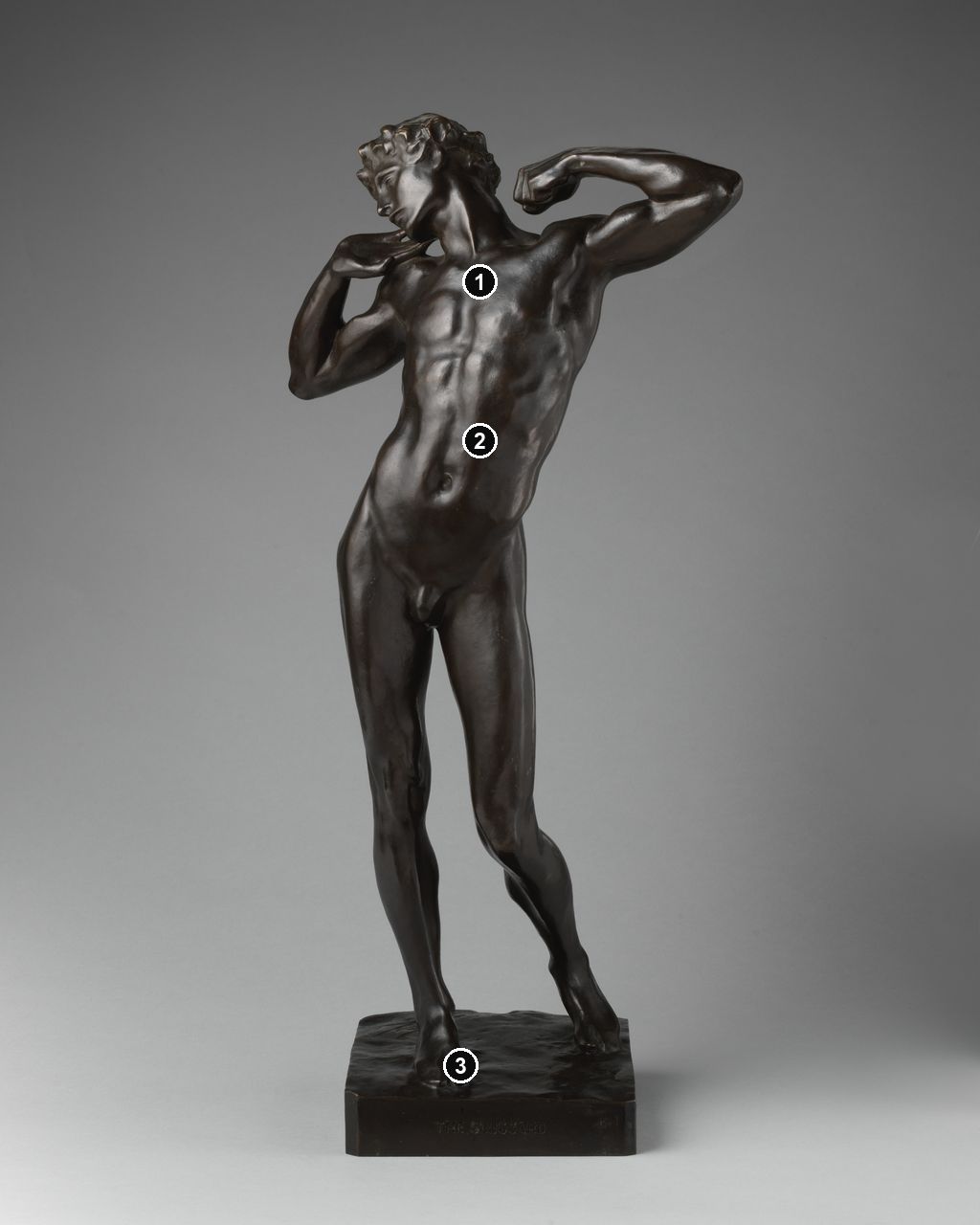
Annotated Details from The Sluggard and Needless Alarms
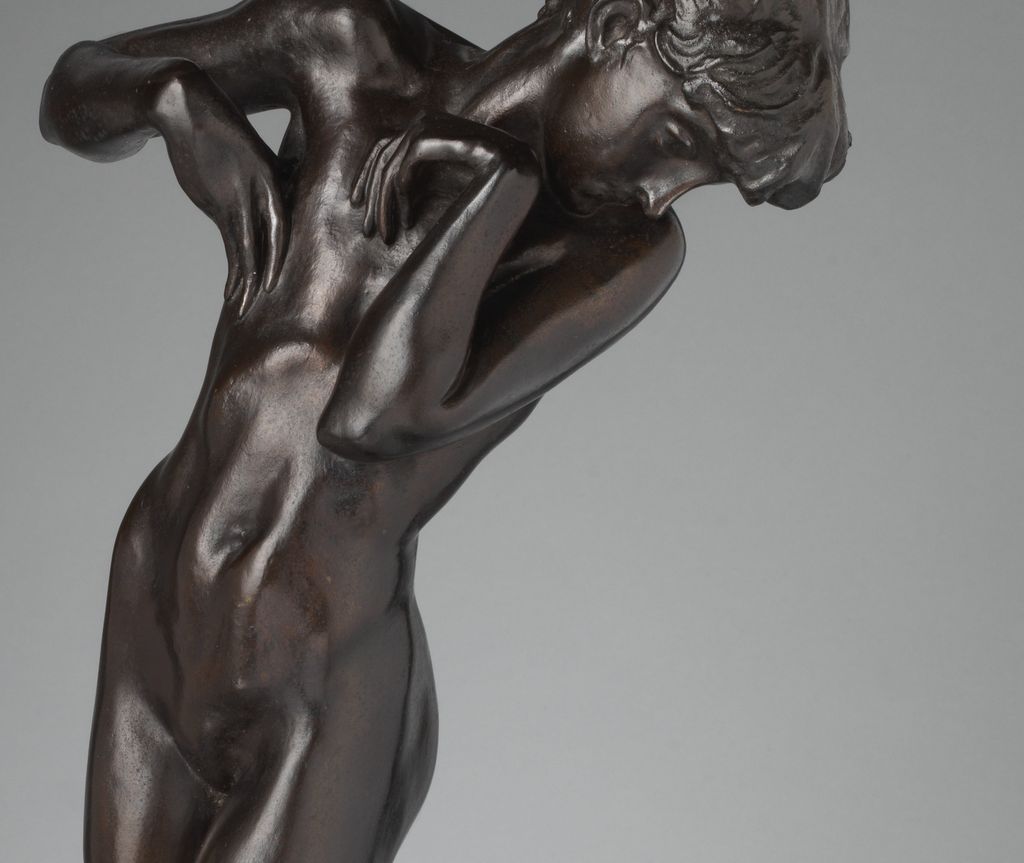
Compare two different movements in these reduced bronze casts: an opening stretch and a startled recoil.
The Sluggard — Met 06.936
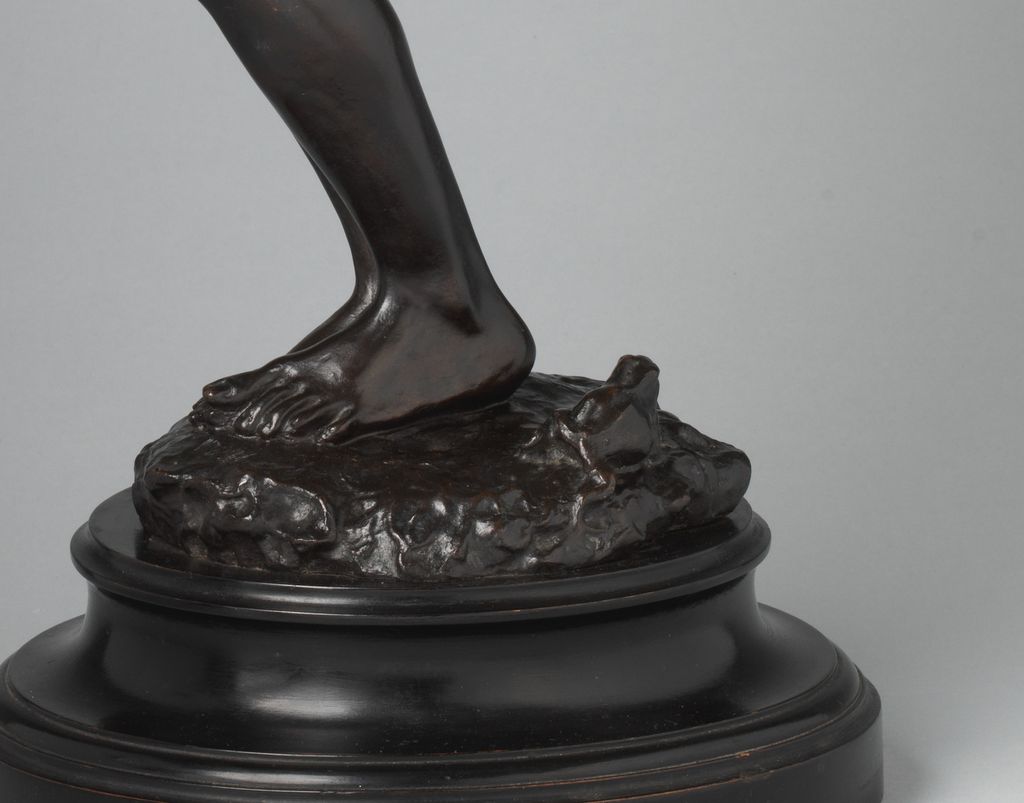
Needless Alarms — Met 06.951
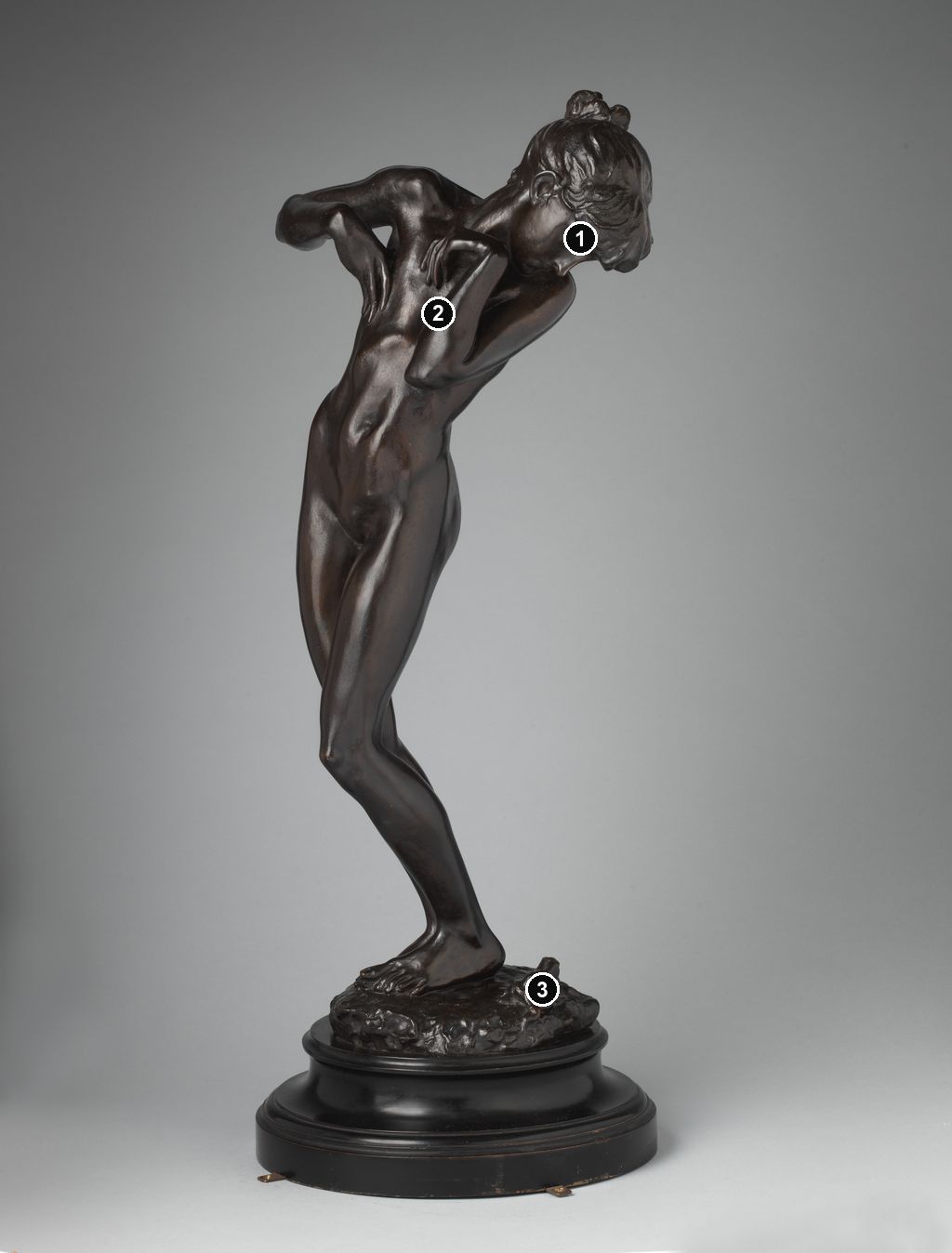
Details from THE SLUGGARD AND NEEDLESS ALARMS
The Metropolitan Museum of Art, New York. The Sluggard, 06.936, modelled 1886, cast possibly before 1896; Needless Alarms, 06.951, modelled 1886, cast nineteenth century. CC0 Open Access images, resized.
The Sluggard — Met 06.936
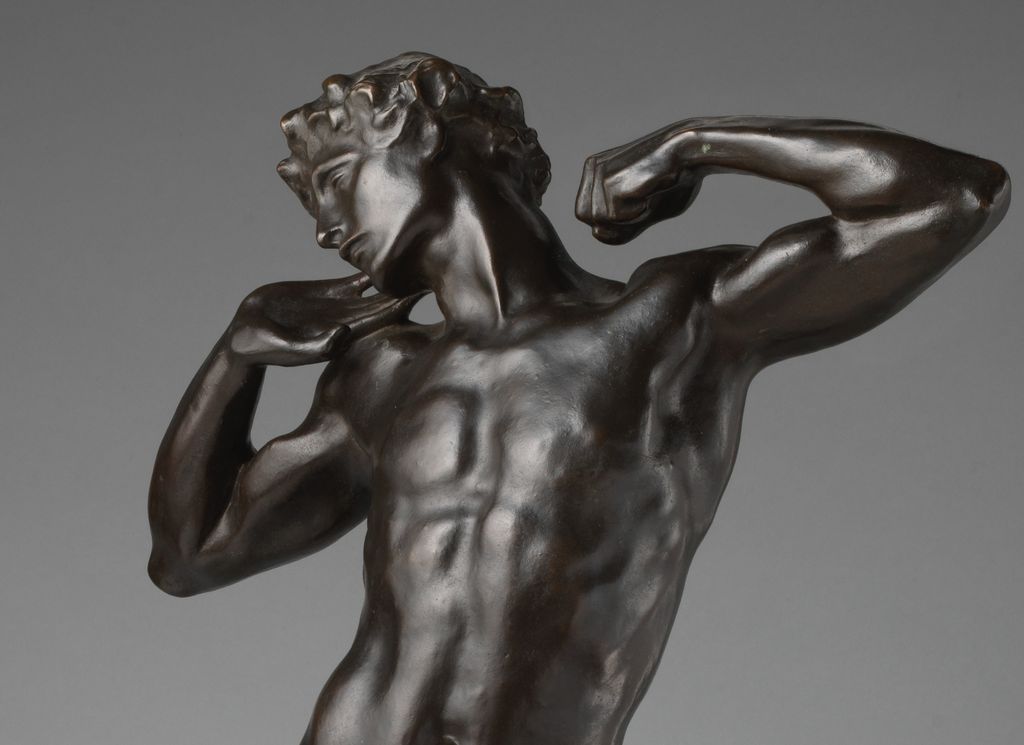
Open arms and a turning head
The bent arms open space beside the head. The face turns towards one shoulder, so that the stretch is felt through an uneven rather than symmetrical arrangement. [6]
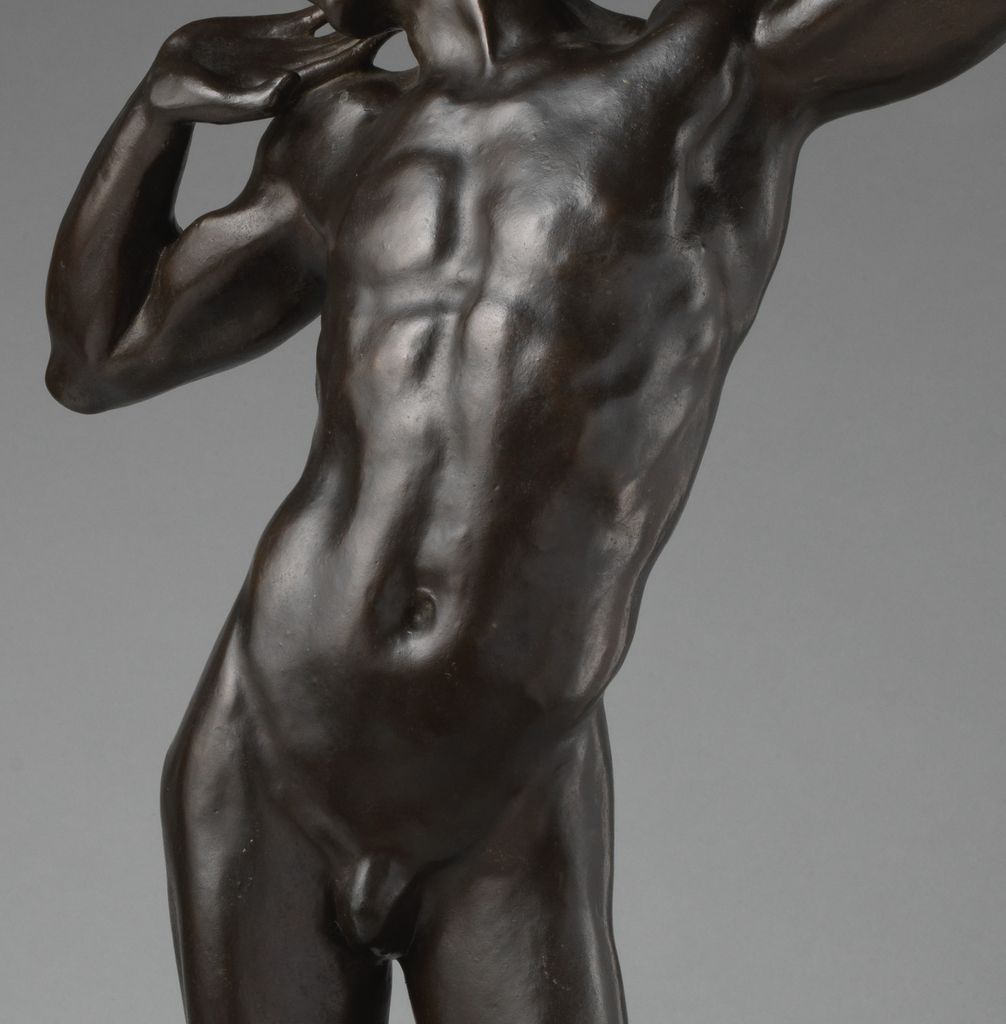
A turn through the torso
Light follows the chest and abdomen while the hips settle in a different direction. The body feels strong without being engaged in an outward task. [6]
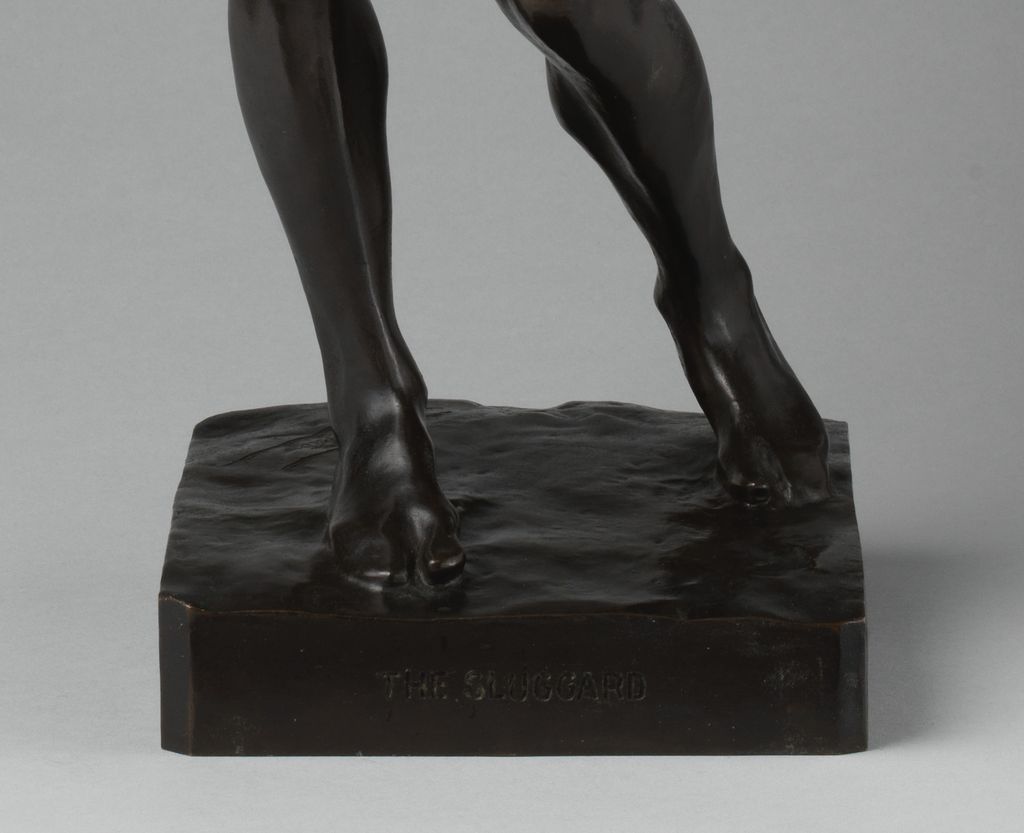
Unequal support
One leg gives a firmer upright line while the other relaxes. Follow the difference down towards the feet and the small bronze base. [6]
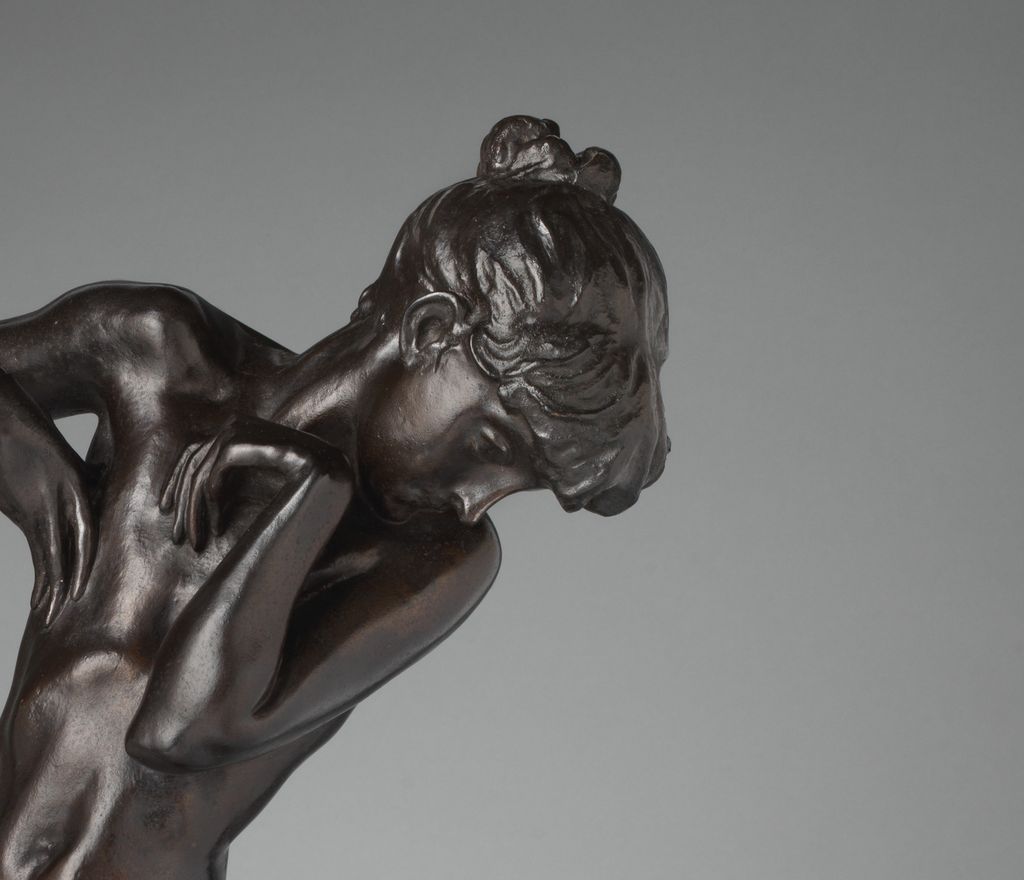
Needless Alarms — Met 06.951
The Sluggard: the effort of waking
The Sluggard turns from an external struggle to a movement familiar from daily life. The figure stands with his arms lifted and bent, his head turning towards one shoulder. The torso lengthens as the hips settle in a different direction. In the Metropolitan Museum’s bronze, the chest opens towards the viewer while the lowered face draws attention sideways. The movement has neither the symmetry of a formal salute nor the clear outward purpose of the Athlete’s grip. It seems to pass through the figure. [6]
Look especially at the spaces between the arms and the head. The elbows widen the silhouette, but the hands return towards the shoulders. The upper body expands without reaching for anything. Below, the legs are unequally engaged: one gives the figure a firmer upright line while the other bends and relaxes. The pose allows solidity and looseness to be felt together. Its muscular body makes the title mildly surprising; the young man possesses ample strength while taking pleasure in a moment without a task. [6]
The familiar story behind the sculpture is that Leighton saw a model stretching after a sitting. Dr Amanda Draper, writing for the University of Liverpool’s Victoria Gallery & Museum, explains that a 1906 biography named the model Giuseppe Valona. Later family evidence identified him as Gaetano Valvona, whose autobiographical manuscript described his work as a model and his connection with the sculpture. The older name consequently needs care when it reappears in collection literature. [7]
The anecdote offers an appealing point of entry, but the finished work involved sustained development. Jeremy Warren’s National Trust account records work on the clay sketch in the early 1880s and completion of the full-size model in Brock’s studio by January 1886. The bronze was exhibited at the Royal Academy that year and at the Paris Exposition Universelle in 1889, where Leighton received a medal of honour. [8]
The alternate title An Athlete Awakening from Sleep, recorded by Museum Wales, makes its connection to the earlier sculpture especially clear. Read together, the subjects explore different uses of the same physical equipment: a strong body resisting another creature and a strong body responding to its own awakening. The comparison does not require the waking figure to carry a fixed moral lesson about laziness. The movement itself supplies much of the interest. [5]
Needless Alarms: a small disturbance
Needless Alarms changes the emotional scale again. A young female figure bends and twists away from a toad at her feet. Christie’s records its exhibition alongside The Sluggard at the Royal Academy in 1886 and distinguishes its original statuette format from the large-scale versions of the two male subjects. The title introduces humour: the elaborate recoil exceeds the apparent danger. [9]
In the Metropolitan Museum’s example, the head tips down towards the ground, the shoulders rise unevenly and the bent arms draw close to the upper body. The hands do not form a defensive wall. Instead, their lifted fingers and placement near the shoulders make the response seem quick and involuntary. Beneath this contracted upper body, the legs form a longer, wavering line. The small animal occupies a tiny part of the composition, yet it helps account for the movement of the whole figure. [10]
There is a pleasure in discovering that disproportion. At first the extended silhouette may suggest a study of bodily balance. Looking down to the base supplies an event and changes how the pose reads. The rough ground also gives a different texture against which to see the smoother limbs. The figure’s movement seems to begin in that little disturbance near the feet and travel upwards, gathering into the shoulders and the bowed head. [10]
The Met dates its example as modelled in 1886 and cast during the nineteenth century. It is bronze with a dark olive-brown patina and stands 50.2 centimetres high. These dimensions invite close attention to its expressive fingers, shoulders and face. [10]
Models, editions and the dates on bronze
The sculptural subject and the individual object have separate histories. At Anglesey Abbey, the National Trust’s Athlete Wrestling with a Python measures 555 by 339 by 310 millimetres and stands on bronze and green marble bases. Its record distinguishes the 1877 model from the 1905 cast. The base preserves the earlier year alongside an edition number and an inscription naming Ernest Brown & Phillips at the Leicester Galleries. That bronze is a small, posthumous cast of the composition, not the life-size statue exhibited in 1877. [1]
The Hood’s Athlete offers a useful comparison. Its inscription includes 1877 and the number XXIII, together with the Leicester Galleries publisher’s name. The inscription records the edition through which this object circulated. A date carried in the model should therefore be read alongside the publisher, scale and fuller catalogue description. [4]
The Sluggard likewise reached viewers through smaller casts. The Anglesey Abbey version names the publisher Arthur Leslie Collie and the foundry J. W. Singer & Sons of Frome. The publication inscription gives 1 May 1890; Warren explains that examples bearing both names were probably made between 1890 and about 1906. The full-size bronze has a laurel wreath near its feet that is absent from the smaller versions. Reduction involved differences in the object, as well as a change in height. [8]
Other museums preserve useful degrees of uncertainty. Museum Wales assigns its 52-centimetre Sluggard a period of 1882–85, while the Met describes its 52.1-centimetre example as modelled in 1886 and cast possibly before 1896. These entries do not provide a single universal casting date. Their wording describes individual collection objects and should travel with them when they are reproduced or discussed. [5] [6]
Across these versions, the three subjects remain unusually distinct. The Athlete opens the figure into a contest; The Sluggard lets movement spread through a body at ease; Needless Alarms gathers it into a startled recoil. Their small number invites attentive comparison. Leighton’s achievement in sculpture can be felt in the variety he drew from such a concentrated group of poses.
Artworks directory
The three principal exhibition sculpture subjects appear through individually identified casts and studies. A model date, an exhibition date and a casting date describe different events. Additional Tate entries retain the museum’s unmaintained October 2014 catalogue snapshot. This selection is not a complete inventory of editions or casts. [11]
| Name | Date | Medium |
|---|---|---|
| Athlete Wrestling with a Python (Anglesey Abbey cast) | model 1877; cast 1905 | Sculpture |
| Athlete Wrestling with a Python (Saint Louis reduced cast) | 1877 (museum date) | Sculpture |
| Athlete Wrestling with a Python (Hood reduced cast) | 1877 (inscribed model date) | Sculpture |
| The Sluggard (Museum Wales) | 1882–85 (museum date) | Sculpture |
| The Sluggard (Met cast) | modelled 1886; cast possibly before 1896 | Sculpture |
| The Sluggard (Anglesey Abbey cast) | probably 1890–about 1906 | Sculpture |
| Needless Alarms (Met cast) | modelled 1886; cast nineteenth century | Sculpture |
| The Spies Escape (Tate A00730) | published 1881 | |
| Cain and Abel (Tate A00731) | published 1881 | |
| Samson and the Lions (Tate A00732) | published 1881 | |
| Abram and the Angel (Tate A00733) | published 1881 | |
| Samson at the Mill (Tate A00734) | published 1881 | |
| Eliezer and Rebekah (Tate A00735) | published 1881 | |
| Moses Views the Promised Land (Tate A00736) | published 1881 | |
| Death of the First Born (Tate A00737) | published 1881 | |
| Samson Carrying the Gate (Tate A00738) | published 1881 | |
| And the Sea Gave Up the Dead Which Were in It (Tate N01511) | exhibited 1892 | Painting |
| The Bath of Psyche (Tate N01574) | exhibited 1890 | Painting |
| The Sluggard (Tate N01752) | 1885 | Sculpture |
| An Athlete Wrestling with a Python (Tate N01754) | 1877 | Sculpture |
| Sketch for ‘An Athlete Wrestling with a Python’ (Tate N01761) | c.1877 | Sculpture |
| Study for ‘The Discovery of Juliet Apparently Lifeless’ (Tate N01806) | c.1858 | Painting |
| Study for ‘Needless Alarms’ (Tate N02945) | 1886 | Sculpture |
| Helios and Rhodes (Tate N03015) | date not known | Painting |
| Puerta de los Vientos, near Ronda, Spain (Tate N04006) | c.1886–9 | Painting |
| A Recognition from ‘Romola’, engraved by Swain (Tate N04054) | published 1862 | |
| Mrs John Hanson Walker (Tate N04731) | 1867 | Painting |
| Needless Alarms (Tate N05120) | 1886 | Sculpture |
| Lieder ohne Worte (Tate T03053) | exhibited 1861 | Painting |
| Fanny Kemble: A Study for ‘Jezebel and Ahab’ (Tate T08208) | c.1862 | Drawing |
| Sketches for Cimon and Iphigenia (Tate T09060) | date not known | Drawing |
| Cimon and Iphigenia, with Many Smaller Subjects (Tate T09061) | date not known | Drawing |
| Preparing for a Festa, Florence (Tate T09062) | date not known | Drawing |
| Various Subjects (Tate T09063) | date not known | Drawing |
Frequently Asked Questions
There are three principal exhibition subjects, but studies, versions and later casts have their own histories. [1]
No. The Anglesey Abbey bronze distinguishes the 1877 model from its 1905 casting. [1]
A strong young man stretching as he wakes; Museum Wales records the alternate title An Athlete Awakening from Sleep. [5]
Discussion
Compare the athlete’s resistance, the waking stretch of The Sluggard and the startled recoil of Needless Alarms.
Reader Insights
How does an opening between limbs change the pose?
Which figure most encourages you to walk around it?
What changes when the cast is smaller or later than the original model?
Join the Conversation
Share a detail, comparison or question about Frederic Leighton Sculptures below.
References
- Jeremy Warren. “Athlete wrestling with a python,” NT 515041. National Trust Collections, 2018. Collection record, in English. View source.Splash image: The Sluggard, Met 06.936: modelled 1886, cast possibly before 1896. This is a reduced bronze cast. The Metropolitan Museum of Art, New York; Open Access image, resized · CC0 / public domain
- Leighton House / Royal Borough of Kensington and Chelsea Museums. “Recreating Leighton’s Athlete Wrestling with a Python.” Undated museum article, in English; accessed 28 October 2026. View source.
- Saint Louis Art Museum. “Athlete Wrestling with a Python,” object 78:1945. Undated collection record, in English; accessed 28 October 2026. View source.
- Hood Museum of Art, Dartmouth College. “Athlete Wrestling with a Python,” object 2016.63.1. Collection record with label from the 2019 exhibition Emulating Antiquity: Nineteenth-Century European Sculpture, curated by Katherine W. Hart. In English; accessed 28 October 2026. View source.
- Amgueddfa Cymru – Museum Wales. “The Sluggard,” NMW A 122. Undated collection record, English version; accessed 28 October 2026. View source.
- The Metropolitan Museum of Art. “The Sluggard,” object 06.936. Undated collection record and object photographs, in English; accessed 28 October 2026. View source.
- Amanda Draper. “More than just a Cheeky Bum.” Victoria Gallery & Museum, University of Liverpool, 16 October 2020. Museum curator’s article, in English. View source.
- Jeremy Warren. “The Sluggard,” NT 515028. National Trust Collections, 2018. Collection record, in English. View source.
- Christie’s. “Frederic, Lord Leighton, P.R.A., R.W.S. (1830–1896), Needless Alarms,” lot 1, sale 12237, Victorian, Pre-Raphaelite and British Impressionist Art. Online lot record and essay, in English; accessed 28 October 2026. View source.
- The Metropolitan Museum of Art. “Needless Alarms,” object 06.951. Undated collection record and object photographs, in English; accessed 28 October 2026. View source.
- Tate, Tate Collection metadata, artwork_data.csv, October 2014 snapshot, released under CC0. Repository readme states that this dataset is no longer maintained. Downloaded and artist rows inspected 28 October 2026. View source.


