 Buy Art Prints Now
from Amazon
* As an Amazon Associate I earn from qualifying purchases.
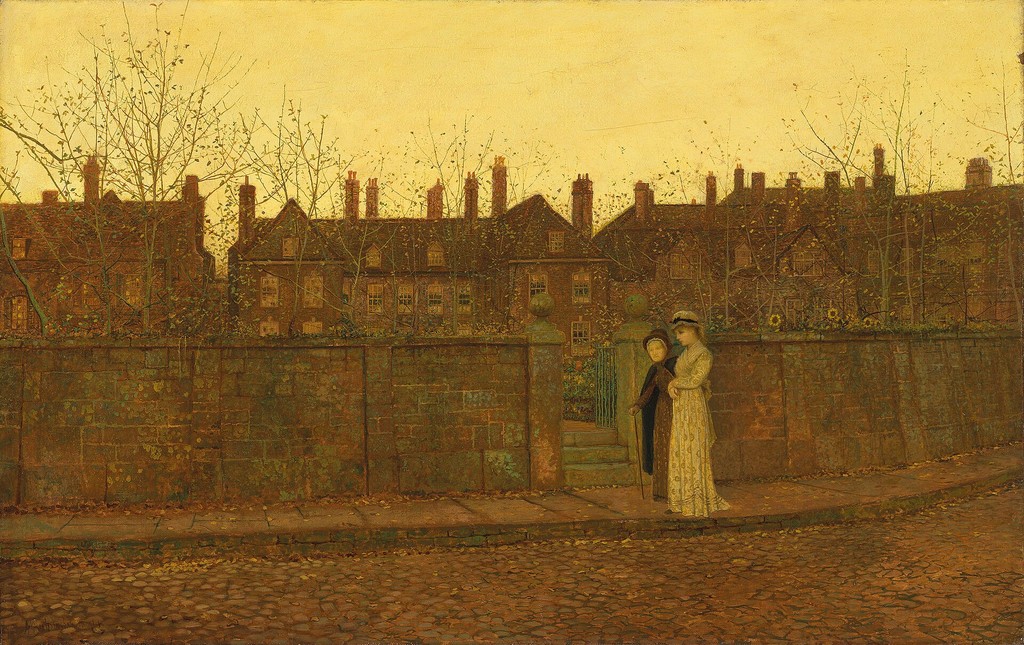
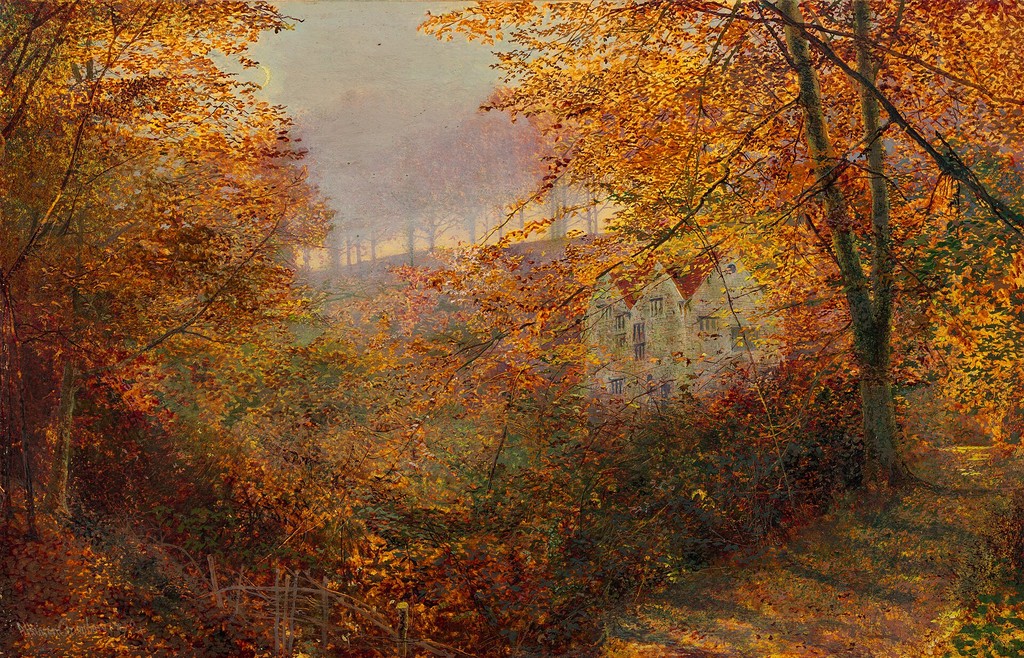
A House in a Clearing — Minneapolis Institute of Art, public domain.
 by Tom Gurney
Tom Gurney BSc (Hons) is an art history expert with over 20 years experience
Page Created: August 31, 2026 / Page Updated: September 16, 2026
Email: tomgurney1@gmail.com / Phone: +44 7429 011000
John Atkinson Grimshaw: Artistic Family and Legacy: Introduction
John Atkinson Grimshaw belonged to an artistic family, but the shared surname creates as many responsibilities as connections. Four of his children—Arthur, Louis, Wilfred and Elaine—painted. Arthur and Louis became particularly associated with subjects close to their father’s nocturnal landscapes. A familiar moonlit lane, a similar palette or the name “Grimshaw” cannot therefore identify a maker on its own.[1][2][3]
The family story also extends beyond painting. Knostrop Old Hall was home, workplace, setting and source of imagery. Family members modelled, made music, collected objects and left photographs, letters, notices, sketches and scores. Leeds institutions preserve much of this evidence. Their records make it possible to understand inheritance and collaboration without silently folding the children’s work into John’s oeuvre.
At a Glance
- ParentsJohn Atkinson Grimshaw and Frances Theodosia Grimshaw, known as Fanny
- FamilyLeeds Libraries records sixteen children, of whom six survived into maturity[1]
- Painting childrenArthur, Louis, Wilfred and Elaine Grimshaw[2]
- Closest stylistic associationArt UK specifically notes imitation of John’s work by Arthur and Louis[3]
- Attribution principleIdentify the individual object through its record, provenance and maker evidence, not surname or resemblance alone
- Key repositoriesLeeds Central Library’s Grimshaw Collection and Leeds Art Gallery’s public holdings[4][7]
Contents
- Introduction
- An Artistic Household at Knostrop
- Arthur Grimshaw: Art and Music
- Louis, Wilfred and Elaine
- Attribution Begins with the Object
- The Leeds Family Archive
- Reputation after 1893
- Collections Shape the Legacy
- From Nostalgia to Modernity
An Artistic Household at Knostrop
Around 1870, Knostrop Old Hall became the Grimshaw family’s principal home. Whether early occupancy is described as rental or purchase differs between sources, but its cultural role is clear. John used rooms, gardens and the conservatory as settings, while Frances and other members of the household appear in pictures or are proposed as models. Literary names, music, plants and decorative objects joined painting in the life constructed there.[1][5]
That domestic richness existed beside bereavement and financial uncertainty. Scarborough Museums records the deaths of three young children in 1874. Leeds Libraries gives the larger scale of the family: John and Frances had sixteen children, six of whom reached maturity. Such facts belong in the biography but should not turn every interior or solitary figure into coded autobiography.[1][5]
The figures, interiors and literature essay considers what can be established about sitters and settings. Here, Knostrop matters as the environment in which younger Grimshaws encountered art. That proximity explains opportunities and shared motifs; it does not make their authorship interchangeable.
Arthur Grimshaw: Art and Music
Arthur Grimshaw, born in 1864 and deceased in 1913 according to Museo Thyssen-Bornemisza, was both an artist and a musician.[2] Leeds Libraries describes him as better known as a composer and as the first choirmaster and organist of Leeds Cathedral. Its holdings include an original musical manuscript and score, evidence that his creative identity cannot be reduced to painting in his father’s manner.[1]
The library’s family collection is precise about individual objects. It lists a watercolour portrait of Elaine by Arthur. In the same group is a watercolour sketch of baby “Arty” made by John. One sibling is artist in the first record; the father is artist and Arthur subject in the second. The names overlap, but the maker roles do not.[4]
Art UK notes that Arthur imitated his father’s popular night scenes.[3] That observation helps explain why misattribution is possible, not why every related-looking work should be assigned to John. Arthur requires his own author field, dates and supporting evidence.
Louis, Wilfred and Elaine
Museo Thyssen-Bornemisza identifies three other painting children: Louis H. Grimshaw (1870–1944), Wilfred Grimshaw (1871–1937) and Elaine Grimshaw (1877–1970).[2] Art UK singles out Louis, alongside Arthur, as an imitator of John’s nocturnal townscapes.[3] “Imitator” describes a close artistic relationship in the authority text; it should not erase Louis as a distinct historical person or become a shortcut for identifying an unsigned canvas.
Less is established in the cited public material about Wilfred’s individual career. The responsible position is limited but firm: an institutional biography states that he painted, and his work must not be assigned to his father without an object record.[2] Silence should remain visible rather than being filled with invented detail.
Elaine is represented concretely in the Leeds Central Library guide. It lists three watercolours of Knostrop Hall and Garden by her, along with pencil or watercolour sketches by Elaine and Arthur elsewhere in the collection.[4] A Knostrop subject is therefore not automatically a John Atkinson Grimshaw. The Leeds and Yorkshire guide explains why the location recurred, while the maker credit determines whose object is under discussion.
Attribution Begins with the Object
Family resemblance is a prompt to investigate, never a verdict. A defensible attribution begins with the specific work: title, dimensions, support, inscription, documented ownership, exhibition history, photograph and current collection record. Signatures can contribute, but a signature-like mark should be assessed with the object’s wider history. Style then becomes comparative evidence rather than the whole case.
This discipline is especially important for marketable Grimshaw motifs. Bare branches, wet roads, harbour masts and green or amber skies were repeated within John’s own practice as well as adapted by followers. Art UK’s account explicitly connects his popularity with imitation by Arthur and Louis.[3] Similarity may therefore point to a family context while leaving the author unresolved.
The paintings and artworks guide treats publicly identified records as a discovery aid, not a catalogue raisonné. Its same-name entries remain separate when their object identities differ. That approach protects both sides of the family history: John’s oeuvre is not inflated, and the children’s work is not made anonymous.
The Leeds Family Archive
Leeds Central Library’s research guide describes a collection rich in more than finished art. One box contains sketches by Elaine and Arthur, family letters and postcards. Another holds notices of deaths and marriages, photographs, memorial cards and further correspondence. A third contains framed watercolours with individual maker descriptions.[4]
These materials can answer different questions. A photograph may help identify a sitter; a notice can establish a life event; a dated letter may document where someone lived; a maker-labelled watercolour supports an attribution. No single category should be forced to prove everything. The value of an archive lies partly in relationships among records.
Leeds Libraries also preserves a research history through books, journal references and exhibition catalogues. Its guide lists Alexander Robertson’s 1988 study, catalogues from the 1950s onward and the multi-venue 1979–80 exhibition in Leeds, Southampton and Liverpool.[4] The archive thus documents not only the Grimshaws but also the changing way their work has been studied.
Reputation after 1893
John continued painting until his death at Knostrop in 1893. Leeds City Art Gallery presented a retrospective in 1897, an early act of commemoration close to his home city.[5] Taste later shifted. The Thoresby Society’s account describes his work falling out of fashion during the twentieth century before returning to favour.[6]
The library’s catalogue sequence makes that revival tangible. Exhibitions appeared in London in 1956–57, 1964, 1970 and 1976, followed by the major regional tour of 1979–80. Later catalogues record presentations in 1990, Scarborough in 1993, and London in 1998 and 2011.[4] These dates do not describe a smooth ascent; they show repeated efforts to re-examine an artist whose reputation had become narrower than his output.
Leeds Museums credits former senior curator Alexander Robertson with doing much to renew Grimshaw’s standing from the late 1970s. His scholarship also underpins more recent Leeds Libraries interpretation of the portraits and interiors.[1][8] Recovery depended on collections, catalogues and object research, not only renewed taste for atmospheric images.
Collections Shape the Legacy
No public institution owns more work by John Atkinson Grimshaw than Leeds Museums and Galleries, according to its collection policy.[7] Art UK extends the view across British public holdings, connecting paintings in Leeds with works preserved in Tate, Guildhall Art Gallery, Liverpool, Scarborough, Harrogate and other collections.[3] Together these records allow comparisons that a private-market reputation alone cannot support.
Collection context also protects identity. A museum accession record for John, a library watercolour by Elaine and a catalogue entry for Arthur remain distinct even when subjects overlap. The moonlight and nocturnes guide can compare visual ideas across works, but the credit attached to each object must travel with that comparison.
The division between art gallery and library is productive. Paintings reveal Grimshaw’s public practice; correspondence, photographs, scores and family notices recover networks around it. The artistic legacy is therefore both visual and documentary.
From Nostalgia to Modernity
Grimshaw’s later fame often rested on the nostalgic appeal of quiet Victorian streets. Leeds Museums’ 2025–26 exhibition proposed a wider interpretation by presenting natural and artificial illumination as a modern concern. It placed his nocturnes beside contemporary painting, neon and photographic work, making perception after dark more important than period charm alone.[8]
That reframing also changes how the family is understood. Arthur, Louis, Wilfred and Elaine are not footnotes included merely because they shared John’s name. They show how a recognisable visual practice travelled through a household, was repeated, redirected and preserved in different media. Strict attribution does not weaken that inheritance. It makes the connections more credible.
The strongest legacy is therefore plural: John’s paintings, the separate work of his children, Leeds’s public collection, the family archive and successive generations of scholarship. Each adds context while keeping individual makers visible.
Researched works directory
This searchable evidence census contains 88 distinct records assembled from public collection data and a reproducible Wikidata snapshot. It is not a catalogue raisonné, not a claim of complete oeuvre coverage, and it keeps works with repeated titles as separate objects.
| Name | Date | Medium |
|---|---|---|
| A Dead Linnet | 1862 | Painting |
| A House in a Clearing | 1870 | Painting |
| A Moonlit Evening | 1880 | Painting |
| A Moonlit Lane | 1874 | Painting |
| A Mossy Glen | 1864 | Painting |
| A View of Hampstead, London | 1882 | Painting |
| A Wooded Valley | Date unknown | Painting |
| A Yorkshire Home | 1878 | Painting |
| An Autumn Idyll | 1885 | Painting |
| Autumn Glory: The Old Mill | 1869 | Painting |
| Autumn Regrets | 1882 | Painting |
| Baiting the Lines, Whitby | 1884 | Painting |
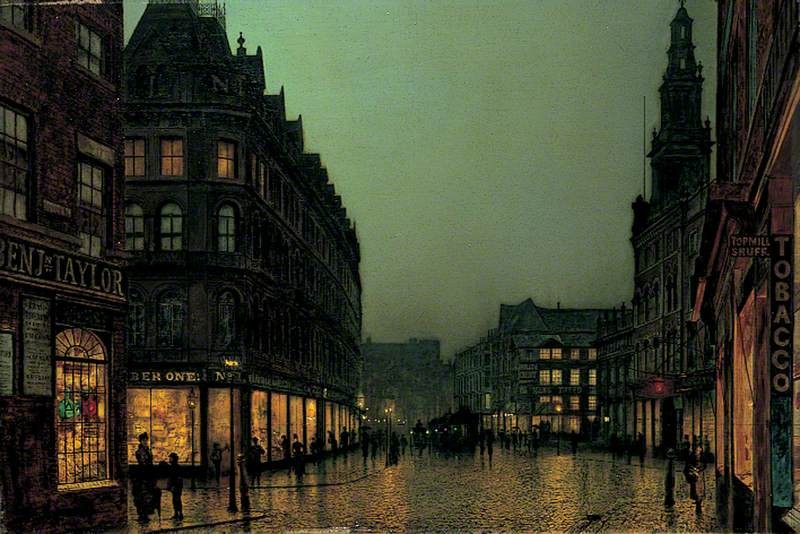
| Boar Lane, Leeds | 1881 | Painting |
| Bowder Stone, Borrowdale | 1865 | Painting |
| Briggate, Leeds | 1891 | Painting |
| 'Burning Off', a Fishing Boat at Scarborough | 1877 | Painting |
| Canny Glasgow | 1887 | Painting |
| Evening Glow | 1884 | Painting |
| Evening Scene by the Docks, Hull | Date unknown | Painting |
| Fiamella | 1883 | Painting |
| Glasgow Docks | 1886 | Painting |
| Gloucester Docks | 1885 | Painting |
| Golden Visions | 1870 | Painting |
| Greenwich, Half Tide | 1884 | Painting |
| In Peril (The Harbour Flare) | 1879 | Painting |
| In the golden gloaming | Date unknown | Painting |
| In the Golden Mists of Autumn | 1884 | Painting |
| In the Golden Olden Times | 1870 | Painting |
| Ingleborough from under White Scar, Yorkshire Limestone Strata | 1868 | Painting |
| Iris | 1886 | Painting |
| Knostrop Old Hall at Dusk | 1870 | Painting |
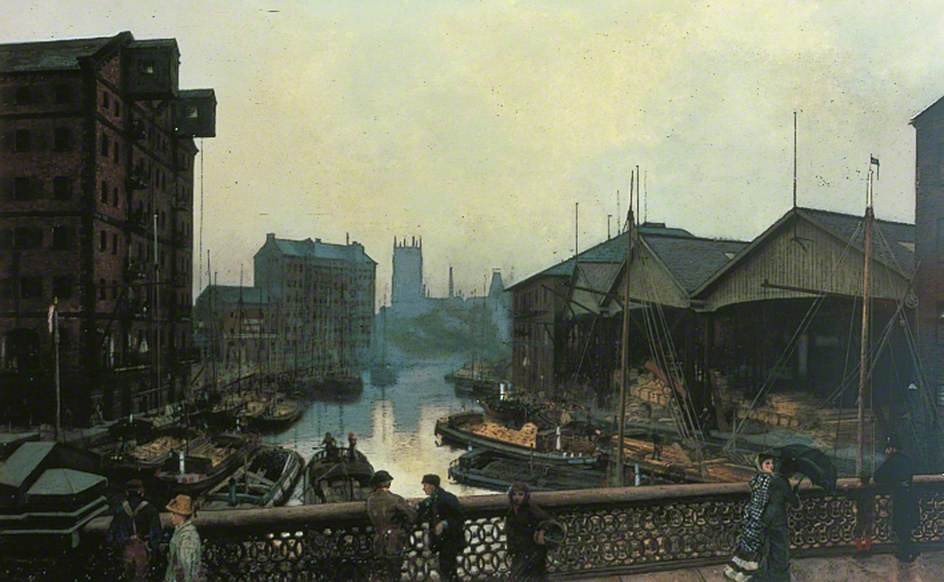
| Leeds Bridge | 1880 | Painting |
| Lights in the Harbour, Scarborough | 1879 | Painting |
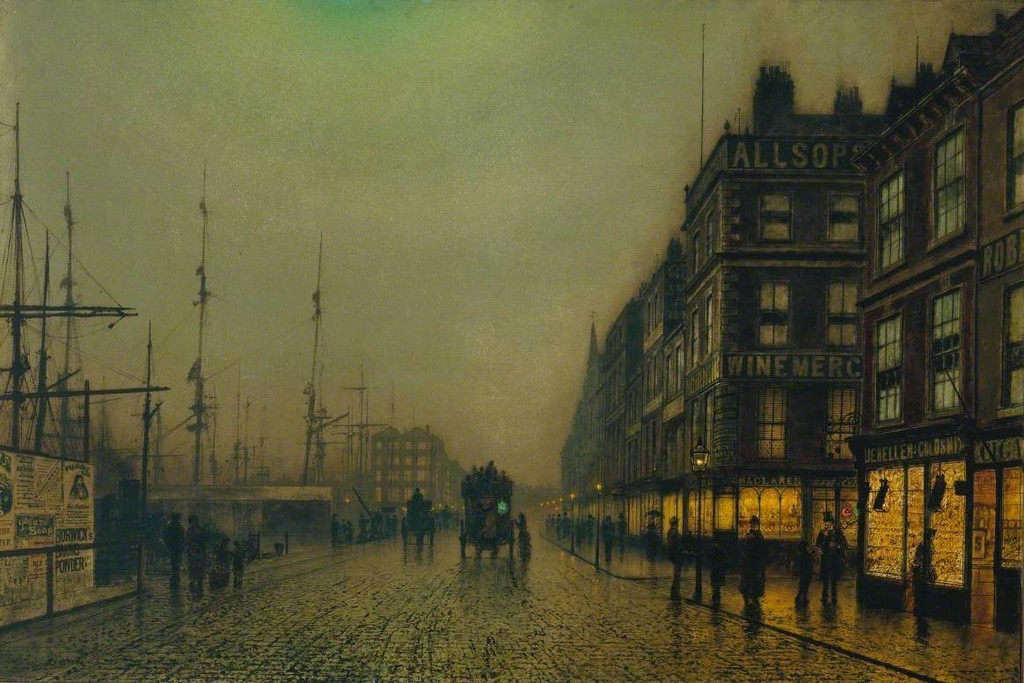
| Liverpool Docks | 1892 | Painting |
| Liverpool Docks by Night | 1892 | Painting |
| Liverpool Docks (panel 1 of 5) | Date unknown | Painting |
| Liverpool Docks (panel 2 of 5) | Date unknown | Painting |
| Liverpool Docks (panel 3 of 5) | Date unknown | Painting |
| Liverpool Docks (panel 4 of 5) | Date unknown | Painting |
| Liverpool Docks (panel 5 of 5) | Date unknown | Painting |
| Liverpool Quay by Moonlight | 1887 | Painting |
| Moonlight Scene near Leeds | 1881 | Painting |
| Night Scene, Rouen | 1893 | Painting |
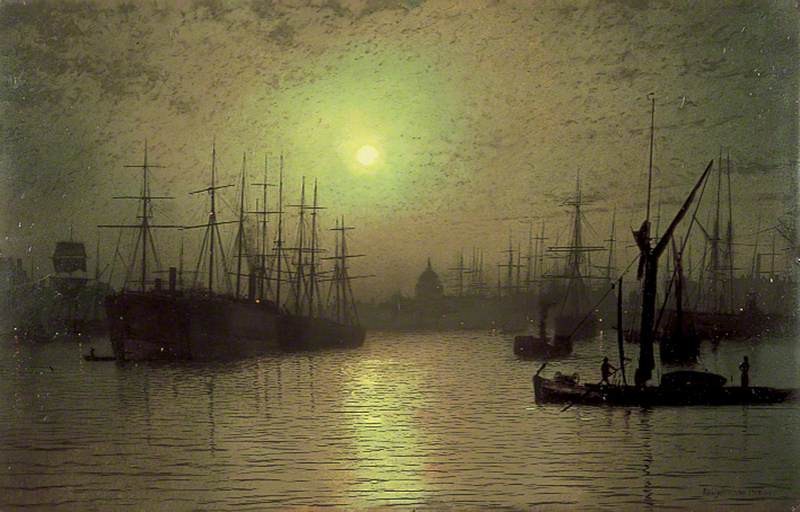
| Nightfall down the Thames | 1880 | Painting |
| Nightfall in Scarborough Harbour, North Yorkshire | 1884 | Painting |
| November Morning, Knostrop Hall, Leeds | 1883 | Painting |
| Old English House by Moonlight | Date unknown | Painting |
| Park Row, Leeds | 1882 | Painting |
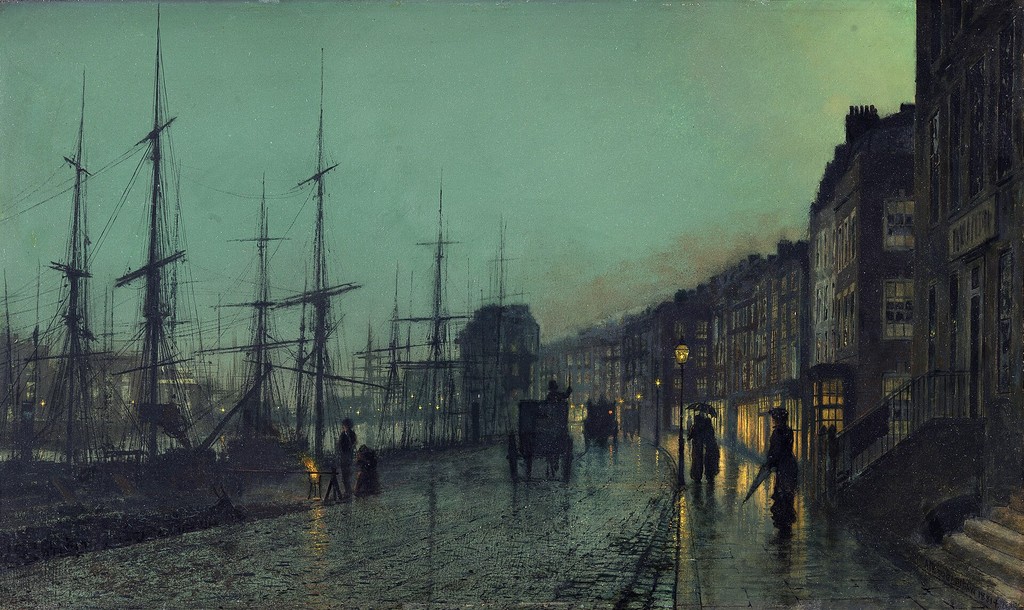
| Princes Dock, Hull | Date unknown | Painting |
| Quai de Paris, Rouen | 1893 | Painting |
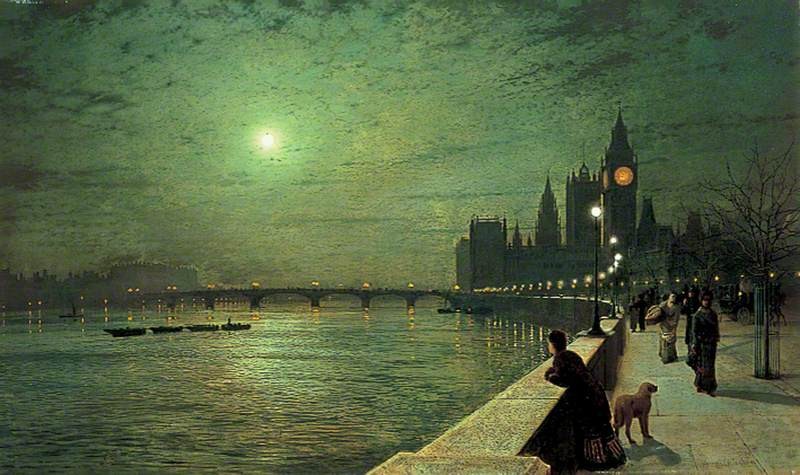
| Reflections on the Thames, Westminster | 1880 | Painting |
| Reflections on the Thames, Westminster, London | 1880 | Painting |
| Roundhay Park Lake | Date unknown | Painting |
| Salthouse Dock, Liverpool | Date unknown | Painting |
| Salthouse Dock, Liverpool, 1884 | Date unknown | Painting |
| Scarborough Lights | 1877 | Painting |
| Shipping on the Clyde | 1881 | Painting |
| Sic transit gloria mundi (The Burning of the Spa Saloon) | 1876 | Painting |
| Silver Moonlight | 1880 | Painting |
| Silver Moonlight | 1886 | Painting |
| Snow and Mist (Caprice in Yellow Minor) | 1892 | Painting |
| Stapleton Park, near Pontefract | Date unknown | Painting |
| Sunday Night, Knostrop Cut, Leeds | 1893 | Painting |
| Thames Moonlight | 1880 | Painting |
| The Custom House, Liverpool, Looking North | Date unknown | Painting |
| The Custom House, Liverpool, Looking South | Date unknown | Painting |
| The Harbour at Whitby by Moonlight | 1879 | Painting |
| The Head of Gertrude Grimshaw | 1874 | Painting |
| 'The Ironbound Shore' | 1869 | Painting |
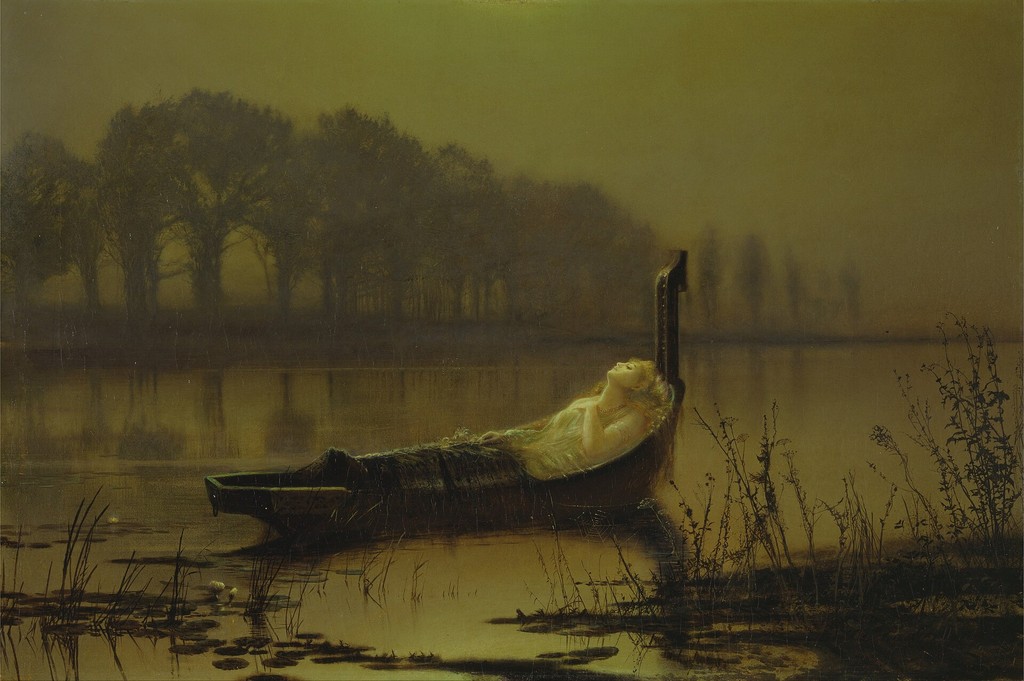
| The Lady of Shalott | 1875 | Painting |
| The Parable of the Lost Sheep | Date unknown | Painting |
| The Rector's Garden, Queen of the Lilies | 1877 | Painting |
| The Seal of the Covenant | 1868 | Painting |
| The Sun's Farewell | Date unknown | Painting |
| The Thames by Moonlight with Southwark Bridge, London | 1884 | Painting |
| Thro' the Wood | Date unknown | Painting |
| Tree Shadows on the Park Wall, Roundhay, Leeds | 1872 | Painting |
| Under the Beeches | 1892 | Painting |
| Under the Silvery Moonbeams | Date unknown | Painting |
| View of Heath Street by Night | 1882 | Painting |
| View of Scarborough | 1876 | Painting |
| View of Southwark Bridge at Night | 1882 | Painting |
| Whitby | 1878 | Painting |
| Whitby Docks | 1876 | Painting |
| Whitby Harbor | 1874 | Painting |
| Windermere | 1863 | Painting |
| Woodland near Leeds | Date unknown | Painting |
| Yew Court, Scalby, near Scarborough | 1875 | Painting |
Frequently Asked Questions
Museo Thyssen-Bornemisza names Arthur, Louis, Wilfred and Elaine Grimshaw as children who also became painters. Leeds Libraries preserves works by Arthur and Elaine in its family collection.[2][4]
Art UK says John’s popular manner was imitated by Arthur and Louis. That close relationship is historically important, but it does not justify assigning every similar nocturne to either son or to their father without object-level evidence.[3]
It is a watercolour sketch of baby Arthur, known as “Arty”, made by John Atkinson Grimshaw. Arthur is the subject, not the artist. The same collection separately catalogues a portrait of Elaine made by Arthur.[4]
Begin with its collection record, provenance, dimensions, support, inscriptions, exhibition history and photographs. Compare style only within that documentary context. A surname, familiar title or moonlit subject is insufficient by itself.
Discussion
Use this evidence-led guide as a starting point for close looking rather than a final verdict.
Share an observation about John Atkinson Grimshaw: Artistic Family and Legacy or a source that adds useful context.
Reader Insights
Which work most clearly complicates the familiar label of painter of moonlight?
Where do place, market, family or literary culture most productively alter your reading?
Which source or surviving object would you investigate next?
Join the Conversation
Add your reading below, keeping observations specific and evidence clear.
References
- Leeds Libraries, “The Portraits of John Atkinson Grimshaw”, accessed 31 August 2026.
- Museo Nacional Thyssen-Bornemisza, John Atkinson Grimshaw artist record, accessed 31 August 2026.
- Art UK, John Atkinson Grimshaw artist authority and public collection record, accessed 31 August 2026.
- Leeds Libraries, The Atkinson Grimshaw Collection research guide, accessed 31 August 2026.
- Scarborough Museums and Galleries, Atkinson Grimshaw: At Home in Yorkshire large-print guide, accessed 31 August 2026.
- The Thoresby Society, “John Atkinson Grimshaw (1836–1893)”, accessed 31 August 2026.
- Leeds Museums and Galleries, Collections Development Policy, accessed 31 August 2026.
- Leeds Museums and Galleries, “Exhibition sheds new light on renowned Leeds artist John Atkinson Grimshaw”, accessed 31 August 2026.