 Buy Art Prints Now
from Amazon
* As an Amazon Associate I earn from qualifying purchases.
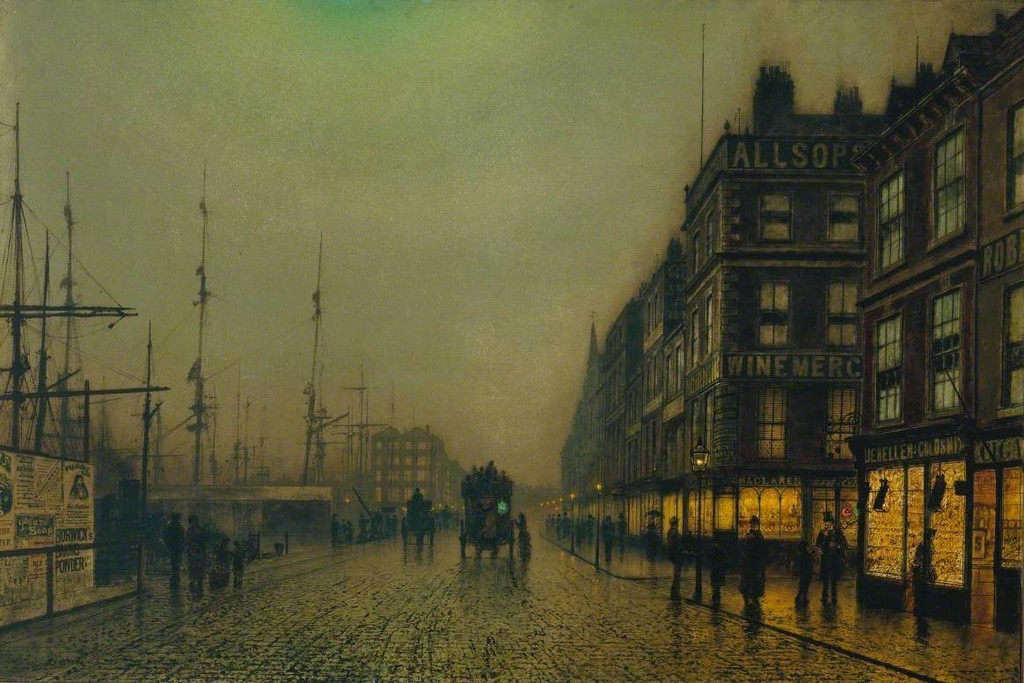
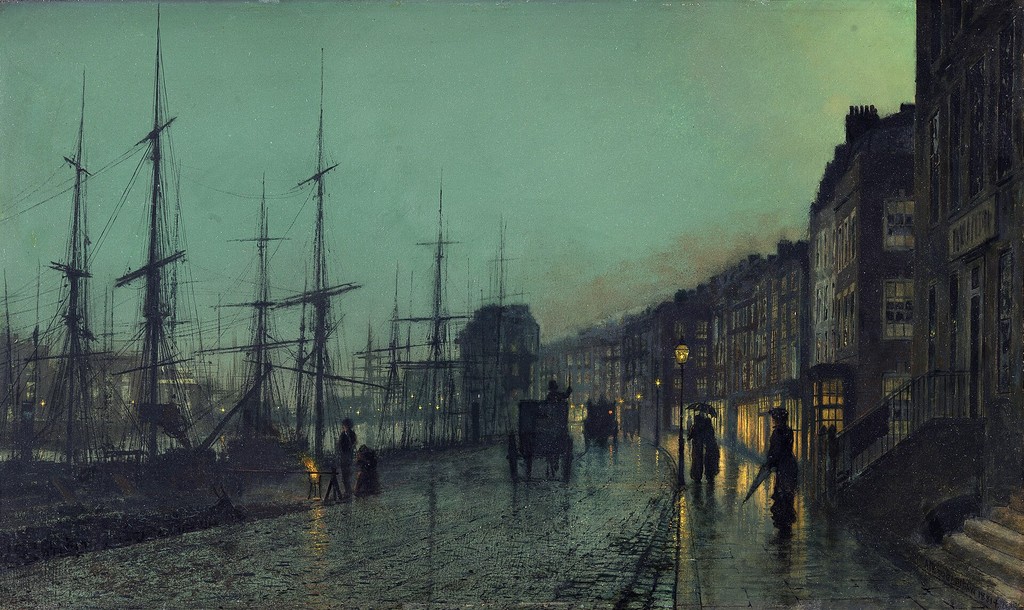
Shipping on the Clyde, 1881 — Carmen Thyssen Collection, public domain.
 by Tom Gurney
Tom Gurney BSc (Hons) is an art history expert with over 20 years experience
Page Created: August 31, 2026 / Page Updated: September 16, 2026
Email: tomgurney1@gmail.com / Phone: +44 7429 011000
Shipping on the Clyde: Introduction
John Atkinson Grimshaw’s Shipping on the Clyde turns a working Glasgow quay into a study of damp air, distance and concentrated warmth. Ships and rigging gather beside a receding street, while fog loosens the outlines of buildings and people. Near the foreground, two dock workers warm themselves at a small fire. Their flame is physically modest but visually decisive: it places human need inside the machinery and commerce of the port.[1]
Painted in 1881, the work belongs to the period in which Grimshaw extended his nocturnal language across northern industrial cities. It does not deny the Clyde’s labour or shipping, yet it selects a hushed interval rather than a crowded spectacle. The balance between documented object, museum interpretation and close observation makes the painting especially useful for understanding how he pictured modern industry.
At a Glance
- TitleShipping on the Clyde
- ArtistJohn Atkinson Grimshaw (1836–1893)
- Date1881
- MediumOil on cardboard or millboard
- Dimensions30.5 × 51 cm
- CollectionCarmen Thyssen Collection, Museo Nacional Thyssen-Bornemisza, accession CTB.1989.28[1][2]
John Atkinson Grimshaw in context
Contents
- Introduction
- Exact Object Record
- A Quay Organised by Distance
- Fire, Workers and Human Scale
- The Clyde as Industrial Setting
- Fog, Moisture and Light
- Morning, Night or Threshold?
- Repetition without Duplication
- A Small Support, a Large World
- Collection and Significance
Exact Object Record
The identified painting is Shipping on the Clyde, made in 1881. Museo Nacional Thyssen-Bornemisza records oil on cardboard; the support is also described as millboard in collection-linked documentation. It measures 30.5 centimetres high by 51 centimetres wide and belongs to the Carmen Thyssen Collection at the museum in Madrid. Its inventory number is CTB.1989.28.[1][2]
A&AePortal independently joins the same title, artist, date, medium, measurements, location and accession.[2] The Commons reproduction carries CTB.1989.28 in its object and embedded image metadata, tying the digital file to this painting rather than to another Clyde subject matched by appearance.[3]
The accession is the clearest safeguard against loose naming. Grimshaw painted several Glasgow and harbour scenes, including the later Canny Glasgow. CTB.1989.28 identifies this particular small-format work even when translated titles or abbreviated captions vary.
A Quay Organised by Distance
Close looking shows a composition that moves steadily away from the viewer. The quay provides a long horizontal route, while façades on one side and ships on the other create a corridor. Vertical masts and rigging repeatedly interrupt that recession. They identify maritime activity without requiring a detailed inventory of every vessel.[3]
The low format reinforces lateral movement. At 51 centimetres wide and 30.5 high, the support gives more space to the extension of waterfront and street than to open sky.[2] The viewer encounters the port as a connected strip of labour, transport and architecture rather than as a single monumental ship portrait.
Fog prevents the perspective from becoming diagrammatic. Near forms retain weight, but contrast diminishes into the background. The eye can follow the road while never arriving at a fully clarified endpoint. This is a visible pictorial relation, not proof that Grimshaw copied one uninterrupted topographical view.
Fire, Workers and Human Scale
Museo Thyssen identifies two dock workers beside a small roadside fire.[1] Their presence changes the painting’s social register. The port is not empty, and the fire is not merely decorative colour. It suggests cold, damp working conditions and a pause within labour, while the workers provide a scale against the quay and ships.
The flame produces the picture’s sharpest warm concentration. It flickers against cooler grey-green and brown surroundings and is echoed more faintly by lights farther along the waterfront. That contrast draws attention without turning the men into heroic protagonists. They remain part of a larger commercial environment.
Nothing in the cited record supplies their names, exact jobs or conversation. Assigning a narrative beyond warming themselves would be invention. Their visible action is enough: in a painting sometimes praised for lyrical atmosphere, bodily discomfort remains present.
The Clyde as Industrial Setting
The museum’s object essay places the scene within Glasgow’s commercial history. It describes a port expanded through trade in tobacco, sugar, cotton and other goods, followed by river engineering and major nineteenth-century shipbuilding. Employment at docks and railways accompanied rapid population growth.[1]
This context explains the density of maritime forms, but the painting is not a statistical survey. It gives no complete account of shipyards, cargoes, housing or the environmental cost of industry. Grimshaw chose an interval in which economic infrastructure is visible through haze. The ports and docklands guide restores the broader network connecting Glasgow with Liverpool, Hull and other working harbours.
Museo Thyssen calls Grimshaw’s port compositions lyrical evocations of the industrial era.[1] “Lyrical” describes their controlled mood; it should not turn the Clyde into timeless scenery. Ships, quayside buildings and dock workers keep the image attached to a specific modern economy.
Fog, Moisture and Light
The museum interpretation stresses Grimshaw’s ability to suggest the chill of fog and damp air.[1] In visual terms, this depends on reduced contrast and softened boundaries. Distant structures share close values, while nearer elements emerge more distinctly. Atmosphere appears to occupy the space between viewer, people, masts and buildings.
Wet ground extends the effect. Small sources become longer, broken marks in the quay’s surface. The fire remains local, but its surrounding warmth seems larger because nearby moisture returns some of its colour. Darker patches interrupt any simple mirror image, making reflection an uneven event.
Grimshaw’s technique, light and photography essay separates this visible organisation from disputed claims about optical tools. The crisp recession of a street or a photographic-looking crop does not, by itself, establish a camera, lens or transfer procedure.
Morning, Night or Threshold?
Museo Thyssen describes the sparse figures as inhabiting the first hours of a foggy morning.[1] A&AePortal connects the image with the subject of night in art.[2] These classifications are not necessarily irreconcilable: low natural light, mist and surviving lamps can belong to a transition between night and day.
The painting’s title does not specify an hour. Close observation can identify subdued illumination, isolated firelight and a sky without full daylight clarity, but it cannot supply a clock time. “Early morning” is best retained as the museum’s interpretation rather than converted into an unqualified fact.
This temporal uncertainty is productive. Grimshaw specialised in conditions when visibility changes and artificial sources remain important. The moonlight and nocturnes essay shows how twilight, dawn and fog sit beside explicitly moonlit scenes in his larger practice.
Repetition without Duplication
Grimshaw returned often to harbour roads, wet paving, masts and small figures. Scarborough Museums connects repeated nocturnal subjects with a dependable private market and notes the rapid pace demanded by his financial pressures in the early 1880s.[4] Shipping on the Clyde belongs to that commercial world without becoming interchangeable with every port scene.
Museo Thyssen’s broader artist record names Glasgow among the cities and ports he treated most often and notes that private clients were central to his career.[6] Repetition therefore belongs to both sustained geographic interest and the practical conditions of selling paintings.
Tate’s later Liverpool Quay by Moonlight uses a straight street, an omnibus, shopfront glow and wet cobbles.[5] The comparison reveals shared devices but also different centres of attention. Liverpool’s commercial frontage and vehicle lead the eye; on the Clyde, the roadside fire and paired workers create a more intimate foreground event.
Related motifs should therefore encourage object comparison, not a claim of mechanical duplication. Date, support, dimensions, accession and specific arrangement keep Shipping on the Clyde distinct. The paintings and artworks guide offers the wider corpus while preserving those identities.
A Small Support, a Large World
The work’s cardboard or millboard support is comparatively compact, yet it contains a substantial industrial setting.[1][2] Scale does not prevent breadth. Grimshaw compresses river, street, shipping, buildings, weather and people into a format that can still feel expansive because recession continues beyond the most legible forms.
The support record is a material fact; the reasons for selecting it are not documented in the sources used here. It may be tempting to connect rigid board directly to speed or portability, but that would require object-specific technical evidence. What can be said is that oil on this support carries both fine vertical accents and broad atmospheric transitions.
The image also complicates the notion that industrial painting must be monumental. Grimshaw makes scale perceptual rather than physical. Ships loom through their masts, the quay lengthens through perspective, and fog implies space that the small panel cannot describe sharply.
Collection and Significance
The Carmen Thyssen Collection owns Shipping on the Clyde, and Museo Nacional Thyssen-Bornemisza maintains its current object record under CTB.1989.28.[1][2] The collection page identifies the work as not currently exhibited, so its online record is especially important for exact study without implying that it is on view.[1]
Its significance lies in the union of port history and restrained human observation. The Clyde’s commercial power is present through shipping and architecture. Two workers and a fire introduce bodily scale. Fog joins these elements without erasing their differences.
Among Grimshaw’s mature works, the painting is a concise demonstration of selection. It neither celebrates industry uncritically nor provides a full record of hardship. Instead, it shows how modern work, weather and artificial light could occupy the same quiet image. That tension gives Shipping on the Clyde its continuing force.
Researched works directory
This searchable evidence census contains 88 distinct records assembled from public collection data and a reproducible Wikidata snapshot. It is not a catalogue raisonné, not a claim of complete oeuvre coverage, and it keeps works with repeated titles as separate objects.
| Name | Date | Medium |
|---|---|---|
| A Dead Linnet | 1862 | Painting |
| A House in a Clearing | 1870 | Painting |
| A Moonlit Evening | 1880 | Painting |
| A Moonlit Lane | 1874 | Painting |
| A Mossy Glen | 1864 | Painting |
| A View of Hampstead, London | 1882 | Painting |
| A Wooded Valley | Date unknown | Painting |
| A Yorkshire Home | 1878 | Painting |
| An Autumn Idyll | 1885 | Painting |
| Autumn Glory: The Old Mill | 1869 | Painting |
| Autumn Regrets | 1882 | Painting |
| Baiting the Lines, Whitby | 1884 | Painting |
| Boar Lane, Leeds | 1881 | Painting |
| Bowder Stone, Borrowdale | 1865 | Painting |
| Briggate, Leeds | 1891 | Painting |
| 'Burning Off', a Fishing Boat at Scarborough | 1877 | Painting |
| Canny Glasgow | 1887 | Painting |
| Evening Glow | 1884 | Painting |
| Evening Scene by the Docks, Hull | Date unknown | Painting |
| Fiamella | 1883 | Painting |
| Glasgow Docks | 1886 | Painting |
| Gloucester Docks | 1885 | Painting |
| Golden Visions | 1870 | Painting |
| Greenwich, Half Tide | 1884 | Painting |
| In Peril (The Harbour Flare) | 1879 | Painting |
| In the golden gloaming | Date unknown | Painting |
| In the Golden Mists of Autumn | 1884 | Painting |
| In the Golden Olden Times | 1870 | Painting |
| Ingleborough from under White Scar, Yorkshire Limestone Strata | 1868 | Painting |
| Iris | 1886 | Painting |
| Knostrop Old Hall at Dusk | 1870 | Painting |
| Leeds Bridge | 1880 | Painting |
| Lights in the Harbour, Scarborough | 1879 | Painting |
| Liverpool Docks | 1892 | Painting |
| Liverpool Docks by Night | 1892 | Painting |
| Liverpool Docks (panel 1 of 5) | Date unknown | Painting |
| Liverpool Docks (panel 2 of 5) | Date unknown | Painting |
| Liverpool Docks (panel 3 of 5) | Date unknown | Painting |
| Liverpool Docks (panel 4 of 5) | Date unknown | Painting |
| Liverpool Docks (panel 5 of 5) | Date unknown | Painting |
| Liverpool Quay by Moonlight | 1887 | Painting |
| Moonlight Scene near Leeds | 1881 | Painting |
| Night Scene, Rouen | 1893 | Painting |
| Nightfall down the Thames | 1880 | Painting |
| Nightfall in Scarborough Harbour, North Yorkshire | 1884 | Painting |
| November Morning, Knostrop Hall, Leeds | 1883 | Painting |
| Old English House by Moonlight | Date unknown | Painting |
| Park Row, Leeds | 1882 | Painting |
| Princes Dock, Hull | Date unknown | Painting |
| Quai de Paris, Rouen | 1893 | Painting |
| Reflections on the Thames, Westminster | 1880 | Painting |
| Reflections on the Thames, Westminster, London | 1880 | Painting |
| Roundhay Park Lake | Date unknown | Painting |
| Salthouse Dock, Liverpool | Date unknown | Painting |
| Salthouse Dock, Liverpool, 1884 | Date unknown | Painting |
| Scarborough Lights | 1877 | Painting |
| Shipping on the Clyde | 1881 | Painting |
| Sic transit gloria mundi (The Burning of the Spa Saloon) | 1876 | Painting |
| Silver Moonlight | 1880 | Painting |
| Silver Moonlight | 1886 | Painting |
| Snow and Mist (Caprice in Yellow Minor) | 1892 | Painting |
| Stapleton Park, near Pontefract | Date unknown | Painting |
| Sunday Night, Knostrop Cut, Leeds | 1893 | Painting |
| Thames Moonlight | 1880 | Painting |
| The Custom House, Liverpool, Looking North | Date unknown | Painting |
| The Custom House, Liverpool, Looking South | Date unknown | Painting |
| The Harbour at Whitby by Moonlight | 1879 | Painting |
| The Head of Gertrude Grimshaw | 1874 | Painting |
| 'The Ironbound Shore' | 1869 | Painting |
| The Lady of Shalott | 1875 | Painting |
| The Parable of the Lost Sheep | Date unknown | Painting |
| The Rector's Garden, Queen of the Lilies | 1877 | Painting |
| The Seal of the Covenant | 1868 | Painting |
| The Sun's Farewell | Date unknown | Painting |
| The Thames by Moonlight with Southwark Bridge, London | 1884 | Painting |
| Thro' the Wood | Date unknown | Painting |
| Tree Shadows on the Park Wall, Roundhay, Leeds | 1872 | Painting |
| Under the Beeches | 1892 | Painting |
| Under the Silvery Moonbeams | Date unknown | Painting |
| View of Heath Street by Night | 1882 | Painting |
| View of Scarborough | 1876 | Painting |
| View of Southwark Bridge at Night | 1882 | Painting |
| Whitby | 1878 | Painting |
| Whitby Docks | 1876 | Painting |
| Whitby Harbor | 1874 | Painting |
| Windermere | 1863 | Painting |
| Woodland near Leeds | Date unknown | Painting |
| Yew Court, Scalby, near Scarborough | 1875 | Painting |
Frequently Asked Questions
It is dated 1881. Museo Thyssen, A&AePortal and the exact Commons record agree on that year.[1][2][3]
It is oil on cardboard, also described as millboard. The painting measures 30.5 × 51 centimetres.[1][2]
It belongs to the Carmen Thyssen Collection at Museo Nacional Thyssen-Bornemisza in Madrid. Its accession number is CTB.1989.28.[1][2]
The museum identifies them as dock workers warming themselves. Their individual names and more specific occupations are not supplied by the cited record.[1]
Discussion
Use this evidence-led guide as a starting point for close looking rather than a final verdict.
Share an observation about Shipping on the Clyde or a source that adds useful context.
Reader Insights
Which visible detail most changes your reading of Shipping on the Clyde?
How do medium, scale, setting and current museum evidence shape the encounter?
What remains uncertain once documented fact is separated from visual inference?
Join the Conversation
Add your reading below, keeping observations specific and evidence clear.
References
- Museo Nacional Thyssen-Bornemisza, Shipping on the Clyde, accessed 31 August 2026.
- A&AePortal, Shipping on the Clyde image record, accessed 31 August 2026.
- Wikimedia Commons, exact file record for Shipping on the Clyde, accessed 31 August 2026.
- Scarborough Museums and Galleries, Atkinson Grimshaw: At Home in Yorkshire large-print guide, accessed 31 August 2026.
- Tate, Liverpool Quay by Moonlight, accessed 31 August 2026.
- Museo Nacional Thyssen-Bornemisza, John Atkinson Grimshaw artist record, accessed 31 August 2026.