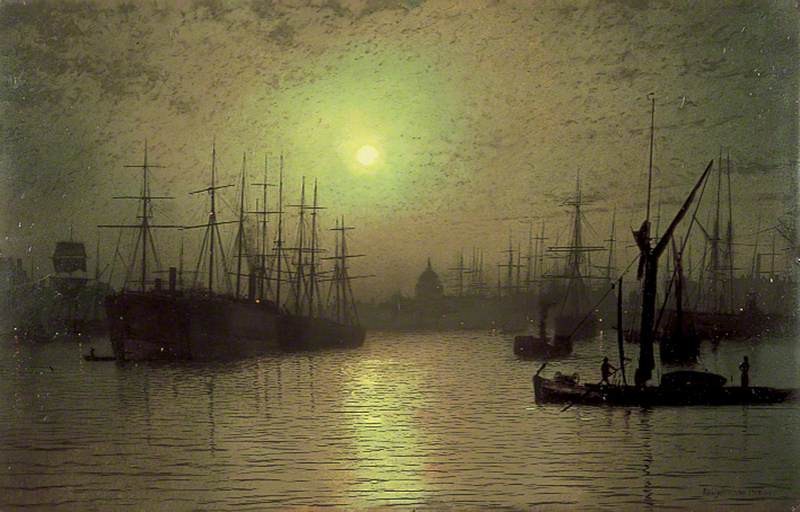
 Buy Art Prints Now
from Amazon
* As an Amazon Associate I earn from qualifying purchases.
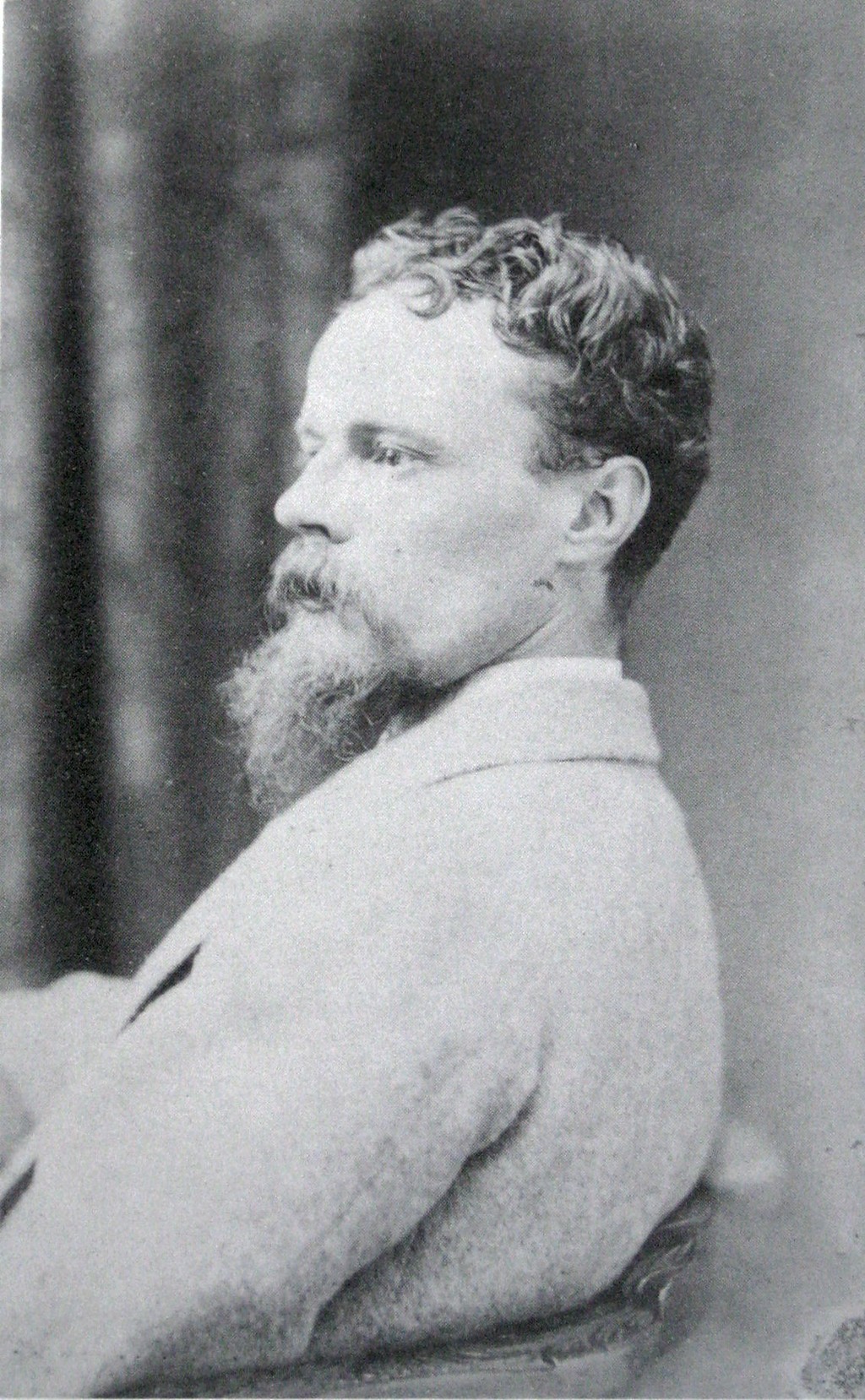
Portrait of John Atkinson Grimshaw, 1870 — public domain.
 by Tom Gurney
Tom Gurney BSc (Hons) is an art history expert with over 20 years experience
Page Created: August 31, 2026 / Page Updated: September 16, 2026
Email: tomgurney1@gmail.com / Phone: +44 7429 011000
John Atkinson Grimshaw: Introduction
John Atkinson Grimshaw made Victorian Britain glow after dark. Moonlight crosses cloud and mist; gas lamps divide a wet street into points of amber; ships, warehouses and lone figures emerge from harbour fog. These scenes made his reputation, yet they are only one part of a career that began with exact studies of birds, blossom and Yorkshire landscape and later expanded into interiors, portraits, literary subjects and winter views. Grimshaw’s distinctive achievement was to make modern cities and working ports feel both materially specific and strangely suspended in time.[1][3][5]
At a Glance
- Born6 September 1836, Leeds, England
- Died31 October 1893, Knostrop Old Hall, Leeds
- Known forMoonlit streets, river views, harbours and seasonal landscapes
- Working placesLeeds, Scarborough, Whitby, Liverpool, Glasgow, Hull and London
- CareerRailway clerk turned self-taught professional painter
- Essential worksBoar Lane, Leeds, Reflections on the Thames and Shipping on the Clyde
John Atkinson Grimshaw in context
Pre-Raphaelite Brotherhood
1848–c.1854Aesthetic Movement
c.1860–1900Impressionism
c.1860–1886Symbolism
c.1880–1910John William Inchbold
1830–1888James McNeill Whistler
1834–1903John Atkinson Grimshaw
1836–1893James Tissot
1836–1902Claude Monet
1840–1926Arthur E. Grimshaw
1864–1913Contents
- Introduction
- Why Grimshaw Matters
- From Railway Office to Studio
- Leeds and Yorkshire
- Moonlight and Modern Streets
- Ports and the Thames
- Technique, Light and Lenses
- Landscapes, Interiors and Stories
- Family, Attribution and Legacy
- How to Explore the Work
Why Grimshaw Matters
Grimshaw found pictorial drama in conditions that many painters treated as obstacles: dusk, fog, rain, smoke and artificial light. His best-known works do not simply record how a Victorian street looked. They organise visibility itself. A pavement may be legible only where a shop window catches it; a river opens through a band of reflected light; branches become a dark screen against a luminous sky. The scenes reward slow looking because their apparent stillness depends on precise contrasts between what can and cannot be seen.
This concentration on reduced light also offered a way to picture industrial modernity without turning every canvas into a literal inventory of mills and machines. The ports and docklands guide shows how warehouses, traffic and maritime trade remain present even when atmosphere softens their edges. The Leeds Museums learning resource for Leeds Bridge is especially useful here: warehouses, boats, workers and a policeman make the river scene evidence of economic life, while Grimshaw’s still water and muted sky shape its emotional register.[9]
His value is not limited to urban history. Early naturalism, literary interiors and late snow paintings complicate the familiar label “painter of moonlight”. The paintings and artworks hub brings those strands together, while the researched directory records 88 item-identified works found through a dated public-data census. That directory is a discovery aid, not a catalogue raisonné.
From Railway Office to Studio
Grimshaw was born in Leeds in 1836 and worked as a clerk for the Great Northern Railway. The current Scarborough Museums guide dates his move into full-time painting to 1861, encouraged by his wife Frances Theodosia Hubbarde. A known Leeds exhibition followed in 1862.[4] He did not pass through a conventional academy, but “self-taught” should not suggest an artist without models. His early work reflects the Victorian demand for close attention to nature, including the influence of John Ruskin’s ideas and the detailed example of the Leeds painter John William Inchbold.[5]
The change of career was a practical risk as well as a declaration of ambition. Painting had to support a growing household, and Grimshaw adapted subjects and methods to the market throughout his life. The biography follows that balance between experiment, commercial pressure, public reputation and private debt. It also keeps documented chronology separate from the anecdotes that have gathered around an artist who left fewer easily accessible personal statements than some of his contemporaries.
By the later 1860s Grimshaw had begun to develop the moonlit scenes that would become his signature. Scarborough Museums identifies a 1867 view of Whitby Harbour as his first known moonlight painting.[4] The date matters because it places the invention within a longer development from observed landscape rather than presenting the nocturne as a sudden formula.
Leeds and Yorkshire
Leeds was Grimshaw’s birthplace, market and recurrent subject. He lived first in the city’s working districts, then at a villa near Headingley, and from 1870 at Knostrop Old Hall east of the centre. The Thoresby Society’s local history connects the Headingley period with walks, wild flowers and nearby wooded lanes, while Knostrop became both a family home and a repeated pictorial setting.[12] Leeds Museums and Galleries now identifies Grimshaw as the artist most strongly associated with its holdings and states that the collection is the largest in public ownership.[2]
His Leeds pictures span different urban experiences. Boar Lane, Leeds turns a commercial street into a long corridor of wet reflections, lamps, vehicles and pedestrians. Park Row, Leeds looks along another recognisable city route. Leeds Bridge opens towards warehouses and river traffic. These are not interchangeable “Victorian scenes”: each joins a particular kind of place to a carefully controlled light effect. The dedicated Leeds and Yorkshire essay places them beside woodland, Knostrop and the coastal towns that broadened his working geography.
Scarborough became a second centre in the 1870s. Grimshaw rented a house he called Castle-by-the-Sea and studied light across the harbour and Yorkshire coast. The museum guide links the move to a period of family loss and dates his departure from the house to 1879, when serious debts forced retrenchment.[4] Scarborough, Whitby and nearby villages supplied harbours, shorelines and actual buildings as well as poetic settings. The result was not a retreat from modern life but another place where commerce, weather, architecture and water met.
Moonlight and Modern Streets
Grimshaw called many of his night pictures “moonlights”. Their visual system combines a cool, often green or silver sky with warmer artificial sources. A lamp, window or small fire establishes local brightness; damp stone and water repeat it in broken reflections; silhouetted branches or masts divide the remaining light. The moonlight and nocturnes guide examines these elements without reducing every scene to a single recipe.
Repetition was part of the practice. Scarborough Museums notes that the popularity of moonlight subjects led Grimshaw to revisit similar compositions, while the current Leeds exhibition frames his nocturnes as unexpectedly modern studies of natural and artificial illumination.[3][4] Repeated motifs need not imply mechanical copying. Changes in viewpoint, traffic, season, colour and weather alter how a familiar street functions.
Art UK’s Oxford authority text records James McNeill Whistler’s admiration for Grimshaw’s moonlit pictures and contrasts their sharp focus with Whistler’s more dissolved nocturnes.[1] The comparison is useful when kept specific. Both artists made darkness a positive pictorial field, but Grimshaw’s fine-edged branches, cobbles and façades often preserve more descriptive information. His streets can feel dreamlike while remaining insistently constructed.
Ports and the Thames
Liverpool, Glasgow and Hull gave Grimshaw a different urban stage. Ships and masts rise beyond shopfronts; figures move along commercial streets; river light competes with lamps and fires. In Shipping on the Clyde of 1881, small human figures and a roadside glow occupy the foreground while boats and buildings recede into the Glasgow atmosphere.[6] Museo Thyssen-Bornemisza identifies ports including Glasgow, Liverpool, Leeds, Scarborough, Whitby and London as recurring subjects and emphasises the breadth beyond night scenes.[5]
The industrial setting is never erased, but its visual treatment is selective. Grimshaw often shows the circulation around trade rather than the interior machinery of production. Carts, omnibus traffic, stacked forms, river crossings and warehouse fronts suggest movement and labour; mist turns that movement into measured intervals. Liverpool Quay by Moonlight and related dock views make this balance especially clear.[7]
London provided bridges, embankments, suburban lanes and the Thames. Reflections on the Thames, Westminster, London spreads a broad field of water beneath the city, using lamps and reflections to connect near darkness with distant architecture. The London and the Thames guide compares such river scenes with the more enclosed geometry of streets and bridges, including Tate's View of Heath Street by Night.[8]
Technique, Light and Lenses
Grimshaw’s surfaces can appear smooth and tightly controlled, especially beside painters who foreground separate brushstrokes. That finish contributes to the peculiar clarity of his night scenes. Thin branches, carriage wheels and architectural edges remain readable, while glazes or close tonal transitions build the surrounding air. Colour is equally structural: green, amber, grey and blue are not merely atmospheric decorations but cues that separate natural from artificial light.
Museo Thyssen-Bornemisza notes Grimshaw’s interest in photography and the possibility that he used a camera obscura to develop compositions.[5] Possibility is the responsible word. An unusually exact perspective or a photographic-looking crop does not by itself prove a particular device. The technique, light and photography essay distinguishes documented context from visual inference and asks a more useful question: how do framing, repeated viewpoints, smooth handling and controlled focus shape the finished image?
Commercial pressure also affected technique. Scarborough Museums reports that, after returning to Leeds in debt, Grimshaw was producing about a painting a week in the early 1880s.[4] A stable repertoire of formats, subjects and light effects could make that pace possible. Yet the late move into much lighter snow scenes shows that efficiency did not end experiment.
Landscapes, Interiors and Stories
Before the famous dock scenes, Grimshaw painted fruit, birds, blossom, woodland and geological detail. Works such as A Dead Linnet, A Mossy Glen and Ingleborough from under White Scar belong to a culture of exact natural observation. Autumn remained important throughout the career: fallen leaves, bare branches and low light became both subjects and devices for organising a view. The landscapes and seasons guide follows that continuity into the late snow paintings documented by Scarborough Museums.[4]
Figure paintings and interiors reveal another kind of construction. Leeds Libraries describes fashionable women placed among patterned textiles, Japanese objects, plants and carefully lit rooms at Knostrop and Castle-by-the-Sea.[11] In these pictures, décor is not passive background. Fans, ceramics, wallpaper and foliage make dense fields against which a figure’s pose becomes legible.
Titles connect many works to poetry and story. Leeds Libraries notes Grimshaw’s admiration for Tennyson and his use of names or phrases from Milton, Wordsworth, Shelley and Browning.[11] Iris gives the literary-classical strand a particularly vivid form. Leeds Museums explains the story inscribed on the painting’s reverse, identifies its 1886 Royal Academy exhibition and describes its gold, autumn colour and reflected light.[10] The figures, interiors and literature guide treats these subjects as part of the career rather than curious exceptions to the nocturnes.
Family, Attribution and Legacy
Several of Grimshaw’s children also became artists. Museo Thyssen-Bornemisza names Arthur, Louis, Wilfred and Elaine; Art UK cautions that Arthur and Louis in particular imitated their father’s manner.[1][5] This makes attribution discipline essential. A moonlit lane signed or catalogued under another Grimshaw cannot be used as evidence for John Atkinson Grimshaw merely because the style resembles his.
The family’s creative activity extended beyond painting. Leeds Libraries describes Arthur as an artist and musician who became the first choirmaster and organist of Leeds Cathedral, and notes that the local Grimshaw Collection includes works and archival material connected with several family members.[11] The artistic family and legacy guide keeps those identities separate while showing how the household helped carry the name into the twentieth century.
Grimshaw’s reputation has endured because his pictures serve several kinds of attention at once. They are records of Victorian places, demonstrations of difficult light effects and mood-rich images that do not surrender all their information immediately. Museum displays in Leeds and Scarborough continue to test the familiar “painter of moonlight” identity against early landscape, portraits, interiors, classical subjects and late experiments.[3][4]
How to Explore the Work
Begin with the biography and the paintings and artworks hub. Then compare one city theme with one exact-object study. Boar Lane, Leeds reveals how a named commercial street becomes a nocturnal corridor; Shipping on the Clyde shifts the balance towards water, trade and harbour light.
Use the researched works directory below as an index of publicly identified objects, not as proof of total output. It currently contains 88 distinct Wikidata items with creator statements for John Atkinson Grimshaw. Repeated titles can describe separate paintings, titles and dates can vary between records, and many privately held works remain outside public datasets. Those limits are part of responsible discovery rather than reasons to disguise uncertainty.
Follow John Atkinson Grimshaw's career through four stages
Railway work, self-education and exact nature
Born in Leeds, Grimshaw painted while employed as a railway clerk and became a full-time artist in 1861. Early birds, blossom, rock and landscape show close natural observation shaped by Ruskinian and Pre-Raphaelite ideas.
Knostrop, Yorkshire and a nocturnal language
A first known Whitby moonlight in 1867 preceded the move to Knostrop Old Hall. Cool skies, bare branches and warm artificial light became a flexible language for Leeds streets, lanes, water and autumn.
Scarborough, family loss, debt and working harbours
Castle-by-the-Sea widened Grimshaw's coastal subjects and connected atmospheric painting to fishing and harbour activity. Financial pressure ended the Scarborough years in 1879 and intensified production.
The Thames, mature nocturnes and a wider final range
A London studio brought Westminster, Chelsea and the Thames into the repertoire. Port scenes, interiors, literary subjects and late snow paintings show continuing experiment until Grimshaw's death at Knostrop in 1893.
Essential works
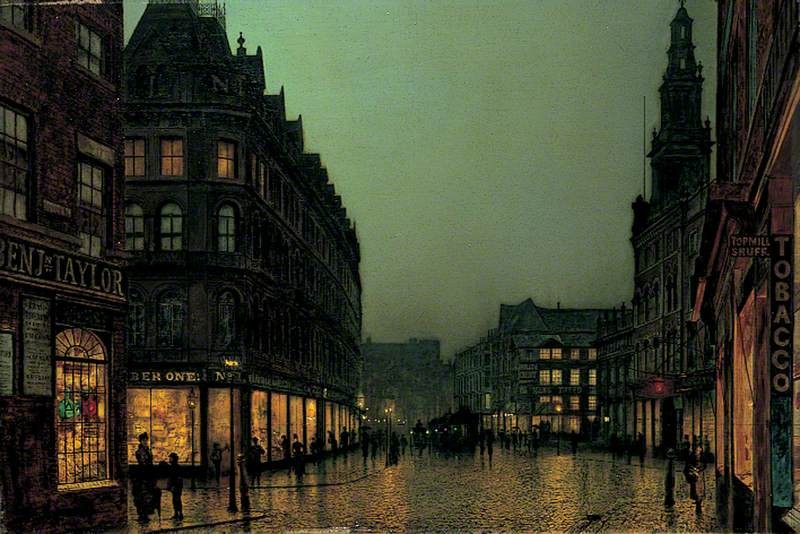
Boar Lane, Leeds
c.1879 · A commercial Leeds street becomes a corridor of lamps, vehicles, pedestrians and wet reflections.
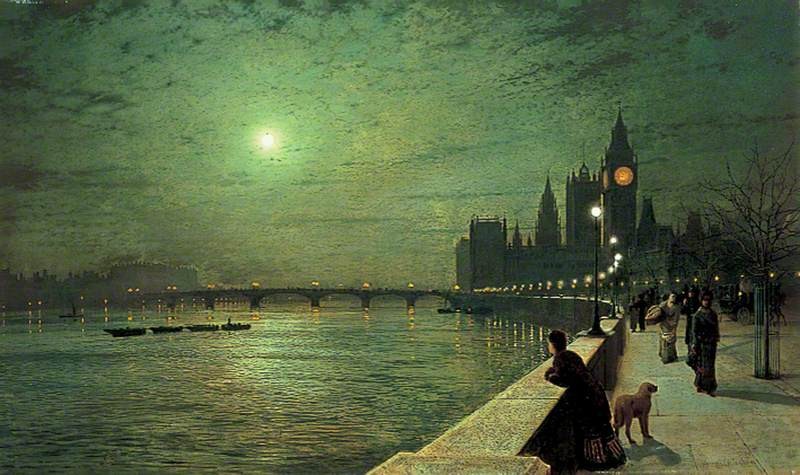
Reflections on the Thames
1880 · Water, distant architecture and repeated points of light turn Westminster into a measured nocturnal field.
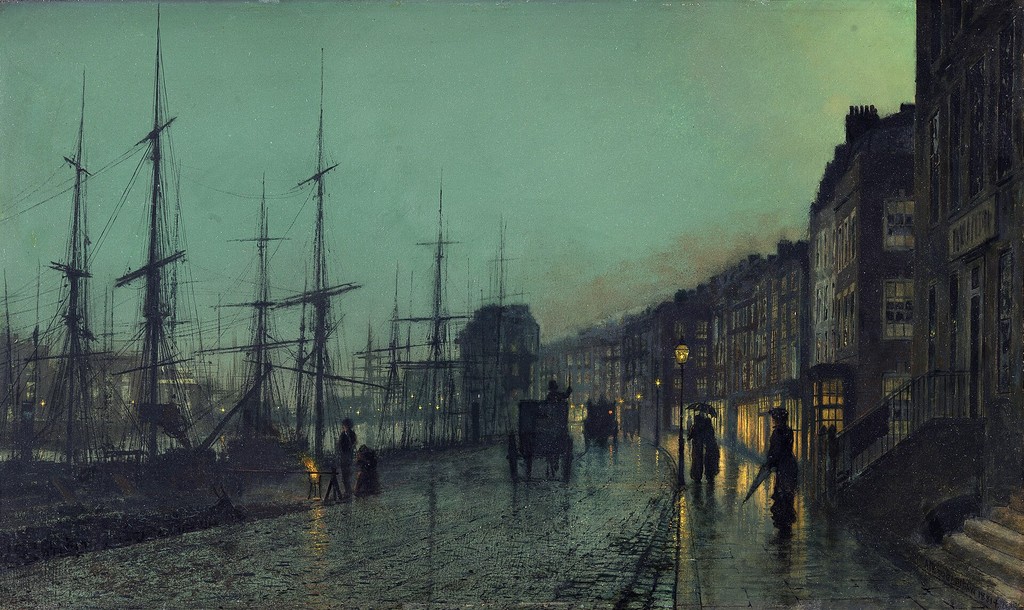
Shipping on the Clyde
1881 · Ships, figures and a foreground glow join working trade to the atmospheric Glasgow waterfront.
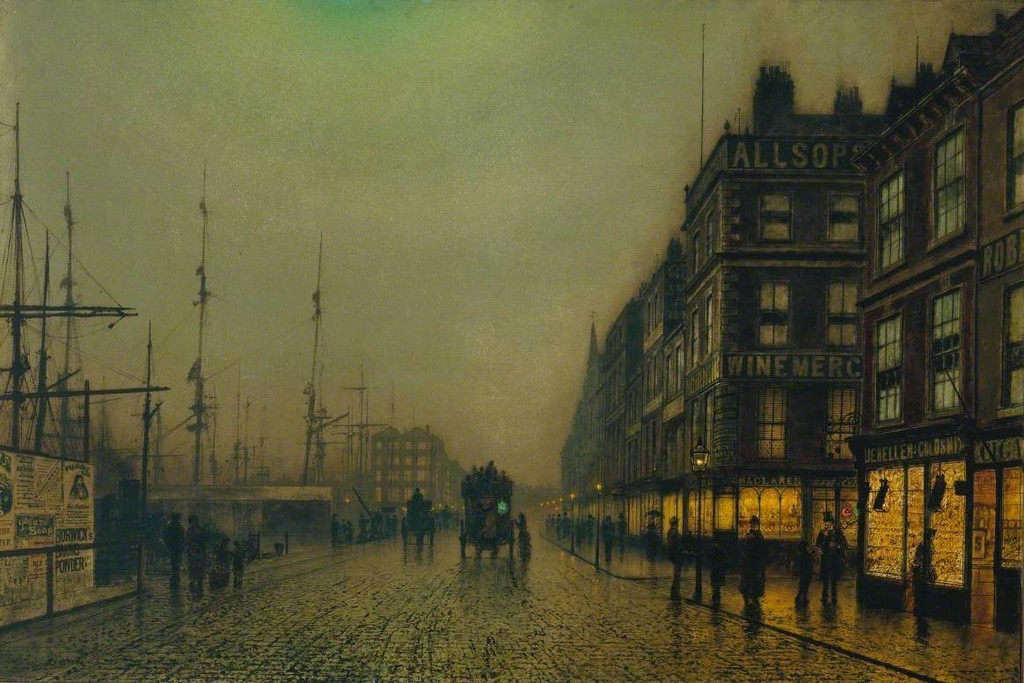
Liverpool Quay by Moonlight
1887 · Shopfront light passes through fog and returns from wet cobbles along a working quay.
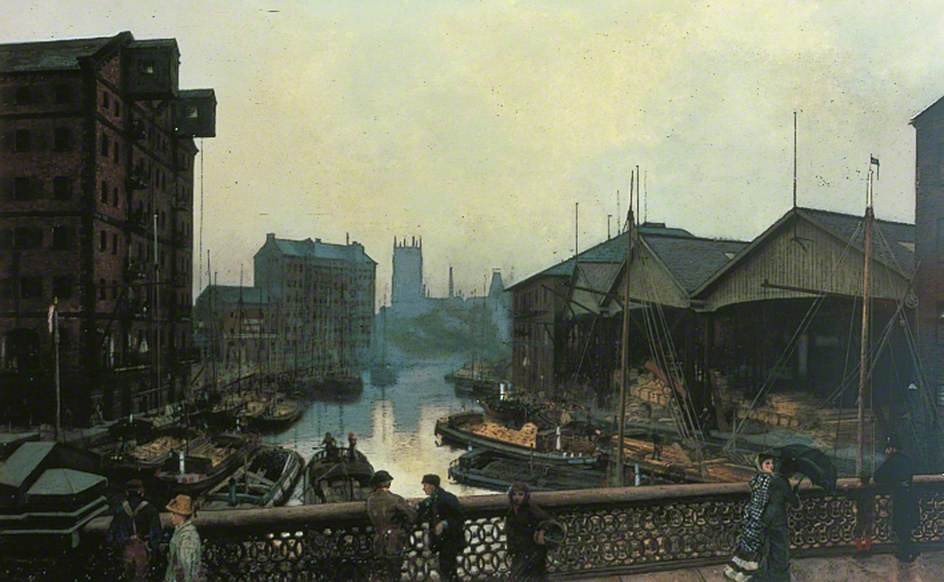
Leeds Bridge
1880s · Warehouses, boats and small figures locate controlled evening atmosphere within industrial Leeds.
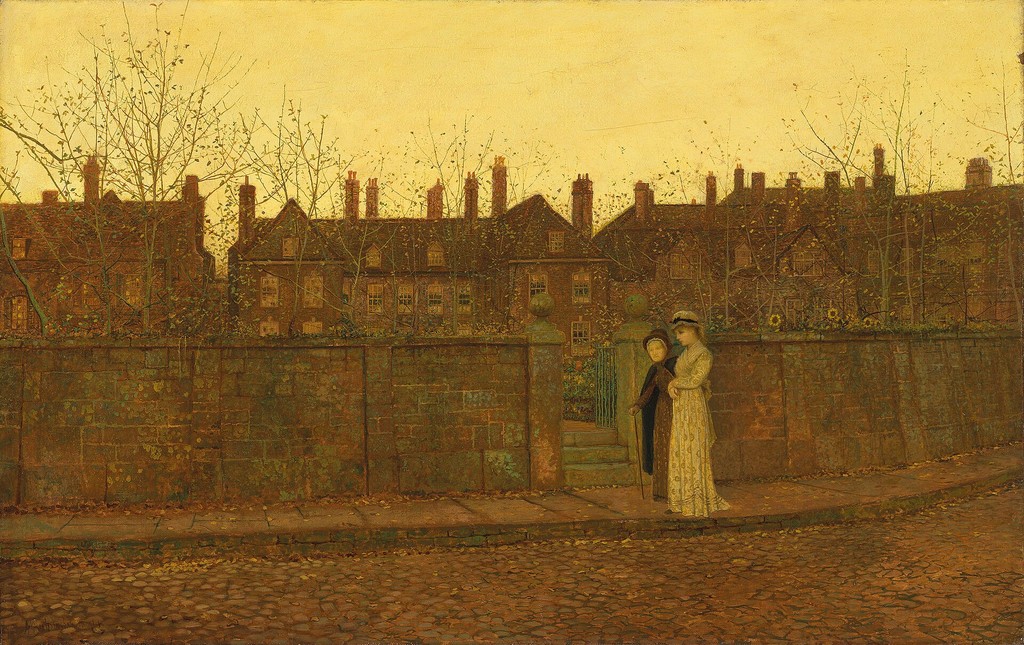
In the Golden Gloaming
1873 · Autumn foliage and receding light connect exact natural observation to a mature poetic mood.
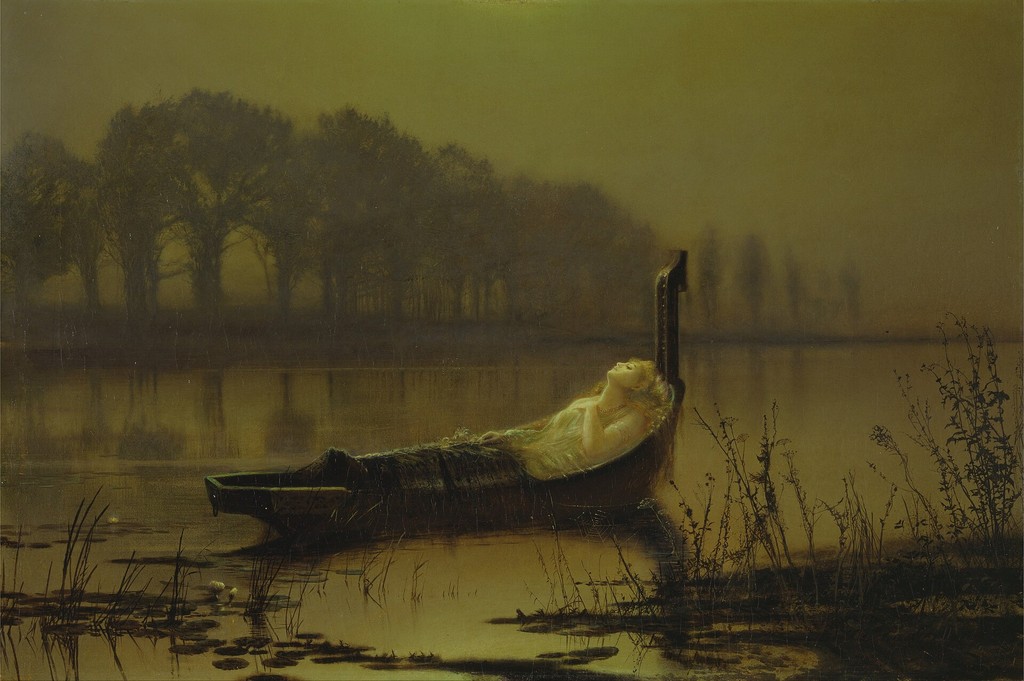
The Lady of Shalott
c.1875 · A literary figure demonstrates that narrative, costume and setting remained active beside urban moonlights.
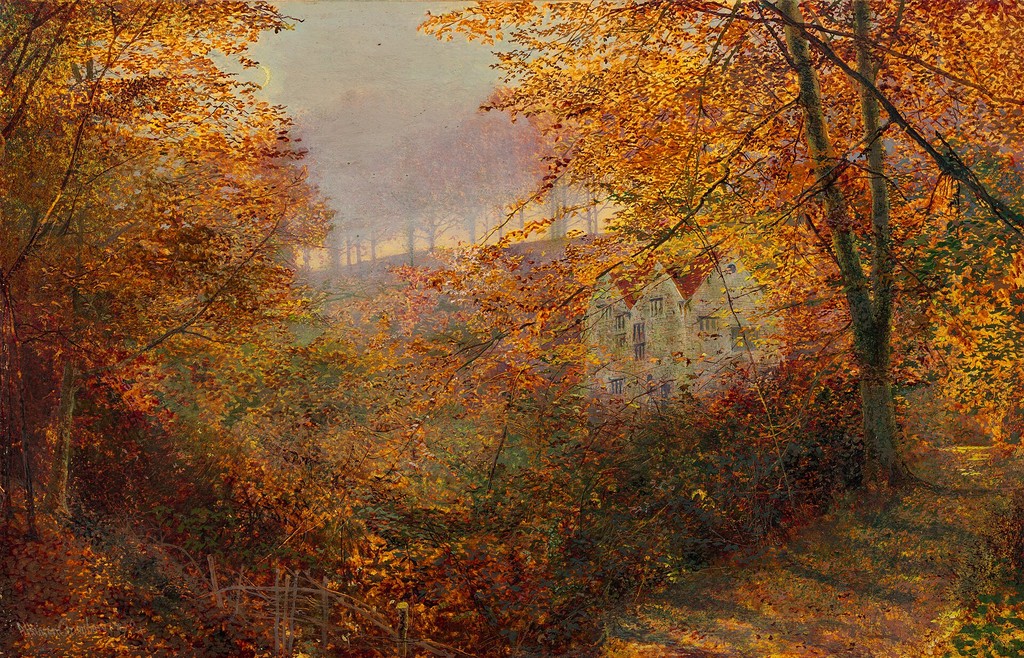
A House in a Clearing
1890 · A quiet building among trees shows the continued role of landscape, architecture and controlled light.
Researched works directory
This searchable evidence census contains 88 distinct records assembled from public collection data and a reproducible Wikidata snapshot. It is not a catalogue raisonné, not a claim of complete oeuvre coverage, and it keeps works with repeated titles as separate objects.
| Name | Date | Medium |
|---|---|---|
| A Dead Linnet | 1862 | Painting |
| A House in a Clearing | 1870 | Painting |
| A Moonlit Evening | 1880 | Painting |
| A Moonlit Lane | 1874 | Painting |
| A Mossy Glen | 1864 | Painting |
| A View of Hampstead, London | 1882 | Painting |
| A Wooded Valley | Date unknown | Painting |
| A Yorkshire Home | 1878 | Painting |
| An Autumn Idyll | 1885 | Painting |
| Autumn Glory: The Old Mill | 1869 | Painting |
| Autumn Regrets | 1882 | Painting |
| Baiting the Lines, Whitby | 1884 | Painting |
| Boar Lane, Leeds | 1881 | Painting |
| Bowder Stone, Borrowdale | 1865 | Painting |
| Briggate, Leeds | 1891 | Painting |
| 'Burning Off', a Fishing Boat at Scarborough | 1877 | Painting |
| Canny Glasgow | 1887 | Painting |
| Evening Glow | 1884 | Painting |
| Evening Scene by the Docks, Hull | Date unknown | Painting |
| Fiamella | 1883 | Painting |
| Glasgow Docks | 1886 | Painting |
| Gloucester Docks | 1885 | Painting |
| Golden Visions | 1870 | Painting |
| Greenwich, Half Tide | 1884 | Painting |
| In Peril (The Harbour Flare) | 1879 | Painting |
| In the golden gloaming | Date unknown | Painting |
| In the Golden Mists of Autumn | 1884 | Painting |
| In the Golden Olden Times | 1870 | Painting |
| Ingleborough from under White Scar, Yorkshire Limestone Strata | 1868 | Painting |
| Iris | 1886 | Painting |
| Knostrop Old Hall at Dusk | 1870 | Painting |
| Leeds Bridge | 1880 | Painting |
| Lights in the Harbour, Scarborough | 1879 | Painting |
| Liverpool Docks | 1892 | Painting |
| Liverpool Docks by Night | 1892 | Painting |
| Liverpool Docks (panel 1 of 5) | Date unknown | Painting |
| Liverpool Docks (panel 2 of 5) | Date unknown | Painting |
| Liverpool Docks (panel 3 of 5) | Date unknown | Painting |
| Liverpool Docks (panel 4 of 5) | Date unknown | Painting |
| Liverpool Docks (panel 5 of 5) | Date unknown | Painting |
| Liverpool Quay by Moonlight | 1887 | Painting |
| Moonlight Scene near Leeds | 1881 | Painting |
| Night Scene, Rouen | 1893 | Painting |
| Nightfall down the Thames | 1880 | Painting |
| Nightfall in Scarborough Harbour, North Yorkshire | 1884 | Painting |
| November Morning, Knostrop Hall, Leeds | 1883 | Painting |
| Old English House by Moonlight | Date unknown | Painting |
| Park Row, Leeds | 1882 | Painting |
| Princes Dock, Hull | Date unknown | Painting |
| Quai de Paris, Rouen | 1893 | Painting |
| Reflections on the Thames, Westminster | 1880 | Painting |
| Reflections on the Thames, Westminster, London | 1880 | Painting |
| Roundhay Park Lake | Date unknown | Painting |
| Salthouse Dock, Liverpool | Date unknown | Painting |
| Salthouse Dock, Liverpool, 1884 | Date unknown | Painting |
| Scarborough Lights | 1877 | Painting |
| Shipping on the Clyde | 1881 | Painting |
| Sic transit gloria mundi (The Burning of the Spa Saloon) | 1876 | Painting |
| Silver Moonlight | 1880 | Painting |
| Silver Moonlight | 1886 | Painting |
| Snow and Mist (Caprice in Yellow Minor) | 1892 | Painting |
| Stapleton Park, near Pontefract | Date unknown | Painting |
| Sunday Night, Knostrop Cut, Leeds | 1893 | Painting |
| Thames Moonlight | 1880 | Painting |
| The Custom House, Liverpool, Looking North | Date unknown | Painting |
| The Custom House, Liverpool, Looking South | Date unknown | Painting |
| The Harbour at Whitby by Moonlight | 1879 | Painting |
| The Head of Gertrude Grimshaw | 1874 | Painting |
| 'The Ironbound Shore' | 1869 | Painting |
| The Lady of Shalott | 1875 | Painting |
| The Parable of the Lost Sheep | Date unknown | Painting |
| The Rector's Garden, Queen of the Lilies | 1877 | Painting |
| The Seal of the Covenant | 1868 | Painting |
| The Sun's Farewell | Date unknown | Painting |
| The Thames by Moonlight with Southwark Bridge, London | 1884 | Painting |
| Thro' the Wood | Date unknown | Painting |
| Tree Shadows on the Park Wall, Roundhay, Leeds | 1872 | Painting |
| Under the Beeches | 1892 | Painting |
| Under the Silvery Moonbeams | Date unknown | Painting |
| View of Heath Street by Night | 1882 | Painting |
| View of Scarborough | 1876 | Painting |
| View of Southwark Bridge at Night | 1882 | Painting |
| Whitby | 1878 | Painting |
| Whitby Docks | 1876 | Painting |
| Whitby Harbor | 1874 | Painting |
| Windermere | 1863 | Painting |
| Woodland near Leeds | Date unknown | Painting |
| Yew Court, Scalby, near Scarborough | 1875 | Painting |
Frequently Asked Questions
He is best known for moonlit city streets, river views and harbours in which natural and artificial light meet on wet surfaces. His wider work also includes early natural studies, seasonal landscapes, interiors, portraits and literary or classical subjects.[1][5]
His early detailed naturalism was influenced by Pre-Raphaelite practice and by John Ruskin’s call for fidelity to nature. His mature career developed a distinct urban and nocturnal language, so the label describes an important formation rather than the whole output.[5]
Museum sources discuss his interest in photography and say that he may have used a camera obscura or related optical aid. The surviving pictorial effects do not prove a specific device, so the claim should remain qualified.[5]
Leeds Art Gallery holds the largest public collection. Works also belong to Tate, Scarborough Museums and Galleries, the Carmen Thyssen-Bornemisza Collection and many other public collections listed through Art UK.[1][2][4]
Discussion
Use this evidence-led guide as a starting point for close looking rather than a final verdict.
Share an observation about John Atkinson Grimshaw or a source that adds useful context.
Reader Insights
Which work most clearly complicates the familiar label of painter of moonlight?
Where do place, market, family or literary culture most productively alter your reading?
Which source or surviving object would you investigate next?
Join the Conversation
Add your reading below, keeping observations specific and evidence clear.
References
- Art UK, John Atkinson Grimshaw (1836–1893), accessed 31 August 2026.
- Leeds Museums and Galleries, Collections Development Policy, accessed 31 August 2026.
- Leeds Museums and Galleries, Don’t Let’s Ask for the Moon: Nocturnes and Atkinson Grimshaw, accessed 31 August 2026.
- Scarborough Museums and Galleries, Atkinson Grimshaw: At Home in Yorkshire, accessed 31 August 2026.
- Museo Nacional Thyssen-Bornemisza, John Atkinson Grimshaw, accessed 31 August 2026.
- Museo Nacional Thyssen-Bornemisza, Shipping on the Clyde, accessed 31 August 2026.
- Tate, Liverpool Quay by Moonlight, accessed 31 August 2026.
- Tate, View of Heath Street by Night, accessed 31 August 2026.
- MyLearning and Leeds Museums and Galleries, Leeds Bridge by John Atkinson Grimshaw, accessed 31 August 2026.
- Leeds Museums and Galleries, Iris (1886), accessed 31 August 2026.
- Leeds Libraries, The Portraits of John Atkinson Grimshaw, accessed 31 August 2026.
- The Thoresby Society, John Atkinson Grimshaw (1836–1893), accessed 31 August 2026.