 Buy Art Prints Now
from Amazon
* As an Amazon Associate I earn from qualifying purchases.
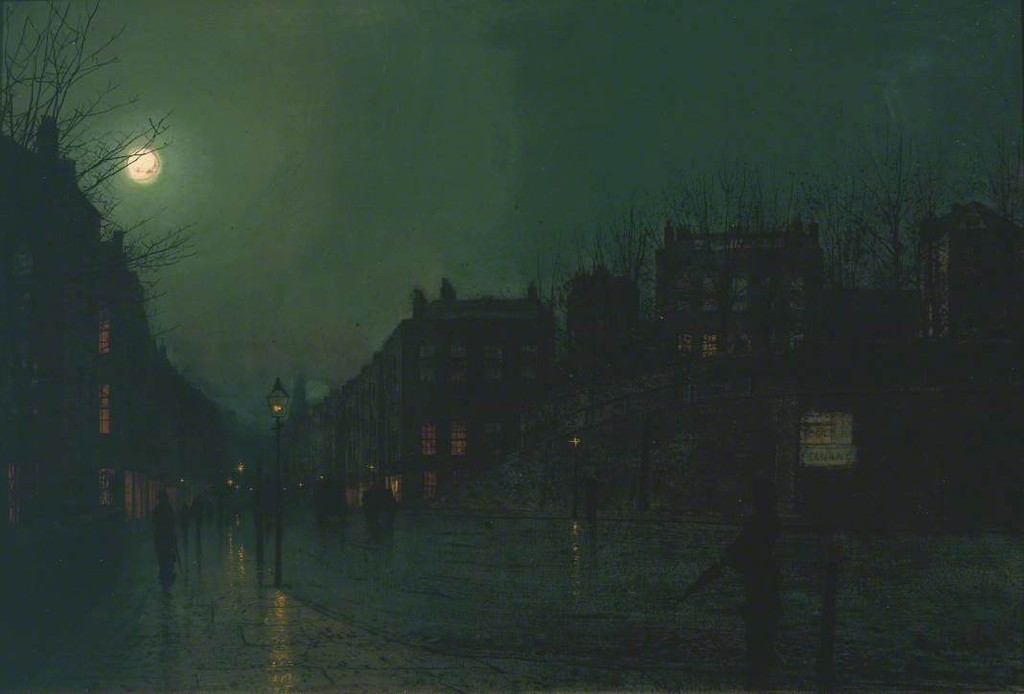
View of Heath Street by Night, 1882 — Tate, public domain.
 by Tom Gurney
Tom Gurney BSc (Hons) is an art history expert with over 20 years experience
Page Created: August 31, 2026 / Page Updated: September 16, 2026
Email: tomgurney1@gmail.com / Phone: +44 7429 011000
John Atkinson Grimshaw: Technique, Light and Photography: Introduction
John Atkinson Grimshaw’s paintings can look uncannily exact and deeply atmospheric at the same time. A road narrows with persuasive geometry, rigging remains legible against mist, and a small flame or window seems to colour the damp air around it. These effects invite questions about tools and process. Did Grimshaw work directly from nature, construct scenes from repeated elements, consult photographs or use an optical device?
The evidence does not support one simple answer. Museums document his early commitment to precise natural observation, his later interest in photography, and the possibility—not the certainty—that he used a camera obscura. Object records identify varied supports and recurring compositional devices. The paintings themselves allow careful description of focus, colour, reflection and depth, but visible resemblance alone cannot establish an undocumented mechanical procedure.[1][2]
At a Glance
- Early approachDetailed naturalism informed by Ruskinian ideas, Pre-Raphaelite practice and the example of John William Inchbold[1]
- Change of directionMuseo Thyssen-Bornemisza dates his move away from that early manner to around 1865[1]
- Light sourcesMoon, sky, windows, gas lamps, shopfronts, vehicle lamps and harbour fires[2][4]
- Documented supportsOil on canvas, board, cardboard and millboard appear in museum records[3][4]
- Repeated devicesReceding roads, solitary figures, bare branches, masts, wet surfaces and familiar architectural forms[3][5]
- Optical evidenceAn interest in photography is documented; camera-obscura use remains a qualified possibility[1][2]
Contents
- Introduction
- Begin with What Is Visible
- From Minute Detail to Tonal Design
- Making Several Lights Coexist
- Mist, Reflection and Selective Edges
- Perspective and Repeated Motifs
- Supports, Pace and Surface
- Photography and the Camera Obscura
- What Close Looking Can Test
Begin with What Is Visible
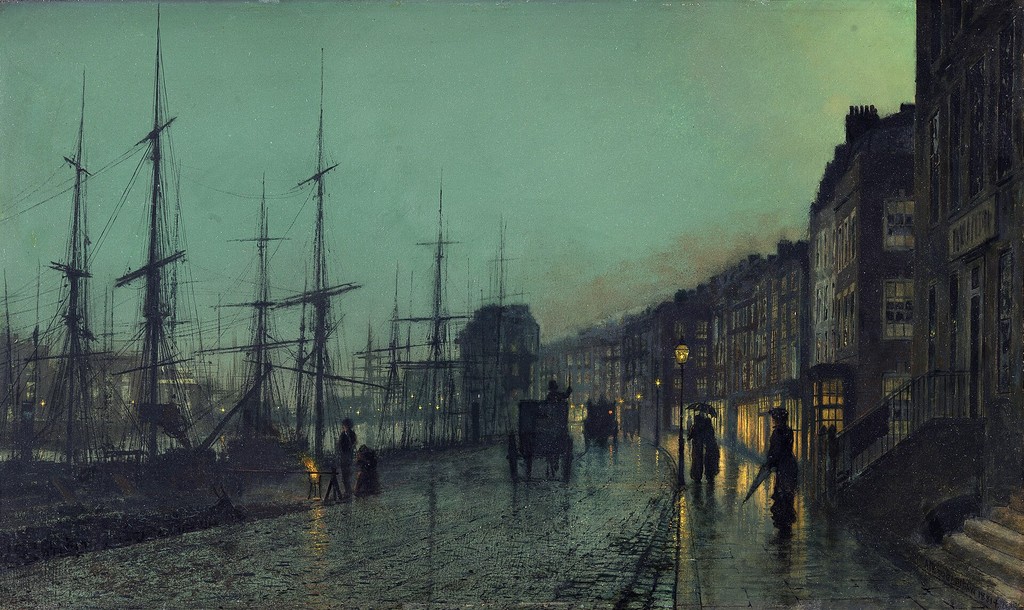
A responsible account of technique starts by separating three kinds of statement. An object record can establish a material fact: Shipping on the Clyde is an oil painting on cardboard or millboard. Close looking can describe a visual relationship: its small fire makes a concentrated warm accent within a cool, misty quay. A claim about how the image was transferred to the support requires further evidence. The first two statements do not automatically prove the third.[4]
That distinction is especially important with Grimshaw because precision can appear photographic to a modern viewer. Accurate recession, a cropped structure or a repeated pose may result from measured drawing, remembered observation, a reused design, an optical aid, a photograph, or several methods used at different times. The paintings and artworks guide brings together the documented range without imposing one technique on every object.
The same caution applies to finish. In reproductions, many contours look controlled and individual brushmarks are not always prominent. That is a valid observation about appearance, not a full reconstruction of paint layers. The museum sources cited here do not provide a comprehensive analysis of grounds, pigments, varnishes or transfer marks across the entire career.
From Minute Detail to Tonal Design
Museo Thyssen-Bornemisza connects Grimshaw’s earliest work with John Ruskin’s ideal of fidelity to nature and with the detailed Pre-Raphaelite manner of the Leeds painter John William Inchbold. This context helps explain his attention to plants, stone, birds and seasonal change. Around 1865, the museum says, he moved away from that style.[1]
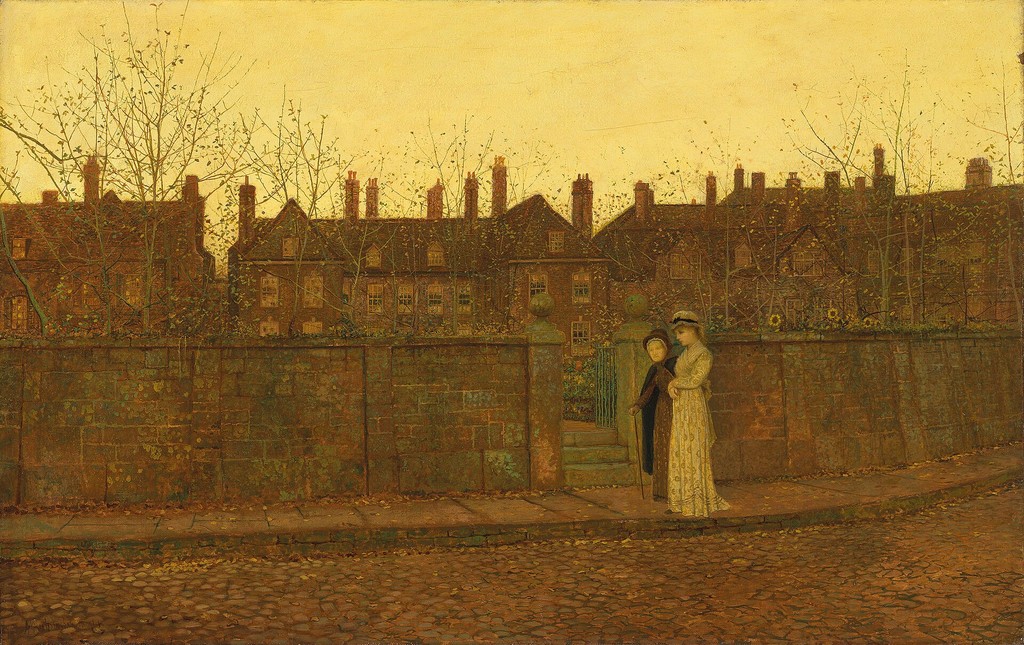
The change was not an abandonment of precision. Rather, fine information began to serve a broader arrangement of light and shade. A branch could still be sharply profiled, but its role might now be to subdivide a luminous sky. Masonry might remain readable near the viewer while dissolving farther down a road. The eye moves between exact incidents and large tonal zones instead of giving every object equal emphasis.
This continuity matters when comparing the early works with the landscapes and seasons and mature nocturnes. His later atmosphere is convincing partly because it rests on a trained sensitivity to small differences in shape and surface. Detail did not vanish; Grimshaw controlled when it would remain visible.
Making Several Lights Coexist
Grimshaw’s night scenes are rarely illuminated by the moon alone. Leeds Museums emphasises the meeting of moonlight with newer artificial sources, while the Museo Thyssen-Bornemisza record for Shipping on the Clyde identifies lamps, shop interiors, vehicle lights and a roadside fire as parts of his visual repertoire.[2][4]
Each source performs a different job. A pale sky may establish the overall value range. A shop window creates a local rectangle of warmth. A lamp marks distance; a flame attracts attention to figures otherwise absorbed by the quay. Water and rain-darkened paving then redistribute brightness across a wider area. This hierarchy lets a dim picture remain spatially intelligible without pretending that darkness has disappeared.
Colour helps distinguish these sources. Cool grey, green or blue passages can sit beside amber, orange and gold accents. Those labels describe visible relationships rather than named pigments. The moonlight and nocturnes essay follows the effect across streets, rivers and harbours; the technical point is that contrast, not raw brightness, makes a small light appear intense.
Mist, Reflection and Selective Edges
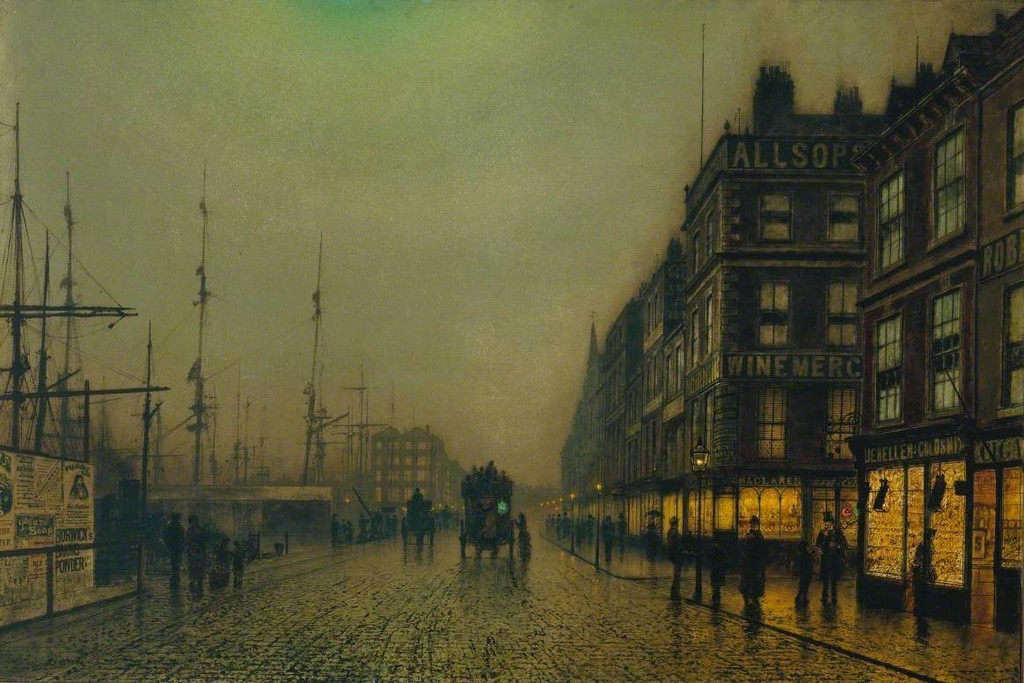
Fog in Grimshaw’s work is an active pictorial element. It reduces distant contrast, allows one light to spread beyond its source and separates a crisp foreground from a less certain background. Tate’s account of Liverpool Quay by Moonlight draws attention to the golden illumination passing from shopfronts through fog and onto wet cobbles.[5]
In close-looking terms, the image alternates definite and indefinite edges. A nearby wheel or façade may be easy to locate, while ships and buildings farther away become layered silhouettes. Reflections extend downward or towards the viewer, converting points of light into routes through the composition. The method persuades the eye that moisture occupies the space between objects.
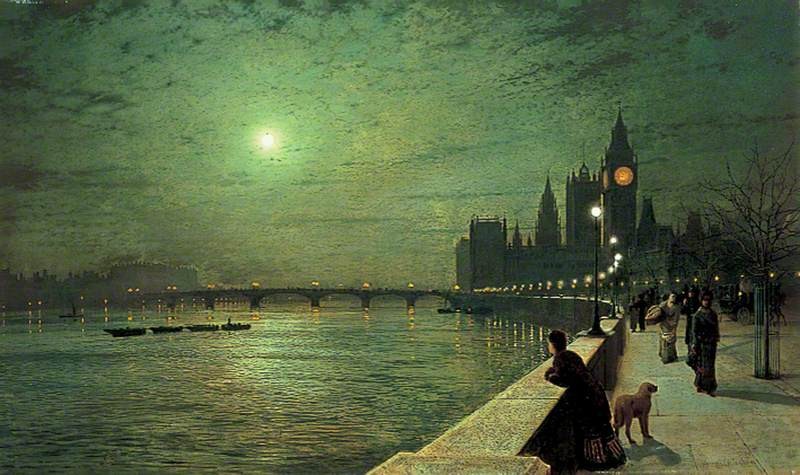
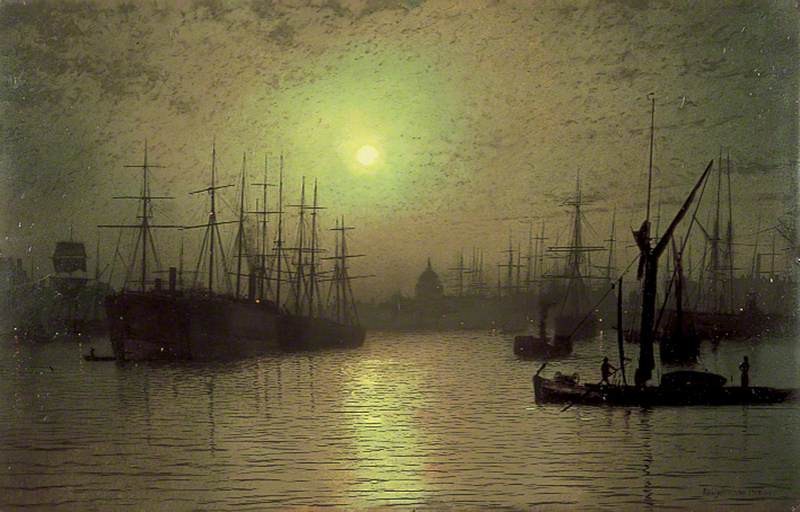
This is not simply an atmospheric veil placed over a completed street. Light, dampness and depth depend on one another. In Reflections on the Thames, water becomes a second field in which the city’s illumination is stretched and interrupted. In Shipping on the Clyde, mist helps connect the workers’ small fire to the wider chill described by the museum.[4]
Perspective and Repeated Motifs
Strong recession is one of Grimshaw’s most dependable compositional tools. Tate notes the omnibus travelling away along a straight street in Liverpool Quay by Moonlight and describes it as a device he used repeatedly.[5] Roads, quays and rivers often give the viewer an immediate route into depth. Masts, branches and building fronts then cross or frame that movement.
Repetition also had a practical role. The Scarborough Museums guide explains that popular moonlight subjects encouraged related versions and that financial pressure in the early 1880s required a rapid pace of work. It describes lane scenes assembled from views and buildings, sometimes incorporating features associated with Knostrop Old Hall.[3]
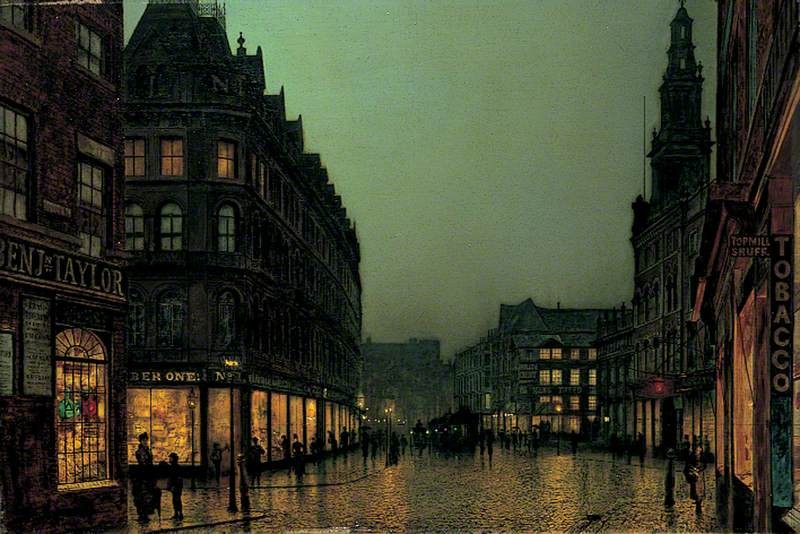
Neither fact makes the paintings mechanically identical. A motif can be retained while its season, illumination, architecture or human presence changes. Comparing Boar Lane, Leeds with harbour views shows how a receding route could organise very different kinds of modern space. Reuse is evidence of a working method and a market, not proof of tracing.
Supports, Pace and Surface
Grimshaw painted in oil on more than one support. Major records include canvas, board, cardboard and millboard. The comparatively small Shipping on the Clyde, measuring 30.5 by 51 centimetres, demonstrates that a modest rigid support could carry an ambitious port composition.[4] Support facts should be taken object by object rather than generalised to all related scenes.
The Scarborough guide reports production of roughly one painting a week during a period of debt in the early 1880s. Adaptable motifs and formats would have helped him sustain that output, but pace alone cannot tell us how any particular surface was built. Some stages may have been prepared or reused; the cited records do not document a universal sequence.[3]
Material history also affects present appearance. Five paintings at Scarborough were conserved in 2021, and cleaning Yew Court, Scalby, near Scarborough brought foreground figures back into view after dirt had obscured them. A painting that looks unusually dark today may reflect age, surface coating, display or reproduction as well as the artist’s original decisions. Conservation evidence warns against reading every current tonal difference as intentional.[3]
Photography and the Camera Obscura
Two institutional accounts establish the careful core of the photography question. Leeds Museums describes Grimshaw as interested in photography. Museo Thyssen-Bornemisza likewise says the new medium fascinated him and adds that he may have used a camera obscura when developing compositions.[1][2] “May have” is essential: neither account identifies a surviving device, a documented session or one procedure proven across named paintings.
A camera obscura projects an optical view that can assist with framing and spatial relationships, but mentioning the instrument does not explain the completed colour, atmosphere or surface. Even if Grimshaw used one on some occasions, he still had to decide what to include, how to alter the view and how to organise light in paint. Nor does possible optical assistance diminish the intellectual work of composition.
Photography is also relevant as a visual culture, not only as equipment. Cropping, tonal concentration and the isolation of a moment after dark could interest a painter without direct copying from a print. Leeds Museums’ exhibition placed Grimshaw beside photographic and neon works to explore the modern experience of illumination. That curatorial comparison clarifies shared questions; it does not retroactively prove a hidden process.[2]
What Close Looking Can Test
Instead of asking whether a picture “looks photographic”, test narrower features. Where does the sharpest edge occur? Do repeated buildings change from version to version? Does perspective remain consistent when a lane combines several architectural sources? Which light controls the value structure, and which lights operate as accents? These questions produce observations that can later be compared with conservation or archival evidence.
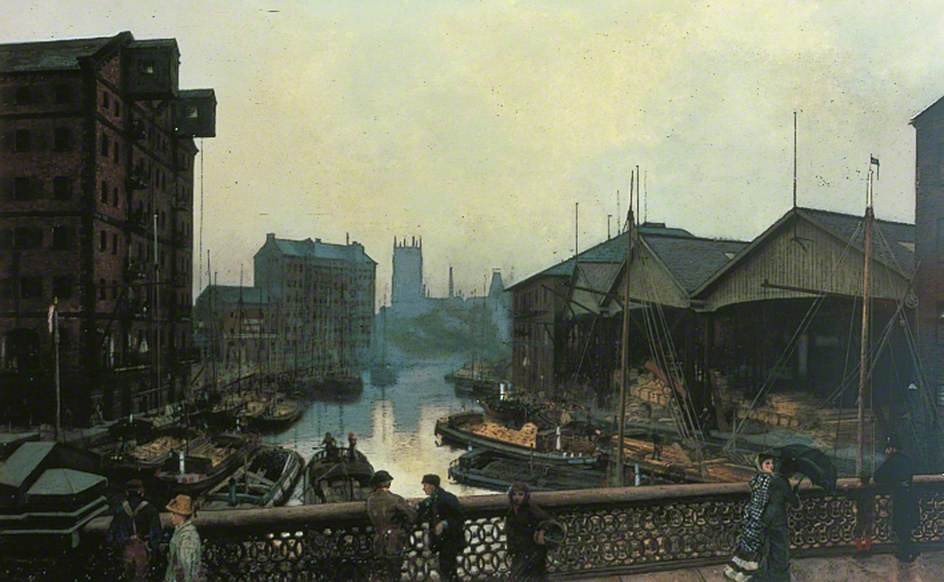
The Leeds Museums learning resource for Leeds Bridge offers a useful model by asking viewers to identify warehouses, boats, lifting equipment, people and the stillness of water before deciding what atmosphere means. It distinguishes what is present from what the artist leaves less visible.[6] Technique becomes a set of choices about attention rather than a hunt for a single secret.
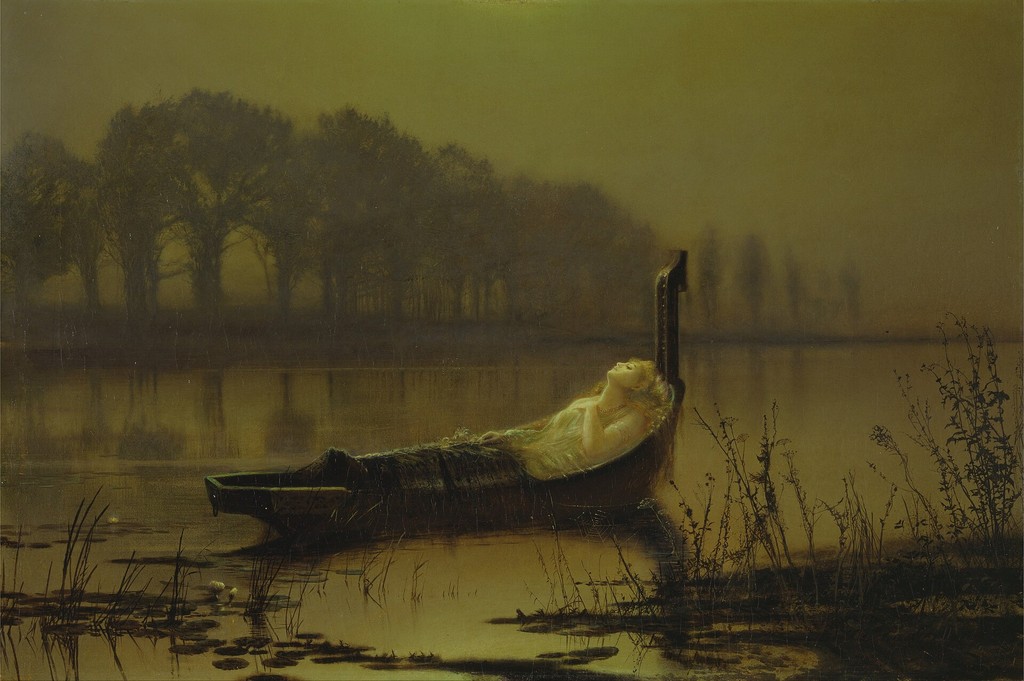
Grimshaw’s range is another check on easy conclusions. Iris uses glowing, kaleidoscopic colour and rich autumn tones around a classical figure, according to Leeds Museums.[7] Its effect differs markedly from a fogbound quay, yet both depend on controlled radiance and silhouette. The figures, interiors and literature essay shows why any account of his handling must accommodate more than night streets.
Researched works directory
This searchable evidence census contains 88 distinct records assembled from public collection data and a reproducible Wikidata snapshot. It is not a catalogue raisonné, not a claim of complete oeuvre coverage, and it keeps works with repeated titles as separate objects.
| Name | Date | Medium |
|---|---|---|
| A Dead Linnet | 1862 | Painting |
| A House in a Clearing | 1870 | Painting |
| A Moonlit Evening | 1880 | Painting |
| A Moonlit Lane | 1874 | Painting |
| A Mossy Glen | 1864 | Painting |
| A View of Hampstead, London | 1882 | Painting |
| A Wooded Valley | Date unknown | Painting |
| A Yorkshire Home | 1878 | Painting |
| An Autumn Idyll | 1885 | Painting |
| Autumn Glory: The Old Mill | 1869 | Painting |
| Autumn Regrets | 1882 | Painting |
| Baiting the Lines, Whitby | 1884 | Painting |
| Boar Lane, Leeds | 1881 | Painting |
| Bowder Stone, Borrowdale | 1865 | Painting |
| Briggate, Leeds | 1891 | Painting |
| 'Burning Off', a Fishing Boat at Scarborough | 1877 | Painting |
| Canny Glasgow | 1887 | Painting |
| Evening Glow | 1884 | Painting |
| Evening Scene by the Docks, Hull | Date unknown | Painting |
| Fiamella | 1883 | Painting |
| Glasgow Docks | 1886 | Painting |
| Gloucester Docks | 1885 | Painting |
| Golden Visions | 1870 | Painting |
| Greenwich, Half Tide | 1884 | Painting |
| In Peril (The Harbour Flare) | 1879 | Painting |
| In the golden gloaming | Date unknown | Painting |
| In the Golden Mists of Autumn | 1884 | Painting |
| In the Golden Olden Times | 1870 | Painting |
| Ingleborough from under White Scar, Yorkshire Limestone Strata | 1868 | Painting |
| Iris | 1886 | Painting |
| Knostrop Old Hall at Dusk | 1870 | Painting |
| Leeds Bridge | 1880 | Painting |
| Lights in the Harbour, Scarborough | 1879 | Painting |
| Liverpool Docks | 1892 | Painting |
| Liverpool Docks by Night | 1892 | Painting |
| Liverpool Docks (panel 1 of 5) | Date unknown | Painting |
| Liverpool Docks (panel 2 of 5) | Date unknown | Painting |
| Liverpool Docks (panel 3 of 5) | Date unknown | Painting |
| Liverpool Docks (panel 4 of 5) | Date unknown | Painting |
| Liverpool Docks (panel 5 of 5) | Date unknown | Painting |
| Liverpool Quay by Moonlight | 1887 | Painting |
| Moonlight Scene near Leeds | 1881 | Painting |
| Night Scene, Rouen | 1893 | Painting |
| Nightfall down the Thames | 1880 | Painting |
| Nightfall in Scarborough Harbour, North Yorkshire | 1884 | Painting |
| November Morning, Knostrop Hall, Leeds | 1883 | Painting |
| Old English House by Moonlight | Date unknown | Painting |
| Park Row, Leeds | 1882 | Painting |
| Princes Dock, Hull | Date unknown | Painting |
| Quai de Paris, Rouen | 1893 | Painting |
| Reflections on the Thames, Westminster | 1880 | Painting |
| Reflections on the Thames, Westminster, London | 1880 | Painting |
| Roundhay Park Lake | Date unknown | Painting |
| Salthouse Dock, Liverpool | Date unknown | Painting |
| Salthouse Dock, Liverpool, 1884 | Date unknown | Painting |
| Scarborough Lights | 1877 | Painting |
| Shipping on the Clyde | 1881 | Painting |
| Sic transit gloria mundi (The Burning of the Spa Saloon) | 1876 | Painting |
| Silver Moonlight | 1880 | Painting |
| Silver Moonlight | 1886 | Painting |
| Snow and Mist (Caprice in Yellow Minor) | 1892 | Painting |
| Stapleton Park, near Pontefract | Date unknown | Painting |
| Sunday Night, Knostrop Cut, Leeds | 1893 | Painting |
| Thames Moonlight | 1880 | Painting |
| The Custom House, Liverpool, Looking North | Date unknown | Painting |
| The Custom House, Liverpool, Looking South | Date unknown | Painting |
| The Harbour at Whitby by Moonlight | 1879 | Painting |
| The Head of Gertrude Grimshaw | 1874 | Painting |
| 'The Ironbound Shore' | 1869 | Painting |
| The Lady of Shalott | 1875 | Painting |
| The Parable of the Lost Sheep | Date unknown | Painting |
| The Rector's Garden, Queen of the Lilies | 1877 | Painting |
| The Seal of the Covenant | 1868 | Painting |
| The Sun's Farewell | Date unknown | Painting |
| The Thames by Moonlight with Southwark Bridge, London | 1884 | Painting |
| Thro' the Wood | Date unknown | Painting |
| Tree Shadows on the Park Wall, Roundhay, Leeds | 1872 | Painting |
| Under the Beeches | 1892 | Painting |
| Under the Silvery Moonbeams | Date unknown | Painting |
| View of Heath Street by Night | 1882 | Painting |
| View of Scarborough | 1876 | Painting |
| View of Southwark Bridge at Night | 1882 | Painting |
| Whitby | 1878 | Painting |
| Whitby Docks | 1876 | Painting |
| Whitby Harbor | 1874 | Painting |
| Windermere | 1863 | Painting |
| Woodland near Leeds | Date unknown | Painting |
| Yew Court, Scalby, near Scarborough | 1875 | Painting |
Frequently Asked Questions
Museo Thyssen-Bornemisza says he may have used one to help develop compositions. That is a credible institutional assessment, but it is not proof of a particular device or its use for every painting.[1]
His interest in photography is documented, but the cited museum sources do not establish direct copying from a photograph for a named work. Photographic-looking framing or perspective is suggestive context, not sufficient evidence by itself.[1][2]
He placed compact warm accents against larger areas of lower-value, often cooler colour and repeated them in damp paving or water. Contrast and reflection make the source feel brighter than its physical area would suggest.[4][5]
Successful moonlight subjects served a strong private market, and financial pressure sometimes demanded rapid production. Grimshaw could retain an organising motif while changing weather, colour, setting and detail.[3]
Discussion
Use this evidence-led guide as a starting point for close looking rather than a final verdict.
Share an observation about John Atkinson Grimshaw: Technique, Light and Photography or a source that adds useful context.
Reader Insights
Which work most clearly complicates the familiar label of painter of moonlight?
Where do place, market, family or literary culture most productively alter your reading?
Which source or surviving object would you investigate next?
Join the Conversation
Add your reading below, keeping observations specific and evidence clear.
References
- Museo Nacional Thyssen-Bornemisza, John Atkinson Grimshaw artist record, accessed 31 August 2026.
- Leeds Museums and Galleries, “Exhibition sheds new light on renowned Leeds artist John Atkinson Grimshaw”, accessed 31 August 2026.
- Scarborough Museums and Galleries, Atkinson Grimshaw: At Home in Yorkshire large-print guide, accessed 31 August 2026.
- Museo Nacional Thyssen-Bornemisza, Shipping on the Clyde, accessed 31 August 2026.
- Tate, Liverpool Quay by Moonlight, accessed 31 August 2026.
- Leeds Museums and Galleries via MyLearning, “Leeds Bridge by John Atkinson Grimshaw”, accessed 31 August 2026.
- Leeds Museums and Galleries, “Iris (1886) by John Atkinson Grimshaw”, accessed 31 August 2026.