 Buy Art Prints Now
from Amazon
* As an Amazon Associate I earn from qualifying purchases.
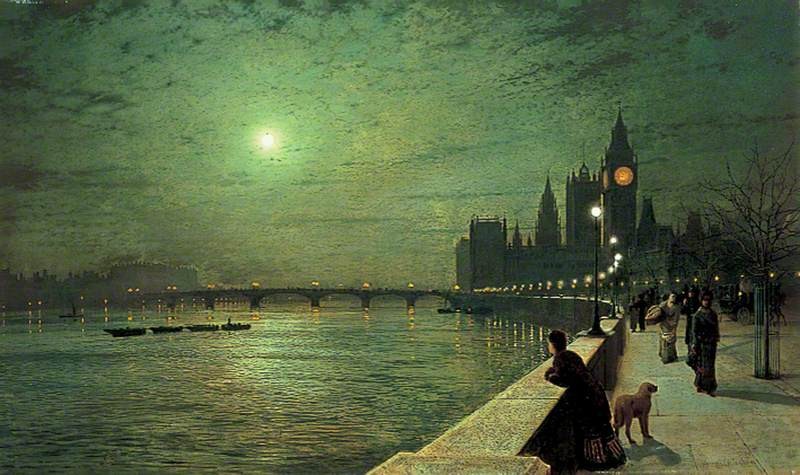
Reflections on the Thames, Westminster, London, 1880 — Leeds Art Gallery, public domain.
 by Tom Gurney
Tom Gurney BSc (Hons) is an art history expert with over 20 years experience
Page Created: August 31, 2026 / Page Updated: September 16, 2026
Email: tomgurney1@gmail.com / Phone: +44 7429 011000
Reflections on the Thames: Introduction
In Reflections on the Thames, Westminster, London, John Atkinson Grimshaw sets a green-lit moon above one of Britain’s most recognisable political landscapes. The river fills most of the lower field, the Palace of Westminster rises at the right, and the embankment draws nearby pedestrians toward the distance. London is unmistakable, but the painting does not behave like a daylight record. Vapour, ripples and multiple lights make every solid form participate in atmosphere.
The picture belongs to 1880, when Grimshaw’s engagement with London intensified. Its subject connects the nocturnal language he had developed in northern streets and ports with the capital’s river architecture. Close looking reveals a modern public space rather than an empty poetic vista: lamps shine, boats move, people occupy the walkway and the clock face remains visible after dark.
At a Glance
- Full titleReflections on the Thames, Westminster, London[1]
- ArtistJohn Atkinson Grimshaw (1836–1893)
- Date1880; an older secondary display gives 1879, but the collection-linked records support 1880[1][2]
- Medium and sizeOil on canvas, 76.2 × 127 cm[2]
- CollectionLeeds Art Gallery, accession LEEAG.PA.1900.0181[1][2]
- Recorded provenanceGiven to Leeds Art Gallery by John Kirk in 1900[2]
John Atkinson Grimshaw in context
Contents
- Introduction
- Exact Object Record
- A view built across water
- Natural and urban light
- The embankment and its figures
- Westminster recognised and transformed
- Colour, haze and reflection
- An 1880 London context
- From London subject to Leeds object
- Why the painting matters
Exact Object Record
The public object is Reflections on the Thames, Westminster, London, dated 1880, painted in oil on canvas and measuring 76.2 centimetres high by 127 centimetres wide. It is held by Leeds Art Gallery under accession number LEEAG.PA.1900.0181.[1][2] The Commons file is an exact digital record tied to that accession, not merely an image matched by title.
The date deserves a short note. Art UK assigns 1880, and the exact file metadata reports a signature and date at the lower right.[1][2] One older secondary display has used 1879. Because the collection-linked evidence converges on 1880, that is the date used here; the discrepancy remains acknowledged rather than silently erased.
The image record also says that John Kirk gave the painting to Leeds Art Gallery in 1900.[2] This documented transfer is distinct from the work’s London subject. Grimshaw painted the capital, but the object’s public life became closely connected with the city of his birth.
A view built across water
Close looking begins with proportion. The canvas is much wider than it is high, and the Thames occupies the largest continuous area.[2] The broad water surface gives the eye room to travel sideways before the embankment’s diagonal pulls it toward Westminster. This creates two simultaneous movements: across the river and along its bank.
The moon sits high to the left, away from the principal architecture. Westminster’s vertical forms gather on the right, with the illuminated clock face acting as a compact counterweight to the moon. The bridge crosses the middle distance, joining rather than dividing the two sides of the composition. Small boats introduce additional horizontals below it.
These are observations from the approved reproduction.[2] They describe pictorial relations, not a surveyed claim that every interval matches a single optical viewpoint. Grimshaw’s precision gives the scene topographical conviction while his spacing decides how it unfolds as a painting.
Natural and urban light
The work contains no single monopoly on brightness. The moon forms a pale disc within the green-yellow sky. The clock face glows warmer, while a chain of lamps follows the embankment and continues across the distant bridge. Their separate reflections descend into the water as broken vertical marks.
Leeds Museums interprets Grimshaw’s nocturnes through the interaction of moonlight with newer forms of artificial illumination.[3] Reflections on the Thames makes that relationship plainly visible. Natural light spreads widely but softly; lamps and the clock appear smaller, sharper and more local. The river receives both, loosening the boundary between their effects.
It would require additional object-specific evidence to name the technology of every bright point. The secure visual claim is that several urban sources coexist with the moon. The Moonlight and Nocturnes essay follows this larger problem across Grimshaw’s cities.
The embankment and its figures
The right foreground is unusually active for a scene often reproduced as a serene river view. A dark-clad woman leans against the parapet. A light-coloured dog stands behind her, and several walkers approach or recede along the pavement. Bare young trees and a line of lamps divide the walkway into repeated intervals.[2]
No institutional record used here identifies these people. Calling the leaning figure a named person, assigning her an occupation or inventing a private crisis would go beyond the evidence. Close looking can say what her pose does: it arrests the diagonal movement of the wall and directs attention across the Thames.
The other pedestrians keep London socially present. Their differing sizes establish depth, while their dark clothing punctuates the lighter pavement. They are neither a crowd nor decorative emptiness. The painting offers a public riverside occupied at night, an aspect developed across London and the Thames.
Westminster recognised and transformed
The Palace of Westminster secures the location. Its towers and long frontage rise beyond the embankment, and the warm clock face provides the most legible architectural detail. Yet much of the building remains dark. Grimshaw offers enough information for recognition without describing every window or ornament with equal force.
That selective clarity transforms a famous civic site into a nocturnal experience. The viewer encounters Parliament as a mass against coloured air, then discovers its smaller details through light. The bridge works similarly: its repeated arches are readable, but distance and haze reduce their edges.
The result is neither pure fantasy nor straightforward architectural illustration. London’s structures organise the scene, while atmosphere determines how quickly they can be read. Grimshaw’s Technique, Light and Photography page considers his exactitude without treating debated optical aids as settled fact.
Colour, haze and reflection
Green dominates the sky and enters the water, but the painting is not monochrome. Yellow and cream gather around the moon and lamps; orange intensifies the clock; deep blue-green and brown define shadowed forms. The limited range makes each warmer note conspicuous.
Grimshaw varies edges to make haze visible. The moon’s immediate halo is soft, clouds merge through small tonal changes and distant buildings lose contrast. By comparison, the foreground parapet and figures are firmer. Space is therefore created through degrees of definition as well as linear perspective.
The reflections do not duplicate their sources in tidy symmetry. Ripples interrupt them, turning lamps into downward sequences and spreading moonlight across a wider patch. This close-looking observation helps explain the plural “Reflections” in the title: the water returns several kinds of illumination, each altered by its surface.[2]
An 1880 London context
Scarborough Museums places Grimshaw’s taking of a London studio in 1880 and gives it a two-year span.[4] Museo Thyssen-Bornemisza links his Chelsea base more broadly to the period following his 1879 financial setback, while his family remained at Knostrop.[5] The exact details are not identical, but both make London an active working location around the date of this painting.
That context should not turn the picture into an illustration of biography. The canvas can be studied securely without claiming it was finished on a particular day or painted wholly from one riverside position. What the chronology establishes is opportunity: Grimshaw was extending his practice into London subjects at the moment the signed date records.
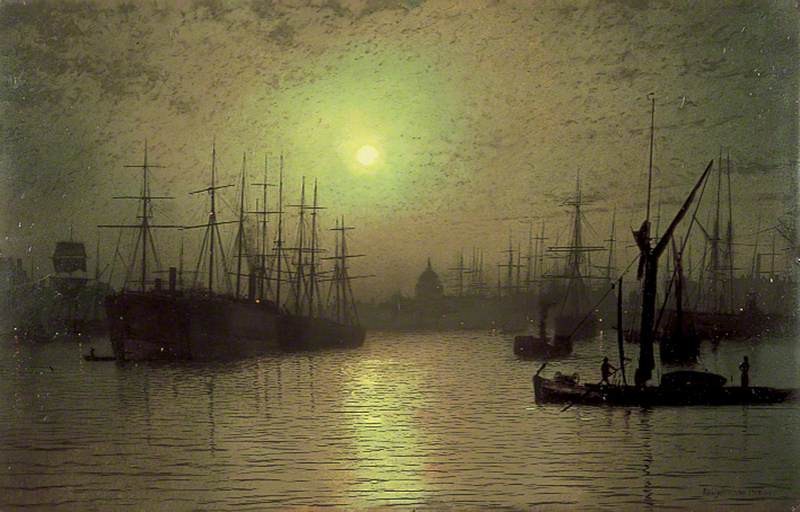
Leeds Museums also names Nightfall down the Thames, likewise dated 1880, among the nocturnes through which it interprets him as a painter of urban modernity.[3] Together, the titles show sustained attention to the river’s changing light rather than a single isolated Westminster view.
From London subject to Leeds object
The 1900 gift placed Reflections on the Thames in the public collection of Leeds Art Gallery.[2] That location is especially apt without needing to be romanticised. Leeds was Grimshaw’s birthplace and principal base; London supplied this subject; the transfer joined both cities within the painting’s later history.
An accession number is more than administrative detail. LEEAG.PA.1900.0181 separates this canvas from other works whose titles contain “Thames”, “Westminster” or “reflections”. It allows the title, measurements, image and ownership record to remain attached to the same object.[1][2]
The exact-file record also enables close looking beyond a caption while preserving attribution to the holding institution. For comparison with other media and themes, use Paintings and Artworks. The present work’s importance lies in how much it brings together: river, city, moon, public life and a collection history spanning London and Leeds.
Why the painting matters
Reflections on the Thames condenses Grimshaw’s mature urban achievement without reducing it to a formula. The work is specific enough to identify Westminster, yet broad enough to make water and sky major subjects. It includes recognisable modern infrastructure while sustaining an improbable green radiance.
Its balance is the source of its memorability. The river does not overwhelm the people; Parliament does not dominate the moon; artificial points of light do not dissolve into daylight clarity. Each element remains distinct while contributing to one night-time system.
This is why the painting can support both object study and thematic interpretation. Its date, medium, dimensions, accession and gift are documented facts. Its organisation of colour, depth and attention emerges through close looking. Keeping those forms of knowledge separate makes their connection more convincing.
Researched works directory
This searchable evidence census contains 88 distinct records assembled from public collection data and a reproducible Wikidata snapshot. It is not a catalogue raisonné, not a claim of complete oeuvre coverage, and it keeps works with repeated titles as separate objects.
| Name | Date | Medium |
|---|---|---|
| A Dead Linnet | 1862 | Painting |
| A House in a Clearing | 1870 | Painting |
| A Moonlit Evening | 1880 | Painting |
| A Moonlit Lane | 1874 | Painting |
| A Mossy Glen | 1864 | Painting |
| A View of Hampstead, London | 1882 | Painting |
| A Wooded Valley | Date unknown | Painting |
| A Yorkshire Home | 1878 | Painting |
| An Autumn Idyll | 1885 | Painting |
| Autumn Glory: The Old Mill | 1869 | Painting |
| Autumn Regrets | 1882 | Painting |
| Baiting the Lines, Whitby | 1884 | Painting |
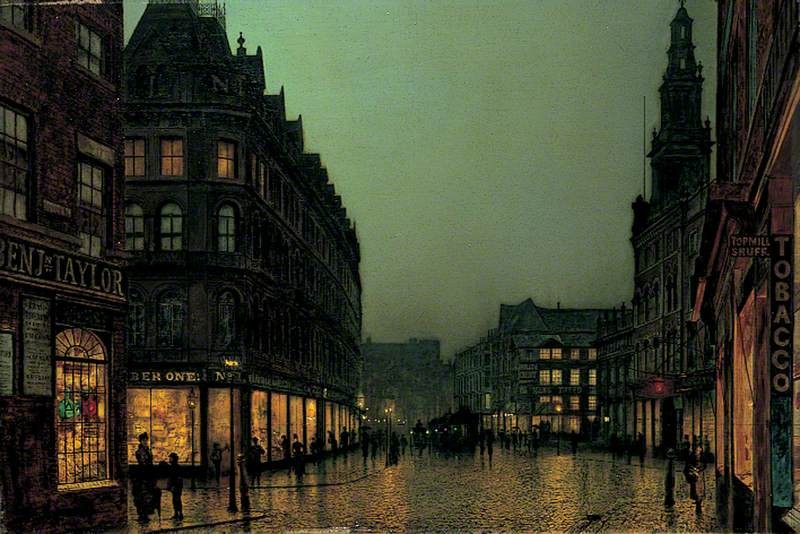
| Boar Lane, Leeds | 1881 | Painting |
| Bowder Stone, Borrowdale | 1865 | Painting |
| Briggate, Leeds | 1891 | Painting |
| 'Burning Off', a Fishing Boat at Scarborough | 1877 | Painting |
| Canny Glasgow | 1887 | Painting |
| Evening Glow | 1884 | Painting |
| Evening Scene by the Docks, Hull | Date unknown | Painting |
| Fiamella | 1883 | Painting |
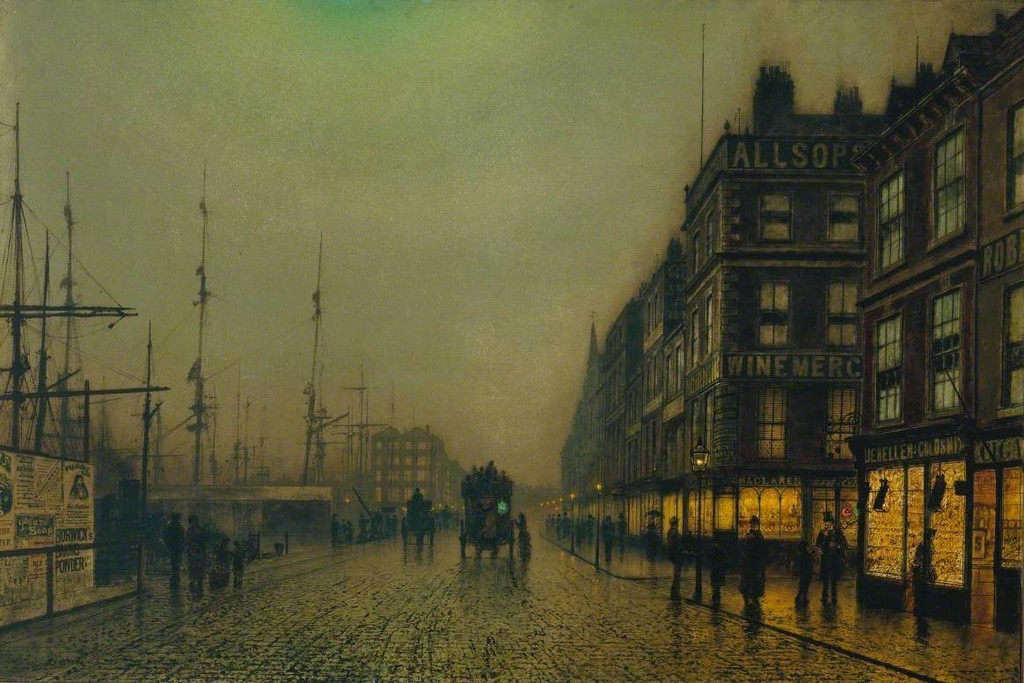
| Glasgow Docks | 1886 | Painting |
| Gloucester Docks | 1885 | Painting |
| Golden Visions | 1870 | Painting |
| Greenwich, Half Tide | 1884 | Painting |
| In Peril (The Harbour Flare) | 1879 | Painting |
| In the golden gloaming | Date unknown | Painting |
| In the Golden Mists of Autumn | 1884 | Painting |
| In the Golden Olden Times | 1870 | Painting |
| Ingleborough from under White Scar, Yorkshire Limestone Strata | 1868 | Painting |
| Iris | 1886 | Painting |
| Knostrop Old Hall at Dusk | 1870 | Painting |
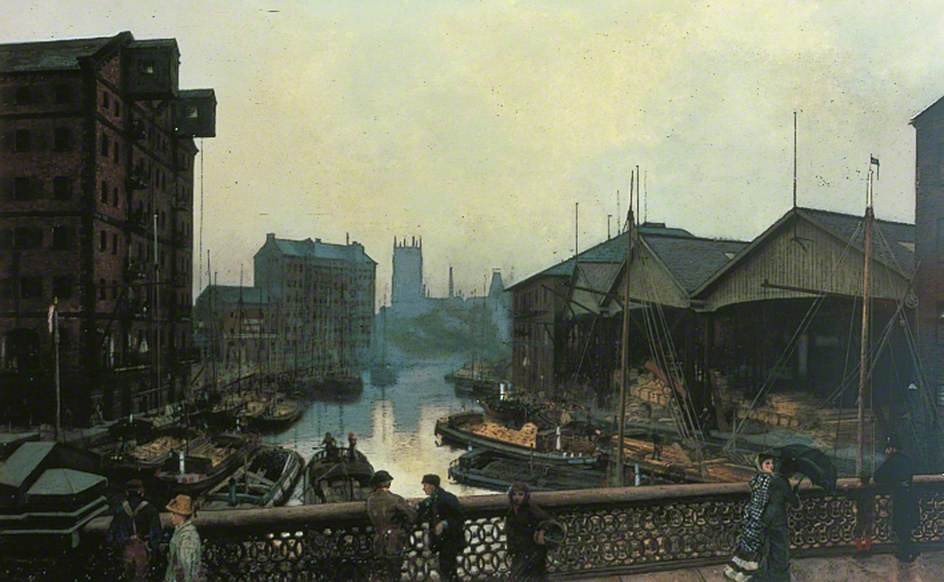
| Leeds Bridge | 1880 | Painting |
| Lights in the Harbour, Scarborough | 1879 | Painting |
| Liverpool Docks | 1892 | Painting |
| Liverpool Docks by Night | 1892 | Painting |
| Liverpool Docks (panel 1 of 5) | Date unknown | Painting |
| Liverpool Docks (panel 2 of 5) | Date unknown | Painting |
| Liverpool Docks (panel 3 of 5) | Date unknown | Painting |
| Liverpool Docks (panel 4 of 5) | Date unknown | Painting |
| Liverpool Docks (panel 5 of 5) | Date unknown | Painting |
| Liverpool Quay by Moonlight | 1887 | Painting |
| Moonlight Scene near Leeds | 1881 | Painting |
| Night Scene, Rouen | 1893 | Painting |
| Nightfall down the Thames | 1880 | Painting |
| Nightfall in Scarborough Harbour, North Yorkshire | 1884 | Painting |
| November Morning, Knostrop Hall, Leeds | 1883 | Painting |
| Old English House by Moonlight | Date unknown | Painting |
| Park Row, Leeds | 1882 | Painting |
| Princes Dock, Hull | Date unknown | Painting |
| Quai de Paris, Rouen | 1893 | Painting |
| Reflections on the Thames, Westminster | 1880 | Painting |
| Reflections on the Thames, Westminster, London | 1880 | Painting |
| Roundhay Park Lake | Date unknown | Painting |
| Salthouse Dock, Liverpool | Date unknown | Painting |
| Salthouse Dock, Liverpool, 1884 | Date unknown | Painting |
| Scarborough Lights | 1877 | Painting |
| Shipping on the Clyde | 1881 | Painting |
| Sic transit gloria mundi (The Burning of the Spa Saloon) | 1876 | Painting |
| Silver Moonlight | 1880 | Painting |
| Silver Moonlight | 1886 | Painting |
| Snow and Mist (Caprice in Yellow Minor) | 1892 | Painting |
| Stapleton Park, near Pontefract | Date unknown | Painting |
| Sunday Night, Knostrop Cut, Leeds | 1893 | Painting |
| Thames Moonlight | 1880 | Painting |
| The Custom House, Liverpool, Looking North | Date unknown | Painting |
| The Custom House, Liverpool, Looking South | Date unknown | Painting |
| The Harbour at Whitby by Moonlight | 1879 | Painting |
| The Head of Gertrude Grimshaw | 1874 | Painting |
| 'The Ironbound Shore' | 1869 | Painting |
| The Lady of Shalott | 1875 | Painting |
| The Parable of the Lost Sheep | Date unknown | Painting |
| The Rector's Garden, Queen of the Lilies | 1877 | Painting |
| The Seal of the Covenant | 1868 | Painting |
| The Sun's Farewell | Date unknown | Painting |
| The Thames by Moonlight with Southwark Bridge, London | 1884 | Painting |
| Thro' the Wood | Date unknown | Painting |
| Tree Shadows on the Park Wall, Roundhay, Leeds | 1872 | Painting |
| Under the Beeches | 1892 | Painting |
| Under the Silvery Moonbeams | Date unknown | Painting |
| View of Heath Street by Night | 1882 | Painting |
| View of Scarborough | 1876 | Painting |
| View of Southwark Bridge at Night | 1882 | Painting |
| Whitby | 1878 | Painting |
| Whitby Docks | 1876 | Painting |
| Whitby Harbor | 1874 | Painting |
| Windermere | 1863 | Painting |
| Woodland near Leeds | Date unknown | Painting |
| Yew Court, Scalby, near Scarborough | 1875 | Painting |
Frequently Asked Questions
The collection-linked title is Reflections on the Thames, Westminster, London.[1] The shorter Reflections on the Thames is useful in headings but does not replace the full object title.
The accepted date is 1880. Art UK and the exact reproduction record support it, with the latter noting the dated signature.[1][2] An older secondary display gives 1879, so the variance is recorded rather than concealed.
Leeds Art Gallery catalogues the canvas as LEEAG.PA.1900.0181.[1][2] John Kirk presented it to the gallery in 1900.[2]
The title identifies Westminster. Close looking reveals the Palace of Westminster, the river, a bridge and a populated embankment under moon and urban lights.[1][2]
Not in the institutional records used here. Her visible pose can be analysed, but a name, occupation or personal story would be speculation.
Discussion
Use this evidence-led guide as a starting point for close looking rather than a final verdict.
Share an observation about Reflections on the Thames or a source that adds useful context.
Reader Insights
Which visible detail most changes your reading of Reflections on the Thames?
How do medium, scale, setting and current museum evidence shape the encounter?
What remains uncertain once documented fact is separated from visual inference?
Join the Conversation
Add your reading below, keeping observations specific and evidence clear.
References
- Art UK, Reflections on the Thames, Westminster, London, accessed 31 August 2026.
- Wikimedia Commons, exact Leeds Art Gallery file record for Reflections on the Thames, Westminster, London, accessed 31 August 2026.
- Leeds Museums and Galleries, “Exhibition sheds new light on renowned Leeds artist John Atkinson Grimshaw”, accessed 31 August 2026.
- Scarborough Museums and Galleries, Atkinson Grimshaw: At Home in Yorkshire large-print guide, accessed 31 August 2026.
- Museo Nacional Thyssen-Bornemisza, “John Atkinson Grimshaw”, accessed 31 August 2026.