 by Tom Gurney
Tom Gurney BSc (Hons) is an art history expert with over 20 years experience
Published on November 5, 2026 / Page Updated on November 5, 2026
Email: tomgurney1@gmail.com / Phone: +44 7429 011000
Introduction
John Constable and J. M. W. Turner are often treated as opposites: water and fire, locality and travel, truth to place and visionary light, rural feeling and sublime drama. The contrast is useful, but only if it is handled carefully. Constable was not merely a painter of quiet countryside, and Turner was not merely a painter of theatrical storms. They were near contemporaries who transformed the status of landscape painting by taking it seriously enough to make it carry memory, weather, history, modernity, ambition and feeling.
The comparison has become newly prominent through Tate Britain's 2025-26 exhibition Turner & Constable: Rivals & Originals, mounted for the 250th anniversary period of both artists' births.[3] Amy Concannon's accompanying Tate volume describes two radically different visions of landscape painting, both original, both contentious, and both shaped by the social, political, economic and environmental changes of the early nineteenth century.[1] That is the right starting point. The story is not simply a rivalry between temperaments. It is a shared test of what landscape could become.
Constable was born in 1776 in East Bergholt, Suffolk. Turner was born in 1775 in London. One built his most powerful art around remembered and repeatedly studied places; the other ranged across Britain and Europe, history, sea, fire, travel, myth and modern spectacle. Yet both believed landscape could do more than decorate. Both pushed against hierarchy. Both used weather, light and handling to make the seen world emotionally and intellectually charged.
The pairing is still potent because neither artist is easy to contain. Constable's images can look reassuring until one notices how much technical experiment, professional anxiety and historical pressure they contain. Turner's works can look like pure spectacle until one recognises the discipline of topographical study, exhibition calculation and lifelong engagement with print, watercolour and oil. Their reputations have hardened into shorthand, but their art remains much less obedient.
At a Glance
- ArtistsJohn Constable and J. M. W. Turner
- Birth yearsTurner 1775; Constable 1776 [7][8]
- BackgroundsTurner: London; Constable: East Bergholt, Suffolk [3]
- Shared arenaRoyal Academy exhibitions [5][6]
- Shared ambitionTo raise landscape painting’s artistic status [2][7]
- Constable's methodReturn, local knowledge, outdoor study and studio construction [8]
- Turner's rangeTopography, sea, history, travel and modern events [7][13]
- Famous encounterThe reported 1832 Varnishing Day red-buoy episode [5]
- Comparison themesPlace and travel; weather and light; memory and spectacle
- Lasting resultTwo different routes to modern landscape painting [1][2]
Contents
- Introduction
- Why They Are Compared
- Two Beginnings
- Landscape and Ambition
- Turner: Range, Light and Modern Event
- Constable: Place, Weather and Return
- The Royal Academy as Arena
- The 1832 Varnishing Day Story
- Fire and Water
- Locality and Travel
Why they are compared
Constable and Turner invite comparison because their lives overlap so closely. They were born only fourteen months apart, trained in the same British artistic culture, exhibited in the same Royal Academy world, and worked during a period when landscape painting was fighting for prestige. Nicola Moorby's Turner and Constable: Art, Life, Landscape stresses that although they have often been seen as polar opposites, they were also fellow travellers in the struggle to win recognition for landscape painting.[2]
That shared cause matters. A crude comparison makes Turner the modern genius and Constable the local traditionalist, or makes Constable the sincere naturalist and Turner the theatrical showman. Both versions are too small. Turner could be intensely observant and technically disciplined. Constable could be radical in his treatment of paint, sky and scale. Their difference lies not in one being serious and the other not, but in the different routes by which each made landscape serious.
They were also compared by contemporaries. Tate's exhibition framing notes that critics of the day described them through opposed terms, including a clash of fire and water.[3] That language has stuck because it is vivid. Turner's blazing colour, marine drama and historical ambition seem fiery; Constable's Stour scenes, clouds and rivers seem watery. Yet the label is more revealing as reception history than as full interpretation. It tells us how eagerly the period wanted to stage them against each other.
Comparison sharpened both reputations. Each made the other more legible. Constable's rootedness looked more rooted beside Turner's travel and spectacle. Turner's volatility looked more volatile beside Constable's local studies and full-scale Stour pictures. The danger is that legibility becomes caricature. A good comparison should make both artists more complex, not less.
The comparison also matters because both artists have suffered from overfamiliarity. Turner is sometimes reduced to late light and theatrical weather; Constable to cottages, rivers and rural calm. Setting them together can disturb those habits. Turner begins to look less like a solitary prophet and more like an artist negotiating institutions, audiences and national identity. Constable begins to look less like an heirloom of Englishness and more like a painter of process, experiment and hard-won public ambition.
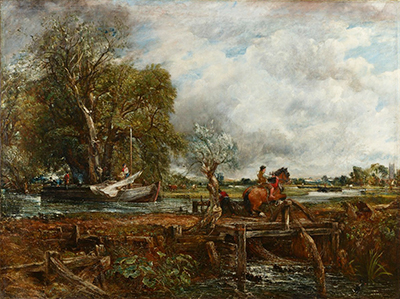
The Tate exhibition poster makes that productive opposition visible by pairing Turner's The Burning of the Houses of Lords and Commons with Constable's The White Horse.[4] It is an apt pairing because it avoids the laziest contrast between Turner and The Hay Wain. Constable's White Horse belongs to the ambitious Stour six-foot sequence, not to small rural anecdote; Turner's Parliament fire is both current event and elemental drama. Together they suggest two large claims for landscape rather than one large artist facing one cosy one.
Two beginnings
Turner's beginning was urban, commercial and precocious. The Metropolitan Museum of Art describes him as the son of a barber and wigmaker in Covent Garden, initially known for topographical watercolours, exhibiting at the Royal Academy from 1790 and aspiring to raise landscape toward the status of history painting.[7] He entered the public art world early and with striking energy.
Constable's beginning was rural, familial and slower. The Metropolitan Museum's Constable essay presents him as the son of a landowning farmer, miller and corn merchant, raised along the Stour at East Bergholt, and guided by the conviction that he should paint his own places best.[8] His entry into art came through family negotiation, Royal Academy training and a long attachment to the landscapes of childhood.
These origins shaped their art without determining it mechanically. Turner's London background and early draughtsmanship helped him move through topography, architecture, travel and public exhibition. Constable's Suffolk background gave him a deep local vocabulary: mills, locks, boats, fields, willows, riverbanks and skies known through repetition. Turner often built outward into range; Constable often deepened by return.
The contrast is not simply city versus country. Turner travelled widely, but he did not paint without memory or feeling. Constable stayed closer to English places, but he did not paint without ambition or awareness of tradition. Their beginnings help explain their differences, but the art exceeds biography.
Their early positions also shaped their relation to confidence. Turner was exhibiting young and entered the art world as an unusually forceful professional presence. Constable's path was more hesitant, marked by family expectation and later institutional recognition. That difference can be felt in their mature reputations: Turner often appears to seize the public stage, while Constable appears to work through resistance, delay and repeated return. Yet both careers required audacity. It is audacious to make a fire, storm or Alpine crossing into a field of colour; it is also audacious to insist that a Suffolk millpond deserves monumental seriousness.
Landscape and ambition
Both artists worked against the assumption that landscape was a lesser form of art. Turner addressed that problem by loading landscape with history, literature, travel, disaster, empire, sea power, classical memory and modern events. The Metropolitan Museum's Turner overview notes the breadth of his iconographic range, from seascapes and topographical views to historical subjects and scenes from his imagination.[7] Turner made landscape expansive.
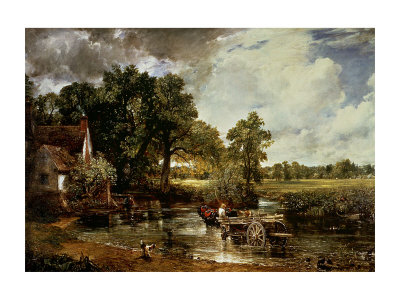
Constable addressed the same hierarchy differently. He made familiar places bear more seriousness than viewers expected. The National Gallery's Hay Wain record shows how he turned Flatford millpond, Willy Lott's house and a working wagon into a large Royal Academy picture, later recognised internationally.[10] The Stour was local, but the artistic claim was not small.
The Tate book's description of Rivals and Originals is valuable because it frames both painters as artists who challenged conventions and made landscape a vehicle for profound reflection.[1] That phrase should not be limited to Turner's obviously dramatic subjects. Constable, too, made landscape think: about memory, labour, weather, belonging and change.
Their shared ambition also helps explain their friction. They were not rivals because one painted landscape and the other did something else. They were rivals because both wanted landscape to matter. Each competed for attention within the same institutional spaces and the same debate over what British art could be.
This is the central reason their comparison still has force. They did not merely occupy the landscape tradition; they enlarged it from different sides. Turner gave landscape the reach of history painting, travel literature, marine drama and modern spectacle. Constable gave it the intensity of local knowledge, weather study and observed light. If one raised landscape by expansion and the other by concentration, both were doing the same larger work of promotion.
The National Gallery's artist record for Constable helps keep the institutional side of that ambition in view, placing him within a public collection that includes several works through which his landscape practice can be followed.[9] For Turner, the Tate-published Loukes volume stresses his range across oils, watercolours and print culture, as well as his technical innovation and engagement with his own times.[13] The two careers therefore cannot be separated from institutions, reproduction, collecting and changing publics.
Landscape's rise was not automatic. It required artists who could persuade viewers that fields, clouds, harbours, fires, mountains and rivers were not secondary subjects. Turner and Constable did this by different kinds of pressure. Turner made landscape absorb the scale of history and sensation. Constable made landscape sustain the density of memory and observation. Their achievement is not that they agreed, but that their disagreements enlarged the field.
Turner: range, light and modern event
Turner's range is astonishing. He moved through topographical watercolour, marine painting, historical landscape, classical subjects, contemporary events, prints, travel sketches and late atmospheric experiment. Tate's Andrew Loukes volume describes his pioneering work in oil and watercolour, innovative colour, use of print media and deep engagement with his own times.[13] He was not only a painter of effects; he was a painter of range itself.
The Cleveland Museum of Art's record for The Burning of the Houses of Lords and Commons, 16 October 1834 shows one side of that range. Turner based the painting on an actual event, the fire that destroyed much of Parliament, but heightened the flames and used the disaster to express human helplessness before destructive natural force.[12] The museum also notes the brilliant colour and variable atmosphere that approach abstraction.[12]
This kind of Turner differs strongly from Constable's Stour work. Turner takes a public disaster in London and turns it into spectacle, atmosphere and existential drama. Fire, water, crowd, reflection and smoke become almost cosmic. Constable's local landscapes rarely operate through such public catastrophe. His drama is usually slower, embedded in place, weather and memory.
Yet the difference should not be overstated into opposition between truth and invention. Turner's painting begins from a real event. Constable's most famous works are also constructed, revised and shaped in the studio. Both transform observation. The difference lies in the scale of transformation and the kind of emotional pressure applied.
Turner's event pictures are especially useful in comparison because they show how landscape can absorb public history. The Parliament fire is not a landscape in the narrow sense, but it depends on water, flame, air, crowd and architectural distance. The Thames becomes a reflective theatre for catastrophe. Turner turns the city into atmosphere and the event into a vision of human smallness before forces that exceed control.
This is one reason Turner can seem more immediately modern. He is willing to let industrial, urban and public events enter the landscape field. He can turn contemporary life into a drama of light. But modernity is not only a matter of subject. It is also a matter of pictorial risk, and here Constable's sketches, surfaces and cloudy skies also belong to the modern story.
Constable: place, weather and return
Constable's strength lies in return. Again and again he came back to places that had formed him: East Bergholt, Flatford, Dedham, the Stour Valley, later Hampstead, Salisbury and coastal sites. The Metropolitan Museum notes that he worked between East Bergholt and London, using outdoor studies as the basis for finished oil paintings exhibited at the Academy.[8] This alternation between place and studio is central to his originality.
His rootedness should not be confused with narrowness. The National Gallery records that The Hay Wain was made in London from open-air sketches accumulated over years, then sent into the public world of the Royal Academy and later the Paris Salon.[10] The painting is local in subject but international in reception. Constable's place became portable because his art made it convincing.
The cloud studies show another side of his originality. The Metropolitan Museum describes his 1821-22 skying period at Hampstead, his dozens of studies in watercolour, crayon and oil, and his practice of noting date, time, wind and weather conditions.[8] Such works are not nostalgic. They are disciplined investigations into atmosphere and perception.
Constable's landscape art is therefore not merely affectionate. It is analytical, technical and ambitious. He asked how a familiar place could hold change; how sky could carry feeling; how a working river valley could sustain monumental painting; and how direct study could survive the pressures of exhibition finish.
The National Gallery catalogue for The Hay Wain is helpful in this comparison because it shows how much construction lies behind an image often mistaken for simple natural truth.[11] The painting's title history, preparatory studies, Paris reception and technical changes all complicate the idea of Constable as an instinctive rural recorder. His art was made, argued, revised and publicly tested.
Constable's originality is therefore not the opposite of sophistication. It is a different sophistication. He does not usually enlarge landscape through mythic subject matter or continental travel. He enlarges it by treating a known world as if it can bear infinite return. The depth comes from looking until a place becomes inexhaustible.
The Royal Academy as arena
The Royal Academy was the arena in which the comparison became public. Both artists exhibited there, competed for attention and shaped their reputations through the annual display. The Academy mattered because landscape painting had to be seen among portraits, history paintings, subject pictures and other claims on public prestige.
Turner entered the exhibition world early and made it part of his career rhythm. Constable's path was slower, and his recognition took longer. Yet both understood that the Royal Academy was not simply a neutral display room. It was a theatre of reputation, placement, scale, critical response and professional ambition.
The Tate Papers essay on Turner and Constable in the Royal Academy helps place the rivalry within this exhibition culture rather than reducing it to personality.[6] It shows how criticism, display and institutional setting shaped the way their works were compared. The Royal Academy made difference visible. It placed pictures near one another, invited comparison and encouraged critics to create memorable oppositions.
This exhibition culture also helps explain why finishing mattered. Paintings were judged in relation to neighbouring works, lighting, hanging position and last-minute adjustments. A picture could be altered not only in the studio but in response to the room. In such a world, rivalry could become material: a touch of colour, a stronger contrast, a more assertive surface.
The Royal Academy also made landscape's hierarchy visible. A landscape did not simply have to be good in private; it had to stand in a crowded public environment where size, colour, subject and finish all competed. Turner's instinct for public impact and Constable's struggle to make his local subjects hold their own both belong to this setting. Their rivalry was intensified by architecture, hanging practice and critical attention.
This helps explain why the 1830s matter so much in the public imagination. By then both artists had established mature languages, and their works could be read against one another with unusual force. The Royal Academy did not invent the difference between them, but it staged that difference.
The 1832 Varnishing Day story
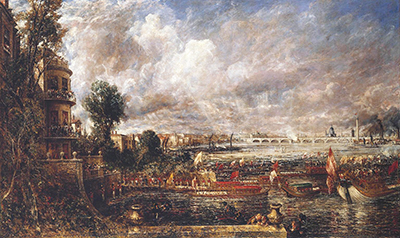
No Constable and Turner comparison can ignore the 1832 Varnishing Day anecdote, but it must be handled with restraint. The Royal Academy's account presents the rivalry as having supposedly reached a dramatic point when Turner's Helvoetsluys hung near Constable's The Opening of Waterloo Bridge and Turner added a small red buoy to his seascape.[5] Constable is reported to have responded with the famous gun remark.[5]
The story has everything a legend needs: two rivals, two paintings, a crowded exhibition, last-minute action, a tiny mark with large consequences. It is memorable because it converts artistic difference into a theatrical gesture. Turner's small red note seems to puncture Constable's more elaborate colour and effort.
But the anecdote should not be made to carry the whole relationship. The RA itself frames the story as fabled and as a mix of fact and myth.[5] That wording matters. The event is important as reception history and as a symbol of exhibition rivalry, but it cannot explain two careers. Turner and Constable had been developing different landscape languages for decades before that moment.
The anecdote is most useful when treated as a miniature of public comparison. Turner appears swift, strategic and compressed; Constable appears laborious, expansive and vulnerable to the room. Whether or not every detail of the later telling is secure, the story reveals how easily the two artists could be cast into roles. A serious comparison must use the story without being trapped by it.
It is also important that the anecdote involves two particular paintings, not two abstract personalities. Constable's Opening of Waterloo Bridge had occupied him for years and involved public ceremony, urban space, flags, river and celebration. Turner's Helvoetsluys was a marine picture whose added red mark could suddenly change the visual balance. The story is really about exhibition optics: what colour does in a room, how a neighbouring picture can alter another, and how quickly reputation can attach itself to a gesture.
The gun remark survives because it is brilliant theatre, but the theatre points back to a serious question. How much can one mark do? For Turner, the answer could be: enough to shift an entire painting's public force. For Constable, whose process was often slower and more accumulative, that kind of intervention could look almost predatory. The anecdote dramatises two tempos of making.
Fire and water
The phrase fire and water has persisted because it feels apt. Turner often made fire, sun, storm, steam, sea and atmospheric dissolution central to pictorial experience. Constable often gave water, cloud, river and damp English weather a slower, more grounded force. The phrase catches something real about their visual temperaments.
Yet it also simplifies. Turner painted water throughout his career: seas, rivers, harbours, canals, Venice, storms and reflections. Constable painted sky with an intensity that can feel far from watery calm. Both were painters of atmosphere; both used light to destabilise solid form. The difference is not that one owns fire and the other water, but that they use elemental forces differently.
In Turner, light can dissolve the world into vision. In Constable, light often clarifies the world by passing through weather and touching known forms. Turner's atmosphere can feel overwhelming, theatrical, even cosmic. Constable's atmosphere usually remains tethered to place, labour and observation.
The Tate Papers title itself uses the fire-and-water pairing, but the surrounding scholarship is valuable because it asks how such critical binaries were made.[6] Labels can help us enter a comparison, but they should not become the comparison. The real interest lies in the pressure each artist put on landscape from his own direction.
Fire and water also describe more than subject matter. They describe critical appetite. Audiences and writers wanted memorable oppositions, because oppositions made exhibitions readable. The danger is that Turner becomes all energy and Constable all calm. In reality, Constable's late skies can be deeply unsettled, and Turner's watercolours can be delicate, measured and quiet. The label works best when it remains provisional.
If the phrase has value, it lies in directing attention to elemental painting. Both artists made landscape out of forces rather than inventory. The question is not only what is represented, but what power moves through the image: flame, rain, wind, reflection, cloud, light, current, smoke. In both careers, landscape becomes a theatre of elements.
Locality and travel
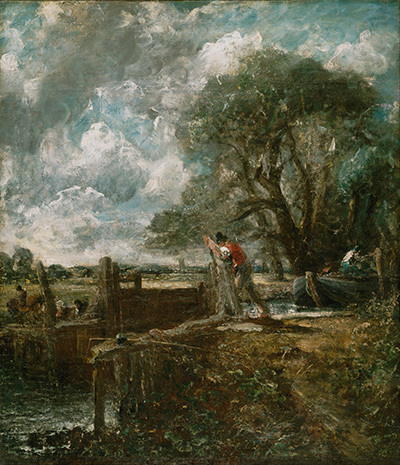
Constable's art is famous for locality. He painted the Stour Valley with unmatched intimacy, later expanding his geography through Hampstead, Salisbury, Brighton and other sites. Even when away from Suffolk, his method retained the pressure of repeated observation. He often made place feel known from within.
Turner's art is famous for travel. He moved through Britain and continental Europe, absorbing mountains, rivers, cities, coastlines, classical ruins, modern industry and marine weather. His landscapes often feel outward-moving, carrying the viewer into distance, voyage, history or spectacle.
This contrast is real, but it can mislead if treated morally. Constable's locality was not small-minded. It was a depth method. Turner's travel was not superficial restlessness. It was a range method. One returned in order to deepen; the other moved in order to enlarge. Both methods generated originality.
Their difference also changes the viewer's relation to place. Constable's best landscapes often invite recognition through accumulation: a cottage, a riverbank, a cloud over a known field. Turner often invites encounter through force: a storm, blaze, vortex, pass, ruin or radiant distance. Constable asks what a known place can contain. Turner asks what landscape can become when pushed toward history, light and imagination.
Locality and travel also imply different kinds of memory. Constable's memory is often layered by return; he knows a house, mill, river or sky through repeated acts of looking. Turner's memory is often accumulative across movement; journeys, sketches, literary associations and public events gather into later works. Both depend on memory, but one memory is deepened by place and the other expanded by itinerary.
This difference affects scale. Constable's places can feel large because they have been internally thickened. Turner’s places can feel large because they open outward into history, distance or elemental force. The viewer is invited either to inhabit a place more fully or to be carried beyond the ordinary terms of place altogether.
Handling, finish and surface
Both artists unsettled expectations of finish, but in different ways. Constable's broken paint, white touches, full-scale sketches and cloud studies could seem rough to viewers accustomed to smoother surfaces. Turner, especially later, pushed colour, light and atmosphere toward forms that could seem dazzling, difficult or illegible. Each made the surface of landscape more active.
Constable's handling often preserves the friction between study and finished work. The V&A sketch material and the earlier Constable manuscripts in this cluster show how outdoor studies, full-scale sketches and studio paintings relate. His surfaces can feel alive because they carry the memory of direct observation into public form.
Turner's handling often pushes beyond description into radiance and dissolution. The Cleveland Burning of the Houses of Lords and Commons record describes brilliant colour and atmospheric effects bordering on abstraction.[12] That word is useful for modern viewers, though it should be used carefully. Turner was not an abstract painter in the twentieth-century sense, but he opened landscape toward experiences that later viewers recognise as modern.
The difference is not simply rough versus smooth. It is a difference in pictorial pressure. Constable uses brokenness to keep place responsive to weather. Turner uses colour and atmosphere to make the world feel unstable, luminous and sometimes overwhelming. Both make landscape less passive.
Both artists also challenge the idea that finish equals truth. Constable's study-like passages can feel more faithful to weather than a smoothly completed field. Turner's dissolving forms can feel truer to light than a carefully bounded object. Each makes the viewer accept that a painting may become more convincing by becoming less conventionally finished.
This has had enormous consequences for later reception. Modern viewers often admire exactly the qualities that troubled earlier audiences: broken touch, exposed process, luminous uncertainty, atmospheric dissolution. Turner and Constable helped make landscape painting a place where unfinished-looking effects could carry serious meaning.
Weather, sky and atmosphere
Weather is one of the best ways to compare the two artists. Constable's weather often grows from observation. His cloud studies, inscriptions and Hampstead skying show a painter trying to know the sky precisely. His finished landscapes use weather to structure feeling, but the feeling remains tied to observed conditions.
Turner's weather often becomes spectacle and force. Storms, fire, steam, sunset and marine atmosphere can dominate the entire image. In The Burning of the Houses of Lords and Commons, the actual event becomes a theatre of flame, reflection, smoke and human vulnerability.[12] In many other works, Turner turns weather into the very substance of vision.
Both artists make weather central because both understand that landscape is not simply land. It is land under conditions. Light, cloud, rain, fire, mist, wind and reflection determine how the world is seen and felt. This shared insight is one of the strongest reasons to keep them together in art history.
The difference lies in scale and temperament. Constable's sky often enters through exact looking and emotional truth to place. Turner's atmosphere often enters through drama, travel, history and the sublime. Constable makes air intimate; Turner makes air immense.
The comparison is sharpest when one sets Constable's Hampstead cloud studies against Turner's storm and fire pictures. Constable isolates weather in order to understand it; Turner often unleashes weather in order to overwhelm. Constable's sky is frequently a field of study, marked by date, wind and condition. Turner's atmosphere often becomes an event in itself, more theatrical but not less observed.
Both approaches changed how viewers understood nature. Constable made weather particular. Turner made it sublime, historical and sometimes almost abstract. Together they moved landscape away from stable scenery and toward changing experience.
Reception and myth
The reception of Constable and Turner has often depended on memorable simplifications. Turner becomes the prophet of modern light; Constable becomes the painter of English rural truth. Turner becomes daring and universal; Constable becomes sincere and local. These stereotypes contain fragments of truth, but they distort both artists.
The Tate Rivals and Originals book description explicitly notes that both were celebrated as originals and attacked as eccentric or difficult.[1] That is crucial. Constable was not simply safe; Turner was not simply triumphant. Both could puzzle viewers. Both challenged expectations. Both were praised and resisted.
Moorby's comparison volume is useful because it promises to uncover layers of fiction that have embellished their achievements.[2] The rivalry itself is one such layer. It is not false, but it is often over-narrated. The real story is less tidy: competition, parallel ambition, shared institutions, mutual visibility, critical framing and later myth-making all work together.
Modern exhibitions continue to shape the myth. Tate's 2025-26 exhibition deliberately placed the two artists together in a 250th-anniversary frame.[3] That act of comparison is not neutral. It invites viewers to look again, to test inherited assumptions and to ask whether rivalry is the best or only lens.
The best modern accounts now tend to treat rivalry as one strand among several. Concannon's Tate volume foregrounds competing originality but also the shared challenge to artistic norms.[1] Moorby's book promises a similar correction, presenting the artists as different but linked by common historical problems.[2] This is healthier than the old winner-takes-all frame. The comparison becomes less like a contest and more like a double history of landscape's rise.
Myth still matters because it shaped viewing. The stories told about Turner and Constable affect how their paintings are seen. If Turner is always expected to be audacious, his quieter works may be ignored. If Constable is always expected to be sincere and rural, his technical daring may be softened. Good comparison should return to the pictures after recognising the myth.
Abroad and at home
Constable's and Turner's reputations also differ in their relation to home and abroad. Turner travelled widely and built a reputation through broad geographical and thematic range. Constable remained more English in his subject matter, yet The Hay Wain achieved crucial recognition in Paris in 1824. The National Gallery records its Paris Salon success and gold medal awarded by Charles X.[10]
That Paris success complicates the idea of Constable as merely domestic. His Suffolk art could appear abroad as something fresh and important. The Metropolitan Museum notes that Constable's surfaces affected French painters, including Delacroix.[8] Locality became international because the treatment of light, surface and natural truth had wider implications.
Turner's internationalism worked differently. His travels supplied subjects, but also ways to test light, history and perception across varied places. His work could absorb Venice, Switzerland, France, the sea, classical antiquity and contemporary disaster into a single artistic world. He made range itself part of his authority.
The distinction is therefore not home versus world. Constable's home ground entered the world through intensity. Turner's world entered art through transformation. Both are international in consequence, but the routes are opposite.
The Paris reception of The Hay Wain is one of the strongest correctives to a parochial Constable. The National Gallery catalogue preserves the importance of that reception, including the sale through Arrowsmith and the French response.[11] Constable's international influence did not require him to become Turner-like. It arose from the specific force of his own surfaces, skies and local truth.
Turner's foreign travel, by contrast, did not make him rootless. Venice, Switzerland, France and other places entered his art through repeated study and imaginative transformation. His range was not tourism in paint. It was a way of testing how light and atmosphere behave under different historical and geographical pressures.
Modernity and change
Both artists responded to a world in transition. The early nineteenth century was shaped by war, industrialisation, urban growth, changing transport, new exhibition cultures, scientific attention to weather and shifting ideas of national art. Landscape could no longer be simply an inherited pastoral language. It had to reckon with modern experience.
Turner often met modernity directly: fire, steam, cities, ships, industry, travel, public catastrophe. Even when he painted classical or historical subjects, his handling made them feel unstable and contemporary. His light often seems to consume the very world it reveals.
Constable met modernity differently. He painted rural places with such intensity partly because they were changing. The National Gallery's account of The Hay Wain suggests that his monumental rural vision may relate to a sense that the old way of life was under pressure from rapid industrialisation.[10] Constable does not need to paint factories to be modern. His modernity lies in the self-conscious act of preserving and transforming observed place.
The Tate book's emphasis on social, political, economic and environmental developments helps bring both artists into the same historical frame.[1] Turner and Constable were not timeless geniuses floating above their century. They were painters whose landscapes answered a changing world with different visual languages.
This point is especially important for Constable. Because later culture turned him into an emblem of rural England, his work can appear removed from modernity. But a painting of a remembered rural world can be modern precisely because it recognises change through preservation. Constable's art often gives form to continuity under pressure.
Turner, by contrast, often makes change visible as event: burning parliament, steam, storm, travel, maritime risk, imperial and historical subjects. If Constable's modernity is sometimes elegiac, Turner's is often spectacular. Both respond to disruption; they simply do not give disruption the same face.
What each saw in landscape
Turner saw landscape as range, force and possibility. A landscape could be a theatre of history, an experiment in light, a sea storm, a mountain passage, a fire, a classical memory, a modern event or a near-dissolution of form. He expanded the category by making it absorb everything.
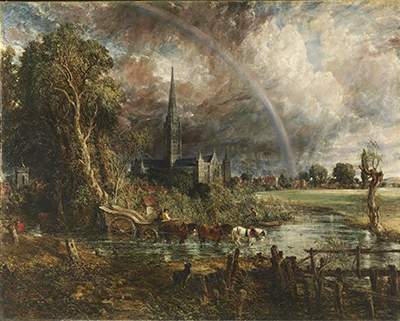
Constable saw landscape as attachment, structure and truth through repeated looking. A landscape could be a working river, a family place, a cloud system, a cathedral meadow, a coastal weather event or a memory reassembled in the studio. He deepened the category by making ordinary places inexhaustible.
Turner often makes the viewer feel small before nature, history or light. Constable often makes the viewer feel placed within weather, locality and time. Turner can be overwhelming; Constable can be absorbing. Turner expands outward; Constable thickens inward.
Neither method is lesser. They answer different needs. Turner shows landscape's capacity for awe, instability and transformation. Constable shows landscape's capacity for knowledge, belonging and emotional truth. Together they make landscape painting impossible to dismiss.
A useful comparison begins by refusing the quick verdict. The question is not who wins. It is what each makes possible. Turner and Constable changed landscape by different means, and the difference itself is historically productive. Their art offers two models of seriousness.
Then compare specific pressures. How does each artist use light? How does each handle weather? How does each relate study to finished work? How does each use scale? How does each turn place into meaning? How does each address the public through the Royal Academy and later institutions?
It also helps to compare not only famous works but working processes. Constable's cloud studies and full-scale sketches show an artist building public painting from sustained observation. Turner's sketches, watercolours, prints and late paintings show an artist constantly moving between record, memory, market, exhibition and experiment. Both artists depend on process, not only masterpieces.
Finally, keep the rivalry in proportion. The 1832 Varnishing Day story is irresistible, but the deeper comparison is bigger than a red buoy. It is a comparison between two ways of making landscape modern: one grounded in the repeated truth of place, the other driven by range, light and transformation.
The comparison also benefits from pairing works by function rather than fame alone. The Hay Wain and The Burning of the Houses of Lords and Commons are both famous, but they do not answer the same pictorial problem. Constable's cloud studies and Turner's atmospheric watercolours may reveal a different kind of kinship. Constable's Opening of Waterloo Bridge and Turner's Helvoetsluys matter because of exhibition encounter, not because either is the whole artist.
This means the strongest comparison is plural. It moves between biography, institution, medium, subject, handling and reception. It resists the single anecdote and the single masterpiece. Turner and Constable are not chess pieces marked fire and water. They are artists whose careers repeatedly cross the same questions from different angles.
The pairing is also useful for readers who know one artist better than the other. Turner can help a Constable viewer see how bold Constable's restraint is; Constable can help a Turner viewer see how much observation lies beneath Turner's spectacle. The two artists act almost like different instruments tuned to the same century. Their sounds are distinct, but the historical pressure passing through them is shared.
Why the pairing still matters
Constable and Turner still matter together because they reveal the breadth of landscape painting at the moment it became newly powerful. One artist shows that a local river valley, watched for years, can sustain monumental art. The other shows that landscape can absorb history, disaster, travel, fire, sea and light until it becomes a vehicle for modern experience.
They also correct each other. Turner prevents Constable from being reduced to nostalgia; beside Turner, Constable's observational discipline and local intensity look like chosen ambition rather than limitation. Constable prevents Turner from being reduced to spectacle; beside Constable, Turner's dramas look like one possible answer to the same problem of making landscape carry meaning.
Their rivalry is therefore most useful when it becomes a form of double vision. We see landscape as place and as force, as memory and as spectacle, as weather record and as luminous event, as national art and as international experiment. The pair do not collapse into one story. They make the field larger.
That is why the comparison keeps returning. Turner and Constable are not simply the two great names of British landscape painting. They are two arguments about what landscape is for. Constable asks how deeply a known world can be seen. Turner asks how far landscape can be pushed toward light, history and vision. Between them, landscape becomes one of the central languages of nineteenth-century art.
Their lasting value is not in resolving the rivalry. It is in keeping both possibilities open. Landscape can be intimate or overwhelming, empirical or visionary, local or expansive, slow or explosive. Turner and Constable made those alternatives visible in the same artistic culture and often in the same exhibition rooms. That is why their comparison remains more than a historical curiosity. It is a way of understanding how landscape became modern without becoming one thing.
Frequently Asked Questions
Discussion
Which comparison reveals more: place against travel, observation against spectacle, or two different kinds of ambition?
Reader Insights
Does Constable's repeated return or Turner's geographical range create the stronger kind of depth?
Where do exact atmosphere and theatrical force begin to overlap rather than oppose each other?
Does the red-buoy story clarify the paintings, or mainly clarify how reputations are made?
Join the Conversation
Share your reading below.
References
- Amy Concannon, ed., Turner and Constable: Rivals and Originals, Tate Publishing, 2026, https://www.abramsbooks.com/product/turner-and-constable_9781849769846/
- Nicola Moorby, Turner and Constable: Art, Life, Landscape, Yale University Press, 2025/2026, https://yalebooks.co.uk/book/9780300290363/turner-and-constable/
- Tate Britain, “Turner & Constable: Rivals & Originals,” https://main-tate-3be997.up.railway.app/whats-on/tate-britain/turner-and-constable
- Tate Shop, “Turner and Constable exhibition poster,” https://shop.tate.org.uk/turner-and-constable-exhibition-poster/347632.html
- Royal Academy, “Constable, Turner and the Royal Academy,” https://shop.royalacademy.org.uk/jan-constable-turner
- Nicola Moorby, “‘Fire and Water’: Turner and Constable in the Royal Academy, 1831,” Tate Papers, no. 33, https://www.tate.org.uk/research/tate-papers/33/fire-water-turner-constable-royal-academy
- Metropolitan Museum of Art, “J. M. W. Turner,” https://www.metmuseum.org/exhibitions/listings/2008/j-m-w-turner
- Metropolitan Museum of Art, “John Constable (1776-1837),” https://www.metmuseum.org/de/essays/john-constable-1776-1837
- National Gallery, “John Constable,” https://www.nationalgallery.org.uk/artists/john-constable
- National Gallery, “John Constable, The Hay Wain,” https://www.nationalgallery.org.uk/paintings/the-hay-wain
- Judy Egerton, “The Hay Wain,” National Gallery Catalogues: The British Paintings, https://www.nationalgallery.org.uk/paintings/catalogues/egerton-2000/the-hay-wain
- Cleveland Museum of Art, “Joseph Mallord William Turner, The Burning of the Houses of Lords and Commons, 16 October 1834,” https://www.clevelandart.org/art/1942.647
- Tate Shop, Andrew Loukes, Artists Series: JMW Turner, https://shop.tate.org.uk/artists-series-jmw-turner/29027.html