 by Tom Gurney
Tom Gurney BSc (Hons) is an art history expert with over 20 years experience
Published on August 14, 2026 / Updated on August 14, 2026
Email: tomgurney1@gmail.com / Phone: +44 7429 011000
The Annunciation: Introduction
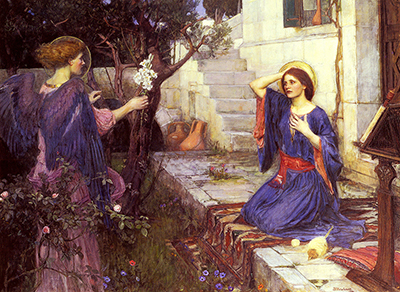
John William Waterhouse's The Annunciation places a foundational Christian encounter in a garden court alive with roses, lilies, stone, woven cloth and household work. The Archangel Gabriel approaches from the shadowed left bearing white flowers. Mary kneels on patterned cushions beside her yarn and loom, one hand pressed to her chest and the other raised to her head in startled attention.
Painted in 1914, the canvas is a late work by an artist better known for classical myth and English poetry. [1] Waterhouse does not discard those visual habits when he turns to the Gospel of Luke. He uses an enclosed garden, a psychologically absorbed woman and a moment poised between message and response. The result is devotional in subject but characteristically human in its treatment of surprise.
At a Glance
- ArtistJohn William Waterhouse
- TitleThe Annunciation
- Date1914 [1]
- MediumOil on canvas [1]
- DimensionsApproximately 99 × 135 cm [1]
- SignatureSigned and dated lower right [1]
- CollectionPrivate collection [1]
- Primary biblical sourceLuke 1:26–38 [2]
- FiguresThe Archangel Gabriel and the Virgin Mary
- Key motifsLilies, enclosed garden, halos, yarn, spindle and loom
Contents
- Introduction
- What the painting shows
- The Gospel story
- Gabriel's arrival
- Mary's gesture and response
- Lilies, roses and the enclosed garden
- Yarn, spindle and loom
- Architecture and domestic space
- Colour, light and composition
- A late Waterhouse religious painting
What the painting shows
Gabriel stands at left, moving towards Mary across a garden threshold. A dark violet-blue mantle covers much of the angel's body, opening to reveal rose-coloured sleeves. One hand presents a spray of white lilies.
Mary kneels at right on rugs and cushions. Her deep blue garment is bound with red at the waist, and red-orange fabric appears at the sleeves. The complementary colours make her the strongest figure against the pale masonry.
Her right hand rests over her chest. Her left arm bends sharply upward so that the hand touches or passes behind her head. The combined movement conveys astonishment before it conveys calm acceptance.
Between the figures is a narrow garden path. Roses climb at Gabriel's feet, small flowers cross the foreground, and a tree twists towards pale steps in the centre.
The house rises at right. Pottery vessels sit near the steps and upper ledge. A large wooden loom or weaving frame is cropped by the edge, while loose fibre, yarn and a spindle lie near Mary's knees.
Both figures have fine circular halos. Waterhouse makes these signs delicate enough to belong to the naturalistic scene without abandoning sacred identity.
The composition therefore divides and joins two worlds: Gabriel comes through garden shadow, Mary occupies the sunlit domestic court, and the message crosses the open space between them.
The Gospel story
Luke records that God sent Gabriel to Nazareth, to a virgin named Mary who was betrothed to Joseph. Gabriel greeted her and announced divine favour. [2]
Mary was troubled and considered what the greeting might mean. The angel told her not to fear and said that she would conceive a son named Jesus, who would be called Son of the Most High. [2]
When Mary asked how this could be, Gabriel answered that the Holy Spirit would come upon her. He also told her that her relative Elizabeth had conceived despite age and barrenness. [2]
Mary's response completes the encounter: she identifies herself as the servant of the Lord and accepts that it should happen according to the message. The angel then departs. [2]
Waterhouse does not illustrate every element. Joseph and Elizabeth are absent; no inscribed words identify a particular verse; no visible dove is prominent in the surviving reproduction.
Instead, he selects the transition from troubled greeting towards response. Gabriel has arrived and is speaking; Mary is still absorbing what she hears.
The Gospel does not mention lilies, roses, yarn, a loom or this architecture. These belong to centuries of Annunciation imagery and to Waterhouse's own visual construction.
Keeping text and pictorial tradition distinct makes the painting richer. It shows how an artist can remain faithful to the central encounter while developing details not specified by Luke.
Gabriel's arrival
The National Gallery identifies Gabriel as the archangel who announced to Mary that she would bear the Son of God. In Western painting he commonly carries a lily or a scroll bearing the greeting from Luke. [3]
Waterhouse gives him lilies but no visible scroll. The message is therefore carried by bodily approach and attribute rather than written text.
Gabriel's face is in profile, directed towards Mary. The figure occupies the darker, densely planted side of the canvas, yet the head and lilies catch enough light to emerge.
The long mantle falls in heavy vertical folds. Pink fabric beneath it echoes the roses, preventing the celestial visitor from appearing colourless or immaterial.
The wings are present but subdued. They do not fill the sky with theatrical flight; their pale, translucent form keeps attention on the exchange of looks and gestures.
Gabriel does not kneel. He advances with the flowers held forward, simultaneously messenger and interruption.
The halo is a narrow ring rather than a solid gold disc. Waterhouse translates a traditional emblem into the naturalism of an outdoor scene.
No audible words can be painted, but the lilies bridge the gap. They project from Gabriel's hands towards the centre, almost giving the message a visible direction.
Mary's gesture and response
Mary's pose combines several moments that Luke narrates in sequence: disturbance, questioning and eventual assent. [2]
The hand at her chest is protective and inward. The raised arm enlarges the silhouette and suggests that work has stopped abruptly.
Her eyes meet or approach Gabriel rather than falling in passive modesty. Surprise does not cancel intelligence; Luke explicitly says she considered the meaning of the greeting. [2]
Waterhouse avoids a broad smile or a gesture of uncomplicated celebration. Mary is confronted with news that transforms her future, and the body registers its weight.
The kneeling posture can signify humility, but it also grows from the practical setting. She has been working beside yarn and textiles at ground level.
Her halo identifies sacred status while her loose hair and interrupted labour preserve everyday presence. The two registers are not opposites in the painting.
The red sash draws attention to the centre of her body without needing an overt beam of divine light. Blue surrounds it, creating a concentrated band of warm colour.
The final verse of the Gospel gives Mary verbal agency. A responsible interpretation should not reduce her to someone upon whom the scene merely happens. Waterhouse's alert gaze and complex gesture leave room for thought before consent.
Lilies, roses and the enclosed garden
White lilies are among the most established attributes of the Annunciation. The National Gallery explains that they generally signify purity and are often placed in Gabriel's hand or a vase. [4]
Their meaning comes from visual tradition, not from Luke's text. Waterhouse gives the flowers to Gabriel, making them both symbol and physical offering.
Roses grow abundantly at the left and scatter through the garden. Their colours link Gabriel's sleeves with the living border at his feet.
The court is enclosed by walls and architecture yet open to sky and growth. In Christian imagery the hortus conclusus, or enclosed garden, became associated with Mary's virginity. The National Gallery identifies this symbolism in Annunciation painting. [5]
Waterhouse frequently used gardens as psychologically charged boundaries. They shelter female figures but can also separate them from a larger world.
Here enclosure does not imply imprisonment. Gabriel has crossed into the court, proving it permeable to a divine message.
The garden is neither a precise reconstruction of first-century Nazareth nor a purely English flower border. Pale Mediterranean architecture and richly cultivated plants create a poetic sacred locality.
Roses and lilies should not be forced into an exhaustive coded programme. Lilies carry unusually stable Annunciation associations; the many other flowers also provide colour, season and sensory abundance.
Yarn, spindle and loom
The most distinctive detail lies at Mary's feet and along the right edge. A ball or mass of pale fibre, a spindle and trailing thread sit before a substantial wooden weaving frame.
Luke does not say that Mary was spinning when Gabriel arrived. The motif comes from an apocryphal tradition associated with the Protoevangelium of James.
The Uffizi explains that this story describes Gabriel appearing while Mary spun purple and scarlet yarn for a curtain of the Temple, which is why spindle and distaff appear in Annunciation art. [6]
The Walters Art Museum likewise notes that Mary was represented as one of the virgins selected to weave the Temple veil, with purple thread assigned to her. [7]
Waterhouse revives that older, particularly Byzantine-associated motif in a large modern oil painting. Mary's garment and sash contain blue-red and purple relationships that resonate with the textile tradition.
The equipment also transforms symbolism into interrupted work. Yarn is loose, the spindle has been set down, and the loom remains at the edge, implying a task extending beyond the visible moment.
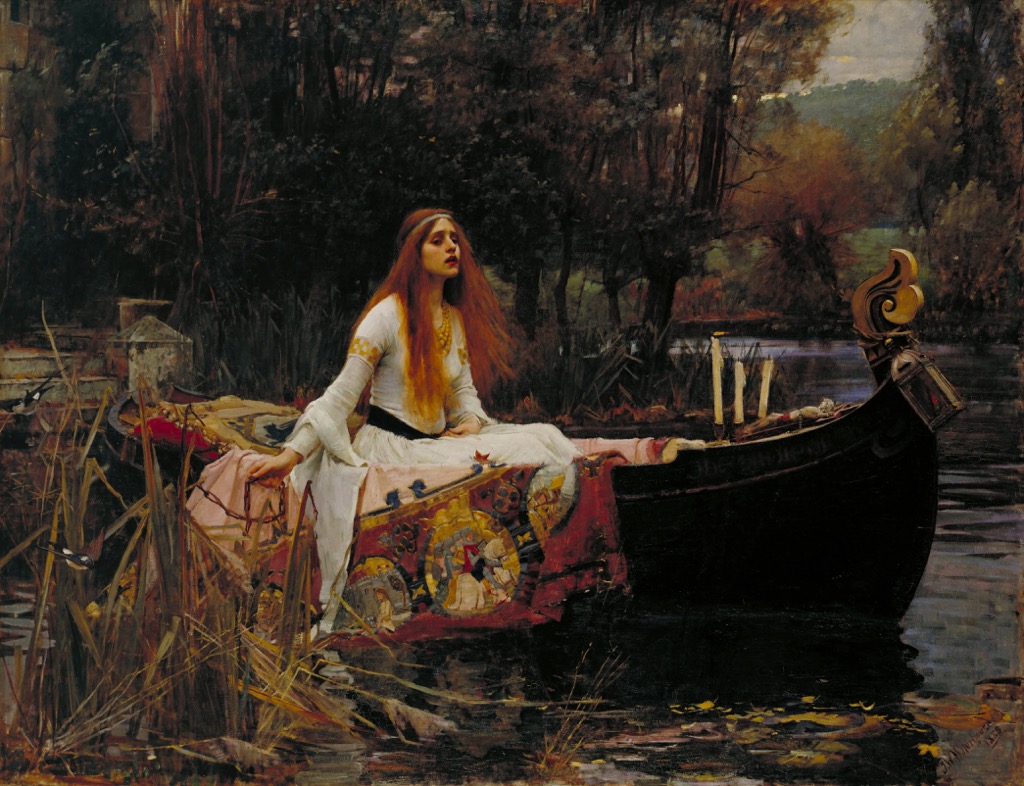
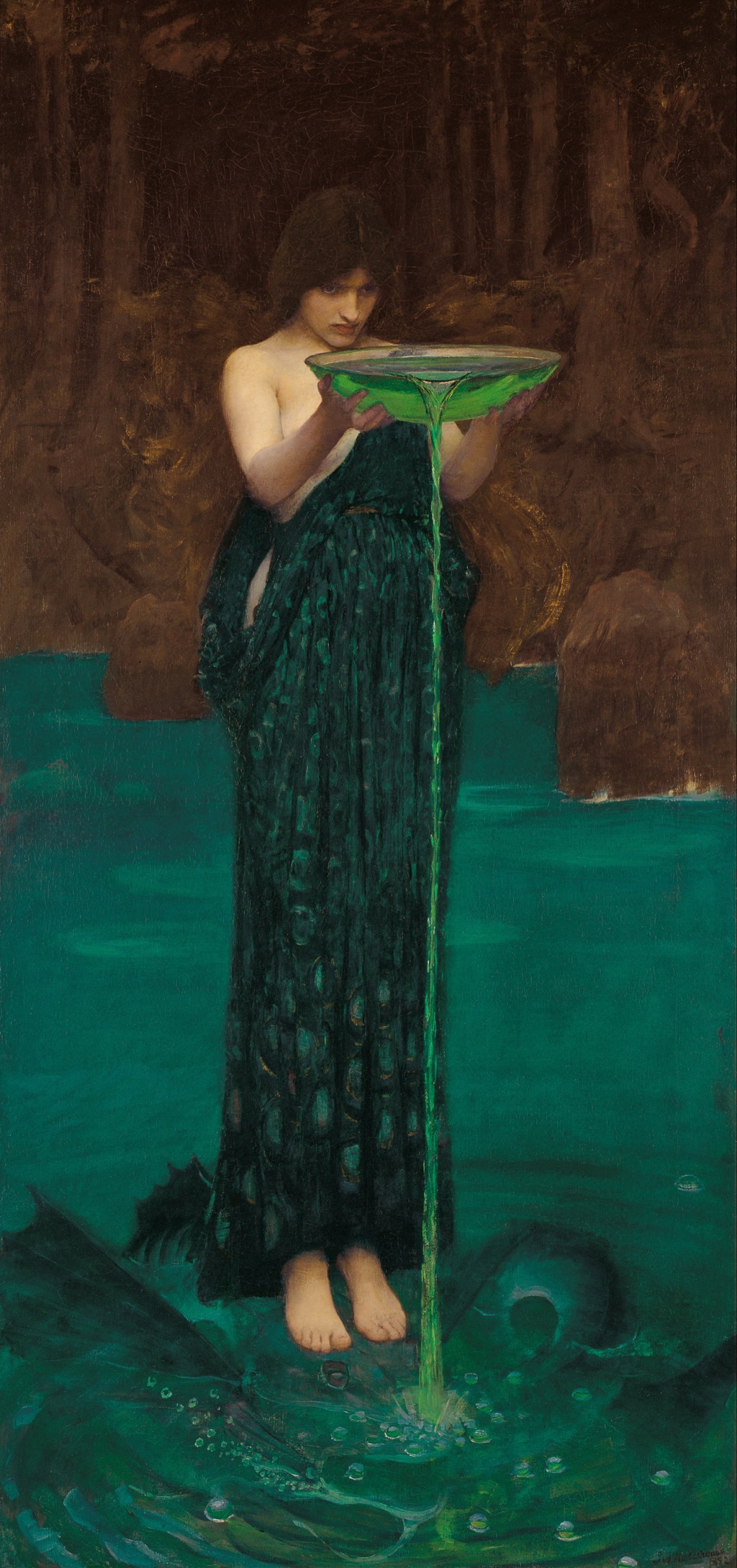
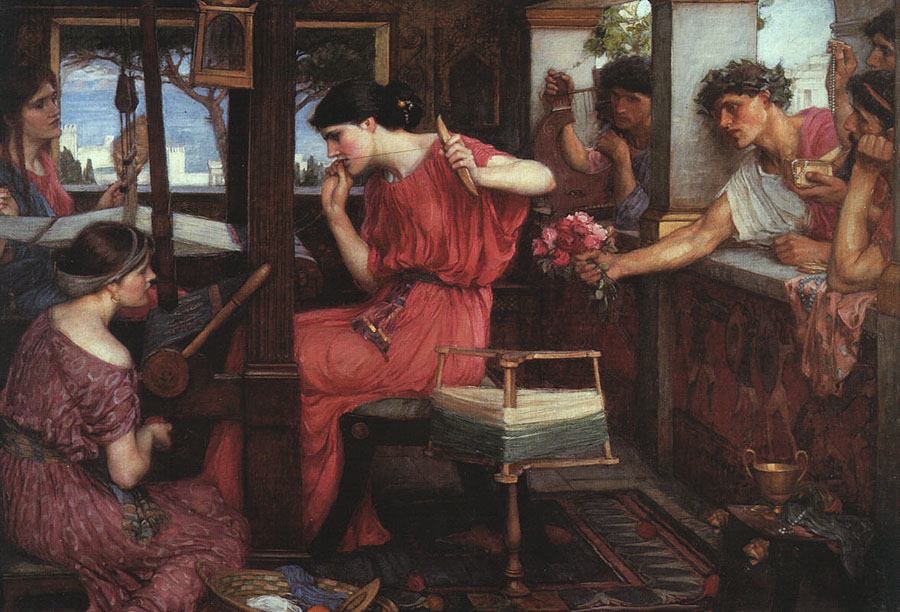
Weaving was already important within Waterhouse's art. Penelope, Circe and the Lady of Shalott connect textile labour with time, identity and narrative. Mary enters that larger constellation without becoming a pagan or literary heroine.
The veil tradition has theological resonance, but the simplest visual effect is immediate: the angel's appearance stops a pair of working hands.
Architecture and domestic space
The setting combines garden and house. Pale stone walls rise behind Mary; a flight of steps leads upward; dark shutters and simple pottery imply habitation.
Waterhouse avoids a church interior. The Annunciation occurs within Mary's daily environment, consistent with the Gospel's placement in Nazareth even though Luke supplies little architectural description. [2]
The stairs create a central wedge of light between the figures. Their ascent may invite symbolic interpretation, but they first solve a spatial problem by carrying the eye into the background.
A wind-bent or carefully trained tree crosses in front of the steps. Its organic line counters masonry and guides movement back towards Gabriel.
The loom at far right acts like an architectural vertical. Because it is cropped, the viewer feels the domestic workspace continuing beyond the canvas.
Clay vessels provide muted orange notes and a sense of storage. They should not automatically be identified with the well episode found in some apocryphal accounts; Waterhouse does not show Mary drawing water.
The varied floor surfaces—garden earth, stone path, rug and cushion—mark Gabriel's and Mary's different zones. The message crosses from planted ground into a space of craft and dwelling.
This threshold organisation is characteristically Waterhouse. Interior and exterior are not fixed opposites but adjacent psychological territories.
Colour, light and composition
The canvas is wider than it is tall, approximately 99 by 135 centimetres. [1] Its format permits two full figures to face each other across a meaningful interval.
Dark foliage massed at left makes Gabriel's lilies bright. Pale architecture at right provides a contrasting field for Mary's blue clothing and red hair.
Blue links the two figures, but their garments are not identical. Gabriel's cloak tends towards violet and shadow; Mary's dress is a clearer, more saturated blue.
Pink and red accents move from roses through Gabriel's sleeves to Mary's belt and cushions. Colour therefore crosses the physical separation before the figures do.
The central path and steps remain comparatively empty. This interval is not dead space: it is where the spoken announcement operates.
Waterhouse places Mary's head against light stone and Gabriel's against dark trees, preserving both profiles. Their halos lightly repeat the circular forms of yarn and pottery.
Surface changes with material. Foliage and flowers are broken and flickering; masonry is broadly planar; textiles receive long directional folds.
Digital reproductions vary considerably in brightness. Claims about exact hues or condition should defer to direct examination and technical records, but the broad warm-cool structure remains legible.
A late Waterhouse religious painting
Waterhouse signed and dated the canvas in 1914, three years before his death. [1] It belongs to a late period in which he continued to revisit absorbed women, gardens and literary or sacred themes.
Religious subjects are less central to his popular reputation than Greek mythology, Arthurian legend and poetry. That makes The Annunciation especially revealing.
The painting does not imitate a medieval altarpiece, though it borrows longstanding iconography. Oil on canvas, naturalistic bodies and a cultivated garden place tradition within Waterhouse's established pictorial language.
The loom links sacred narrative to themes present throughout his career. The enclosed court recalls other secluded female spaces. The paused gesture resembles the charged instants in his mythological scenes.
Yet the ethical direction differs. Gabriel is not a threatening enchantment, and Mary's attention is not fatal curiosity. The encounter opens towards Christian incarnation and voluntary assent.
The date 1914 invites connection with the outbreak of the First World War. Without documentary evidence, however, the picture should not be claimed as a war allegory. It may acquire poignancy from its date without proving a specific political programme.
Late style here means synthesis. Waterhouse brings together his preferred formal vocabulary and an image tradition much older than his own career.
That synthesis is especially clear when the painting is compared conceptually with The Lady of Shalott. Both women sit beside textile work at the moment an outside event changes the direction of life. Yet Mary does not abandon work because a forbidden world has tempted her. The interruption carries a sacred vocation, and her response is articulated through dialogue rather than catastrophe.
Waterhouse also avoids making late religious art look archaic for its own sake. Halos and lilies remain legible, but modelling, garden light and the bodily weight of kneeling belong to his contemporary oil technique. Tradition is quoted through objects and signs, not through imitation of an early panel's gold ground.
Interpretation, uncertainty and legacy
The painting can be approached as Christian devotional art, a late Pre-Raphaelite-associated treatment of female experience, or a study of interruption and response. These readings need not exclude one another.
Its strongest interpretive tension lies between stillness and transformation. Nothing in the architecture visibly changes, yet Mary's future has been radically redefined.
The flowers, halo and wings make Gabriel recognisable. The yarn and loom place Mary in an expanded tradition. Neither group of symbols replaces the expressive force of her body.
Viewers should resist treating surprise as refusal or consent as passivity. Luke's sequence includes troubling, questioning and answering; Waterhouse compresses that intellectual and emotional movement into one pose. [2]
Current ownership is private, so exhibition and access may change. Claims about a permanent location should not be made from circulating reproductions. [1]
The high-quality public-domain image has given the work wide digital visibility, but online captions sometimes supply conflicting measurements or omit its textile iconography. Object data and direct visual inspection provide a firmer foundation.
Within the Waterhouse cluster, The Annunciation expands both subject and tradition. It shows an artist famous for ancient enchantresses engaging a Christian mystery through the practical world of a young woman at work.
The private ownership of the canvas increases the importance of cautious digital scholarship. Reproduction makes close comparison possible, but it cannot establish current condition, exact colour balance or exhibition availability. Those questions require collection-level confirmation.
What the image can securely support is already substantial: the signed date, two facing figures, floral attributes, enclosed setting and textile apparatus. Building interpretation outward from those features produces a more durable account than repeating devotional symbolism without looking at Waterhouse's particular decisions.
The picture's emotional ambiguity is therefore a strength. A believer may understand Mary's gesture through humility and incarnation; a secular viewer may recognise the shock of life-changing news. Waterhouse permits both encounters without making the sacred narrative generic.
Related Pages
- The Lady of Shalott: Compare Waterhouse's best-known literary composition.
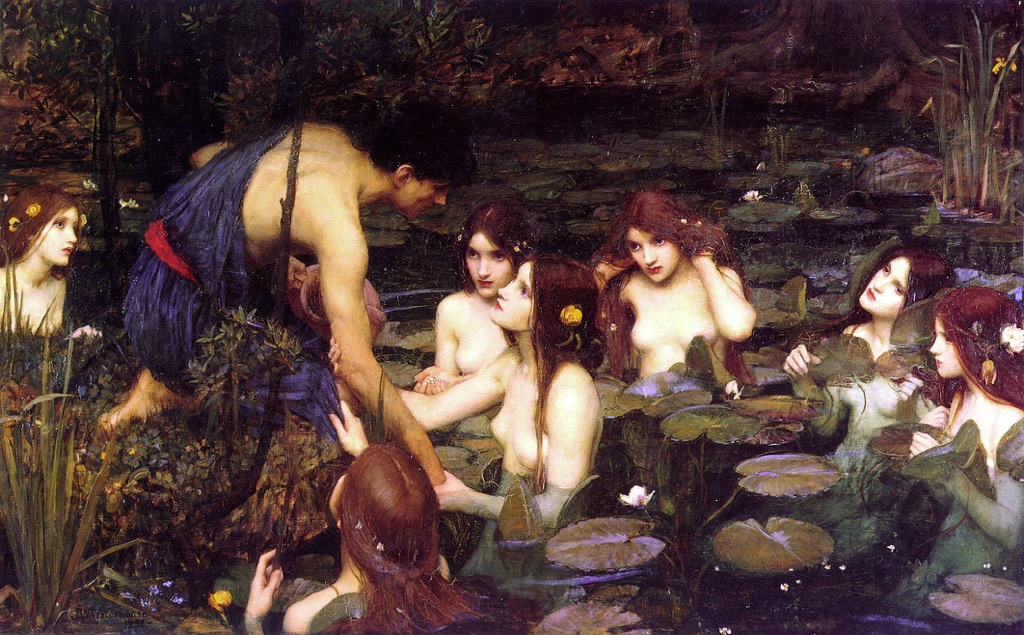
- Hylas and the Nymphs: Compare another major mythological scene.
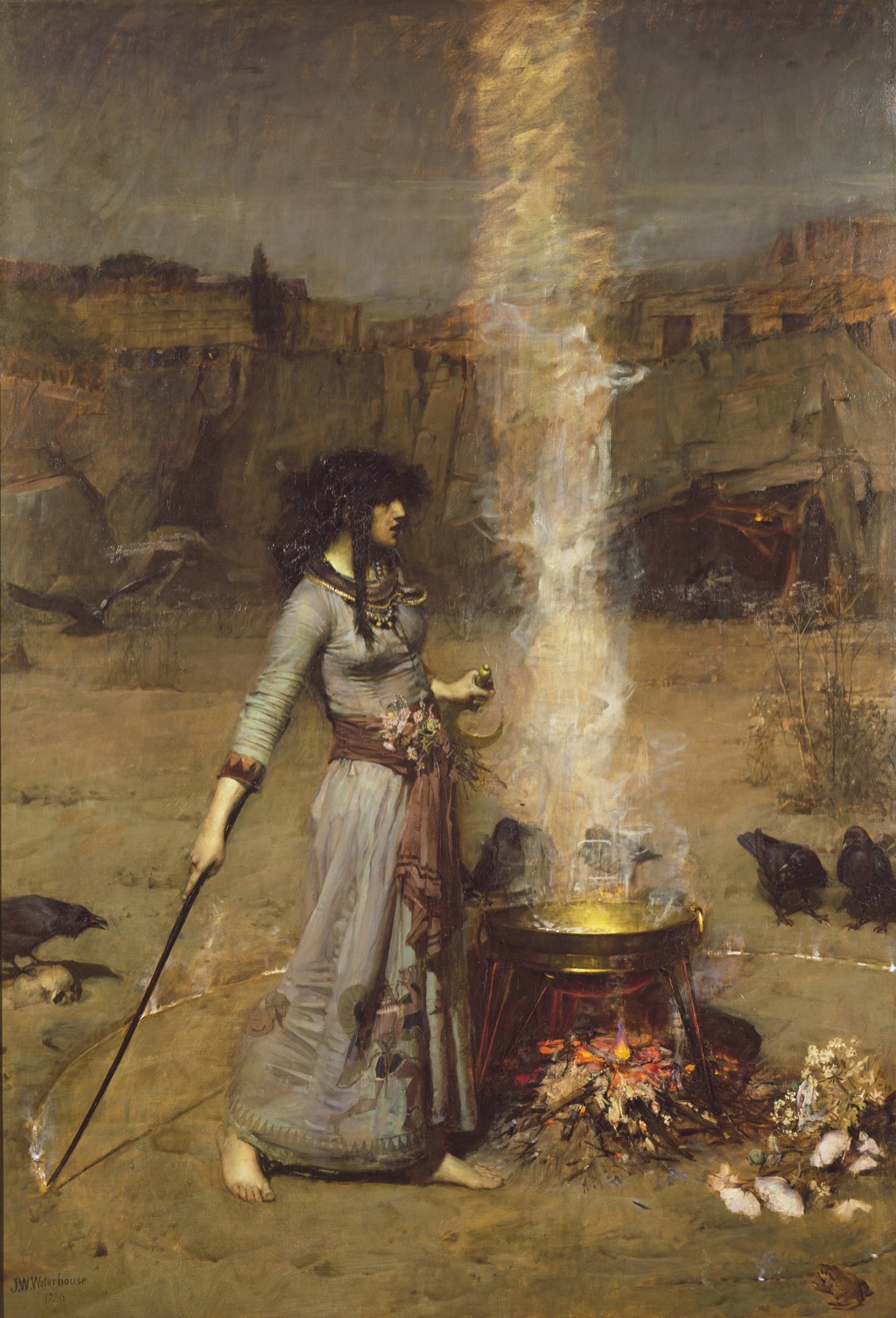
- The Magic Circle: Compare Waterhouse's treatment of ritual and symbolism.
Frequently Asked Questions
He signed and dated it in 1914. [1]
It depicts Gabriel's announcement to Mary that she would conceive Jesus, narrated in Luke 1:26–38. [2]
White lilies became an established symbol of Mary's purity and a common attribute in Annunciation imagery. [3] [4]
They refer to an apocryphal tradition in which Mary spun thread for the Temple veil when Gabriel appeared. [6] [7]
No. It comes from later-apocryphal and visual tradition, not Luke's account.
Approximately 99 by 135 centimetres. [1]
It is recorded in a private collection. [1]
It was painted in 1914, but no specific wartime allegory should be asserted without documentary evidence.
Discussion
Waterhouse's Annunciation succeeds because it honours an immense theological subject through a precisely observed interruption. The wool remains at Mary's feet, the loom waits at the edge, and ordinary architecture continues behind her. Gabriel's message enters that working world rather than replacing it.
Traditional symbols are clear but never merely catalogued. Lilies project into the space between the figures; halos hover like fine lines; an enclosed garden becomes a traversed threshold. Older Western and Byzantine motifs are absorbed into a painterly language developed through decades of myth and poetry.
Reader Insights
Which visible detail most changes the way you read this page?
Which source or comparison helps the work feel less familiar and more specific?
What question would you bring back to the painting after reading?
Join the Conversation
Share your reading of this page below.
References
- Wikimedia Commons object data, John William Waterhouse, The Annunciation, 1914, medium, dimensions, signature and collection status. View source
- United States Conference of Catholic Bishops, Luke 1:26–38, the Annunciation narrative. View source
- The National Gallery, London, “Gabriel, Archangel,” the messenger and his conventional lily attribute. View source
- The National Gallery, London, “Lilies,” their association with purity and Annunciation imagery. View source
- The National Gallery, London, Fra Filippo Lippi, The Annunciation, discussion of the enclosed garden as a Marian symbol. View source
- Uffizi Galleries, Master of Greve, Virgin and Child Enthroned; Annunciation, spinning tools and the apocryphal Temple-veil tradition. View source
- The Walters Art Museum, Saint John the Evangelist Dictating to Prochorus; the Annunciation, Mary, purple thread and the Protoevangelium of James. View source