John William Waterhouse.jpg)
 by Tom Gurney
Tom Gurney BSc (Hons) is an art history expert with over 20 years experience
Published on August 14, 2026 / Updated on August 14, 2026
Email: tomgurney1@gmail.com / Phone: +44 7429 011000
Dolce Far Niente: Introduction
John William Waterhouse's 1879 Dolce Far Niente shows a red-haired woman reclining in a small, enclosed classical interior. Dressed in blue and blue-green, she idly releases feathers from a white fan while sunlight strikes the mottled wall above her. Sunflowers and a hanging lamp turn inactivity into a highly controlled arrangement of colour, curve and light.
The signed and dated oil measures 49.6 × 36.2 cm and was first exhibited at the Dudley Gallery in 1879. [1] It is entirely different from Waterhouse's horizontal Dolce Far Niente of 1880 in Kirkcaldy. The shared Italian title—“sweet doing nothing” or “the sweetness of doing nothing”—must not be allowed to collapse two distinct compositions. [1] [2]
At a Glance
- ArtistJohn William Waterhouse
- TitleDolce Far Niente [1]
- Date1879; signed and dated lower right [1]
- MediumOil on canvas [1]
- Dimensions49.6 × 36.2 cm [1]
- CollectionPrivate collection [1]
- First exhibitionDudley Gallery, London, 1879, no. 13 [1]
- Former mistaken titleThe White Feather Fan [1]
- SubjectA reclining woman idly letting feathers fall in a sunlit classical interior
- Important distinctionNot the wider 1880 painting of the same title in Kirkcaldy Galleries [2]
Contents
- Introduction
- What the painting shows
- What “dolce far niente” means
- Idleness and Aestheticism
- The white feather fan
- Sunflowers and self-admiration
- Blue, green and changing light
- Alma-Tadema, Albert Moore and Rossetti
- The model and the averted face
- Two paintings with the same title
What the painting shows
A young woman reclines diagonally within a compact upright canvas. Her body occupies much of the lower and middle field.
Blue and blue-green drapery wraps her figure, producing the colour harmony praised by a contemporary reviewer. [1]
One arm extends upward or outward. From the hand, small white feathers drift through the air.
A white feather fan is the source of this idle game. The object once caused the painting to be miscatalogued as The White Feather Fan. [1]
Her face is partly turned away. Curly red hair and distinctive profile catch the side light.
Sunflowers appear in the foreground and background. Their round dark centres and yellow petals answer the arc of fan, arm and falling feathers.
A hanging lamp occupies the upper area. The feathers guide the eye towards it across a mottled, illuminated wall.
The interior is closed rather than panoramic. No distant Mediterranean landscape promises travel or action.
Every object supports suspension: reclining body, floating feathers, still flowers and lamp waiting to be lit.
The classical setting supplies distance from Victorian everyday life, but the action is deliberately trivial.
Waterhouse's subject is not what the woman does but the visual pleasure created when she need do nothing.
What “dolce far niente” means
The Italian phrase dolce far niente is commonly translated as “sweet doing nothing,” “pleasant idleness” or “the sweetness of doing nothing.”
It describes enjoyment of leisure rather than boredom or enforced unemployment.
In nineteenth-century British culture, the Italian language and imagined Mediterranean life could make idleness seem sensuous, artistic and removed from industrial discipline.
Waterhouse's woman does perform one minimal action: she lets feathers fall. The gesture proves how little consequence is required.
The title turns inactivity into a positive experience. Her leisure is “sweet,” not guilty.
At the same time, the phrase can conceal material conditions. Leisure depends on freedom from paid labour and domestic obligation.
The painting shows no servant, patron or source of wealth. The classical fantasy naturalises her availability for rest.
This selectivity belongs to the genre. Dolce far niente was a popular title among nineteenth-century artists because it suspended narrative and moral demand.
Christie's explains that Aesthetic-minded painters valued the theme precisely because it liberated them from illustrating stories or pointing lessons, allowing harmonious form, line and colour to become the subject. [1]
Waterhouse's title therefore names both the woman's state and the painting's programme. She does nothing useful; the picture need teach nothing explicit.
That does not make the work meaningless. It relocates meaning into looking, time, privilege and design.
Idleness and Aestheticism
Aestheticism promoted art's autonomy and the pursuit of beauty without compulsory moral or narrative instruction.
An idle classical woman was an ideal vehicle. Her body could be arranged with drapery, flowers and objects while no dramatic event competed for attention.
Waterhouse's composition asks viewers to notice relations: blue beside green, falling white against mottled wall, sunflower against red hair.
The woman's lethargy mirrors the desired pace of viewing. We are encouraged to linger.
This aesthetic invitation differs from a history painting that rewards identification of a climactic episode.
Yet Aestheticism is not socially neutral. As Christie's notes, the supine pose also encouraged male fantasy, and the closed setting removes the model from everyday life. [1]
The woman is inactive partly so that she can remain available to sight.
Her averted face reduces reciprocal engagement. She becomes form and colour more readily than an individual confronting the spectator.
Modern interpretation can enjoy the composition while recognising this gendered structure.
Idleness was not equally admired in all people. Upper-class leisure could appear cultured, while working-class inactivity was often condemned.
The classical costume and Italian title elevate the woman's pause above ordinary laziness.
Waterhouse's picture therefore records the attraction and privilege of Aesthetic leisure, not a universal human condition.
The white feather fan
The fan is both prop and source of movement. Its feathers are loosened and released into the air.
The gesture is delightfully wasteful. A useful object is being dismantled or played with for no practical reason.
Three floating feathers lead the eye from the woman's extended arm towards the hanging lamp, according to Christie's formal analysis. [1]
They create a curving ascent through the composition. What seems accidental is carefully designed.
White feathers catch light against the darker wall and blue drapery.
Their slow fall gives time visible form. Unlike a thrown ball or pouring liquid, feathers descend gradually.
This tempo suits the title. Nothing happens quickly and no outcome matters.
The fan also belongs to rituals of feminine self-presentation, flirtation and comfort. Here it is not used to cool the face or communicate a coded message.
Its normal function has been suspended along with work.
The former title The White Feather Fan arose when the picture was miscatalogued in 1996. [1]
That history shows how a conspicuous prop can displace an original or documented title.
Restoring Dolce Far Niente is interpretively important. The fan describes one object; the Italian phrase explains the entire relation between body, gesture and time.
Sunflowers and self-admiration
Sunflowers appear at the lower right and in the background, making them a repeated motif rather than incidental decoration. [1]
The sunflower became a prominent emblem of the Aesthetic Movement. Its bold shape appeared in design, satire and artistic self-fashioning.
Christie's notes that Victorian flower-language associated it with self-admiration. [1]
That meaning fits a painting devoted to beauty and withdrawn attention, but it should not become a rigid code.
The flowers also have formal roles. Their yellow petals warm the cool blues and greens, while dark centres create compact circular accents.
Sunflowers turn towards light. Christie's draws a parallel with the model, whose partly averted face is oriented towards illumination. [1]
This visual rhyme links human figure and plant without requiring a mythological transformation.
The model is not literally Narcissus and no mirror appears. Self-admiration is suggested through Aesthetic convention rather than depicted self-gazing.
The flower's size and current cultural familiarity make it an immediate sign of summer and brightness.
In the enclosed room, it imports the sun symbolically even where the sky is unseen.
Its bold natural form also contrasts with the fragile, airborne feathers.
Together sunflower and feather articulate two kinds of idleness: rooted turning towards light and weightless drifting through it.
Blue, green and changing light
The Illustrated London News praised the painting's “happy harmony” of blue and bluish-green when it appeared in 1879. [1]
That contemporary observation identifies colour as central to its first reception.
The drapery does not merely clothe the model. It creates a cool mass across the lower canvas and modulates the body into the room.
Sunlight falls from above, striking skin, feathers and wall differently.
Christie's interprets the mottled wall as a major compositional element because it reflects light and occupies so much of the picture. [1]
Its broken surface prevents the background from becoming blank while preserving enclosure.
Waterhouse had recently begun to lighten the dark melancholy of earlier 1870s paintings. Christie's connects the change with international naturalism, French Impressionism and Alma-Tadema's brighter palette. [1]
Shorter, broken brushstrokes and thicker impasto in places help light feel active rather than merely drawn around forms.
This does not make the work an Impressionist painting. Figure, objects and classical interior remain carefully designed.
It does show a young artist responding to contemporary experiments beyond British academic finish.
Blue-green harmony gives the picture unity; sunflower yellow, red hair and white feathers prevent monotony.
Colour carries more of the painting's interest because narrative action is intentionally slight.
Alma-Tadema, Albert Moore and Rossetti
Christie's identifies several artistic reference points for the 1879 composition. [1]
Lawrence Alma-Tadema provided a powerful model for classical women engaged in trivial or domestic activity among antique objects.
The Magazine of Art criticised Waterhouse's picture as too fantastically imitative of Alma-Tadema and compared it with Water Pets and Play Garden of 1875. [1]
That response confirms both influence and contemporary anxiety about derivation.
Albert Moore's reclining maidens offered another model. Moore treated classically draped women and Aesthetic props as vehicles for rigorous pattern and tonal harmony rather than narrative.
Waterhouse adopted the languor without fully emulating Moore's formal severity, in Christie's assessment. [1]
Dante Gabriel Rossetti's Italianate women provided a different precedent: sensuous red-haired models, enclosed spaces and decorative objects charged with mood.
These influences meet rather than cancel one another. Antique genre, Aesthetic design and Rossettian femininity converge around Waterhouse's own experiment with light.
The painting should not be reduced to a copy. Its asymmetry, floating feathers and mottled wall create a distinctive solution.
Nor should influence be hidden to protect a myth of isolated genius. Waterhouse was a young painter learning from visible successes in British and European exhibitions.
His later mature style emerged through such selective borrowing and transformation.
The model and the averted face
The model has curly red hair and a distinctive profile. Christie's notes her crooked nose and links her appearance with a contemporary taste for the “exotic” beauty associated with actress Sarah Bernhardt. [1]
The same model appears in Waterhouse's La Favorita, exhibited at the Royal Academy in 1879 and known through a line drawing. [1]
No secure personal name is supplied in the object record. She should remain an unidentified model rather than being assigned a speculative identity.
Her partially averted face reduces portrait specificity. The viewer receives profile, hair and light more than direct psychological exchange.
Christie's describes this as making her a decorative form comparable to the sunflower. [1]
That analysis captures the Aesthetic programme but also its objectification. Individuality is subordinated to composition.
The pose appears lethargic, yet the extended arm is highly articulate. Idleness must still be shaped for the painter.
Her body is supine without being asleep. She actively plays with the fan and turns towards light.
This intermediate state—awake but released from purpose—is precisely the title's sweetness.
The closed room removes social explanation. We do not know who she is, whose interior she occupies or why she can rest.
Anonymity makes her widely legible as an ideal while limiting biographical interpretation.
Two paintings with the same title
Waterhouse painted two entirely different works called Dolce Far Niente. [1]
The 1879 version is upright, privately owned and measures 49.6 × 36.2 cm. Its red-haired woman reclines with a white feather fan and sunflowers. [1]
The 1880 version is horizontal, publicly owned by Kirkcaldy Galleries and depicts a different classical leisure scene. [2]
The Kirkcaldy canvas was already covered as manuscript 74 in this collection. The present manuscript is solely for the 1879 fan composition.
Dates, dimensions, ownership and visual description must not migrate between them.
The duplication was not accidental confusion created by later cataloguers. Christie's states that Waterhouse developed two different paintings bearing the same title. [1]
The shared phrase offered a theme broad enough for variation.
One composition concentrates a single woman and airborne feathers within an upright enclosure. The other distributes leisure across a wider setting.
Using year in page titles, filenames, captions and internal links is the clearest control.
The former mistaken title The White Feather Fan can help users identify the 1879 image, but it should remain an alternate historical miscataloguing, not the preferred title.
Version control is especially important in search, where thumbnails and object facts frequently become crossed.
Exhibition, provenance and modern rediscovery
Waterhouse signed and dated the work lower right in 1879. [1]
It appeared at the Dudley Gallery that year as number 13. [1]
The Dudley Gallery offered an important exhibition alternative to the Royal Academy and was associated with artists interested in Aesthetic ideals. [3]
Contemporary reviews supplied both praise and criticism: the Illustrated London News admired the colour harmony, while The Magazine of Art objected to the perceived imitation of Alma-Tadema. [1]
Charles J. Galloway owned the painting before its sale at Christie's in 1905. [1]
Its later private history included misidentification as The White Feather Fan in 1996. [1]
The work re-entered major public attention through the 2009–10 retrospective J. W. Waterhouse: The Modern Pre-Raphaelite, shown in Groningen, London and Montreal. [1]
Christie's sold it in London in June 2010, recording the catalogue history that now anchors the object facts. [1]
Price is part of market history but not a measure of artistic quality. More important is the recovery of correct title and place within Waterhouse's 1879 transition.
Temporary retrospective display also reminds us that a private painting can have significant public exhibition lives.
Its present public accessibility should always be checked against current loans rather than assumed from the 2009–10 tour.
The public-domain image record links the reproduced canvas back to the Christie's object history, providing a useful visual check while leaving the auction catalogue authoritative for measurements, exhibition and provenance. [4] That division of sources matters when a privately held work becomes far more familiar online than in direct view.
The Royal Academy's retrospective page records the London stage of the 2009 exhibition and the institutional reappraisal expressed by its title, J. W. Waterhouse: The Modern Pre-Raphaelite. [5] The 1879 canvas complicates that label productively: its immediate debts are as much Aesthetic, academic and international as later Pre-Raphaelite.
A close-looking route through idleness
Begin with the wall rather than the woman. Its broad mottled surface appears empty, but light changes across it and makes the feathers visible. Waterhouse reserves a large portion of a small canvas for this apparently uneventful field. Emptiness becomes active support for everything the title celebrates.
Then follow the three feathers. Their positions convert gravity into a curved sequence and link the hand with the lamp. The woman's trivial gesture therefore controls the entire upper composition. “Doing nothing” is revealed as a carefully timed act.
Move next to the sunflowers. Their circular faces interrupt the oblique body and direct attention towards brightness. Red hair, yellow petals and warm skin form a counter-system to the blue-green drapery praised in 1879. The colour balance makes idleness luminous rather than dull.
Finally, notice how little space lies beyond the model. There is no doorway inviting departure and no companion initiating dialogue. Closed space protects the Aesthetic experiment from narrative demands, but it also confines the woman to visibility. She can turn towards light but not towards a wider world within the canvas.
This route makes the social question sharper. The spectator is free to move imaginatively through colour and form while the represented woman remains posed in indefinite leisure. Her release from labour is also her containment as an image.
Why the 1879 version matters
The painting catches Waterhouse at a point of rapid change. Its classical props look back to academic training and Alma-Tadema, while broken light, asymmetric design and visible impasto respond to current naturalist experimentation. [1]
Its subject also predicts later Waterhouse absorption. Mature heroines weave, listen, gaze or gather with narrative intensity; this unnamed woman performs the smallest possible private action. The psychological inwardness is present before a famous poem supplies it.
At the same time, the picture belongs specifically to Aestheticism's late-1870s moment. Sunflower, fan and purposeless beauty would have carried topical associations for its first audience. Treating it only as a generic “Pre-Raphaelite woman” erases that historical precision.
The duplicate 1880 title makes the 1879 work even more revealing. Waterhouse did not regard dolce far niente as a single fixed scene. It was a problem of how to organise bodies, objects and time—a theme capable of complete reinvention one year later.
Related Pages
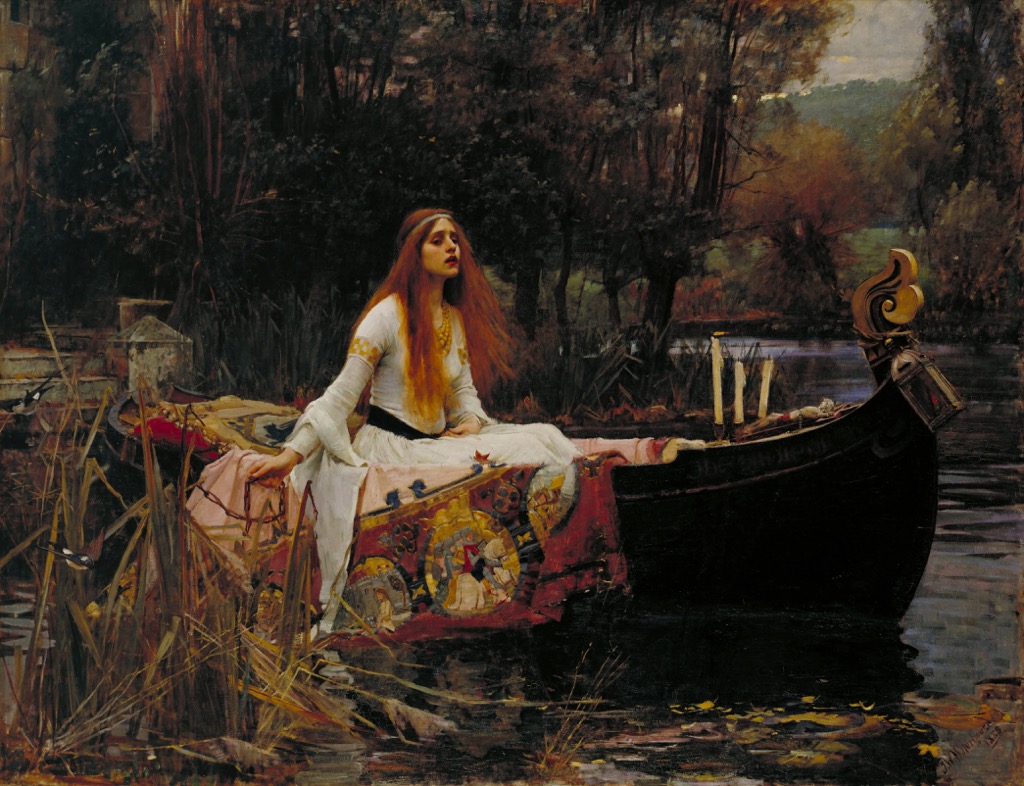
- The Lady of Shalott: Compare Waterhouse's best-known literary composition.
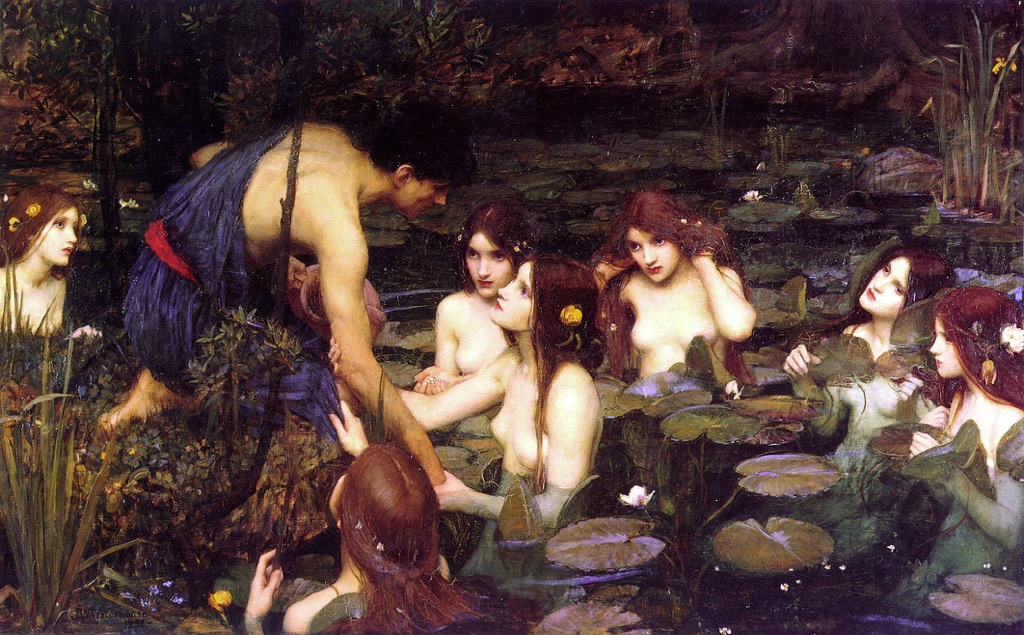
- Hylas and the Nymphs: Compare another major mythological scene.
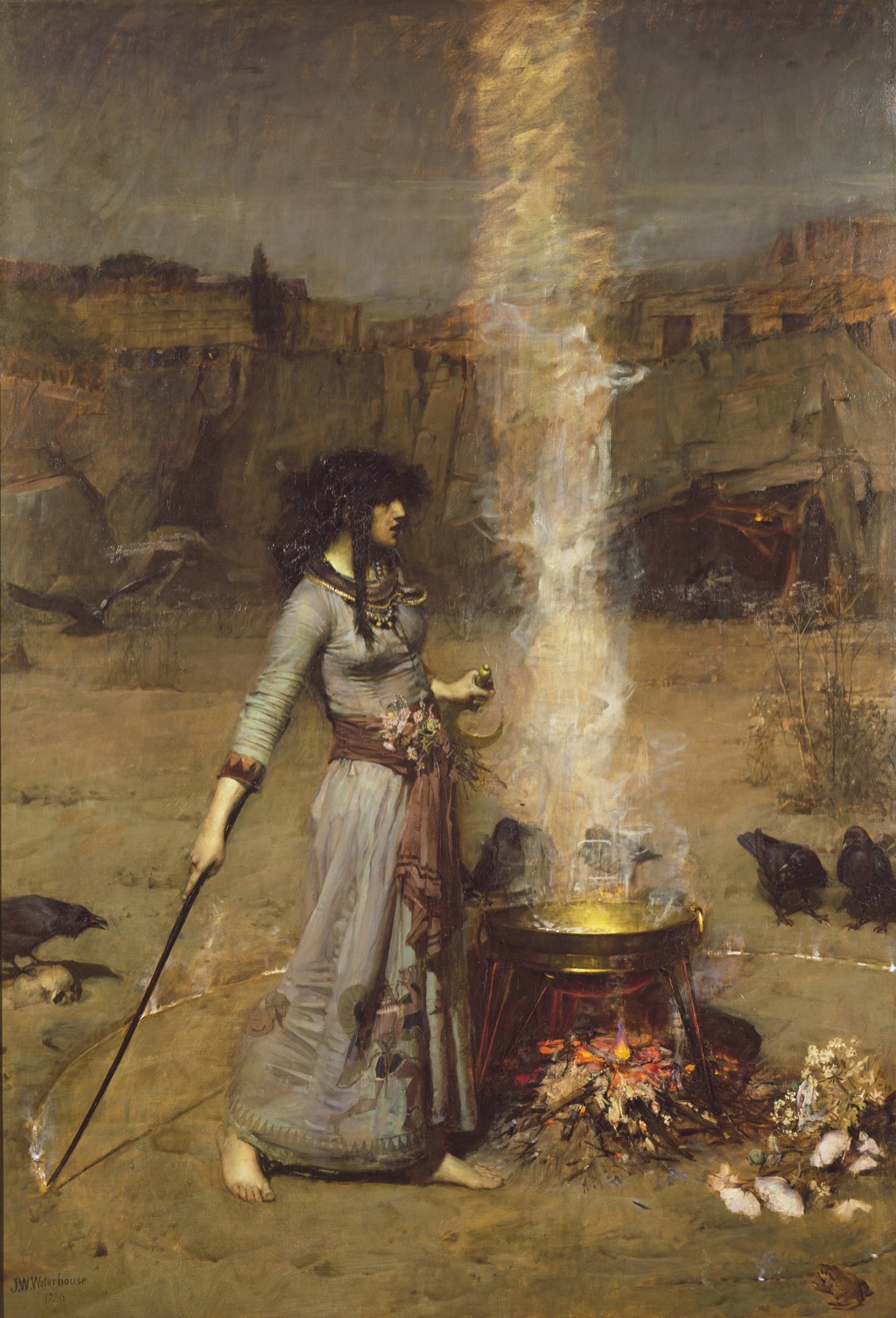
- The Magic Circle: Compare Waterhouse's treatment of ritual and symbolism.
Frequently Asked Questions
It means “sweet doing nothing,” “pleasant idleness” or “the sweetness of doing nothing.”
It is signed and dated 1879. [1]
It is privately owned. [1]
No. Kirkcaldy owns a different horizontal Dolce Far Niente painted in 1880. [2]
It was mistakenly catalogued under that descriptive title in 1996 because the model holds a feather fan. Christie's restored the documented Dolce Far Niente identity. [1]
They were associated with Aestheticism and, in Victorian flower language, self-admiration. [1] They also balance the cool drapery and connect the model with light.
Discussion
The apparent ease of Dolce Far Niente is laboriously designed. A feather falls slowly, but its route leads the eye; a woman turns idly, but her profile answers a sunflower; a mottled wall seems incidental, but it stages the changing light.
This difference between depicted leisure and artistic work is the painting's productive paradox. The model does nothing useful so that Waterhouse can demonstrate composition, colour and modern handling.
Reader Insights
Which visible detail most changes the way you read this page?
Which source or comparison helps the work feel less familiar and more specific?
What question would you bring back to the painting after reading?
Join the Conversation
Share your reading of this page below.
References
- Christie's, “John William Waterhouse: Dolce Far Niente,” lot record and essay, 16 June 2010, recording signature, date, dimensions, provenance, exhibition history, critical reception and iconography. View source.
- Art UK, “John William Waterhouse: Dolce Far Niente,” collection record for the separate 1880 version at Kirkcaldy Galleries. View source.
- Sotheby's, “John William Waterhouse: Offerings,” catalogue note discussing the Dudley Gallery and Waterhouse's early domestic classical sequence. View source.
- Wikimedia Commons, “John William Waterhouse: Dolce Far Niente (1879),” public-domain image and sale-source metadata. View source.
- Royal Academy of Arts, J. W. Waterhouse: The Modern Pre-Raphaelite, exhibition context, 2009. View source.