 by Tom Gurney
Tom Gurney BSc (Hons) is an art history expert with over 20 years experience
Published on August 14, 2026 / Updated on August 14, 2026
Email: tomgurney1@gmail.com / Phone: +44 7429 011000
La Fileuse: Introduction
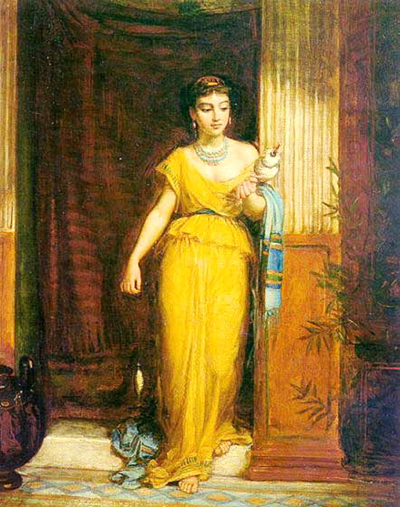
John William Waterhouse's La Fileuse presents a young woman pausing at the threshold of a shadowed classical interior. Dressed in yellow and blue, she holds the tools and fibre of hand-spinning while one bare foot advances into the light. The small canvas gives a routine textile process the gravity of a full-length portrait.
Painted in 1874, La Fileuse belongs to Waterhouse's earliest public phase. [1] [2] Its French title means “the female spinner,” but it does not securely name the figure as a goddess, Fate or literary heroine. Her identity arises from work. A spindle, prepared fibre and controlled fingers matter more than a fixed story.
At a Glance
- ArtistJohn William Waterhouse
- TitleLa Fileuse, also translated as The Spinner [1]
- Date1874 [1] [2]
- MediumOil on canvas [1] [2]
- Dimensions32 × 25.5 cm [1]
- CollectionPrivate collection [1] [2]
- ExhibitionRoyal Society of British Artists, London, spring 1874 [2]
- SubjectA classically dressed woman spinning fibre into thread
- Title languageFrench; fileuse is the feminine noun for a spinner [3]
- Career contextAn early classical genre picture painted before Waterhouse's Royal Academy breakthrough
Contents
- Introduction
- What the painting shows
- What the title means
- Spindle, fibre and textile work
- The standing figure
- Costume, jewellery and colour
- Architecture and threshold
- Small scale and painterly handling
- Fate, Clotho and the limits of identification
- The 1874 exhibition context
What the painting shows
A single woman stands almost full length within a narrow vertical canvas. Her body advances from a dark curtained recess into a strip of pale flooring.
She wears a long golden-yellow dress bound at the waist, with a blue textile draped from the working arm and falling towards the ground. A necklace of several coloured rows crosses her chest; a narrow band ornaments her hair.
The raised hand holds prepared fibre or a spinning implement close to a stone pier. The other hand hangs lower, guiding a fine strand or maintaining the process.
Her head inclines and her gaze drops towards the work. Although walking, she appears mentally still, concentrated on the small material held between her fingers.
Columns or pilasters frame the interior. At right a brown panel carries delicate plant decoration, and actual foliage emerges from the deeper shadow beyond it. At left a dark vessel or piece of furniture is cropped by the edge.
Geometric borders on the floor provide the brightest pattern. The bare feet cross this band, making the threshold both architectural and bodily.
The image has no visible supporting cast and no obvious dramatic event. Waterhouse turns attention to coordination: hand, fibre, step, cloth and gaze.
What the title means
La Fileuse is French for “the female spinner.” The masculine and feminine forms fileur and fileuse describe someone who spins fibre into thread. [3]
The foreign-language title would have given a London exhibition picture a Continental tone. It also identifies occupation without supplying a personal name.
“Spinner” can suggest several things in English: a textile worker, a domestic woman, or a mythic power who spins life. The French title likewise permits resonance without proving allegory.
Waterhouse's woman is not shown beside a spinning wheel. Her tools belong to older hand-spinning practice, appropriate to the classicising dress and architecture.
The title should remain in French in the page heading because that is how the work is catalogued. The Spinner is a useful translation, not a replacement title.
Nor should fileuse be translated as “weaver.” Spinning makes yarn from fibre; weaving interlaces prepared threads into cloth. The distinction is fundamental to understanding the action.
By naming a task, Waterhouse asks viewers to recognise labour before story. That emphasis sets the painting apart from later titles drawn directly from famous poems.
Spindle, fibre and textile work
Hand-spinning draws out prepared fibres and twists them into continuous yarn. A spindle supplies rotation and stores the forming thread; a distaff can hold unspun fibre so that it remains manageable.
The Metropolitan Museum of Art succinctly identifies the distaff's purpose as spinning wool into thread and preserves an ancient Roman example. [4]
In Waterhouse's image, the precise tools are partly obscured by hands and loosely painted fibre. It is safest to describe a hand-spinning process rather than claim a fully visible mechanism.
The woman's attention suggests skill. Even fibre requires steady drawing and twist; fingers must regulate thickness while the spindle's movement is maintained.
That sequence explains the separation of her hands. In hand-spinning, one hand can control the supply of fibre while the other regulates the emerging thread. The distance between them is not merely graceful posing: it makes the transformation from loose material to a continuous strand intelligible.
The image is too small and loosely handled to inventory every attachment with certainty. A dark vertical near the raised hand may belong to a distaff or support, while the fine lower element suggests the working strand. Naming the process is firmer than assigning each painted mark to a specialised tool.
This restraint matters because later spinning-wheel imagery can shape modern expectations. A drop spindle needs neither a chair nor a large wheel; it can be used while standing and, by an experienced worker, while moving slowly. Waterhouse's walking spinner is therefore plausible in general action even though the setting is idealised.
The long blue cloth should not be mistaken for the new yarn. It is a finished textile draped over the arm, visually linking raw fibre, making and completed fabric.
Spinning was historically repetitive labour, often performed within domestic economies. Classical art also made spindle and distaff attributes of ideal female industry.
Waterhouse does not depict strain, poverty or a workshop. Jewellery, clothing and architecture instead place the spinner in an elite imagined household.
This social idealisation needs acknowledgment. The picture honours concentration and skill but transforms production into an elegant solitary act.
The standing figure
The spinner's pose is built from asymmetry. One shoulder rises with the working hand while the opposite arm drops; one foot advances while the other remains behind.
Her head does not follow the step. It turns slightly inward, creating tension between forward movement and downward attention.
The frontal body could have appeared statuesque, but the crossed action of hands and textiles prevents rigidity.
Her bare feet are carefully placed. The forward foot touches the patterned threshold, while the rear foot remains partly in shadow and cloth.
Waterhouse's later women often sit, lean or kneel at pools and looms. This early standing figure shows him already interested in action suspended between phases.
The face is idealised but not theatrically expressive. Lowered eyes communicate absorption more securely than any invented emotion such as sadness or prophecy.
Because the picture is small, the figure's near-total command of the canvas feels intimate rather than monumental. She is close enough for jewellery and fingers to matter.
No model has been securely identified in the object record. Facial resemblance to later Waterhouse figures cannot establish a sitter across decades.
Costume, jewellery and colour
The yellow dress dominates. Its light folds descend in long vertical strokes, allowing the garment to echo the fluted architectural support at right.
Blue forms a concentrated counter-colour. It crosses the raised forearm, drops beside the body and gathers near the feet.
The dress is classicising rather than a demonstrably exact reconstruction of one ancient garment. Its loose neckline, girdle and draped fabric create an accessible visual antiquity.
Multiple necklace strands and earrings indicate adornment. A coloured headband holds the dark hair close, presenting the face clearly against the curtain.
These ornaments complicate any simple reading of the figure as a poor labourer. Waterhouse joins work and beauty within an affluent interior.
The pale fibre in her hand is close in value to stone, making the action easy to overlook at first glance. The eye may encounter dress and face before understanding the title.
Dark brown and green surround the bright costume. The controlled palette creates an emergence from interior shadow rather than the outdoor luminosity of In the Peristyle.
Reproductions vary in yellow warmth and blue intensity. Exact pigment or condition claims require technical examination; the visible relationship of gold, blue and darkness is the secure formal fact.
Architecture and threshold
The scene is framed by vertical architecture: a pale fluted element at left, a broad support at right and a shadowed opening between them.
The woman occupies that opening without being swallowed by it. Light catches face, dress and forward foot, turning movement across the threshold into the composition's structure.
A hanging or curtain deepens the left background. Its folds repeat the dress but remain nearly black, distinguishing textile from body through value rather than outline.
At right, painted plant motifs decorate a panel below the fluting. Dark real foliage appears further back, creating a subtle exchange between ornament and nature.
The floor border contains blue diamond-like shapes. Its horizontal geometry checks the downward rush of dress folds and makes the bare feet conspicuous.
No exact archaeological site is identified. The architecture works as a learned Victorian composite rather than evidence for one Roman house.
Thresholds became crucial throughout Waterhouse's career. Figures stand between garden and room, safety and danger, ordinary action and narrative change.
Here the stakes remain open. The spinner may simply be walking while working; the architecture creates passage without specifying destination.
Small scale and painterly handling
At 32 by 25.5 centimetres, La Fileuse is a cabinet-sized canvas. [1] Its entire surface is smaller than many later Waterhouse heads and torsos.
The scale requires economy. Columns are indicated with long strokes, patterned decoration with quick marks, and the interior with broad darkness.
Face, jewellery and hands receive enough definition to guide attention, but they are not enamelled miniatures. Brushwork remains visible in dress and architecture.
This economy differs from the highly resolved finish of Waterhouse's great Royal Academy canvases. It should not be labelled incomplete solely because reproduction reveals loose passages.
The upright proportion intensifies the figure's verticality. A larger or wider scene would need additional objects; the small panel-like field makes one person sufficient.
Its proportions also make the viewer read from top to bottom. Head, lifted hand, belt, lowered hand and advancing foot form a descending sequence that effectively rehearses the downward movement of fibre towards spindle and floor.
The most detailed accents are distributed sparingly along that route. Jewellery holds the upper body, the girdle articulates the middle, and blue cloth gathers at the feet. This prevents the narrow figure from becoming one uninterrupted yellow column.
Waterhouse further varies degrees of finish. The face and contour must remain legible, while the recess is allowed to dissolve into tonal shadow. The contrast supplies depth without requiring the elaborate architectural description possible on a large exhibition canvas.
Close cropping also creates ambiguity. The dark object at lower left and foliage at right are only partially described, encouraging the viewer to imagine a room beyond the edges.
The work's portability helped it pass through private collections and the market, though small size alone does not prove its original purchaser or intended room.
Fate, Clotho and the limits of identification
Spinning has powerful mythological associations. In Greek tradition, the Moirai or Fates govern human destiny, and Clotho is commonly associated with spinning the thread of life. [5]
That tradition makes an allegorical reading of La Fileuse possible. A solitary classical spinner can remind viewers of time, life and destiny.
Possibility is not identification. The title does not say Clotho, no companion Fates appear, and no distinctive inscription establishes a mythic narrative.
Waterhouse's woman may be an anonymous ancient household figure, an ideal of industry or a poetic spinner. These categories can overlap without collapsing into certainty.
The act itself already carries temporal meaning. Fibres pass through fingers, become thread and accumulate; repeated motion creates something that did not exist before.
One need not name a goddess to recognise that suggestiveness. Indeed, keeping the figure anonymous may strengthen it by allowing ordinary labour to approach allegory.
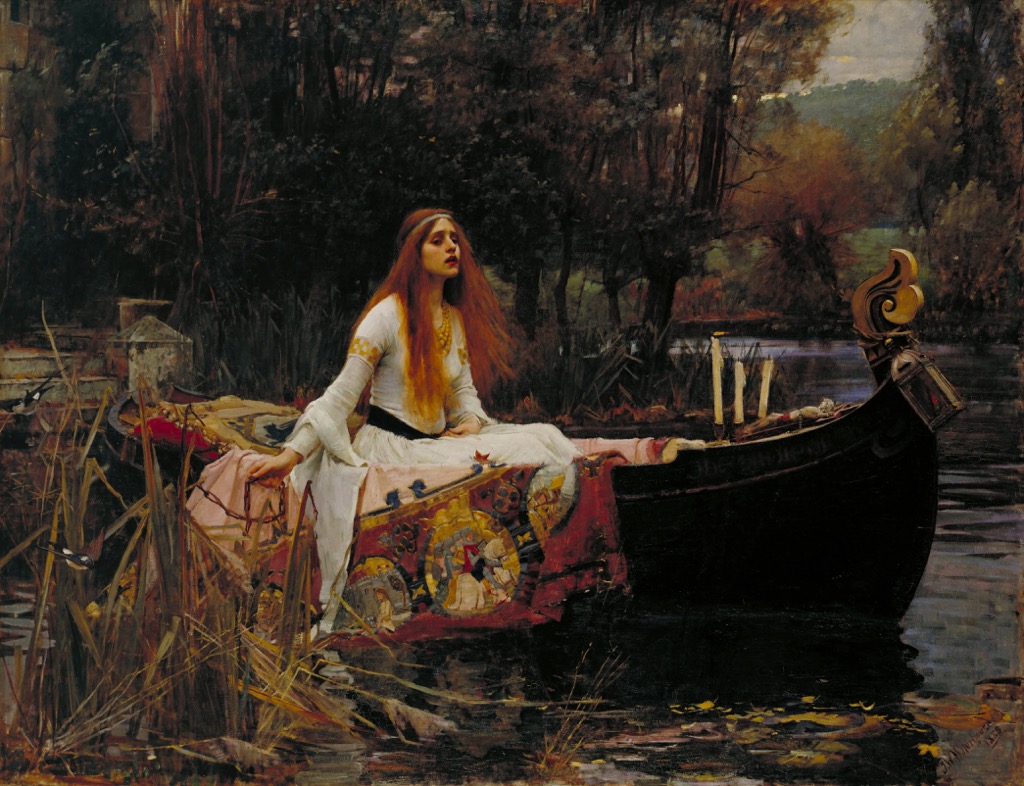
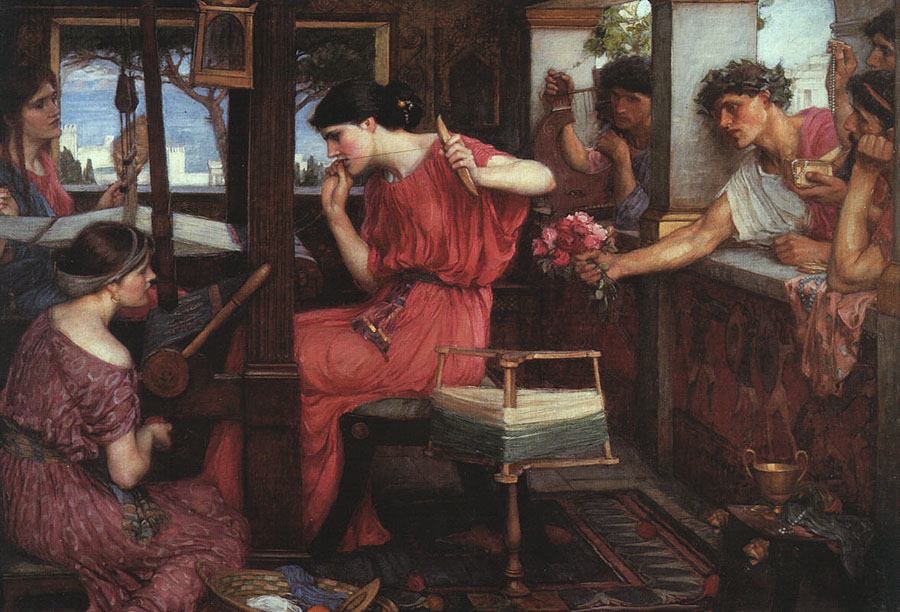
Later Waterhouse paintings give textile work explicit literary stakes: Penelope delays her suitors, the Lady of Shalott weaves under a curse, and Mary pauses at the Annunciation. La Fileuse is the early, open-ended counterpart.
Responsible captioning should therefore say “sometimes interpreted in relation to Clotho” rather than “the woman is Fate.”
The 1874 exhibition context
The picture was exhibited at the Royal Society of British Artists in spring 1874. [2] This was an important London venue for a young painter seeking public recognition.
Waterhouse had not yet begun the sustained Royal Academy exhibition career that would define his professional standing. The RBA appearance belongs to his period of testing subjects and markets.
The French title could signal cosmopolitan ambition within that setting. French and Continental exhibition culture exerted a strong influence on British painting during the period.
No contemporary review specific to La Fileuse has been securely established in the sources used here. Claims about its critical reception should therefore be avoided.
The absence of an identified review is itself useful discipline. An exhibition record proves that the public could see the work; it does not prove applause, neglect or a particular interpretation. Those are different historical questions and should not be merged.
Nor does the RBA venue make the painting academically marginal. The Royal Society of British Artists maintained a substantial exhibition programme and provided a practical route into the London art world. For Waterhouse, the appearance documents professional activity at the very beginning of his career.
Its combination of modest dimensions and a polished French title may have suited that setting particularly well. The work offered an immediately attractive figure while rewarding closer recognition of an old process. It did not depend upon viewers knowing a long poem or rare classical episode.
The painting later belonged to the collection associated with Claudio Bruni Sakraischik and appeared at Bonhams in London in September 2010, when it sold into another private collection. [2]
Auction price is part of modern provenance, not an index of original artistic importance. It can change dramatically with date, attribution, condition and market context.
What the exhibition fact establishes is public intent. However intimate its dimensions, this was not simply an undocumented private exercise.
Place within Waterhouse's career
The year 1874 also produced In the Peristyle and Sleep and His Half-Brother Death. Together they show unusual range: domestic classicism, allegorical intimacy and experimental narrative.
La Fileuse shares with In the Peristyle a solitary young woman, classical architecture, bare feet and purposeful action. One moves through a sunlit court; the other emerges from shadow.
The spinner also anticipates Waterhouse's lifelong concern with textile making. What is an occupation here becomes strategic, magical or sacred in later paintings.
His mature figures often appear psychologically distant because attention is fixed on an object or process. The lowered gaze of this early woman already produces that privacy.
The small canvas should not be described merely as a step towards famous works. Its concentrated vertical design and refusal to over-explain the sitter give it independent strength.
Comparison with the later textile pictures also reveals a meaningful difference. Penelope and the Lady of Shalott are constrained by stories that make cloth a device for delay or imprisonment. The spinner's work carries no stated prohibition. She appears competent within an ordinary rhythm, even if mythic associations gather around it.
That relative freedom alters the emotional temperature. Her lowered gaze is not necessarily melancholy, and the doorway is not demonstrably a trap. Waterhouse allows absorption to be peaceful before his mature narratives repeatedly bind female attention to danger.
It also broadens the public picture of Waterhouse. Before nymphs and tragic heroines, he could make an image from the coordination of a hand, a thread and a measured step.
The French title, Roman setting and painterly handling combine cultural distance with direct observation. That mixture will remain central to his art.
Related Pages
- The Lady of Shalott: Compare Waterhouse's best-known literary composition.
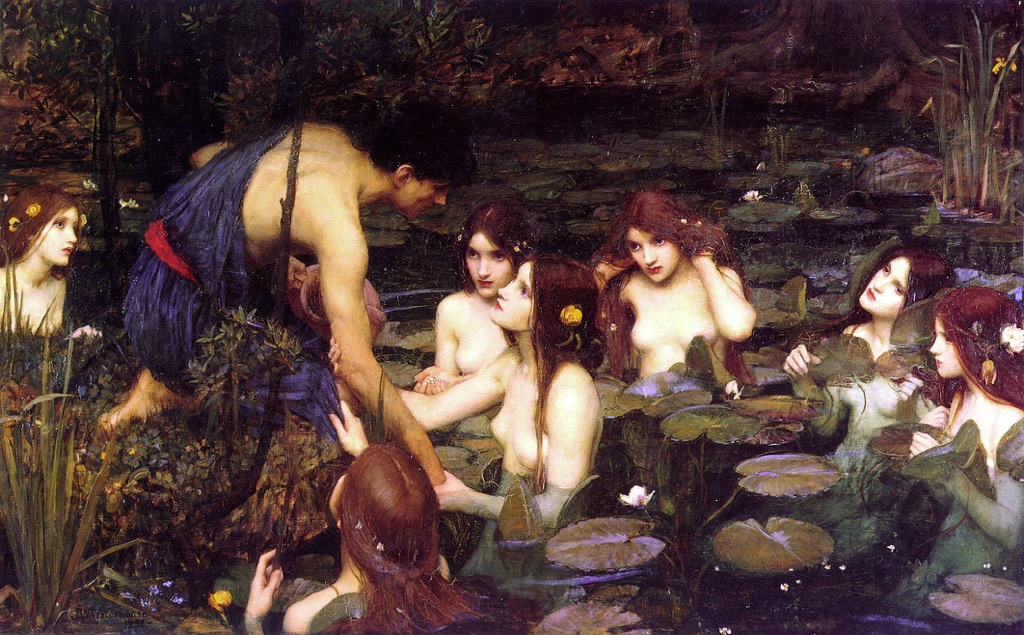
- Hylas and the Nymphs: Compare another major mythological scene.
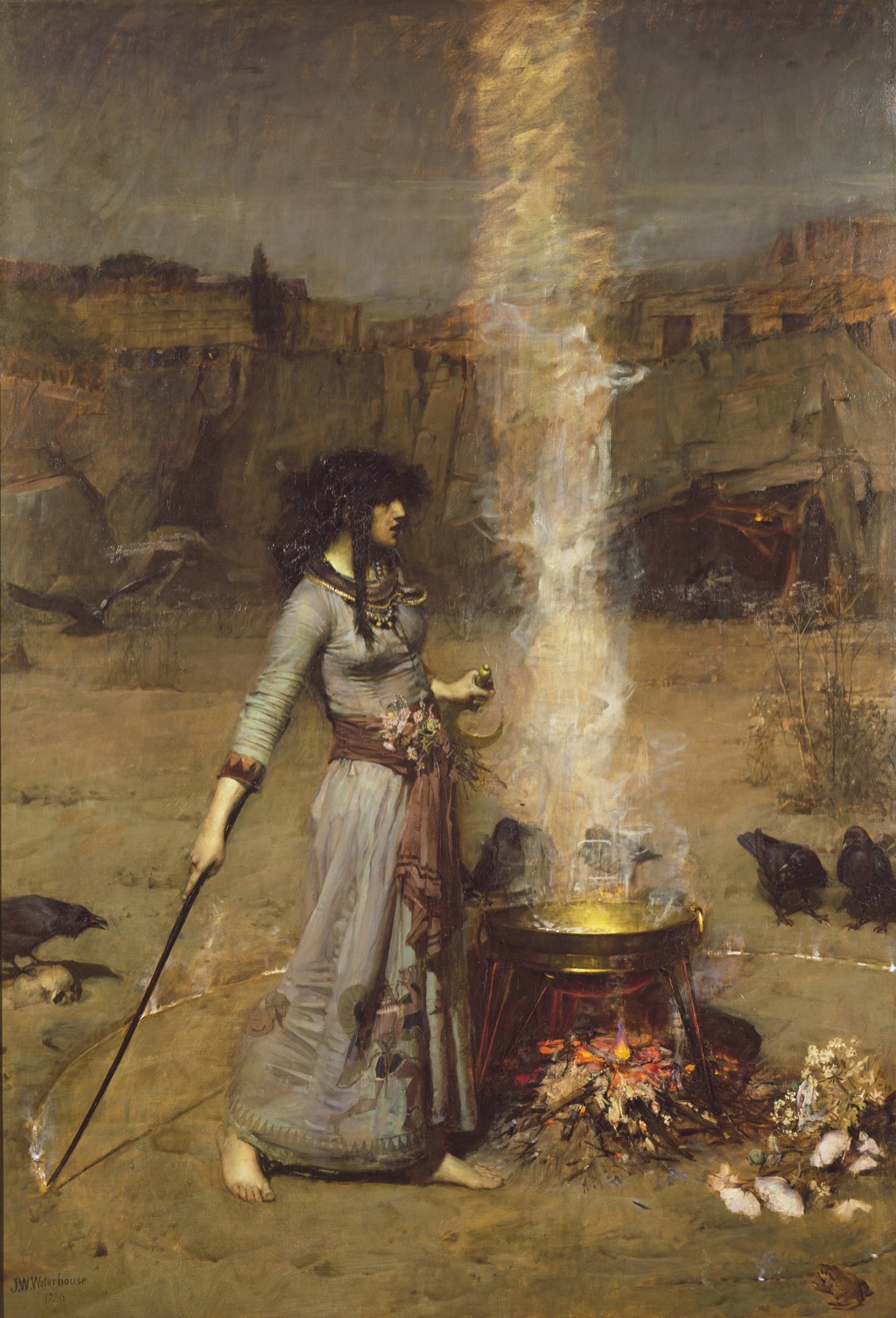
- The Magic Circle: Compare Waterhouse's treatment of ritual and symbolism.
Frequently Asked Questions
It means “the female spinner” in French. [3]
She is using hand-spinning tools to draw and twist fibre into thread.
Clotho is a possible association because she spins the thread of life, but the title and surviving object evidence do not securely identify the woman as that goddess. [5]
It measures 32 by 25.5 centimetres. [1]
Yes. It was shown at the Royal Society of British Artists in spring 1874. [2]
No. She is spinning fibre into yarn; weaving is the later process of interlacing threads into fabric.
Discussion
La Fileuse makes textile work both specific and mysterious. The woman's fingers regulate real fibre, yet the dark doorway, classical dress and foreign title lift the action beyond straightforward documentation.
Waterhouse's restraint is crucial. He provides no companion figures, written source or narrative climax. Meaning accumulates like thread: through repeated visual relations between hand and tool, gold and blue, shadow and light, backward foot and forward step.
Reader Insights
Which visible detail most changes the way you read this page?
Which source or comparison helps the work feel less familiar and more specific?
What question would you bring back to the painting after reading?
Join the Conversation
Share your reading of this page below.
References
- Wikimedia Commons object data, John William Waterhouse, La Fileuse / The Spinner, date, medium, dimensions, subject and collection status. View source
- Bonhams, “John William Waterhouse, R.A., R.I., La Fileuse,” object, exhibition, provenance and sale record, 29 September 2010. View source
- Larousse, “fileur, fileuse,” French definition and English translation. View source
- The Metropolitan Museum of Art, Roman bronze distaff, function and historical context. View source
- Encyclopaedia Britannica, “Fate,” the Moirai and the spinning of the thread of human life. View source