 by Tom Gurney
Tom Gurney BSc (Hons) is an art history expert with over 20 years experience
Published on August 14, 2026 / Updated on August 14, 2026
Email: tomgurney1@gmail.com / Phone: +44 7429 011000
Flora: Introduction
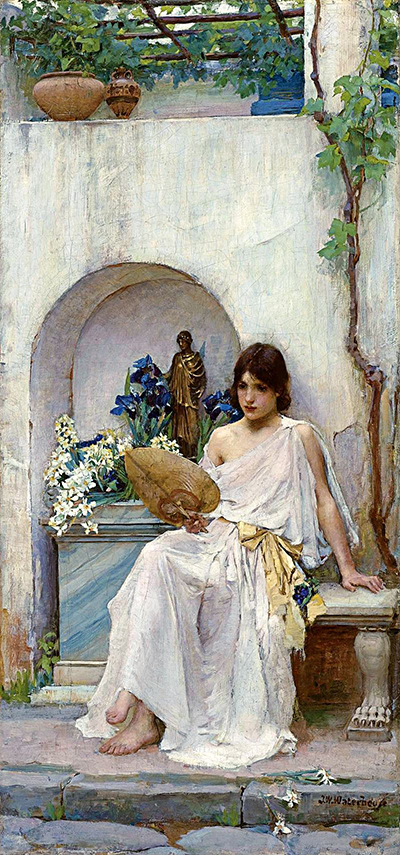
A barefoot young woman sits beside a roadside shrine in a narrow, whitewashed garden. She holds a heart-shaped fan; irises and narcissi have been arranged around a small bronze female statue. John William Waterhouse’s Flora, often reproduced as Flora in White Attire, is not simply a portrait of the Roman goddess. The seated figure appears to be a worshipper making a spring offering to Flora’s image. [1]
The canvas was inspired by Waterhouse’s 1890 Capri visit and exhibited at the Royal Academy in 1891 as number 373. [1] [2] It measures approximately 73 × 33 cm and is signed at lower right. [1] [3] The likely 1890–91 execution and secure 1891 exhibition should replace a falsely precise claim that every source agrees on one creation year.
At a Glance
- ArtistJohn William Waterhouse (1849–1917)
- Authoritative exhibited titleFlora [1] [2]
- Common descriptive titleFlora in White Attire
- Datec.1890–91; exhibited in 1891 [1] [2] [3]
- MediumOil on canvas [1]
- DimensionsApproximately 73 × 33 cm [3]
- SignatureSigned “J. W. Waterhouse” lower right [1]
- CollectionPrivate collection [1] [3]
- Royal Academy1891, no. 373 [1] [2]
- SubjectA young worshipper arranging spring flowers beside a statuette of Flora
Contents
- Introduction
- Who Is Flora in the Painting?
- The Shrine, Flowers and Fan
- Floralia and the Roman Spring Festival
- White Dress, Gold Sash and Bare Feet
- Capri Translated into Antiquity
- The Unnamed Model
- Technique, Pentimenti and Condition
- Exhibition, Criticism and Provenance
- Flora and Alma-Tadema’s Spring
Who Is Flora in the Painting?
The title can mislead. The seated woman is often assumed to be Flora, Roman goddess of flowers and spring.
Sotheby’s catalogue identifies the bronze garlanded female statuette within the arched shrine as Flora and interprets the living woman as a worshipper who has been arranging offerings. [1]
This reading fits the visible structure. Flowers cluster on the ledge around the small image; the larger figure sits outside the niche holding a fan.
The title may name the deity who receives devotion rather than the mortal participant.
That distinction matters across Waterhouse’s catalogue. In Flora and the Zephyrs of 1898, Flora herself is a mythological protagonist surrounded by pursuing wind figures.
Here divine presence is mediated through a statue. The living woman and bronze image occupy different scales and materials.
The common title Flora in White Attire can collapse them into one figure. It is useful as a legacy search phrase but should not override the painting’s internal evidence and Sotheby’s account. [1]
Waterhouse had long painted scenes of domestic or public devotion, including Offerings, The Household Gods, A Roman Offering and later The Shrine. [1]
Flora belongs to that lineage. Its subject is an encounter with a sacred image, not merely a goddess posing in a garden.
The worshipper’s name and social identity remain fictional or unspecified. The model who embodied her is also unnamed.
The Shrine, Flowers and Fan
The shrine is cut into a pale wall as a broad semicircular niche. A dark bronze statuette stands against blue-violet flowers. [1]
White narcissi or similar spring blooms spill along the left edge of the ledge. Their brightness echoes the seated woman’s dress.
Sotheby’s identifies irises and narcissi, both appropriate to April and May bloom. [1]
The offering is partly complete. Flowers have been placed, yet the woman remains nearby as if paused during the task.
She holds a large, heart-shaped fan across her lap. Its warm brown surface forms the composition’s central oval.
The fan can cool the body in a warm courtyard and contribute to costume. Its heart shape may encourage romantic interpretation, but no documented code makes it a declaration of love.
Waterhouse positions the fan between face and bare feet, giving the long white dress a necessary interruption.
Its ribs and edge introduce crafted structure among soft cloth and petals.
The shrine ledge, bench and pavement create successive horizontal stages. The tall woman crosses them vertically.
Flowers occupy both sacred and ordinary space. Some cluster around the bronze image; a few appear lower near the woman and pavement.
This distribution links worshipper, deity and garden without confusing their identities.
Floralia and the Roman Spring Festival
Sotheby’s connects the subject with Floralia, the Roman festival honouring Flora in late April and early May. [1]
Ovid describes the festival in Book 5 of the Fasti, a poem organised through the Roman calendar. The period bridges April and May, appropriate to a goddess of flowering. [1]
The festival developed historically over time. Roman accounts associate it with games, theatrical performance, colourful dress, flowers and the protection of blossom. [1]
Waterhouse does not paint a crowded public spectacle. One woman, one shrine and a small group of flowers condense festival into private devotion.
The Floralia reading is plausible rather than explicitly inscribed. The title, spring species and votive statue support it.
Yet the painting does not reconstruct every ancient rite archaeologically. Waterhouse creates a Victorian classicising idyll informed by Roman themes.
The woman’s stillness is especially different from accounts of lively games. She appears to have withdrawn from festival or prepared before it.
Her fan and averted expression introduce personal reverie into public religion.
That psychological concentration is characteristic of Waterhouse. Historical subject becomes an occasion for one person’s pause.
The manuscript should avoid presenting the catalogue’s romantic-daydream suggestion as certain thought. We can see distraction; we cannot identify its cause. [1]
Floralia supplies context, not a transcript of her mind.
White Dress, Gold Sash and Bare Feet
The woman wears a thin white draped garment gathered by a gold sash or stola at the waist. [1]
White dominates the narrow canvas. Waterhouse varies it through blue, grey, cream and reflected garden colour so the body remains legible.
The gold sash introduces a concentrated warm accent and separates torso from skirt.
Sotheby’s notes that Romans celebrating Floralia wore colourful clothing and proposes that the gold may enliven an otherwise modest white dress. [1]
The historical terminology should remain cautious. A stola was a Roman woman’s garment rather than simply any sash, and Waterhouse’s costume is an artistic classicising design, not a museum reconstruction.
Her left shoulder and upper chest are exposed by the drape. Bare feet extend onto or above the pavement.
Sotheby’s suggests that bare feet could imply dancing, but they also fit heat, rest or timeless idealisation. [1]
No single explanation is proven.
The narrow dress forms a long cascade. Fold after fold draws the eye down from face and fan to feet.
This vertical movement is contained by the 73 × 33 cm format. [3]
Waterhouse makes pale cloth simultaneously modest and sensuous, a tension contemporary criticism and auction writing have often emphasised.
Modern description can register the body without sexualising the unnamed young model.
Capri Translated into Antiquity
Waterhouse visited Capri in 1890 and made studies for a group of garden and courtyard paintings. [1] [4]
Sotheby’s proposes that background studies for Flora were made on the island while figure drawings were probably completed after his return to London. [1]
This distinction explains the image’s convincing place and idealised inhabitant.
White wall, vine trellis, blue-green ledge, terracotta vessels and bright outdoor light belong to the Capri group. [4]
The bronze shrine and classical dress shift that observed setting into ancient imagination.
Waterhouse does not need to reconstruct Rome. Mediterranean architecture can serve as a bridge between contemporary Capri and antiquity.
The tall narrow composition resembles At Capri, where two women groom in another flower-filled courtyard. Both use stacked wall, plant and figure.
Titles change historical time. At Capri keeps location modern or ambiguous; Flora activates Roman religion.
The same travel experience could therefore generate genre and mythic-classical work.
This mobility was one of Waterhouse’s strengths. Observation did not confine him to documentary realism; it gave imagined antiquity material credibility.
The process also belongs to the travelling gaze of a British artist. Capri becomes a source of light, architecture and models for pictures sold and exhibited elsewhere.
Its local reality remains present but transformed.
The Unnamed Model
Sotheby’s describes the model as a recurring young woman who entered Waterhouse’s art around this period and appeared through many works of the 1890s. [1]
Her identity has not been firmly established. [1]
The catalogue connects her features with the 1889 Ophelia, Circe Invidiosa, Danaë, A Hamadryad, Saint Cecilia, Pandora and Hylas and the Nymphs. [1]
Such recurrence may indicate a regular professional model, though painted resemblance should not become an unsupported name.
The route through Muriel Foster remains unproven for this early period. The sitter should remain unnamed.
Her contribution was substantial. The seated twist, hand supporting the body, crossed or extended feet and fan position require sustained coordination.
Waterhouse’s idealisation does not erase that physical labour.
The model may have posed in London against studio props while Capri sketches supplied the wall and foliage. [1]
If so, the final unity is assembled from different times and places.
This makes the painting a collaboration without implying equal authorship. Waterhouse designed and executed the canvas; the model provided embodied possibilities.
Naming the archive’s silence is preferable to romantic stories about a secret muse.
The same face can carry different fictional identities because professional modelling and mythological character are distinct categories.
Technique, Pentimenti and Condition
The Sotheby’s condition report states that the canvas was unlined and in very good condition at the time of sale. [1]
It recorded strong colours, fine craquelure and limited retouching, including small areas along the pavement and the woman’s forehead. [1]
Most revealing are two pentimenti: Waterhouse changed the position of the woman’s head and the shape of the arch. [1]
Pentimenti are visible or technically detected traces of earlier decisions. They demonstrate revision at the easel.
Changing the head would alter gaze, balance and relation to the shrine. Changing the arch would alter the architectural frame around the statue.
These are not minor decorative adjustments. Figure and setting were developed together.
The evidence also cautions against imagining Waterhouse as a painter who transferred a completely fixed drawing and merely filled colour.
He could reconsider composition in paint.
The unlined state means the original canvas had not been adhered to a second supporting canvas at that time. It does not mean the work had never received other conservation.
Auction condition reports are qualified observations, not comprehensive conservation publications. Still, they provide rare material evidence for a privately owned painting.
The later moulded frame recorded by Sotheby’s should not be described as Waterhouse’s original. [1]
Exhibition, Criticism and Provenance
Flora appeared at the Royal Academy in 1891 as number 373. [1] [2] This secure exhibition date is the strongest chronological control.
Claude Phillips reviewed the work in Academy on 9 May 1891, praising its technical charm and vitality in comparison with Alma-Tadema. [1]
The comparison was apt. Both artists used classical architecture and ancient life, but Waterhouse brought a looser outdoor freshness to the solitary figure.
The first documented owner was the artist Luke Fildes. [1] Sotheby’s states that Fildes sold it to Agnew’s in 1894.
Gooden & Fox later handled the work, and Captain J. A. Harvey purchased it there in 1912. [1]
Around 1950 it passed through Marshall Field & Company in Chicago to the family of a later consignor. [1]
It appeared at Sotheby’s on 20 April 2005, lot 96, and again in London in December 2008 as lot 129. [1]
This provenance carries the painting from one artist’s collection through dealers, British ownership and an American commercial context.
Fildes’s ownership is particularly interesting because his own An Al-Fresco Toilet formed part of the artistic context for Waterhouse’s Capri period. [4]
The relationship should not become a claim that the paintings are identical or that Fildes commissioned Flora.
Provenance documents possession; motive requires further evidence.
Flora and Alma-Tadema’s Spring
Sotheby’s compares Waterhouse’s intimate devotion with Lawrence Alma-Tadema’s crowded representation of Floralia in Spring. [1]
Alma-Tadema fills a procession with architecture, flowers, music and numerous participants. Public festival becomes spectacle.
Waterhouse reduces the subject to a pause beside a roadside shrine.
The difference is not only scale. It changes how the ancient world is imagined.
Crowd history becomes individual psychology; civic route becomes enclosed garden; masses of flowers become a few carefully placed species.
The woman’s fan and distant gaze are as important as ritual objects. Waterhouse makes antiquity feel emotionally adjacent to a Victorian viewer.
This accessibility may sacrifice archaeological complexity, but it creates another kind of vitality.
Phillips’s contemporary praise recognised that Waterhouse’s classical art could exceed mannered imitation through living colour and presence. [1]
The comparison also locates Flora before Waterhouse’s mature literary Pre-Raphaelitism fully dominated his reputation.
He remained in conversation with academic classical painters while moving towards the concentrated female protagonists of the 1890s.
From Flora to The Shrine
Waterhouse returned to a young woman beside flowers and a sacred recess in The Shrine of 1895. [1]
The later work medievalises or historicises the setting differently and centres scent or offering through another close figure.
Arranging Flowers and A Roman Offering provide still closer compositional companions around 1890. [1]
These repetitions show that the shrine was not a one-time antiquarian detail. It became a device for staging mediated attention.
A woman does not simply look outward. She attends to flowers, statue, book, mirror or another object that occupies a boundary between material and inward experience.
In Flora, devotion may be interrupted by thought. The fan rests while the flowers remain around the deity.
Waterhouse can therefore combine ritual and reverie without resolving which dominates.
The motif also anticipates the late flower-women. Flowers move from religious offering towards sensory and seasonal subjects, yet arrangement remains central.
Flora stands at a hinge: Capri naturalism, classical cult, recurring model and future flower imagery meet in one narrow canvas.
A Date Between Journey and Exhibition
The difference between 1890 and 1891 is best understood as a production interval rather than an error that can be solved by preference.
Waterhouse’s Capri visit took place in 1890, and Sotheby’s discusses the present painting among works begun from that experience. [1]
The Royal Academy record proves that Flora was publicly exhibited in 1891. [1] [2]
The signature described by Sotheby’s does not include a published date. [1] Without a dated inscription, both years describe part of the work’s history.
Background studies may have originated on Capri in 1890; the London figure and final canvas may have developed afterwards. [1]
Academic exhibition practice also required work to be prepared before opening. A picture shown in 1891 could naturally have been conceived or substantially painted in the previous year.
Using “c.1890–91” in the structured facts acknowledges that process. Search metadata should also include 1891 because it is the catalogue year most strongly attached to the object. [2] [3]
This avoids two misleading extremes: treating the older 1890 label as entirely false or treating the Academy year as proof that no work occurred earlier.
Chronology in studio practice is often layered. Idea, study, execution, revision and exhibition can cross calendar boundaries.
Flora offers an unusually clear example because travel and exhibition provide two secure anchors even when the exact completion day is unknown.
The Living Figure and the Bronze Figure
The painting’s scale contrast deserves sustained attention. The seated woman is nearly life-like within the narrow canvas, while Flora’s bronze image is small enough to fit inside the niche.
Both are female bodies, but Waterhouse differentiates living flesh from sacred representation through size, colour and material.
The statue is dark and upright. The woman is pale, seated and softly draped. The statue receives flowers; the woman supplies or arranges them.
Their relation repeats the structure of art-making. A living model helps produce a painted figure who attends to another made figure.
The bronze Flora is an artwork inside Waterhouse’s artwork, just as the mirror in At Capri is an image-bearing object inside a painted scene.
Viewers encounter layers of representation: unnamed model, fictional worshipper, painted statue and goddess understood through the statue.
Calling the seated woman “Flora” collapses those layers. The established title can be retained while prose restores the difference. [1]
The contrast also affects devotion. The woman does not meet a living deity face to face. She directs offerings towards a representation believed to carry sacred significance.
Waterhouse was interested repeatedly in such mediation—mirrors, books, crystal balls, looms and cult images structure how his figures encounter absent worlds.
In Flora, the small bronze form makes spring divinity present while remaining visibly made.
Pause, Distraction and the Ethics of Interpretation
The woman has apparently stopped arranging flowers. Her fan rests across her lap and her gaze reaches forward rather than towards the shrine. [1]
Sotheby’s proposes a romantic daydream, encouraged by flushed cheeks and the heart-shaped fan. [1]
That reading belongs to a long tradition of interpreting young women’s distraction as love. It is possible, but the canvas does not reveal a lover or thought.
She might be resting, watching someone approach, listening or simply holding the pose Waterhouse required.
The difference between visual description and psychological story is important. Averted gaze and paused task are visible; romance is inference.
The fan’s heart shape strengthens the association but does not function as a written confession.
Modern viewers should also remember the professional model beneath the fictional worshipper. Her stillness was studio work, not necessarily private reverie.
Holding these levels apart does not remove mood. It lets Waterhouse’s ambiguity remain active.
The painting can suggest desire, spring awakening and inward thought without assigning the unnamed woman one emotional biography.
This restraint is especially appropriate because the auction catalogue’s gendered language reflects its own time as well as Waterhouse’s image.
Interpretation becomes richer when it recognises how readily viewers turn a composed young woman into a romance.
A Narrow Format and a Tall Act of Looking
At approximately 73 by 33 centimetres, Flora is more than twice as high as it is wide. [3]
That proportion allows wall, trellis, pots, niche, seated body and pavement to stack vertically.
The woman’s white garment becomes the central descending line. The climbing vine on the right supplies a parallel natural ascent.
The niche creates a curved interruption around the bronze figure, while the bench and ledge divide horizontal levels.
Waterhouse therefore avoids monotony within narrowness. Curves, verticals and ledges alternate.
The format also enforces solitude. There is no lateral room for another person or a crowd of festival participants.
Even the deity must appear in miniature inside the wall rather than beside the worshipper at equal scale.
The design turns a public spring festival into an intimate column of attention. Viewers read downward from trellis and vessels through shrine, face, fan and feet.
This compositional compression helps explain the painting’s difference from Alma-Tadema’s Spring. Waterhouse’s subject is not merely less crowded; the canvas is built to exclude crowd spectacle.
The narrowness is thus thematic as well as practical. It makes devotion and distraction private.
Related Pages
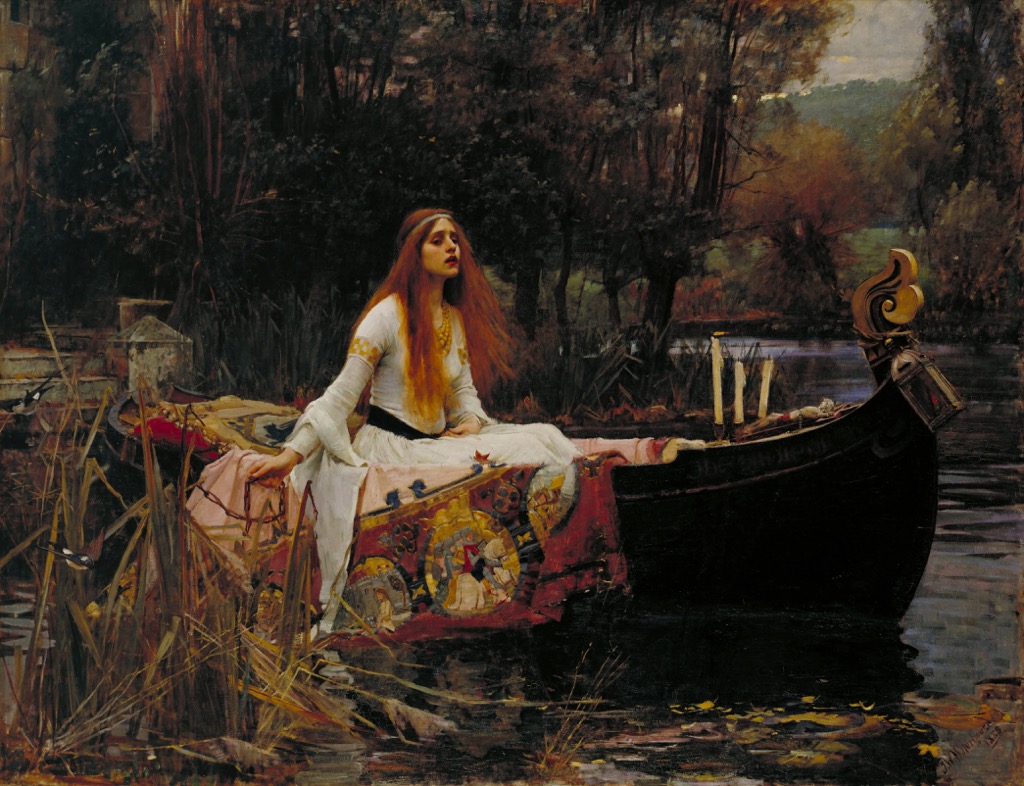
- The Lady of Shalott: Compare Waterhouse's best-known literary composition.
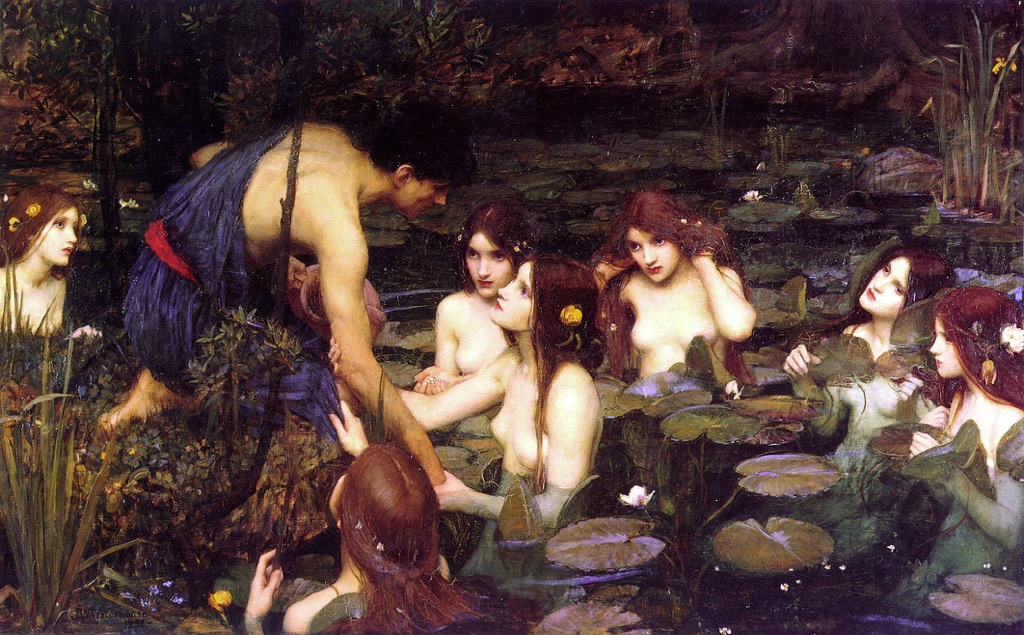
- Hylas and the Nymphs: Compare another major mythological scene.
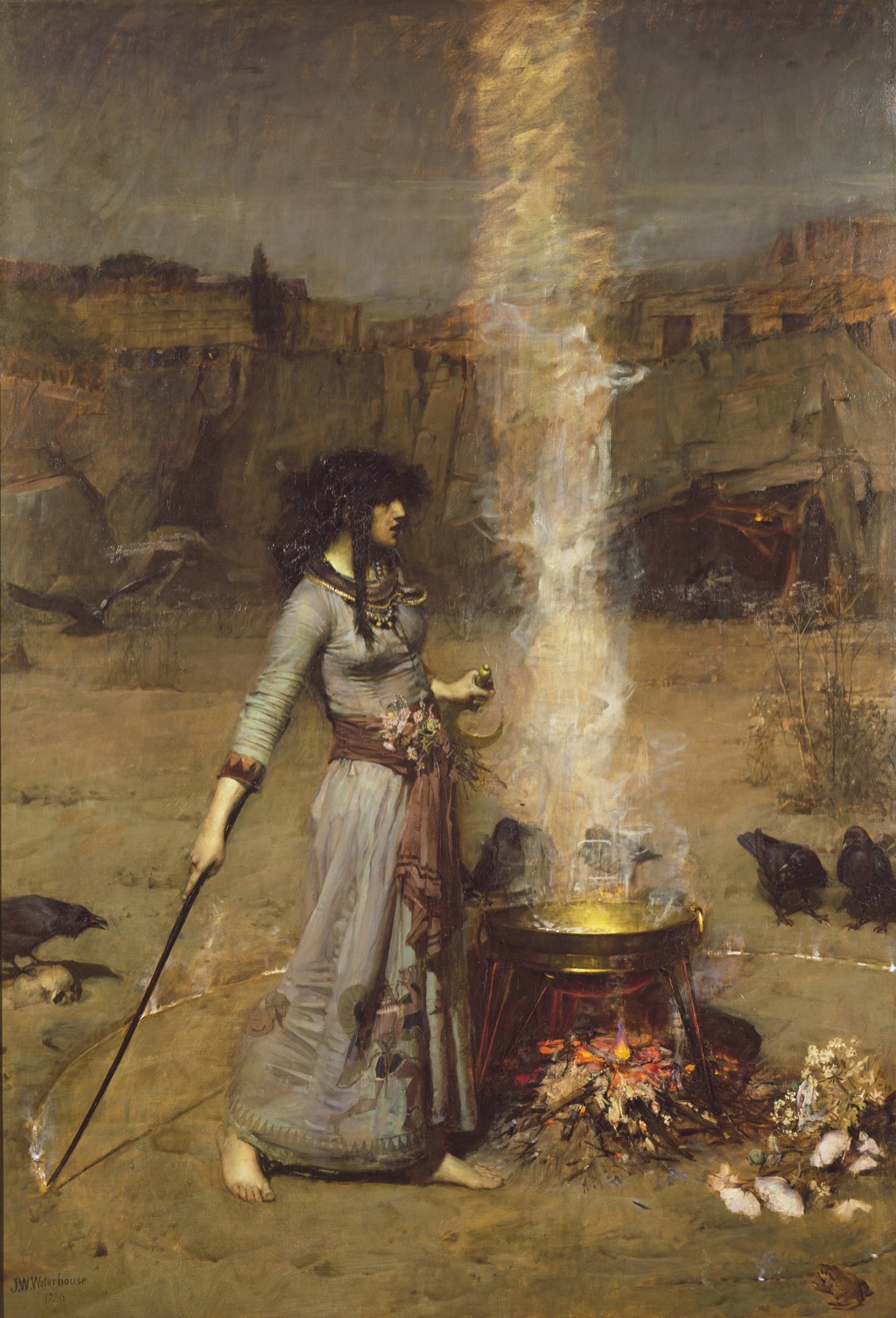
- The Magic Circle: Compare Waterhouse's treatment of ritual and symbolism.
Frequently Asked Questions
Probably not. Sotheby’s identifies the bronze statue in the niche as Flora and the living woman as a worshipper making offerings. [1]
It was probably developed around 1890–91 after Waterhouse’s Capri visit and was exhibited at the Royal Academy in 1891. [1] [2]
Sotheby’s identifies irises and narcissi, appropriate to spring. [1]
No firm identification has been established. [1]
Discussion
Flora is most revealing when its title is read through the shrine. The living woman is not simply the goddess dressed in white; she pauses beside Flora’s bronze image after arranging spring flowers. Devotion, season and private attention meet without a fully specified narrative.
The painting also completes Waterhouse’s Capri sequence in miniature. White wall, vine and outdoor light derive from travel; model and classical costume were probably developed in London. Two pentimenti preserve evidence that he revised both head and architecture during painting.
Reader Insights
Which visible detail most changes the way you read this page?
Which source or comparison helps the work feel less familiar and more specific?
What question would you bring back to the painting after reading?
Join the Conversation
Share your reading of this page below.
References
- Sotheby’s, “John William Waterhouse, R.A., R.I., Flora,” lot 129, including signature, provenance, 1891 exhibition, condition, pentimenti and catalogue essay. View source.
- Algernon Graves, The Royal Academy of Arts: A Complete Dictionary of Contributors and Their Work, Waterhouse entry recording Flora, 1891, no. 373. View source.
- Wikimedia Commons, “John William Waterhouse: Flora,” object summary recording 73 × 33 cm dimensions and 1891 catalogue date. View source.
- Peter Trippi, “John William Waterhouse: An Orange Garden,” Kilgore Gallery research catalogue, Capri sequence and related-title context. View source.