 by Tom Gurney
Tom Gurney BSc (Hons) is an art history expert with over 20 years experience
Published on August 14, 2026 / Updated on August 14, 2026
Email: tomgurney1@gmail.com / Phone: +44 7429 011000
Mariamne Leaving the Judgement Seat of Herod: Introduction
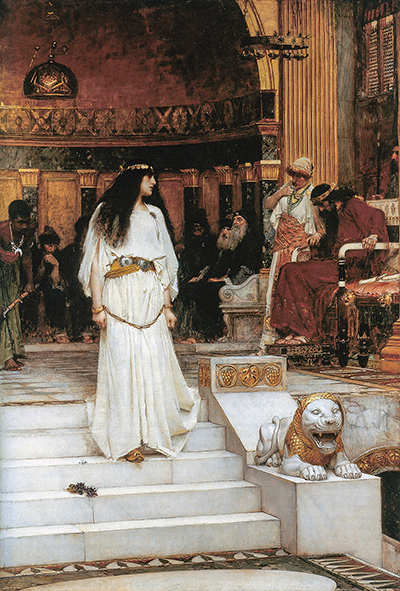
Mariamne is already leaving when she turns for one last look. The court that has condemned her rises behind in marble, mosaic and gold. Her husband Herod remains seated, divided between attachment and the death sentence issued under his authority. Beside him stands his sister Salome, whose pressure has helped make the judgement irreversible.
John William Waterhouse's Mariamne Leaving the Judgement Seat of Herod is not a scene from the Bible and does not show the Salome famous for the death of John the Baptist. Its source is the history of Herod the Great and his Hasmonean wife in Flavius Josephus's Jewish Antiquities. Painted in 1887 on the largest canvas of Waterhouse's career, it turns a palace murder into an encounter of looks, distances and downward movement.
At a Glance
- ArtistJohn William Waterhouse (1849–1917)
- TitleMariamne Leaving the Judgement Seat of Herod, commonly shortened to Mariamne [1]
- Date1887 [1]
- MediumOil on canvas [1]
- Dimensions267 × 183.5 cm [1]
- ScaleThe largest painting Waterhouse is documented to have made [1]
- CollectionPrivate collection; its modern provenance includes the Forbes Collection of Victorian Pictures [1]
- Signed and dated“J.W. Waterhouse / 1887” [1]
- First exhibitedRoyal Academy, London, 1887, no. 134 [1]
- Principal literary-historical sourceFlavius Josephus, Jewish Antiquities, Book 15 [1] [2]
- SubjectMariamne I, Hasmonean princess and wife of Herod the Great, leaving after a trial that ends in her execution [2] [3]
- Other principal figuresHerod the Great and his sister Salome [1]
- Essential warningThese are not Herod Antipas and the later Salome associated with John the Baptist [1]
Contents
- Introduction
- The Moment after Judgement
- Mariamne and Herod the Great
- Josephus's Trial and Execution
- Herod and Salome: The Correct Identities
- The Farewell Look and the Divided Court
- White Dress, Marble Steps and Scale
- Architecture and Theatre
- The Royal Academy Reception of 1887
- An International Exhibition Life
The Moment after Judgement
Waterhouse chooses neither accusation nor execution. The trial has ended, and Mariamne has begun the walk away from power.
This interval contains two opposed facts. The court has decided her death, but she remains physically present, upright and capable of returning the king's gaze. The sentence controls her destination; it does not yet control how she occupies the hall.
The figure descends towards the viewer. White dress and pale steps pull her forward from the more crowded, darker court. Her movement gives the tall canvas a strong downward direction while her head turns back against it.
That turn divides body from attention. Mariamne's feet and drapery continue towards execution, but her final look remains with Herod. Waterhouse can therefore show departure and confrontation at once.
Herod is not raised into a triumphant profile. He sits to the right, withdrawn within the architecture and surrounded by others. His position is politically powerful but visually compromised: the person who will die dominates the canvas.
Salome stands near him. Her nearness matters because influence rather than official rank drives the fatal decision. Josephus reports that, after the court passed sentence, Herod and some advisers considered imprisonment, but Salome's party pressed for immediate execution. [2]
The judges and attendants enlarge the setting without taking emotional command. Their number makes Mariamne's isolation visible. A state apparatus surrounds the death of one woman, yet the picture's clearest exchange runs between wife and husband.
Waterhouse leaves the violence outside the frame. No weapon, wound or executioner performing the sentence interrupts the scene. The horror lies in knowledge of what follows and in the court's capacity to continue looking.
Mariamne and Herod the Great
Mariamne I was a Hasmonean princess. Her ancestry connected her on both sides to the dynasty that had ruled Judea before Herod's rise. Herod married her in 37 BCE after a period of betrothal, making the marriage both personal and politically significant. [3]
Herod's position depended upon Roman support, military success and the displacement of Hasmonean claims. Marriage to Mariamne connected him to an established royal line, but her family could also appear as a rival source of legitimacy. [3]
Josephus's story of their marriage is governed by attachment, fear and unequal power. He repeatedly describes Herod's intense love for Mariamne, but that passion coexists with suspicion and lethal control. [2]
Members of her family died through Herod's decisions. Her brother Aristobulus, appointed high priest while still young, was drowned in circumstances Josephus presents as contrived. Her grandfather Hyrcanus was later executed. Mariamne confronted Herod over these deaths. [2] [3]
Her resentment was therefore not a free-floating hostility that Salome happened to exploit. It arose within a marriage in which political consolidation destroyed members of her own dynasty.
Mariamne also learned that Herod had ordered her death if he failed to return from dangerous encounters abroad. Josephus interprets the disclosure of these secret commands through Herod's sexual jealousy, but the orders themselves reveal the extremity of his possessiveness: he intended that no one should have her after his death. [2]
The marriage cannot responsibly be reduced to a tragic romance between a loving king and a proud wife. Affection operated inside monarchy, imprisonment, surveillance and the capacity to kill.
Nor should Mariamne be treated only as a passive victim. Josephus, despite criticising her lack of moderation, describes chastity, courage, dignity and freedom of speech. A modern historical account emphasises her position as a Hasmonean woman whose political identity and determination have often been overshadowed by Herod's story. [3]
Waterhouse's title restores action to her. Herod occupies the judgement seat, but Mariamne performs the leaving.
Josephus's Trial and Execution
The principal source is Book 15 of Flavius Josephus's Jewish Antiquities. Josephus wrote long after the events, so his narrative is historical evidence shaped by an ancient author's sources, judgements and dramatic methods—not a transcript of the trial. [2]
The immediate crisis begins when Mariamne refuses Herod's invitation and reproaches him for the deaths of her grandfather and brother. Salome, Herod's sister, observes his anger and sends a prepared cupbearer with a story about a potion. [2]
The cupbearer claims that Mariamne had asked for his help in giving Herod a “love potion.” Josephus identifies the charge as calumny. The allegation remains ambiguous enough to turn supposed desire into suspected poisoning. [2]
Herod orders one of Mariamne's trusted eunuchs tortured. The man cannot confirm the potion accusation, but he reveals that Mariamne knew a secret communicated by Sohemus. Herod interprets that disclosure as evidence of sexual intimacy and orders Sohemus killed. [2]
Mariamne is then tried before people loyal to the king. Josephus states that Herod speaks without restraint and is too impassioned to judge soundly. The court recognises his determination and passes a sentence of death. [2]
There is still a pause. Herod and others consider placing her in a fortress rather than executing her immediately. Salome and her party argue that keeping Mariamne alive could provoke popular unrest, and they prevail. [2]
Josephus then describes Mariamne being led to death. Her mother Alexandra, fearing for herself, publicly attacks her daughter and pretends to accept the accusations. Mariamne refuses to answer the performance. She goes to execution with an unchanged face and what Josephus calls firmness and nobility. [2]
Waterhouse does not illustrate every element. The cupbearer, torture, Sohemus's death and Alexandra's public betrayal are not made separately legible. He condenses the history into a court, a departing queen, a seated king and the sister who strengthens his resolve.
This condensation changes emphasis. Josephus leads readers through a sequence of plots and volatile exchanges. Waterhouse holds time still after decision, allowing one look to contain marriage, accusation and death.
The painting is sometimes described as showing a false charge of adultery. Josephus's immediate formal accusation concerns the potion, while Herod's jealousy converts disclosed secrets into sexual suspicion. [2] It is best to recognise this mixture rather than invent a clear modern indictment.
Herod and Salome: The Correct Identities
The name Herod belongs to several related rulers, and Salome appears more than once within the extended dynasty. That repetition has encouraged confusion around the painting.
Waterhouse's Herod is Herod the Great, ruler of Judea in the first century BCE. Mariamne I was his Hasmonean wife. [1] [3]
The woman beside him is his sister Salome. In Josephus's account, she participates in hostility towards Mariamne, prepares the cupbearer's allegation and presses for execution after the court has considered imprisonment. [2]
She is not the young dancer conventionally associated with the head of John the Baptist. That later story concerns Herod Antipas, a son of Herod the Great, and a younger Salome in the next generations of the family. [1]
The difference is not a minor genealogical correction. It changes every relationship on the canvas. The standing Salome is the king's sister and Mariamne's sister-in-law, not Herod's daughter dancing for him.
Waterhouse does not show a dance, banquet, Baptist or severed head. The court's violence is judicial and domestic. A ruler lets jealousy and faction turn marriage into a death proceeding.
Christie's notes that nineteenth-century and later culture could bring the two Herodian stories into imaginative proximity because both involve a Salome and a fatal command. [1] That reception history should not erase the distinct ancient narratives.
The painting's Salome is threatening through proximity and counsel. She need not perform before the court; she stands close enough to shape the ruler's will.
The Farewell Look and the Divided Court
Mariamne's backward glance is the work's decisive invention. Josephus describes her composure on the way to execution, but Waterhouse designs a visual exchange appropriate to painting. [2]
Her face turns towards Herod while the body continues down the steps. The look can hold reproach, appeal, grief and judgement without resolving into one scripted emotion.
It would be easy to call it forgiveness or hatred, but neither is secured by the image. The restraint is stronger than a fixed label. Mariamne lets Herod see the person whose death he can still understand but will not prevent.
Herod's response is less exposed. Seated and partly contained by people and objects, he appears burdened rather than commanding. Christie's describes him as caught in conflicting emotions while Salome reinforces the fatal choice. [1]
This does not absolve him. Emotional agony is not moral innocence. He created the conditions of the trial, spoke in a passion, accepted its result and possessed the authority to stop the execution. [2]
Salome's upright presence contrasts with his inward posture. She appears to stabilise the decision at the moment when he cannot stabilise himself.
Other figures look, wait or withdraw. The judges occupy a gilded recess, lending formal grandeur to a process Josephus depicts as governed by the king's temper. Architecture claims impartial order while narrative reveals compromised judgement.
Mariamne crosses this network without physical collapse. Her pale figure reads as a vertical column in motion, more coherent than the clustered court.
The painting consequently reverses the normal hierarchy of a judgement scene. The throne is not the strongest moral position. The condemned woman leaving it is.
White Dress, Marble Steps and Scale
At 267 cm high, Mariamne is taller than most viewers and is the largest painting Waterhouse is known to have produced. [1]
Its scale makes Mariamne's approach physical. She does not remain a small figure inside a remote reconstruction of antiquity. As she descends, her body approaches the viewer's space.
Contemporary critics noticed this effect. George Bernard Shaw described her as advancing almost straight out of the frame, while Harry Quilter and D. S. MacColl compared the picture's conception to stage performance and tableau. [1]
The white clothing is not a blank area. Folds gather, descend and change under shadow. The Illustrated London News praised Waterhouse's handling of three whites—the dress, marble steps and ivory throne—whose differences create much of the colour scheme. [1]
Those whites make a moral contrast possible without becoming a simple innocence code. Mariamne's body remains warm and material; marble supports and surrounds the institution that condemns her; ivory belongs to royal authority.
A gold belt and ornaments interrupt the dress, retaining her status as queen even as the court removes her future. Her hands appear constrained before her body, making the sentence visible without introducing an execution scene.
Dark hair frames the pale face and upper dress. The contrast concentrates attention upon her look back across the hall.
The stair performs more than an architectural function. Each descending level carries Mariamne farther from the judges and nearer to execution. Her movement is both pictorially forward and narratively final.
The sculpted lion beside the steps adds ceremonial power to the route, yet stone authority is inert. Mariamne supplies the canvas's living dignity.
Not every ornament should be decoded as a fixed symbol. Waterhouse's setting establishes splendour, hierarchy and historical distance, but no surviving statement cited here assigns a private allegory to each animal, mosaic or colour.
Architecture and Theatre
The court is an imagined ancient interior rather than a documented reconstruction of one known Herodian room. A gilded semi-dome, raised judgement area, blue-and-gold mosaics, marble and sculptural details combine several historical associations. [1]
The space makes power architectural. Judges occupy an apse-like enclosure; steps regulate approach and departure; the throne fixes Herod's rank. Mariamne's path cuts diagonally through these systems.
Christie's records scholarly comparisons with the theatrical interiors of Lawrence Alma-Tadema and a possible echo of Frederic Leighton's Arab Hall. These are proposals about artistic context, not proof that Waterhouse copied one specific building. [1]
French academic painting also provides a relevant framework. The catalogue essay relates Waterhouse's paint handling and tragic queen to a transnational academic culture in which historical drama could be monumental, emotionally direct and richly staged. [1]
At the same time, contemporaries and later scholars found a particular restraint in the work. The execution is withheld; Mariamne does not tear her clothing or collapse; the emotional climax passes through a turn of the head.
The theatrical comparison need not mean falseness. Theatre organises bodies so that a large audience can read relationship and crisis. Waterhouse similarly uses steps, sightlines and separated figure groups to make a complicated history intelligible at exhibition scale.
The court resembles a stage whose leading actor is walking out of the performance. This is why the painting can feel both ceremonially composed and dynamically unfinished.
Its strongest action is departure. Once Mariamne exits, the magnificence behind her will remain, but its judgement will have become murder.
The Royal Academy Reception of 1887
Waterhouse exhibited Mariamne at the Royal Academy in 1887 as catalogue no. 134. He was thirty-eight and had been elected an Associate of the Royal Academy two years earlier. [1]
The work stood near the culmination of his early engagement with ancient and late-antique subjects. The following year, The Lady of Shalott announced a more visible turn towards Tennyson and the later Pre-Raphaelite legacy. [1]
That sequence can make Mariamne look like an ending, but it also anticipates later Waterhouse. A woman at a threshold of irreversible change, a literary source condensed into one suspended action, and a face whose emotion cannot be named with certainty all remain central to his mature work.
Contemporary response was extensive and divided. The Illustrated London News praised its pathos, conception, execution and colour. The Times admired Mariamne as a dramatic figure and recognised Waterhouse's ability to draw and paint, while wishing the canvas were half the size. [1]
Other critics saw imbalance. The Art Journal treated it as one of the year's important pictures but wondered whether accessories overwhelmed the main actors. Claude Phillips admired Mariamne's pride, appeal and suggested movement while judging Herod, Salome and the court inadequate as a compositional counterweight. [1]
F. G. Stephens in the Athenaeum recognised picture-making skill but attacked the design and melodrama. Shaw and others reached for theatrical comparisons because Mariamne's forward movement seemed to press beyond the frame. [1]
These responses reveal that scale was part of meaning, not a neutral measurement. Some viewers felt physically addressed by the descending figure; others felt the architecture and supporting cast expanded beyond the drama they could sustain.
The disagreement is useful. It prevents present admiration from flattening the painting into an uncontested Victorian masterpiece. Mariamne was recognised as ambitious and technically serious, but its very ambition exposed it to arguments about history painting, theatricality and excess.
An International Exhibition Life
The painting quickly moved beyond one Royal Academy season. It appeared in Manchester's Royal Jubilee Exhibition in 1887 and at the Paris Exposition Universelle of 1889, where it received a bronze medal. [1]
Later exhibitions included Whitechapel and Birmingham in 1890, Chicago's World's Columbian Exposition in 1893, the London Guildhall in 1894 and the Brussels Exposition Internationale in 1897, where it received a gold medal. [1]
At Chicago it appeared under the variant title Miriamne Leaving the Praetorium. That title belongs to the same monumental canvas and should not be mistaken for a second Waterhouse composition. [1]
Sir Cuthbert Quilter owned and frequently lent the work. Christie's calculates that during his twenty-two years of ownership it travelled to at least eighteen exhibitions across Europe and America. [1]
This circulation suited the painting. Its large size, legible drama and opulent setting could command international exhibition halls even when audiences did not know Josephus's narrative in detail.
James Dobie made an etching published as the Art Journal frontispiece in 1888, extending the image into reproducible form. [1]
Quilter sold the painting at Christie's in 1909 for 480 guineas. When Leopold Albu's ownership ended at auction in 1938, it realised only 48 guineas, evidence of the steep decline in the market for much Victorian academic art. [1]
Mrs A. M. W. Stirling acquired it, and the work later passed through the De Morgan Foundation trustees before a 1970 Christie's sale. It subsequently formed part of the Forbes Collection of Victorian Pictures. [1]
The auction record documents private ownership rather than a current public museum location. The painting's extensive exhibition past should not be confused with permanent public access.
How to Look at the Painting
Begin with Mariamne's feet and follow the steps downward. Then notice that her head turns in the opposite direction.
Trace her gaze towards the seated Herod. Look at the figures between them and ask whether they connect the couple or make their separation more complete.
Compare the three principal whites: living dress, hard marble and the throne. They share colour but not material or moral function.
Notice the difference between Mariamne and Salome. One moves through the open centre; the other remains close to royal power.
Look upward to the judges in the gilded recess. Their formal setting promises order, while the source narrative tells of a court responding to Herod's anger.
Finally imagine the next step. Waterhouse's monumental canvas is devoted to the short interval between sentence and disappearance.
Related Pages
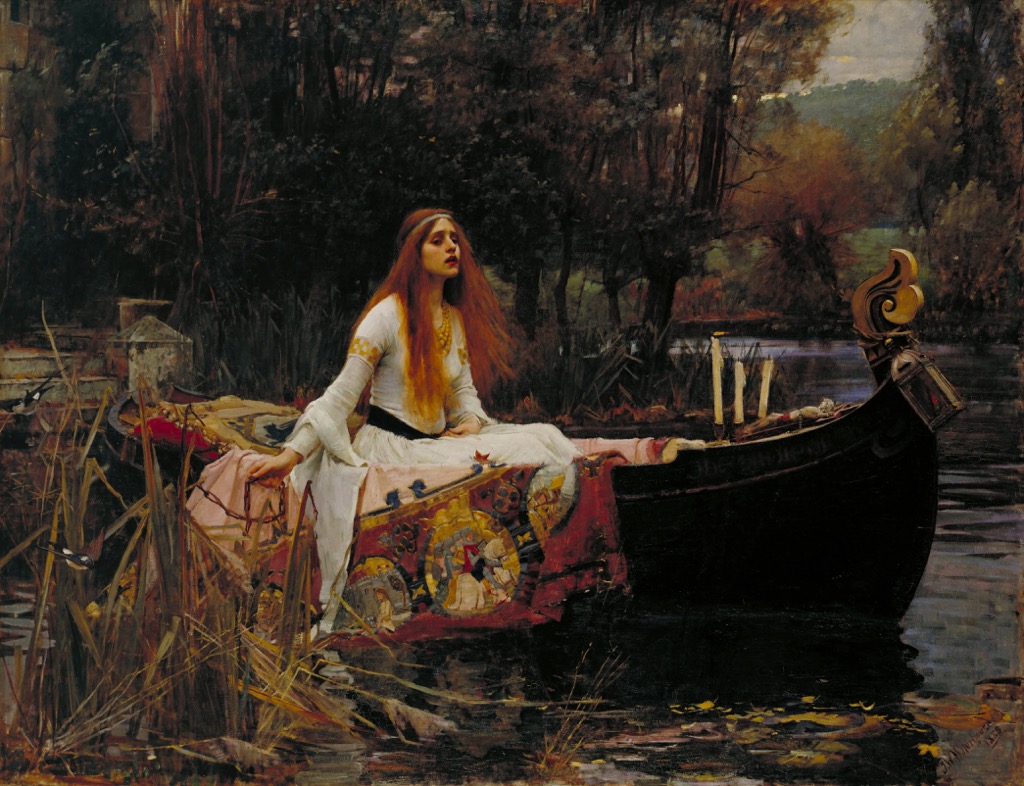
- The Lady of Shalott: Compare Waterhouse's best-known literary composition.
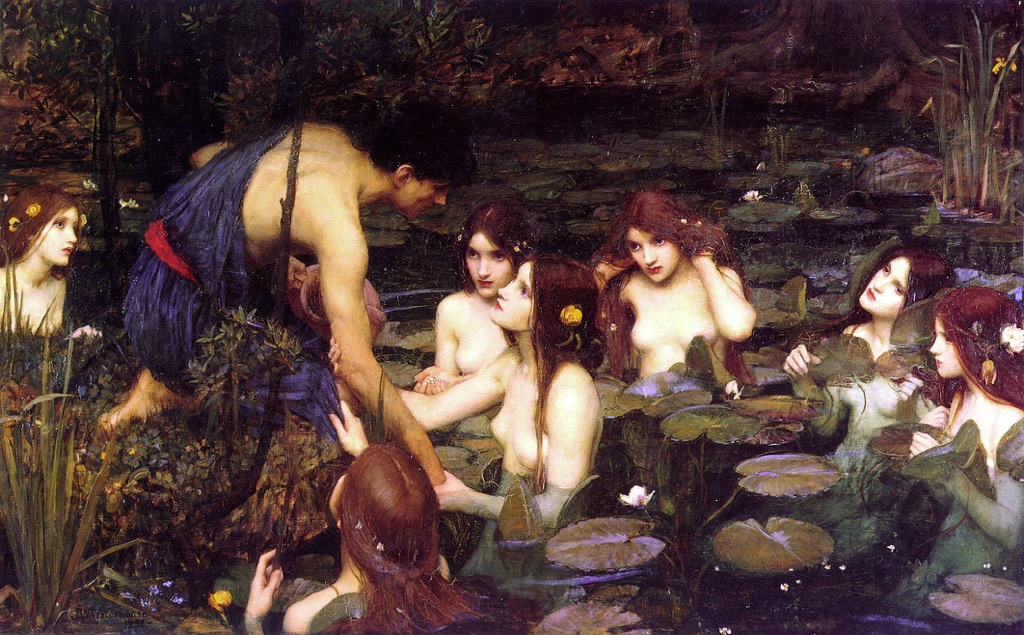
- Hylas and the Nymphs: Compare another major mythological scene.
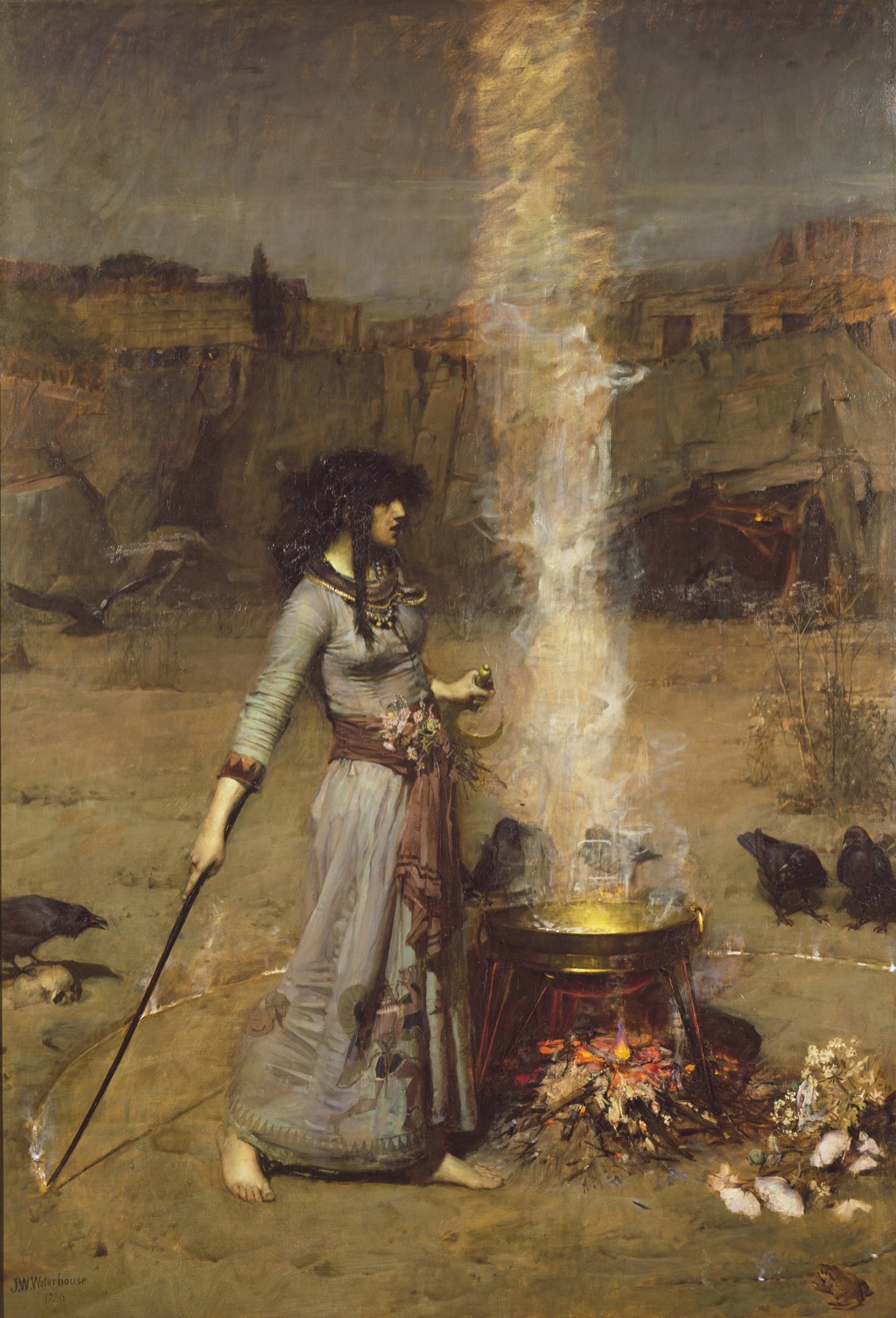
- The Magic Circle: Compare Waterhouse's treatment of ritual and symbolism.
Frequently Asked Questions
Mariamne I was a Hasmonean princess and the wife of Herod the Great. Her ancestry gave her an important relationship to the dynasty that preceded Herod's rule in Judea. [2] [3]
Josephus describes a fabricated allegation involving a potion, torture of a trusted servant and Herod's sexual jealousy. The proceedings are often summarised as false charges of adultery or poisoning, but the ancient account combines several suspicions rather than presenting a clear modern indictment. [2]
She is Herod the Great's sister and Mariamne's sister-in-law. Josephus says that her faction pressed for Mariamne's execution. [1] [2]
No. That later story involves Herod Antipas and a younger Salome in subsequent generations of the Herodian family. [1]
The glance allows Waterhouse to show departure and confrontation simultaneously. Its exact emotional content—reproach, appeal, grief or judgement—remains open.
Yes, Christie's identifies the 267 × 183.5 cm canvas as the largest work he painted. [1]
It is documented in private ownership and was formerly in the Forbes Collection. No current public-museum collection should be assigned without newer evidence. [1]
It received a bronze medal at the Paris Exposition Universelle in 1889 and a gold medal at the Brussels Exposition Internationale in 1897. [1]
Discussion
Mariamne Leaving the Judgement Seat of Herod asks where authority resides after a court has failed. Herod possesses the throne, the judges possess ceremony and Salome possesses influence. Yet Mariamne alone possesses the scale and visual coherence to command the room.
Her backward look does not reverse the sentence. It changes who is judged. Herod must occupy the same canvas as the consequence of his jealousy, and the viewer must measure the small seated king against the monumental woman he allows to die.
Reader Insights
Which visible detail most changes the way you read this page?
Which source or comparison helps the work feel less familiar and more specific?
What question would you bring back to the painting after reading?
Join the Conversation
Share your reading of this page below.
References
- Christie's. “John William Waterhouse, Mariamne,” catalogue record and extensive essay documenting the object, subject, reception, exhibition history and provenance. View source
- Flavius Josephus / University of Chicago LacusCurtius. Jewish Antiquities, Book 15, especially the account of the potion allegation, trial, intervention of Salome's party and Mariamne's execution. View source
- Malka Z. Simkovich, TheTorah.com. “Mariamme, the Last Hasmonean Princess,” historical discussion of Mariamne's dynastic position, marriage and treatment in ancient sources. View source