 by Tom Gurney
Tom Gurney BSc (Hons) is an art history expert with over 20 years experience
Published on August 14, 2026 / Updated on August 14, 2026
Email: tomgurney1@gmail.com / Phone: +44 7429 011000
The Remorse of the Emperor Nero after the Murder of His Mother: Introduction
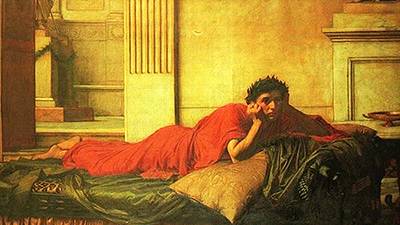
John William Waterhouse's The Remorse of the Emperor Nero after the Murder of His Mother shows power collapsing into isolation. Nero lies across a richly covered couch, wrapped in red, his head sunk against one hand. The Roman interior is spacious and costly, but no courtier shares it. The murdered Agrippina does not appear; her absence determines the emperor's state.
Painted in 1878 and exhibited at the Dudley Gallery, the large horizontal canvas was one of Waterhouse's most ambitious early historical subjects. [1] [2] Its title draws on an ancient tradition in which Nero suffered guilt or haunting after ordering his mother's death in AD 59. Waterhouse turns that disputed psychological report into a single, oppressive aftermath.
At a Glance
- ArtistJohn William Waterhouse
- TitleThe Remorse of the Emperor Nero after the Murder of His Mother
- Date1878 [1]
- MediumOil on canvas [1]
- DimensionsApproximately 94 × 168 cm [1]
- CollectionPrivate collection [1]
- ExhibitionDudley Gallery, London, 1878 [2]
- SubjectEmperor Nero after ordering the murder of Agrippina the Younger
- Historical eventAgrippina's killing in AD 59 [3] [4]
- Important visual distinctionAgrippina's corpse is not visibly depicted
Contents
- Introduction
- What the painting shows
- Nero and Agrippina
- The murder in ancient accounts
- Why “remorse” matters
- An emperor alone
- Red drapery, darkness and light
- Architecture and imperial display
- The 1878 reception
- History painting and source criticism
What the painting shows
Nero reclines lengthwise on a low couch that stretches across most of the canvas. One elbow supports his raised head while the other arm disappears among dark coverings.
A vivid red robe wraps the body and spreads behind his legs. Bare feet extend towards the left; the face, framed by dark hair or a wreath, turns outward with a heavy, unfocused gaze.
The couch is layered with patterned fabric, cushions and a near-black drape. A leopard-patterned skin or textile appears near the foot, adding luxury without brightening the mood.
Behind Nero, pale architecture catches yellow light. A fluted column divides an open passage at left from the broad wall at centre.
At right, a pedestal supports the lower part of a statue. A shallow metal lamp or dish rests on a projecting ledge, while dark furniture and vessels collect below.
The room is unoccupied except for Nero. Nothing in the visible image securely represents Agrippina's body. Descriptions that say he is literally contemplating her corpse confuse title and scene.
Waterhouse depicts consequence through posture and emptiness. The murder has already occurred elsewhere; the painting asks what remains when command cannot undo action.
Nero and Agrippina
Nero was born Lucius Domitius Ahenobarbus in AD 37. His mother, Agrippina the Younger, married the emperor Claudius, who adopted Nero; the young man succeeded Claudius in AD 54. [3]
Agrippina was central to her son's rise. Coins and sculpture could present them together, but their political relationship deteriorated after his accession.
The British Museum notes that Nero removed her from the palace and ultimately ordered her death in AD 59, amid suspicion and conflict over her influence. [3]
Nero was therefore about twenty-one when Agrippina died, not the mature man Waterhouse appears to paint. A contemporary reviewer noticed the age discrepancy. [5]
Agrippina was not simply a private mother. She was a Julio-Claudian dynast, former wife of Claudius and experienced participant in imperial power.
The ancient sources are hostile and were written after Nero's reign. Their accounts combine political history, moral judgement and sensational anecdote. Modern institutions caution that much of the familiar image of Nero comes through elite opponents. [3]
Waterhouse's title nevertheless adopts their moral framework. The son's matricide becomes a crime capable of penetrating even imperial self-command.
The murder in ancient accounts
Tacitus narrates an elaborate failed attempt to kill Agrippina through a collapsible boat. After she survived and reached shore, armed men were sent to complete the murder. [4]
He reports competing claims about whether Nero later looked upon the body and praised its beauty. That disagreement inside the ancient text is important: even Tacitus marks uncertainty. [4]
Agrippina is said to have met the assassins with the declaration that her son could not have ordered the crime. Later retellings make her final gestures increasingly theatrical.
Suetonius also records failed poison and mechanical schemes, followed by the order to kill. He then supplies the tradition most directly relevant to Waterhouse: Nero could not endure the stings of conscience and claimed to be pursued by his mother's ghost and the Furies. [6]
These accounts were not eyewitness transcripts of Nero's private mind. Tacitus and Suetonius wrote decades later and shaped their narratives around tyranny and moral consequence.
They also differ in purpose and method. Tacitus embeds the killing within a political narrative of court factions, failed machinery, messengers and military obedience. Suetonius organises a ruler's life through character-revealing deeds and anecdotes. A later painter could draw emotional material from both without reproducing either account scene by scene.
The distance between event and record becomes greatest at the point Waterhouse chooses: private feeling. Orders, deaths and public responses may leave traces, but remorse inside a closed room is exceptionally difficult to verify. The canvas occupies that historical silence imaginatively.
It does so without repeating the sources' most lurid imagery. No collapsing boat, exposed wound, assassin or avenging spirit appears. Withholding them keeps attention on the ethical aftermath rather than the mechanics of death.
Waterhouse does not illustrate the murder method, corpse inspection or supernatural Furies. He extracts the internal aftermath.
The painting can therefore be linked securely to the ancient remorse tradition without claiming to reconstruct one precise paragraph.
Why “remorse” matters
The title dictates the figure's psychological interpretation. Without it, the pose could signify exhaustion, boredom, illness or thought.
“Remorse” goes beyond regret at political inconvenience. It implies moral consciousness of wrongdoing and a pain directed back upon the self.
Waterhouse makes this feeling bodily. Nero's head is heavy, the torso slack and the long imperial body nearly horizontal.
No external Fury needs to appear because the couch has become a place of inward punishment. The hand that once commanded now merely props up the face.
Yet the painting does not prove that the historical Nero felt remorse. It represents a Victorian artist's response to an ancient literary tradition.
The title also creates irony. An emperor possesses command over others but cannot order memory or conscience to depart.
Whether viewers believe the emotion sincere remains open. Nero may appear haunted, self-pitying or theatrically absorbed in his own suffering after causing another's death.
That ambiguity prevents remorse from becoming redemption. Nothing in the canvas restores Agrippina or shows accountability.
Remorse can even be another form of imperial self-centredness. Nero's suffering fills the title and canvas, while Agrippina's experience is displaced beyond view. A modern reading may recognise the force of conscience and still ask why the perpetrator receives the body, colour and psychological attention.
Waterhouse partly answers through emptiness. The emperor is not surrounded by consoling witnesses who might ratify his pain. His isolation makes remorse look sterile: intense feeling without repair, confession or changed action.
The supported head is crucial here. It resembles the conventional pose of melancholy and thought, but the long title fixes its cause in a particular crime. Gesture remains general enough for viewers to enter; language supplies the historical accusation.
An emperor alone
The single figure is unusually small relative to the broad horizontal room. Empty wall and architecture deny him the visual fullness of court ceremony.
His pose combines privilege and collapse. He reclines on luxury, but the couch cannot provide ease.
The gaze does not meet another person. It passes into the viewer's space without forming direct contact, intensifying mental distance.
Waterhouse crops the setting so that doors and statuary imply a palace beyond the canvas. Still, no guard, servant or adviser enters.
Isolation can be read as consequence. Political crime destroys ordinary relationship, leaving only objects that reflect status.
It can also be read as theatrical convention. A solitary protagonist makes an emotion legible from a gallery distance.
The extended body creates a slow visual journey from feet to face. Viewers must cross red fabric before arriving at Nero's expression.
That delay matters. Imperial splendour is encountered first, then the psychologically diminished person inside it.
The couch is almost a stage within the larger stage. Its continuous horizontal edge displays the body, yet the surrounding floor and wall leave it stranded. Nero can be fully visible without becoming socially accessible.
His bare feet further reduce ceremony. They belong to rest or private withdrawal rather than an emperor enthroned before subjects. Crown, armour and public insignia have given way to robe, cushion and exposed skin.
The painting therefore reverses the normal logic of a state portrait. Instead of compressing empire into an upright commanding likeness, it stretches a ruler laterally and makes the room greater than he is. Rank remains readable, but mastery does not.
Red drapery, darkness and light
Red is the painting's dominant colour. It covers Nero's body, pools along the couch and isolates him from pale stone.
The colour may suggest imperial luxury, bodily warmth, violence or blood. None of those meanings should be declared exclusive without documentary evidence.
The robe's brightness gives the figure visual authority even when his pose denies active power. Waterhouse lets colour and body contradict one another.
Dark textiles surge from the right and gather beneath the raised torso. Their folds are difficult to separate from furniture, turning comfort into a heavy mass.
Light falls across the central wall, column and portions of the robe. The far sides recede into brown-black shadow.
Unlike moralising pictures in which illumination signifies release, this light offers no exit. It exposes Nero within the room.
The lamp or dish at right contains a small warm gleam. It is too modest to balance the great red field, and its isolation reinforces stillness.
Digital reproductions sometimes intensify saturation and contrast. Exact pigment symbolism should therefore remain secondary to the robust structural relationship between red body, black couch and pale architecture.
Architecture and imperial display
The Roman setting is constructed from fluted column, paved floor, marble-like wall, pedestal, statuary and luxurious furnishings.
No specific palace room is identified. Waterhouse creates a general imperial interior rather than a documented chamber of AD 59.
The cropped statue at upper right suggests heroic or divine public imagery. Its upright stone body contrasts with Nero's horizontal living one.
The column performs a similar comparison. Architecture remains erect and ordered while the emperor folds upon himself.
At left an opening permits a view into another pale space, but Nero does not move towards it. His body runs across rather than into the depth.
Objects communicate power after attendants have gone. Costly fabric and classical decoration tell us who the solitary man is before any crown or inscription does.
The fragmentary statue is especially pointed. Only its lower part enters the composition, so it functions less as a named deity than as an impersonal standard of permanence and ideal form. Nero's soft, bent body appears temporary beneath it.
Likewise the paved floor imposes geometric order that human conduct has violated. Waterhouse does not need to paint judicial punishment; straight architectural intervals surround a figure morally and physically disarranged.
The palace is thus neither a neutral backdrop nor a literal reconstruction. It is a system of comparisons—upright and reclining, pale and red, durable and mortal—through which psychological history becomes visible.
This emphasis belongs to Victorian historical painting, which used researched or plausible material detail to make past emotion credible.
Credibility is not archaeological exactness. The room translates Rome for a nineteenth-century gallery audience through atmosphere and design.
The 1878 reception
The painting was shown at the Dudley Gallery in 1878. [2] Its large format, ancient subject and extended title signalled serious ambition from a painter still in his twenties.
The Art Journal described the figure's agony as painfully manifest and made the viewer an unwilling witness to remorse. [5] That response confirms that the intended emotion was clearly legible.
The Magazine of Art praised the composition's simplicity and lack of exaggeration while calling it somewhat scholastic. [5]
Another contemporary notice objected that Waterhouse's Nero looked much older than the historical ruler at the time of the event. Since Nero was born in AD 37 and Agrippina died in 59, the criticism has chronological force. [3] [5]
These comments are evidence of reception, not final verdicts. “Scholastic” may register the classical training and controlled arrangement that modern viewers value.
They also reveal the expectations applied to Victorian history painting. Reviewers asked whether emotion could be read, whether bodily type suited the documented age, and whether composition remained controlled. A painting was judged at once as drama, historical representation and display of trained design.
The age objection exposes a productive conflict. Waterhouse may have preferred a face capable of carrying worn inwardness, but the choice weakens literal chronology. A strong account can recognise the expressive success without explaining the discrepancy away.
Conversely, the praise for simplicity shows that restraint was visible to first viewers. The work's severity is not merely a modern preference imposed on a faded reproduction; contemporaries noticed the lack of exaggerated action. [5]
The reviewers also show that the work was not ignored. Its emotional force and historical plausibility were debated in the year of exhibition.
Later auction records place the painting in a private collection, including a Sotheby's sale in June 1984. [1]
History painting and source criticism
Historical painting often presents what archives cannot: an inward moment after public action. That imaginative privilege creates both power and risk.
Waterhouse uses ancient historians as a moral prompt but cannot know Nero's exact posture, room or thoughts.
Tacitus and Suetonius themselves are literary authors, not neutral cameras. They inherited earlier reports, selected anecdotes and wrote under later emperors. [3] [4] [6]
Modern scholarship has complicated the one-dimensional monster of popular legend without absolving Nero of political violence. The British Museum stresses both the hostility of major sources and the order for Agrippina's death. [3]
The painting should therefore be described as a Victorian imagination of a reported remorse, not a verified historical scene.
That distinction does not weaken it. Art can examine the ethical meaning of matricide even when private emotion remains unrecoverable.
Nor should Agrippina disappear from interpretation simply because she is absent from the canvas. Her political agency, motherhood and death generate the entire image.
The empty room is thus not empty of history. Its unseen victim structures every visible fold.
Place within Waterhouse's career
The work follows A Sick Child Brought into the Temple of Aesculapius by one year. Both are large classical interiors organised around mortality.
The 1877 canvas distributes concern among a family and ritual community; the 1878 painting removes every witness and concentrates guilt in one body.
Waterhouse would later become famous for female protagonists, but this early male subject shows equal interest in psychological suspension.
The reclining pose and red field have a blunt monumentality unlike the intricate vegetation of his mature mythological pictures.
Yet familiar methods are present. A charged moment is isolated from its wider narrative, objects and architecture carry moral pressure, and outcome remains outside the frame.
The painting also anticipates The Favourites of the Emperor Honorius, another image of a Roman ruler diminished within imperial luxury. Nero suffers conscience; Honorius is insulated by trivial absorption.
The comparison marks Waterhouse's development. Nero makes red cloth and a single agonised body carry almost everything; Honorius distributes irony among mosaics, attendants, birds and the distant threat to empire. One is tragic inwardness, the other political satire.
Both refuse a triumphal account of Rome. Antiquity offers Waterhouse not only beautiful dress and architecture but ways to examine failed authority. That critical strand deserves a place beside the better-known enchantresses and doomed heroines.
Together they demonstrate Waterhouse's sceptical interest in power. Palace settings do not guarantee command of self or history.
Related Pages
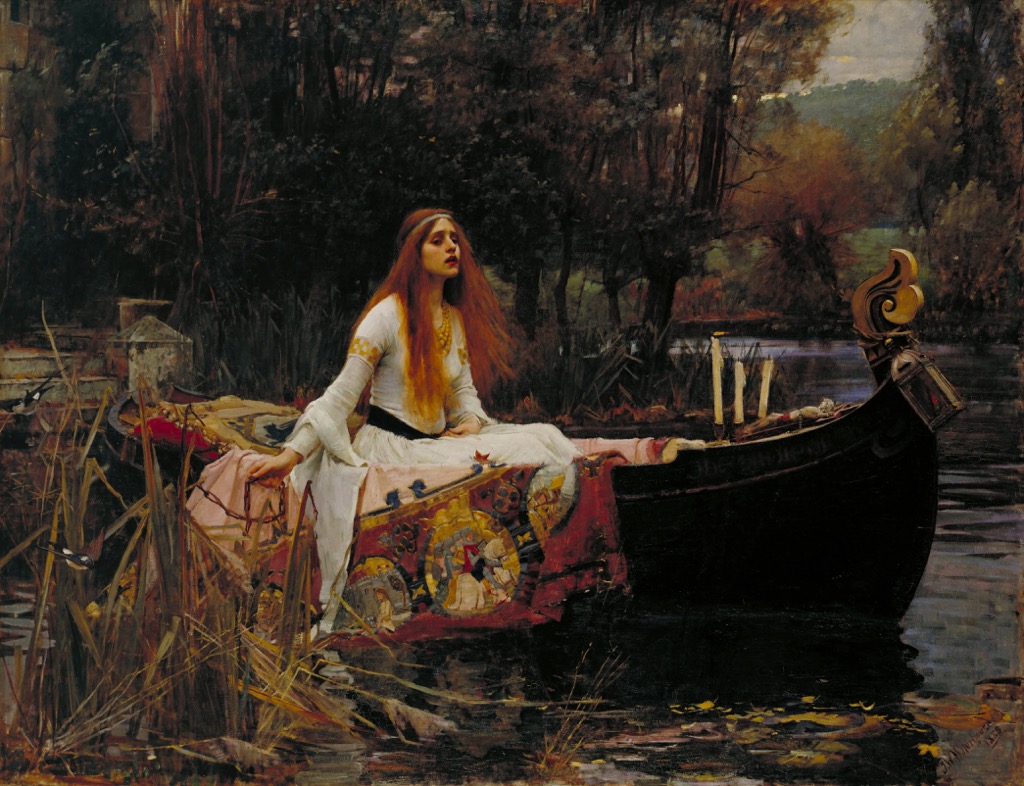
- The Lady of Shalott: Compare Waterhouse's best-known literary composition.
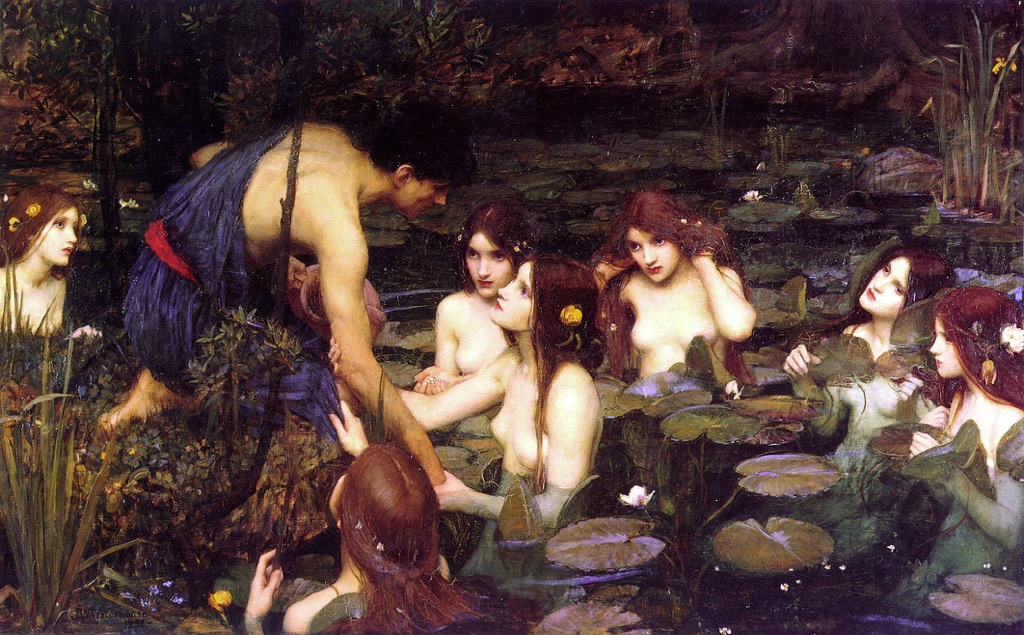
- Hylas and the Nymphs: Compare another major mythological scene.
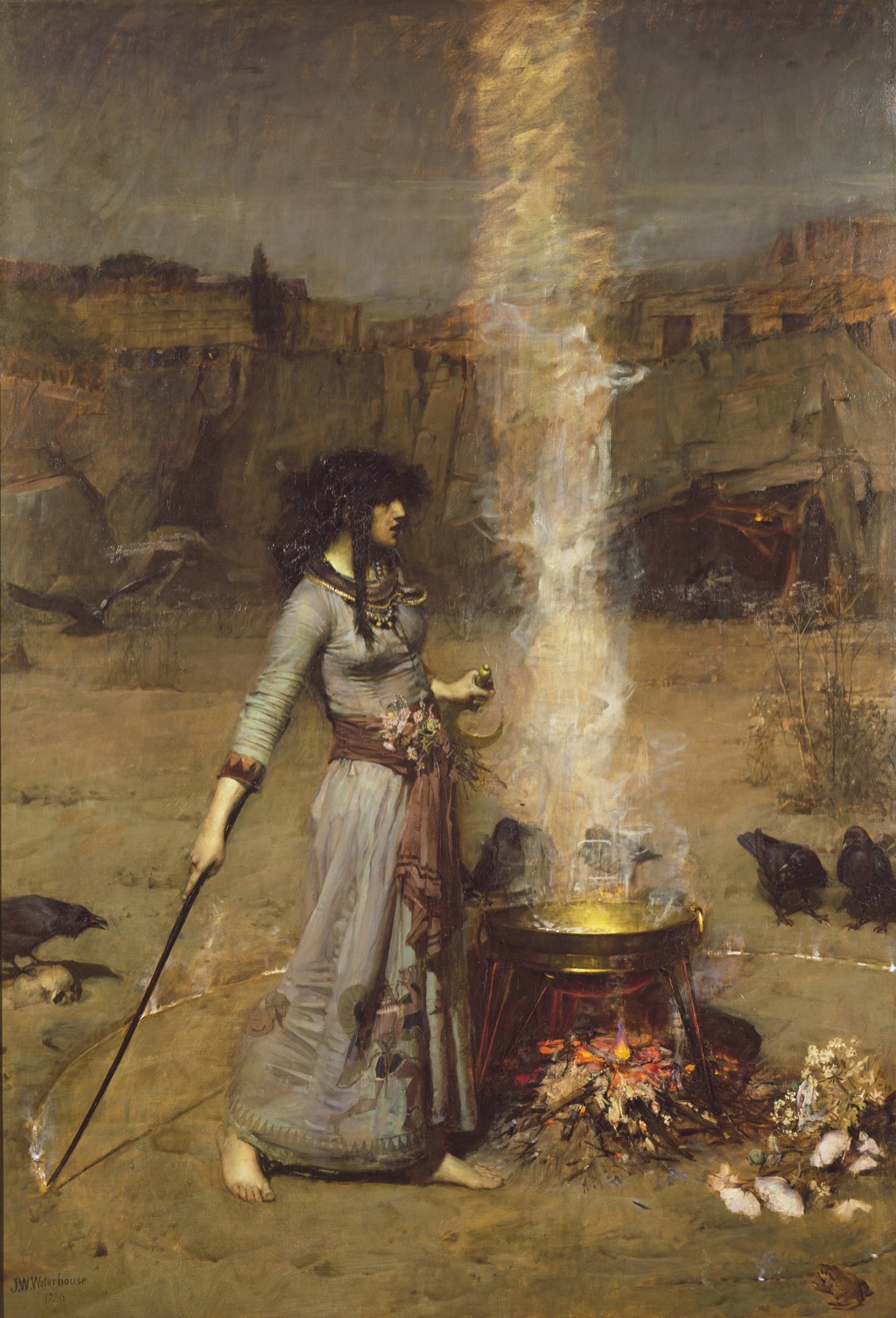
- The Magic Circle: Compare Waterhouse's treatment of ritual and symbolism.
Frequently Asked Questions
He painted it in 1878. [1]
No. The visible painting contains Nero alone in the immediate room; the victim is present through title and absence.
Suetonius records guilt, haunting and attempts to appease Agrippina's ghost, but this is a later literary account rather than direct access to Nero's mind. [6]
He was about twenty-one, which makes Waterhouse's older-looking figure historically inexact. [3]
Approximately 94 by 168 centimetres. [1]
It is held in a private collection. [1]
At the Dudley Gallery in London in 1878. [2]
Discussion
Waterhouse's Nero is not caught issuing an order or committing violence. He is shown after authority has reached its limit. The deed can be commanded; its mental return cannot.
The painting's apparent simplicity is deliberate. One figure, one couch and a large pale wall create more pressure than a crowd of assassins. Agrippina's absence refuses sensational spectacle while making memory the true antagonist.
Reader Insights
Which visible detail most changes the way you read this page?
Which source or comparison helps the work feel less familiar and more specific?
What question would you bring back to the painting after reading?
Join the Conversation
Share your reading of this page below.
References
- Paul Mellon Centre Photographic Archive / object data, John William Waterhouse, The Remorse of Nero after the Murder of His Mother, date, medium, dimensions, ownership and sale history. View source
- Sotheby's, catalogue note for Waterhouse's Offerings, placing The Remorse of Nero at the Dudley Gallery in 1878 and within the artist's early career. View source
- British Museum, “Who was Nero?”, biography, chronology, Agrippina and the problem of hostile ancient sources. View source
- *Tacitus, Annals, Book XIV*, ancient narrative of Nero and the murder of Agrippina. View source
- *The Art Journal and Magazine of Art, 1878*, contemporary critical responses, collated with publication details. View source
- *Suetonius, Life of Nero, chapter 34*, the ancient account of conscience, haunting and the Furies after Agrippina's murder. View source