 by Tom Gurney
Tom Gurney BSc (Hons) is an art history expert with over 20 years experience
Published on August 14, 2026 / Updated on August 14, 2026
Email: tomgurney1@gmail.com / Phone: +44 7429 011000
The Slave: Introduction
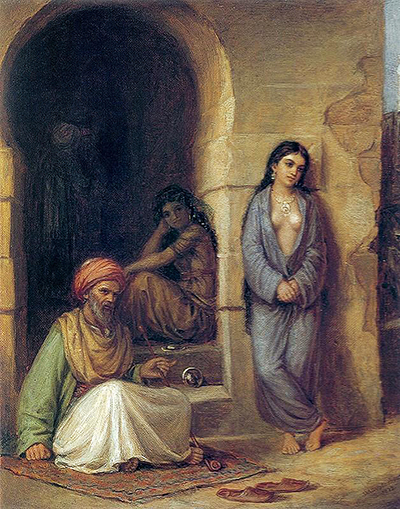
Painted in 1872, John William Waterhouse's The Slave is a large early Orientalist scene centred on an exposed young woman in blue drapery. A turbaned older man sits nearby, apparently engaged in negotiation, while another female figure is partly visible within the shadowed architecture. The title makes captivity and sale the governing context even though no documented literary narrative identifies the individuals.
The oil is privately owned or unlocated in current authoritative discussion, and its public record is thin. [1] [2] That scarcity makes restraint essential. The painting should be analysed as a British fantasy of an unspecified Middle Eastern or North African slave market—not as neutral evidence for a real place, religion or people.
At a Glance
- ArtistJohn William Waterhouse
- TitleThe Slave [1]
- Date1872 [1]
- MediumOil on canvas [1]
- DimensionsRecorded as approximately 254 × 203 cm [1]
- CollectionPrivate collection / current location not publicly established [1] [2]
- SubjectAn exposed young woman presented within an imagined Orientalist market or interior
- SettingUnspecified Middle Eastern or North African fantasy
- ContextAn early work painted while Waterhouse was a Royal Academy Schools student
- Important cautionThe scene constructs racialised and gendered Victorian ideas of “the East”; it is not documentary reportage
Contents
- Introduction
- What the painting shows
- What the title establishes
- The woman's exposure and the spectator
- Negotiation, power and withheld narrative
- Waterhouse's early Orientalism
- Gérôme and the slave-market convention
- Scale, colour and architecture
- Slavery in the year 1872
- What can and cannot be claimed
What the painting shows
The composition is vertical and dominated by a standing young woman. Blue cloth covers part of her body but leaves her breasts exposed.
She wears jewellery at the neck and possibly other adornment. Its brightness contrasts with the vulnerability implied by the title.
Her hands are held near the body, and her expression appears withdrawn, apprehensive or resigned depending on the reproduction and viewer.
To one side sits an older, bearded or turbaned man. His hand gesture suggests speech, valuation or negotiation.
Another woman is partly visible behind or beyond him in the shadowed arched setting.
The architecture creates a public threshold rather than a fully described domestic room. Steps, arch and deep shade organise bodies by access and visibility.
The standing woman receives the strongest light and fullest exposure. The seated man remains clothed and socially active.
This contrast establishes power more clearly than any facial expression. One person is displayed; another participates in the process that displays her.
The title converts ambiguity into coercion. Without it, the picture might be mistaken for a model in an exotic interior. With it, exposed flesh and negotiation become parts of enslavement.
No chains are required for captivity to register. Spatial arrangement, clothing and unequal agency make the condition visible.
The scene should be described closely but not embellished with invented names, price, nationality or outcome.
What the title establishes
“The Slave” names the woman's legal and social condition, not her identity. The definite article makes her exemplary while withholding a personal name.
That anonymity was common in nineteenth-century images of enslaved people. It could invite sympathy, but it could also reduce an individual to a type.
The painting does not tell us how she was captured, who owns her, whether a sale is beginning or ending, or what happens next.
The seated man's gesture makes negotiation plausible, while the Commons classification and later cataloguing identify a slave-market context. [1]
Still, “market” should be presented as an interpretation supported by title and composition, not a verbatim subtitle supplied by Waterhouse.
The woman appears to be the enslaved figure because her exposure and isolation make her the object of inspection.
The other female figure's status is unclear. She could be another enslaved woman, an attendant, seller or observer.
Waterhouse gives the standing figure visual prominence but little narrative control. She does not speak through an inscription or resist through a documented action.
Her unreadable expression allows viewers to project pity, desire, fear or fantasy. That openness is ethically charged because it serves the spectator more than the represented person.
The title therefore does two things at once: it condemns her lack of freedom as a condition and makes that condition the attraction of the picture.
Modern interpretation must hold those functions together.
The woman's exposure and the spectator
The exposed chest is not incidental. It is the most direct sign that the woman cannot control how her body is presented.
Within the scene, exposure implies inspection by buyers or sellers. Outside it, the painting offers the same body to an exhibition audience.
This double gaze is central to Orientalist slave-market imagery. Coercion within the fiction could provide a respectable explanation for nudity before Victorian spectators.
The viewer might condemn the depicted commerce while still receiving the visual access it creates.
Waterhouse's arrangement does not let us stand outside that structure easily. The woman is frontal or prominently turned, lit and enlarged.
Blue drapery heightens rather than removes exposure. Its colour frames skin and marks what has been selectively uncovered.
Jewellery adds another contradiction. Ornament may suggest value and beauty, but in a sale it can become part of presentation rather than personal choice.
Her relative stillness differs from the man's gesture. He acts; she is made visible.
A sympathetic reading can recognise vulnerability and unequal power. A critical reading asks whether the painting challenges that inequality or aestheticises it.
The surviving evidence does not support a simple abolitionist claim. Waterhouse provides no known protest text, identifiable contemporary event or heroic rescue.
Nor is it enough to call the work merely erotic. The title and negotiation confront viewers with ownership, even if the image packages coercion as spectacle.
The most responsible reading describes this uncomfortable coexistence rather than resolving it in the artist's favour.
Negotiation, power and withheld narrative
The seated man occupies less canvas but appears to possess social agency. His gesture and covered body contrast with the standing woman.
If he is a seller, he may be speaking to a buyer outside the frame. If a buyer, he may be bargaining with the partly hidden figure.
The painting does not identify either role securely. Calling him a dealer is plausible, not certain.
This missing participant can draw the spectator into the exchange. The open side of the composition may place us where a buyer would stand.
Such a position increases ethical unease. Looking becomes analogous to inspection.
Architecture reinforces the hierarchy. The woman is isolated against a dark opening or wall, while other figures occupy a zone of conversation.
She stands at the boundary between interior concealment and public display.
The partly visible woman adds social depth but not explanation. Her obscurity may suggest a larger system extending beyond the principal victim.
Waterhouse does not provide a climax. There is no sale completed, chain broken or rescuer arriving.
The image suspends the woman within the condition named by the title.
That suspension was useful for exhibition art because it preserved narrative tension and prolonged looking.
It also denies the enslaved subject a future. A modern page can acknowledge that limitation without inventing an emancipatory conclusion.
Waterhouse's early Orientalism
The Slave belongs to Waterhouse's earliest known ventures into Orientalist subject matter.
Christie's describes Consulting the Oracle of 1884 as a re-emergence of an Orientalism first explored in the now-unlocated The Slave. [2]
The following year's The Unwelcome Companion: A Street Scene in Cairo continued his interest in imagined or studied Eastern figures and settings. [3]
“Orientalism” here names a Western artistic system that constructed a broad “East” as exotic, sensual, violent, timeless or irrational.
The term does not mean the painting accurately represents a single culture. Waterhouse combines turban, arch, drapery and exposed woman into an unspecified elsewhere.
The lack of geographic precision is meaningful. A generalised East could carry fantasies that would be unacceptable in a contemporary British setting.
Christie's later account of Consulting the Oracle explicitly notes how Victorian art used Eastern women as imagined opposites to the idealised Englishwoman: passionate, seductive and unknowable. [2]
That framework is already active in The Slave. The woman's body is exposed under a social order presented as foreign.
Waterhouse may have drawn Arab or Italian models and studied museum objects, but a model's identity would not turn the fictional scene into ethnography.
His early Orientalism was not the defining mode of his entire career. He moved towards classical genre and later literary myth, although Eastern settings recurred selectively.
The painting is therefore important evidence of experimentation before his public style stabilised.
It is also evidence that objectification and racial difference were present within that experimentation.
Gérôme and the slave-market convention
Jean-Léon Gérôme was the leading French painter of meticulously detailed Orientalist markets, baths and slave sales.
Christie's identifies Gérôme as an important influence on Waterhouse's early 1870s work, before Lawrence Alma-Tadema became more decisive in his domestic classical scenes. [2] [4]
Gérôme's slave-market pictures often combine archaeological or ethnographic-looking detail with exposed bodies offered to clothed male inspection.
Their polished realism can make an invented scene appear authoritative.
Waterhouse's The Slave uses the same basic asymmetry: female exposure, male clothing and an exoticised marketplace.
The comparison does not prove copying from one exact canvas. It locates the work within a widely recognised exhibition convention.
British audiences sometimes objected to the cruelty or explicitness of French Orientalist slave markets while continuing to view and collect related subjects. [5]
This mixture of fascination and moral distance was part of the genre's operation.
Setting abuse abroad could reassure viewers about British civilisation, even though the British Empire and economy had deep historical involvement in slavery and coercive labour.
The foreign scene could also obscure ongoing systems by treating slavery as a spectacle belonging elsewhere.
Waterhouse's young age and training context explain influence but do not neutralise content.
Reading the painting beside Gérôme helps identify its visual grammar and the cultural assumptions that grammar carried.
Scale, colour and architecture
The recorded dimensions—about 254 × 203 centimetres—make The Slave an exceptionally large early canvas. [1]
At that scale, the standing figure would approach or exceed life size, intensifying both presence and exposure.
Because the object is not publicly accessible and the measurement circulates through secondary metadata, it should be reported as recorded rather than independently verified.
The vertical format follows the woman's body. Architecture rises around her, creating a monumental niche.
Blue cloth is the principal saturated colour in descriptions and reproductions. It draws attention to the body while contrasting with warm stone, red turban and shadow.
The older man's clothing carries more pattern and coverage, visually reinforcing control.
The arch is both setting and frame within the frame. It turns the woman into a displayed figure.
Deep shadow behind the participants makes the market feel enclosed and unknowable, a conventional Orientalist atmosphere rather than a transparent civic space.
Light is unequally distributed. It reveals the person with least power.
This is not simply a technical effect. Illumination and social exposure become the same visual action.
Waterhouse's later paintings often use a bright heroine against dark surroundings, but here the formula is inseparable from enslavement.
The large scale suggests ambition while the handling and type remain formative.
Slavery in the year 1872
By 1872, slavery had been abolished within most of the British Empire for decades, but its wealth, racial hierarchies and global consequences remained present.
Forms of enslavement and slave trading continued in parts of Africa, the Ottoman world, the Indian Ocean and elsewhere, while abolition was a live imperial and humanitarian discourse.
The exact coincidence of date does not prove Waterhouse responded to one news report. No such source has been established.
It does mean the subject was not a harmless remnant of remote antiquity.
British viewers could read an Eastern slave market through current claims that Britain opposed slavery abroad.
Such claims sometimes supported imperial intervention and a self-congratulatory contrast between “civilised” Britain and a supposedly backward East.
At the same time, Britain had only recently profited enormously from Atlantic slavery and continued to benefit from unequal colonial systems.
The painting's unspecified setting avoids confronting that national history directly.
Modern interpretation should not impose a detailed political programme Waterhouse did not document. It should situate the image within those larger realities.
The woman's exposure is fictional, but the institution named by the title was real and violent.
That distinction makes tone important. The page should neither sensationalise her body nor turn the work into a generic decoration.
What can and cannot be claimed
Secure facts are limited: artist, title, 1872 date, oil medium, large recorded dimensions and private or unestablished location. [1] [2]
Visible evidence supports a standing exposed woman, seated turbaned man, another woman and arched Eastern setting.
The title supports enslavement. Composition makes a sale or inspection plausible.
No secure evidence names the city, ethnicity, religion or historical period of the figures.
The scene should not be called Ottoman, Arab, Egyptian, Turkish or North African as a fact unless a catalogue source establishes the label. “Unspecified Orientalist setting” is safer.
The woman should not be named a prostitute. Enslavement and sexual availability can overlap in the genre, but the title does not supply that additional category.
The man should not be assigned a buyer or seller role as certainty.
The painting should not be praised as abolitionist without documentation. Sympathy and critique are possible effects, not proven programme.
Nor should every detail be treated as an accurate record of Eastern dress. Studio props and artistic convention shaped the scene.
These limits leave substantial room for analysis. Power, gaze, exposure, Orientalism and spectacle are grounded in the painting's visible structure.
Honest uncertainty protects the work from both romantic apology and unsupported condemnation of specific peoples.
Reading the surviving image responsibly
The current public image is itself part of the problem. The painting is privately held or unlocated in authoritative discussion, so most viewers meet it through a modest digital file rather than the recorded life-size canvas. Artchive's description confirms the principal visible arrangement—standing exposed woman, seated turbaned man, second woman and arched setting—but it is a secondary account, not a conservation record. [6]
Close interpretation should begin with relations that survive reproduction. Clothing is distributed unequally; light is distributed unequally; activity is distributed unequally. The man gestures while the standing woman waits. Those contrasts do not depend on guessing a facial emotion or naming the city.
The painting's enormous recorded size would have made the spectator's bodily relation unavoidable. A woman represented near life size is not a distant anecdotal figure. Yet scale does not automatically confer dignity when the composition exposes her for inspection. Monumentality and objectification can coexist.
Digital display can also make blue drapery seem decorative before the title is read. The responsible page should therefore place “enslaved woman” and Orientalist context early, preventing the image from circulating merely as an exotic beauty. Description must neither conceal nudity nor reproduce it voyeuristically.
Finally, the woman's anonymity should remain visible as loss. Inventing a name would be false repair; treating her as only a formal device would repeat the reduction. The manuscript can acknowledge that Waterhouse left no individual history while refusing to let the surrounding market eclipse the represented human being.
Place in Waterhouse's development
Waterhouse was studying at the Royal Academy Schools in the early 1870s and had not yet made his reputation through annual Academy exhibits.
The Slave predates Sleep and His Half-Brother Death of 1874, his first Royal Academy success.
It shows early ambition in scale and dramatic subject, together with dependence on international academic models.
Within a few years he moved from generalised Orientalism towards Greek and Roman interiors, influenced increasingly by Alma-Tadema. [4]
Later he would return to dark interiors and intense female gazes in Consulting the Oracle. [2]
The comparison shows continuity without equivalence. Both make “Eastern” women emotionally and visually charged, but the later painting has a more developed group psychology and documented pseudo-historical source.
The Slave is not recognisably Pre-Raphaelite in the manner of Waterhouse's mature literary works.
It is an academic Orientalist experiment by a young artist testing scale, body, colour and narrative tension.
Its importance lies partly in discomfort. It reveals a path Waterhouse explored and the cultural conventions available to him.
Excluding it from serious discussion would produce a falsely innocent account of his development.
Studying it critically places the later beauty of his art within the wider visual culture of Victorian empire, gender and spectatorship.
Related Pages
- The Lady of Shalott: Compare Waterhouse's best-known literary composition.
- Hylas and the Nymphs: Compare another major mythological scene.
- The Magic Circle: Compare Waterhouse's treatment of ritual and symbolism.
Frequently Asked Questions
It is usually recorded as privately owned, while Christie's calls it now unlocated. [1] [2] No current public display is established.
Wikimedia's object metadata records approximately 254 × 203 cm. [1] Because the canvas is not publicly catalogued by a current museum, the figure should be treated cautiously.
No source has been established. It appears to be an invented slave-market or sale scene in a generalised Eastern setting.
The woman's vulnerability may provoke sympathy, but no documentary evidence establishes an abolitionist programme. The picture also eroticises the access created by enslavement.
It uses a Western fantasy of an unspecified Middle East or North Africa—turban, arch, drapery and slave sale—to create exotic distance and sensual spectacle.
No. In 1872 he was an Academy student working through academic and Orientalist influences. His later association with Pre-Raphaelite subjects should not be projected backwards unchanged.
Discussion
The Slave creates its visual force through unequal access. The clothed man can gesture and speak; the woman is lit, exposed and unnamed. The spectator receives a privileged view produced by the same loss of agency the title asks us to recognise.
That contradiction makes simple praise or denunciation inadequate. The picture may invite pity, but it also turns captivity into an occasion for looking. Its Eastern setting distances abuse from Victorian Britain while drawing on imperial habits of imagining foreign societies as sensual and cruel.
Reader Insights
Which visible detail most changes the way you read this page?
Which source or comparison helps the work feel less familiar and more specific?
What question would you bring back to the painting after reading?
Join the Conversation
Share your reading of this page below.
References
- Wikimedia Commons, “John William Waterhouse: The Slave,” object and image metadata, recording 1872, oil on canvas, approximately 254 × 203 cm and private ownership. View source.
- Christie's, “John William Waterhouse: Consulting the Oracle,” catalogue essay discussing The Slave as Waterhouse's early, now-unlocated Orientalist work and analysing the Victorian construction of Eastern women. View source.
- Art UK, “John William Waterhouse: The Unwelcome Companion: A Street Scene in Cairo,” Towneley Hall collection record. View source.
- Sotheby's, “John William Waterhouse: Offerings,” catalogue note discussing the young artist's transition from Gérôme's influence to Alma-Tadema. View source.
- Mary Roberts, “Orientalism,” Smarthistory, overview of nineteenth-century Orientalist visual culture and power. View source.
- Artchive, “John William Waterhouse: The Slave (1872),” artwork record and visual description. View source.