


 by Tom Gurney
Tom Gurney BSc (Hons) is an art history expert with over 20 years experience. Updated September 24, 2026.
Introduction
Utagawa Kuniyoshi (歌川国芳, usually dated 1797–1861) made some of the most energetic images of Japan's late Edo period, but the shape of his life is less simple than a famous skeleton print suggests. He learned within the Utagawa school, passed through an early period of limited success, became widely noticed for heroic figures from Suikoden in the late 1820s, then designed across warrior stories, theatre, women, landscape, books and comic pictures. He continued to work amid changing rules for publishing and left a large circle of pupils as well as two daughters who also made art. The Ōta Memorial Museum's chronological father-and-daughters exhibition [3] and its whole-career retrospective [2] offer the clearest Japanese museum frameworks; the British Museum's artist record [1] establishes the principal teacher and broad career range.
A biography built from prints needs to be candid about its limits. A museum date often applies to one physical impression; it is not a diary entry proving where the artist stood that day. A dramatic picture does not by itself reveal his political opinions, family relationships or temperament. Even the birth year is not wholly uniform in catalogues: the British Museum and National Diet Library authority use 1797, while some older or exhibition records use 1798. The useful task is therefore to distinguish known events and named relationships, reasonable period descriptions, and later stories or disputed interpretations. This page uses that distinction throughout, rather than turning gaps into a seamless tale of genius discovered overnight.
Contents
- Introduction
- Birth, training and what the records do not say
- A slow start and a breakthrough that can be dated
- The 1830s: testing the landscape and the human figure
- The Tenpō reforms, theatre and the problem of intention
- A household and workshop visible in part
- Later projects and the final years
- How his reputation was made and remade
- What a biography can and cannot show
Chronology and source confidence
| Date or period | What can be established | Confidence and limit |
|---|---|---|
| 1797–1861 | The British Museum authority [1] and Ōta Memorial Museum [2] give these life years. | Strong institutional consensus; a few catalogues use 1798, so an exact modern birthday requires separate documentation. |
| Early nineteenth century | Kuniyoshi was a pupil of Utagawa Toyokuni I; the British Museum [1] and Shimane Art Museum [6] identify the relationship. | Strong teacher identification. A precise entry year varies by museum summary and is better given as approximate. |
| Late teenage years and 1820s | The Ōta Museum [2] describes a late-teen debut followed by lean years. | Museum synthesis. It does not prove a particular first print or a fixed number of years without work. |
| About 1827–30 | Early Tsūzoku Suikoden hero prints, including the MFA Boston example [12] and a Cleveland sheet [13], show the celebrated new direction. | Dated surviving objects support the span. “108” is the story and series label, not a verified design count. |
| 1830 | The National Diet Library [14] records a Kanagaki Suikoden edition with Ryūtei Tanehiko, Kuniyoshi and Nishimuraya Yohachi in distinct roles. | Strong publication evidence; authorship and later instalments need care because the NDL also documents ghostwriting during Tanehiko's illness. |
| Early 1830s–1840 | Cleveland's Ōmori [15] and the Met's Water Scene [16] show scenery and spatial experiment. | Object dates support artistic range; they do not prove a specific Western print was copied. |
| 1841–43 | Ōta's cat exhibition [34] discusses 1841 actor-faced cat fans; MFA Boston [21] holds the 1843 Earth Spider print. | Secure objects and exhibition chronology. Political satire in the Spider design was rumoured; intent is not documented. |
| Mid-1840s–1850s | Takiyasha, seasonal women, ghosts, cat stories and later warriors show continuing range. | Use each museum object's date, not one date assigned to all versions of a design. |
| 1861 and after | Kuniyoshi died in 1861. Ōta [3] and the British Museum's block-ready drawing [25] document family and pupil continuities. | Death year secure; a later pupil's reuse of his drawing does not make that later print Kuniyoshi's. |
Birth, training and what the records do not say
The life-year form 1797–1861 is the most useful heading for this site because it matches the British Museum [1], Ōta [2] and the National Diet Library's authority for the artist [5]. The mismatch with catalogues that give 1798 should be noted rather than ignored, particularly when material about an apparent age at publication is being calculated backward. Some Japanese museum summaries describe him as the son of a dyer and place his entry into Toyokuni's workshop around 1810 or 1811; others give a different age. Bunkamura's MFA Boston exhibition text [7] and the Nakagawa-machi Bato Hiroshige Museum record [8] are useful examples of such retrospective accounts. The artist's teacher is well supported, while the exact month or age of apprenticeship is not established here by an enrolment document.
Utagawa Toyokuni I led a workshop in a commercially powerful print school. The British Museum's Toyokuni record [9] describes his importance for actor prints and the Utagawa school's reach. Training there meant more than receiving a style: an apprentice entered a world of drawing, name use, workshop hierarchy, publishers and performers whose likenesses were sold as prints. Kuniyoshi's later actor pictures and comic impersonations make more sense within that wider ecology. We need not invent a childhood encounter with a single warrior print as the moment that made him an artist. A later anecdote may convey how admirers explained his career, but it is not a substitute for a dated early object.
Kuniyoshi was not the only remarkable artist formed by that school. Utagawa Kunisada, later Toyokuni III, was an older fellow pupil who became exceptionally successful in actor and beauty prints. Hiroshige belonged to another branch of the Utagawa network. The Ōta Museum's exhibition on Kunisada, Kuniyoshi and Hiroshige [10] explains the school's late Edo scale without making the three men a single collaborative studio. An artist's name beginning with “Utagawa” does not make another Utagawa artist his brother or direct pupil. Those relationships must be named from the specific evidence.
A slow start and a breakthrough that can be dated
The Ōta Memorial Museum [2] says Kuniyoshi debuted in his late teens and spent an unsuccessful period before the Suikoden designs of his early thirties drew major attention. The Kitakyushu Municipal Museum of Art [11] likewise ties his rise to a series begun about 1827. “Unsuccessful” should be read as a relative assessment of his place in the print market, not proof that he produced nothing, lived in a particular hardship or lacked patrons throughout the 1810s and early 1820s. The surviving corpus and contemporary publishing records are uneven. A biography should acknowledge the gap rather than turn it into a dramatic ten-year silence.
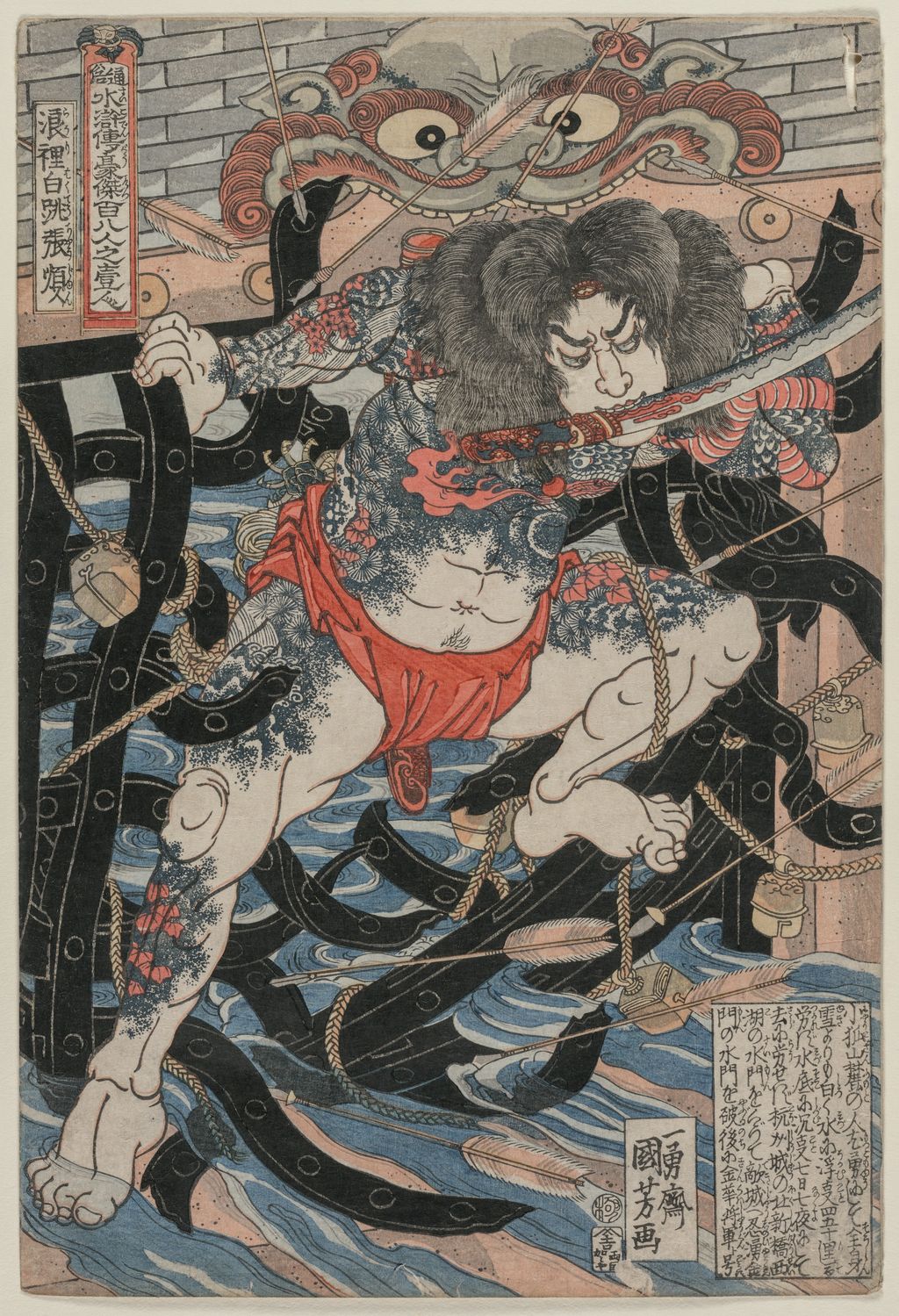
The surviving Suikoden sheets are more precise. The MFA Boston [12] describes a print of Tanmeijirō Genshōgo from One Hundred and Eight Heroes of the Popular Shuihuzhuan at about 1827–30. The Cleveland Museum of Art's Rori Hakuchō Chōjun, accession 1980.85 [13], belongs to the late 1820s. In its vertical field, the hero's tattooed body, weapon and surrounding forms make the narrative figure memorable even without the rest of a book. The style is a visible event in the career, but a style cannot date itself: the holding institutions' object evidence gives the defensible range. The Ōta Museum's 2019 checklist [4] also places named designs from this early series around 1827–28.
The breakthrough affected what publishers could plausibly ask him to do next. Warrior histories and legendary heroes remained important, but the success did not lock him in one genre. By 1830, his name appears as illustrator of the Kanagaki Suikoden printed book described by the NDL [14]. The printed book adds Ryūtei Tanehiko as author and Nishimuraya Yohachi as publisher. An illustrated book required the artist to serve a sequence and text, a different problem from the single-sheet hero. The NDL's account of letters from Tanehiko to his pupil Kasatei Senka also records episodes of substituted writing during illness. They remind us to describe named roles with care: even the person credited as author did not necessarily write each instalment without assistance.
The 1830s: testing the landscape and the human figure
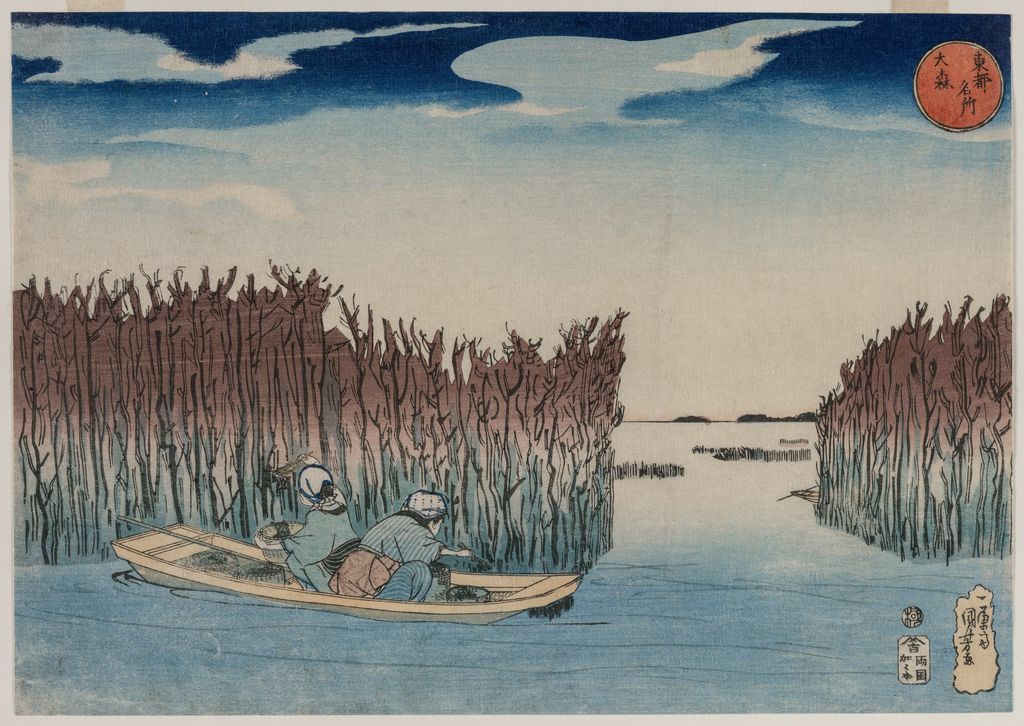
Kuniyoshi's early fame as a warrior designer can obscure the fact that he was soon trying other ways to organise a sheet. The Cleveland Museum's Ōmori, accession 1985.335 [15], dated to the early 1830s, lets small people in a boat sit between two banks of vegetation and a broad expanse of water and sky. The scene belongs to Famous Places in the Eastern Capital. It cannot tell us where Kuniyoshi travelled on a particular day. It can tell us that, soon after the celebrated hero prints, a print under his name made place and distance central to the composition. The British Museum authority [1] identifies Western-style landscape experiments in the 1830s and early 1840s, but that broad category should be tested against specific objects rather than asserted for every print with a horizon.
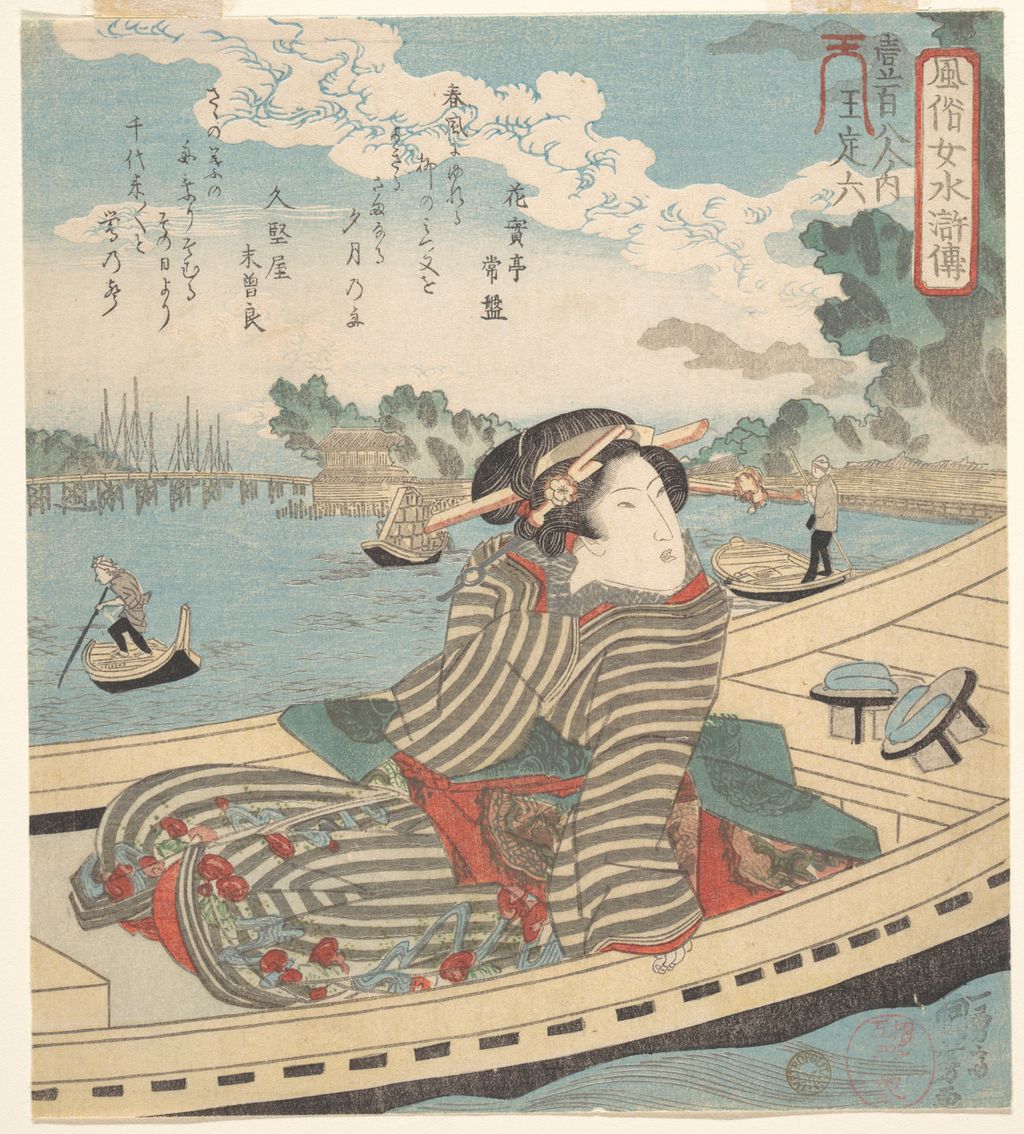
The Met's 1840 Water Scene, JP1252 [16], illustrates the problem more sharply. Its woman in a boat has a Suikoden allusion, while the background uses spatial effects that the museum relates to European models. It is also a surimono, a privately circulated print whose smaller scale and likely audience differ from a commercially issued warrior sheet. Calling this a switch from “Japanese” to “Western” art would misdescribe how the references work together. Kuniyoshi could use an imported-looking treatment of depth in a Japanese print about a Chinese story that presents a male hero through a female figure. That layered invention is more historically interesting than a binary label.
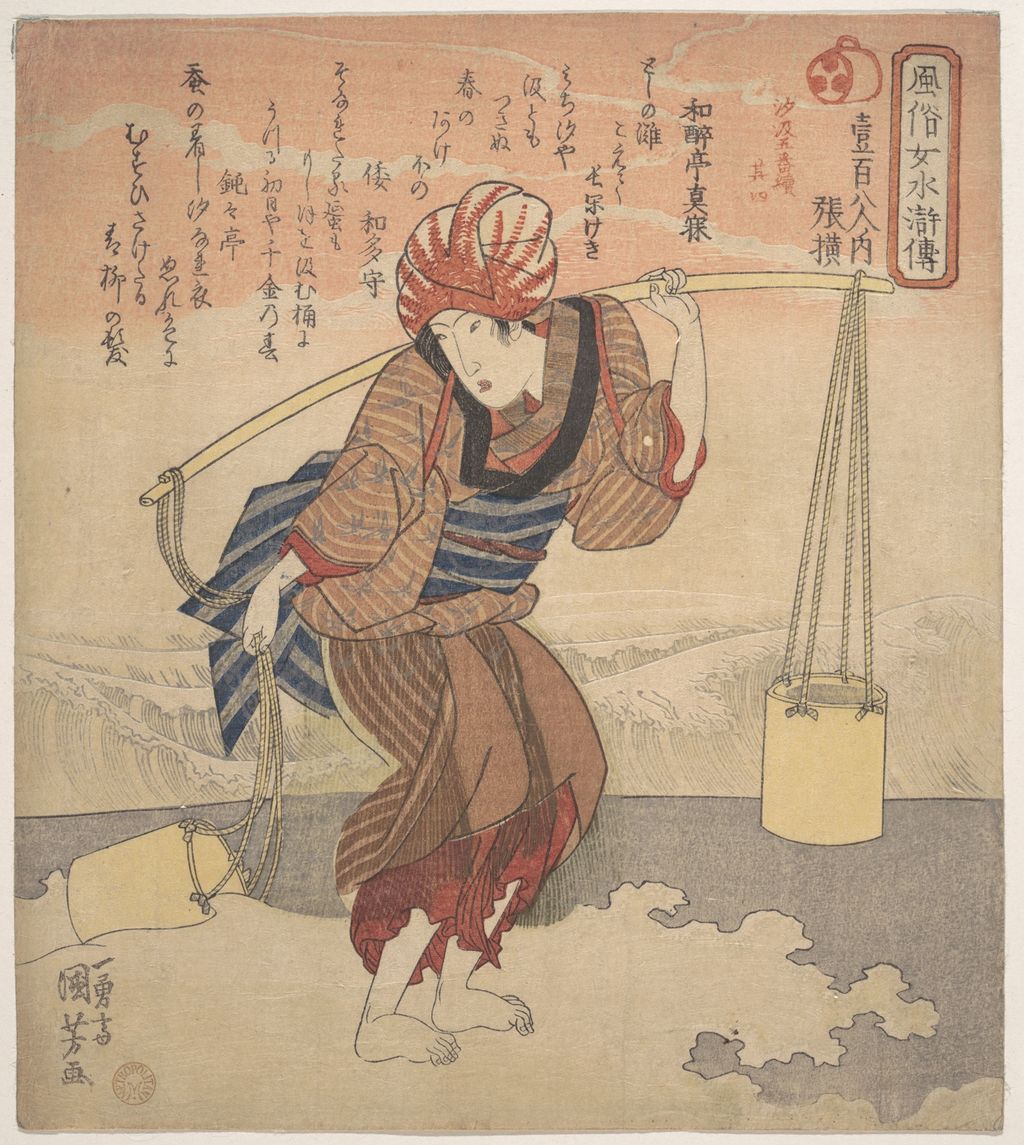
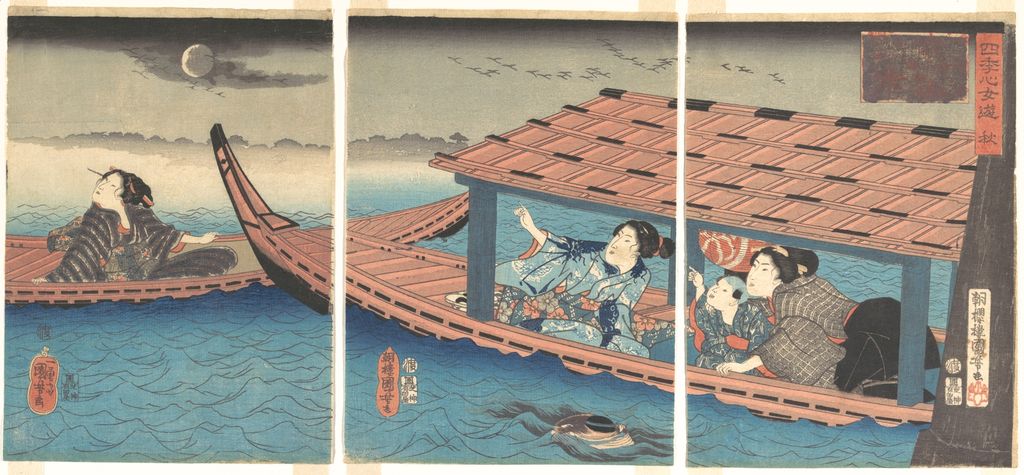
His depiction of women was likewise not one fixed style. The Met's Girl Filling a Bucket with Sea Water, JP1149 [17], is dated around 1830 and survives as a surimono. Gesture and a small object carry the scene. The Met's Autumn from Women's Pleasures of the Four Seasons, JP3136 [18], is a mid-1840s triptych with women and a child looking at the moon from boats, printed with silver as well as colour. The change between them is not a simple march toward ever larger works. It shows how a commercial or social occasion, print format and subject could bring out different solutions over many years. The Ōta Museum's 2024 fan-print exhibition [19] points to yet another medium in which actor and female figures were common. The range should be part of the biography because it formed his working life, not relegated to a list of “other subjects.”
The Tenpō reforms, theatre and the problem of intention
Government regulation of prints changed the conditions in which Kuniyoshi and his publishers worked in the early 1840s. The MFA Boston's comparison of Kuniyoshi and Kunisada [20] describes particularly severe print restrictions during the Tenpō reforms. Direct colour actor imagery could be curtailed, while stories from history, folklore and literature remained sources for designs. Those rules did not mean that every fantasy image was a secret political attack or that artists simply stopped making popular work. They shaped a market in which titles, disguises and interpretive ambiguity mattered.
One well documented point of contention is the 1843 print The Earth Spider Generates Monsters at the Mansion of Lord Minamoto Yorimitsu, MFA Boston object 495519 [21]. The MFA confirms the year and object; its exhibition discussion [20] says rumours spread that the monsters hinted at contemporary politics. A rumour at the time is itself historical evidence of how viewers could read the print. It is not direct proof of what Kuniyoshi intended, which official each figure represents or that the whole design was conceived as a coded manifesto. A biography may say that the image became politically legible to some viewers, while keeping its supernatural narrative and publication context in view. The Ōta Museum's 2024 checklist [22] dates its exhibited Earth Spider sheet to about 1842–43, a useful reminder that individual catalogues may express a range rather than one exact issue day.
The British Museum's Princess Takiyasha triptych [23] presents a related but distinct issue. Its account notes stage treatments of the story in 1836 and 1844 and suggests that a historical-looking print may have addressed interest in a 1844 performance under rules affecting actor prints. The wording is conditional. It does not establish a contract between Kuniyoshi and a troupe, nor does it establish that the image reproduced a stage set. The design's title, story characters and visible composition provide solid grounds for analysing the work; the proposed performance link adds context only when described as an interpretation. The same caution applies to the catalogue's suggestion of a Western medical model for the skeleton: a possible source is not the same as an identified source sheet.
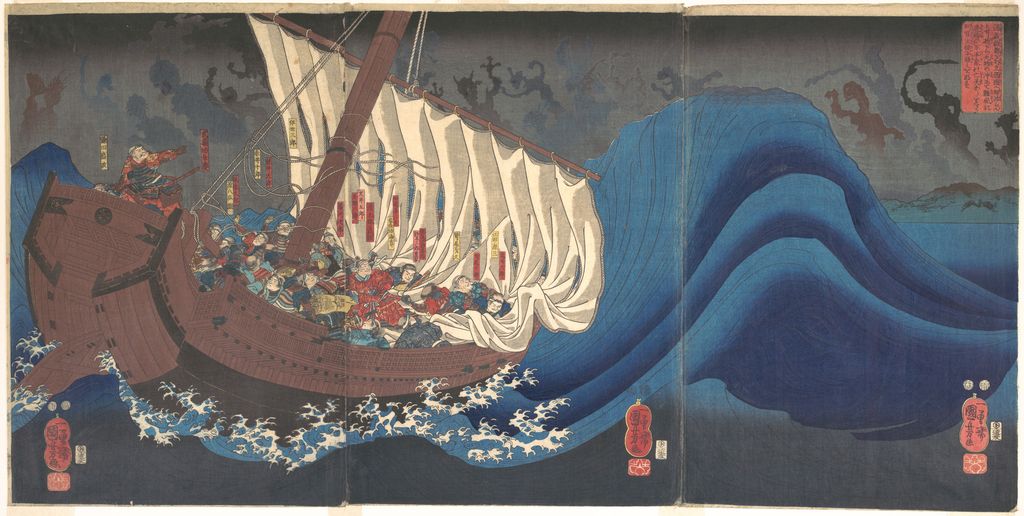
The biography should also account for persistence rather than divide the 1840s into “before censorship” and “after freedom.” Kuniyoshi continued to make works across genres while regulations shifted. The Met's Ghosts of the Taira at Daimotsu Bay, JP1565 [24], is dated 1843–47; its Autumn triptych [18] about 1844–46; the Ōta 2024 exhibition [19] demonstrates that fan prints remained a substantial part of his production. The variety prevents a single prosecution or rumour from becoming an all-purpose explanation for every picture. When a sheet has a named publisher or censorship seal, those details should be read on that sheet. General reform history cannot supply them by inference.
A household and workshop visible in part
The Ōta Memorial Museum's 2019 exhibition, Kuniyoshi: His Work and His Daughters [3], gives an unusually clear correction to the lone-master biography. It names two daughters, Yoshitori and Yoshijo, and treats their own artistic activity alongside their father's prints. They were not merely family members mentioned to humanise a male artist; their work and signatures form part of the history of the Utagawa school. The exhibition's chronological checklist lets a reader compare works across years rather than assume all family images were made at home or for private use. A girl in one New Year scene has been proposed as Yoshitori because of an apparent “tori” in her garment pattern. The museum identifies that as a scholarly suggestion drawn from Iwakiri Yuriko's study. It must not become a certain portrait of his child in a caption.
The pupil network was wider. The Shimane Art Museum's artist summary [6] names Ochiai Yoshiiku and Tsukioka Yoshitoshi among those who carried work forward; the Yokohama Museum of Art's exhibition [26] follows transformations in the lineage beyond Kuniyoshi's death. “Influence” can be vague, so the British Museum's block-ready drawing [25] offers a more precise example. Scholar Iwakiri considers it a Kuniyoshi drawing from around 1849; the museum says that a composition using its main elements, reversed, appeared in Yoshitoshi's 1868 triptych. The years prevent us from calling Yoshitoshi's finished print a Kuniyoshi print, while giving real evidence of a design's passage through or beyond the workshop.
The same studio relationships resist sentimental shorthand. A pupil could learn, adapt, inherit material, work with different publishers and eventually make images for a new audience. A daughter could be an artist without every picture of a child by Kuniyoshi being an autobiographical scene. We know less from surviving objects about the family's domestic routines, health or private feelings. A truthful biography can state that limitation openly. It is more useful than filling the silence with colourful stories that cannot be checked.
Later projects and the final years
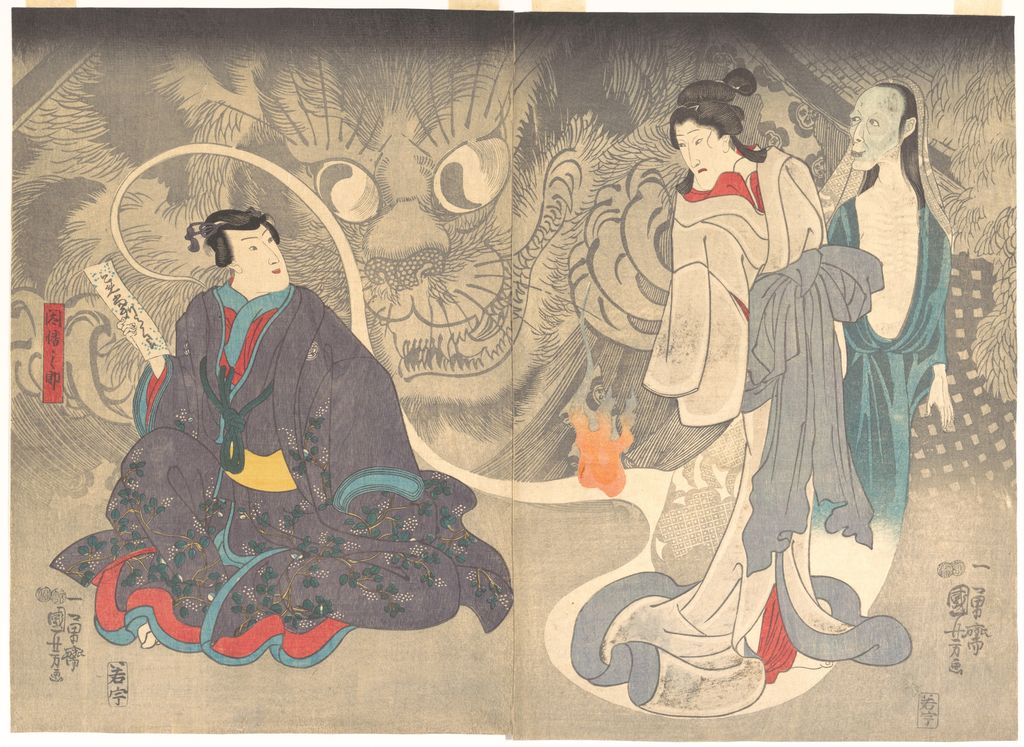
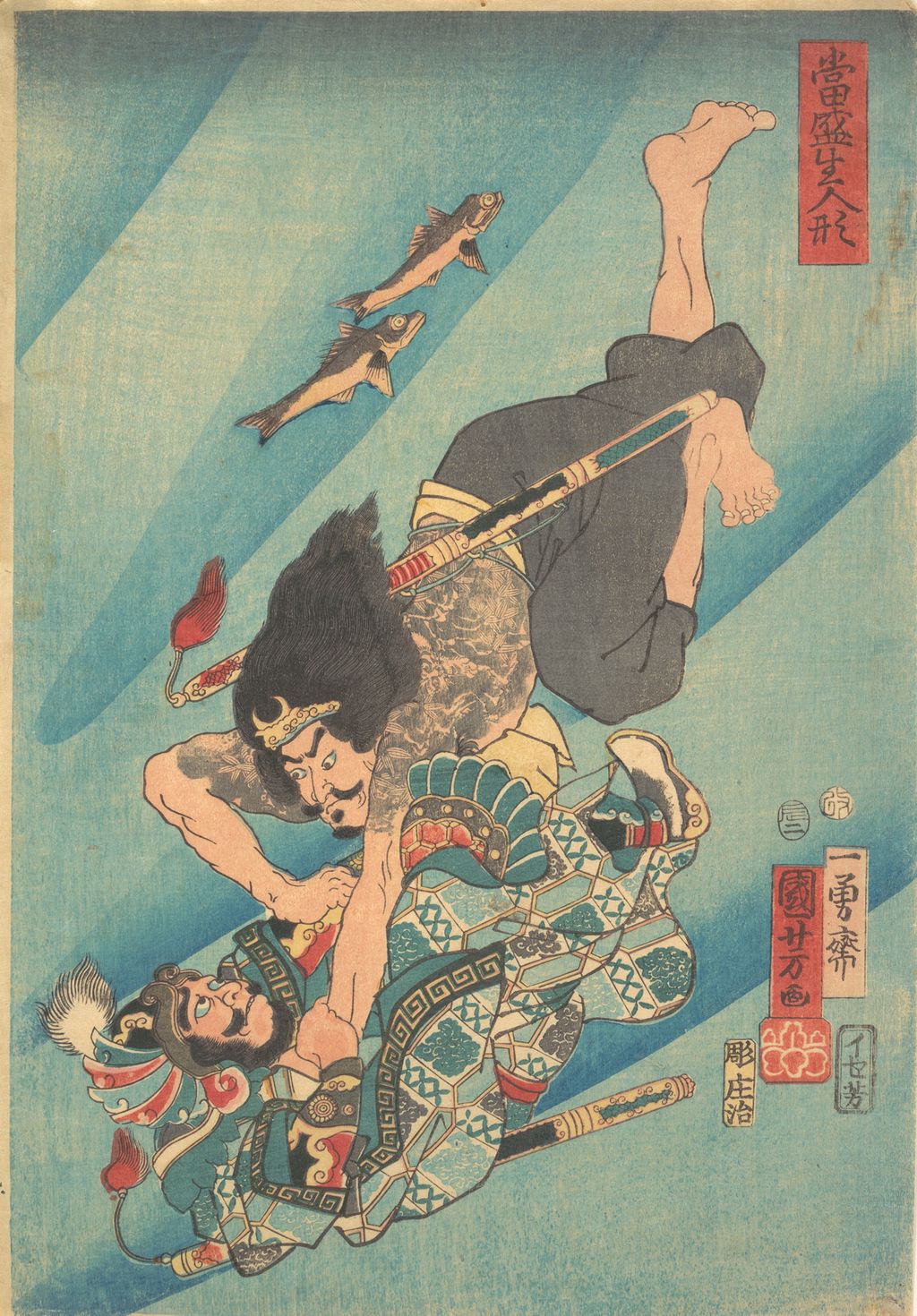
The 1850s are sometimes made to look like an epilogue after the famous 1840s triptychs. Dated objects tell a more active story. The Met's Scene from a Ghost Story: The Okazaki Cat Demon, JP1563 [27], is placed around 1850, using a two-sheet format and a creature far from the charming domestic cats of some fan prints. Its two-volume Tale of Eight Dogs, 2013.763a,b [28], is dated 1853 and continues his work with narrative books. The Met's Tanmeijirō Genshōgo Fighting Under Water, 2001.715.9 [29], is precisely dated to the second month of 1856. It revisits a Suikoden name that had mattered to the early breakthrough, but it is not an 1820s survivor. Such records let us talk about continuity and change without imagining that the artist's later practice was merely repetition.
The 1853 book also helps place Kuniyoshi in a changing publishing culture. The Hakkenden story circulated in many visual and textual forms. The Met's record describes its particular object as a set of two woodblock printed books, each 18 × 12 cm; its digital presentation is meant to be read from right to left. A single leaf may be spectacular, but the viewer should remember the sequence and the hand-held scale. The artistic decision about how one image leads to the next was as important in such a book as the shock of a triptych seen all at once. The home page surveys these formats; the biography uses the date to show that illustrated books remained part of the later career.
Kuniyoshi died in 1861. Institutional records agree on the year, but this article does not assign a precise day, medical cause or deathbed scene from an unsourced retelling. A 1861 likeness of Kuniyoshi by Ochiai Yoshiiku appears in the Ōta Museum's father-and-daughters checklist [4], a valuable prompt to ask how his contemporaries represented him. A memorial or portrait made by another artist is evidence about remembrance and relationships, not direct evidence of Kuniyoshi's own appearance at every stage of life. Similarly, a print by Yoshitoshi after 1861 can show the workshop's afterlife, not a late Kuniyoshi production.
This is also why a neat “last masterpiece” claim needs care. A print dated 1856 may be among the latest works illustrated on this page, while other designs and impressions can be dated later in museum collections. Publication dates may be ranges; an image may have been designed, approved, printed and reprinted at different moments. What is secure is the broader arc: the same artist who transformed heroic figures in the late 1820s remained involved in books, supernatural narratives, women, scenery and theatrical or comic images in subsequent decades. His death brought one career to an end, not an end to the forms or workshop methods with which he worked.
Why dated impressions cannot become a day-by-day diary
The timeline on this page is built from different kinds of dates. A museum may assign a sheet to “late 1820s” from seals, publisher activity, style or scholarship; another may record a month from a censor or publication mark. A book's imprint can date a volume, while a painter's sketch can be dated by comparison with a later print. These are not interchangeable claims. The Cleveland Rori Hakuchō Chōjun [13] establishes an early series object within a broad range. The Met underwater Tanmeijirō [29] has a 1856 month in its catalogue. The British Museum's block-ready drawing [25] carries a circa-1849 scholarly proposal, yet no issued Kuniyoshi print of that drawing is known. Putting all three on a visual timeline with the same kind of dot would make a broad attribution look as certain as a dated publication.
The site should instead explain the date type beside the image. A surviving impression documents that this version exists; it need not be the first printing of a design. A composition used again by another maker documents a later relationship, not a second phase of Kuniyoshi's own career. This matters for prints often detached from their original sets. A collector can preserve the left and centre sheets of a triptych while the right sheet is lost; a digital reconstruction may place panels from different impressions together. Before turning such an image into evidence for a biography, its exact object record and assembly history should be checked. The owner-supplied skeleton composite is excellent for explaining the design, but until its physical source is identified it cannot settle the year of printing or whether its three panels belong to one original set.
Such caution does not make a life unreadable. It gives the reader a more accurate picture of artistic work: ideas could circulate through publishers and stories; drawings could precede an issued print; printers could produce more than one impression; and a pupil could later adapt a design. Kuniyoshi's biography is partly the history of those transitions. Its chronology is strongest when it names what is dated, by whom, and with what margin of uncertainty, rather than making every museum label stand for a day in the artist's private life.
How his reputation was made and remade
Modern readers often arrive through the skeleton, a cat picture or one tattooed hero. Kuniyoshi's contemporaries met a more varied and changing output, in an environment where publishers and performers mediated circulation. The Ōta Museum's 2011 exhibition [30] and 2021 retrospective [2] both deliberately include multiple genres. The MFA Boston's Kuniyoshi X Kunisada publication [31] sets the two major Utagawa designers side by side across actors, women, warriors and fantasy. These exhibitions help correct the way online image sharing can make an oeuvre appear to consist of only a handful of repeated pictures.
There is a more specific historical legacy in the school. Yoshitoshi and Yoshiiku had careers of their own; Kuniyoshi's daughters had artistic roles; later audiences collected, studied and republished his prints. The Yokohama Museum of Art [26] traces the development of related picture-making after him rather than claiming a straight line from one 1840s sheet to all modern comics. The British Museum's Arthur R. Miller Collection bibliography [32] gives a collection-based route into the prints, while the publisher record for Matthi Forrer's Kuniyoshi [33] shows a modern whole-career monograph. These publications belong in a reader's book module as further study. Their catalogue descriptions are not evidence that every page of the books has been consulted for this manuscript.
Today's claim that Kuniyoshi “predicted manga and anime” is best treated as a modern comparison, not a fact about what nineteenth-century audiences expected. His dynamic cropping, visual jokes and strange transformations may feel familiar to contemporary viewers. That response is legitimate, but it cannot replace the Japanese titles, dates, print formats and stories that made the works intelligible to their first buyers. The strongest path from his life to his legacy runs through documented pupils, surviving designs, publication circumstances and later collecting, then asks how modern viewers interpret them.
What a biography can and cannot show
Kuniyoshi's career is well supported at some points and thinly documented at others. The known includes his place in Toyokuni's school, the dated late-1820s Suikoden works, 1830 book credits, many later objects, two artist daughters, named pupils and death in 1861. Likely or broadly supported are the retrospective accounts of a late-teen debut, a difficult early career and about-1810/11 workshop entry, though their precision varies by source. Disputed or interpretive are the exact birth year across catalogues, the identity of a child in one print, the intention behind political readings of the Earth Spider, and any unproven exact Western illustration behind the Takiyasha skeleton. These are not equally uncertain: the labels explain what kind of support each claim has.
The method changes how we look at the artworks. A triptych set at Sōma's ruined palace is excellent evidence of a composition and its printed story; it does not prove Kuniyoshi visited an actual ruin. An early-1830s view of Ōmori establishes that he designed a landscape with that title; it does not fix his viewpoint in a later photograph. A print's cat may be actor, joke or demon; it does not establish how many pets were in his household. Dated images make a life visible through work, while also marking the places where a private life remains out of reach. The home page's object guide follows those works by subject; this biography keeps the chronological and evidential frame.
Frequently asked questions
The British Museum [1], Ōta Memorial Museum [2] and the NDL authority use 1797, while some catalogues use 1798. Use 1797–1861 as the main site form, with the discrepancy noted where age calculations matter. An exact birthday is not established here.
Utagawa Toyokuni I is the well-supported teacher. British [1] and Japanese museum records [6] agree on that relationship. Specific entry ages and dates in later summaries differ, so the biography says “around 1810/11” only as a reported approximation.
No. The Ōta Museum [2] describes an unsuccessful early period before the Suikoden hero prints brought attention in his early thirties. This does not mean he made no earlier work. It means the evidence and the museum's career synthesis support a major change in standing in the late 1820s.
The MFA Boston [20] records contemporary rumours of a political reading of the 1843 print. A rumour shows that such a reading circulated. It does not establish Kuniyoshi's private intention or a one-to-one identity for every monster.
Yes. The Ōta Memorial Museum [3] names Yoshitori and Yoshijo and includes their work in a chronological exhibition. That evidence should not be expanded into certain identifications of every child in his own prints.
No. Pupils developed separate careers. The British Museum's unpublished drawing [25] supplies a concrete example of how a composition could be reused by Yoshitoshi in 1868, after Kuniyoshi died. The later print is attributed to Yoshitoshi.
References
- British Museum, Utagawa Kuniyoshi artist authority.
- Ōta Memorial Museum of Art, Kuniyoshi 2021 retrospective.
- Ōta Memorial Museum of Art, Kuniyoshi: His Work and His Daughters.
- Ōta Memorial Museum of Art, father-and-daughters dated object checklist.
- National Diet Library, Kuniyoshi name authority.
- Shimane Art Museum, Kuniyoshi artist record.
- Bunkamura, MFA Boston Kuniyoshi/Kunisada exhibition.
- Nakagawa-machi Bato Hiroshige Museum, Kuniyoshi artist record.
- British Museum, Toyokuni I artist record.
- Ōta Memorial Museum of Art, Kunisada, Kuniyoshi and Hiroshige exhibition.
- Kitakyushu Municipal Museum of Art, Kuniyoshi artist record.
- Museum of Fine Arts Boston, Tattoos in Japanese Prints.
- Cleveland Museum of Art, Rori Hakuchō Chōjun, 1980.85.
- National Diet Library, Ryūtei Tanehiko, his letters and Kanagaki Suikoden.
- Cleveland Museum of Art, Ōmori, 1985.335.
- Metropolitan Museum of Art, Water Scene, JP1252.
- Metropolitan Museum of Art, Girl Filling a Bucket with Sea Water, JP1149.
- Metropolitan Museum of Art, Autumn, JP3136.
- Ōta Memorial Museum of Art, Kuniyoshi fan-print exhibition.
- Museum of Fine Arts Boston, Kuniyoshi and Kunisada under Tenpō reforms.
- Museum of Fine Arts Boston, Earth Spider object 495519.
- Ōta Memorial Museum of Art, ghost print checklist.
- British Museum, Princess Takiyasha triptych.
- Metropolitan Museum of Art, Ghosts of the Taira, JP1565.
- British Museum, Kuniyoshi block-ready drawing, 2015,3012.1.
- Yokohama Museum of Art, Kuniyoshi's artistic lineage.
- Metropolitan Museum of Art, Okazaki Cat Demon, JP1563.
- Metropolitan Museum of Art, two-volume Tale of Eight Dogs, 2013.763a,b.
- Metropolitan Museum of Art, Tanmeijirō Genshōgo Fighting Under Water, 2001.715.9.
- Ōta Memorial Museum of Art, 2011 Kuniyoshi exhibition.
- Museum of Fine Arts Boston, Sarah E. Thompson, Kuniyoshi X Kunisada.
- British Museum, Arthur R. Miller Collection bibliography.
- Prestel, Matthi Forrer, Kuniyoshi.
- Ōta's cat exhibition
