


 by Tom Gurney
Tom Gurney BSc (Hons) is an art history expert with over 20 years experience. Updated September 24, 2026.
Introduction
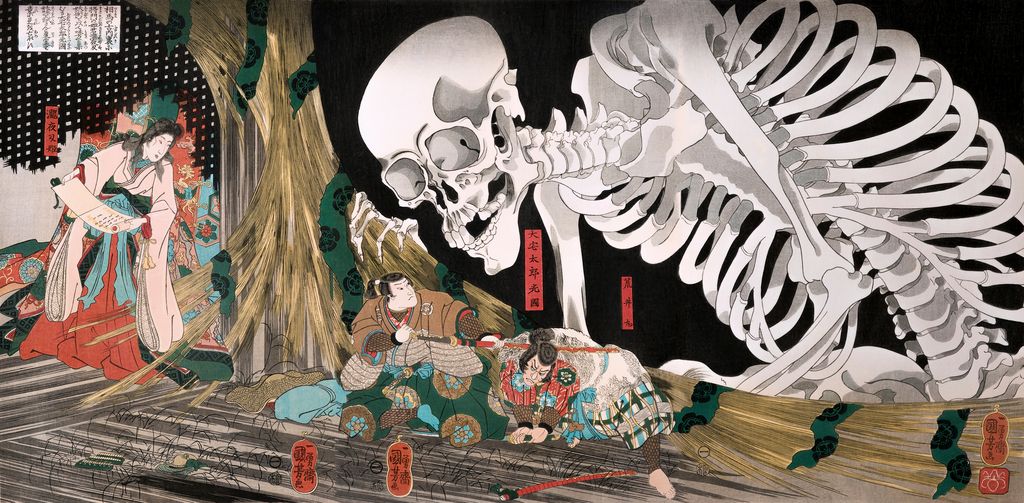
A giant skeleton breaks through the torn blinds of a ruined palace while a princess reads an incantation and a warrior braces to meet it. Kuniyoshi's design known as Princess Takiyasha and the Skeleton Spectre makes the viewer's eye travel across three sheets as if one stage had suddenly become too small for the story. It deserves its fame. Yet the same artist also imagined the hero of a Chinese novel with a tattooed body caught amid ropes and water, composed a calm view from a boat at Ōmori, drew women looking at the autumn moon, and turned cats and actors into comic inventions. To understand Utagawa Kuniyoshi (歌川国芳, 1797–1861), the spectacular ghost is a beginning, not a complete definition. The British Museum's artist record [1] and the Ōta Memorial Museum's career survey [2] both insist on his unusually broad repertoire.
This guide follows that range through objects with identifiable collections and dates. The point is not to crown a single “best” Kuniyoshi print, or to imply that he personally carved and printed every sheet. It is to see how a designer working in Edo's print world could shift between martial action, historical and supernatural narrative, playful parody, fashionable women, scenery, theatre and books. His skill lies partly in arranging the viewer's attention: a shape across three sheets, a compressed figure on one, an empty band of sky in a landscape, or a figure whose costume carries a second story. Some images demand recognition of a specific play or tale; others reward attention to how the print is made. The Met's account of ukiyo-e woodblock production [20] explains why design, blocks, colour printing and publication have to be considered together.
Contents
- Introduction
- A route through Kuniyoshi's work
- Warriors: the early Suikoden breakthrough
- Takiyasha: three sheets, one encounter
- Ghosts beyond the skeleton
- Cats: affection, theatre, parody and menace
- Women, surimono and another scale of invention
- Scenery, space and the print of a place
- Books, publishers and the moving image
- A network, not a lone eccentric
- What to explore next
The works illustrated here come from different physical sources. The large skeleton composite was supplied by this site's owner as a public-domain image. Its design corresponds to the famous Takiyasha composition, but its exact impression, publisher line and date have not yet been established. The museum objects have their own accession numbers and rights records. A British Museum example of the skeleton composition [3] helps explain the story and print, but its accession and condition must not be silently transferred to the supplied picture. Such distinctions matter throughout Kuniyoshi's career, because multiple impressions of a design can look alike on a screen while differing in printed detail or later history.
At a glance
- Who was he?An Edo-period designer of prints, books and other images, documented as a pupil of Utagawa Toyokuni I. The British Museum authority record [1] gives 1797–1861 and names his special strength in warrior and comic subjects.
- What changed his career?A group of late-1820s Suikoden hero prints won attention after a less successful early phase, according to the Ōta Memorial Museum [2]. A Cleveland print from the series [4] supplies an actual surviving object to inspect.
- Why so many genres?Edo publishers and audiences wanted warriors, theatre, beauties, scenery, stories and parody. Kuniyoshi worked across those forms rather than making one signature design repeatedly.
- Where should I begin?Put Cleveland's early Suikoden hero beside the Met's 1856 underwater Tanmeijirō [6], then compare the skeleton triptych with Cleveland's quiet Ōmori view [18].
- What is a triptych?Three printed sheets designed to read together. A complete digital composite and its three panel files still represent one design, not four separate works.
A route through Kuniyoshi's work
The reader can move through this artist by medium and narrative purpose. Warrior prints bring named heroes, patterned armour and physical danger into a single sheet or a connected composition. Ghosts and historical dramas depend on a story that may have been retold in fiction or theatre; their implied movement can span an entire triptych. Cats and comic pictures can distort that grand language into a visual joke, while remaining just as carefully designed. Women and privately circulated surimono show another scale and set of production circumstances. Landscapes give more weight to space, weather or a particular place. Books organise images in a sequence, with author, illustrator and publisher occupying distinct roles. The Ōta Museum's 2021 exhibition [2] grouped caricature and social life separately from warriors and landscape, a useful corrective to an all-skeleton introduction.
These are routes through a body of work, not sealed compartments. A woman in a boat may parody a male hero; an actor may be represented through an animal; a scenic view can belong to a print series that turns place into a publisher's recurring theme. The Met's Water Scene, JP1252 [16], is especially instructive. It appears to show a woman resting on a boat, but the museum identifies a literary allusion to Katsusenba Oteiroku, one of the Suikoden strongmen. Its landscape uses pictorial methods the museum connects with Western models. A label such as “beauty” would miss the parody and the experiment with space. The work is therefore a bridge between the warrior, surimono and scenic sections of this guide.
Looking at a print as an object
The most responsible caption answers several questions: Who designed it? What is pictured? What does the source record call it in Japanese? What date does the record assign to this impression? What are the format, dimensions, accession number and image rights? Titles in English are often helpful translations or cataloguing descriptions; they are not always the exact words a nineteenth-century reader saw. A triptych may survive with all three sheets joined, or as separately collected panels. A sheet from a printed book can lose its page context when reproduced alone. A later impression can carry colour differences that alter the force of a scene. The Met's Open Access records [26] and Cleveland Museum's CC0 policy [21] permit useful reproductions, but permission to use an image does not make its object metadata interchangeable with another copy.
The woodblock process also involved more hands than an artist signature names. Kuniyoshi furnished the design; a publisher commissioned or marketed the project; block cutters translated the drawing into blocks; printers registered the blocks and applied colour; writers or poets could supply text. Those roles vary by object. The National Diet Library's discussion of the 1830 Kanagaki Suikoden book [7] is valuable because it names Ryūtei Tanehiko as writer, Kuniyoshi as illustrator and Nishimuraya Yohachi as publisher. It gives us a concrete publishing relationship without pretending that every Kuniyoshi sheet had the same collaborators.
Warriors: the early Suikoden breakthrough
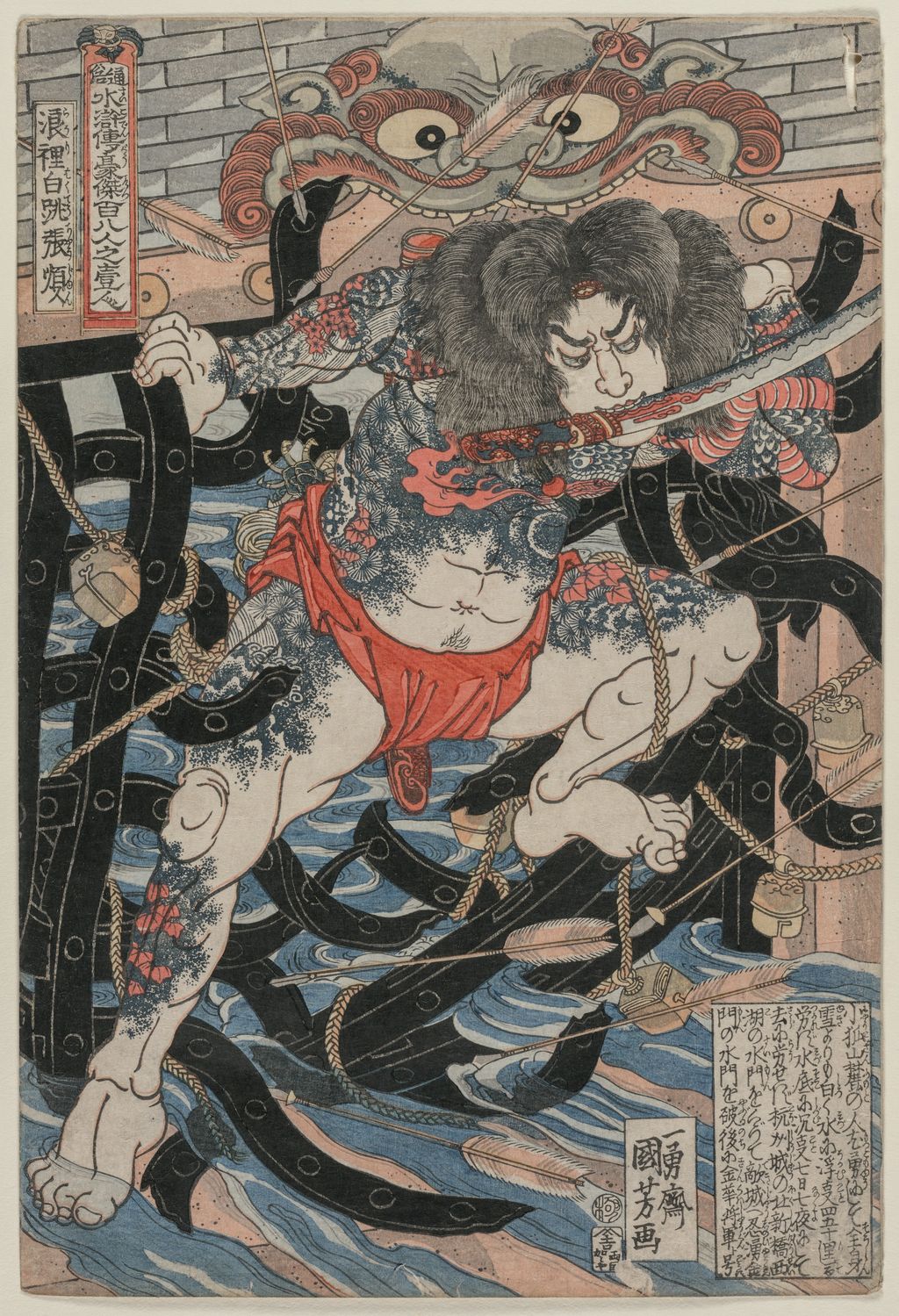
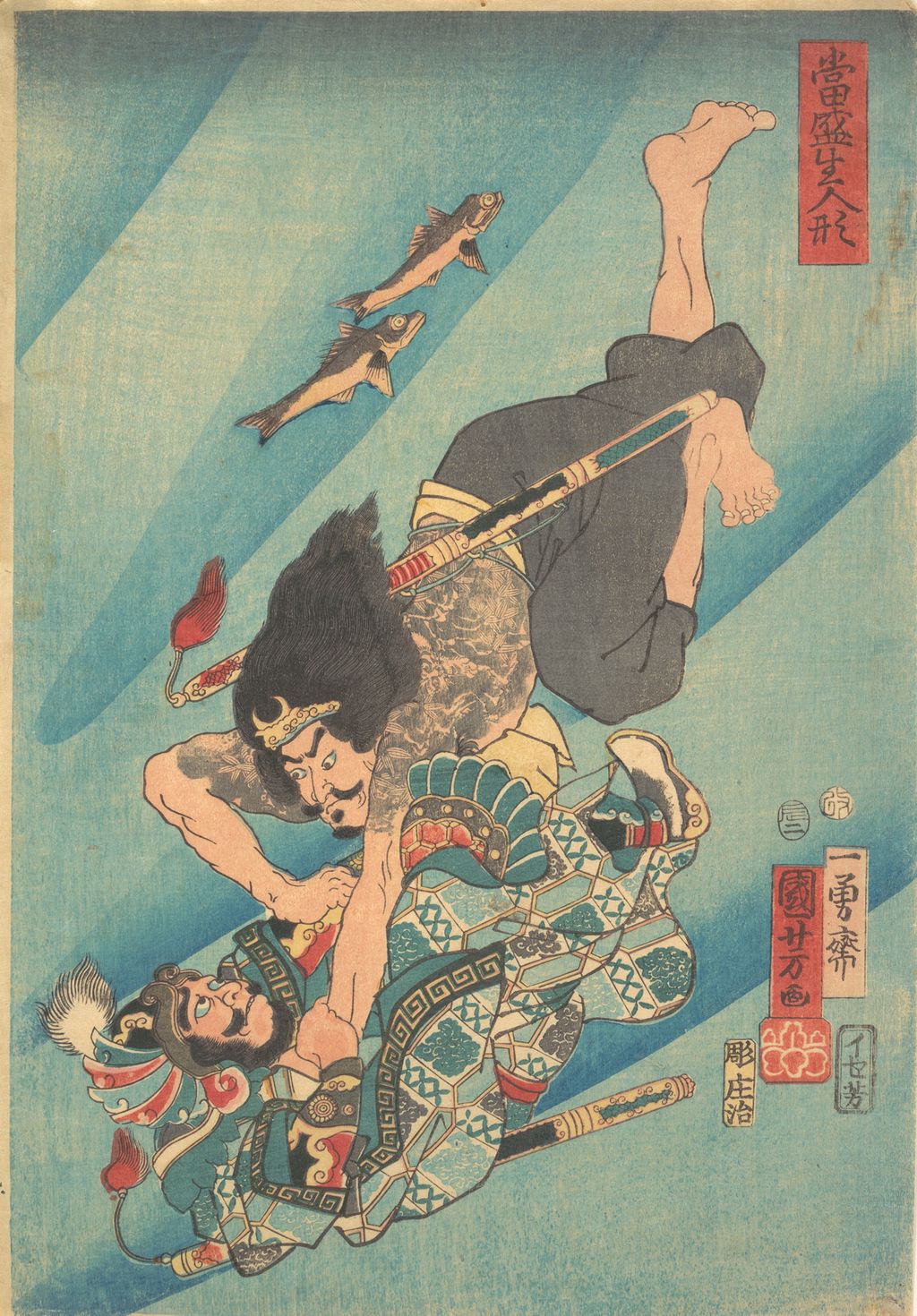
The Water Margin, a Chinese narrative known in Japan as Suikoden, offered Kuniyoshi a company of memorable heroes. Its story world made bodies, weapons, encounters and personal emblems visually legible. The Ōta Museum [2] describes the Tsūzoku Suikoden gōketsu hyakuhachinin no hitori series as the work that brought a breakthrough when Kuniyoshi was in his early thirties. The Museum of Fine Arts Boston [5] catalogues an early Tanmeijirō Genshōgo from the series at about 1827–30 and highlights the relation of the heroes' fantastic body ornament to the history of tattoos in Japanese prints. The phrase “one of the 108 heroes” names a story framework and series; it is not proof that exactly 108 distinct designs were issued.
The Cleveland Museum of Art's Rori Hakuchō Chōjun, accession 1980.85 [4], dates to the late 1820s. A single figure crowds the vertical sheet, with a tattooed chest, a blade near his face and dark shapes that pull the eye across the lower field. The character's printed name occupies a column at the left. The design works because the figure cannot be separated from the dense surrounding pattern: the body seems to press against the image's available space. The Cleveland record identifies the object as a colour woodblock print, sheet 38 × 25.7 cm, and marks the digital image CC0. We can examine this specific image closely without pretending its ink, colour and sheet margins prove what every copy in the series looked like.
Set it beside the Met's Tanmeijirō Genshōgo Fighting Under Water, accession 2001.715.9 [6]. The Met dates its print 1856, second month. Its submerged hero belongs to a much later phase, even though the name and watery danger recall the earlier Suikoden triumph. On a website, a dramatic tattooed warrior and another waterborne hero can be made to look like a single contemporary “warrior style.” Their object dates resist that flattening. The return to a subject decades later tells us more about Kuniyoshi's continuing ability to remake heroic action than a catalogue of interchangeable fighters would. The dedicated series page should compare documented early impressions and explain character names, not borrow the 1856 date for an 1820s print.
Kuniyoshi's heroes reached beyond the single print. The National Diet Library's 1830 illustrated Kanagaki Suikoden record [7] shows his drawing in a literary publishing project. At the other end of the image scale, the British Museum's rare block-ready drawing [8] demonstrates that triptych-size heroic designs could be developed for cutting yet never published. This drawing, proposed by scholar Iwakiri Yuriko as Kuniyoshi's own work from around 1849, is not a coloured print. The museum reports that the main elements reappeared in reverse in an 1868 print by his pupil Yoshitoshi. The distinction between design, cut block, issued print and later reuse is part of the artist's working history, not a technical footnote.
Takiyasha: three sheets, one encounter
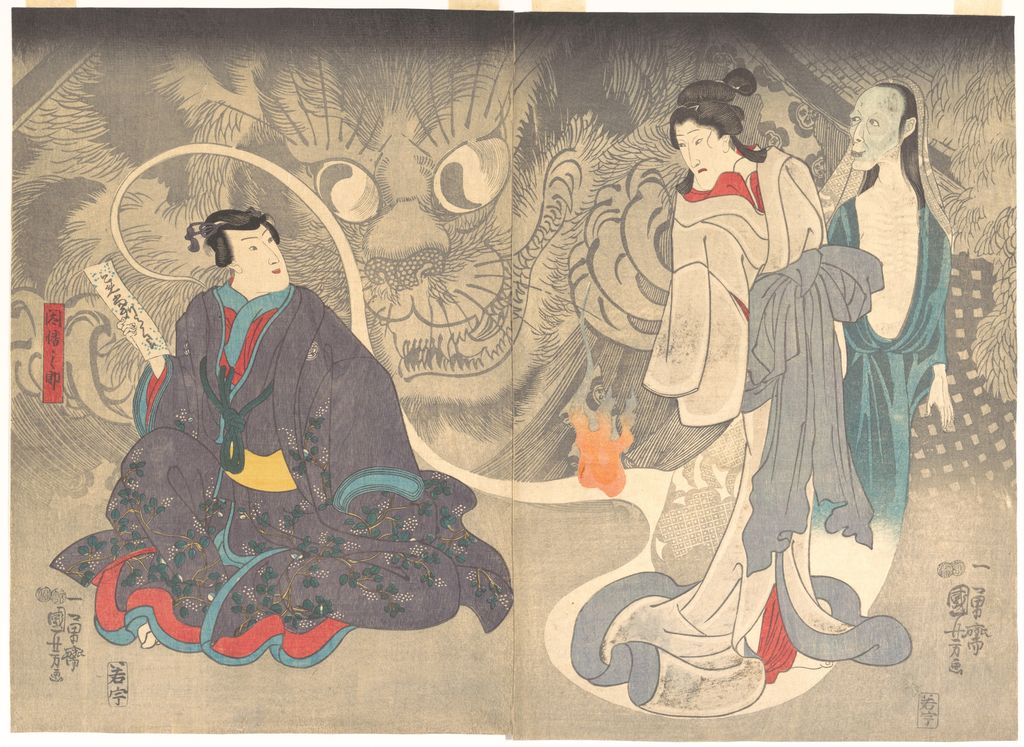
The Takiyasha composition is a lesson in how format can tell a story. In the British Museum's example [3], Princess Takiyasha occupies the left of Masakado's ruined palace and summons the skeleton by reading an incantation; the warrior Mitsukuni faces the apparition near the centre. The skeleton's reach and the torn blinds make the former palace seem both architectural and impossibly fragile. The ghost is much larger than any human figure, but the scene does not abandon narrative clarity. A viewer can find the summoner, the threatened investigator and the supernatural force in one sweep across the joined sheets. The design depends on their different scales and on the interruption caused by the sheet divisions.
Its plot is not a factual depiction of tenth-century Japan. The setting invokes Taira no Masakado, a historical rebel, but the print stages a later tale of his daughter and a court investigator. The British Museum notes versions of the story in Kabuki performances of 1836 and 1844. It suggests that an historical-looking treatment may have served audiences interested in a 1844 performance when Tenpō restrictions made direct colour actor prints problematic. That is an interpretation of a relationship between theatre, publishing and censorship; it is not a documented commission for a particular show. The Ōta Memorial Museum's Kuniyoshi exhibitions [27] also treat the skeleton as a representative work. Different catalogues date surviving impressions somewhat differently, so this site's owner-supplied image should not be pinned to the British Museum's precise circa-1844 date without its own physical evidence.
The picture's power is sometimes explained through an asserted Western anatomy source. The British Museum catalogue raises the possibility that imported medical illustration informed the skeleton, but it does not identify the exact source sheet or prove the route by which Kuniyoshi saw it. The safer question is visible: how do joints, ribs, fingers and teeth produce a skeletal body that can act within the composition? The specific comparison with a Western model belongs in the dedicated Takiyasha page only if an identifiable model is found. Here the design already proves that a triptych can make a story's physical environment part of the drama. The owner's high-resolution original can support that later close reading and popup annotation; the separate left, centre and right files should then be labelled as views of the same design.
Ghosts beyond the skeleton
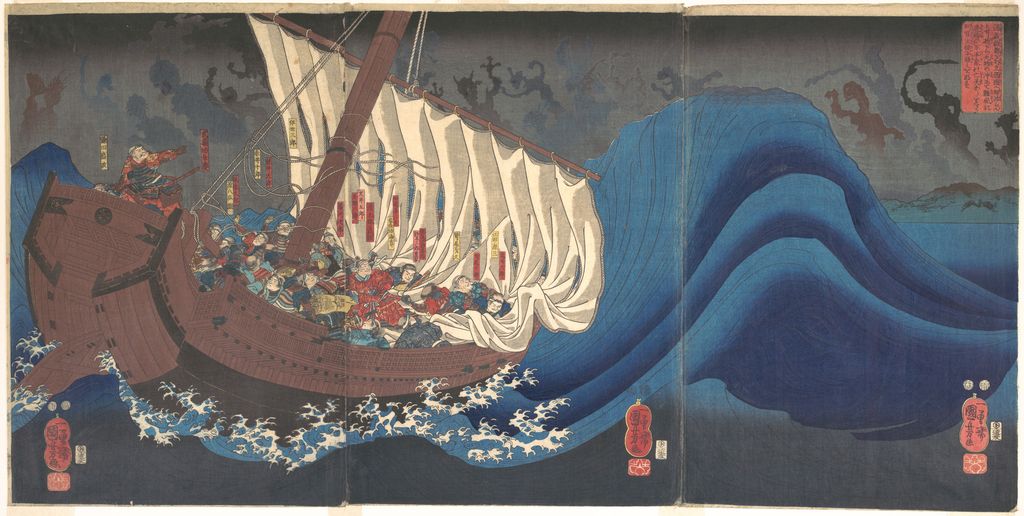
The Metropolitan Museum's Ghosts of the Taira at Daimotsu Bay, JP1565 [9], is another three-sheet supernatural scene, dated in its record to 1843–47. Its subject reaches into the memory of conflict between the Taira and Minamoto, but its pictorial problem is different from the skeleton's abrupt intrusion into a room. Here a ship and threatening apparitions meet on water. The environment is active: waves, distance and the ghostly mass mediate the conflict. The Met holds another triptych of the same title, JP1115.2a–c [10], assigned 1849–52. The two records are useful evidence of how separately held impressions can be given different dates and details; they are not a reason to display two near-identical compositions as if they were separate inventions.
That comparison changes the usual story about Kuniyoshi's “monsters.” The monster or ghost is rarely an isolated creature waiting for a modern horror-film label. It appears in relation to a named tale, an actor or reader's memory, a physical setting and a format that controls revelation. A three-sheet spread can delay recognition: one sheet offers a human action, another sets the environment, and another supplies the supernatural answer. For the viewer today, identification of the narrative is part of the pleasure, but it should follow the original inscription and a museum's object research. A familiar English nickname can be a useful search phrase while hiding who or what the original print actually names.
Cats: affection, theatre, parody and menace
Kuniyoshi's cats cannot all be filed as cute domestic pictures. The Ōta Museum's 2023 cat exhibition [11] highlights an 1841 fan print in which cat faces take on actors' expressions. Its 2012 exhibition on Kuniyoshi's school [12] describes cats behaving like people and even forming characters from multiple bodies. A cat can therefore be an actor, a written sign, a social type or the engine of a visual pun. The humour depends on knowledge of Edo entertainments and language as much as on fondness for animals. Later artists of Kuniyoshi's circle developed their own cat prints; the presence of an anthropomorphic cat alone is not enough to attribute a sheet to the master.
There is also a more threatening feline. The Met's Scene from a Ghost Story: The Okazaki Cat Demon, JP1563 [13], is a diptych of about 1850. The two-sheet format and supernatural subject shift the animal away from a fan print's compact joke. Its title points the reader to a specific ghost-story scene, not to Kuniyoshi's pet. To compare it with the 1841 actor-faced cats is to see the range of functions that one animal could serve: humorous impersonation, punning display and uncanny character. The dedicated cat page can unpack those print by print. It should not treat the user-supplied frog actors as cats or take a similarly playful animal picture as proof of the same publication circumstance.
Ōta's 2024 exhibition on Kuniyoshi's uchiwa-e [14] adds a useful material distinction. These were prints designed for fans, ordinary accessories that could also show performers, women or advertising. The museum notes that actor and beauty subjects were especially numerous in this format, even though Kuniyoshi is now best known for warriors and comedy. Because fans were used and discarded, the survival of examples is uneven. A modern selection of celebrated museum sheets can thus exaggerate one part of the artist's output. Medium and likely use matter as much as a subject tag.
Women, surimono and another scale of invention
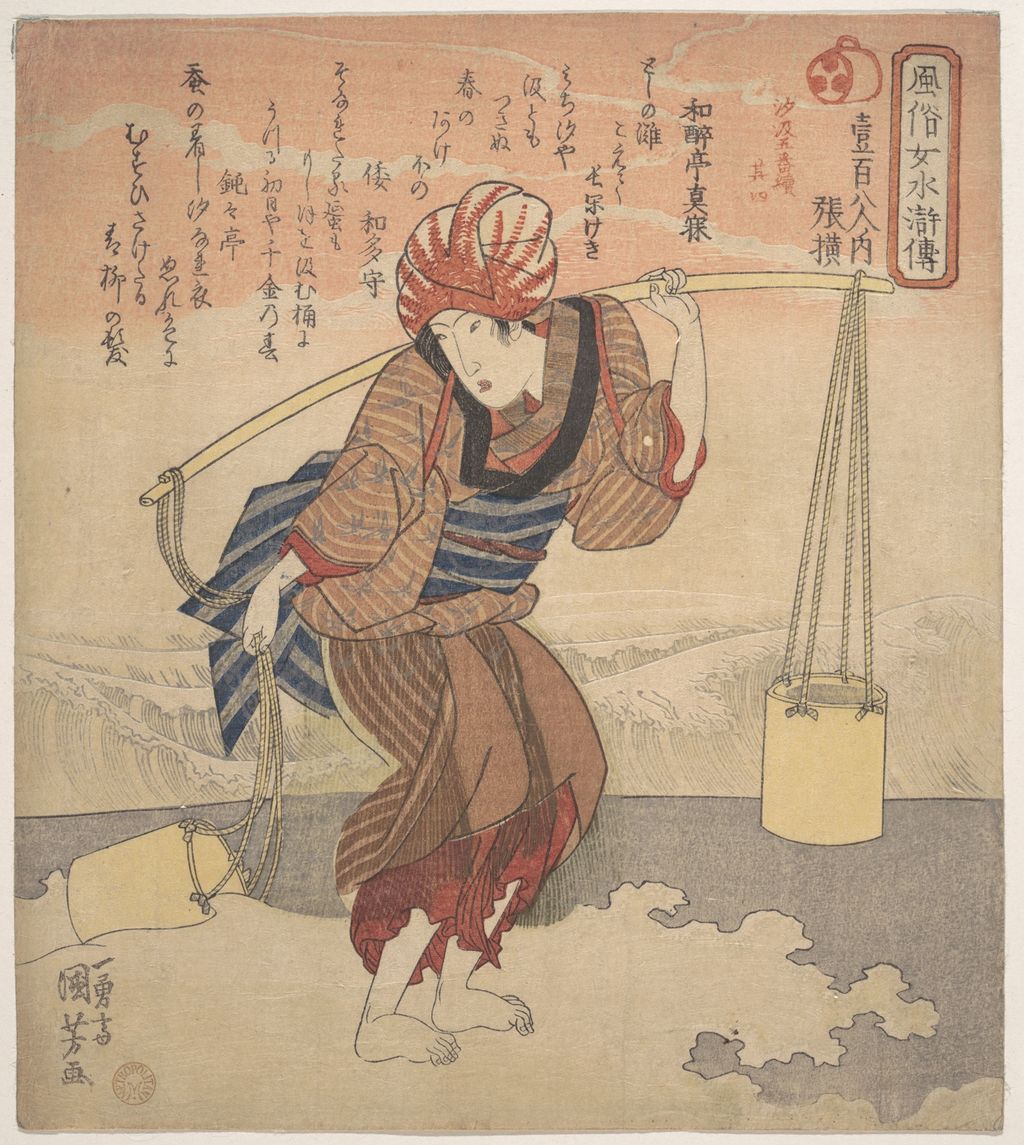
The Met's Girl Filling a Bucket with Sea Water, JP1149 [15], is a small surimono dated around 1830. It works at a scale quite unlike the palace skeleton or a warrior triptych. A figure, vessel and shallow-water action ask the viewer to notice balance and gesture rather than explosive confrontation. Surimono were privately commissioned or circulated prints whose paper, printing and poetry could be especially elaborate. This specific museum record establishes its object, date and format; it does not, by itself, reveal the exact group that commissioned it. The distinction keeps a page about “Kuniyoshi's women” from collapsing every image into a generic beauty print or inventing a sitter's identity.
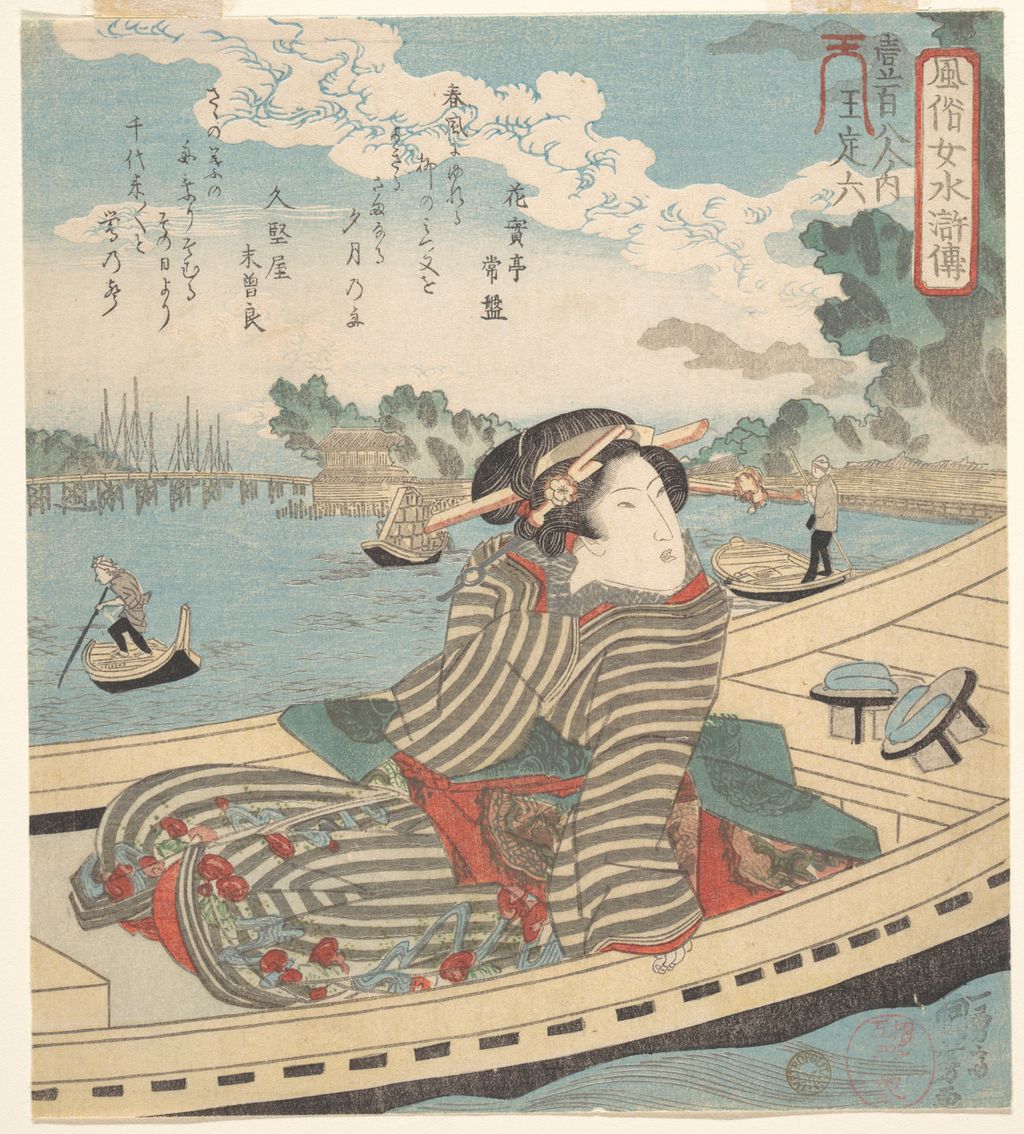
The Met's 1840 Water Scene, JP1252 [16], complicates that category further. A woman in a boat alludes to a Suikoden strongman, Katsusenba Oteiroku, while the setting uses pictorial depth that the museum relates to Western models. This small sheet can be read at once as a female figure, a literary parody and an experiment in landscape. A visitor who sees only the English title might miss all three strands. The illustrator's job was not always to render a scene from life; it could be to combine cultural references in a form that rewarded informed looking.
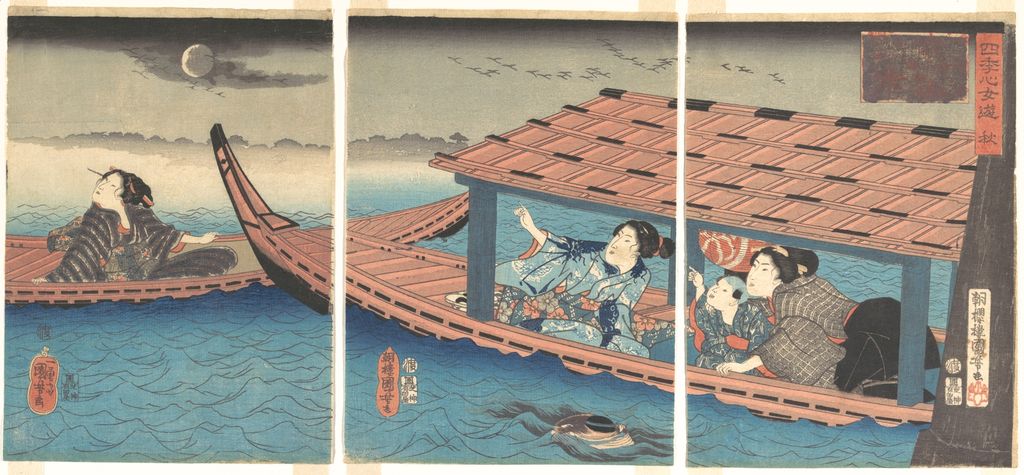
By the mid-1840s, the Met's Autumn from Women's Pleasures of the Four Seasons, JP3136 [17], placed three women and a boy on boats to view the moon. Its record dates the triptych circa 1844–46 and specifies ink, silver and colour. The museum draws attention to a cropped bridge support at the edge, reflected lantern light and a poem in the cartouche. Those are not ornamental leftovers around “three beauties”; they guide how the eye travels through an evening scene. The tarnished silver also reminds us that today's impression has a material history. A photographic reproduction cannot automatically recover its first appearance. Compare this object with the intimate sea-water surimono: both involve women and water, yet their scale, audience and composition differ considerably.
Scenery, space and the print of a place
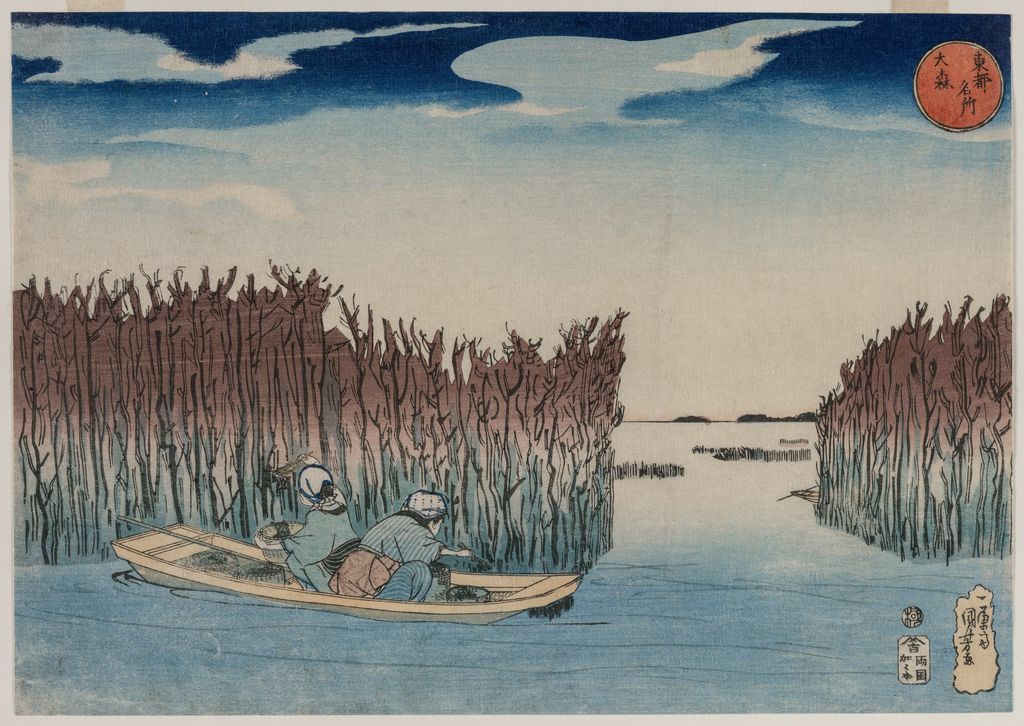
Kuniyoshi was not only a maker of scenes that happen somewhere. He designed landscapes in which the site and the viewer's position are the subject. The Cleveland Museum's Ōmori from Famous Places in the Eastern Capital, 1985.335 [18], is dated to the early 1830s. Two people sit low in a small boat between dense upright barriers; the pale open water and broad sky draw the view toward a distant horizon. Its colour and relatively quiet structure make an instructive counterpart to a compressed warrior print. The museum marks the sheet CC0 and measures it at 23.9 × 34.2 cm. The Japanese cartouche identifies Ōmori, but a modern reader should not imagine that every line is a literal topographical survey. It is a composed image of place within a series.
The British Museum's artist record [1] specifically mentions Western-style landscape in the 1830s and early 1840s. “Western-style” here points to visual methods such as spatial recession; it does not mean that Kuniyoshi stopped working within Japanese print traditions or that every landscape can be traced to an imported original. The Met's Water Scene provides a single object where its curators discuss Western perspective in relation to a fictional Chinese subject. The two images give a reader a way to compare different uses of space without reducing the artist to either imitation or isolation.
Ōmori also raises the question of historic place photographs. Later nineteenth-century photography can help readers imagine a changing shoreline or settlement, provided the specific vantage and date are known. Such a photograph would be a later view and never documentary proof that Kuniyoshi stood at a particular point or saw the same built environment. This page should add one only if an identifiable image with usable rights and honest geographical relationship is located. The present print, not a conjectural photograph, remains the evidence for Kuniyoshi's composition.
Books, publishers and the moving image
One sheet can suggest a moment before or after, but a book can place successive images directly into a reader's hands. Kuniyoshi illustrated printed narrative as well as issuing single-sheet designs. The National Diet Library's record of Kanagaki Suikoden [7] shows a work with a named writer, illustrator and publisher in 1830. The Met's two-volume Tale of Eight Dogs object [19] gives another route into Kuniyoshi's book illustration. A book opening should not be captioned as a free-standing print without noting the original sequence, binding and text. The collaboration is also more visible when the reader sees a title page or spread rather than an isolated attractive plate.
Publishing relationships help explain why the same designer moved between stories and formats. The audience for an illustrated volume, a privately circulated surimono, a fan, a single warrior sheet and a large triptych was not identical, nor was the printer's task. A large connected composition required sheet-by-sheet alignment and a buyer able to assemble or see the set. A book asked the reader to turn pages. A fan print entered daily use. The creative decisions belong to this material setting: the place of a signature, the size of a text cartouche, the printing effect on water or mist, and whether a figure is cropped by a sheet edge all change the experience of the image. The Met's ukiyo-e production essay [20] offers a useful general account, while specific object records have the final word on an individual work.
A network, not a lone eccentric
Kuniyoshi is often introduced through adjectives such as “wild,” “eccentric” or “visionary.” They convey something about the force of his images but can hide the working network that made them possible. The British Museum [1] identifies him as a pupil of Utagawa Toyokuni I. The Ōta Museum's overview of Kunisada, Kuniyoshi and Hiroshige [22] places them in the prosperous late Edo Utagawa school without making their careers identical. The MFA Boston's Kuniyoshi X Kunisada publication [24] is a useful comparative guide: it treats actor images, women, warriors and fantasy as shared commercial genres in which two designers made different choices. A page on Kuniyoshi can acknowledge a rival or colleague without claiming that every formal resemblance proves personal influence.
His studio and family also complicate the image of the isolated genius. The Ōta Museum's father-and-daughters exhibition [23] identifies two daughters, Yoshitori and Yoshijo, who worked as artists. It discusses a proposed reading of a child's garment in one print as referring to his eldest daughter; the identification is a scholar's suggestion, not a secure portrait label. The British Museum's unpublished drawing [8] gives unusually concrete evidence of later studio transmission because Yoshitoshi reused the main elements after Kuniyoshi's death. These points belong more fully in the biography, but they matter here because the site's image of an artist affects how readers understand objects. A signature represents a design attributed to Kuniyoshi within a wider production and teaching world.
Modern enthusiasm can impose another simplification. Publisher descriptions sometimes call his dynamic prints precursors to manga and anime. Viewers may recognise an energy that connects across media, and that can be an inviting observation. It is not a substitute for describing an 1820s woodblock print, its subject, the people who made it and its contemporary audience. The Prestel description of Matthi Forrer's Kuniyoshi [25] establishes that the monograph takes a whole-career approach, including books, women, actors, warriors, landscapes and Western art. Its blurb is a guide to topics, not evidence that a specific Japanese print directly caused a modern genre. For close object claims, collection records and scholarship on the exact design must carry the weight.
What to explore next
Start with the separate biography for training, the uneven early career, the late-1820s breakthrough, the political and publishing setting of the 1840s, Kuniyoshi's family and pupils, and the last years. Then compare the dedicated pages on Princess Takiyasha, cats and the early Suikoden heroes when those local routes are complete. The skeleton page can use the owner's large original as the base for a detailed, labelled popup, with the three sheets, names and story explained below it. The cat page should distinguish fan prints, actor impersonation, puns and the Okazaki Cat Demon. The series page must compare dated impressions and title variants rather than assume that a later underwater hero is part of the first issue.
For now, the most revealing comparison on this page is perhaps the simplest: Cleveland's late-1820s warrior [4] and its early-1830s Ōmori [18]. Both are colour woodblock prints associated with one designer and one museum, but the first compresses figure and patterned action into a vertical field while the second lets figures occupy a quiet margin of a horizontal place view. Their difference is not evidence that one is the “real” Kuniyoshi and the other a deviation. It is a reason to keep following his work across formats and subjects.
Frequently asked questions
Yes. Princess Takiyasha and the Skeleton Spectre at Sōma's Old Palace is a Kuniyoshi design known through surviving triptych impressions, including a British Museum example [3]. The owner-supplied composite on this page has the same design but is not claimed to be the museum's physical impression. Its three panels are parts of one composition.
No. The Ōta Museum's career survey [2] names caricature, landscapes, women, actors, children and other subjects. The Met and Cleveland objects discussed here provide specific examples. The warrior prints were a crucial breakthrough, but they do not measure the full career.
The 108 comes from the Suikoden story and the series title. It should not be repeated as a verified count of distinct designs without a specialist series catalogue. This guide identifies the individual early Cleveland sheet [4] and the MFA Boston early Tanmeijirō [5]; the Met's 1856 underwater scene is later.
No. The Ōta Museum [11] describes actor-faced cat fan prints and other playful inventions, while the Met's Okazaki Cat Demon [13] belongs to a ghost story. The animal's role depends on the specific design and its text.
He is credited as designer, but Edo colour woodblock prints normally depended on publishers, block cutters and printers. A known participant should be named only when the particular object or related documents support it. The Met's process essay [20] explains the roles.
A verified historic photograph can add place context, but it records a later date and a particular camera viewpoint. It cannot establish that Kuniyoshi visited the spot or that an 1830s print was a literal survey. A photograph should be paired with a clear caption and source, not used as an unlabelled substitute for the print.
Discussion
Choose one Kuniyoshi print and describe how its format, story and physical impression shape what you see.
Reader Insights
How does the triptych format change the encounter between Takiyasha, the skeleton and the warriors?
When Kuniyoshi uses cats, which details make the scene affectionate, comic or unsettling?
What can the museum record tell you about the print’s publisher, date, state or surviving impression?
Join the Conversation
Share a close observation tied to a specific Kuniyoshi object or museum record.
References
- British Museum, Utagawa Kuniyoshi artist authority record.
- Ōta Memorial Museum of Art, 2021 Kuniyoshi retrospective.
- British Museum, Princess Takiyasha triptych, 1915,0823,0.915–916.
- Cleveland Museum of Art, Rori Hakuchō Chōjun, 1980.85.
- Museum of Fine Arts Boston, Tattoos in Japanese Prints.
- Metropolitan Museum of Art, Tanmeijirō Genshōgo Fighting Under Water, 2001.715.9.
- National Diet Library, 1830 Kanagaki Suikoden and Ryūtei Tanehiko.
- British Museum, Kuniyoshi block-ready drawing, 2015,3012.1.
- Metropolitan Museum of Art, Ghosts of the Taira at Daimotsu Bay, JP1565.
- Metropolitan Museum of Art, later catalogued Ghosts triptych, JP1115.2a–c.
- Ōta Memorial Museum of Art, 2023 Edo cat exhibition.
- Ōta Memorial Museum of Art, 2012 Kuniyoshi school cat exhibition.
- Metropolitan Museum of Art, Scene from a Ghost Story: The Okazaki Cat Demon, JP1563.
- Ōta Memorial Museum of Art, 2024 Kuniyoshi fan prints exhibition.
- Metropolitan Museum of Art, Girl Filling a Bucket with Sea Water, JP1149.
- Metropolitan Museum of Art, Water Scene, JP1252.
- Metropolitan Museum of Art, Autumn from Women's Pleasures of the Four Seasons, JP3136.
- Cleveland Museum of Art, Ōmori, 1985.335.
- Metropolitan Museum of Art, Tale of Eight Dogs, book object 78665.
- Metropolitan Museum of Art, woodblock prints in the ukiyo-e style.
- Cleveland Museum of Art, Open Access policy.
- Ōta Memorial Museum of Art, 2008 Kunisada, Kuniyoshi and Hiroshige exhibition.
- Ōta Memorial Museum of Art, 2019 Kuniyoshi father-and-daughters exhibition.
- Museum of Fine Arts Boston, Sarah E. Thompson, Kuniyoshi X Kunisada.
- Prestel, Matthi Forrer, Kuniyoshi, 2020.
- Met's Open Access records
- Kuniyoshi exhibitions
