


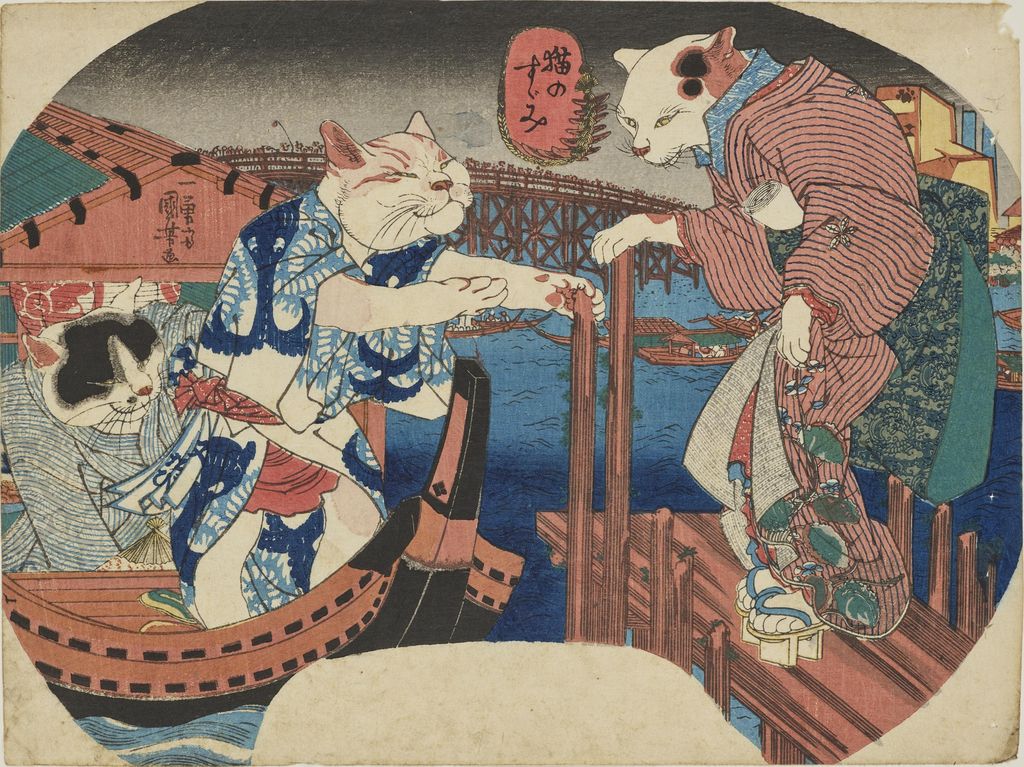
Source: ColBase, Tokyo National Museum, A-10569-5470. Image resized and compressed by TheHistoryOfArt.org; no crop or colour adjustment.
 by Tom Gurney
Tom Gurney BSc (Hons) is an art history expert with over 20 years experience. Updated September 24, 2026.
Introduction
In one print, cats arrange themselves into a written word. In another, they stand in for the stations of the Tōkaidō road. Elsewhere they impersonate kabuki performers, relax like fashionable people or swell into a terrifying apparition. Utagawa Kuniyoshi's cats are memorable because they can perform several jobs at once: they remain recognisably cats while giving a viewer a way into a joke, a play, a story or a picture about picture-making. The Ōta Memorial Museum's 2023 checklist [1] records a wide range of these works, while its 2024 fan-print checklist [2] gives Japanese and English titles for designs that rarely appear in general surveys.
It is tempting to explain them all as evidence that Kuniyoshi simply liked cats. That may be a useful starting point, but it does not explain why a cat's shape can become a word, why a sequence of poses can parody a famous route, or why an enormous ghost belongs in a theatrical scene. Each group asks for a different way of looking. Domestic observation makes the body convincing. Wordplay requires the reader to connect an image to spoken Japanese. The stage prints draw on familiar actors and supernatural roles. This page follows those shifts and keeps the surviving objects distinct: the Rijksmuseum owns one sheet of the Tōkaidō cat triptych, for example, whereas the MFA Boston records a complete three-sheet example. A digital image of one is not a photograph of the other. Rijksmuseum AK-MAK-909 [6]; MFA Boston 2019.193a–c [5].
Contents
At a glance
- When did Kuniyoshi develop these cat designs?The Ōta checklists cluster many of the fan, actor and character-forming works around 1841–43, with further cat parodies and ghost images through the later 1840s. Individual print dates vary and are often approximate.
- What is Cats Forming Characters ?A group titled
猫の当字, in which cat bodies make up words such asかつを,たこ,なまづ,ふぐandうなぎ; Ōta dates its listed impressions around 1842–43. - What is Fifty-three Cats ?
其まゝ地口 猫飼好五十三疋, a three-sheet visual pun on Tōkaidō station names. The full design includes the road's 53 stations and its two endpoints. MFA Boston [5]. - Are all famous composite cats by Kuniyoshi?No. The print of nineteen kittens forming a large cat is by his pupil Utagawa Yoshifuji in Ōta's 2023 catalogue [1], entry 48.
- Can the images be reused?Rights attach to the particular digital file. The Rijksmuseum Tōkaidō sheet [6], Rijksmuseum cat-ghost triptych [7] and Met Okazaki diptych [8] are labelled public domain by their respective institutions. Other files need separate checks.
Begin with the cats, not with the pun
A successful cartoon of an animal has to give it enough recognisable movement that a viewer sees the animal before decoding the joke. Kuniyoshi's cat designs repeatedly use arched backs, crouching hindquarters, extending paws, narrow eyes and the unexpected angles a cat takes while washing or twisting. These are observable shapes, not a claim that a named studio pet posed for a particular print. The Ōta cat exhibition's checklist [1] includes both explicitly domestic subjects and images in which the cats become performers. Its titles alone show the distance between Cat Playing with a Girl (猫と遊ぶ娘, c. 1845) and a print such as Dancing Cats (猫のおどり, c. 1841).
When a human figure shares the picture with a cat, the animal can make the encounter less formal. A girl playing with a pet gives the viewer a plausible action rather than a static emblem of femininity. A pet may turn its head away, reach toward a toy or ignore its owner, introducing a small incident into a portrait-like composition. The titles in the catalogue establish that Kuniyoshi treated such scenes; the exact gesture in any individual image still has to be checked against the image used on the page. That distinction matters because a general claim about “the domestic cat” can otherwise become a caption for a print the writer has not seen.
The apparently ordinary cat also helps explain the more outlandish designs. The visual joke is strongest when the viewer recognises how a real cat could plausibly curl, sprawl or lash its tail even as the drawing asks it to do something impossible. In the actor and word pictures, Kuniyoshi need not transform every cat into a completely human figure. He can keep a feline head or body and add a costume, pose or setting that supplies the theatrical role. The contrast between an animal's habitual movement and a person's social performance creates much of the humour. Ōta's 2012 exhibition on Kuniyoshi's school [3] places his cat imagery within a wider line of prints by pupils and successors, but it is not evidence that every cat image in that exhibition was designed by Kuniyoshi himself.
A summer evening at Ryōgoku Bridge
The Tokyo National Museum's Cats Enjoying the Evening Cool (猫のすゞみ), A-10569-5470 [11], offers an unusually rich example of cats given human roles. Its ColBase record describes a fan-format colour print from the nineteenth century, 21.5 by 28.9 centimetres. In the image, a cat in a boat reaches toward another dressed cat on the landing, while a third peeks from behind. Ryōgoku Bridge runs across the background. The river, boats and crowded bridge place the joke in a recognisable urban summer activity. This is a more specific location than the abstract space of the character-forming prints, and it makes a useful bridge between pet observation and the cat-as-person parodies.
The museum's Japanese commentary [11] identifies several tiny jokes embedded in the clothes and title. Bonito flakes frame the title. The cats' garments carry abalone, eel and octopus motifs. The boatman's cloth and the lantern include 又, part of a matatabi wordplay; a guest's clothing bears coin designs that recall the saying “pearls before swine” in its Japanese cat-and-gold-coin form, 猫に小判. The institution suggests, rather than establishes as a fact, that 又たび could also be a boat-house name. A caption should keep that uncertainty and allow readers to inspect each motif in a popup made from the 3000 × 2246-pixel ColBase original.
It would be easy to call the print merely a comic scene of anthropomorphic animals. Looking at its fan shape and layers reveals a more deliberate structure. The bridge provides a shallow horizon across the upper half, while the boat and landing meet at the hands of the two principal cats. Patterned textiles carry jokes that would disappear at thumbnail size. The third cat looking out from the left adds a small counterpoint to the greeting at the centre. Every element makes the social scene more feline without dissolving its recognisable human setting. A future vintage photograph of Ryōgoku Bridge could add historical context for the place, provided that its precise bridge, date, source and reuse terms are verified; it would remain a separate record from the imaginative fan print.
The ColBase image can be used commercially under its terms [11], with a source link and a statement when it is processed. The site's 1024-pixel, quality-80 version is resized and compressed from the museum's original, so the credit will say so even though the design is not cropped. Annotation details should likewise disclose cropping. This is an example where a strong production image and a detailed Japanese museum explanation arrive together, making close visual analysis possible without guessing at the tiny inscriptions.
Cats as written words: 猫の当字
The title 猫の当字 is commonly rendered Cats Forming Characters. Ōta's 2023 list [1] names five examples: かつを (bonito), たこ (octopus), なまづ (catfish), ふぐ (pufferfish) and うなぎ (eel). Its dates fall around 1842–43; some are marked as approximate. The choices are not random fish illustrations with a cat pasted beside them. Their very subjects invite a second association with cats as creatures interested in food, while the bodies themselves become the marks that have to be read. Ōta's 2011 retrospective [4] singled out かつを among Kuniyoshi's best-known visual inventions.
For a viewer who does not read Japanese, a photograph of one of these sheets can look like a crowd of cats. A useful explanation has to slow the act of recognition down. First look at the animals separately: their faces, legs and tails still make sense as cat parts. Then step back and follow the larger silhouette or sequence of strokes. The bodies join into a written expression. The work asks the reader to alternate between animal and sign. Neither reading replaces the other. This is why a single labelled detail is more valuable than a gallery of unexplained thumbnails: a reader needs to see where one body ends and one character begins.
That reading must be attached to an identified image. The Ōta checklist is strong evidence for the series' titles and dates, but its privately owned print photographs are not automatically cleared for this site's commercial pages. Until a particular open-access impression of 猫の当字 is secured, this manuscript can explain the method and link to the museum record but should not create a fabricated annotation or crop from a low-resolution exhibition poster. Nor should it use Utagawa Yoshifuji's kitten composite as a substitute. The two designs can be compared later because both make a larger form out of animals, but their makers, dates and visual aims must remain separate.
The character prints also show Kuniyoshi working at the edge of legibility. Too many rigid cat silhouettes would make a mechanically obvious word and lose the sense of independent animals. Too much natural movement would dissolve the reading. His solution turns a sequence of small bodies into an image that rewards a double look. This is a compositional observation, not evidence for how quickly a first buyer solved the puzzle or for a specific audience's literacy. The only safe claim about circulation from the object records here is that these were printed designs, represented today by impressions in collections. Print run, price and initial sales remain undocumented by the sources used for this page.
A road made of cats: 其まゝ地口 猫飼好五十三疋
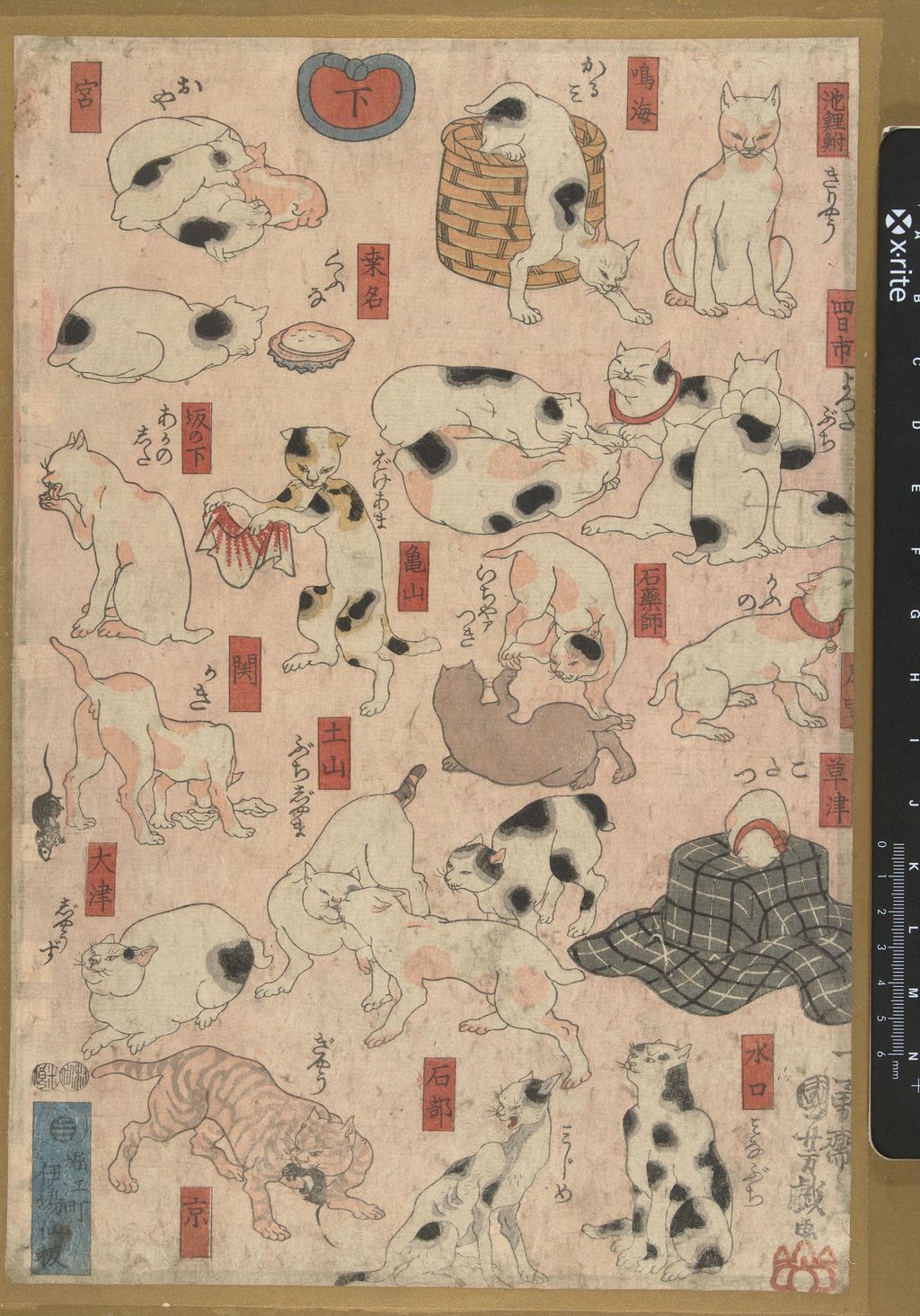
The Tōkaidō road connected Edo and Kyoto through a celebrated sequence of 53 post stations. Kuniyoshi's 其まゝ地口 猫飼好五十三疋 turns that route into a sequence of feline picture puns. The MFA Boston's acquisition note [5] describes its complete vertical ōban triptych as 53 station jokes plus the two cities at the ends. The Ōta Memorial Museum [1] dates the design to about 1848, while the Rijksmuseum's individual sheet [6] is broadly catalogued 1847–50. The dates are not a reason to identify two different designs; they express the catalogues' levels of precision for surviving objects.
The title itself signals verbal play. 地口 (jiguchi) denotes a pun or a word turned into a sound-alike expression. The Okayama Prefectural Library's answer in the National Diet Library's reference database [10] identifies three printed Japanese books that reproduce all three sheets and describes the substitution of cat actions and gestures for station names. It cites Shunhiko Tei's revised Motto Shiritai Utagawa Kuniyoshi (2022), Kaneko Nobuhisa's Neko to Kuniyoshi (2012) and Fuchū Art Museum's Utagawa Kuniyoshi (2015). This reference answer verifies those books as paths into the design; it does not substitute for reading every page of them. More precise translations of individual puns require the relevant caption or Japanese-language scholarly explanation.
The Rijksmuseum sheet AK-MAK-909 [6] provides a close look at one third of the design. Red cartouches carry place names beside cats in changing poses. Some figures face left, others bend, reach or rest; the arrangement reads as a collection of small incidents rather than a single landscape. That is the point of Kuniyoshi's reversal. A conventional Tōkaidō view may supply weather, travellers, a bridge or a famous bend in the road. Here a cat's action is the event, and the station name becomes the clue. The actual road still supplies the order that holds the triptych together. This is a parody of an established subject, not documentary evidence for cats at the historical stations.
The Rijksmuseum's catalogue records that its object is one sheet, 354 by 239 millimetres, with publisher Ibaya Senzaburō and censors Murata Heiemon and Mera Taichirō. Its public-domain image is large enough for careful inspection. The MFA's accession 2019.193a–c is a different, complete impression of three sheets. A page caption should therefore say “one sheet of Fifty-three Cats, Rijksmuseum AK-MAK-909,” and a module that names all 55 puns should either show the whole design from a cleared source or make clear that the visible sheet contains only a portion. An annotation can point to a red cartouche, a pose, a signature and the relation between separate vignettes. It should not assert an exact pun based on guesswork from a tiny cartouche.
The travel-parody structure matters beyond the number 53. It places a familiar public route inside a domestic and comic visual world. A reader who already knows the road series can enjoy the difference between a named place and a cat doing something visually related to a new phrase. Another reader may simply see lively animals. Both audiences can enter the design, although the verbal layer needs translation. This helps explain why a bilingual page should preserve the Japanese title and its original spelling rather than flatten it into a single English label. An English rendering can signal the subject; the Japanese form remains the key to its sound play.
A close look at the Rijksmuseum sheet
The high-resolution Rijksmuseum image [6] repays looking from top to bottom rather than taking in the sheet as a decorative pattern. At the top, one pale cat twists inside a tall woven container, its back curved across the rim while another looks outward from the right. A seated cat nearby forms a comparatively quiet vertical shape. In the middle, several bodies overlap and their spots and collars help separate one from another. Lower down, one cat arches over another; a striped cat at the bottom crouches in a very different, compact posture. Small red vertical cartouches punctuate the field. The cats do not progress in an orderly single file, and that visual irregularity is part of the pleasure of discovering a route hidden in a swarm of independent actions.
The sheet is also a lesson in how a print can hold many brief episodes without a conventional landscape background. Kuniyoshi uses little architectural setting around each animal. An object such as the basket or the patterned cloth creates a local situation, while many other cats need only a body, a patch of ground and a place-name label. This economy lets the viewer move from one vignette to the next. It may be tempting to call the whole image a page of sketches, but the repeated red labels, measured spacing and varied silhouettes show a composed print. The open areas between animals give room for each pose and for the little written sounds beside some of them. They are working spaces in the design, not empty gaps awaiting scenery.
The photographed museum object includes a dark measuring strip and the edges of its mount. Those elements are evidence of the museum file, not parts of Kuniyoshi's print design. The web derivative retains the whole source image, because silently cutting off the instrument would conceal how the object was photographed. A focused annotation may crop inside the printed sheet, but the popup should disclose that it is a detail of AK-MAK-909 and offer the uncropped image. This is especially important for a 1024-pixel display: at page width, the cartouches are too small to read comfortably, so a detail view has a genuine explanatory purpose.
The original print was a three-sheet work, and the Rijksmuseum preserves only one sheet in this accession. This means that any apparent beginning or end in the photographed image could be a join with a missing neighbouring panel, rather than the edge of the full sequence. The red station labels on this sheet can be studied as inscriptions in an object; the full series order must be checked against complete triptychs and Japanese descriptions. The Boston acquisition [5] confirms that a complete example exists, while the Okayama library guide [10] points to three books that reproduce all the panels. This is why the module should never animate this single sheet as if it contained a whole journey from Edo to Kyoto.
An interactive explanation can therefore proceed in stages. Show the entire Rijksmuseum file with its object identity. Let a reader select a cat, then enlarge its pose and adjacent label. Explain what is visible—for example a cat leaning from the container—before giving a Japanese reading of the cartouche. If a verified source supplies the wordplay, add the place name, the cat expression and a concise translation beside the detail. If it does not, the module can still explain the print's structure without manufacturing an answer. The difference between an observed pose and a translated pun should remain visible in both languages.
A print of the road beside a photograph of a place
If the page pairs a Tōkaidō reference with a vintage photograph of a station or bridge, the photograph should explain the historical route, not pretend to document Kuniyoshi's feline scene. A nineteenth-century view of a named location may be valuable as a second kind of evidence, but it needs its own date, photographer or archive, rights statement and caption. The cat print supplies an imagined pun, not a topographical view. The proposed feature should therefore begin with the visual and verbal structure of the print; a period photograph belongs in a clearly marked contextual sidebar only when its identification has been verified. This follows the site's wider plan to use vintage photographs where places are discussed without turning them into evidence for a different image.
Explore one sheet of *Fifty-three Cats*
Select a number to read its explanation below, then enlarge the detail image. Crops come from the Rijksmuseum’s 4661 × 6666-pixel original, about 496 dpi at the print’s recorded size.
Source: Rijksmuseum, AK-MAK-909 [6]. Public domain. Details are cropped and resized.
Annotated image details
Cats at the upper left
A small group of cats sits beside a red station cartouche. Read the visible poses first; the exact wordplay needs a checked Japanese source.
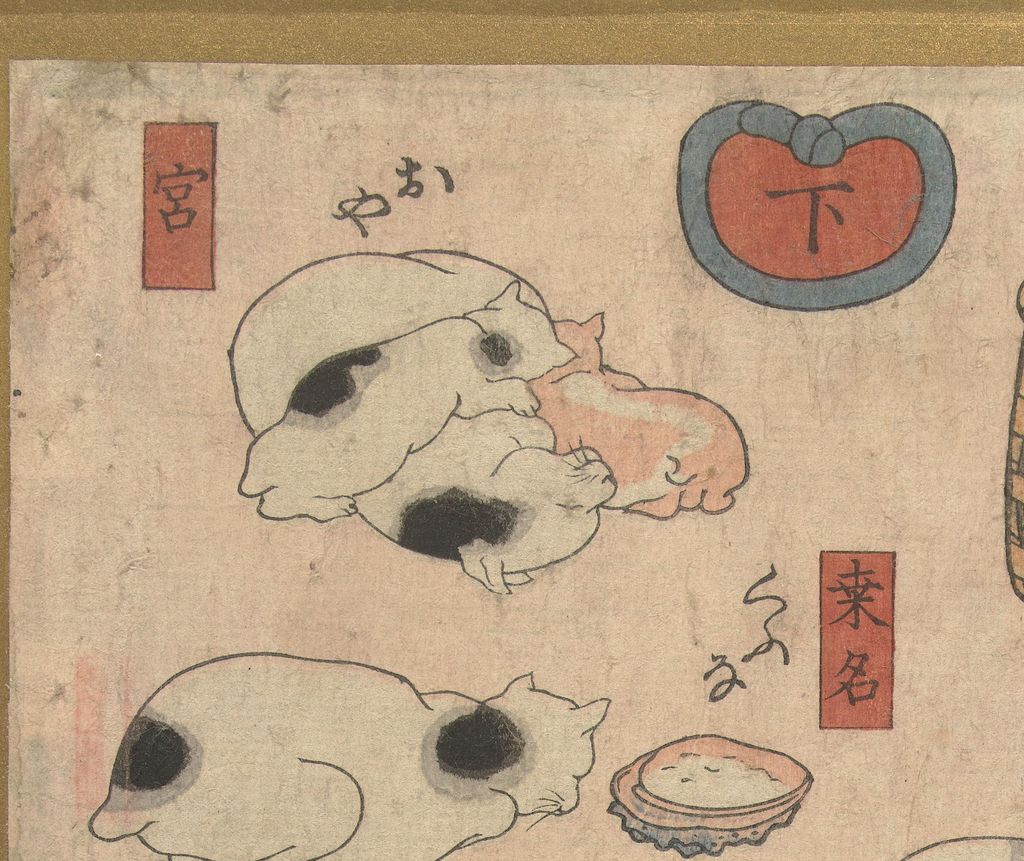 Cropped and resized from Rijksmuseum AK-MAK-909.
A cat leaning from a basket
One pale cat bends over a woven container while another sits nearby. Their different outlines keep the small incidents distinct.
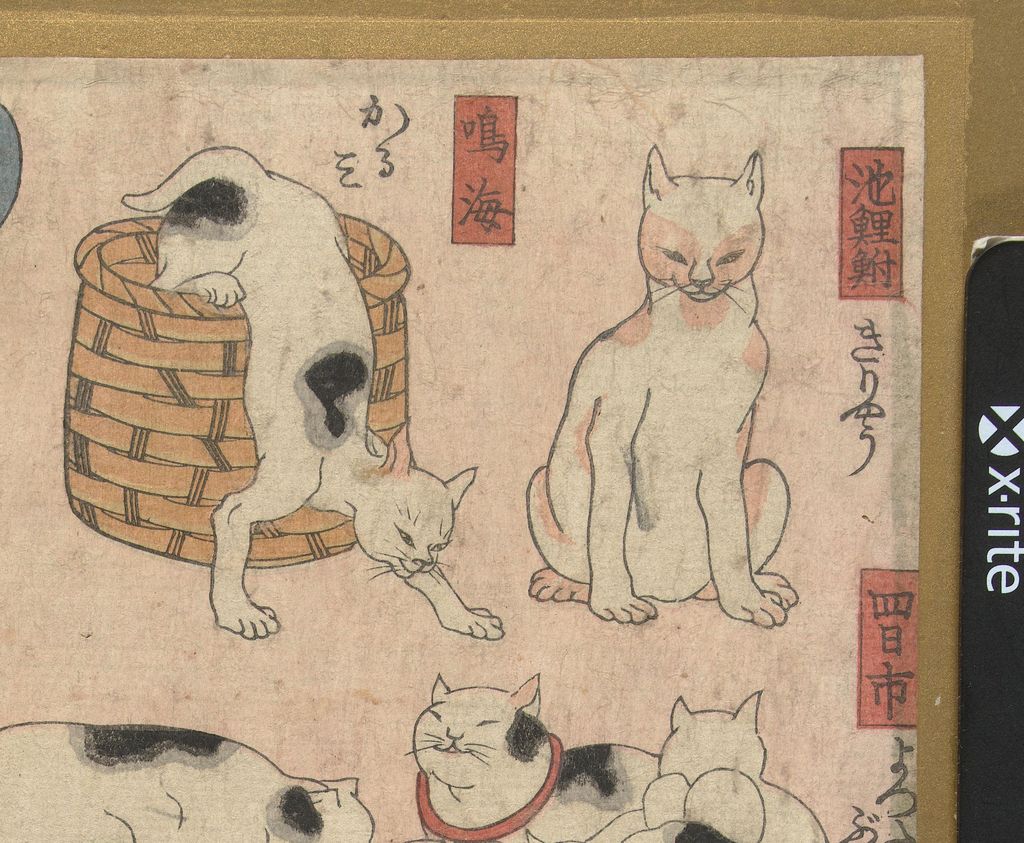 Cropped and resized from Rijksmuseum AK-MAK-909.
Overlapping cats and labels
Spots, collars and red labels help separate the overlapping bodies and the place names they parody.
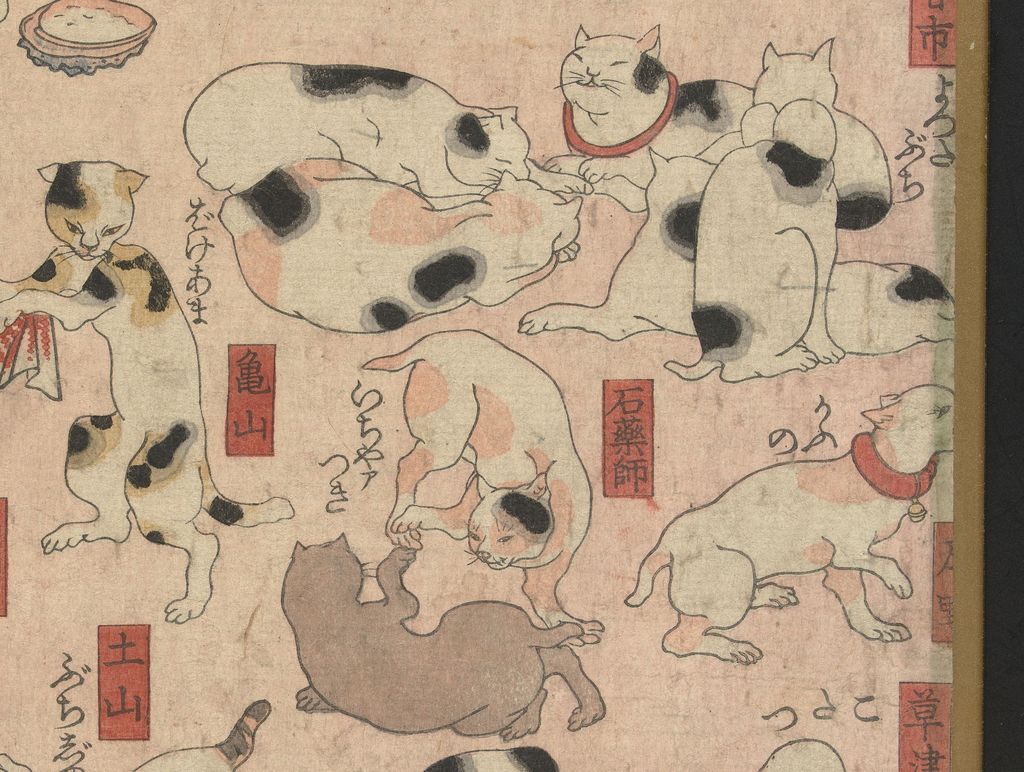 Cropped and resized from Rijksmuseum AK-MAK-909.
Several independent actions
The cats do not form a single procession. Kuniyoshi gives each short vignette enough space to be read separately.
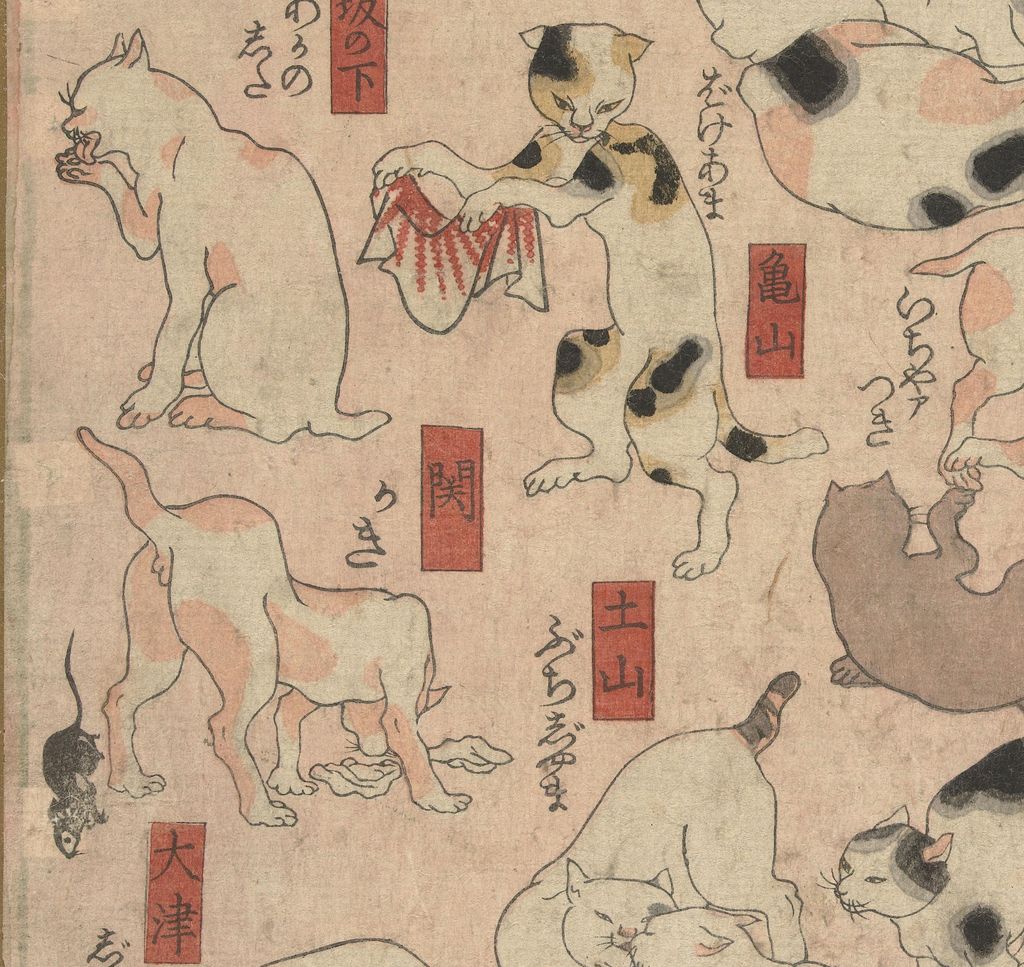 Cropped and resized from Rijksmuseum AK-MAK-909.
The lower scenes and sheet edge
The striped crouching cat is one of several low figures. This museum sheet is only one part of the original three-sheet design.
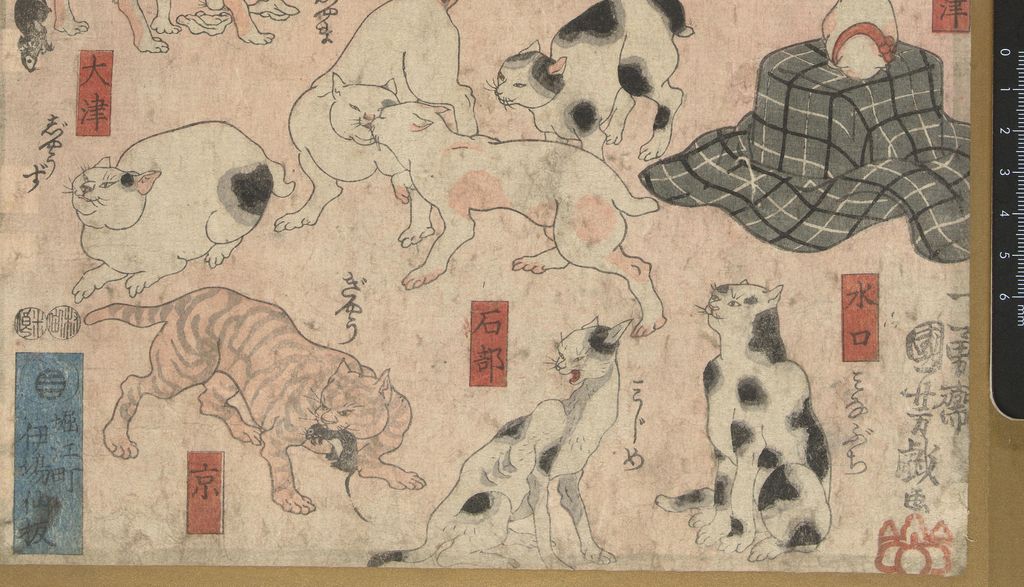 Cropped and resized from Rijksmuseum AK-MAK-909.
Cats on stage
Kuniyoshi's cats frequently take human roles. The Ōta 2024 fan-print list [2] includes Dancing Cats, One-hundred Faces of Cats, Kabuki Play by Cats and Cat Version of the Tale of Genji: Sakaki. Dates in that list place the first group around 1841–42. These works are more specific than a generic category called “funny cats.” An actor parody needs an audience that recognises performance conventions; a Genji picture invites recognition of literary characters or episodes; a dance scene turns bodily grace into a comic analogy. The underlying stories and titles change the joke.
The phrase “one hundred faces” promises a range of expressions or personae, not necessarily an extant suite of exactly one hundred separate surviving prints. The Ōta checklist lists examples connected to Chūshingura and named performers. A cautious page may say that the series uses feline physiognomy to parody theatrical types. It should not claim to have identified each actor solely from a simplified translated title. Facial marking, costume, pose and written cartouches need to be read together on a particular impression. When an open-access example is found, an annotated comparison between cat face and role name could be a strong feature; without one, the museum's bilingual titles provide a reliable starting map.
The fan format also matters. A print made to be pasted or mounted on a fan has a different shape and handling life from an upright ōban sheet. Ōta's checklist calls several cat works 団扇絵判, a fan-print format, and dates Dancing Cats and other actor subjects around 1841. The image may now be stored flat in a museum, but its design was made for a curved, portable surface. When describing its composition, we should ask how cats move across that shape rather than judging it by the rectangular screenshot in a search result. The object record should determine whether a particular surviving example is still mounted on a fan or was only printed in that format.
These fan prints provide an opportunity for the Japanese and English pages to explain more than subject matter. 猫の源氏 賢木 tells a reader that a cat version of The Tale of Genji is involved, but the title alone does not identify which detail performs the parody. 賢木 is the Sakaki chapter; a viewer unfamiliar with the tale needs a short statement of what chapter is being invoked, supported by a source about the particular print. Likewise, a cat identified as a kabuki performer needs a name and role drawn from the impression's inscription or a museum catalogue. The 2024 Ōta list provides the secure title and broad date; it does not license a confident reading of every small prop in a file we have yet to secure. This careful separation makes a later illustrated expansion possible without building a vivid but unsupported story around a convenient thumbnail.
From familiar animal to 化け猫
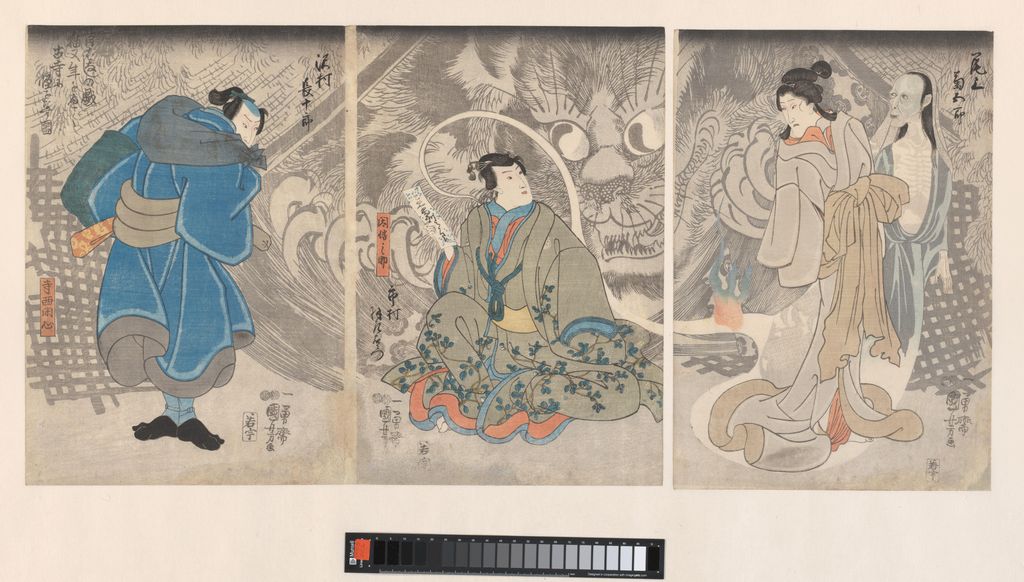
The affectionate or mischievous cat is not the only cat in nineteenth-century visual culture. The Edo-Tokyo Museum's cat exhibition [9] distinguishes supernatural 化け猫 stories from household and literary subjects and notes how tales of old cats transforming into monsters circulated through stories and plays. That context helps prevent the ghost prints from being described as exaggerated pet scenes. A frightening feline apparition belongs to a narrative and performance tradition, even though its form begins with a recognisable animal.
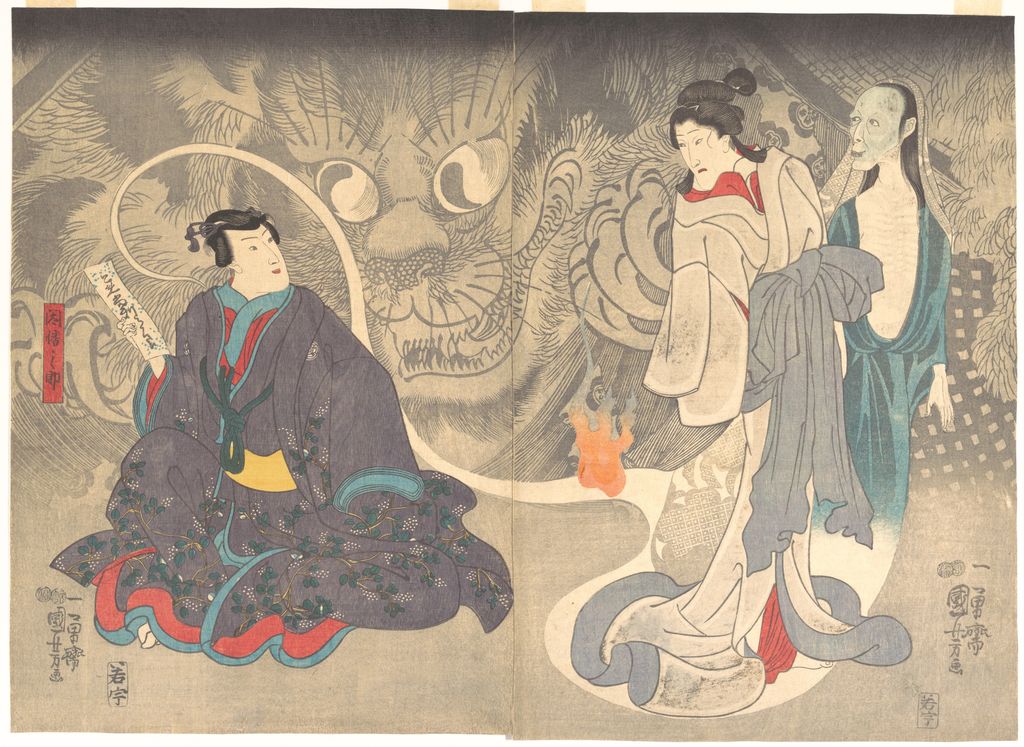
The Rijksmuseum's The Cat Ghost, RP-P-2019-208 [7], is dated July 1847. Its record describes two men, a woman, a spirit and a huge cat form in the background of a kabuki scene. The print commemorates the retirement of Onoe Kikugorō III, known for ghost roles, and relates to a tale of a monstrous cat haunting an old temple while disguised as a kindly older woman. The institution's image depicts all three sheets together. The cat's enormous head occupies the backdrop, its scale shifting the scene from human confrontation to apparition. Human bodies and the ghost share the same stage space, but they do not carry the same visual weight. This is an interpretation of what is visible in the Rijksmuseum file, grounded in its object description; it is not proof of an actual stage backdrop or a reconstruction of a particular performance.
The Met's Scene from a Ghost Story: The Okazaki Cat Demon, JP1563 [8], is dated about 1850 and catalogued as a diptych, not the same 1847 triptych. It can help show how Kuniyoshi returned to cat-monster material through different print formats. “Cat ghost” and “Okazaki Cat Demon” are not interchangeable object titles. Their figures, settings and sheet counts have to be described from their own accession records. Showing both on the page is useful only if a caption or comparison explains the change of scene or composition; two large monsters without such a comparison would repeat the same visual function.
Scale is the main device that turns the cat into a threat in the Rijksmuseum design. A pet small enough to curl beside a person becomes an apparition whose face occupies almost the width of three print sheets. The frightening effect comes partly from retaining cat features at an impossible size. It also depends on the contrast with ordinary human scale: the figures in front tell the viewer how much the animal has exceeded a plausible body. This observation can be explored in an annotated image by pointing to the actor group, ghost face and sheet joins. It should not be used to claim that a specific theatrical producer copied the print or that the print copied a documented performance set without further evidence.
Studio, publisher and print
The cat designs are associated with Kuniyoshi as designer, but a colour woodblock print was a collaborative product. The publisher commissioned, financed and distributed prints; block cutters and printers translated the drawing into lines and colour on paper. The Rijksmuseum Tōkaidō sheet [6] names publisher Ibaya Senzaburō and two censors. The Rijksmuseum ghost design [7] names Wakasaya Yoichi as publisher. These object-specific names are more useful than saying vaguely that Kuniyoshi “printed” a work. They also guard against treating all cat prints as one uniform series from one publisher.
The dates of the cat designs overlap with a period when Kuniyoshi was making warrior scenes, actor prints, comic images and pictures of women. A cat was not a specialist signature that replaced his other subjects. The Ōta retrospective [4] places the かつを cats beside monsters, warriors, beauties and experiments with Western-looking representation. The breadth matters: the same ability to make an image arresting at a glance appears in both the huge skeleton and the compact cat puzzle, though their stories and emotional effects differ. A page about cats can cross-link to those other Kuniyoshi works without claiming that one directly caused the other.
Some often-repeated stories about the number of cats Kuniyoshi kept in his studio may be true in broad spirit, but the cited object and exhibition records here do not establish a precise count, a named pet or the circumstances in which he drew a particular animal. The page should avoid turning an anecdote into a universal explanation of the pictures. What can be demonstrated from his surviving work is the range of cat subjects and the precision with which he adapts feline forms to different visual tasks. That is already a stronger art-historical claim than a speculative studio inventory.
What the images can and cannot prove
In the visual sequence planned for this page, each file needs a verifiable source. The Rijksmuseum Tōkaidō sheet [6] and cat-ghost triptych [7] are marked public domain on their object pages; high-resolution originals and 1024-pixel, quality-80, 144-dpi derivatives are retained in the production library. The Met Okazaki image [8] is also labelled public domain and open access. These rights statements cover their own institutional image files. They do not clear an illustration copied from a modern book, another museum's photograph or a privately owned exhibition image.
The 2012 Ōta exhibition [3] covered Kuniyoshi's school as well as the artist himself. Its catalogue is a strong research guide but not a production-image licence. The 2023 checklist makes the distinction explicit: after Kuniyoshi entries it names Yoshifuji and other makers. One especially seductive image is Yoshifuji's 猫の子の小猫を十九あつめ大猫とする, dated about 1847–48. Nineteen little cats form a big cat. It is a clever companion to Kuniyoshi's character-forming animals, but it is not a Kuniyoshi print. If it appears in a related-work card, its maker belongs in the heading and caption, not hidden in a footnote.
Differences between digitised impressions can be meaningful, but a screen comparison alone cannot establish an edition, state or chronological sequence. Print sheets may be trimmed, colours may vary among impressions, and institutional photography changes the apparent warmth or density of paper. The Rijksmuseum's 354 × 239 mm measurement belongs to AK-MAK-909, not to the MFA's complete triptych. The Met's dimensions belong to its own two-sheet ghost object. A page that captions each image with its accession and file source lets readers compare them without implying that every difference is a change Kuniyoshi ordered.
How to explore this page
Start with a familiar cat shape, then ask what it is being made to represent. In a character-forming design, step back until a word appears. In a Tōkaidō sheet, follow the red place-name labels and try to see the cats as a sequence of small incidents. In an actor or fan print, ask which elements belong to animal behaviour and which borrow from a human performance. Finally look at the large cat ghost and notice how an ordinary face becomes uncanny when its scale changes. These are viewing exercises, not a single rule that explains every print.
The proposed interactive feature should offer three views: everyday cat, cat as performer or pun, and cat as supernatural figure. Each image must retain its Japanese title where known, date range, collection, object number and rights line. The annotated Tōkaidō image can identify the visual grammar—the red cartouche, cat pose, sheet edge and publisher/censor details—before attempting to translate individual jokes. Popup details should be made from the retained high-resolution original, with their explanations below the image, using the approved site-wide annotation structure. If a particular pun is decoded, the source for that reading should appear beside its note.
The value of this selection is not that cats replace all the other subjects in Kuniyoshi's art. It is that the same small animal can carry observation, comic substitution, verbal invention and fear without losing its feline character. His cat designs let us watch an Edo printmaker adjust scale, format, language and story for different kinds of attention. The funniest sheet is still a work of printed design; the frightening one still depends on the body of a recognisable cat. Looking closely at those choices gives the cats more to say than a modern label of “cute” can convey.
Reader insights and discussion
Share what changes when you read the cats as animals, words or performers.
Reader Insights
Which animal pose also works as part of a written character?
How does a station name change the way you see its cat?
What happens when a familiar cat face becomes larger than the actors?
Join the Conversation
Share a print or detail that changed how you see Kuniyoshi.
References
- Ōta Memorial Museum, Edo Cats: An Ukiyo-e Cat Extravaganza exhibition checklist, 2023. Japanese titles, dated works, artist attributions and formats.
- Ōta Memorial Museum, Fan Pictures by Kuniyoshi: Cats, Kabuki Actors and Girls checklist, 2024. Bilingual titles and dates for fan-print subjects.
- Ōta Memorial Museum, One Hundred Views of Cats: Kuniyoshi's School, 2012. Exhibition framing of Kuniyoshi and pupils.
- Ōta Memorial Museum, Kuniyoshi, 2011. Retrospective and
猫の当字 かつを. - MFA Boston, The Museum Year 2019: accession 2019.193a–c. Complete Fifty-three Cats triptych and description.
- Rijksmuseum, Cats for the 53 Stations of the Tōkaidō, AK-MAK-909. One-sheet object and public-domain image.
- Rijksmuseum, The Cat Ghost, RP-P-2019-208. July 1847 triptych, theatre context and public-domain image.
- Metropolitan Museum of Art, Scene from a Ghost Story: The Okazaki Cat Demon, JP1563. Public-domain diptych, c. 1850.
- Edo-Tokyo Museum, Edo-Tokyo Cats exhibition. Japanese contextual account of household and supernatural cats.
- National Diet Library Collaborative Reference Database, Okayama Prefectural Library answer. Bibliographic guide to three Japanese books reproducing and discussing the triptych; consult the books for fine-grained pun readings.
- ColBase, Tokyo National Museum, Cats Enjoying the Evening Cool, A-10569-5470. Fan-print object, Ryōgoku Bridge, and Japanese detail explanation; ColBase reuse terms.
