


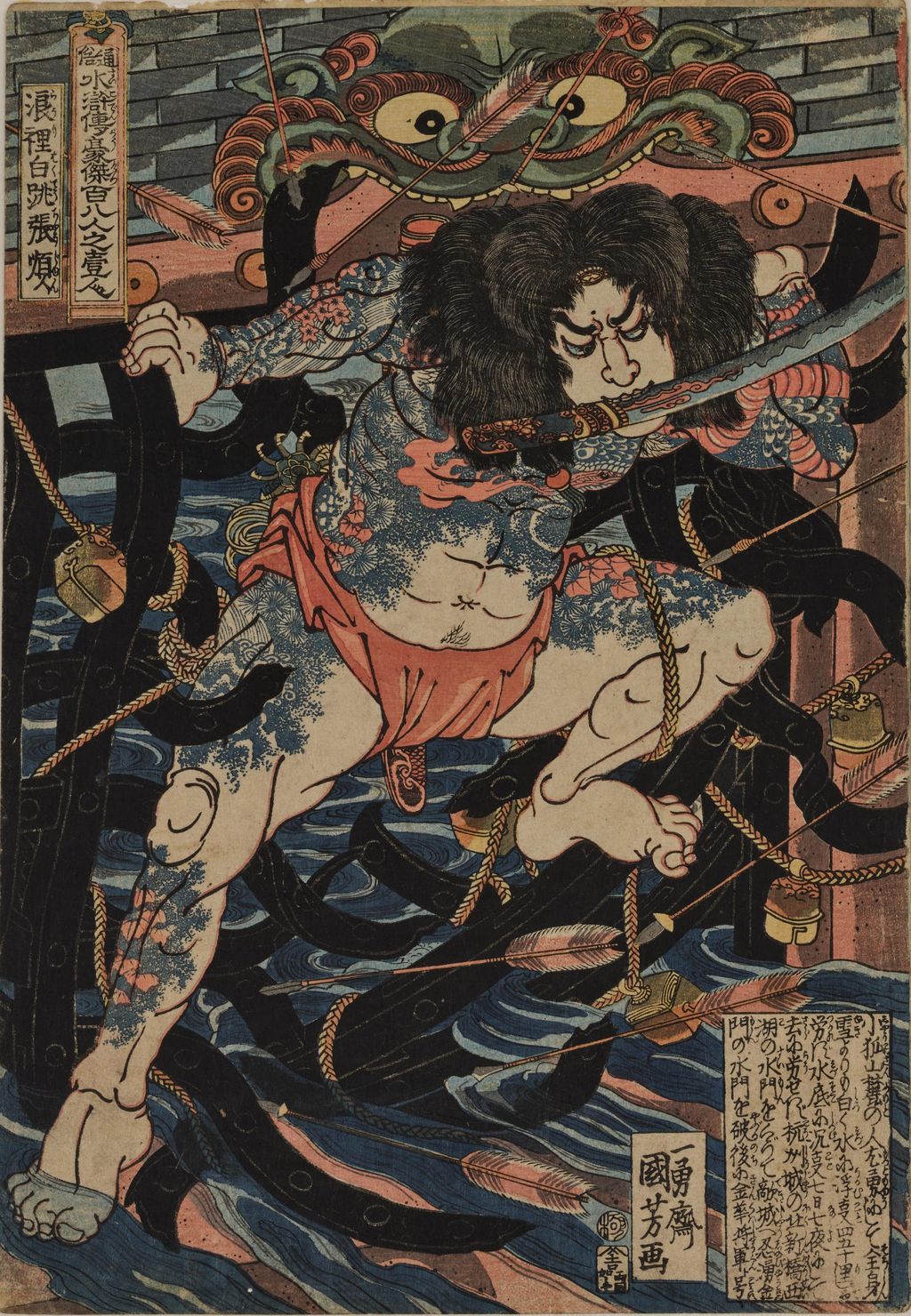
Source: ColBase, Tokyo National Museum, A-10569-5426. Image resized and compressed; no crop or colour adjustment.
 by Tom Gurney
Tom Gurney BSc (Hons) is an art history expert with over 20 years experience. Updated September 24, 2026.
Introduction
A man forces his way through a water gate as arrows fly toward him. Another drives a weapon into a pine trunk, scattering pieces across the sheet. A tattooed archer pauses with a bow in front of a river. These are not interchangeable pictures of “samurai.” They are individual heroes from the Chinese novel Shuihu zhuan, known in Japan as Suikoden or The Water Margin, reimagined by Utagawa Kuniyoshi for an Edo print audience. The Tokyo National Museum's Zhang Shun [7], the Rijksmuseum's Lu Zhishen [8], and its Zhu Gui [8] let us look at specific surviving sheets instead of repeating a general description of a famous series.
The long title is usually romanised Tsūzoku Suikoden gōketsu hyakuhachinin no hitori: “One of the 108 Heroes of the Popular Water Margin.” Its number points to the band of heroes in the story. It does not mean Kuniyoshi issued 108 different designs. The Ōta Memorial Museum identifies 74 known designs [2]; its 2016 exhibition account [1] says it showed 73 of them. The museum dates the series' start to around 1827 and describes it as the breakthrough that made a struggling artist known for warrior prints. What survives is a group of designs represented by physical impressions in different collections, not a single numbered album whose every copy looks identical.
Contents
- Introduction
- From Chinese story to Edo print
- Why these prints changed Kuniyoshi's position
- Zhang Shun at the water gate
- Lu Zhishen: a force made visible
- Explore Lu Zhishen’s print in detail
- Zhu Gui: a warrior not yet in motion
- Yan Qing: the body as a place for invention
- Tattoos are only one part of the visual language
- A series, a print and a publishing network
- What came after the first heroes
- How the images and sources are used here
- Reading the series today
This page follows the series through bodies, water, text, tattoos and the print trade. It compares two impressions of Zhang Shun and two of Lu Zhishen, because repeated designs reveal how a museum's image can differ from another museum's image of the same composition. It also sets the original series beside later Suikoden inventions without pulling a dated 1856 print backwards into the 1820s. The pictures were made to catch attention, but their precise titles, inscriptions and object records are what let a modern viewer understand whose action is being staged.
At a glance
- What is the source story?Shuihu zhuan, a Chinese narrative of 108 outlaws and their exploits, adapted and read in Edo Japan as Suikoden. The Met's account of a later theatrical work [12] explains the narrative framework.
- When did Kuniyoshi start the print series?Around 1827, according to the Ōta Memorial Museum [1]. MFA Boston [5] dates its early Tanmeijirō sheet about 1827–30.
- How many prints were there?Ōta identifies 74 known designs. The 108 in the title counts the story's heroic company, not the issued designs.
- Why did the series matter?Ōta [1] and the Tokyo National Museum [4] describe it as the success that raised Kuniyoshi's profile.
- Are all the figures tattooed?Tattoos are conspicuous in many important sheets, but each design must be checked. The Rijksmuseum's Lu Zhishen [8] and Zhu Gui [8] are useful examples; the series cannot be reduced to one motif.
- Is the 1856 underwater hero part of this original series?No. The Met dates its Tanmeijirō Genshōgo Fighting Under Water to the second month of 1856 [12]. It is a later treatment of a related subject.
From Chinese story to Edo print
The 108 heroes belong to a Chinese story world. A picture about them made for Edo buyers was already an act of translation: names, episodes and character traits moved across languages and visual conventions. The Ōta Memorial Museum's exhibition on ukiyo-e and China [2] places Suikoden beside the Three Kingdoms as Chinese narratives that Edo printmakers repeatedly transformed. Its point is more useful than calling the prints simply “Chinese scenes.” An Edo sheet could preserve a recognisable character while turning the action into a highly inventive Japanese colour woodblock design.
An individual print commonly gives the viewer a title cartouche, a hero's name and a block of explanatory writing. These marks are part of the design. In the Tokyo National Museum's Zhang Shun [7], for example, the title rises at the top left, the hero's name runs beside it, and another text block occupies the lower right. The figure and wooden barriers dominate between them. A reader need not decipher every historical character to see that picture and writing cooperate: the name identifies the hero, the prose situates the incident, and the body supplies the immediate drama. The Japanese title appears with variant characters and endings across TNM [7], Rijksmuseum [8] and British Museum [10] catalogues. A page should preserve each institution's transcription when quoting an object, rather than force every sheet under one silently standardised spelling.
This is also why “illustration of the novel” needs qualification. Some sheets condense an episode into a single decisive gesture; others make a particular hero memorable through posture and ornament. The Ōta collection note on Li Jun [3] names chapter 59 and the figure thrown from a boat. That is a traceable episode. A tattoo pattern or dramatic colour scheme may be the printmaker's addition to characterization rather than a literal passage copied from a text. MFA Boston's account of Yan Qing [6] explicitly makes that distinction: the novel describes the wrestler's tattooing, but Kuniyoshi supplied the particular lions-among-peonies motif in the print it discusses.
The printmaker was not the only authorial presence. A publisher commissioned and sold the sheet; cutters and printers made colour blocks and impressions from designs. The Rijksmuseum's Lu Zhishen record [8] names Kagaya Kichiemon as publisher. A British Museum early-series sheet [10] names Ibaya Senzaburō instead. This evidence does not establish that every design was issued in exactly the same way, or that one publisher controlled the complete 74. It shows why an object-by-object approach is needed even when the large title stays the same.
Why these prints changed Kuniyoshi's position
The Ōta Memorial Museum [1] places the beginning of the series around 1827, when Kuniyoshi had yet to stand out among Utagawa Toyokuni I's pupils. It calls the heroes' dramatic bodies and exotic presence central to the work's popularity. The Tokyo National Museum's 2013 account [4] likewise says the series raised a relatively obscure artist into prominence. Those are museum syntheses, not sales ledgers. They support “breakthrough” and “popular,” but not a precise print run, income figure or ranking among publishers.
The prints would have been easy to recognise at a distance. Large figures push toward the sheet edges; a weapon, beam, tree or stretch of water makes the bodily action legible; patterned skin or cloth rewards a closer look. The contrast between distant impact and near detail matters for a commercial print. One could notice the heroic movement first and identify the named episode later. In Zhang Shun [7], a sword clenched in the mouth is the rapid visual hook. In Lu Zhishen [8], the figure and red-brown trunk fill so much of the sheet that the destruction seems to happen against the image's borders. In Zhu Gui [8], the tattooed torso and bent bow organize a more contained moment before action.
Popular success also produced successors, parodies and related formats. The Ōta 2016 exhibition [1] separates the original hero sheets from later comic, female and Japanese-hero adaptations. The Smithsonian's circa-1830 Eight Hundred Heroes of the Water Margin of Japan object [13] confirms a related but differently titled series. A reader should not see “Suikoden” and assume every print belongs to the first 74. The series was an artistic and publishing success precisely because its visual language could be reused in new projects.
Zhang Shun at the water gate
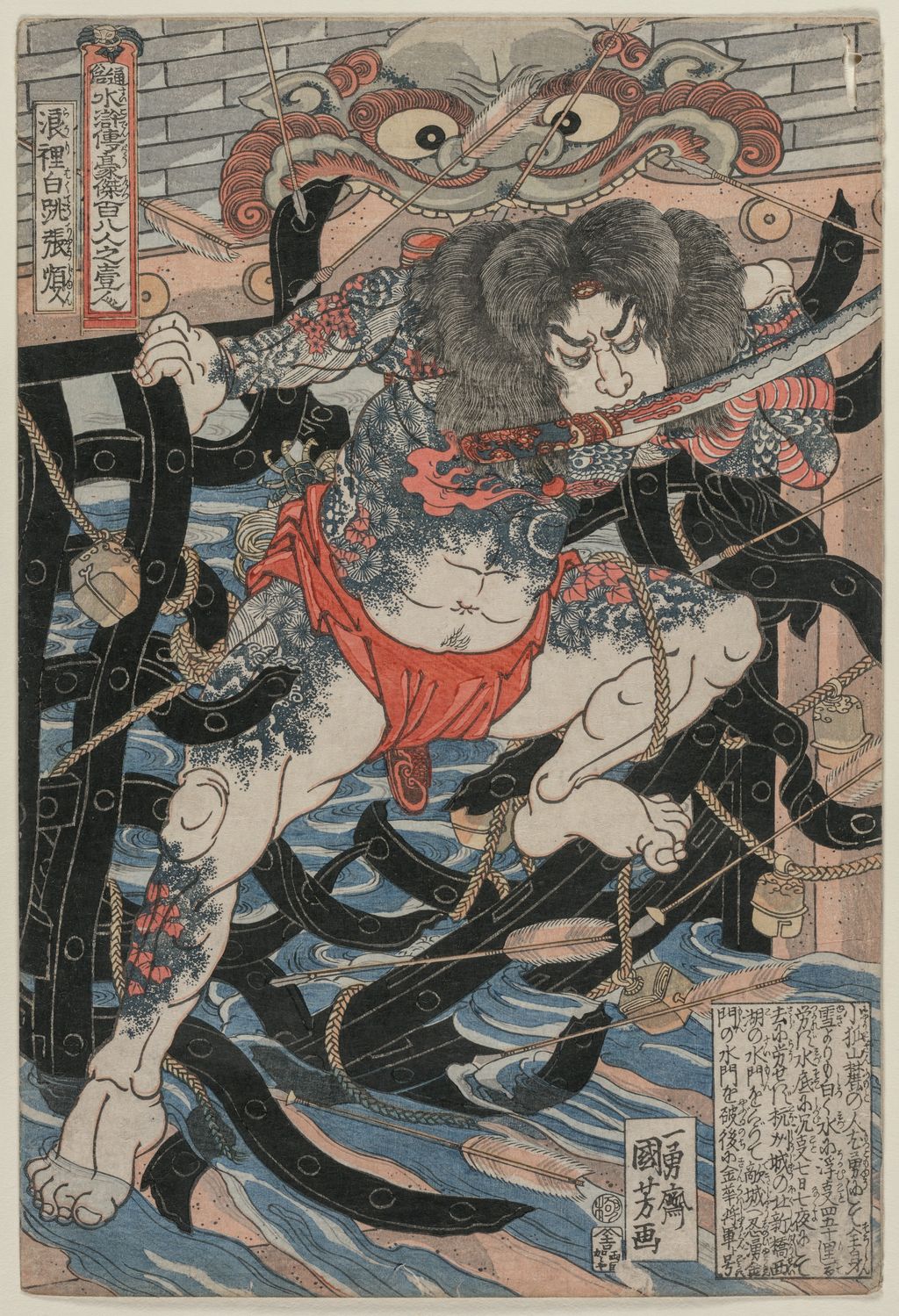
The figure in Tokyo National Museum A-10569-5426 [7] is 浪裡白跳張順, often rendered Rōri Hakuchō Chōjun in Japanese romanisation, Zhang Shun in Chinese. He holds a blade between his teeth while his arms reach across a broken structure. Arrows enter from the surrounding space; water moves below. The combination leaves the viewer with a body exposed on all sides. The Ōta Memorial Museum's detailed exhibition label [1] identifies the structure as a water gate at Hangzhou. It explains that Zhang Shun is breaking through it before his death under enemy attack. That account anchors the narrative; without it, a modern viewer could read the dark beams simply as a bridge or fence.
The design creates pressure by making the gate larger than a prop. Its crosspieces and dark uprights interrupt the hero's limbs, making the body appear at once trapped and capable of forcing a passage. Arrows are small next to the muscular figure but numerous enough to turn the whole scene hostile. The sword at the mouth frees the hands for climbing and breaking; it is a visual solution to the action as well as a sign of danger. The blue tattoo follows his exposed chest and limbs, while the red cloth and pale skin divide the figure from the dark barrier. These are observations from the TNM file [7], with the story action supplied by Ōta's label. They do not prove exactly how every printed impression looked when sold.
The Cleveland Museum of Art's 1980.85 [9] is another surviving impression of this design, dated “late 1820s” by that institution. The Cleveland sheet measures 38 × 25.7 cm, while the TNM record gives 37.8 × 26.2 cm. Museum photography, trimming, paper colour and the condition of two sheets can make them feel more or less crowded on screen. A comparison feature can let a reader align the name cartouches, sword, arrows and gate, then observe visible differences in margins or colour. It should not conclude from a compressed display image that one is an earlier state or that Kuniyoshi revised the blocks. That would require print-specific technical evidence not supplied by these object records.
Ōta calls Zhang Shun a master swimmer and a leader of naval forces. That identity adds pathos to the image: the water hero reaches a decisive gate, yet the story does not guarantee his escape. The scene is effective because Kuniyoshi chooses an action with two possible readings before the viewer knows the outcome. A bare-limbed figure breaching an obstacle can look victorious; the surrounding arrows foreshadow disaster. The print does not depict an entire life, but its selection of a charged instant can make a named character seem larger than the single sheet.
Lu Zhishen: a force made visible
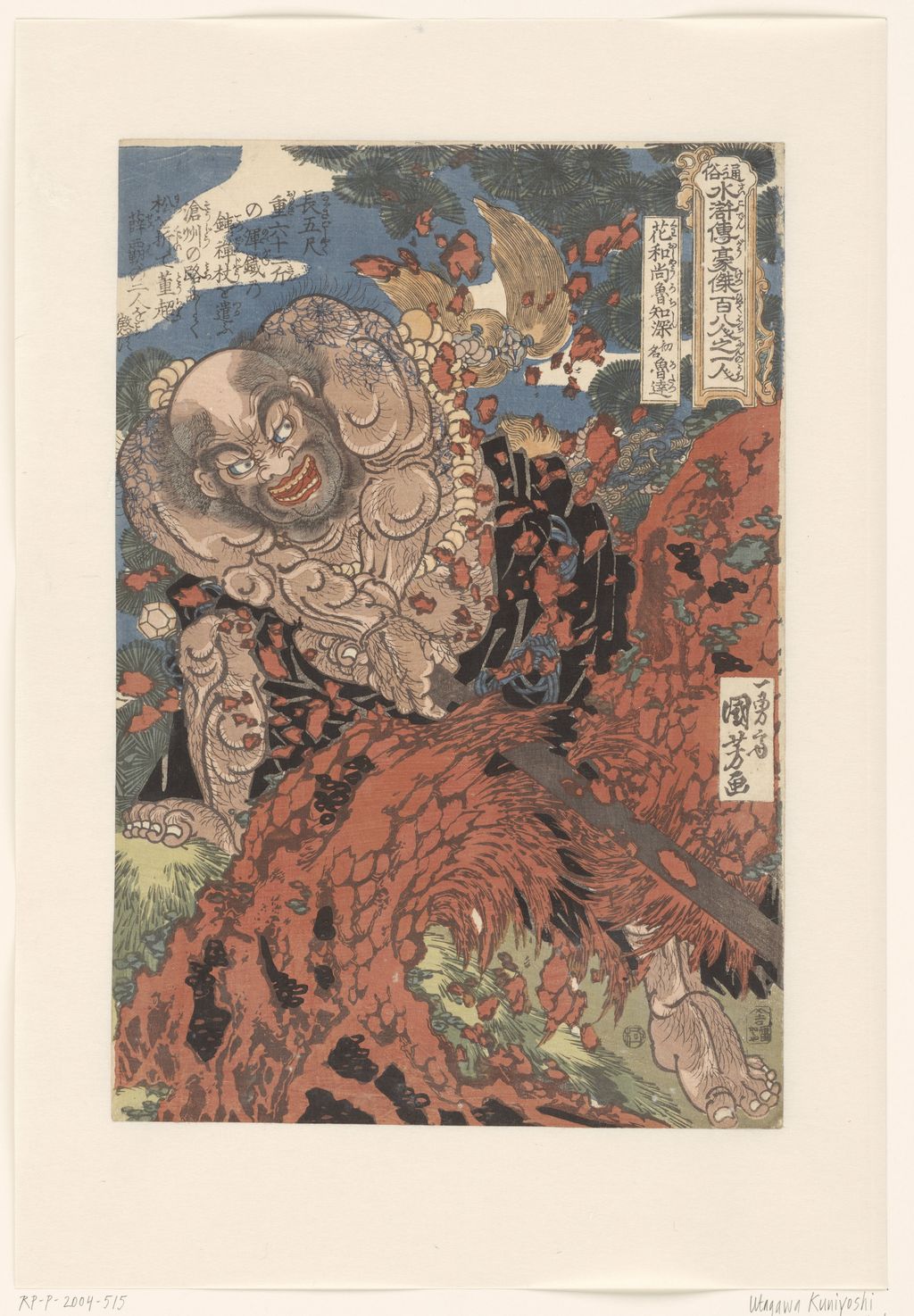
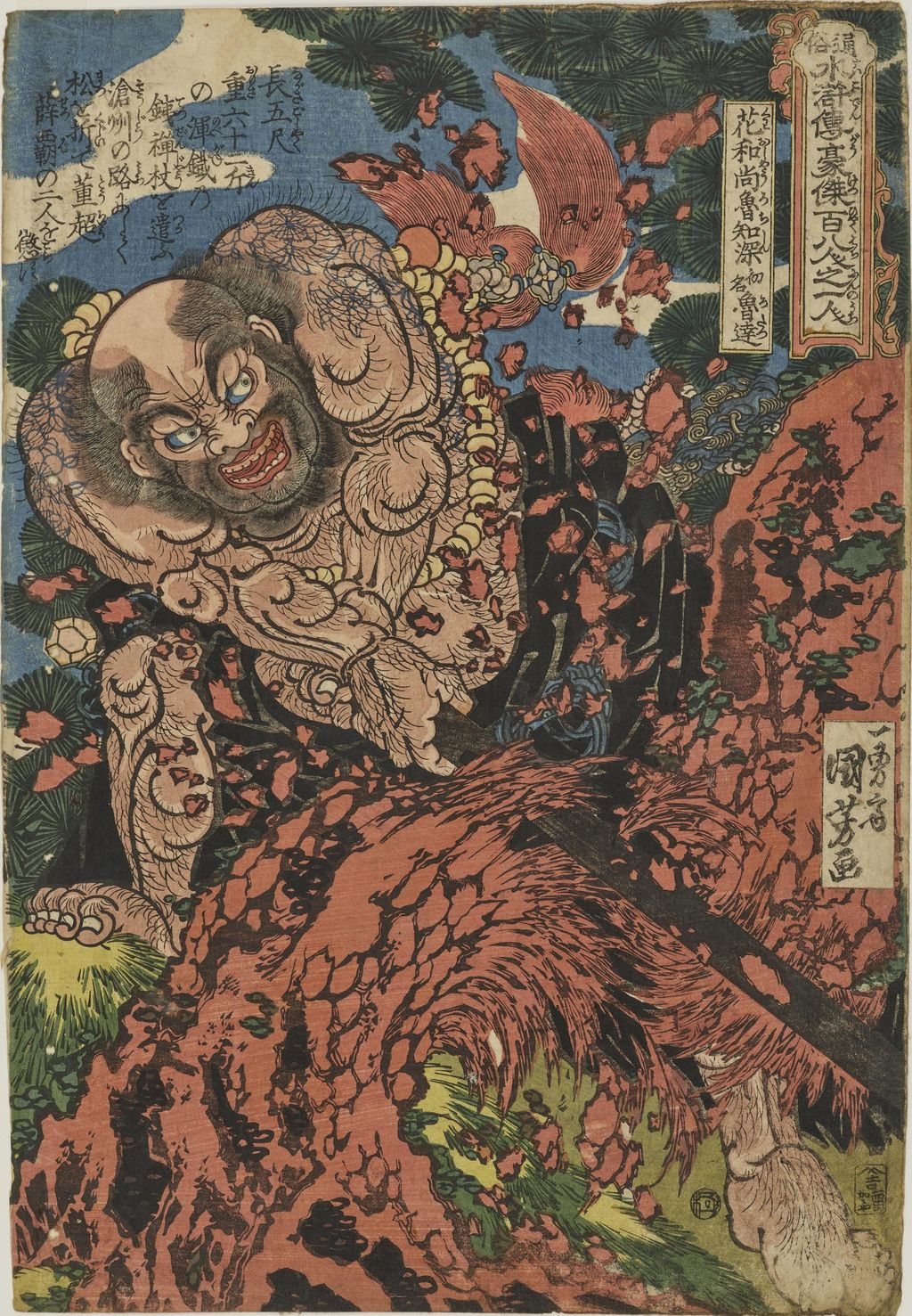
The Rijksmuseum's RP-P-2004-515 [8] shows 花和尚魯知深, Kashō Roshishin in Japanese reading, usually Lu Zhishen in Chinese. Its catalogue describes a bare-footed, tattooed figure cutting through a pine trunk; it dates the sheet around 1827–30 and identifies publisher Kagaya Kichiemon. The Tokyo National Museum's A-10569-5427 [7] is a second impression of the same composition. Their identification rests on the figure, trunk, tree fragments, name cartouche and surrounding inscriptions, not simply on the fact that both bear the name Lu Zhishen. Different stories can feature the same hero.
The composition puts a curve against a diagonal. Lu's rounded shoulder and arm gather force at the left; the trunk drives down across the lower half; chips of wood break into the space between body and tree. This gives the viewer the instant of impact, not an orderly “before” or “after.” Darker branches at the top make the body seem to push out from woodland, while the hero's patterned skin connects him to the dense surface of the tree. The tattoos do not just decorate a passive portrait. They amplify the surface of a body that is straining against a resistant material. The explanatory inscription and two right-hand cartouches still matter: they make the figure a named episode of the series rather than an anonymous strongman.
There is an instructive difference in how these two museum files present the same design. The Rijksmuseum image preserves a broad pale mount around the colour sheet. TNM's ColBase file fills most of the digital frame with its object. On a page where both appear at equal CSS width, the Rijksmuseum artwork would look smaller unless the interface separates image dimensions from artwork dimensions. Cropping away the mount for an annotation may help inspect the printed lines, but the full-sheet view and caption must disclose the crop. A visual comparison should not say Kuniyoshi gave one version more empty paper; much of that emptiness belongs to the museum photograph.
The Rijksmuseum original is 5418 × 7797 pixels as downloaded from its image service. Against the museum's reported 380 × 260 mm sheet, that gives well over 300 pixels per physical inch in each direction, even allowing for the photographed mount. It is therefore a sound base for detailed popup crops of Lu's face, the patterned upper body, the break in the trunk and the printed title. The site copy should remain the user's standard 1024-pixel-wide JPEG at quality 80 and 144 dpi; the high-resolution original stays in the retained research library. The popup can explain what is visible and where on the sheet it appears, while the caption states which museum file supplied the detail.
Explore Lu Zhishen’s print in detail
Select a number for its explanation below, then enlarge the cropped image. The details come from the Rijksmuseum’s 5418 × 7797-pixel original, over 300 pixels per inch at the recorded sheet size.
Source: Rijksmuseum RP-P-2004-515 [8] · Public domain. Details are cropped and resized.
Annotated image details
The face
The hero turns out of the action, making his expression as prominent as his force.
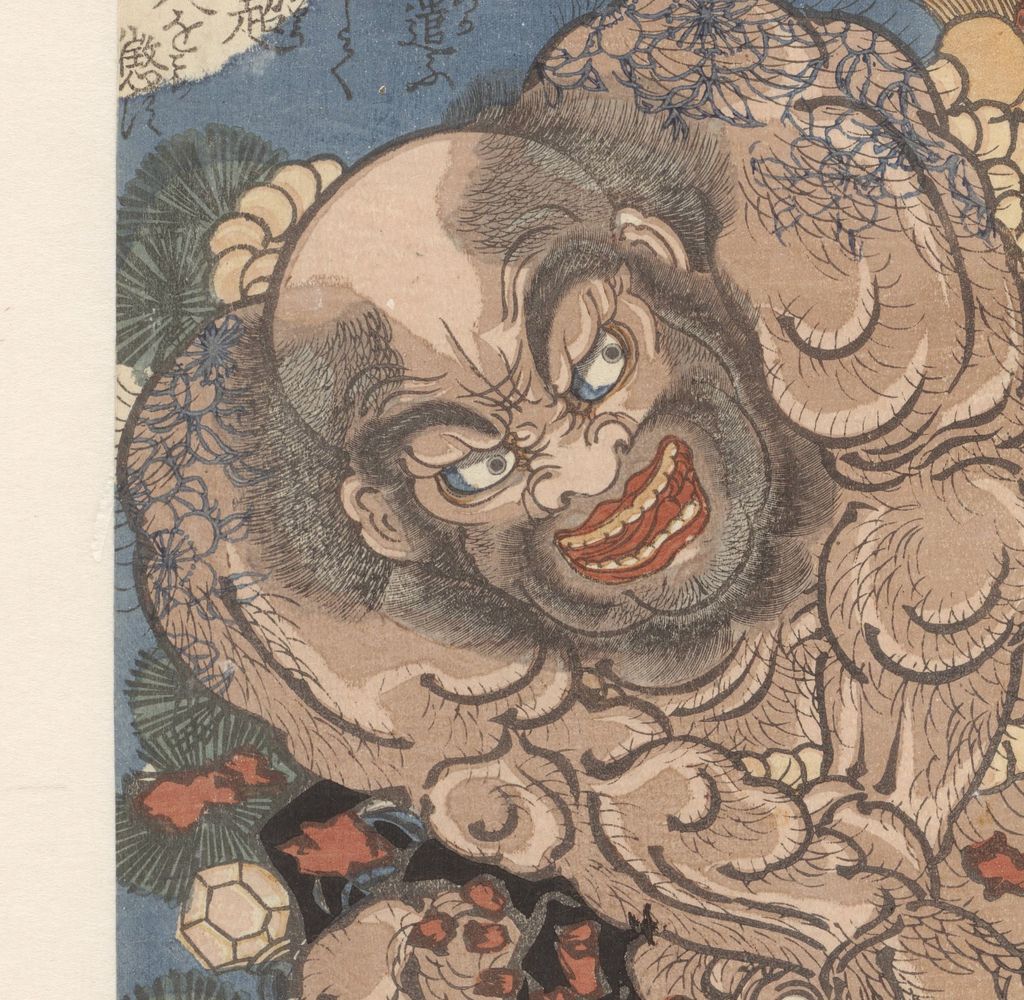 Cropped and resized from Rijksmuseum RP-P-2004-515.
Tattooed shoulder and arm
Curved tattoo lines follow the shoulders; they are distinct from the pine needles and broken wood.
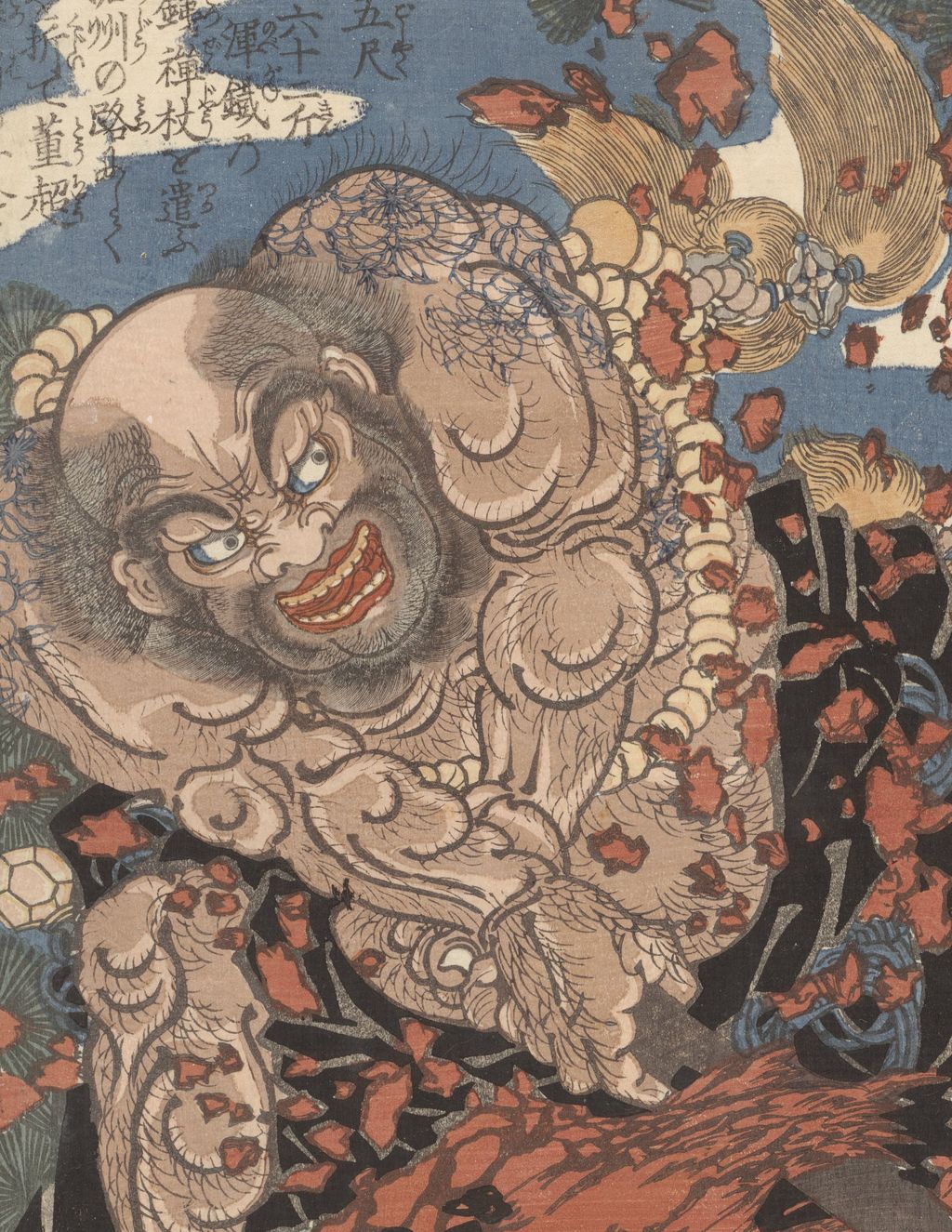 Cropped and resized from Rijksmuseum RP-P-2004-515.
The broken trunk
The diagonal tree and scattered pieces turn bodily force into a visible impact.
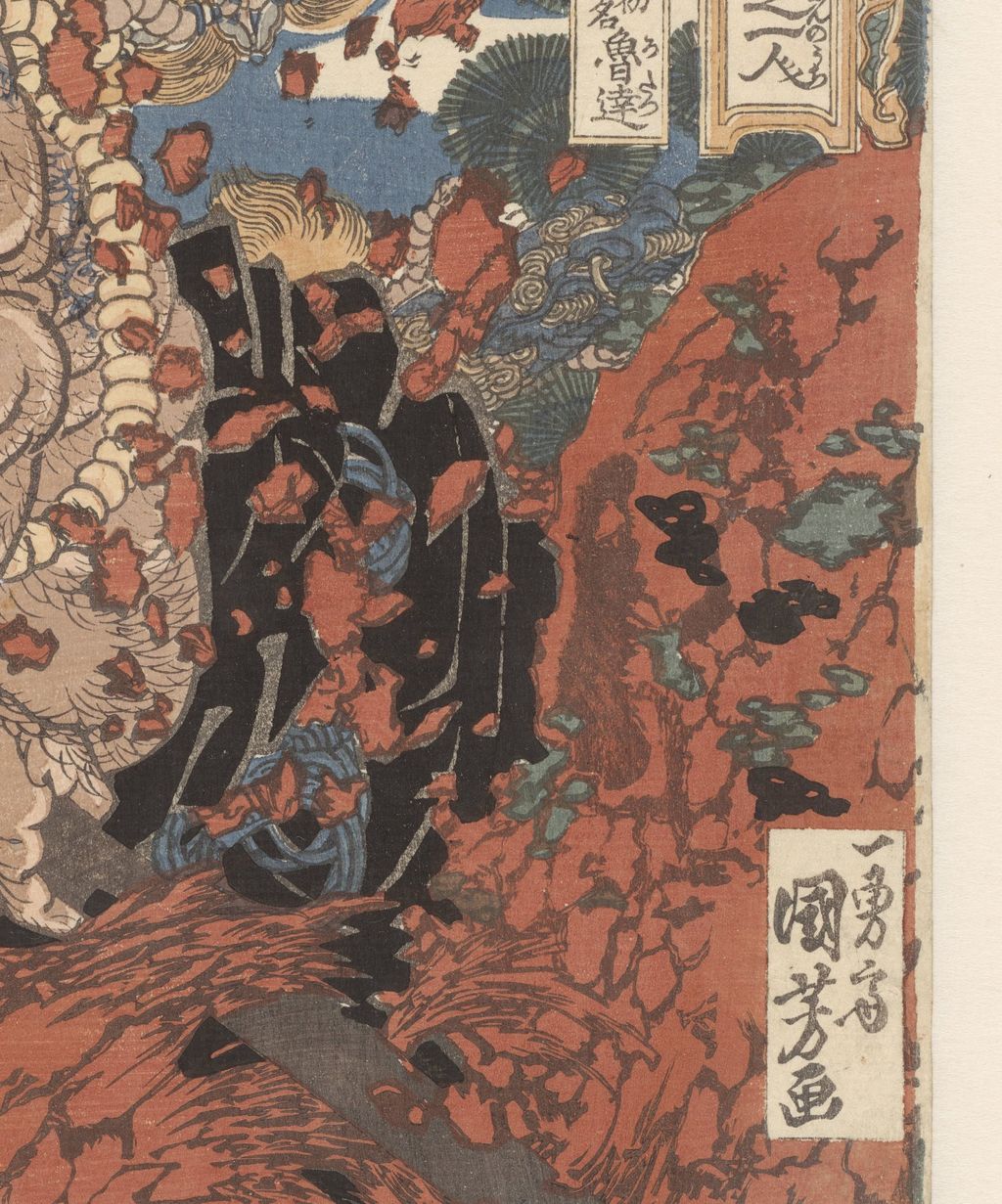 Cropped and resized from Rijksmuseum RP-P-2004-515.
Title and name
The printed cartouches identify the series and Lu Zhishen; the lettering belongs to the design.
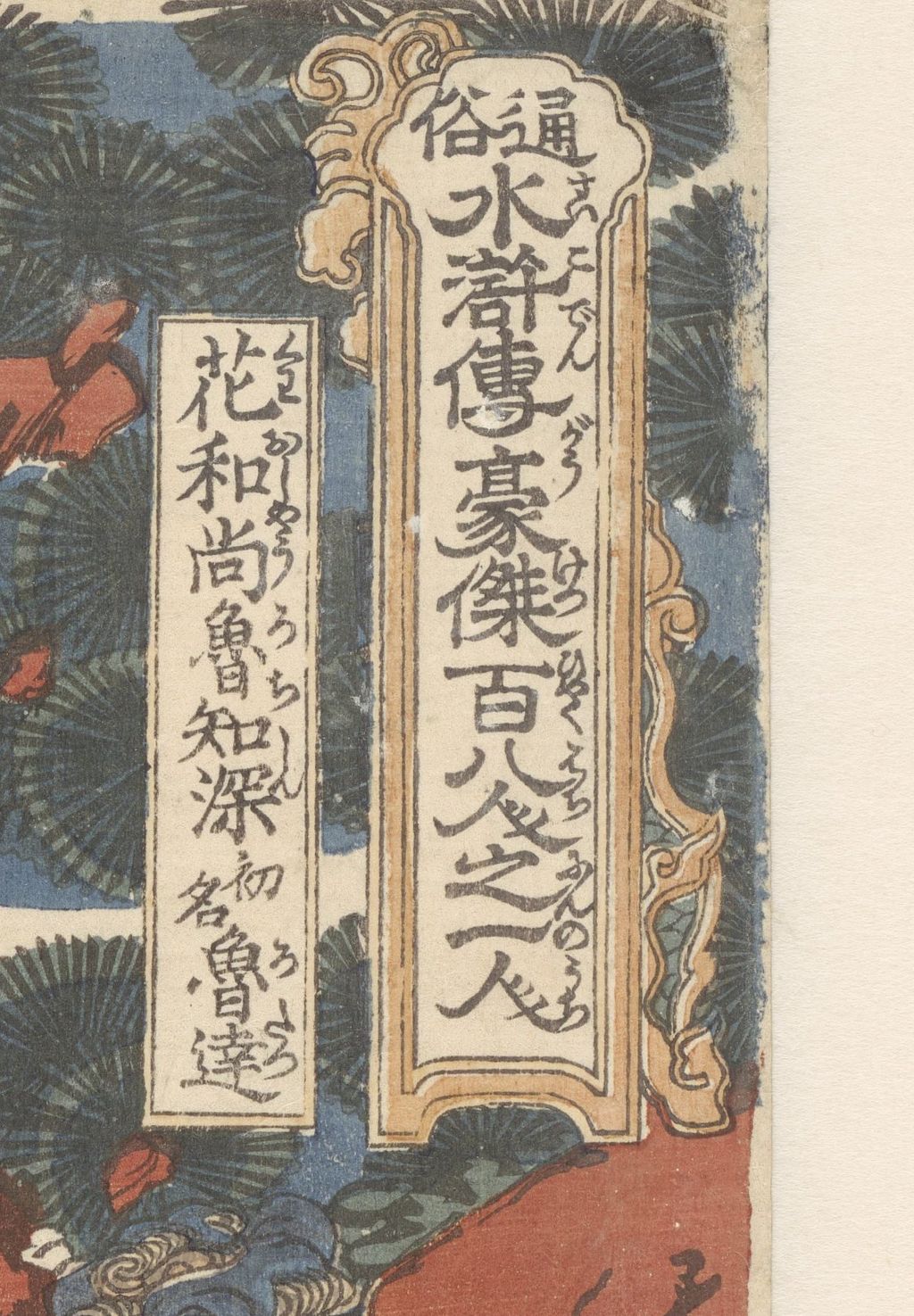 Cropped and resized from Rijksmuseum RP-P-2004-515.
Zhu Gui: a warrior not yet in motion
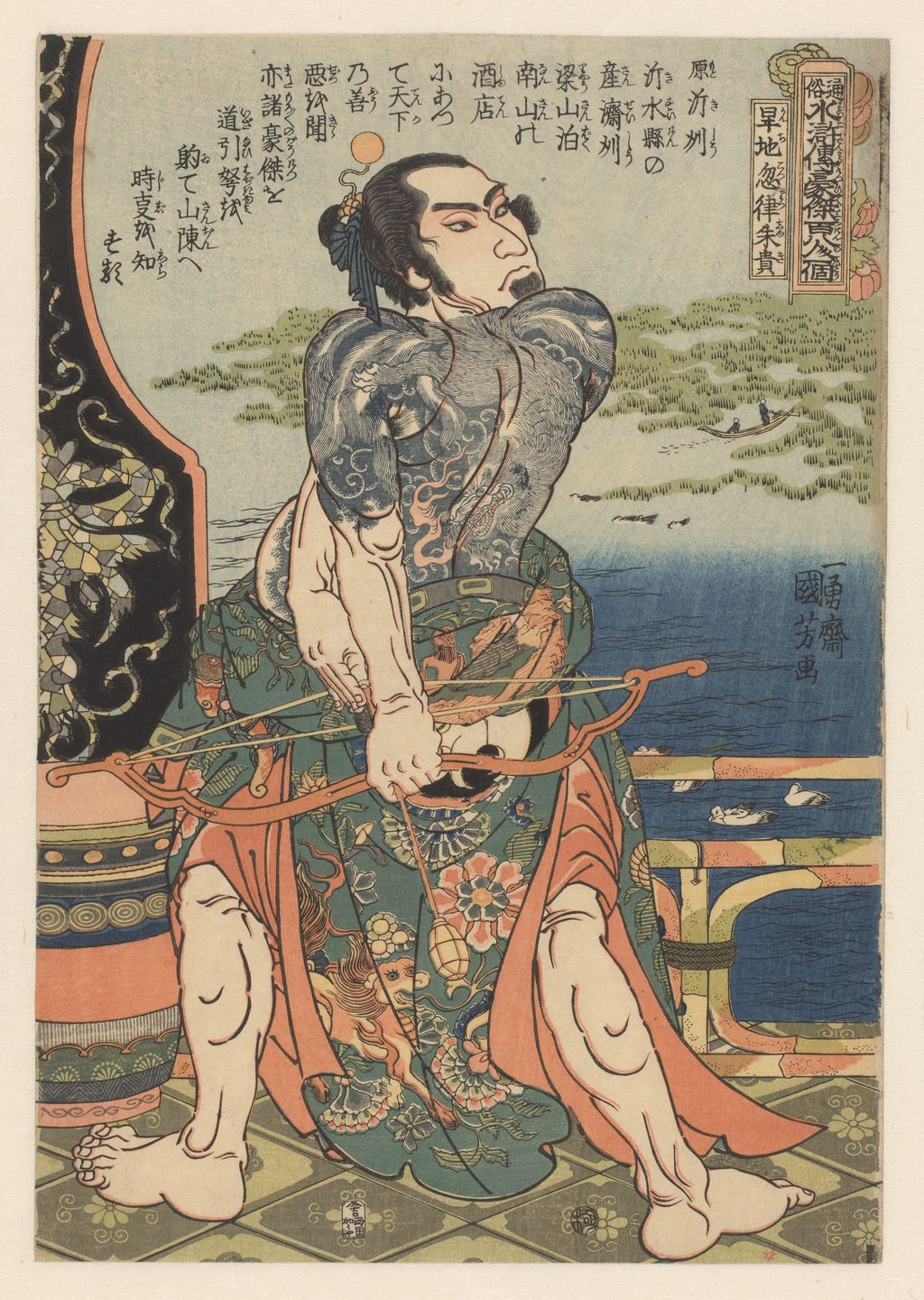
The Rijksmuseum's RP-P-2019-202 [8] gives a useful counterpoint to the tree-breaking sheet. It catalogues 旱地忽律朱貴, Kanchikotsuritsu Shuki in Japanese reading, as a circa-1827 print. The archer holds his bow across his body. His back and arm carry a dark tattoo, but the figure does not burst across a scene in the same way as Lu Zhishen. A tiled foreground and a narrow river behind him give the torso a more stable setting. The tiny boat in the distance is easy to miss at web size. Looking closely turns an apparent warrior portrait into a relation between the armed body and a watery landscape.
The bow's line runs horizontally through the lower half of the figure. His turned head looks away from the direction of that line. This creates a pause, an implied action or alertness rather than a completed shot. The viewer can inspect the line of the bow, the hand, the arrow and the position of the small boat without claiming to know a precise chapter of the Chinese novel from the image alone. The museum title provides the hero; the printed passage may provide more specific narrative context, but it requires a verified transcription and translation before the page can confidently state which incident is shown.
The Rijksmuseum object page marks the image public domain, and its 4612 × 6492-pixel file permits detailed reading. However, the page also gives zero millimetres for the physical dimensions, an evident catalogue gap. This article should cite the accession and image size without repeating that impossible measurement as if it were a factual sheet size. It is a small example of why source-led work includes checking whether a catalogue field makes sense. An official object record is strong evidence for its identity and stated rights, but its data can still be incomplete.
Yan Qing: the body as a place for invention
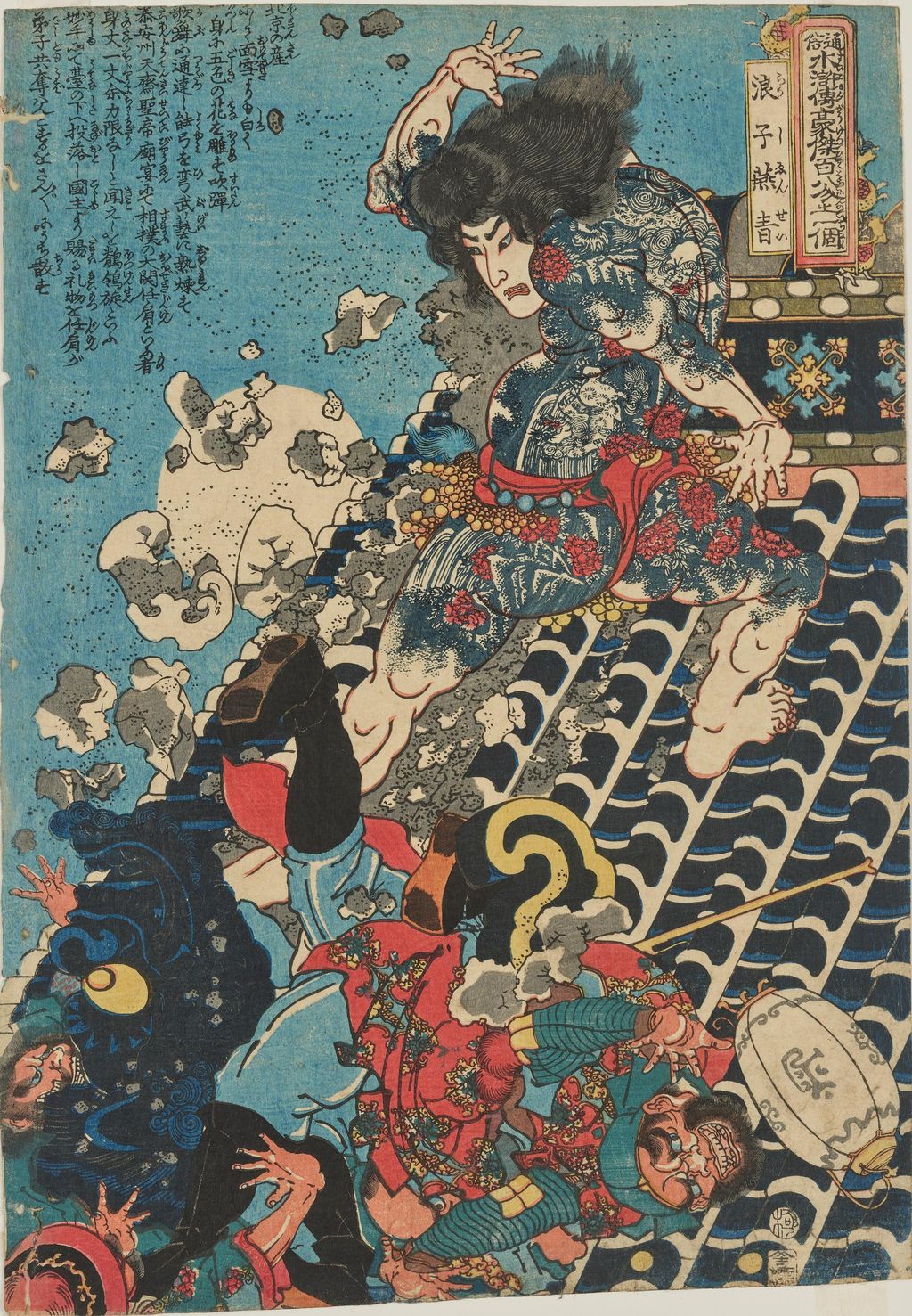
The Tokyo National Museum's A-10569-5423 [7] names 浪子燕青, Rōshi Ensei or Yan Qing, as a hero in Kuniyoshi's series. His image gives another kind of bodily display from Zhang Shun's exposure to arrows or Lu Zhishen's blow against wood. Here the interest of a tattoo can be considered together with the story's characterization of a skilled wrestler. The MFA Boston's account [6] says Yan Qing is described as tattooed in the novel, then specifies the lions among peonies as Kuniyoshi's choice. Those are different levels of evidence. The printed image is not a transparent diagram of the source text, and the artist's motif should not be attributed to the author of Shuihu zhuan.
The density of ornament changes how the torso reads. A large tattoo takes an anatomical plane that could have been left blank and gives it a second story: one sees both the hero's physical capability and an image carried on his skin. In a print, that image is made again through carved lines and colour on paper. The visual puzzle is productive: a representation of a tattoo becomes a test of a printmaker's pattern-making. The wearer is a fictional Chinese hero; the printed tattoo is part of an Edo artistic invention. A modern caption should not leap directly from that invention to a claim about what every Edo person wore on the street.
The Boston discussion also warns against a single-direction account of influence. It notes oral traditions among tattoo artists and the continuing attraction of Kuniyoshi's warriors. Its 2019 tattoo exhibition [5] puts early series sheets alongside later prints and modern tattoo practice. That supports a long and complex reception, not a documented first tattoo copied from a specific accession. The most precise page can say that the series helped make tattooed heroic bodies unusually visible in print and became important to later tattoo imagery, with the museum's wording attached to the claim.
Tattoos are only one part of the visual language
The tattooed body is memorable enough to dominate modern posters and book covers, yet the series also depends on water, weaponry, obstacles and text. The Ōta Memorial Museum [1] emphasizes varied personalities and actions. The named hero must be distinguished from a generic type by the particular challenge and pose. Zhang Shun's surrounding water and gate form a crisis; Lu Zhishen's trunk gives force a material resistance; Zhu Gui's bow creates held tension. Calling all three “tattooed warriors” would discard most of the information Kuniyoshi built into their sheets.
Nor should every patterned area be read as skin. Clothing, water, wood and title ornaments carry repeated shapes of their own. In the Zhang Shun impression, the pattern crossing the exposed body differs from the spirals and straight beams below it. In the Lu print, tattoo lines have to remain distinct from pine needles and jagged wood. A close-looking feature can help a reader identify which lines belong to body, garment, weapon or setting before it tries to decode symbolism. This is more useful than placing unverified hotspots over every decorative form.
Colour also needs an object-specific account. The TNM and Rijksmuseum Lu images appear different in tone on screen, and the Cleveland and TNM Zhang Shun files need not render the same blues and paper colour. Some difference can reflect surviving ink, but digitisation and lighting are also involved. We can describe the particular file we show—its blue tattoo or red-brown wood—while avoiding a false story that Kuniyoshi altered a block or ordered a new palette. A curatorial or conservation study could later justify a state comparison. The image viewer should currently be called an impression comparison, not an edition sequence.
A series, a print and a publishing network
Seventy-four known designs are a substantial visual undertaking, but the figure does not tell us how many copies were printed or sold. A design could be cut into blocks and printed repeatedly; individual impressions might be trimmed, mounted, damaged or preserved in quite different ways. A museum accession identifies one physical survivor. The Ōta Museum's 73-sheet exhibition [1] was therefore an assembly of surviving examples of designs, not a recovery of a unique original set that Kuniyoshi personally bound. The exact number needs its qualifier: “74 known designs according to Ōta,” not “74 prints sold” or “74 heroes in the novel.”
The difference between drawing, carving, printing and distribution is easiest to remember when a named publisher appears in a record. Rijksmuseum RP-P-2004-515 [8] credits Kagaya Kichiemon for its Lu Zhishen impression. British Museum 1906,1220,0.1261 [10] gives Ibaya Senzaburō for another early hero. These are the names of people or firms that helped turn the artist's images into objects for circulation. A page can explain the general collaborative process, but it should attach a particular cutter or publisher only to the object for which a museum actually records that person.
Kuniyoshi's Suikoden interests also reached illustrated books. The National Diet Library's account of the 1830 Kanagaki Suikoden [11] names Ryūtei Tanehiko as writer, Kuniyoshi as illustrator and Nishimuraya Yohachi as publisher. A book opening offers text and image in sequence, while an upright single sheet has to make one character and incident persuasive at a glance. The name Suikoden therefore links media that should remain distinct in captions. The 1830 book is evidence of a related publishing project, not a missing sheet of the original hero series or proof that Nishimuraya published all its prints.
What came after the first heroes
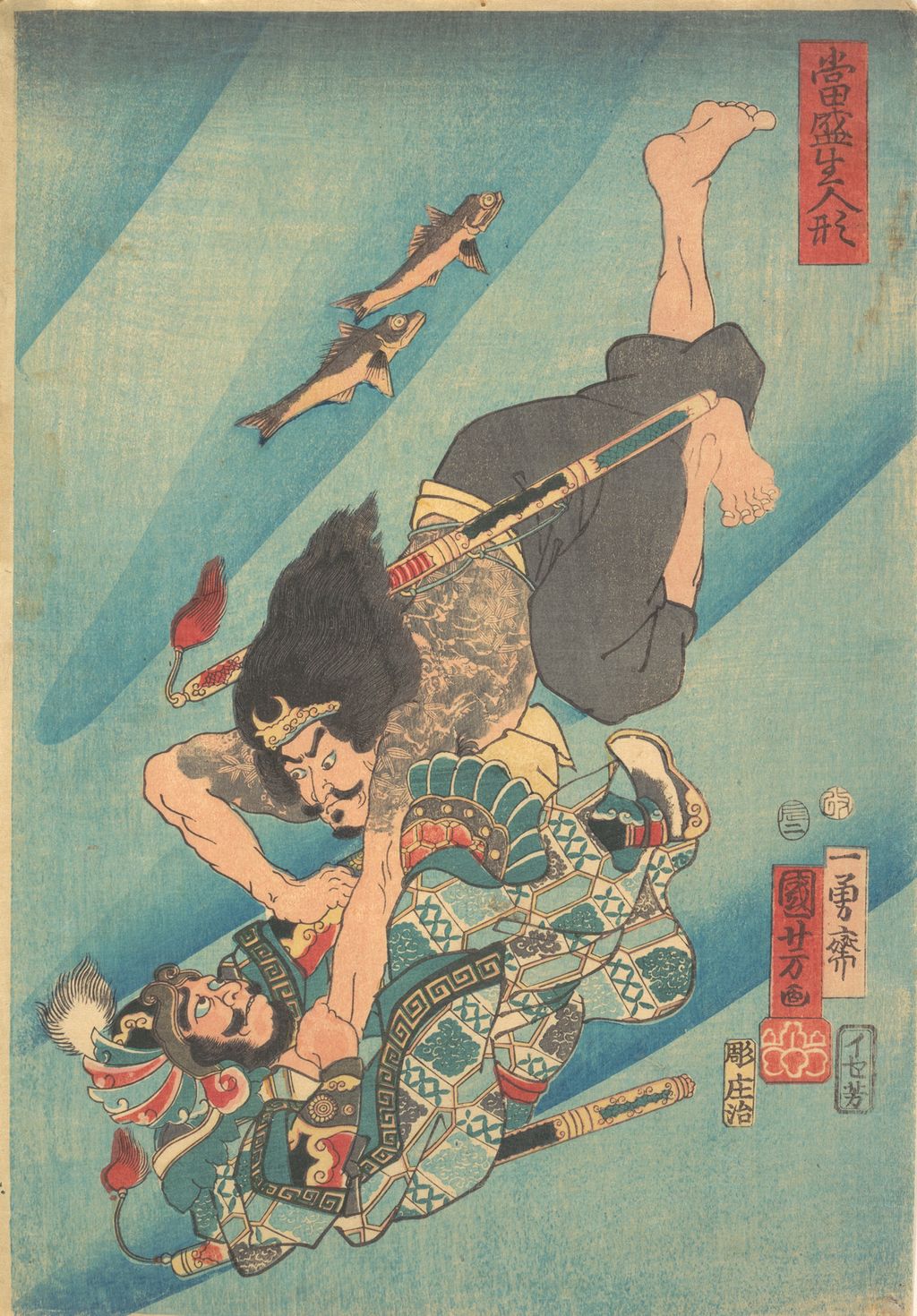
The success of one formula invites variation. The Ōta Museum's Kuniyoshi heroes exhibition [1] deliberately set the first series beside comic and female versions and a Japanese Water Margin hero group. A woman can be made to stand for a hero; a contemporary performer can borrow a familiar heroic pose; the format of a toy or game can turn a dramatic figure into playful material. These works show cultural reach without changing the count of original-series designs. The Rijksmuseum's 1832 Elegant Women as Heroes of the Suikoden sheet RP-P-1958-497 [14] is catalogued as a surimono in a differently titled series, with a woman playing a one-string koto. Its refined format and female subject make the distinction visible at once.
A much later comparison is the Met's Tanmeijirō Genshōgo Fighting Under Water, 2001.715.9 [12], dated 1856, second month. The hero's name and underwater action can recall earlier Suikoden sheets, but the Met's title and date are those of this specific object. MFA Boston has an early Tanmeijirō from the original series dated about 1827–30 [5]. Presenting the two as a before-and-after can demonstrate Kuniyoshi's continuing interest in the story. Presenting the 1856 image as an original-series sheet would erase nearly three decades of development and mislead the reader about both objects.
Other artists also adapted the narrative. The Met's circa-1835 tetraptych by Shunbaisai Hokuei [12] invents an encounter of four actor characters who did not actually appear together on the Osaka stage, according to its catalogue. The Met's 1863 Kunisada print [12] shows major kabuki performers in a Japanese Suikoden adaptation. Such records show that the story moved through theatre, print and parody beyond one artist's early series. They should be used as contextual comparisons with their makers plainly named, not slipped into a Kuniyoshi image gallery.
How the images and sources are used here
The display images come from object-specific records. The ColBase Tokyo National Museum sheets [7] are available for commercial publication with attribution under ColBase's terms; their image credit must link the object and disclose resizing or any crop. The Rijksmuseum's Lu Zhishen [8] and Zhu Gui [8] are marked public domain on their object pages. The Cleveland Zhang Shun [9] is CC0, and the Met 1856 comparison [12] is public domain. Original files, accession numbers, rights wording and the 1024-pixel, quality-80, 144-dpi derivatives are retained in the image ledgers. Research images from museums with restricted terms do not inherit those rights merely because the nineteenth-century design itself is old.
There is no suitable vintage photograph of Zhang Shun's fictional water-gate incident or Lu Zhishen's printed pine that could honestly act as evidence for these pictures. Hangzhou is named in the Ōta interpretation [1], but a nineteenth-century photograph of the city would depict a different moment and place-specific reality from Kuniyoshi's imagined scene. A separately dated view could be useful in a future article about how Suikoden was read geographically. Here it would distract from the story and invite a false implication that the print copied that view. The richer historical record is in the sheets and their inscriptions.
The proposed interactive feature begins with the series distinction: 108 story heroes and 74 known Kuniyoshi designs. A reader can select a named hero, see the full museum sheet with its accession, and open short notes on the action, inscriptions and print surface. A Lu Zhishen annotation can use the high-resolution Rijksmuseum file to show the face, tattoo, falling wood and title cartouches; its detail panels state that they are crops. A Zhang Shun comparison aligns the TNM and Cleveland impressions, with a source link for each. The Japanese version should use the original character names and explain the distinction between title variants, story names and present-day museum readings rather than merely translate the English labels.
Reading the series today
The most rewarding way into these prints is to let the named incident guide the eye. Start with Zhang Shun's sword and gate, then discover that the Ōta account [1] places him at the edge of death. Look next at Lu Zhishen's tree and ask how a single diagonal can make strength visible. Pause with Zhu Gui and notice that a bow and tattoo can hold a figure in readiness instead of forcing a violent climax. Each sheet delivers a different way of making a hero memorable. The text cartouche, name, body and setting work together; none is merely a caption for the others.
The series made Kuniyoshi's reputation, but it did not lock him into one subject. His later prints turn to cats, ghosts, actors, women, books and landscape. The heroic sheets matter within that larger career because they show him solving a central printmaking problem: how to make a story known to readers vivid in one portable image. Source records let us recover what those images actually show, while the separate impressions remind us that a famous design is still encountered through particular surviving objects. The difference between the 108 characters of the tale, Ōta's 74 known designs and the individual sheets on this page is the key to looking accurately.
Reader insights and discussion
Look at one Kuniyoshi print closely, then share what its figures, text and format reveal.
Reader Insights
How do the joins shape the story in the skeleton triptych?
What changes when you read a cat or warrior print’s title?
Where does your eye go in a Suikoden sheet compared with the Ōmori landscape?
Join the Conversation
Share a print or detail that changed how you see Kuniyoshi.
References
- Ōta Memorial Museum, Kuniyoshi Heroes: Heroes from Tales of the Water Margin, 2016. Series breakthrough, 74 known designs, early date, Zhang Shun scene and later adaptations.
- Ōta Memorial Museum, Ukiyo-e and China, 2023. Japanese exhibition account of Chinese narrative in ukiyo-e and the 74-design series.
- Ōta Memorial Museum, Li Jun collection note. Chapter-specific description and 74 currently known designs.
- Tokyo National Museum, 2013 newsletter. Japanese account of Kuniyoshi's breakthrough and the donated Suikoden sheets.
- MFA Boston, Tattoos in Japanese Prints. Early Tanmeijirō sheet and tattoo reception.
- MFA Boston, Showdown! Kuniyoshi vs. Kunisada. Yan Qing, lion-and-peony tattoo and the artist's invention.
- ColBase, Tokyo National Museum, Zhang Shun A-10569-5426; Yan Qing A-10569-5423; Lu Zhishen A-10569-5427. Exact objects and downloadable images.
- Rijksmuseum, Lu Zhishen RP-P-2004-515; Zhu Gui RP-P-2019-202. Object attribution, dating, rights and image files.
- Cleveland Museum of Art, Zhang Shun 1980.85. Late-1820s CC0 impression.
- British Museum, Li Gun 1906,1220,0.1247; another early series sheet 1906,1220,0.1261. Series identity, date and publisher evidence.
- National Diet Library, Kanagaki Suikoden. The 1830 illustrated-book collaboration.
- Metropolitan Museum of Art, Tanmeijirō Genshōgo Fighting Under Water, 2001.715.9. Dated 1856 comparison; Hokuei theatrical Suikoden tetraptych and Kunisada theatrical print for other-makers context.
- Smithsonian's circa-1830 Eight Hundred Heroes of the Water Margin of Japan object
- Rijksmuseum's 1832 Elegant Women as Heroes of the Suikoden sheet RP-P-1958-497
