 by Tom Gurney
Tom Gurney BSc (Hons) is an art history expert with over 20 years experience
Page Created on August 30, 2026 / Page Updated on November 6, 2026
Email: tomgurney1@gmail.com / Phone: +44 7429 011000
Eye-Balloon: Introduction
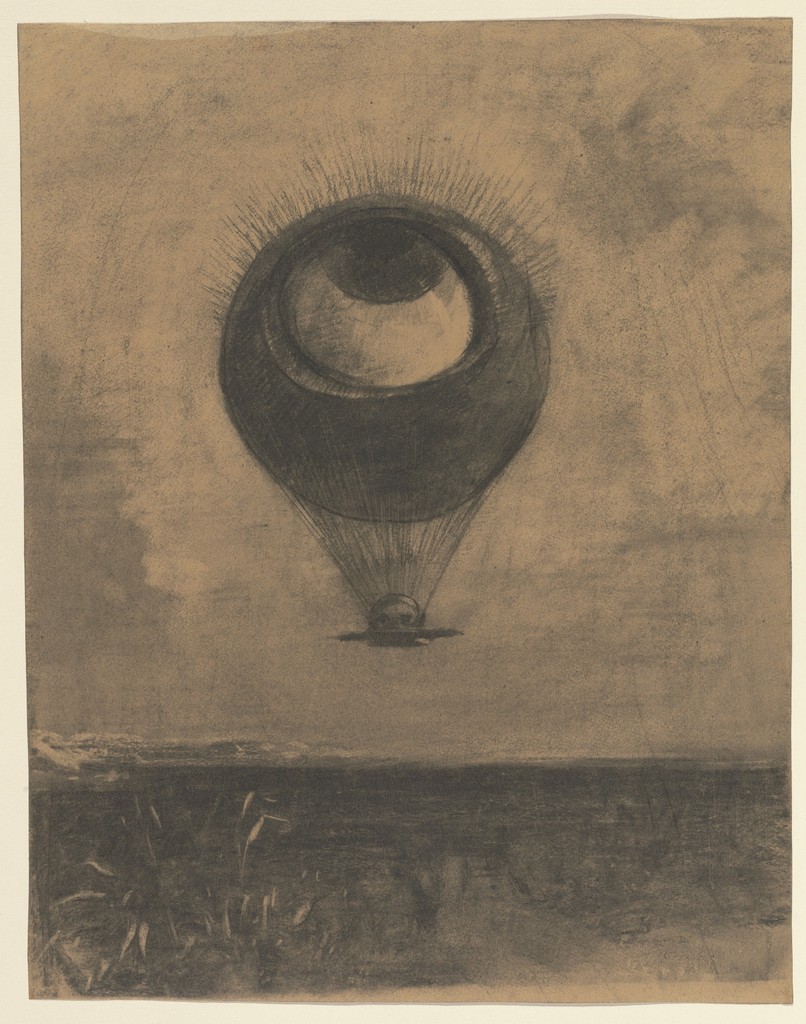
A huge eye rises like a balloon above a low, dark horizon. Fine cords descend from its rounded body to a severed human head resting on a shallow carrier, so that sight, face and flying machine become one improbable apparatus. Odilon Redon made Eye-Balloon (Œil-ballon) in 1878, using charcoal and chalk on coloured paper. The Museum of Modern Art, New York, records the sheet as object 4.1964 and measures it at 42.2 × 33.3 centimetres.[1] Its strangeness is immediate, but the image does not depend on strangeness alone. Redon makes an impossible being seem subject to weight, atmosphere and distance.
At a Glance
- ArtistOdilon Redon (1840–1916).
- Date and medium1878; charcoal and chalk on coloured paper.[1]
- Dimensions42.2 × 33.3 cm.[1]
- Subjectan eye-shaped balloon carrying a severed head above a marsh-like landscape.
- Key distinctionthis drawing is not the separate 1882 lithograph associated with Redon's album To Edgar Poe.[2]
- Current collectionThe Museum of Modern Art, New York; object 4.1964. Its display status can change, so visitors should check MoMA's record.[1]
Odilon Redon in context
Eye-Balloon
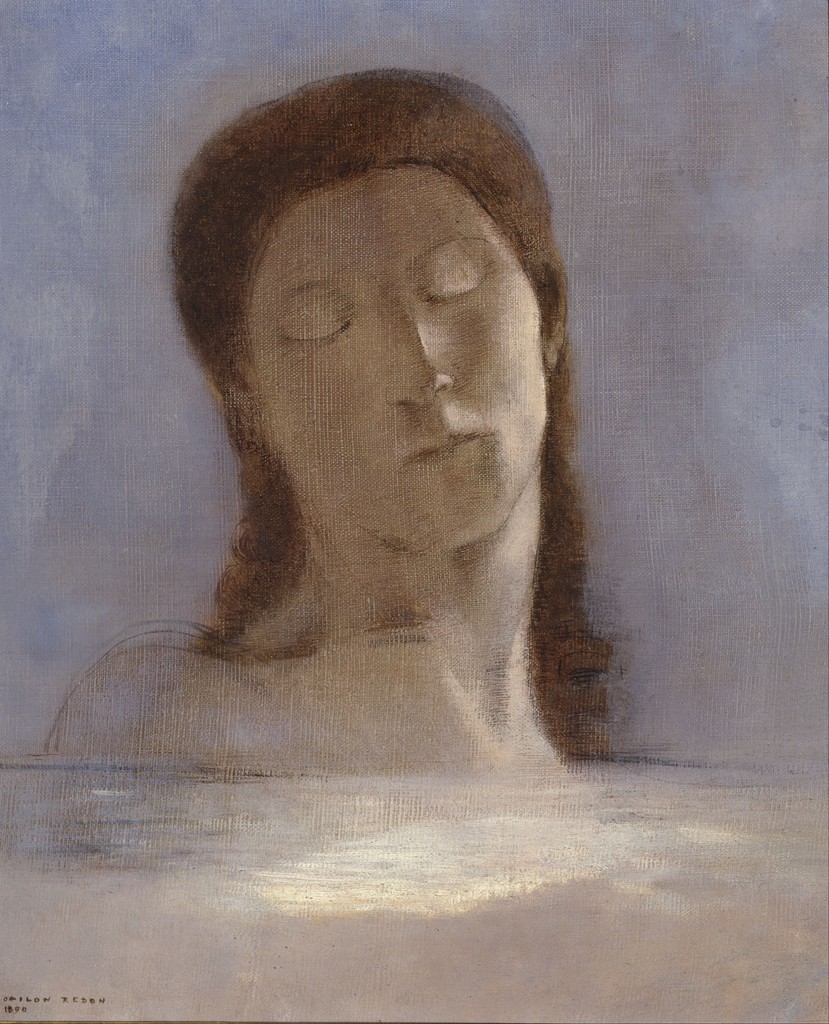
1878Closed Eyes
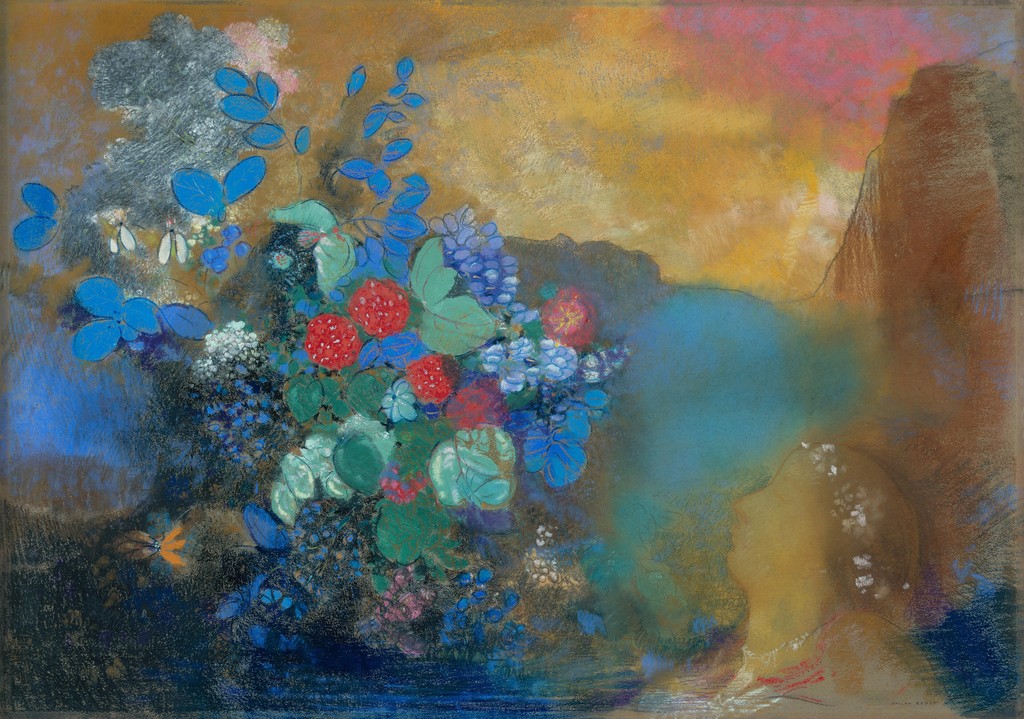
1890Ophelia among the Flowers
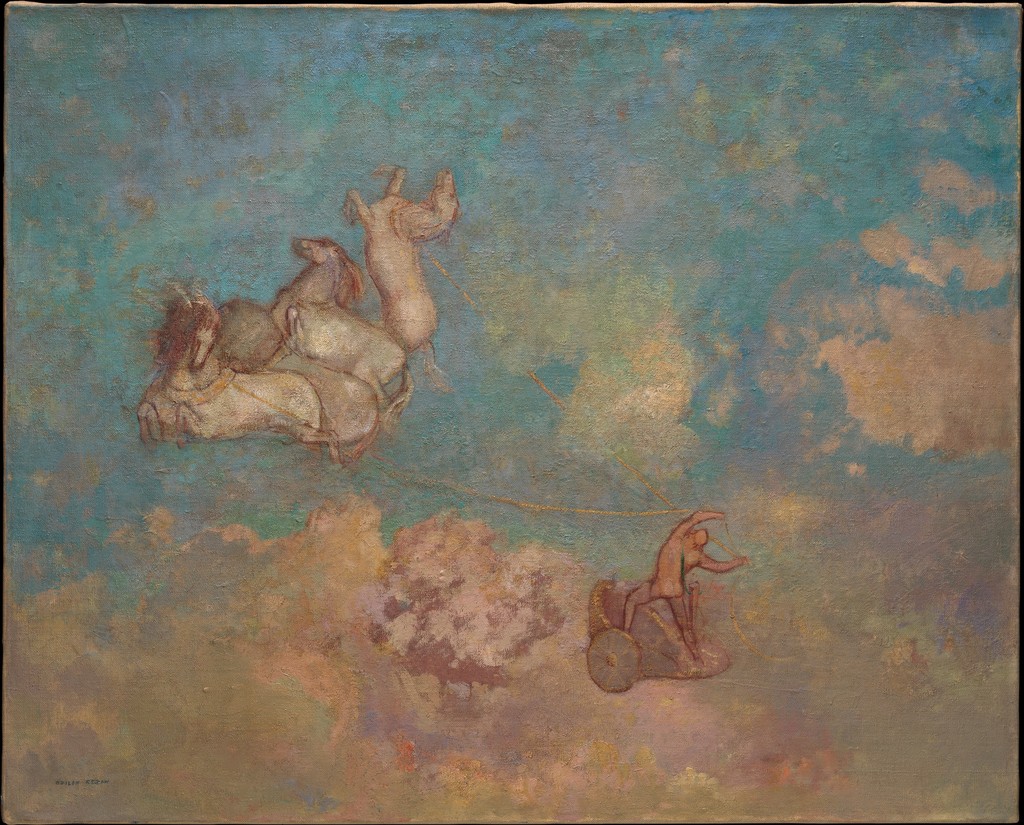
c. 1905–08The Chariot of Apollo
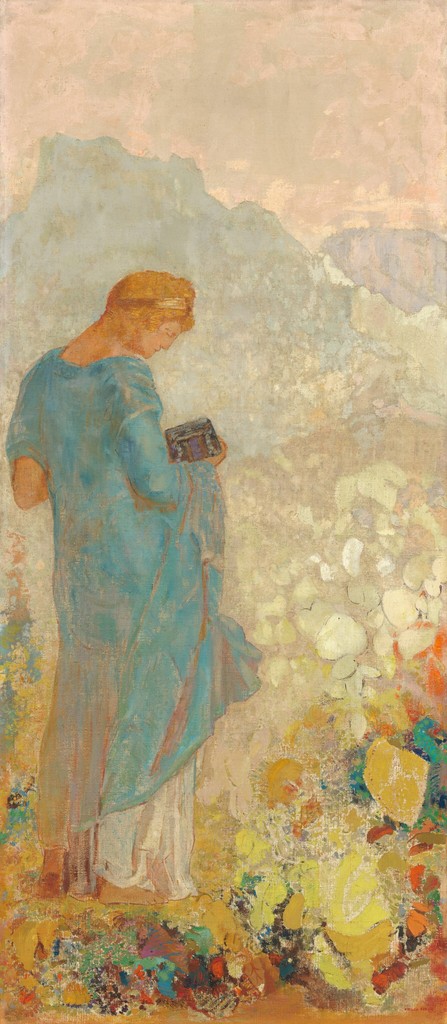
1905–16Pandora
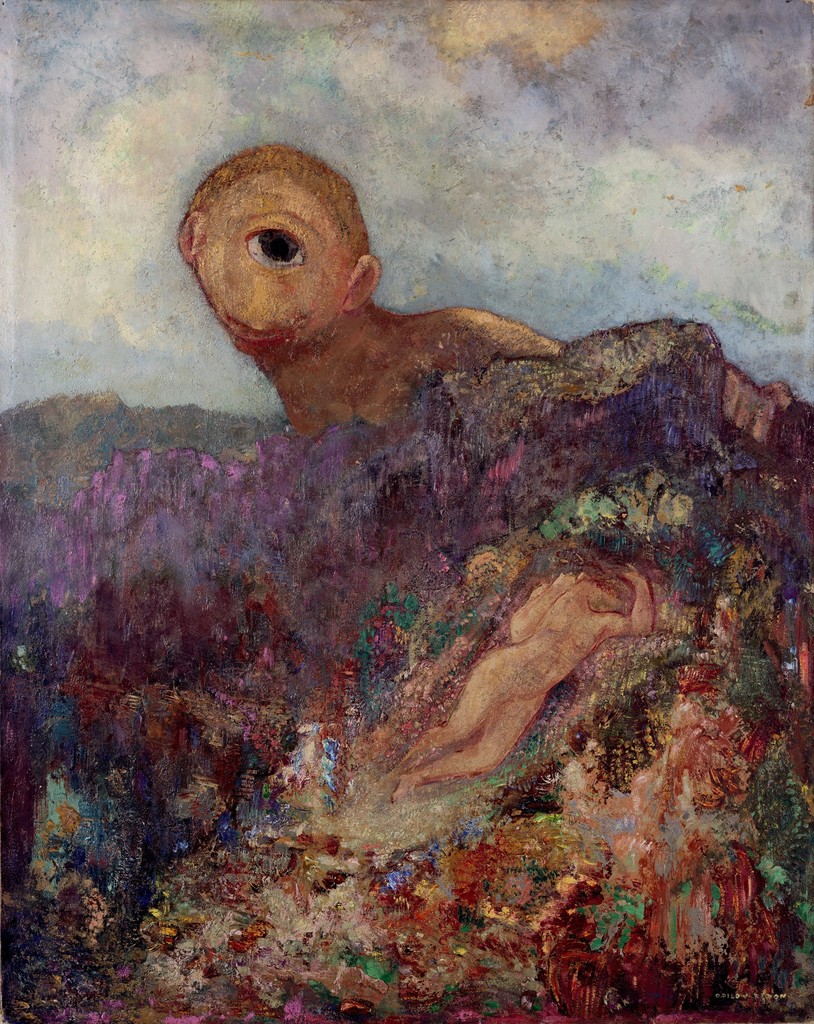
1910/12The Cyclops
c. 1914Contents
- Introduction
- A Guided Route Through the Image
- An Eye, a Head and a Basket
- Charcoal as Weather and Substance
- Making the Invisible Plausible
- The Eye as a Recurrent Motif
- The 1878 Drawing and the 1882 Lithograph
- Reception and the Work at MoMA
A Guided Route Through the Image
Begin at the upper centre, where a dark circular mass occupies much of the sheet. The form reads first as an eye: an oval opening suggests the pale globe, while a black pupil hangs beneath a heavy upper lid. It also reads as a balloon envelope. Short, radiating strokes around the rim resemble hairs, lashes or a fringe of energy, preventing the contour from becoming mechanically smooth. The hybrid is legible because Redon preserves enough of both sources. It is not merely an eye enlarged, nor simply a balloon decorated with an eye.
Follow the thin converging lines downward. They translate the eye's lower edge into the rigging of an aircraft and lead to a tiny human head. MoMA describes the head as severed and set on a plate.[1] In visual terms, the flat support also occupies the place where a balloon's basket would be expected. That double identity matters: the head appears both carried passenger and bodily fragment. The contraption seems to have escaped the ordinary body, yet it has taken a remnant of that body with it.
Only after reading this vertical structure should the eye move to the landscape. A narrow band divides sky from darker ground or water. Pale marks at the left suggest a distant shore, while broken strokes below evoke reeds or rough vegetation. The site is sufficient to establish altitude and scale but too indefinite to become a named place. This balance between observed structure and imagined event is characteristic of Redon's art, which MoMA places between description and dream, the natural world and fantastic transformation.[3]
An Eye, a Head and a Basket
The drawing's disturbing force comes partly from the way it separates functions normally joined in a person. The eye sees; the head thinks and recognises; the basket carries. Redon converts those roles into independent components of a vertical machine. Yet the parts never settle into a practical mechanism. The eye has no conventional envelope around it, and the head has no body from which to act. Visual coherence and bodily incoherence coexist.
Scale intensifies the dislocation. The eye is colossal beside the head, while both float far above the narrow earth. The head cannot plausibly control its vehicle. Nor does the eye simply belong to it. This uneven hierarchy invites different readings: vision might be carrying consciousness beyond material limits, or an immense power of seeing might be transporting a helpless human remnant. The sheet does not decide between liberation and threat.
That uncertainty is why a single label such as surveillance, spirit or death is too restrictive. Each idea can illuminate part of the image, but none accounts for every element. The exposed eye can imply watching or intensified perception; ascent can suggest release; the severed head can suggest mortality or detachment. The sombre atmosphere can make the voyage ominous, while the upward movement can also appear exploratory. Redon's achievement is to keep these implications active without turning the drawing into an emblem with one authorised translation.
Charcoal as Weather and Substance
Eye-Balloon belongs to the works Redon called his noirs, a name that joins blackness to medium rather than merely describing a gloomy subject. MoMA emphasises that charcoal's material behaviour is central to this drawing: blurred and erased passages around the airborne eye make the sky nebulous and foreboding.[1] The background is therefore not an empty field behind a finished creature. Smudges, veils and lifted areas create the atmosphere through which it appears to move.
The coloured paper participates too. Its warm middle tone remains visible between the darkest deposits and the lighter marks. That support lets Redon work in more than a simple opposition of black line and white ground. Dense charcoal makes the eye feel heavy and almost solid; thinner deposits allow the surrounding air to remain porous. Chalk provides another value within this range, although the museum record does not justify assigning every pale passage to one exact tool.[1]
Redon varies his handling according to the role of each form. The eye is built with concentric bands, compact shading and emphatic contours. The suspension lines are fine and tensile. The landscape is abbreviated, and the sky is rubbed, disturbed and partially cleared. These changes allow one sheet to hold object, engineering diagram and weather. They also make the viewer alternate between recognising a scene and attending to powdered matter on paper.
Current technical research into nineteenth-century black drawing warns against identifying materials solely by unaided appearance. The Getty notes the era's expanded range of charcoal, fabricated chalks, Conté crayon and lithographic crayon, as well as artists' use of blending, scraping, erasure and fixatives.[4] For this particular sheet, MoMA's designation—charcoal and chalk on coloured paper—should govern. The wider research helps explain why black drawing could offer Redon so many textures without licensing a more precise recipe than the object record supplies.
Readers interested in this material language can continue to Redon's noirs, prints and drawings, where charcoal sheets and lithographic albums are considered without collapsing them into one process.
Making the Invisible Plausible
MoMA relates Eye-Balloon to Redon's stated ambition to use the logic of visible things in the service of the invisible.[1] The phrase helps because the drawing is not formless fantasy. An eye has an observable anatomy; a balloon has volume, rigging and a suspended load; a horizon establishes gravity and distance. Redon recombines those intelligible relations until they support a being that could not exist.
Scientific observation and imagination are thus not enemies here. The rounded form suggests pressure and buoyancy, the narrowing cords suggest suspension, and the smaller lower unit gives the whole structure an apparent function. At the same time, none of this makes the creature anatomically or mechanically possible. Getty identifies modern science, nature, religion, mythology and literature among Redon's broad sources of inspiration, while MoMA stresses his transformations of the observed world.[3][5] Those contexts support a habit of imaginative hybridity, but they do not prove that this drawing illustrates a particular experiment or scientific text.
The low viewpoint completes the fiction. Because the horizon sits well below the central form, the viewer seems to look outward and upward. The eye is not pasted onto a neutral field; it occupies an apparent interval between earth and sky. Atmospheric charcoal then weakens the border between solid body and surrounding vapour. The visible gives the apparition rules, while erasure and blur keep those rules from closing around it.
For a broader account of Redon's literary and speculative sources, see Symbolism, dreams and imagination. The drawing is a powerful Symbolist image precisely because it generates associations rather than decoding itself into a fixed message.
The Eye as a Recurrent Motif
Redon returned repeatedly to isolated eyes, floating heads and bodies joined across species. The eye suited his project because it points in two directions at once. It receives information from the world, but it also suggests inward consciousness, dream and imagination. Once removed from a normal face, it can become an actor rather than an organ: it watches, travels, hovers or confronts the person looking at it.
In Eye-Balloon, the eye's position is especially unstable. It seems to look outward, yet its pupil also functions as a dark mass within the flying body. The radiating lashes are bodily details and atmospheric accents at the same time. The viewer may feel watched, but the drawing offers no visible target for the eye's attention. This lack of a clear exchange prevents the motif from becoming a straightforward sign of surveillance.
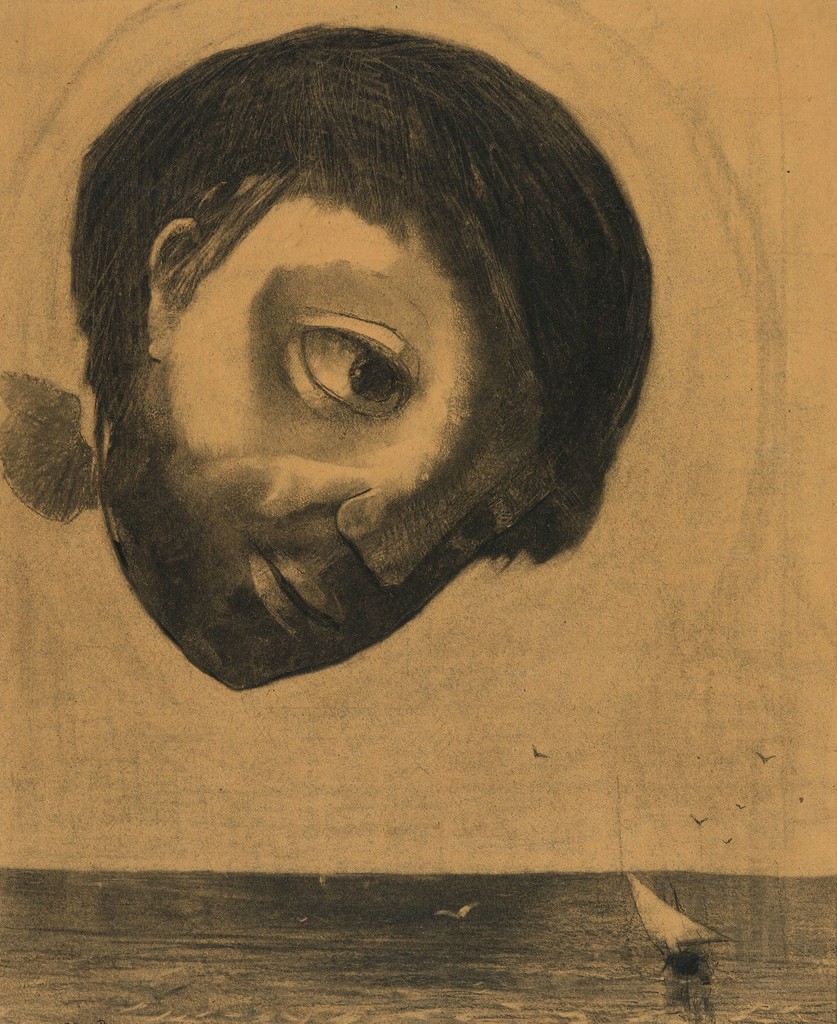
Comparison with Guardian Spirit of the Waters, another charcoal drawing of 1878, clarifies Redon's flexibility. Both place an enormous head-like presence above a miniature landscape, yet the guardian's face remains more recognisably human and its relation to the vessel below is different. The comparison reveals a shared interest in scale and apparition rather than a single repeated code.
The 1878 Drawing and the 1882 Lithograph
Four years later, Redon revisited the airborne eye in The Eye like a Strange Balloon Mounts toward Infinity. MoMA dates that work to 1882 and identifies it as a lithograph on chine appliqué. Its composition measures 25.9 × 19.6 centimetres; the museum's impression is a proof without letters, outside an edition of fifty, printed by Lemercier et Cie. and published by G. Fischbacher in Paris.[2] Those facts belong to the print, not to the 1878 sheet.
The distinction is more than clerical. Lithography gave Redon gradations of light and dark, fine linear work and the ability to circulate images in editions. MoMA credits that wider circulation with helping his reputation grow among artists and writers drawn to fantastic and mysterious subjects.[2] Recasting an earlier charcoal invention as a lithograph therefore moved it into a different material and social life. A unique drawing and an editioned print ask different questions of surface, repetition and audience.
The 1882 image belongs to Redon's six-print album To Edgar Poe. The dedication creates a literary atmosphere around the motif, but it does not make the 1878 drawing a direct illustration of a Poe story. The eye-balloon existed before the album, and MoMA describes most of Redon's literary albums as based on thematic or literary subjects rather than presenting this plate as a literal scene from one text.[2] The safest relationship is one of affinity and reinvention: an existing visual idea entered a Poe-inspired sequence and acquired new associations.
Keeping the two works separate also improves close looking. The charcoal sheet uses a broad, worked sky and the colour of its support to surround the apparition. The lithograph translates the conception into marks suited to printing and a planned album. The later title's reference to mounting toward infinity sharpens the sense of ascent, but it should not replace the concise museum title Eye-Balloon (Œil-ballon) when identifying the 1878 drawing.
Reception and the Work at MoMA
Redon's strange creatures eventually found an especially receptive audience among Symbolist poets and artists in late nineteenth-century Paris. MoMA connects that response to his effort to make dreams and fantasies visible, and its broader exhibition history positions his charcoal, pastel, painting and print practices near the beginnings of modernism.[1][3] Eye-Balloon can look uncannily modern because it fuses body, technology and atmosphere without explaining the result, but its 1878 date places that invention firmly within Redon's early mature work.
The drawing is now in MoMA's Department of Drawings and Prints, a gift of Larry Aldrich, with object number 4.1964.[1] The museum's online record currently says it is not on view. That notice concerns display, not ownership: gallery rotations and loans can change, while the collection record remains the reliable place to confirm current access before a visit.
Within Redon's life and career, the sheet marks a moment before his best-known lithographic albums and long before colour became prominent. It already establishes the durable terms of his art: exact observation reorganised into a hybrid, material technique made inseparable from mood, and meaning kept open through a carefully constructed image.
Researched works directory
This searchable evidence census was assembled from public museum records and a reproducible Wikidata snapshot. It is not a catalogue raisonné, a claim to complete oeuvre coverage, or a substitute for Alec Wildenstein's printed catalogue, which was not consulted for this directory.
| Name | Date | Medium |
|---|---|---|
| A La Vieillesse (To Old Age) | 1886 | |
| A Madman in a Dismal Landscape | 1885 | |
| A Woman Reading a Book or Reading | 1914 | Painting |
| Allégorie : un arbre rouge non rougi par le soleil | 1905 | Painting |
| Alsace | 1914 | Painting |
| Andromeda | 1907 | Painting |
| Andromeda | 1912 | Painting |
| Andromeda enchained | 1905 | Painting |
| Anémones | Date unknown | Painting |
| Anemones and Tulips | 1902 | Painting |
| Animals at the Bottom of the Sea | Date unknown | Painting |
| Antoine: Quel Est Le But de Tout Cela? ... | Date unknown | |
| Apache (Man on Horseback) | Date unknown | Painting |
| Apache (Man on Horseback II) | Date unknown | Painting |
| Apollo | 1905 | Painting |
| Apollo's chariot | 1910 | Painting |
| Apollon vainqueur du serpent Python | 1872 | Painting |
| Apollonius | 1896 | Drawing |
| Apparition | 1905 | Painting |
| Apparition | 1907 | Painting |
| Apres cela je vis descendre du ciel un ange qui avait la clef de l'abime, et une grande chaine en sa main (And I saw an angel come down from heaven, having the key of the bottomless pit and a great chain in his hand) | 1899 | |
| Arabe musicien | 1893 | Painting |
| Arbre dans la lande | Date unknown | Painting |
| Arbre (Tree) | 1892 | |
| Arbres sur un fond jaune | 1901 | Painting |
| Ari | 1898 | |
| Armor | 1891 | Drawing |
| At the Bottom of the Sea | 1905 | Painting |
| Au réveil j’aperçus la Déesse de l’Intelligible au profil sévère et dur [Bij het ontwaken zag ik de godin van het begrijpelijke in een streng en hard profiel], uit de reeks Hommage à Goya. 6 lithographies par Odilon Redon | 1885 | |
| Autoportrait en buste | 1876 | Painting |
| Bain de Venus | 1900 | Painting |
| Barbizon en automne | Date unknown | Painting |
| Baronne de Domecy | 1900 | Painting |
| Baronne Robert de Domecy | 1900 | Painting |
| Barques | 1885 | Painting |
| Barques dans le port | 1880 | Painting |
| Battle with the dragon | 1907 | Painting |
| Beatrice | 1885 | Painting |
| Béatrice | 1897 | |
| Bell-Tower Keeper | Date unknown | Painting |
| Black Sun | 1900 | Painting |
| Bloemstilleven | 1901 | Painting |
| Boqueteau | Date unknown | Painting |
| Bouddha dans sa jeunesse | Date unknown | Painting |
| Bouleaux à Bièvres | Date unknown | Painting |
| Bouquet au vase noir | Date unknown | Painting |
| Bouquet de fleurs | 1900 | Painting |
| Bouquet de fleurs | 1908 | Painting |
| Bouquet de fleurs au mimosa | Date unknown | Painting |
| Bouquet in a Chinese Vase | 1912 | Painting |
| Bouquet of Flowers | 1902 | Painting |
| Bouquet of flowers | 1904 | Painting |
| Bouquet of Flowers in a Green Vase | 1915 | Painting |
| Breton Village | 1890 | Painting |
| Brunnhilde | 1894 | |
| Butterflies | 1910 | Painting |
| C'est le Diable | 1888 | |
| C'est moi, Jean, qui ai vu et qui ai oie ces choses (And I John saw these things and heard them | 1899 | |
| C'etait un voile, un empriente (It was a veil, an imprint) | 1891 | |
| Cain and Abel | 1886 | |
| Caïn et Abel | Date unknown | Painting |
| Caliban, petit monstre ou gnome | 1881 | Drawing |
| Calvary | 1895 | Painting |
| Carnations | Date unknown | Drawing |
| Carton de vitrail | 1911 | Painting |
| Cavalier Galopant (Galloping Horseman) | 1866 | |
| Cellule Auriculaire | 1894 | |
| Cellule Auriculaire (Auricular Cell) | 1894 | |
| Centaur visant les Nues (Centaur aiming at the Clouds) | 1895 | |
| Chaumière bretonne | Date unknown | Painting |
| Chemin près de la mer | Date unknown | Painting |
| Cheval aile (Winged Horse) | 1894 | |
| Cheval cabré sur une cime | Date unknown | Painting |
| Christ | 1887 | |
| Christ and the Samaritan Woman (The White Flower Bouquet) | 1895 | Painting |
| Christ on the cross | 1910 | Painting |
| Ciel couvert sur une lande | Date unknown | Painting |
| Citroen en paprika | 1901 | Painting |
| Cliff Scene | 1895 | Painting |
| Closed Eyes | 1890 | Painting |
| Closed Eyes (Yeux Clos) | 1890 | |
| Colline, près de Royan | Date unknown | Painting |
| Combat équestre | 1910 | Painting |
| Composition à trois personnages (Flagellation ?) | Date unknown | Painting |
| Composition: Flowers | Date unknown | Painting |
| Composition: Flowers without a Vase | Date unknown | Painting |
| Conque marine | Date unknown | Painting |
| Conversation mystique | Date unknown | Painting |
| copie d'après 'La chasse aux lions' de Delacroix | 1865 | Painting |
| Copie d'après 'La Grèce sur les ruines de Missolonghi' de Delacroix | Date unknown | Painting |
| Coquelicots | 1885 | Painting |
| Couverture - Frontispice | 1890 | |
| Crucifixion | Date unknown | Painting |
| Cul-de-Lampe | 1890 | |
| Dans l'Ombre des Gens Pleurent et Prient Entourés d'Autres Qui Les Exhortent | Date unknown | |
| Dans mon rêve, je vis au ciel un visage de mystère | 1885 | |
| Dante and Beatrice | 1914 | Painting |
| De oude Ridder | 1896 | |
| De Strijdwagen van Apollo | Date unknown | Painting |
| Den helige Antonius, bröstbild | 1906 | Drawing |
| Des Fleurs Tombent, et la Tête d'un Python Parait | Date unknown | |
| Des Peuples Divers Habitent Les Pays De L'Océan | Date unknown | |
| Die Kathedrale - 13080 - Bavarian State Painting Collections | 1914 | Painting |
| Druidesse | 1891 | |
| Druidesse | 1892 | |
| Dunes | Date unknown | Painting |
| Edouard Vuillard | 1900 | |
| Een man van het volk. Tekening voor een illustratie in Le Juré van Edmond Picard | 1887 | Drawing |
| Eerbetoon aan Goya | 1895 | Painting |
| Elle Tire de Sa Poitrine une Éponge Toute Noire, La Couvre de Baisers | Date unknown | |
| Elle tire de sa poitrine une eponge toute noire, la couvre de baisers (She draws from her bosom a sponge, perfectly black, and covers it with kisses) | 1896 | |
| Escape to Egypt | Date unknown | Painting |
| Esquisse de vitrail | 1905 | Drawing |
| Et celui qui était monté dessus se nommait la Mort (And his name that sat on him was Death) | 1899 | |
| Et il avait dans sa main droit sept etoiles, et de sa bouch sortait une epee aigue a deux tranchants (And he had in his right hand seven stars; and out of his mouth went a sharp two-edged sword) | 1899 | |
| Et Il Distingue Une Plaine Aride et Mamelonneuse | Date unknown | |
| Et il tombe du ciel une grande etoile ardente (And there fell a great star from heaven burning as it were a lamp) | 1899 | |
| Et l'homme parut, interrogeant le sol d'ou il sort et qui l'attire, il se fraya la voie vers (And Man appeared; questioning theearth from which he emerged and which attracts hi m, he made his way toward somber brightness) | 1883 | |
| Et la-bas l'idole astrale, l'Apotheose (And beyond, the star idol, the apotheosis) | 1891 | |
| Et le diable qui les seduisait, fut jete dans l'etang de feu et de soufre, ou es la b ete et le faux prophete (And the devil thatdeceived them was cast into the lake of fire and brimstone, where the beast and the false prophet are) | 1899 | |
| Et le lia pour mille ans (And bound him a thousand years) | 1899 | |
| Et moi, Jean, Je vis la sainte cite, la nouvelle Jerusalem, qui descendait du ciel, d'aupres de dieu (And I John saw the holy city, new Jerusalem, coming down from God out of heaven) | 1899 | |
| Et Partout ce Sont des Colonnes de Basalte,... La Lumière Tombe des Voutes | Date unknown | |
| ...Et Que Des Vuex Sans Tête Flottaient Comme Des Mollusques | Date unknown | |
| Et un autre ange sortit du temple qui est au ciel, ayant lui aussi une faucille tranchante (And another angel came out of the temple which is in heaven, and he also having a sharp sickle) | 1899 | |
| Etruscan Vase with Flowers | 1905 | Painting |
| étude pour 'La chasse aux lions' d’après Delacroix | 1867 | Painting |
| Eve | 1904 | Painting |
| Evocation of Butterflies | 1910 | Painting |
| Evocation of Roussel | 1912 | Painting |
| Eye-Balloon | 1878 | Drawing |
| Falaise dominant la mer | Date unknown | Painting |
| Fantasia | 1910 | Painting |
| Fantasmagorie | Date unknown | Painting |
| Femme a la torque ornee (Woman with a plumed hat) | 1900 | |
| Femme de Profil (Profile of a Woman) | 1900 | |
| Femme en rouge | 1898 | Drawing |
| Ferme et rochers | Date unknown | Painting |
| Figure | 1901 | Painting |
| Figure cornue | Date unknown | Drawing |
| Figure devant un arbre | 1894 | Drawing |
| Figure portant une tête ailée | 1876 | Drawing |
| Figure, yellow flower | 1901 | Painting |
| Fireplace screen | 1908 | Painting |
| Fishing Boat | Date unknown | Painting |
| Fishing Boats: Memory of Venice | 1908 | Painting |
| Fishing Village, Brittany | 1883 | Painting |
| Five Butterflies | 1912 | Drawing |
| Fleurs | Date unknown | Painting |
| Fleurs dans un paysage de montagne avec visage | Date unknown | Painting |
| Fleurs dans un vase | 1907 | Painting |
| Fleurs dans un Vase bleu | 1903 | Painting |
| Fleurs dans un vase : pivoines | Date unknown | Painting |
| Fleurs des champs | 1906 | Painting |
| Fleurs étranges | 1910 | Painting |
| Flower Clouds | 1903 | Drawing |
| Flowers in a Japanese Vase | 1908 | Painting |
| Flowers in a Vase | 1910 | Painting |
| Flowers in Green Vase | Date unknown | Painting |
| Flowers: Poppies and Daisies | 1867 | Painting |
| Frieze of flowers and berries | 1901 | Painting |
| Frise de fleurs, marguerite rose | 1901 | Painting |
| Frontispiece | 1889 | |
| Gekruisigde Christus | Date unknown | Drawing |
| Geraniums and other Flowers in a Stoneware Jug | 1910 | Painting |
| Grand Bouquet | 1901 | Painting |
| Grand bouquet de fleurs des champs | 1903 | Painting |
| Grand panneau à décor végétal, fond clair | 1901 | Painting |
| Grand tapis de prière | 1908 | Painting |
| Green Death | Date unknown | Painting |
| Grey frieze | 1901 | Painting |
| Groupe de maisons blanches aux toits rouges | Date unknown | Painting |
| Guardian Spirit of the Waters | 1878 | Drawing |
| Hantise (Obsession) | 1894 | |
| Hélène (Ennoia) | Date unknown | |
| Hommage à Goya. 6 lithographies par Odilon Redon | 1885 | |
| Icarus | 1890 | Painting |
| Il Tombe Dans L'Abime, La Tête En Bas | Date unknown | |
| Il y eut aussi des êtres embryonnaires [Er waren ook embryonale wezens], uit de reeks Hommage à Goya. 6 lithographies par Odilon Redon | 1885 | |
| Il y eut des luttes et des vaines victoires (There were struggles and vain victories) | 1883 | |
| Il y eut peut-etre une vision premiere essayee dans la fleur (There was perhaps a first vision attempted in the flower | 1883 | |
| Immédiatement Surgissent Trois Déesses | Date unknown | |
| Initiation to Study—Two Young Ladies | 1905 | Painting |
| J'ai Quelquefois Aperçu Dans Le Ciel Comme Des Formes D'Esprits | Date unknown | |
| Jacob and the Angel | 1907 | Painting |
| Jacob's Struggle with the Angel | 1910 | Painting |
| Jacob Wrestling with the Angel | 1907 | Painting |
| Je Me Suis Enfoncé dans la Solitude. J'habitais L'Arbre Derrière Moi | Date unknown | |
| Je Suis Toujours la Grande Isis! Nul N'A Encore Soulevé Mon Fruit Est Le Soleil | Date unknown | |
| Je t'adore a l'egal de la voute nocturne. O vase de tristesse, o grande taciturne (I adore you as I adore the vault of the night sky, O vessel of sadness, O tall silent woman) | 1890 | |
| Jésus et la Samaritaine | Date unknown | Painting |
| L'Aile impuissante n'eleva point la bete en ces noirs espaces (The impotent wing did not lift the animal into that black space | 1883 | |
| L'Aile (The Wing) | 1893 | |
| L'ange déchu | 1875 | Painting |
| L'ange guerrier | 1900 | Painting |
| L'apparition | Date unknown | Painting |
| L'Araignée souriante | 1881 | Drawing |
| L'Arbre | Date unknown | Painting |
| L'Art Celeste (The Celestial Art) | 1894 | |
| L'Automne en Médoc | 1897 | Painting |
| L'Enlèvement de Ganymède | Date unknown | Painting |
| L'Intelligence Fut A Moi! Je Devins Le Buddha | Date unknown | |
| La Baie des Trépassés | Date unknown | Painting |
| La Barque | 1900 | Painting |
| La Barque rouge | 1900 | Painting |
| La Branche fleurie jaune | 1901 | Painting |
| La captive | 1914 | Painting |
| La Chute de Phaéton | 1906 | Painting |
| La Chute de Phaëton | 1910 | Painting |
| La fleur du marécage, une tête humaine et triste [De moerasbloem, een triest menselijk hoofd], uit de reeks Hommage à Goya. 6 lithographies par Odilon Redon | 1885 | |
| La Mare à Peyrelebade | 1897 | Painting |
| La Mer à Morgat | 1883 | Painting |
| La Mort: C'est Moi Te Rendes Sérieuse; Enlaçons-Nous | Date unknown | |
| La Mort d'Orphée | 1908 | Painting |
| La mort. Mon ironie dépasse toutes les autres! | 1890 | Painting |
| La Mort: Mon ironie depasse toutes les autres! (Death: My iron surpasses all others!) | 1889 | |
| La palme | Date unknown | Painting |
| La Peur (Fear) | 1865 | |
| La route de Bièvres | 1890 | Painting |
| La sirene sortit des flots vetue de dards (The Siren clothed in barbs, emerged from the waves | 1883 | |
| La Sulamite (The Shulamite) | 1897 | |
| La Vieille: Que Crains-tu? Un Large Trou Noir! Il Est Vide Peut-être? | Date unknown | |
| La Vieille: Que Crains-tu? Un large trou Noir! Il est vide peut-etre? (What are you afraid of? A wide black hole! It is empty, perhaps!) | 1896 | |
| Lady of the Flowers | 1892 | Painting |
| Lande avec une mare | Date unknown | Painting |
| Lande nue | Date unknown | Painting |
| Landscape | 1872 | Painting |
| Landscape | Date unknown | Painting |
| Landscape at Daybreak | 1872 | Painting |
| Landscape with Rocks near Royan | Date unknown | Painting |
| Large Vase with Flowers | 1912 | Painting |
| Le Bouddha | 1895 | |
| Le Bouddha | 1906 | Drawing |
| Le Buddha | 1895 | |
| Le Centaure à l'arc | Date unknown | Painting |
| Le Centaure aux coquelicots | 1910 | Painting |
| Le centaure et le dragon | Date unknown | Painting |
| Le char d'Apollon | 1905 | Painting |
| Le Chemin à Peyrelebade | Date unknown | Painting |
| Le Chêne | Date unknown | Painting |
| Le Coursier (The Race Horse) | 1894 | |
| Le Gue (The Ford) | 1865 | |
| Le Jour (Day) | 1891 | |
| Le Jour Enfin Parait,... Et Dans Le Disque Même Du Soleil, Rayonne La Face de Jésus-Christ | Date unknown | |
| Le Liseur (The reader) | 1892 | |
| Le paravent rouge (avec Pégase) | Date unknown | Painting |
| Le pavot noir | Date unknown | Painting |
| Le Petit Vase vert | Date unknown | Painting |
| Le Polype difforme flottait sur les rivages, sorte de cyclope souriant et hideux (Thedeformed polyp floated on the shores, a sort of smiling and hideous Cyclops | 1883 | |
| Le Regard | 1901 | Painting |
| Le Regard | 1910 | Painting |
| Le Rêve – Fleurs et Visage | 1890 | Drawing |
| Le Rocher rose | 1880 | Painting |
| Le Satyre au cynique sourire (The Satyr with the cynical smile) | 1883 | |
| Le Silence | 1895 | Painting |
| Le Vitrail | 1906 | Painting |
| Les Anemones (Still Life with Anemones) | 1905 | Painting |
| Les Bêtes De La Mer Rondes Comme Des Outres | Date unknown | |
| Les Croisés | Date unknown | Painting |
| Les Landes à Peyrelebade | 1885 | Painting |
| Les Parques | Date unknown | Painting |
| Les Quais à Bordeaux | 1900 | Painting |
| Les rochers (Rochers en Bretagne) | 1875 | Painting |
| Les Sciapodes: La tete le plus bas possible, c'est le secret du bonheur! (The Skiapods: "The head as low as possible, that is the secret of happiness!") | 1889 | |
| Les trois vases bleus | 1910 | Painting |
| Liserons et coquelicots dans un petit pichet vert | 1866 | Painting |
| Lueur precaire, une tete a l'infini suspendue(Precarious glimmering, a head suspended | 1891 | |
| Lumière | Date unknown | |
| Lumiere (Light) | 1893 | |
| Madame Arthur Fontaine (Marie Escudier, born 1865) | 1901 | Painting |
| Madame Odilon Redon | 1882 | Painting |
| maison avec deux arbres | Date unknown | Painting |
| Marguerites | 1901 | Painting |
| Marguerites et baies de Sorbier | 1901 | Painting |
| Maurice Denis | 1903 | |
| Médoc, arbres dans la prairie | Date unknown | Painting |
| Médoc, l'arbre | Date unknown | Painting |
| Médoc, la lande | Date unknown | Painting |
| Médoc, le bouquet d'arbres | Date unknown | Painting |
| Melancholy | 1868 | Drawing |
| Mes Baisers ont le Gout d'un Fruit Qui Se Fondrait Dans Ton Coeur!... | Date unknown | |
| Meules couvertes de bâches près d'un arbre | Date unknown | Painting |
| Mme Sabouraud (Thérèse Balandier) | 1907 | Drawing |
| Mon Enfant (My Child) | 1892 | |
| Montagnes des Pyrénées | Date unknown | Painting |
| Morgat vue des dunes de la Palue | Date unknown | Painting |
| moulin en Bretagne | Date unknown | Painting |
| Mystery | 1910 | Painting |
| Mystical Conversation | 1896 | Painting |
| Nasturtium | 1905 | Painting |
| Nature morte | 1901 | Painting |
| Navet | 1875 | Painting |
| Noce juive au Maroc | Date unknown | Painting |
| Nocturne | Date unknown | Painting |
| Nuages clairs sur une lande | Date unknown | Painting |
| Oannès | 1905 | Painting |
| Oannès | 1908 | Painting |
| Oannes and the Sphinx | 1910 | Painting |
| Oannès: Moi, La Première Conscience Du Chaos, J'ai Surgi de L'Abime Pour Durcir la Matière, Pour Régler les Formes | Date unknown | |
| Offrande | Date unknown | Painting |
| Old Man With Wings and Beard or Winged Old Man with a Long White Beard | 1870 | Drawing |
| Ophelia | 1901 | Painting |
| Ophelia | 1905 | Painting |
| Ophelia | Date unknown | Painting |
| Ophelia among the Flowers | c. 1905–1908 | Drawing |
| Ophelia with a Blue Wimple in the Water | 1900 | Painting |
| Orphée | 1910 | Painting |
| Orphée | Date unknown | Painting |
| Orpheus | 1903 | Drawing |
| Pandora | 1910/1912 | Painting |
| Panneau décoratif | 1902 | Painting |
| Pansies | 1905 | Drawing |
| Papillons | 1910 | Painting |
| Paravent d'Olivier Sainsère | 1903 | Painting |
| Parfois on trouve un vieux flacon qui se souvient, d'ou jaillit toute vive une ame qui revient (Sometimes one finds an old reminiscing flask, whence issues in full life a returning soul) | 1890 | |
| Parsifal | 1892 | |
| Passage d'une Ame (Passage of a Spirit) | 1891 | |
| Paul Gauguin | 1904 | Painting |
| Paul Serusier | 1903 | |
| Paysage de Venise | 1908 | Painting |
| Pégase et l'Hydre | 1900 | Painting |
| Pegasus | 1914 | Painting |
| Pegasus and the Hydra | 1907 | Painting |
| Pegasus, the Horse on the Rock | 1908 | Drawing |
| Pélerin du monde sublunaire (Pilgrim of the sublunary world) | 1891 | |
| Perversité | 1891 | |
| Perversite (Perversity) | 1891 | |
| Petite fille tricotant | Date unknown | Painting |
| Peupliers à Peyrelebade | Date unknown | Painting |
| Peyrelebade | 1888 | Painting |
| Pierre Bonnard | 1900 | |
| Piety Beside a Red Tree | 1905 | Painting |
| Pivoine, géranium et lilas | Date unknown | Painting |
| Plante verte dans une urne | Date unknown | Painting |
| Pond in les Landes | 1880 | Painting |
| Port breton | Date unknown | Painting |
| Portrait d'Arï Redon au col marin | 1897 | Painting |
| Portrait d'Arï Redon en profil | 1892 | |
| Portrait de Jeanne Chaine | 1903 | Drawing |
| Portrait de jeune fille sur fond d'arcatures | 1911 | Painting |
| Portrait de Madame Redon | 1911 | Painting |
| Portrait de Paule Gobillard | 1908 | Drawing |
| Portrait of A.M.L. Bonger-van der Linden | 1905 | Painting |
| Portrait of Emile Bernard | 1901 | Drawing |
| Profil de jeune fille parmi les fleurs | 1905 | Painting |
| Profil de lumiere (Profile of light) | 1886 | |
| Profile | Date unknown | Painting |
| Profile and Flowers | 1912 | Drawing |
| Profile of a Woman with a Vase of Flowers | 1900 | Painting |
| Profile on Red Meanders (formery known as Jeanne d'Arc) (see Google Books) | 1900 | Drawing |
| Prophète | Date unknown | Painting |
| Puis l'ange prit l'encensoir (And the angel took the censer) | 1899 | |
| Quadrige, le char d’Apollon | 1909 | Painting |
| Quand s'eveillait la Vie au Fon de la matiere obscure (When life was awakening in the depths of obscure matter | 1883 | |
| Reflections | 1903 | Drawing |
| rocher en Bretagne | Date unknown | Painting |
| Rocher sur la grève | Date unknown | Painting |
| Rochers de Vallières, près de Royan | Date unknown | Painting |
| Rochers en Bretagne | 1884 | Painting |
| Rochers près de Royan | Date unknown | Painting |
| Rochers sur la plage | Date unknown | Painting |
| Rocks on the Beach | 1883 | Painting |
| Rocky Peak | 1875 | Painting |
| Rocky Slope | Date unknown | Painting |
| Roger and Angelica | 1910 | Drawing |
| Roger et Angélique | Date unknown | Painting |
| Roger Marx | 1904 | |
| Roland à Ronceveaux | 1862 | Painting |
| Rose, iris et marguerites dans un vase vert | Date unknown | Painting |
| rue à Saint-Georges-de-Didonne | Date unknown | Painting |
| Rue de village | 1875 | Painting |
| Rue Douarnenez | 1880 | Painting |
| Sailboats (Allegorical Landscape) | 1907 | Painting |
| Saint Anthony and the Two Temptresses (Saint Antoine et deux Tentatrices) | 1896 | Drawing |
| Saint-Antoine...A travers ses longs cheveux qui lui couvraient la figure, j'ai cru reconnaitre Ammonaria (Saint Anthony: "Beneathe her long hair , which covered her face, I thought I recognized Ammonaria) | 1889 | |
| Saint-Antoine: Au Secours Mon Dieu! | Date unknown | |
| Saint George and the Dragon | Date unknown | Drawing |
| Saint George and the Dragon (Saint Georges et le dragon) | 1909 | Painting |
| Saint Jean | 1910 | Drawing |
| Saint John | 1900 | Painting |
| Saint Sebastian | 1900 | Painting |
| Saint Sebastian | 1910 | Painting |
| Saint Sebastian (Basel) | 1910 | Painting |
| Saint Sébastien | 1910 | Painting |
| Salomé | 1910 | Painting |
| Sans cesse a mes cotes s'agite le demon (Ceaselessly by my side the demon stirs) | 1890 | |
| Seated Man | Date unknown | Painting |
| Self-portrait | 1867 | Painting |
| Self-portrait | 1880 | Painting |
| Self-portrait | 1885 | Painting |
| Si par une nuit lourde et sombre, un bon chretien, par charite, derriere quelque vieux decombre, enterre votre corps voute (If on a close dark night a good Christian, out of charity, behind some old ruin, buries your arched body) | 1890 | |
| Silence | 1911 | Painting |
| Siren | 1900 | Painting |
| Small Grey Panel I | 1901 | Painting |
| Small Grey Panel II | 1901 | Painting |
| Sommeil de Caliban | 1895 | Painting |
| Sous-bois au printemps | Date unknown | Painting |
| Sous l'aile d'ombre | Date unknown | |
| Sous l'aile d'ombre, l'etre noir appliquait une active morsure (Beneath the wing of shadow the black creature was biting energetically) | 1891 | |
| Spring | 1907 | Painting |
| Still Life with Flowers | 1905 | Painting |
| Still Life with Fruit | 1905 | Painting |
| stillife | Date unknown | Painting |
| Sur le fond de nos nuits dieu de son doigt savant dessine un cauchemar multiforme et sans treve (On backdrop of our nights God with His knowing finger traces a multiform implacable nightmare) | 1890 | |
| Symbolic Head | 1890 | Painting |
| Tete d'Enfant avec Fleurs (Head of a Child with Flowers) | 1897 | |
| Tete d'Enfant (Head of a Child) | 1899 | |
| Tête d'Orphée | Date unknown | Painting |
| The Angel Raphael Leaving Tobit and His Family | 1862 | Painting |
| The Birth of Venus | 1906 | Painting |
| The Birth of Venus | 1912 | Painting |
| The Book of Light | 1893 | Drawing |
| The Buddha | 1904 | Painting |
| The Chariot of Apollo | 1905–1916 | Painting |
| The Chariot of Apollo series | Date unknown | Painting |
| The chariot of the Sun | 1910 | Painting |
| The Crucifixion | 1904 | Painting |
| The Cyclops | c. 1914 | Painting |
| The Death of Orpheus | 1904 | Painting |
| The Devil (Le Diable) | 1896 | Drawing |
| The Dog | 1896 | |
| The Fisherwoman | Date unknown | Drawing |
| The Flowers in a Blue Vase | 1913 | Drawing |
| The Golden Cell | 1892 | Painting |
| The Gothic Window | 1900 | Painting |
| The Green Vase | Date unknown | Painting |
| The Grey Sail | Date unknown | Painting |
| The Haunting (Hantise) | 1893 | Artwork |
| The Headhunter and His Family | 1870 | Drawing |
| The Mount of Calvary | 1895 | Drawing |
| The Muse on Pegasus | 1908 | Painting |
| The Port of Morgat | 1882 | Painting |
| The Potted Geranium | 1865 | Painting |
| The Prayer | 1893 | Painting |
| The Queen of Sheba (La Reine de Saba) | 1896 | Drawing |
| The Red Boat | 1910 | Painting |
| The Red Man | 1905 | Painting |
| The red poppy | 1895 | Painting |
| The Red Tree | 1905 | Painting |
| The Sea in Brittany | Date unknown | Painting |
| The Shadow (L'Ombre) | 1896 | Drawing |
| The Tree | 1875 | Painting |
| The Two Graces | 1900 | Painting |
| The Winged Man | 1890 | Painting |
| The Yellow Sail | 1905 | Painting |
| Three Fates | 1900 | Painting |
| Trees in Bièvres | Date unknown | Painting |
| Trees in the Blue Sky | 1883 | Painting |
| Triumph of Truth | 1870 | Painting |
| Tronc d'arbre dans la plaine | Date unknown | Painting |
| Two Dancers | Date unknown | Painting |
| Two Young Girls among Flowers | 1912 | Painting |
| Un étrange jongleur [Een vreemde evenwichtskunstenaar], uit de reeks Hommage à Goya. 6 lithographies par Odilon Redon | 1885 | |
| Underwater Vision | 1910 | Painting |
| Une femme revêtue du Soleil (A woman clothed with the sun) | 1899 | |
| Une longue chrysalide couleur de sang (A longchrysalis, the color of blood) | 1889 | |
| Vase de fleurs | 1915 | Painting |
| Vase de fleurs | Date unknown | Painting |
| Vase of Flowers | 1867 | Painting |
| Vase of Flowers | 1890 | Painting |
| Vase of Flowers | 1901 | Painting |
| Vase of Flowers | 1904 | Painting |
| Vase of Flowers | 1905 | Painting |
| Vase of Flowers, after Cézanne | 1896 | Painting |
| Vase of Flowers (Pink Background) | c. 1906 | Painting |
| Vase with Bindweed and Camomile | 1867 | Painting |
| Vase with Wild Flowers | 1900 | Drawing |
| Vieil arbre dans une prairie | Date unknown | Painting |
| Vierge | 1916 | Painting |
| Vieux Chevalier (Old Knight) | 1896 | |
| Village by the Sea in Brittany | 1880 | Painting |
| Village dans les Basses-Pyrénées | Date unknown | Painting |
| Village Square, Brittany | 1883 | Painting |
| Village sur la côte de Bretagne | Date unknown | Painting |
| Vision | 1890 | Painting |
| Vision dans les nuages | 1900 | Painting |
| Vision- vase of flowers | 1900 | Painting |
| Voici La Bonne-Déesse, L'Idéenne des Montagnes | Date unknown | |
| Volupte, Fantome Elastique! (Pleasure, elastic phantom!) | 1890 | |
| Wildflowers | 1905 | Drawing |
| Wildflowers in a Long Neck Vase | Date unknown | Painting |
| Window | 1907 | Painting |
| Winged Horse | 1895 | |
| With Closed Eyes | Date unknown | Painting |
| Woman in a gothic arcade- woman with flowers | 1905 | Painting |
| Yellow frieze | 1901 | Painting |
| Yeux Clos (Closed Eyes) | 1890 | |
| Young Man (Jeune Homme) | 1896 | Drawing |
| Young Woman in Profile | 1910 | Drawing |
| Young woman standing | Date unknown | Painting |
Frequently Asked Questions
Redon made the drawing in 1878. MoMA catalogues it as charcoal and chalk on coloured paper, measuring 42.2 × 33.3 centimetres.[1] It is one of the black drawings Redon called noirs. The paper's tone, dense charcoal, fine lines and rubbed or erased atmosphere all contribute to the effect; the official medium should not be expanded into a more exact technical recipe without further object analysis.
It shows a giant eye transformed into the body of a hot-air balloon above a marsh-like horizon. Thin cords descend to a severed head placed on a shallow plate, which also occupies the position of a balloon basket.[1] The recognisable parts form an apparently coherent flying apparatus, even though their bodily and mechanical combination is impossible.
No single interpretation is compulsory. The detached eye may suggest expanded sight, inward vision or the unease of being watched; ascent may imply exploration or release; the severed head and dark air may introduce mortality or threat. These are interpretive possibilities, not a solved code. MoMA's account of Redon's visible forms serving the invisible is a better guide to the method than any one-word explanation.[1]
No. Eye-Balloon (Œil-ballon) is a charcoal-and-chalk drawing dated 1878. In 1882, Redon recast the motif as the lithograph The Eye like a Strange Balloon Mounts toward Infinity for the six-print album To Edgar Poe. That editioned reinvention does not supply a second date or alternate medium for MoMA's drawing.[1][2]
It belongs to the Museum of Modern Art in New York, where it is catalogued as 4.1964 in the Department of Drawings and Prints.[1] MoMA's record currently lists it as not on view. Anyone planning a visit should consult that record shortly beforehand because works on paper are sensitive and displays can rotate.
Discussion
Use this evidence-led guide as a starting point for close looking rather than a final verdict.
Share an observation about Eye-Balloon or a source that adds useful context.
Reader Insights
Which detail most changes your reading of Eye-Balloon?
How do scale, support, medium or present museum evidence shape the encounter?
What remains uncertain when visual inference is separated from documented fact?
Join the Conversation
Add your reading below, keeping observations specific and evidence clear.
References
- Museum of Modern Art, “Odilon Redon: Eye-Balloon (Œil-ballon), 1878.”, accessed 30 August 2026.
- Museum of Modern Art, “Odilon Redon: The Eye like a Strange Balloon Mounts toward Infinity, 1882.”, accessed 30 August 2026.
- Museum of Modern Art, “Beyond the Visible: The Art of Odilon Redon.”, accessed 30 August 2026.
- J. Paul Getty Museum, “Noir: Technical Examination and Analysis of 19th-century Black Drawing Materials.”, accessed 30 August 2026.
- J. Paul Getty Museum, “Odilon Redon: Otherworldly Visions.”, accessed 30 August 2026.