 by Tom Gurney
Tom Gurney BSc (Hons) is an art history expert with over 20 years experience
Page Created on August 30, 2026 / Page Updated on November 6, 2026
Email: tomgurney1@gmail.com / Phone: +44 7429 011000
The Cyclops: Introduction
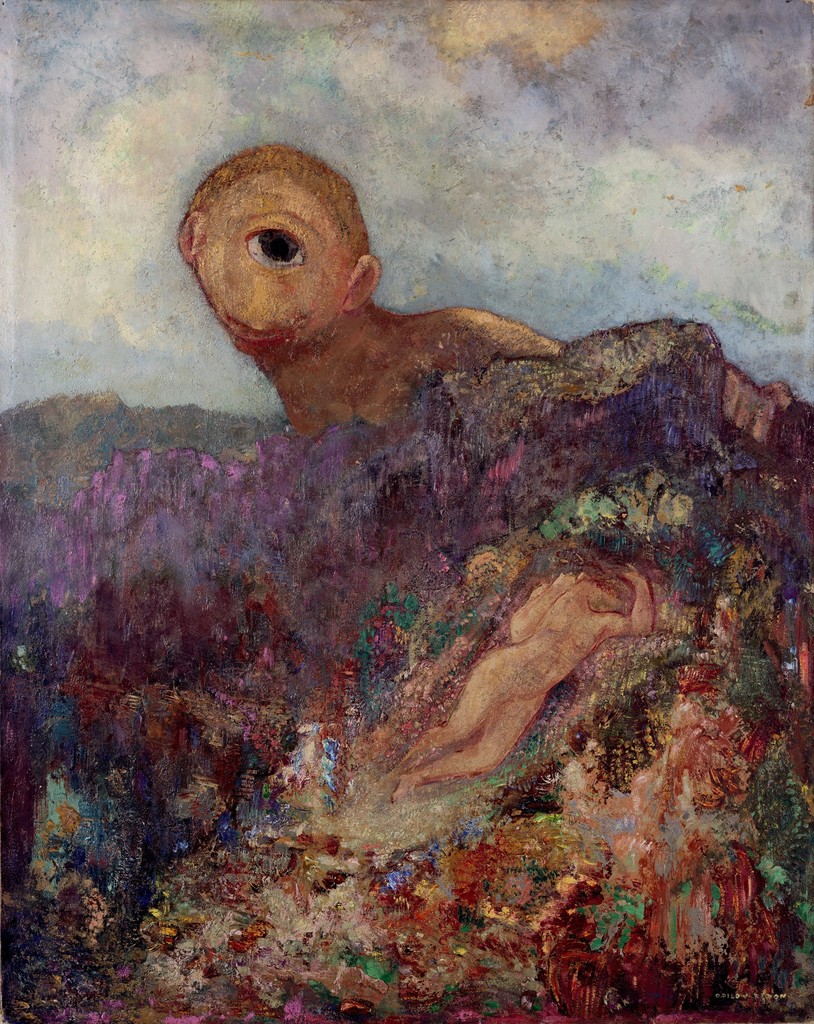
In Odilon Redon's The Cyclops, a single eye rises above a ridge. It belongs to Polyphemus, yet almost all of the giant is withheld: a rounded head, one ear, part of a shoulder and the suggestion of a hand are enough to make his presence enormous. Below him, a pale woman lies among flowers and dark vegetation. The Kröller-Müller Museum identifies her as the sleeping sea nymph Galatea and describes Polyphemus as spying on her.[1]
Redon painted this compact oil around 1914, late in a career that had begun with charcoal shadows and black lithographs. The colours are abundant—powder blue, violet, green, rose, orange and sulphurous yellow—but they do not make the encounter innocent. Nor does the Cyclops's size make him only a monster. Desire, threat, solitude and something like tenderness remain in unresolved competition. That instability is the painting's special force.
At a Glance
- ArtistOdilon Redon (1840–1916), a French Symbolist who repeatedly transformed myth, literature and natural forms.[3][4]
- Datec. 1914, the current dating used by the Kröller-Müller Museum.[1]
- MediumOil on cardboard mounted on panel.[1]
- Dimensions65.8 × 52.7 cm, a modest vertical format whose internal shifts of scale make the scene feel much larger.[1]
- SubjectThe Cyclops Polyphemus looking over a ridge towards Galatea, whom the museum identifies as asleep; Ovid's story of Galatea, Acis and Polyphemus supplies the narrative context.[1][2]
- Current homeKröller-Müller Museum, Otterlo, the Netherlands; inventory number KM 103.098.[1]
Odilon Redon in context
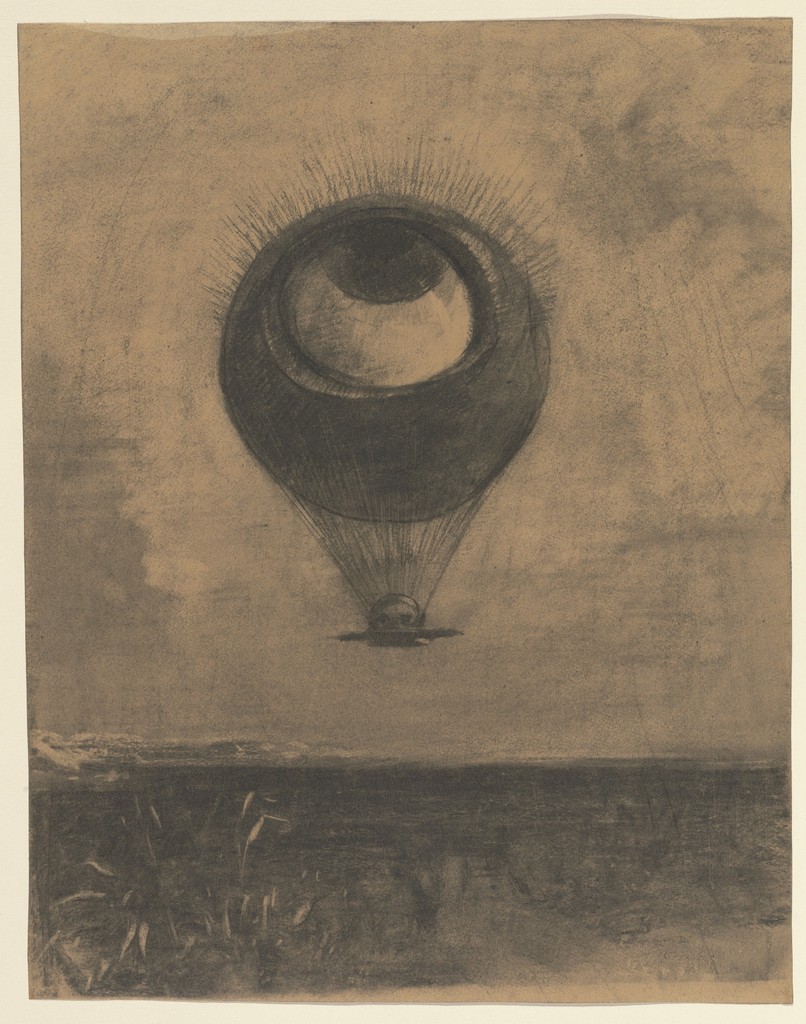
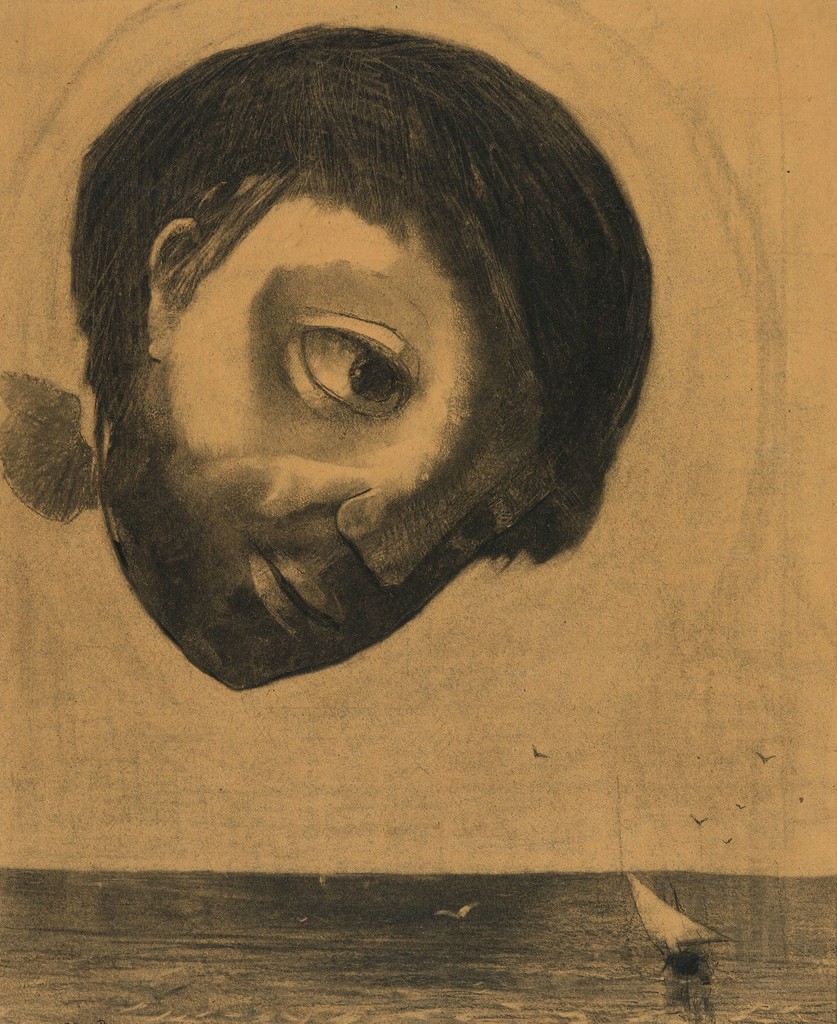
Eye-Balloon
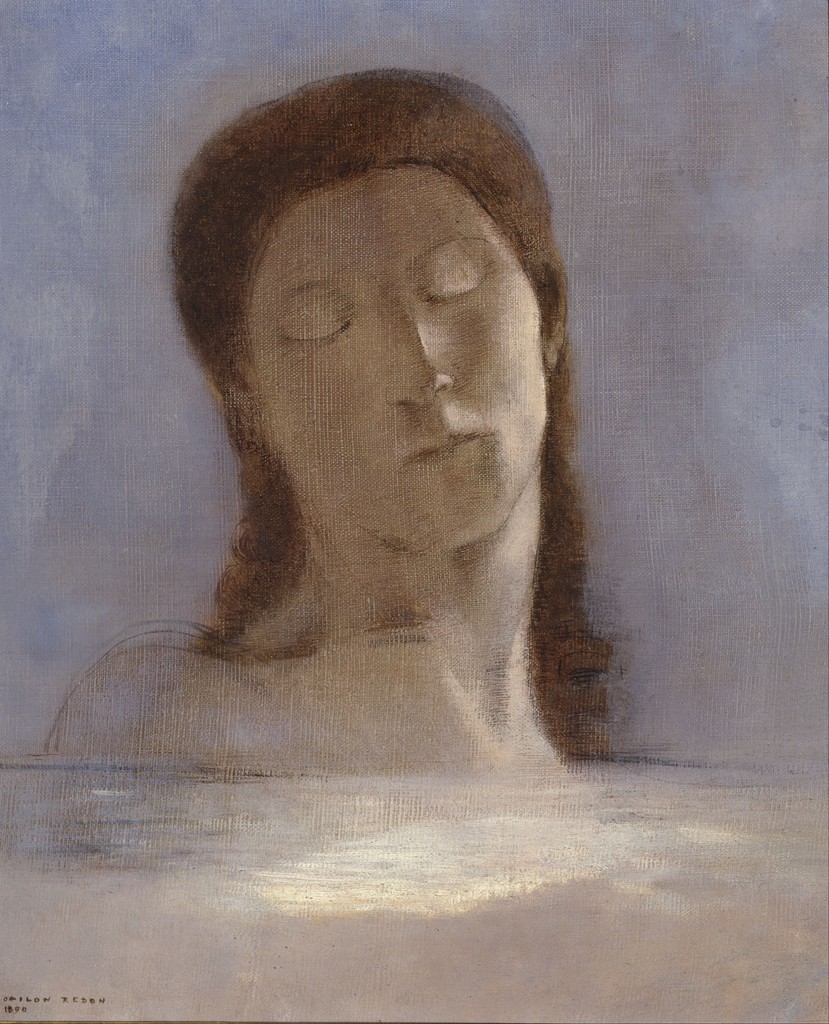
1878Closed Eyes
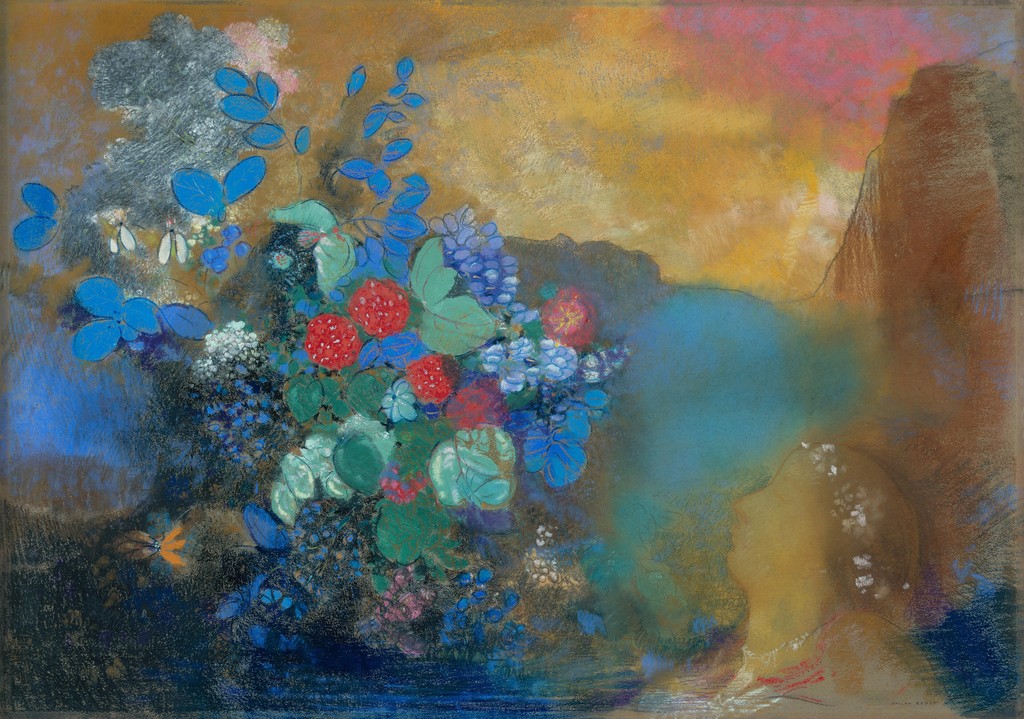
1890Ophelia among the Flowers
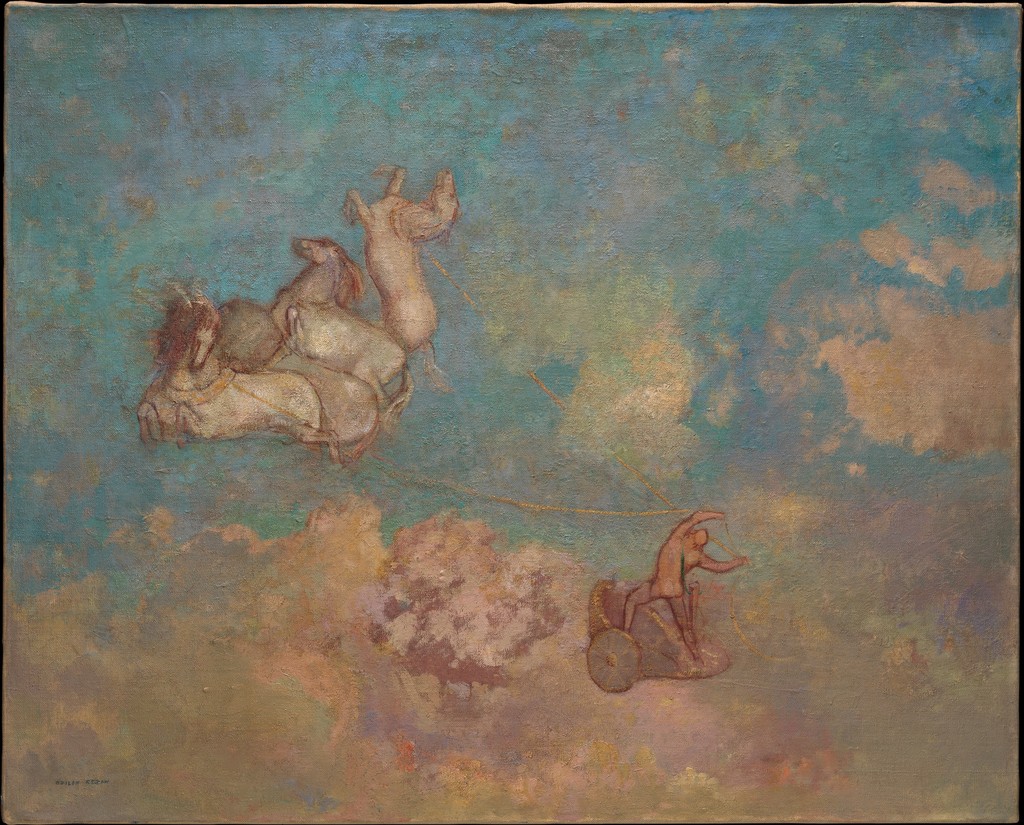
c. 1905–08The Chariot of Apollo
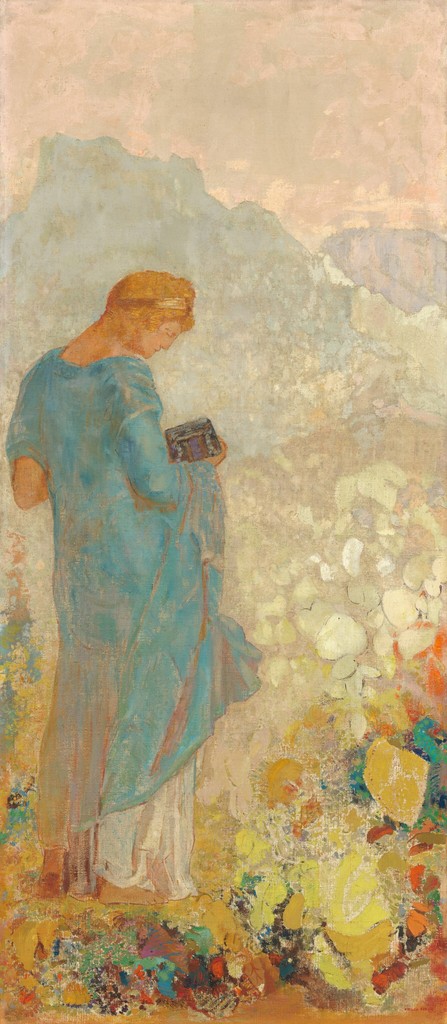
1905–16Pandora
1910/12The Cyclops
c. 1914Contents
- Introduction
- A Route from Galatea to the Eye
- Scale and the Unequal View
- The Ovidian Story behind the Scene
- What Redon Hides
- Desire, Menace and Tenderness
- Bright Colour without Reassurance
- The Eye after the Noirs
- A Small Painting with a Large Afterlife
- Why The Cyclops Matters
A Route from Galatea to the Eye
Begin in the lower half, where Galatea reclines diagonally from left to right. Her legs extend towards the centre-left, her torso turns away, and her bent arm carries the line towards her head. Closed eyelids and a relaxed cheek provide the visible basis for the museum's identification of sleep.[1] Redon gives the body a warm, peach-coloured light, but does not isolate it with a hard outline. Greens, reds and brown-violets press close around the figure, so flesh and vegetation meet along a broken edge.
Around Galatea, the ground behaves like a garden, a rocky shelter and a field of pigment at once. There are small flower-like bursts in red, turquoise, cream and yellow. Some marks resemble petals or leaves; others remain dabs and streaks. A rust-coloured vertical form at the lower right might be read as a plant or rocky growth. The setting supports recognition without yielding a botanical map.
The eye next climbs through the central barrier. Violet and black passages build a steep ridge over Galatea's head. Its upper edge rises sharply at the right before dropping towards a softer purple slope on the left. Flecks of green and ochre complicate the dark mass. This band is more than scenery: it divides the two figures, hides the giant's body and makes every look across it feel furtive.
Polyphemus emerges beyond that divide. His shoulder follows the ridge; his neck stretches leftward; his head turns so that its only eye faces down into the scene. The round cranium is close in colour to the glowing sky, while a reddish jaw and neck join the darker land. He is therefore both distinct from the landscape and partially made from it.
Finally, the gaze reaches the eye. A dark pupil sits inside a pale ring, encircled by pink, rust and ochre. It is disproportionately large even for a Cyclops, and its blunt oval interrupts the softer atmosphere. The museum calls it the painting's most conspicuous element.[1] After wandering through flowers, hill and body, the viewer discovers that the organ has seemed to watch the entire journey.
Scale and the Unequal View
The painting creates giant scale by concealment. Redon does not need to show Polyphemus standing beside Galatea. The ridge acts like a screen, and the small portion visible above it invites the mind to imagine the rest. If the head is this large at a distance, the absent body must be immense. That inference makes the modest 65.8-centimetre panel expand into a landscape of impossible proportions.
The two figures also occupy unequal visual positions. Galatea lies below, enclosed by dense colour and apparently unaware of being observed. Polyphemus has the elevated view. Yet the giant is not granted complete mastery. His lower body disappears, his shoulder is cut by the ridge, and his eye cannot see beyond the painted surface. The viewer sees both watcher and watched, a privilege that neither figure shares.
This arrangement makes looking the subject of the picture rather than merely the means of encountering it. We look down towards Galatea, up towards Polyphemus and then back along the implied line between them. Because the Cyclops's pupil faces slightly outward as well as downward, his attention can feel difficult to locate. He may be looking at Galatea, past her or towards us. The museum's account establishes the narrative act of spying; the painted geometry keeps that act perceptually unstable.[1]
The Ovidian Story behind the Scene
The relevant story appears in Book 13 of Ovid's Metamorphoses and is told in Galatea's voice. She is a Nereid, one of the sea nymphs, and loves the youthful Acis. Polyphemus desires her, but his love is not returned. In Ovid's account, the Cyclops tends his flocks, tries to improve his appearance and sings an elaborate appeal to Galatea. His song shifts between praise, complaint and angry jealousy.[2]
Galatea and Acis hear him while concealed near a rock. Polyphemus eventually discovers the lovers. Acis runs, but the Cyclops tears away a mass of mountain and throws it, crushing him. Galatea then transforms the blood beneath the rock into water, and Acis survives in altered form as a river divinity.[2] The tale moves from courtship through violence to metamorphosis.
Redon's painting does not show that sequence. No clearly identifiable Acis provides a rival presence. There is no hurled boulder, flight or rushing stream. Galatea's recumbent body differs from Ovid's image of the lovers hiding together, while Polyphemus is reduced to a face behind a natural barrier. Rather than illustrate one dramatic climax, Redon extracts a relationship: the desiring giant looks towards a woman who does not return his gaze.
This alteration is characteristic of Redon's way with inherited subjects. A Kröller-Müller exhibition on literature and music explained that he used motifs from classical antiquity onward repeatedly, changing their forms and giving them new associations like variations on a musical theme.[3] Myth supplies names and pressures here, but the painting invents its own suspended interval.
What Redon Hides
Absence activates almost every part of The Cyclops. Polyphemus's body is missing, Acis is not securely visible, and the violent ending remains outside the frame. Even the terrain lacks a clear geography. The picture offers enough narrative information to awaken memory, then blocks the details that would turn it into a complete illustration.
Hiding the giant also changes his expressive range. A fully shown colossus might make bodily power the dominant fact. This cropped apparition depends instead on a face and, above all, an eye. His mouth forms a small curved line beneath a reddish beard. That shape can look wistful, awkward or faintly smiling. None of these impressions establishes his mental state. They matter because they prevent the menace carried by scale and myth from becoming the only possible response.
Galatea is likewise both present and protected from complete disclosure. Her body is visible, yet flowers, coloured strokes and the ridge enfold it. Her closed eyes tell us that she is not meeting the giant's gaze; they do not reveal what she dreams or feels. Redon withholds reciprocal expression, leaving the drama concentrated in a direction of looking rather than a conversation between faces.
Desire, Menace and Tenderness
Ovid's Polyphemus is not a harmless lover. His desire leads to possessive rage and the killing of Acis.[2] That knowledge lends danger to the elevated watcher, and the museum emphasises the menace of the giant—or, more precisely, of the eye—spying on the nude woman.[1] The difference in scale and awareness intensifies the imbalance. One figure can see; the other appears unable to respond.
Yet the visible giant is not painted in a moment of attack. His head leans over the ridge rather than bursting through it. The warm colouring of his face echoes Galatea's flesh, while his softly rounded skull lacks the armoured hardness of a conventional monster. Viewers may therefore detect hesitation, loneliness or tenderness alongside threat. These are interpretations of pose, colour and the remembered tale, not facts about his intention.
The painting refuses to choose between those responses because each depends on a different kind of evidence. Myth warns what Polyphemus will do. Scale and surveillance make the present encounter disturbing. The tilted head and subdued mouth can temper that disturbance without cancelling it. Redon allows compassion for unreturned desire to coexist uneasily with recognition of coercive power.
This complexity does not redeem the Cyclops's later violence. It makes the interval before violence psychologically and ethically difficult. The viewer must reckon with the beauty of the scene while remaining alert to the unequal relationship it stages.
Bright Colour without Reassurance
The Kröller-Müller describes the colours as unusually bright and argues that they reinforce rather than dispel the eye's menace.[1] The effect depends less on unmixed brilliance than on contrast. Pale blue and cloudy green open the sky; ochre warms the giant; purples weight the ridge; scattered emerald, crimson and turquoise animate the foreground. Galatea's light body rests within this chromatic density like a momentary clearing.
Redon's surface does not keep those zones neat. Thin, clouded passages alternate with opaque touches. Dark underlayers remain perceptible around the ridge and vegetation, while scratches and broken strokes roughen the giant's skin. The cardboard support has been mounted on panel, but a reproduction cannot establish every stage of the painting's physical construction.[1] What it does make visible is a deliberate refusal of polish: sky, flesh and earth all seem to be forming and eroding at once.
This matters within Redon's late colour work. Getty's account of his development describes a move from charcoal and black-and-white lithography towards pastel and oil while stressing the survival of his symbolic imagery.[4] The Cyclops is not a sunny departure from the earlier imagination. Colour gives an old realm of monsters a different atmosphere, then makes that atmosphere morally ambiguous.
The Eye after the Noirs
Long before this painting, Redon had treated the eye as if it could become an independent being. In the 1878 charcoal Eye-Balloon, a vast eyeball floats above a small landscape, tethered to a severed head.[5] The Kröller-Müller similarly describes the eye in Redon's art as an autonomous, controlling presence and a sign of the soul or unknown inner world.[1]
The late painting changes that invention without abandoning it. Polyphemus's eye belongs to a mythological anatomy, so its singularity has a narrative explanation. Redon nevertheless enlarges and isolates it until the face feels organised around the organ. The Cyclops becomes almost an eye with a body, just as the balloon drawing makes an eye into a creature.
The comparison reveals continuity between Redon's noirs, prints and drawings and his paintings and pastels. Black charcoal let an eye emerge from shadow; oil lets another emerge from a flowering landscape. Different media and moods serve the same deeper question: when vision is pictured as a thing in itself, does it promise inward knowledge or exert control over what it sees?
A Small Painting with a Large Afterlife
At 65.8 × 52.7 cm, The Cyclops is not physically monumental.[1] Its remembered scale comes from the contrast between giant, ridge and reclining figure. A public-domain digital file preserves the exact Kröller-Müller object identity and permits detailed study of its crowded surface, though screen size can disguise the work's actual dimensions.[6]
The painting's current home is the Kröller-Müller Museum in Otterlo, where it is catalogued as KM 103.098.[1] It also carried the visual identity of the museum's 2018 exhibition Odilon Redon: Literature and Music: the brochure placed a reproduction of The Cyclops prominently beside an account of 167 works drawn from the museum's Redon holdings, a private collection and loans.[3] That context located the picture within a career that moved across black lithographs, radiant pastels, ancient narratives and modern literary culture.
No unsupported chain of ownership is needed to explain its place today. The museum record establishes the object, and the later exhibition history shows how the institution has used it to represent Redon's transformation of inherited themes. For visitors, display conditions can change; the collection record is the dependable place to confirm current access.
Why The Cyclops Matters
The painting condenses Redon's art into one encounter without reducing it to a formula. A myth becomes a dreamlike pause. A monster becomes a watcher whose expression cannot be fixed. A landscape becomes a screen, a garden and a material field. Colour glows while carrying unease.
Most importantly, the work makes interpretation depend on point of view. Polyphemus sees Galatea but not himself as seen by us. Galatea, identified as asleep, does not return the look. We know the violent story, but confront a moment before its action. Redon holds those positions together inside a small rectangle and lets none become complete. The Cyclops endures because its great eye reveals no final answer.
Researched works directory
This searchable evidence census was assembled from public museum records and a reproducible Wikidata snapshot. It is not a catalogue raisonné, a claim to complete oeuvre coverage, or a substitute for Alec Wildenstein's printed catalogue, which was not consulted for this directory.
| Name | Date | Medium |
|---|---|---|
| A La Vieillesse (To Old Age) | 1886 | |
| A Madman in a Dismal Landscape | 1885 | |
| A Woman Reading a Book or Reading | 1914 | Painting |
| Allégorie : un arbre rouge non rougi par le soleil | 1905 | Painting |
| Alsace | 1914 | Painting |
| Andromeda | 1907 | Painting |
| Andromeda | 1912 | Painting |
| Andromeda enchained | 1905 | Painting |
| Anémones | Date unknown | Painting |
| Anemones and Tulips | 1902 | Painting |
| Animals at the Bottom of the Sea | Date unknown | Painting |
| Antoine: Quel Est Le But de Tout Cela? ... | Date unknown | |
| Apache (Man on Horseback) | Date unknown | Painting |
| Apache (Man on Horseback II) | Date unknown | Painting |
| Apollo | 1905 | Painting |
| Apollo's chariot | 1910 | Painting |
| Apollon vainqueur du serpent Python | 1872 | Painting |
| Apollonius | 1896 | Drawing |
| Apparition | 1905 | Painting |
| Apparition | 1907 | Painting |
| Apres cela je vis descendre du ciel un ange qui avait la clef de l'abime, et une grande chaine en sa main (And I saw an angel come down from heaven, having the key of the bottomless pit and a great chain in his hand) | 1899 | |
| Arabe musicien | 1893 | Painting |
| Arbre dans la lande | Date unknown | Painting |
| Arbre (Tree) | 1892 | |
| Arbres sur un fond jaune | 1901 | Painting |
| Ari | 1898 | |
| Armor | 1891 | Drawing |
| At the Bottom of the Sea | 1905 | Painting |
| Au réveil j’aperçus la Déesse de l’Intelligible au profil sévère et dur [Bij het ontwaken zag ik de godin van het begrijpelijke in een streng en hard profiel], uit de reeks Hommage à Goya. 6 lithographies par Odilon Redon | 1885 | |
| Autoportrait en buste | 1876 | Painting |
| Bain de Venus | 1900 | Painting |
| Barbizon en automne | Date unknown | Painting |
| Baronne de Domecy | 1900 | Painting |
| Baronne Robert de Domecy | 1900 | Painting |
| Barques | 1885 | Painting |
| Barques dans le port | 1880 | Painting |
| Battle with the dragon | 1907 | Painting |
| Beatrice | 1885 | Painting |
| Béatrice | 1897 | |
| Bell-Tower Keeper | Date unknown | Painting |
| Black Sun | 1900 | Painting |
| Bloemstilleven | 1901 | Painting |
| Boqueteau | Date unknown | Painting |
| Bouddha dans sa jeunesse | Date unknown | Painting |
| Bouleaux à Bièvres | Date unknown | Painting |
| Bouquet au vase noir | Date unknown | Painting |
| Bouquet de fleurs | 1900 | Painting |
| Bouquet de fleurs | 1908 | Painting |
| Bouquet de fleurs au mimosa | Date unknown | Painting |
| Bouquet in a Chinese Vase | 1912 | Painting |
| Bouquet of Flowers | 1902 | Painting |
| Bouquet of flowers | 1904 | Painting |
| Bouquet of Flowers in a Green Vase | 1915 | Painting |
| Breton Village | 1890 | Painting |
| Brunnhilde | 1894 | |
| Butterflies | 1910 | Painting |
| C'est le Diable | 1888 | |
| C'est moi, Jean, qui ai vu et qui ai oie ces choses (And I John saw these things and heard them | 1899 | |
| C'etait un voile, un empriente (It was a veil, an imprint) | 1891 | |
| Cain and Abel | 1886 | |
| Caïn et Abel | Date unknown | Painting |
| Caliban, petit monstre ou gnome | 1881 | Drawing |
| Calvary | 1895 | Painting |
| Carnations | Date unknown | Drawing |
| Carton de vitrail | 1911 | Painting |
| Cavalier Galopant (Galloping Horseman) | 1866 | |
| Cellule Auriculaire | 1894 | |
| Cellule Auriculaire (Auricular Cell) | 1894 | |
| Centaur visant les Nues (Centaur aiming at the Clouds) | 1895 | |
| Chaumière bretonne | Date unknown | Painting |
| Chemin près de la mer | Date unknown | Painting |
| Cheval aile (Winged Horse) | 1894 | |
| Cheval cabré sur une cime | Date unknown | Painting |
| Christ | 1887 | |
| Christ and the Samaritan Woman (The White Flower Bouquet) | 1895 | Painting |
| Christ on the cross | 1910 | Painting |
| Ciel couvert sur une lande | Date unknown | Painting |
| Citroen en paprika | 1901 | Painting |
| Cliff Scene | 1895 | Painting |
| Closed Eyes | 1890 | Painting |
| Closed Eyes (Yeux Clos) | 1890 | |
| Colline, près de Royan | Date unknown | Painting |
| Combat équestre | 1910 | Painting |
| Composition à trois personnages (Flagellation ?) | Date unknown | Painting |
| Composition: Flowers | Date unknown | Painting |
| Composition: Flowers without a Vase | Date unknown | Painting |
| Conque marine | Date unknown | Painting |
| Conversation mystique | Date unknown | Painting |
| copie d'après 'La chasse aux lions' de Delacroix | 1865 | Painting |
| Copie d'après 'La Grèce sur les ruines de Missolonghi' de Delacroix | Date unknown | Painting |
| Coquelicots | 1885 | Painting |
| Couverture - Frontispice | 1890 | |
| Crucifixion | Date unknown | Painting |
| Cul-de-Lampe | 1890 | |
| Dans l'Ombre des Gens Pleurent et Prient Entourés d'Autres Qui Les Exhortent | Date unknown | |
| Dans mon rêve, je vis au ciel un visage de mystère | 1885 | |
| Dante and Beatrice | 1914 | Painting |
| De oude Ridder | 1896 | |
| De Strijdwagen van Apollo | Date unknown | Painting |
| Den helige Antonius, bröstbild | 1906 | Drawing |
| Des Fleurs Tombent, et la Tête d'un Python Parait | Date unknown | |
| Des Peuples Divers Habitent Les Pays De L'Océan | Date unknown | |
| Die Kathedrale - 13080 - Bavarian State Painting Collections | 1914 | Painting |
| Druidesse | 1891 | |
| Druidesse | 1892 | |
| Dunes | Date unknown | Painting |
| Edouard Vuillard | 1900 | |
| Een man van het volk. Tekening voor een illustratie in Le Juré van Edmond Picard | 1887 | Drawing |
| Eerbetoon aan Goya | 1895 | Painting |
| Elle Tire de Sa Poitrine une Éponge Toute Noire, La Couvre de Baisers | Date unknown | |
| Elle tire de sa poitrine une eponge toute noire, la couvre de baisers (She draws from her bosom a sponge, perfectly black, and covers it with kisses) | 1896 | |
| Escape to Egypt | Date unknown | Painting |
| Esquisse de vitrail | 1905 | Drawing |
| Et celui qui était monté dessus se nommait la Mort (And his name that sat on him was Death) | 1899 | |
| Et il avait dans sa main droit sept etoiles, et de sa bouch sortait une epee aigue a deux tranchants (And he had in his right hand seven stars; and out of his mouth went a sharp two-edged sword) | 1899 | |
| Et Il Distingue Une Plaine Aride et Mamelonneuse | Date unknown | |
| Et il tombe du ciel une grande etoile ardente (And there fell a great star from heaven burning as it were a lamp) | 1899 | |
| Et l'homme parut, interrogeant le sol d'ou il sort et qui l'attire, il se fraya la voie vers (And Man appeared; questioning theearth from which he emerged and which attracts hi m, he made his way toward somber brightness) | 1883 | |
| Et la-bas l'idole astrale, l'Apotheose (And beyond, the star idol, the apotheosis) | 1891 | |
| Et le diable qui les seduisait, fut jete dans l'etang de feu et de soufre, ou es la b ete et le faux prophete (And the devil thatdeceived them was cast into the lake of fire and brimstone, where the beast and the false prophet are) | 1899 | |
| Et le lia pour mille ans (And bound him a thousand years) | 1899 | |
| Et moi, Jean, Je vis la sainte cite, la nouvelle Jerusalem, qui descendait du ciel, d'aupres de dieu (And I John saw the holy city, new Jerusalem, coming down from God out of heaven) | 1899 | |
| Et Partout ce Sont des Colonnes de Basalte,... La Lumière Tombe des Voutes | Date unknown | |
| ...Et Que Des Vuex Sans Tête Flottaient Comme Des Mollusques | Date unknown | |
| Et un autre ange sortit du temple qui est au ciel, ayant lui aussi une faucille tranchante (And another angel came out of the temple which is in heaven, and he also having a sharp sickle) | 1899 | |
| Etruscan Vase with Flowers | 1905 | Painting |
| étude pour 'La chasse aux lions' d’après Delacroix | 1867 | Painting |
| Eve | 1904 | Painting |
| Evocation of Butterflies | 1910 | Painting |
| Evocation of Roussel | 1912 | Painting |
| Eye-Balloon | 1878 | Drawing |
| Falaise dominant la mer | Date unknown | Painting |
| Fantasia | 1910 | Painting |
| Fantasmagorie | Date unknown | Painting |
| Femme a la torque ornee (Woman with a plumed hat) | 1900 | |
| Femme de Profil (Profile of a Woman) | 1900 | |
| Femme en rouge | 1898 | Drawing |
| Ferme et rochers | Date unknown | Painting |
| Figure | 1901 | Painting |
| Figure cornue | Date unknown | Drawing |
| Figure devant un arbre | 1894 | Drawing |
| Figure portant une tête ailée | 1876 | Drawing |
| Figure, yellow flower | 1901 | Painting |
| Fireplace screen | 1908 | Painting |
| Fishing Boat | Date unknown | Painting |
| Fishing Boats: Memory of Venice | 1908 | Painting |
| Fishing Village, Brittany | 1883 | Painting |
| Five Butterflies | 1912 | Drawing |
| Fleurs | Date unknown | Painting |
| Fleurs dans un paysage de montagne avec visage | Date unknown | Painting |
| Fleurs dans un vase | 1907 | Painting |
| Fleurs dans un Vase bleu | 1903 | Painting |
| Fleurs dans un vase : pivoines | Date unknown | Painting |
| Fleurs des champs | 1906 | Painting |
| Fleurs étranges | 1910 | Painting |
| Flower Clouds | 1903 | Drawing |
| Flowers in a Japanese Vase | 1908 | Painting |
| Flowers in a Vase | 1910 | Painting |
| Flowers in Green Vase | Date unknown | Painting |
| Flowers: Poppies and Daisies | 1867 | Painting |
| Frieze of flowers and berries | 1901 | Painting |
| Frise de fleurs, marguerite rose | 1901 | Painting |
| Frontispiece | 1889 | |
| Gekruisigde Christus | Date unknown | Drawing |
| Geraniums and other Flowers in a Stoneware Jug | 1910 | Painting |
| Grand Bouquet | 1901 | Painting |
| Grand bouquet de fleurs des champs | 1903 | Painting |
| Grand panneau à décor végétal, fond clair | 1901 | Painting |
| Grand tapis de prière | 1908 | Painting |
| Green Death | Date unknown | Painting |
| Grey frieze | 1901 | Painting |
| Groupe de maisons blanches aux toits rouges | Date unknown | Painting |
| Guardian Spirit of the Waters | 1878 | Drawing |
| Hantise (Obsession) | 1894 | |
| Hélène (Ennoia) | Date unknown | |
| Hommage à Goya. 6 lithographies par Odilon Redon | 1885 | |
| Icarus | 1890 | Painting |
| Il Tombe Dans L'Abime, La Tête En Bas | Date unknown | |
| Il y eut aussi des êtres embryonnaires [Er waren ook embryonale wezens], uit de reeks Hommage à Goya. 6 lithographies par Odilon Redon | 1885 | |
| Il y eut des luttes et des vaines victoires (There were struggles and vain victories) | 1883 | |
| Il y eut peut-etre une vision premiere essayee dans la fleur (There was perhaps a first vision attempted in the flower | 1883 | |
| Immédiatement Surgissent Trois Déesses | Date unknown | |
| Initiation to Study—Two Young Ladies | 1905 | Painting |
| J'ai Quelquefois Aperçu Dans Le Ciel Comme Des Formes D'Esprits | Date unknown | |
| Jacob and the Angel | 1907 | Painting |
| Jacob's Struggle with the Angel | 1910 | Painting |
| Jacob Wrestling with the Angel | 1907 | Painting |
| Je Me Suis Enfoncé dans la Solitude. J'habitais L'Arbre Derrière Moi | Date unknown | |
| Je Suis Toujours la Grande Isis! Nul N'A Encore Soulevé Mon Fruit Est Le Soleil | Date unknown | |
| Je t'adore a l'egal de la voute nocturne. O vase de tristesse, o grande taciturne (I adore you as I adore the vault of the night sky, O vessel of sadness, O tall silent woman) | 1890 | |
| Jésus et la Samaritaine | Date unknown | Painting |
| L'Aile impuissante n'eleva point la bete en ces noirs espaces (The impotent wing did not lift the animal into that black space | 1883 | |
| L'Aile (The Wing) | 1893 | |
| L'ange déchu | 1875 | Painting |
| L'ange guerrier | 1900 | Painting |
| L'apparition | Date unknown | Painting |
| L'Araignée souriante | 1881 | Drawing |
| L'Arbre | Date unknown | Painting |
| L'Art Celeste (The Celestial Art) | 1894 | |
| L'Automne en Médoc | 1897 | Painting |
| L'Enlèvement de Ganymède | Date unknown | Painting |
| L'Intelligence Fut A Moi! Je Devins Le Buddha | Date unknown | |
| La Baie des Trépassés | Date unknown | Painting |
| La Barque | 1900 | Painting |
| La Barque rouge | 1900 | Painting |
| La Branche fleurie jaune | 1901 | Painting |
| La captive | 1914 | Painting |
| La Chute de Phaéton | 1906 | Painting |
| La Chute de Phaëton | 1910 | Painting |
| La fleur du marécage, une tête humaine et triste [De moerasbloem, een triest menselijk hoofd], uit de reeks Hommage à Goya. 6 lithographies par Odilon Redon | 1885 | |
| La Mare à Peyrelebade | 1897 | Painting |
| La Mer à Morgat | 1883 | Painting |
| La Mort: C'est Moi Te Rendes Sérieuse; Enlaçons-Nous | Date unknown | |
| La Mort d'Orphée | 1908 | Painting |
| La mort. Mon ironie dépasse toutes les autres! | 1890 | Painting |
| La Mort: Mon ironie depasse toutes les autres! (Death: My iron surpasses all others!) | 1889 | |
| La palme | Date unknown | Painting |
| La Peur (Fear) | 1865 | |
| La route de Bièvres | 1890 | Painting |
| La sirene sortit des flots vetue de dards (The Siren clothed in barbs, emerged from the waves | 1883 | |
| La Sulamite (The Shulamite) | 1897 | |
| La Vieille: Que Crains-tu? Un Large Trou Noir! Il Est Vide Peut-être? | Date unknown | |
| La Vieille: Que Crains-tu? Un large trou Noir! Il est vide peut-etre? (What are you afraid of? A wide black hole! It is empty, perhaps!) | 1896 | |
| Lady of the Flowers | 1892 | Painting |
| Lande avec une mare | Date unknown | Painting |
| Lande nue | Date unknown | Painting |
| Landscape | 1872 | Painting |
| Landscape | Date unknown | Painting |
| Landscape at Daybreak | 1872 | Painting |
| Landscape with Rocks near Royan | Date unknown | Painting |
| Large Vase with Flowers | 1912 | Painting |
| Le Bouddha | 1895 | |
| Le Bouddha | 1906 | Drawing |
| Le Buddha | 1895 | |
| Le Centaure à l'arc | Date unknown | Painting |
| Le Centaure aux coquelicots | 1910 | Painting |
| Le centaure et le dragon | Date unknown | Painting |
| Le char d'Apollon | 1905 | Painting |
| Le Chemin à Peyrelebade | Date unknown | Painting |
| Le Chêne | Date unknown | Painting |
| Le Coursier (The Race Horse) | 1894 | |
| Le Gue (The Ford) | 1865 | |
| Le Jour (Day) | 1891 | |
| Le Jour Enfin Parait,... Et Dans Le Disque Même Du Soleil, Rayonne La Face de Jésus-Christ | Date unknown | |
| Le Liseur (The reader) | 1892 | |
| Le paravent rouge (avec Pégase) | Date unknown | Painting |
| Le pavot noir | Date unknown | Painting |
| Le Petit Vase vert | Date unknown | Painting |
| Le Polype difforme flottait sur les rivages, sorte de cyclope souriant et hideux (Thedeformed polyp floated on the shores, a sort of smiling and hideous Cyclops | 1883 | |
| Le Regard | 1901 | Painting |
| Le Regard | 1910 | Painting |
| Le Rêve – Fleurs et Visage | 1890 | Drawing |
| Le Rocher rose | 1880 | Painting |
| Le Satyre au cynique sourire (The Satyr with the cynical smile) | 1883 | |
| Le Silence | 1895 | Painting |
| Le Vitrail | 1906 | Painting |
| Les Anemones (Still Life with Anemones) | 1905 | Painting |
| Les Bêtes De La Mer Rondes Comme Des Outres | Date unknown | |
| Les Croisés | Date unknown | Painting |
| Les Landes à Peyrelebade | 1885 | Painting |
| Les Parques | Date unknown | Painting |
| Les Quais à Bordeaux | 1900 | Painting |
| Les rochers (Rochers en Bretagne) | 1875 | Painting |
| Les Sciapodes: La tete le plus bas possible, c'est le secret du bonheur! (The Skiapods: "The head as low as possible, that is the secret of happiness!") | 1889 | |
| Les trois vases bleus | 1910 | Painting |
| Liserons et coquelicots dans un petit pichet vert | 1866 | Painting |
| Lueur precaire, une tete a l'infini suspendue(Precarious glimmering, a head suspended | 1891 | |
| Lumière | Date unknown | |
| Lumiere (Light) | 1893 | |
| Madame Arthur Fontaine (Marie Escudier, born 1865) | 1901 | Painting |
| Madame Odilon Redon | 1882 | Painting |
| maison avec deux arbres | Date unknown | Painting |
| Marguerites | 1901 | Painting |
| Marguerites et baies de Sorbier | 1901 | Painting |
| Maurice Denis | 1903 | |
| Médoc, arbres dans la prairie | Date unknown | Painting |
| Médoc, l'arbre | Date unknown | Painting |
| Médoc, la lande | Date unknown | Painting |
| Médoc, le bouquet d'arbres | Date unknown | Painting |
| Melancholy | 1868 | Drawing |
| Mes Baisers ont le Gout d'un Fruit Qui Se Fondrait Dans Ton Coeur!... | Date unknown | |
| Meules couvertes de bâches près d'un arbre | Date unknown | Painting |
| Mme Sabouraud (Thérèse Balandier) | 1907 | Drawing |
| Mon Enfant (My Child) | 1892 | |
| Montagnes des Pyrénées | Date unknown | Painting |
| Morgat vue des dunes de la Palue | Date unknown | Painting |
| moulin en Bretagne | Date unknown | Painting |
| Mystery | 1910 | Painting |
| Mystical Conversation | 1896 | Painting |
| Nasturtium | 1905 | Painting |
| Nature morte | 1901 | Painting |
| Navet | 1875 | Painting |
| Noce juive au Maroc | Date unknown | Painting |
| Nocturne | Date unknown | Painting |
| Nuages clairs sur une lande | Date unknown | Painting |
| Oannès | 1905 | Painting |
| Oannès | 1908 | Painting |
| Oannes and the Sphinx | 1910 | Painting |
| Oannès: Moi, La Première Conscience Du Chaos, J'ai Surgi de L'Abime Pour Durcir la Matière, Pour Régler les Formes | Date unknown | |
| Offrande | Date unknown | Painting |
| Old Man With Wings and Beard or Winged Old Man with a Long White Beard | 1870 | Drawing |
| Ophelia | 1901 | Painting |
| Ophelia | 1905 | Painting |
| Ophelia | Date unknown | Painting |
| Ophelia among the Flowers | c. 1905–1908 | Drawing |
| Ophelia with a Blue Wimple in the Water | 1900 | Painting |
| Orphée | 1910 | Painting |
| Orphée | Date unknown | Painting |
| Orpheus | 1903 | Drawing |
| Pandora | 1910/1912 | Painting |
| Panneau décoratif | 1902 | Painting |
| Pansies | 1905 | Drawing |
| Papillons | 1910 | Painting |
| Paravent d'Olivier Sainsère | 1903 | Painting |
| Parfois on trouve un vieux flacon qui se souvient, d'ou jaillit toute vive une ame qui revient (Sometimes one finds an old reminiscing flask, whence issues in full life a returning soul) | 1890 | |
| Parsifal | 1892 | |
| Passage d'une Ame (Passage of a Spirit) | 1891 | |
| Paul Gauguin | 1904 | Painting |
| Paul Serusier | 1903 | |
| Paysage de Venise | 1908 | Painting |
| Pégase et l'Hydre | 1900 | Painting |
| Pegasus | 1914 | Painting |
| Pegasus and the Hydra | 1907 | Painting |
| Pegasus, the Horse on the Rock | 1908 | Drawing |
| Pélerin du monde sublunaire (Pilgrim of the sublunary world) | 1891 | |
| Perversité | 1891 | |
| Perversite (Perversity) | 1891 | |
| Petite fille tricotant | Date unknown | Painting |
| Peupliers à Peyrelebade | Date unknown | Painting |
| Peyrelebade | 1888 | Painting |
| Pierre Bonnard | 1900 | |
| Piety Beside a Red Tree | 1905 | Painting |
| Pivoine, géranium et lilas | Date unknown | Painting |
| Plante verte dans une urne | Date unknown | Painting |
| Pond in les Landes | 1880 | Painting |
| Port breton | Date unknown | Painting |
| Portrait d'Arï Redon au col marin | 1897 | Painting |
| Portrait d'Arï Redon en profil | 1892 | |
| Portrait de Jeanne Chaine | 1903 | Drawing |
| Portrait de jeune fille sur fond d'arcatures | 1911 | Painting |
| Portrait de Madame Redon | 1911 | Painting |
| Portrait de Paule Gobillard | 1908 | Drawing |
| Portrait of A.M.L. Bonger-van der Linden | 1905 | Painting |
| Portrait of Emile Bernard | 1901 | Drawing |
| Profil de jeune fille parmi les fleurs | 1905 | Painting |
| Profil de lumiere (Profile of light) | 1886 | |
| Profile | Date unknown | Painting |
| Profile and Flowers | 1912 | Drawing |
| Profile of a Woman with a Vase of Flowers | 1900 | Painting |
| Profile on Red Meanders (formery known as Jeanne d'Arc) (see Google Books) | 1900 | Drawing |
| Prophète | Date unknown | Painting |
| Puis l'ange prit l'encensoir (And the angel took the censer) | 1899 | |
| Quadrige, le char d’Apollon | 1909 | Painting |
| Quand s'eveillait la Vie au Fon de la matiere obscure (When life was awakening in the depths of obscure matter | 1883 | |
| Reflections | 1903 | Drawing |
| rocher en Bretagne | Date unknown | Painting |
| Rocher sur la grève | Date unknown | Painting |
| Rochers de Vallières, près de Royan | Date unknown | Painting |
| Rochers en Bretagne | 1884 | Painting |
| Rochers près de Royan | Date unknown | Painting |
| Rochers sur la plage | Date unknown | Painting |
| Rocks on the Beach | 1883 | Painting |
| Rocky Peak | 1875 | Painting |
| Rocky Slope | Date unknown | Painting |
| Roger and Angelica | 1910 | Drawing |
| Roger et Angélique | Date unknown | Painting |
| Roger Marx | 1904 | |
| Roland à Ronceveaux | 1862 | Painting |
| Rose, iris et marguerites dans un vase vert | Date unknown | Painting |
| rue à Saint-Georges-de-Didonne | Date unknown | Painting |
| Rue de village | 1875 | Painting |
| Rue Douarnenez | 1880 | Painting |
| Sailboats (Allegorical Landscape) | 1907 | Painting |
| Saint Anthony and the Two Temptresses (Saint Antoine et deux Tentatrices) | 1896 | Drawing |
| Saint-Antoine...A travers ses longs cheveux qui lui couvraient la figure, j'ai cru reconnaitre Ammonaria (Saint Anthony: "Beneathe her long hair , which covered her face, I thought I recognized Ammonaria) | 1889 | |
| Saint-Antoine: Au Secours Mon Dieu! | Date unknown | |
| Saint George and the Dragon | Date unknown | Drawing |
| Saint George and the Dragon (Saint Georges et le dragon) | 1909 | Painting |
| Saint Jean | 1910 | Drawing |
| Saint John | 1900 | Painting |
| Saint Sebastian | 1900 | Painting |
| Saint Sebastian | 1910 | Painting |
| Saint Sebastian (Basel) | 1910 | Painting |
| Saint Sébastien | 1910 | Painting |
| Salomé | 1910 | Painting |
| Sans cesse a mes cotes s'agite le demon (Ceaselessly by my side the demon stirs) | 1890 | |
| Seated Man | Date unknown | Painting |
| Self-portrait | 1867 | Painting |
| Self-portrait | 1880 | Painting |
| Self-portrait | 1885 | Painting |
| Si par une nuit lourde et sombre, un bon chretien, par charite, derriere quelque vieux decombre, enterre votre corps voute (If on a close dark night a good Christian, out of charity, behind some old ruin, buries your arched body) | 1890 | |
| Silence | 1911 | Painting |
| Siren | 1900 | Painting |
| Small Grey Panel I | 1901 | Painting |
| Small Grey Panel II | 1901 | Painting |
| Sommeil de Caliban | 1895 | Painting |
| Sous-bois au printemps | Date unknown | Painting |
| Sous l'aile d'ombre | Date unknown | |
| Sous l'aile d'ombre, l'etre noir appliquait une active morsure (Beneath the wing of shadow the black creature was biting energetically) | 1891 | |
| Spring | 1907 | Painting |
| Still Life with Flowers | 1905 | Painting |
| Still Life with Fruit | 1905 | Painting |
| stillife | Date unknown | Painting |
| Sur le fond de nos nuits dieu de son doigt savant dessine un cauchemar multiforme et sans treve (On backdrop of our nights God with His knowing finger traces a multiform implacable nightmare) | 1890 | |
| Symbolic Head | 1890 | Painting |
| Tete d'Enfant avec Fleurs (Head of a Child with Flowers) | 1897 | |
| Tete d'Enfant (Head of a Child) | 1899 | |
| Tête d'Orphée | Date unknown | Painting |
| The Angel Raphael Leaving Tobit and His Family | 1862 | Painting |
| The Birth of Venus | 1906 | Painting |
| The Birth of Venus | 1912 | Painting |
| The Book of Light | 1893 | Drawing |
| The Buddha | 1904 | Painting |
| The Chariot of Apollo | 1905–1916 | Painting |
| The Chariot of Apollo series | Date unknown | Painting |
| The chariot of the Sun | 1910 | Painting |
| The Crucifixion | 1904 | Painting |
| The Cyclops | c. 1914 | Painting |
| The Death of Orpheus | 1904 | Painting |
| The Devil (Le Diable) | 1896 | Drawing |
| The Dog | 1896 | |
| The Fisherwoman | Date unknown | Drawing |
| The Flowers in a Blue Vase | 1913 | Drawing |
| The Golden Cell | 1892 | Painting |
| The Gothic Window | 1900 | Painting |
| The Green Vase | Date unknown | Painting |
| The Grey Sail | Date unknown | Painting |
| The Haunting (Hantise) | 1893 | Artwork |
| The Headhunter and His Family | 1870 | Drawing |
| The Mount of Calvary | 1895 | Drawing |
| The Muse on Pegasus | 1908 | Painting |
| The Port of Morgat | 1882 | Painting |
| The Potted Geranium | 1865 | Painting |
| The Prayer | 1893 | Painting |
| The Queen of Sheba (La Reine de Saba) | 1896 | Drawing |
| The Red Boat | 1910 | Painting |
| The Red Man | 1905 | Painting |
| The red poppy | 1895 | Painting |
| The Red Tree | 1905 | Painting |
| The Sea in Brittany | Date unknown | Painting |
| The Shadow (L'Ombre) | 1896 | Drawing |
| The Tree | 1875 | Painting |
| The Two Graces | 1900 | Painting |
| The Winged Man | 1890 | Painting |
| The Yellow Sail | 1905 | Painting |
| Three Fates | 1900 | Painting |
| Trees in Bièvres | Date unknown | Painting |
| Trees in the Blue Sky | 1883 | Painting |
| Triumph of Truth | 1870 | Painting |
| Tronc d'arbre dans la plaine | Date unknown | Painting |
| Two Dancers | Date unknown | Painting |
| Two Young Girls among Flowers | 1912 | Painting |
| Un étrange jongleur [Een vreemde evenwichtskunstenaar], uit de reeks Hommage à Goya. 6 lithographies par Odilon Redon | 1885 | |
| Underwater Vision | 1910 | Painting |
| Une femme revêtue du Soleil (A woman clothed with the sun) | 1899 | |
| Une longue chrysalide couleur de sang (A longchrysalis, the color of blood) | 1889 | |
| Vase de fleurs | 1915 | Painting |
| Vase de fleurs | Date unknown | Painting |
| Vase of Flowers | 1867 | Painting |
| Vase of Flowers | 1890 | Painting |
| Vase of Flowers | 1901 | Painting |
| Vase of Flowers | 1904 | Painting |
| Vase of Flowers | 1905 | Painting |
| Vase of Flowers, after Cézanne | 1896 | Painting |
| Vase of Flowers (Pink Background) | c. 1906 | Painting |
| Vase with Bindweed and Camomile | 1867 | Painting |
| Vase with Wild Flowers | 1900 | Drawing |
| Vieil arbre dans une prairie | Date unknown | Painting |
| Vierge | 1916 | Painting |
| Vieux Chevalier (Old Knight) | 1896 | |
| Village by the Sea in Brittany | 1880 | Painting |
| Village dans les Basses-Pyrénées | Date unknown | Painting |
| Village Square, Brittany | 1883 | Painting |
| Village sur la côte de Bretagne | Date unknown | Painting |
| Vision | 1890 | Painting |
| Vision dans les nuages | 1900 | Painting |
| Vision- vase of flowers | 1900 | Painting |
| Voici La Bonne-Déesse, L'Idéenne des Montagnes | Date unknown | |
| Volupte, Fantome Elastique! (Pleasure, elastic phantom!) | 1890 | |
| Wildflowers | 1905 | Drawing |
| Wildflowers in a Long Neck Vase | Date unknown | Painting |
| Window | 1907 | Painting |
| Winged Horse | 1895 | |
| With Closed Eyes | Date unknown | Painting |
| Woman in a gothic arcade- woman with flowers | 1905 | Painting |
| Yellow frieze | 1901 | Painting |
| Yeux Clos (Closed Eyes) | 1890 | |
| Young Man (Jeune Homme) | 1896 | Drawing |
| Young Woman in Profile | 1910 | Drawing |
| Young woman standing | Date unknown | Painting |
Frequently Asked Questions
The painting draws on the story of Polyphemus, Galatea and Acis told in Book 13 of Ovid's Metamorphoses. Galatea loves Acis, while the Cyclops desires her. After discovering the pair, Polyphemus kills Acis with a rock; Galatea transforms her lover into a river.[2] Redon does not show the killing. He invents a quieter scene in which the giant looks over a ridge towards Galatea.
The Kröller-Müller Museum dates it c. 1914. It is oil on cardboard mounted on panel and measures 65.8 × 52.7 cm.[1] Older alternative ranges attached to secondary records should not replace the museum's current dating of this particular object.
The eye identifies Polyphemus and controls the composition. The museum also relates it to Redon's recurring eye as an autonomous presence associated with the soul and the mysterious inner world.[1] It can suggest desire, vigilance or domination, but the painting does not supply one exclusive symbolic definition.
It belongs to Redon's late work in oil, when vivid colour had become central to his practice.[4] Blue sky, violet terrain, warm flesh and jewel-like foreground accents make the imagined world sensuous. The bright palette does not guarantee a happy mood: the Kröller-Müller argues that its unusual intensity can strengthen the menace of the watching eye.[1]
The painting belongs to the Kröller-Müller Museum in Otterlo, the Netherlands, where its inventory number is KM 103.098.[1] Because galleries rotate works, check the museum's current collection information before planning a visit.
Discussion
Use this evidence-led guide as a starting point for close looking rather than a final verdict.
Share an observation about The Cyclops or a source that adds useful context.
Reader Insights
Which detail most changes your reading of The Cyclops?
How do scale, support, medium or present museum evidence shape the encounter?
What remains uncertain when visual inference is separated from documented fact?
Join the Conversation
Add your reading below, keeping observations specific and evidence clear.
References
- Kröller-Müller Museum, “The Cyclops,” KM 103.098, accessed 30 August 2026.
- Ovid, Metamorphoses, Book 13, lines 750–897, trans. Brookes More, Perseus Digital Library, accessed 30 August 2026.
- Kröller-Müller Museum, Odilon Redon: Literature and Music exhibition brochure (2018), accessed 30 August 2026.
- J. Paul Getty Museum, Odilon Redon: Otherworldly Visions — Gallery Text (2026), accessed 30 August 2026.
- Museum of Modern Art, “Eye-Balloon,” object 4.1964, accessed 30 August 2026.
- Wikimedia Commons, “Odilon Redon — The Cyclops, c. 1914,” public-domain file record, accessed 30 August 2026.