 by Tom Gurney
Tom Gurney BSc (Hons) is an art history expert with over 20 years experience
Page Created on August 30, 2026 / Page Updated on November 6, 2026
Email: tomgurney1@gmail.com / Phone: +44 7429 011000
Odilon Redon Biography: Introduction
Odilon Redon’s career does not divide neatly into a dark youth and a bright old age. He drew in charcoal, made prints, painted landscapes and experimented with colour across overlapping periods. What changed was emphasis. For much of his early public career, the velvety charcoal drawings and black-and-white lithographs he called his noirs carried his reputation. From the 1890s onward, pastel and oil became increasingly prominent, while the eyes, floating heads, flowers, myths and indeterminate spaces of his earlier art continued to migrate between media. Current museum scholarship therefore presents continuity as well as transformation: Redon repeatedly joined close observation of nature to images that could not be found in nature alone.[1][8]
At a Glance
- Full nameBertrand-Jean Redon, known as Odilon Redon
- Born20 April 1840, Bordeaux, France
- Died6 July 1916, Paris, France
- Known forcharcoal noirs, lithographic albums, pastels, paintings, portraits, flower pieces and decorative ensembles
- Key teachers and guidesStanislas Gorin, Armand Clavaud, Rodolphe Bresdin and, briefly, Jean-Léon Gérôme
- Artistic contexta central figure for Symbolist writers and artists, later admired by the Nabis and presented prominently at the 1913 Armory Show
Odilon Redon in context
Romanticism
c. 1800–1850Realist contexts
c. 1840–1900Symbolism
c. 1880–1910Eugène Delacroix
1798–1863Rodolphe Bresdin
1822–1885Henri Fantin-Latour
1836–1904Odilon Redon
1840–1916Paul Gauguin
1848–1903Henri Matisse
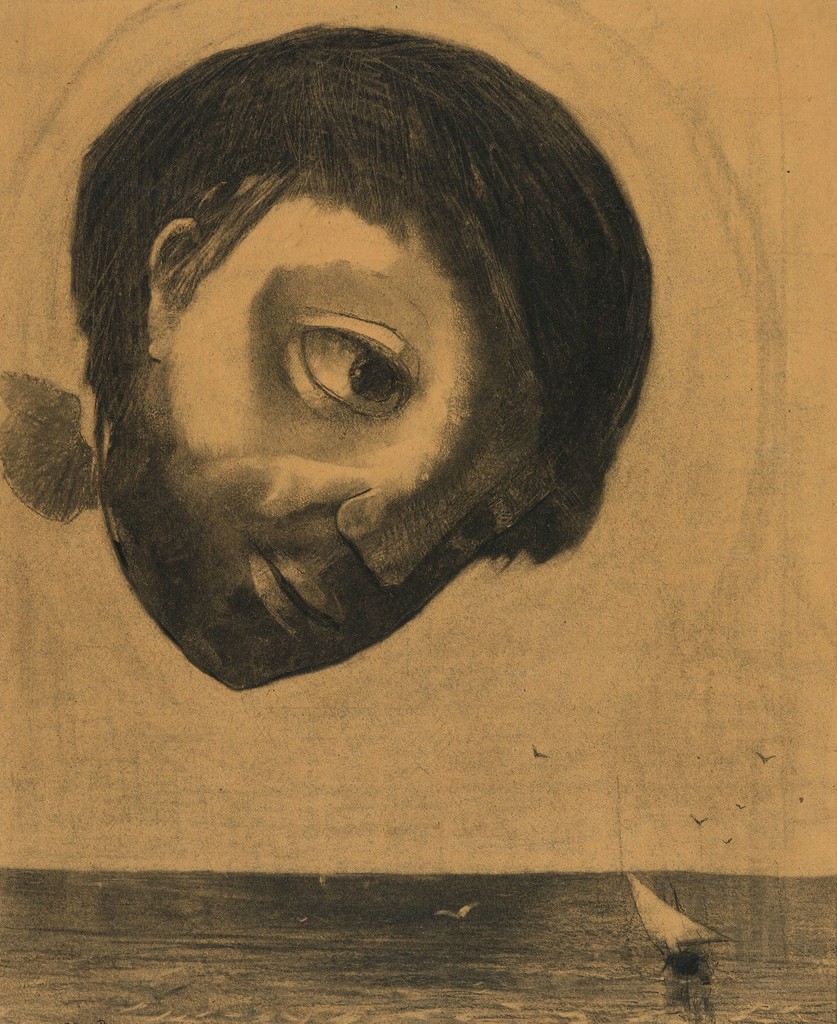
1869–1954Eye-Balloon
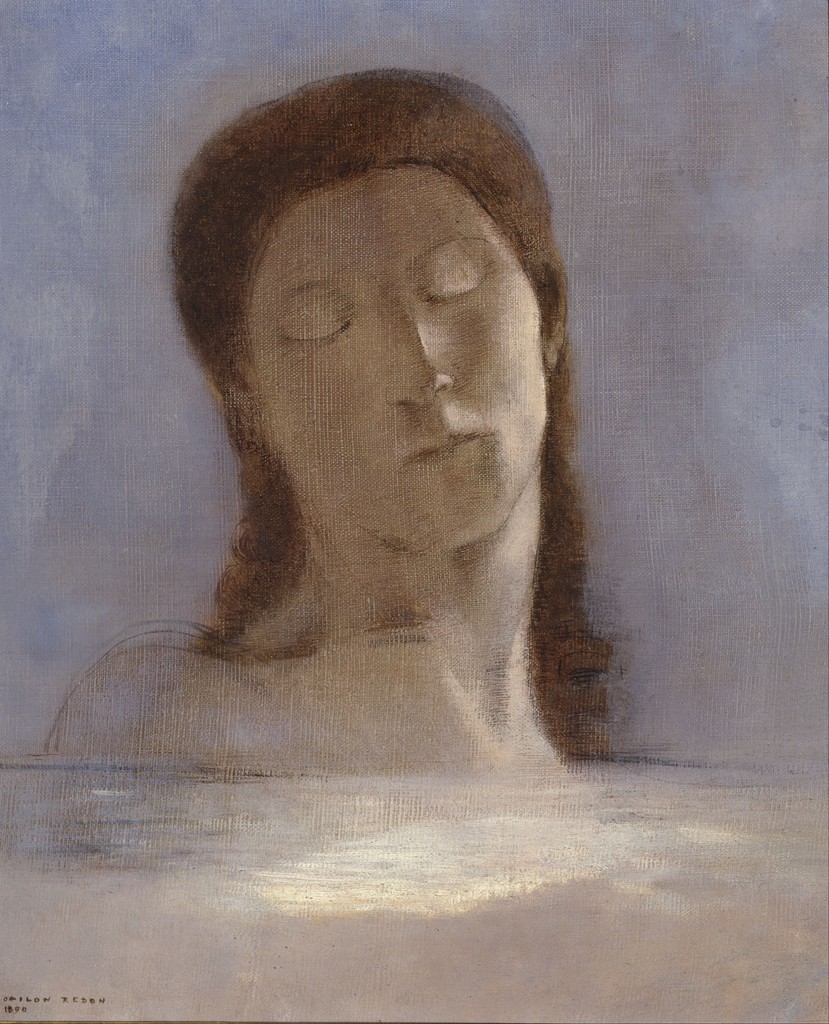
1878Closed Eyes
1890Ophelia among the Flowers
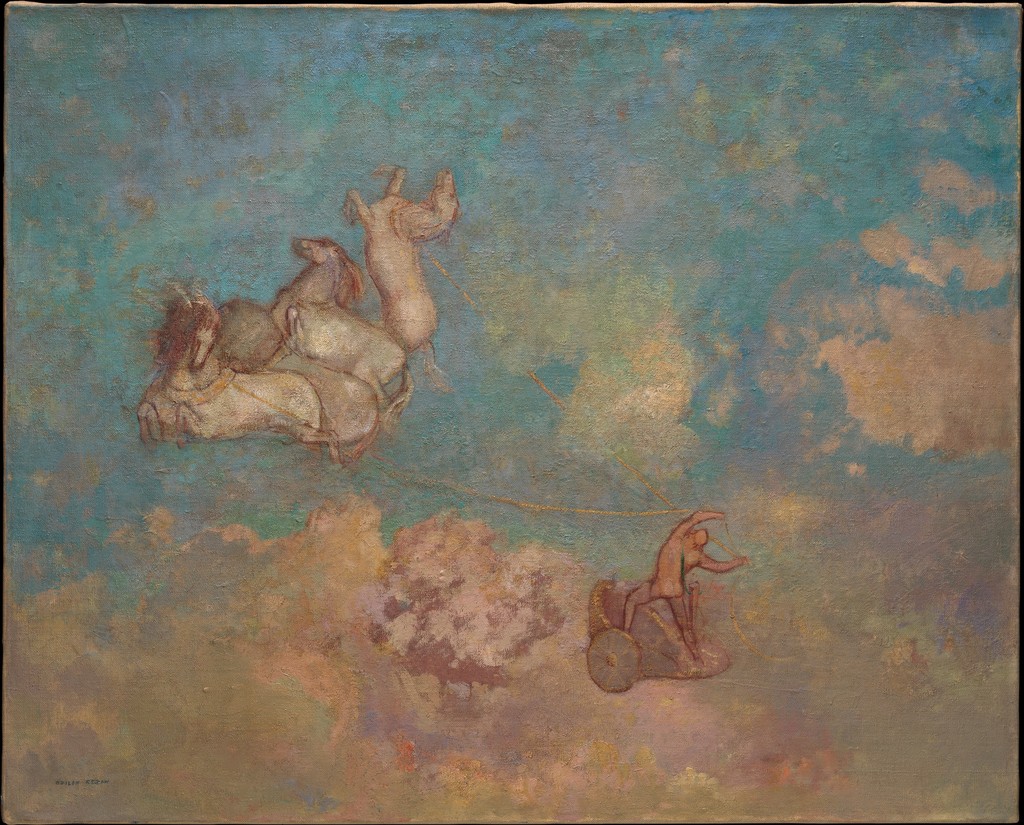
c. 1905–08The Chariot of Apollo
1905–16Pandora
1910/12The Cyclops
c. 1914Contents
Four Career Stages
1. Bordeaux and formation, 1840–1870
Redon was born Bertrand-Jean Redon in Bordeaux on 20 April 1840. The name by which he became known, Odilon, derived from his mother, Odile. His father was a French entrepreneur who had worked in Louisiana; his mother was a French Creole from New Orleans. These transatlantic details belong to the family record, but they should not be turned into a ready-made explanation for the artist’s imagery. The Getty’s authority record identifies him simply and securely as a French painter and printmaker active from 1840 to 1916.[2]
Because of poor health, Redon spent much of his early childhood away from his parents at Peyrelebade, the family property in the Médoc north-west of Bordeaux. Later accounts describe an estate among vineyards and marshy ground, and Redon himself recalled its trees, horizons, music and silences. His older brother Ernest was a musician, and Redon played the violin. Those recollections matter because the mature artist repeatedly returned to Peyrelebade and wrote about the place. They do not prove that solitude caused the noirs, however. The black works were made by an adult who had acquired technical training, studied art and science, read widely and responded to the material possibilities of charcoal and lithography.[3]
Redon returned to school in Bordeaux and began drawing lessons with the local Romantic painter Stanislas Gorin at about fifteen. Gorin encouraged observation and introduced him to the work of Eugène Delacroix. Another decisive friendship was with the botanist Armand Clavaud, who widened Redon’s field of attention in two directions at once. Clavaud’s scientific work concerned minute forms of life, while his literary interests brought Redon into contact with writers including Edgar Allan Poe, Charles Baudelaire and Gustave Flaubert. It is safer to call this a documented exchange of books, ideas and observation than to assign any single later creature to one scientific source. Redon’s mature hybrids grew from accumulated looking, reading and making.[3]
His father wanted him to pursue architecture. Redon worked with architects in Bordeaux and failed the entrance examination for the architecture section of the École des Beaux-Arts in Paris. He later credited architectural exercises in light, shadow and solid form with helping him give improbable subjects a persuasive structure. Around 1862 he met Rodolphe Bresdin, an accomplished but impoverished printmaker then living in Bordeaux. Bresdin taught him etching and showed how an imagined landscape could be constructed through exacting graphic labour. Redon signed an early etching of 1865 as Bresdin’s pupil, yet his later charcoal manner was his own rather than a copy of his mentor’s densely worked line.[3]
In 1864 Redon briefly studied in Paris with the academic painter Jean-Léon Gérôme. The experience was discouraging: Gérôme’s insistence on firm contour conflicted with Redon’s sensitivity to unstable light and form. Back in Bordeaux and during further periods in Paris, he continued to draw, paint small landscapes, study old masters and learn from direct encounters. He exhibited an etching at the Salon in 1867 and wrote reviews of the 1868 Salon for the Bordeaux newspaper La Gironde. Those articles already defended an art that could begin with observed nature and still give thought, memory and imagination an active role.[3]
Landscape remained one test of that principle. Redon worked from the countryside around Peyrelebade and travelled in the Pyrenees and Brittany, producing modest oils and drawings whose places are more readily identifiable than the settings of his visionary sheets. In 1878 he went to the Netherlands to study Rembrandt, paying particular attention to the way light and shadow could carry an idea without depending on anecdote. These activities complicate the familiar picture of an artist sealed inside fantasy. His imagined works were supported by repeated study of trees, rocks, figures, old-master compositions and the behaviour of light across surfaces.[3]
2. War, Paris and the public life of black, 1870–1889
The Franco-Prussian War interrupted Redon’s uncertain early career. Drafted in October 1870, he served until illness led to his release early in 1871. He later described the experience as a moment of resolve, but it would be misleading to turn warfare into a simple stylistic trigger. What can be said is that after the conflict he established himself in Paris and concentrated increasingly on charcoal. He also studied anatomy and natural history so that fantastic forms could retain an underlying visual credibility.[3]
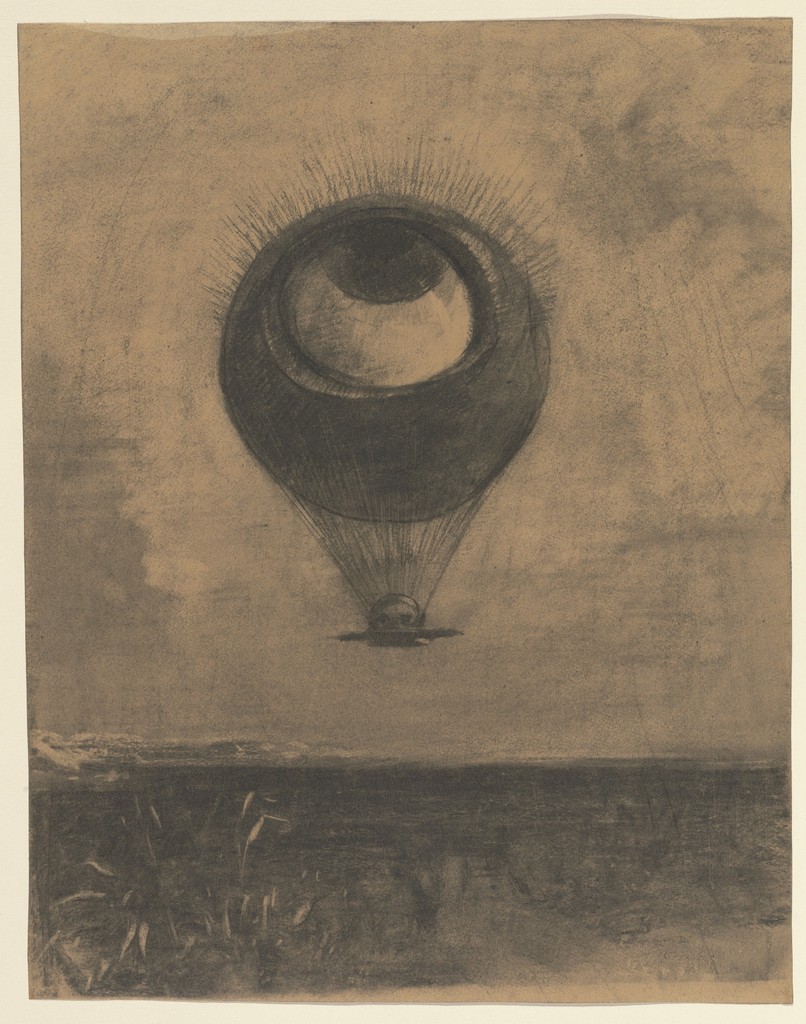
The charcoal drawings of the 1870s established the world now associated with the noirs: heads that hover or ascend, eyes separated from bodies, plants approaching animal or human form, and figures that emerge from darkness without a stable setting. Guardian Spirit of the Waters and Eye-Balloon, both dated 1878, show how varied that world already was. The first gives a monumental human profile to an expanse of sea and sky; the second turns an eye into an airborne head. Neither is merely a coded confession. Redon used charcoal’s capacity for blurring, erasure, dense black and powdery atmosphere to make visible forms behave in improbable ways.[4]
Printmaking gave this private-looking art a public route. Henri Fantin-Latour drew Redon’s attention to transfer lithography, in which an image drawn on prepared paper could be moved to the stone and printed. In 1879 Redon issued In the Dream (Dans le rêve), a portfolio of ten lithographs printed by Lemercier, probably published by the artist in an edition of twenty-five. Later albums drew on Poe, Goya and Flaubert. They did not usually illustrate a continuous plot; captions and sequences instead evoked an author’s atmosphere. MoMA stresses that the portfolio format became one of Redon’s major contributions as a printmaker, while the possibility of editions helped circulate imagery first developed in drawings.[5]
The distinction between an image and its printed recurrence is important. The 1878 Eye-Balloon is a charcoal-and-chalk drawing on coloured paper; the similarly titled plate in the 1882 album To Edgar Poe is a lithograph, not the same object. Redon often translated or rethought an idea across media, and a print could preserve the tonal reach of charcoal while changing scale, surface and audience. His albums thus formed neither a conventional illustrated book nor a mechanical archive of drawings. They were new sequences in which an image’s position, caption and neighbouring plates helped create an open-ended experience.[4][5]
Redon married Camille Falte on 1 May 1880. The Musée d’Orsay identifies Camille, born in 1853, in Redon’s portraits of her, including an 1880 pastel showing her sewing. Historical accounts also credit her with handling practical dealings with publishers and dealers. Their partnership belonged to the working conditions of his art, not to an imagined cure for darkness. Redon continued making noirs and lithographic albums after the marriage, just as he had painted small colour landscapes before it.[3][6]
His public recognition arrived gradually. A modest one-man display in the offices of La Vie Moderne in 1881 drew little notice, but exhibitions in 1881 and 1882 brought responses from the writer Joris-Karl Huysmans and the critic Émile Hennequin. Huysmans included Redon’s work in the 1884 novel Against Nature, bringing it to readers interested in Symbolism and Decadence. In the same year, Redon helped found the Société des Artistes Indépendants and served as a vice-president; he exhibited there in 1884, 1886 and 1887. He also accepted an invitation from the Belgian group Les XX in 1886 and participated in the eighth and final Impressionist group exhibition that year, even though his priorities differed sharply from Impressionism’s public image of immediate outdoor vision.[3]
3. Family, Symbolist networks and the gradual turn to colour, 1889–1900
Redon’s circle linked visual art to poetry and music. Through Huysmans he became close to Stéphane Mallarmé; the two spent time near the Seine at Samois and Valvins. The composer Ernest Chausson was another longstanding friend, and Redon’s own violin playing made music a practice rather than a decorative analogy. Poe, Baudelaire and Flaubert supplied titles, moods and situations, while Redon refused to reduce his pictures to literary puzzles. MoMA describes his broader cultural milieu as one in which observation and dream, natural history and the supernatural could be held together.[1]
Family life brought both grief and continuity. The Redons’ first child, born in 1886, died in infancy. Their son Arï was born in 1889. The Musée d’Orsay’s record for Redon’s portrait of the boy notes how often his father drew and painted him. Arï later became an important steward of the work; through him and his wife Suzanne Dujardin, substantial groups of studio material and artworks entered French national collections in the twentieth century.[7]
At the same time, younger artists sought Redon out. Émile Bernard introduced admirers from the generation associated with Gauguin and the Nabis. Maurice Denis, Pierre Bonnard, Édouard Vuillard and Paul Sérusier valued an older artist who gave inner vision formal substance without prescribing a school. The evidence supports friendship, conversation and admiration, not a claim that Redon single-handedly determined their styles. The Musée d’Orsay preserves Denis’s later description of Redon as an ideal for the young Symbolist generation, alongside Bonnard’s praise for the conjunction of refined material form and mysterious expression in his work.[7]
Colour became more prominent during this period, but it did not arrive overnight. Redon had made oil landscapes for years; the National Gallery of Art notes that he continued painting outdoor studies while producing noirs. Around 1890, however, pastel and oil began to move towards the centre of his exhibited work. Closed Eyes, the Musée d’Orsay painting of 1890, is a useful threshold: a pale face and closed lids emerge from a muted, materially delicate field. It is neither a charcoal drawing coloured in nor a complete renunciation of the earlier art.[8]
Material evidence makes the continuity especially clear. The Musée d’Orsay explains that pastel shared charcoal’s powdery, light-absorbing surface. Redon mixed media, retained charcoal within pastels and used hatching to make colour vibrate. He could therefore move from black into colour through related acts of rubbing, layering, fixing and leaving pigment matte. His subjects also persisted. Mythic figures, flowers, disembodied heads and ambiguous spaces changed their chromatic conditions rather than disappearing.[8]
The 1890s also show why biography cannot supply one “reason” for colour. Arï’s birth, wider recognition and a growing circle of patrons coincided with the change, and contemporaries naturally connected the artist’s circumstances to his brighter palette. Yet the works provide a more concrete account: pastel let Redon retain powder, matteness and erasure while introducing intense hues, and oil allowed him to pursue similarly veiled or chalk-like surfaces. Personal events are relevant context, but the sustained investigation of materials explains how the change actually took visual form.[1][8]
Recognition widened with the 1894 Durand-Ruel exhibition, which assembled more than 130 drawings, paintings, pastels and prints. Dealers and collectors including Ambroise Vollard, Andries Bonger and Gustave Fayet increasingly sustained the work. Redon’s friendships with the Nabis placed him in productive contact with artists much younger than himself, while his independence from any single programme remained important. By the later 1890s he was working extensively in pastel and oil, and the luminous phase of his career was plainly visible to a larger public.[3]
4. Decoration, late subjects and international recognition, 1900–1916
Around 1900 Redon began to work at architectural scale for patrons. For Baron Robert de Domecy’s château in Burgundy, he made a dining-room ensemble of eighteen paintings around 1900–01. The surviving panels dissolve trees, flowers and coloured atmospheres across a room rather than telling one sequential story. The commission expanded the suggestive space of an individual sheet into an environment. In 1910–11 he decorated the library at Fontfroide Abbey with the large panels Day and Night, extending the same dialogue between radiant colour, shadow, music and dream.[9]
Decoration changed more than dimensions. A viewer of a framed noir confronts one concentrated field; a viewer in the Domecy dining room would have turned among related panels while living and moving through the space. Redon responded by loosening recognisable motifs into intervals of trees, foliage and colour. Fontfroide brought a different architectural and intellectual setting, made for his friend and patron Gustave Fayet. In both places, suggestion became spatial: no single emblem governs the ensemble, and the room itself joins the work.[9]
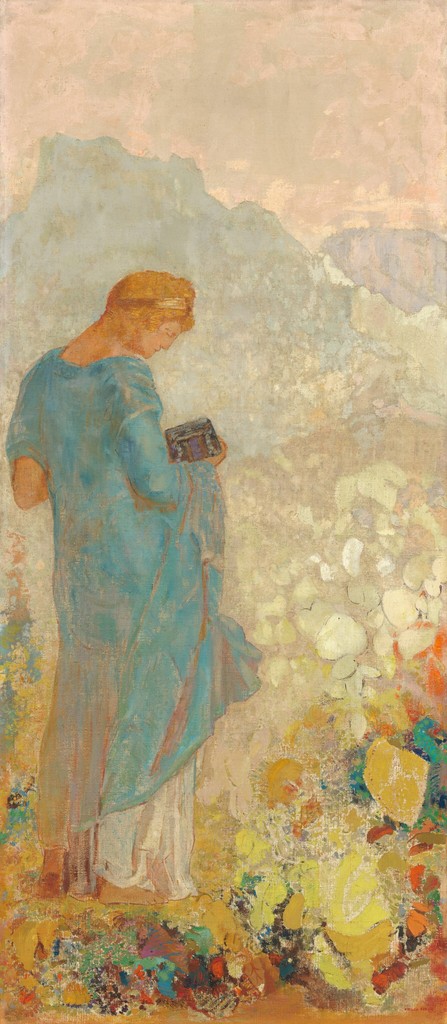
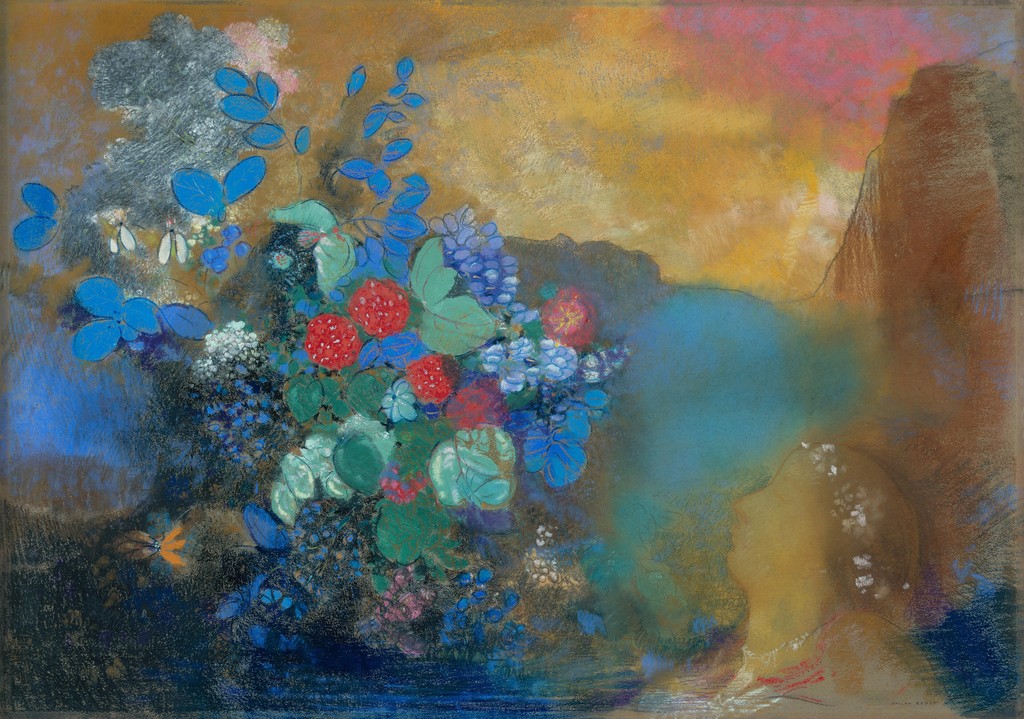
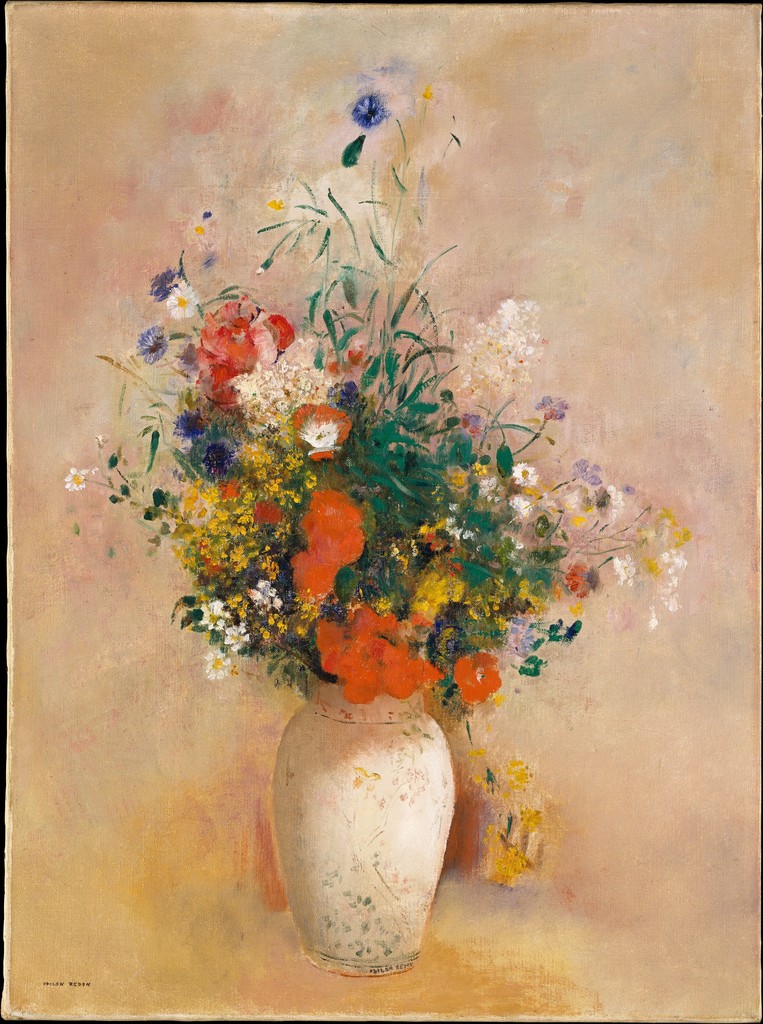
His late production was broad rather than repetitive. Portraits placed sitters within floating fields of colour and flowers. Still lifes such as Vase of Flowers (Pink Background) joined identifiable poppies and cornflowers to a misty, invented setting. Literary subjects remained active in Ophelia among the Flowers, while classical myth generated multiple solutions rather than fixed illustrations. The Chariot of Apollo belongs to a motif Redon explored in more than thirty works, and Pandora suspends its heroine before the fateful action rather than narrating the whole tale.[10]
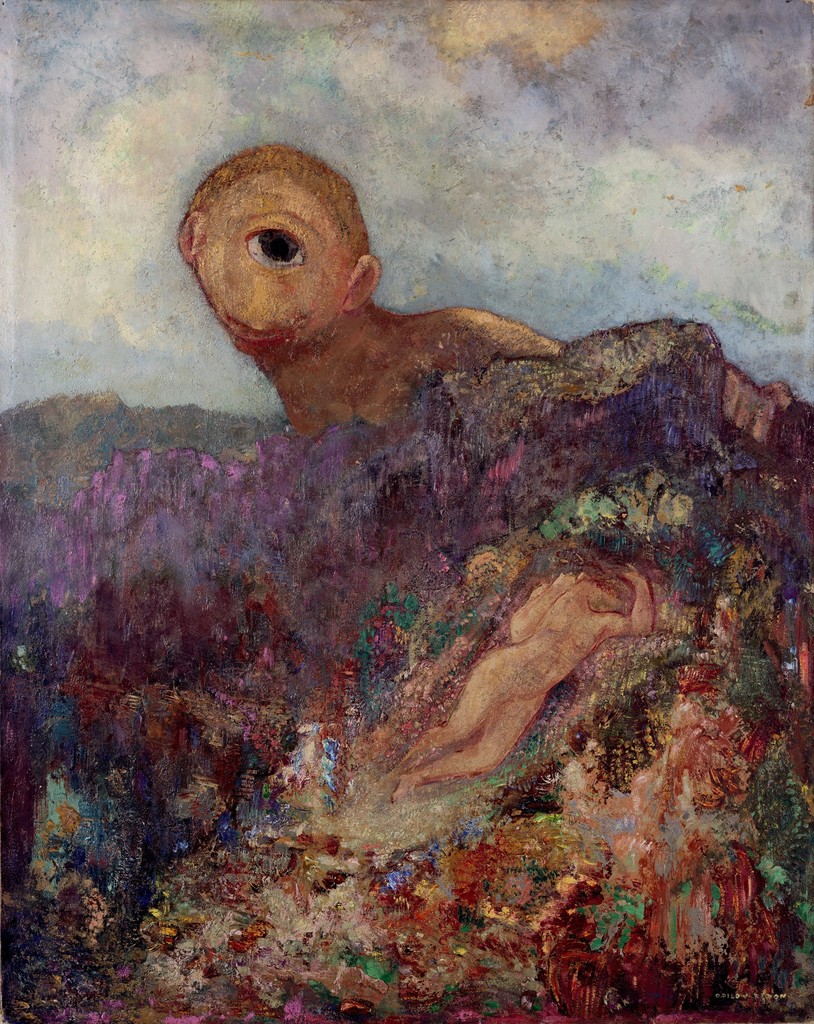
Nor did the autonomous eye vanish with the noirs. In The Cyclops, dated about 1914 by the Kröller-Müller Museum, a single huge eye looks over a ridge in a colour painting whose mythic figure seems at once monumental and hesitant. The work offers a late answer to Eye-Balloon: not a return to an early formula, but proof that Redon could reconfigure a durable motif through oil, landscape colour and the story of Polyphemus.[11]
Official recognition followed the expanding audience. Redon received the Legion of Honour in 1903, and the first Salon d’Automne devoted a room to his work in 1904. The 1913 International Exhibition of Modern Art, known as the Armory Show, then gave him exceptional visibility in the United States. At its Chicago venue, thirty-six works occupied a room of their own. In New York, collector Lillie P. Bliss bought several Redons, including the pastel Roger and Angelica; those acquisitions later helped form the Museum of Modern Art’s founding collection. His appeal at the Armory Show is significant because American audiences encountered him beside younger European modernists, not simply as a survivor of nineteenth-century Symbolism.[3][12]
The First World War darkened Redon’s final years. Arï served in the French forces, and his father’s letters record sustained anxiety about him. Redon’s health declined, and he died in Paris on 6 July 1916. He was seventy-six. The date closes the life but not the history of the work: Camille, Arï and Suzanne preserved it, while collections in France, the Netherlands, Britain and the United States made its full range increasingly visible.[3][7][12]
Legacy: A Modernism of Suggestion
Redon’s legacy rests less on a catalogue of strange creatures than on a method. He observed plants, bones, faces and light closely, then let medium and imagination reorganise them. In charcoal, a mark could be rubbed away until a head seemed to materialise from atmosphere. In lithography, tonal gradation could carry that effect through an edition. In pastel and oil, colour could detach itself from ordinary description without abandoning material sensation. The work asks viewers to complete relations that it deliberately leaves open.[1]
That practice made Redon important to different generations for different reasons. Symbolist writers valued the indeterminate image; the Nabis admired the union of surface and inward expression; collectors at the Armory Show saw an established French artist who still looked experimental. Later accounts have positioned him as a precursor to Surrealism, but “precursor” should not erase his own historical setting. He belonged to nineteenth-century print culture, literary Symbolism, natural history and the modern exhibition system even as his imagery proved available to twentieth-century artists.[13]
The later history of Redon’s studio also shaped what can now be studied. Arï and Suzanne’s stewardship helped bring not only finished works but albums, drawings and documentary material into public collections. That breadth has corrected a reputation once divided between frightening black visions and decorative flower pictures. Museum collections now make it possible to trace revisions, repeated motifs and technical continuities across decades—the evidence on which a less dramatic, more accurate biography depends.[7]
The best way to follow that range is to move between media rather than treating black and colour as opposites. Begin with the Odilon Redon overview, compare the material arguments in Noirs, Prints and Drawings and Paintings and Pastels, then examine how literature, science, music and myth interact in Symbolism, Dreams and Imagination. Together with the eight works linked above, these routes show a career built through returns, revisions and changes of medium rather than one dramatic conversion.
Follow Odilon Redon's career through four stages
Bordeaux, Peyrelebade and observed nature
Redon moved between Bordeaux and the Médoc, studied drawing and printmaking, and formed durable interests in landscape, botany, literature and music. Rodolphe Bresdin and Armand Clavaud widened the technical and scientific resources from which his art developed.
Charcoal, lithography and visionary albums
Beginning with the 1879 portfolio In Dreams, Redon made charcoal drawings and lithographic series in which eyes, heads, organisms and literary prompts emerge from manipulated black surfaces.
Closed eyes, pastel and a gradual rebalancing
Colour became increasingly prominent through oil, pastel and mixed media. The transition was gradual: charcoal remained within later pastels, while the apparition-like spaces of the noirs survived in colour.
Flowers, myth, portraiture and decoration
Radiant flowers, portraits, classical and literary subjects and decorative commissions expanded Redon's public range. International exhibitions and younger artists brought wider recognition without making the late works less enigmatic.
Researched works directory
This searchable evidence census was assembled from public museum records and a reproducible Wikidata snapshot. It is not a catalogue raisonné, a claim to complete oeuvre coverage, or a substitute for Alec Wildenstein's printed catalogue, which was not consulted for this directory.
| Name | Date | Medium |
|---|---|---|
| A La Vieillesse (To Old Age) | 1886 | |
| A Madman in a Dismal Landscape | 1885 | |
| A Woman Reading a Book or Reading | 1914 | Painting |
| Allégorie : un arbre rouge non rougi par le soleil | 1905 | Painting |
| Alsace | 1914 | Painting |
| Andromeda | 1907 | Painting |
| Andromeda | 1912 | Painting |
| Andromeda enchained | 1905 | Painting |
| Anémones | Date unknown | Painting |
| Anemones and Tulips | 1902 | Painting |
| Animals at the Bottom of the Sea | Date unknown | Painting |
| Antoine: Quel Est Le But de Tout Cela? ... | Date unknown | |
| Apache (Man on Horseback) | Date unknown | Painting |
| Apache (Man on Horseback II) | Date unknown | Painting |
| Apollo | 1905 | Painting |
| Apollo's chariot | 1910 | Painting |
| Apollon vainqueur du serpent Python | 1872 | Painting |
| Apollonius | 1896 | Drawing |
| Apparition | 1905 | Painting |
| Apparition | 1907 | Painting |
| Apres cela je vis descendre du ciel un ange qui avait la clef de l'abime, et une grande chaine en sa main (And I saw an angel come down from heaven, having the key of the bottomless pit and a great chain in his hand) | 1899 | |
| Arabe musicien | 1893 | Painting |
| Arbre dans la lande | Date unknown | Painting |
| Arbre (Tree) | 1892 | |
| Arbres sur un fond jaune | 1901 | Painting |
| Ari | 1898 | |
| Armor | 1891 | Drawing |
| At the Bottom of the Sea | 1905 | Painting |
| Au réveil j’aperçus la Déesse de l’Intelligible au profil sévère et dur [Bij het ontwaken zag ik de godin van het begrijpelijke in een streng en hard profiel], uit de reeks Hommage à Goya. 6 lithographies par Odilon Redon | 1885 | |
| Autoportrait en buste | 1876 | Painting |
| Bain de Venus | 1900 | Painting |
| Barbizon en automne | Date unknown | Painting |
| Baronne de Domecy | 1900 | Painting |
| Baronne Robert de Domecy | 1900 | Painting |
| Barques | 1885 | Painting |
| Barques dans le port | 1880 | Painting |
| Battle with the dragon | 1907 | Painting |
| Beatrice | 1885 | Painting |
| Béatrice | 1897 | |
| Bell-Tower Keeper | Date unknown | Painting |
| Black Sun | 1900 | Painting |
| Bloemstilleven | 1901 | Painting |
| Boqueteau | Date unknown | Painting |
| Bouddha dans sa jeunesse | Date unknown | Painting |
| Bouleaux à Bièvres | Date unknown | Painting |
| Bouquet au vase noir | Date unknown | Painting |
| Bouquet de fleurs | 1900 | Painting |
| Bouquet de fleurs | 1908 | Painting |
| Bouquet de fleurs au mimosa | Date unknown | Painting |
| Bouquet in a Chinese Vase | 1912 | Painting |
| Bouquet of Flowers | 1902 | Painting |
| Bouquet of flowers | 1904 | Painting |
| Bouquet of Flowers in a Green Vase | 1915 | Painting |
| Breton Village | 1890 | Painting |
| Brunnhilde | 1894 | |
| Butterflies | 1910 | Painting |
| C'est le Diable | 1888 | |
| C'est moi, Jean, qui ai vu et qui ai oie ces choses (And I John saw these things and heard them | 1899 | |
| C'etait un voile, un empriente (It was a veil, an imprint) | 1891 | |
| Cain and Abel | 1886 | |
| Caïn et Abel | Date unknown | Painting |
| Caliban, petit monstre ou gnome | 1881 | Drawing |
| Calvary | 1895 | Painting |
| Carnations | Date unknown | Drawing |
| Carton de vitrail | 1911 | Painting |
| Cavalier Galopant (Galloping Horseman) | 1866 | |
| Cellule Auriculaire | 1894 | |
| Cellule Auriculaire (Auricular Cell) | 1894 | |
| Centaur visant les Nues (Centaur aiming at the Clouds) | 1895 | |
| Chaumière bretonne | Date unknown | Painting |
| Chemin près de la mer | Date unknown | Painting |
| Cheval aile (Winged Horse) | 1894 | |
| Cheval cabré sur une cime | Date unknown | Painting |
| Christ | 1887 | |
| Christ and the Samaritan Woman (The White Flower Bouquet) | 1895 | Painting |
| Christ on the cross | 1910 | Painting |
| Ciel couvert sur une lande | Date unknown | Painting |
| Citroen en paprika | 1901 | Painting |
| Cliff Scene | 1895 | Painting |
| Closed Eyes | 1890 | Painting |
| Closed Eyes (Yeux Clos) | 1890 | |
| Colline, près de Royan | Date unknown | Painting |
| Combat équestre | 1910 | Painting |
| Composition à trois personnages (Flagellation ?) | Date unknown | Painting |
| Composition: Flowers | Date unknown | Painting |
| Composition: Flowers without a Vase | Date unknown | Painting |
| Conque marine | Date unknown | Painting |
| Conversation mystique | Date unknown | Painting |
| copie d'après 'La chasse aux lions' de Delacroix | 1865 | Painting |
| Copie d'après 'La Grèce sur les ruines de Missolonghi' de Delacroix | Date unknown | Painting |
| Coquelicots | 1885 | Painting |
| Couverture - Frontispice | 1890 | |
| Crucifixion | Date unknown | Painting |
| Cul-de-Lampe | 1890 | |
| Dans l'Ombre des Gens Pleurent et Prient Entourés d'Autres Qui Les Exhortent | Date unknown | |
| Dans mon rêve, je vis au ciel un visage de mystère | 1885 | |
| Dante and Beatrice | 1914 | Painting |
| De oude Ridder | 1896 | |
| De Strijdwagen van Apollo | Date unknown | Painting |
| Den helige Antonius, bröstbild | 1906 | Drawing |
| Des Fleurs Tombent, et la Tête d'un Python Parait | Date unknown | |
| Des Peuples Divers Habitent Les Pays De L'Océan | Date unknown | |
| Die Kathedrale - 13080 - Bavarian State Painting Collections | 1914 | Painting |
| Druidesse | 1891 | |
| Druidesse | 1892 | |
| Dunes | Date unknown | Painting |
| Edouard Vuillard | 1900 | |
| Een man van het volk. Tekening voor een illustratie in Le Juré van Edmond Picard | 1887 | Drawing |
| Eerbetoon aan Goya | 1895 | Painting |
| Elle Tire de Sa Poitrine une Éponge Toute Noire, La Couvre de Baisers | Date unknown | |
| Elle tire de sa poitrine une eponge toute noire, la couvre de baisers (She draws from her bosom a sponge, perfectly black, and covers it with kisses) | 1896 | |
| Escape to Egypt | Date unknown | Painting |
| Esquisse de vitrail | 1905 | Drawing |
| Et celui qui était monté dessus se nommait la Mort (And his name that sat on him was Death) | 1899 | |
| Et il avait dans sa main droit sept etoiles, et de sa bouch sortait une epee aigue a deux tranchants (And he had in his right hand seven stars; and out of his mouth went a sharp two-edged sword) | 1899 | |
| Et Il Distingue Une Plaine Aride et Mamelonneuse | Date unknown | |
| Et il tombe du ciel une grande etoile ardente (And there fell a great star from heaven burning as it were a lamp) | 1899 | |
| Et l'homme parut, interrogeant le sol d'ou il sort et qui l'attire, il se fraya la voie vers (And Man appeared; questioning theearth from which he emerged and which attracts hi m, he made his way toward somber brightness) | 1883 | |
| Et la-bas l'idole astrale, l'Apotheose (And beyond, the star idol, the apotheosis) | 1891 | |
| Et le diable qui les seduisait, fut jete dans l'etang de feu et de soufre, ou es la b ete et le faux prophete (And the devil thatdeceived them was cast into the lake of fire and brimstone, where the beast and the false prophet are) | 1899 | |
| Et le lia pour mille ans (And bound him a thousand years) | 1899 | |
| Et moi, Jean, Je vis la sainte cite, la nouvelle Jerusalem, qui descendait du ciel, d'aupres de dieu (And I John saw the holy city, new Jerusalem, coming down from God out of heaven) | 1899 | |
| Et Partout ce Sont des Colonnes de Basalte,... La Lumière Tombe des Voutes | Date unknown | |
| ...Et Que Des Vuex Sans Tête Flottaient Comme Des Mollusques | Date unknown | |
| Et un autre ange sortit du temple qui est au ciel, ayant lui aussi une faucille tranchante (And another angel came out of the temple which is in heaven, and he also having a sharp sickle) | 1899 | |
| Etruscan Vase with Flowers | 1905 | Painting |
| étude pour 'La chasse aux lions' d’après Delacroix | 1867 | Painting |
| Eve | 1904 | Painting |
| Evocation of Butterflies | 1910 | Painting |
| Evocation of Roussel | 1912 | Painting |
| Eye-Balloon | 1878 | Drawing |
| Falaise dominant la mer | Date unknown | Painting |
| Fantasia | 1910 | Painting |
| Fantasmagorie | Date unknown | Painting |
| Femme a la torque ornee (Woman with a plumed hat) | 1900 | |
| Femme de Profil (Profile of a Woman) | 1900 | |
| Femme en rouge | 1898 | Drawing |
| Ferme et rochers | Date unknown | Painting |
| Figure | 1901 | Painting |
| Figure cornue | Date unknown | Drawing |
| Figure devant un arbre | 1894 | Drawing |
| Figure portant une tête ailée | 1876 | Drawing |
| Figure, yellow flower | 1901 | Painting |
| Fireplace screen | 1908 | Painting |
| Fishing Boat | Date unknown | Painting |
| Fishing Boats: Memory of Venice | 1908 | Painting |
| Fishing Village, Brittany | 1883 | Painting |
| Five Butterflies | 1912 | Drawing |
| Fleurs | Date unknown | Painting |
| Fleurs dans un paysage de montagne avec visage | Date unknown | Painting |
| Fleurs dans un vase | 1907 | Painting |
| Fleurs dans un Vase bleu | 1903 | Painting |
| Fleurs dans un vase : pivoines | Date unknown | Painting |
| Fleurs des champs | 1906 | Painting |
| Fleurs étranges | 1910 | Painting |
| Flower Clouds | 1903 | Drawing |
| Flowers in a Japanese Vase | 1908 | Painting |
| Flowers in a Vase | 1910 | Painting |
| Flowers in Green Vase | Date unknown | Painting |
| Flowers: Poppies and Daisies | 1867 | Painting |
| Frieze of flowers and berries | 1901 | Painting |
| Frise de fleurs, marguerite rose | 1901 | Painting |
| Frontispiece | 1889 | |
| Gekruisigde Christus | Date unknown | Drawing |
| Geraniums and other Flowers in a Stoneware Jug | 1910 | Painting |
| Grand Bouquet | 1901 | Painting |
| Grand bouquet de fleurs des champs | 1903 | Painting |
| Grand panneau à décor végétal, fond clair | 1901 | Painting |
| Grand tapis de prière | 1908 | Painting |
| Green Death | Date unknown | Painting |
| Grey frieze | 1901 | Painting |
| Groupe de maisons blanches aux toits rouges | Date unknown | Painting |
| Guardian Spirit of the Waters | 1878 | Drawing |
| Hantise (Obsession) | 1894 | |
| Hélène (Ennoia) | Date unknown | |
| Hommage à Goya. 6 lithographies par Odilon Redon | 1885 | |
| Icarus | 1890 | Painting |
| Il Tombe Dans L'Abime, La Tête En Bas | Date unknown | |
| Il y eut aussi des êtres embryonnaires [Er waren ook embryonale wezens], uit de reeks Hommage à Goya. 6 lithographies par Odilon Redon | 1885 | |
| Il y eut des luttes et des vaines victoires (There were struggles and vain victories) | 1883 | |
| Il y eut peut-etre une vision premiere essayee dans la fleur (There was perhaps a first vision attempted in the flower | 1883 | |
| Immédiatement Surgissent Trois Déesses | Date unknown | |
| Initiation to Study—Two Young Ladies | 1905 | Painting |
| J'ai Quelquefois Aperçu Dans Le Ciel Comme Des Formes D'Esprits | Date unknown | |
| Jacob and the Angel | 1907 | Painting |
| Jacob's Struggle with the Angel | 1910 | Painting |
| Jacob Wrestling with the Angel | 1907 | Painting |
| Je Me Suis Enfoncé dans la Solitude. J'habitais L'Arbre Derrière Moi | Date unknown | |
| Je Suis Toujours la Grande Isis! Nul N'A Encore Soulevé Mon Fruit Est Le Soleil | Date unknown | |
| Je t'adore a l'egal de la voute nocturne. O vase de tristesse, o grande taciturne (I adore you as I adore the vault of the night sky, O vessel of sadness, O tall silent woman) | 1890 | |
| Jésus et la Samaritaine | Date unknown | Painting |
| L'Aile impuissante n'eleva point la bete en ces noirs espaces (The impotent wing did not lift the animal into that black space | 1883 | |
| L'Aile (The Wing) | 1893 | |
| L'ange déchu | 1875 | Painting |
| L'ange guerrier | 1900 | Painting |
| L'apparition | Date unknown | Painting |
| L'Araignée souriante | 1881 | Drawing |
| L'Arbre | Date unknown | Painting |
| L'Art Celeste (The Celestial Art) | 1894 | |
| L'Automne en Médoc | 1897 | Painting |
| L'Enlèvement de Ganymède | Date unknown | Painting |
| L'Intelligence Fut A Moi! Je Devins Le Buddha | Date unknown | |
| La Baie des Trépassés | Date unknown | Painting |
| La Barque | 1900 | Painting |
| La Barque rouge | 1900 | Painting |
| La Branche fleurie jaune | 1901 | Painting |
| La captive | 1914 | Painting |
| La Chute de Phaéton | 1906 | Painting |
| La Chute de Phaëton | 1910 | Painting |
| La fleur du marécage, une tête humaine et triste [De moerasbloem, een triest menselijk hoofd], uit de reeks Hommage à Goya. 6 lithographies par Odilon Redon | 1885 | |
| La Mare à Peyrelebade | 1897 | Painting |
| La Mer à Morgat | 1883 | Painting |
| La Mort: C'est Moi Te Rendes Sérieuse; Enlaçons-Nous | Date unknown | |
| La Mort d'Orphée | 1908 | Painting |
| La mort. Mon ironie dépasse toutes les autres! | 1890 | Painting |
| La Mort: Mon ironie depasse toutes les autres! (Death: My iron surpasses all others!) | 1889 | |
| La palme | Date unknown | Painting |
| La Peur (Fear) | 1865 | |
| La route de Bièvres | 1890 | Painting |
| La sirene sortit des flots vetue de dards (The Siren clothed in barbs, emerged from the waves | 1883 | |
| La Sulamite (The Shulamite) | 1897 | |
| La Vieille: Que Crains-tu? Un Large Trou Noir! Il Est Vide Peut-être? | Date unknown | |
| La Vieille: Que Crains-tu? Un large trou Noir! Il est vide peut-etre? (What are you afraid of? A wide black hole! It is empty, perhaps!) | 1896 | |
| Lady of the Flowers | 1892 | Painting |
| Lande avec une mare | Date unknown | Painting |
| Lande nue | Date unknown | Painting |
| Landscape | 1872 | Painting |
| Landscape | Date unknown | Painting |
| Landscape at Daybreak | 1872 | Painting |
| Landscape with Rocks near Royan | Date unknown | Painting |
| Large Vase with Flowers | 1912 | Painting |
| Le Bouddha | 1895 | |
| Le Bouddha | 1906 | Drawing |
| Le Buddha | 1895 | |
| Le Centaure à l'arc | Date unknown | Painting |
| Le Centaure aux coquelicots | 1910 | Painting |
| Le centaure et le dragon | Date unknown | Painting |
| Le char d'Apollon | 1905 | Painting |
| Le Chemin à Peyrelebade | Date unknown | Painting |
| Le Chêne | Date unknown | Painting |
| Le Coursier (The Race Horse) | 1894 | |
| Le Gue (The Ford) | 1865 | |
| Le Jour (Day) | 1891 | |
| Le Jour Enfin Parait,... Et Dans Le Disque Même Du Soleil, Rayonne La Face de Jésus-Christ | Date unknown | |
| Le Liseur (The reader) | 1892 | |
| Le paravent rouge (avec Pégase) | Date unknown | Painting |
| Le pavot noir | Date unknown | Painting |
| Le Petit Vase vert | Date unknown | Painting |
| Le Polype difforme flottait sur les rivages, sorte de cyclope souriant et hideux (Thedeformed polyp floated on the shores, a sort of smiling and hideous Cyclops | 1883 | |
| Le Regard | 1901 | Painting |
| Le Regard | 1910 | Painting |
| Le Rêve – Fleurs et Visage | 1890 | Drawing |
| Le Rocher rose | 1880 | Painting |
| Le Satyre au cynique sourire (The Satyr with the cynical smile) | 1883 | |
| Le Silence | 1895 | Painting |
| Le Vitrail | 1906 | Painting |
| Les Anemones (Still Life with Anemones) | 1905 | Painting |
| Les Bêtes De La Mer Rondes Comme Des Outres | Date unknown | |
| Les Croisés | Date unknown | Painting |
| Les Landes à Peyrelebade | 1885 | Painting |
| Les Parques | Date unknown | Painting |
| Les Quais à Bordeaux | 1900 | Painting |
| Les rochers (Rochers en Bretagne) | 1875 | Painting |
| Les Sciapodes: La tete le plus bas possible, c'est le secret du bonheur! (The Skiapods: "The head as low as possible, that is the secret of happiness!") | 1889 | |
| Les trois vases bleus | 1910 | Painting |
| Liserons et coquelicots dans un petit pichet vert | 1866 | Painting |
| Lueur precaire, une tete a l'infini suspendue(Precarious glimmering, a head suspended | 1891 | |
| Lumière | Date unknown | |
| Lumiere (Light) | 1893 | |
| Madame Arthur Fontaine (Marie Escudier, born 1865) | 1901 | Painting |
| Madame Odilon Redon | 1882 | Painting |
| maison avec deux arbres | Date unknown | Painting |
| Marguerites | 1901 | Painting |
| Marguerites et baies de Sorbier | 1901 | Painting |
| Maurice Denis | 1903 | |
| Médoc, arbres dans la prairie | Date unknown | Painting |
| Médoc, l'arbre | Date unknown | Painting |
| Médoc, la lande | Date unknown | Painting |
| Médoc, le bouquet d'arbres | Date unknown | Painting |
| Melancholy | 1868 | Drawing |
| Mes Baisers ont le Gout d'un Fruit Qui Se Fondrait Dans Ton Coeur!... | Date unknown | |
| Meules couvertes de bâches près d'un arbre | Date unknown | Painting |
| Mme Sabouraud (Thérèse Balandier) | 1907 | Drawing |
| Mon Enfant (My Child) | 1892 | |
| Montagnes des Pyrénées | Date unknown | Painting |
| Morgat vue des dunes de la Palue | Date unknown | Painting |
| moulin en Bretagne | Date unknown | Painting |
| Mystery | 1910 | Painting |
| Mystical Conversation | 1896 | Painting |
| Nasturtium | 1905 | Painting |
| Nature morte | 1901 | Painting |
| Navet | 1875 | Painting |
| Noce juive au Maroc | Date unknown | Painting |
| Nocturne | Date unknown | Painting |
| Nuages clairs sur une lande | Date unknown | Painting |
| Oannès | 1905 | Painting |
| Oannès | 1908 | Painting |
| Oannes and the Sphinx | 1910 | Painting |
| Oannès: Moi, La Première Conscience Du Chaos, J'ai Surgi de L'Abime Pour Durcir la Matière, Pour Régler les Formes | Date unknown | |
| Offrande | Date unknown | Painting |
| Old Man With Wings and Beard or Winged Old Man with a Long White Beard | 1870 | Drawing |
| Ophelia | 1901 | Painting |
| Ophelia | 1905 | Painting |
| Ophelia | Date unknown | Painting |
| Ophelia among the Flowers | c. 1905–1908 | Drawing |
| Ophelia with a Blue Wimple in the Water | 1900 | Painting |
| Orphée | 1910 | Painting |
| Orphée | Date unknown | Painting |
| Orpheus | 1903 | Drawing |
| Pandora | 1910/1912 | Painting |
| Panneau décoratif | 1902 | Painting |
| Pansies | 1905 | Drawing |
| Papillons | 1910 | Painting |
| Paravent d'Olivier Sainsère | 1903 | Painting |
| Parfois on trouve un vieux flacon qui se souvient, d'ou jaillit toute vive une ame qui revient (Sometimes one finds an old reminiscing flask, whence issues in full life a returning soul) | 1890 | |
| Parsifal | 1892 | |
| Passage d'une Ame (Passage of a Spirit) | 1891 | |
| Paul Gauguin | 1904 | Painting |
| Paul Serusier | 1903 | |
| Paysage de Venise | 1908 | Painting |
| Pégase et l'Hydre | 1900 | Painting |
| Pegasus | 1914 | Painting |
| Pegasus and the Hydra | 1907 | Painting |
| Pegasus, the Horse on the Rock | 1908 | Drawing |
| Pélerin du monde sublunaire (Pilgrim of the sublunary world) | 1891 | |
| Perversité | 1891 | |
| Perversite (Perversity) | 1891 | |
| Petite fille tricotant | Date unknown | Painting |
| Peupliers à Peyrelebade | Date unknown | Painting |
| Peyrelebade | 1888 | Painting |
| Pierre Bonnard | 1900 | |
| Piety Beside a Red Tree | 1905 | Painting |
| Pivoine, géranium et lilas | Date unknown | Painting |
| Plante verte dans une urne | Date unknown | Painting |
| Pond in les Landes | 1880 | Painting |
| Port breton | Date unknown | Painting |
| Portrait d'Arï Redon au col marin | 1897 | Painting |
| Portrait d'Arï Redon en profil | 1892 | |
| Portrait de Jeanne Chaine | 1903 | Drawing |
| Portrait de jeune fille sur fond d'arcatures | 1911 | Painting |
| Portrait de Madame Redon | 1911 | Painting |
| Portrait de Paule Gobillard | 1908 | Drawing |
| Portrait of A.M.L. Bonger-van der Linden | 1905 | Painting |
| Portrait of Emile Bernard | 1901 | Drawing |
| Profil de jeune fille parmi les fleurs | 1905 | Painting |
| Profil de lumiere (Profile of light) | 1886 | |
| Profile | Date unknown | Painting |
| Profile and Flowers | 1912 | Drawing |
| Profile of a Woman with a Vase of Flowers | 1900 | Painting |
| Profile on Red Meanders (formery known as Jeanne d'Arc) (see Google Books) | 1900 | Drawing |
| Prophète | Date unknown | Painting |
| Puis l'ange prit l'encensoir (And the angel took the censer) | 1899 | |
| Quadrige, le char d’Apollon | 1909 | Painting |
| Quand s'eveillait la Vie au Fon de la matiere obscure (When life was awakening in the depths of obscure matter | 1883 | |
| Reflections | 1903 | Drawing |
| rocher en Bretagne | Date unknown | Painting |
| Rocher sur la grève | Date unknown | Painting |
| Rochers de Vallières, près de Royan | Date unknown | Painting |
| Rochers en Bretagne | 1884 | Painting |
| Rochers près de Royan | Date unknown | Painting |
| Rochers sur la plage | Date unknown | Painting |
| Rocks on the Beach | 1883 | Painting |
| Rocky Peak | 1875 | Painting |
| Rocky Slope | Date unknown | Painting |
| Roger and Angelica | 1910 | Drawing |
| Roger et Angélique | Date unknown | Painting |
| Roger Marx | 1904 | |
| Roland à Ronceveaux | 1862 | Painting |
| Rose, iris et marguerites dans un vase vert | Date unknown | Painting |
| rue à Saint-Georges-de-Didonne | Date unknown | Painting |
| Rue de village | 1875 | Painting |
| Rue Douarnenez | 1880 | Painting |
| Sailboats (Allegorical Landscape) | 1907 | Painting |
| Saint Anthony and the Two Temptresses (Saint Antoine et deux Tentatrices) | 1896 | Drawing |
| Saint-Antoine...A travers ses longs cheveux qui lui couvraient la figure, j'ai cru reconnaitre Ammonaria (Saint Anthony: "Beneathe her long hair , which covered her face, I thought I recognized Ammonaria) | 1889 | |
| Saint-Antoine: Au Secours Mon Dieu! | Date unknown | |
| Saint George and the Dragon | Date unknown | Drawing |
| Saint George and the Dragon (Saint Georges et le dragon) | 1909 | Painting |
| Saint Jean | 1910 | Drawing |
| Saint John | 1900 | Painting |
| Saint Sebastian | 1900 | Painting |
| Saint Sebastian | 1910 | Painting |
| Saint Sebastian (Basel) | 1910 | Painting |
| Saint Sébastien | 1910 | Painting |
| Salomé | 1910 | Painting |
| Sans cesse a mes cotes s'agite le demon (Ceaselessly by my side the demon stirs) | 1890 | |
| Seated Man | Date unknown | Painting |
| Self-portrait | 1867 | Painting |
| Self-portrait | 1880 | Painting |
| Self-portrait | 1885 | Painting |
| Si par une nuit lourde et sombre, un bon chretien, par charite, derriere quelque vieux decombre, enterre votre corps voute (If on a close dark night a good Christian, out of charity, behind some old ruin, buries your arched body) | 1890 | |
| Silence | 1911 | Painting |
| Siren | 1900 | Painting |
| Small Grey Panel I | 1901 | Painting |
| Small Grey Panel II | 1901 | Painting |
| Sommeil de Caliban | 1895 | Painting |
| Sous-bois au printemps | Date unknown | Painting |
| Sous l'aile d'ombre | Date unknown | |
| Sous l'aile d'ombre, l'etre noir appliquait une active morsure (Beneath the wing of shadow the black creature was biting energetically) | 1891 | |
| Spring | 1907 | Painting |
| Still Life with Flowers | 1905 | Painting |
| Still Life with Fruit | 1905 | Painting |
| stillife | Date unknown | Painting |
| Sur le fond de nos nuits dieu de son doigt savant dessine un cauchemar multiforme et sans treve (On backdrop of our nights God with His knowing finger traces a multiform implacable nightmare) | 1890 | |
| Symbolic Head | 1890 | Painting |
| Tete d'Enfant avec Fleurs (Head of a Child with Flowers) | 1897 | |
| Tete d'Enfant (Head of a Child) | 1899 | |
| Tête d'Orphée | Date unknown | Painting |
| The Angel Raphael Leaving Tobit and His Family | 1862 | Painting |
| The Birth of Venus | 1906 | Painting |
| The Birth of Venus | 1912 | Painting |
| The Book of Light | 1893 | Drawing |
| The Buddha | 1904 | Painting |
| The Chariot of Apollo | 1905–1916 | Painting |
| The Chariot of Apollo series | Date unknown | Painting |
| The chariot of the Sun | 1910 | Painting |
| The Crucifixion | 1904 | Painting |
| The Cyclops | c. 1914 | Painting |
| The Death of Orpheus | 1904 | Painting |
| The Devil (Le Diable) | 1896 | Drawing |
| The Dog | 1896 | |
| The Fisherwoman | Date unknown | Drawing |
| The Flowers in a Blue Vase | 1913 | Drawing |
| The Golden Cell | 1892 | Painting |
| The Gothic Window | 1900 | Painting |
| The Green Vase | Date unknown | Painting |
| The Grey Sail | Date unknown | Painting |
| The Haunting (Hantise) | 1893 | Artwork |
| The Headhunter and His Family | 1870 | Drawing |
| The Mount of Calvary | 1895 | Drawing |
| The Muse on Pegasus | 1908 | Painting |
| The Port of Morgat | 1882 | Painting |
| The Potted Geranium | 1865 | Painting |
| The Prayer | 1893 | Painting |
| The Queen of Sheba (La Reine de Saba) | 1896 | Drawing |
| The Red Boat | 1910 | Painting |
| The Red Man | 1905 | Painting |
| The red poppy | 1895 | Painting |
| The Red Tree | 1905 | Painting |
| The Sea in Brittany | Date unknown | Painting |
| The Shadow (L'Ombre) | 1896 | Drawing |
| The Tree | 1875 | Painting |
| The Two Graces | 1900 | Painting |
| The Winged Man | 1890 | Painting |
| The Yellow Sail | 1905 | Painting |
| Three Fates | 1900 | Painting |
| Trees in Bièvres | Date unknown | Painting |
| Trees in the Blue Sky | 1883 | Painting |
| Triumph of Truth | 1870 | Painting |
| Tronc d'arbre dans la plaine | Date unknown | Painting |
| Two Dancers | Date unknown | Painting |
| Two Young Girls among Flowers | 1912 | Painting |
| Un étrange jongleur [Een vreemde evenwichtskunstenaar], uit de reeks Hommage à Goya. 6 lithographies par Odilon Redon | 1885 | |
| Underwater Vision | 1910 | Painting |
| Une femme revêtue du Soleil (A woman clothed with the sun) | 1899 | |
| Une longue chrysalide couleur de sang (A longchrysalis, the color of blood) | 1889 | |
| Vase de fleurs | 1915 | Painting |
| Vase de fleurs | Date unknown | Painting |
| Vase of Flowers | 1867 | Painting |
| Vase of Flowers | 1890 | Painting |
| Vase of Flowers | 1901 | Painting |
| Vase of Flowers | 1904 | Painting |
| Vase of Flowers | 1905 | Painting |
| Vase of Flowers, after Cézanne | 1896 | Painting |
| Vase of Flowers (Pink Background) | c. 1906 | Painting |
| Vase with Bindweed and Camomile | 1867 | Painting |
| Vase with Wild Flowers | 1900 | Drawing |
| Vieil arbre dans une prairie | Date unknown | Painting |
| Vierge | 1916 | Painting |
| Vieux Chevalier (Old Knight) | 1896 | |
| Village by the Sea in Brittany | 1880 | Painting |
| Village dans les Basses-Pyrénées | Date unknown | Painting |
| Village Square, Brittany | 1883 | Painting |
| Village sur la côte de Bretagne | Date unknown | Painting |
| Vision | 1890 | Painting |
| Vision dans les nuages | 1900 | Painting |
| Vision- vase of flowers | 1900 | Painting |
| Voici La Bonne-Déesse, L'Idéenne des Montagnes | Date unknown | |
| Volupte, Fantome Elastique! (Pleasure, elastic phantom!) | 1890 | |
| Wildflowers | 1905 | Drawing |
| Wildflowers in a Long Neck Vase | Date unknown | Painting |
| Window | 1907 | Painting |
| Winged Horse | 1895 | |
| With Closed Eyes | Date unknown | Painting |
| Woman in a gothic arcade- woman with flowers | 1905 | Painting |
| Yellow frieze | 1901 | Painting |
| Yeux Clos (Closed Eyes) | 1890 | |
| Young Man (Jeune Homme) | 1896 | Drawing |
| Young Woman in Profile | 1910 | Drawing |
| Young woman standing | Date unknown | Painting |
Frequently Asked Questions
He was born Bertrand-Jean Redon in Bordeaux, France, on 20 April 1840. “Odilon,” the name under which he worked, was formed from his mother’s name, Odile. Museum authority records identify him as a French painter and printmaker who died in Paris on 6 July 1916.[2]
Redon’s training was dispersed rather than confined to one academy. In Bordeaux, Stanislas Gorin taught drawing, the botanist Armand Clavaud shared scientific and literary interests, and Rodolphe Bresdin taught him etching. Redon also studied architecture, worked briefly with a sculptor and spent an unhappy period in Jean-Léon Gérôme’s Paris studio in 1864. Museums and old-master study, especially his attention to Delacroix and Rembrandt, continued that education.[3]
The noirs are the charcoal drawings and black-and-white lithographs that dominated Redon’s public work from the 1870s into the 1890s. Their subjects include hybrid beings, isolated eyes, floating heads, plants and mythic figures. “Period” is useful but imperfect: Redon also painted landscapes in colour during these decades, and charcoal remained present when pastel became prominent. His print albums circulated the imagery without establishing one definitive lifetime print total.[5]
Redon married Camille Falte on 1 May 1880. She appears in numerous portraits and helped manage practical relations with publishers and dealers. Their first child died in infancy in 1886. Their son Arï, born in 1889, survived his father and helped preserve the art and documentary record; Arï and his wife Suzanne were later associated with major gifts to French national collections.[6][7]
Colour had appeared in Redon’s landscapes and occasional portraits well before 1890, but pastel and oil became much more prominent from the 1890s. No single documented cause explains the change. Family stability, recognition and new patrons formed part of its context, while pastel offered a powdery, matte surface materially related to charcoal. The shift is therefore best understood as a gradual expansion of means: Redon carried longstanding motifs into colour and developed new flower, portrait, decorative and mythological subjects alongside them.[8]
Discussion
Use this evidence-led guide as a starting point for close looking rather than a final verdict.
Share an observation about Odilon Redon Biography or a source that adds useful context.
Reader Insights
Which work most clearly complicates the familiar division between Redon's noirs and his later colour?
Where do Bordeaux, literary networks, natural science or older art most productively alter your reading?
Which source or surviving object would you investigate next?
Join the Conversation
Add your reading below, keeping observations specific and evidence clear.
References
- Museum of Modern Art, Beyond the Visible: The Art of Odilon Redon, exhibition page and curatorial overview:, accessed 30 August 2026.
- Getty Research Institute, ULAN Full Record: Redon, Odilon (500007292): https://www.getty.edu/vow/ULANFullDisplay?find=&nation=&role=&subjectid=500007292; Metropolitan Museum of Art, Fantastic Blooms: Odilon Redon in The Met Collection:, accessed 30 August 2026.
- John Rewald, Odilon Redon, in Museum of Modern Art, Odilon Redon, Gustave Moreau, Rodolphe Bresdin (1961), digitised exhibition catalogue:, accessed 30 August 2026.
- Museum of Modern Art, Eye-Balloon (1878): https://www.moma.org/collection/works/33013; Art Institute of Chicago, Guardian Spirit of the Waters (1878):, accessed 30 August 2026.
- Museum of Modern Art, In the Dream (Dans le rêve) (1879): https://www.moma.org/collection/works/187003; Museum of Modern Art, Beyond the Visible press release:, accessed 30 August 2026.
- Musée d’Orsay, Madame Redon brodant (1880):, accessed 30 August 2026.
- Musée d’Orsay, Portrait d’Arï Redon au col marin (about 1897): https://www.musee-orsay.fr/fr/oeuvres/portrait-dari-redon-au-col-marin-7956; Musée d’Orsay, Arï Redon (1889–1972):, accessed 30 August 2026.
- Musée d’Orsay, Redon 1840–1916: Pastels: https://www.musee-orsay.fr/en/articles/redon-1840-1916-219378; National Gallery of Art, Picturing France 1830–1900: https://www.nga.gov/content/dam/ngaweb/Education/learning-resources/teaching-packets/pdfs/picturing_france.pdf; Musée d’Orsay, Les Yeux clos (1890):, accessed 30 August 2026.
- Musée d’Orsay, Décor de la salle à manger du château de Domecy (1901): https://www.musee-orsay.fr/fr/oeuvres/decor-de-la-salle-manger-du-chateau-de-domecy-200115; Getty Research Institute, CONA Full Record: Baronne de Domecy: https://www.getty.edu/cona/CONAFullSubject.aspx?subid=700007834; Musée d’Orsay, Lumières d’Odilon Redon:, accessed 30 August 2026.
- Metropolitan Museum of Art, Vase of Flowers (Pink Background): https://www.metmuseum.org/art/collection/search/437382; Metropolitan Museum of Art, The Chariot of Apollo: https://www.metmuseum.org/art/collection/search/437380; National Gallery of Art, Pandora: https://www.nga.gov/artworks/46531-pandora; National Gallery, London, Ophelia among the Flowers:, accessed 30 August 2026.
- Kröller-Müller Museum, Odilon Redon, The Cyclops:, accessed 30 August 2026.
- Art Institute of Chicago, The International Exhibition of Modernist Art: https://archive.artic.edu/ryerson/armory/3; Museum of Modern Art, Roger and Angelica: https://www.moma.org/collection/works/34050; Metropolitan Museum of Art, Fantastic Blooms: Odilon Redon in The Met Collection:, accessed 30 August 2026.
- J. Paul Getty Museum, Odilon Redon: Otherworldly Visions:, accessed 30 August 2026.