 by Tom Gurney
Tom Gurney BSc (Hons) is an art history expert with over 20 years experience
Page Created on August 30, 2026 / Page Updated on November 6, 2026
Email: tomgurney1@gmail.com / Phone: +44 7429 011000
Odilon Redon Noirs, Prints and Drawings: Introduction
Odilon Redon's black works do not simply form a gloomy prelude to his later colour. They are an extensive practice in which material, process and imagination are inseparable. Redon used the word noirs—blacks—for charcoal drawings and black-and-white prints whose darkness creates more than outlines and shadows. A head can surface from a smoky field, an eye can become a flying body, and a plant or marine creature can look both observed and invented. The image remains legible, yet its setting never becomes fully secure.[1][3]
That uncertainty was made by hand. Charcoal could be deposited, spread, fixed, removed and brightened; lithography could translate some of its tonal range while adding the serial possibilities of a printed portfolio. Redon's subjects came from nature, literature, religion, myth and contemporary science, but he resisted treating the results as straightforward illustrations. The noirs are best understood as constructed encounters between a recognisable fragment and a darkness that keeps changing its meaning.[2][3]
At a Glance
- What “noir” meansRedon's own term for works in black, especially charcoal drawings and black-and-white lithographs; it does not describe every drawing he made.[1][3]
- Principal materialsvaried charcoals, black chalk or Conté crayon, occasional pastel, white chalk and prepared or coloured papers.[1][2][8]
- Characteristic methodsstumping, rubbing or wiping, erasing, scraping, incising, lifting and white heightening, used in different combinations.[1][2][10]
- First major print portfolioIn Dreams (Dans le rêve), published in 1879 as ten lithographs.[5][12]
- Literary relationshipsEdgar Allan Poe and Gustave Flaubert supplied atmospheres, titles and points of departure rather than scripts for literal illustration.[3][5][6]
- Career continuitycharcoal became less dominant after the mid-1890s, but its outlines, veils and emerging forms continued within Redon's colour work.[1][3]
Selected Odilon Redon works on paper
Contents
- Introduction
- What Redon Meant by a Noir
- Charcoal Was a Family of Materials
- Drawing by Addition and Removal
- Bresdin, Fantin-Latour and the Turn to Lithography
- Lithography Was More Than Reproduction
- Portfolios, Authors and Suggestive Titles
- Editions, Proofs and States
- Eyes, Heads, Hybrids and Scientific Forms
- Black Continued Inside Colour
What Redon Meant by a Noir
Calling these works “black drawings” is accurate but incomplete. Redon's term joins colour to a way of thinking. The Musée d'Orsay notes that he devoted himself primarily to drawings and prints until the middle of the 1890s, exhibiting the unusual charcoal works in Paris from the beginning of the 1880s. In his own published reflections, charcoal mattered because it enabled research into chiaroscuro and what could not be directly seen. Black was therefore both a substance on paper and a field in which an image might appear.[3]
The category still needs boundaries. A landscape study, a graphite sketch or a later pastel is not automatically a noir merely because Redon drew it. Conversely, a lithograph may belong to the practice even though its ink was printed rather than rubbed directly onto the final sheet. What unites the central works is their sustained reliance on black as an active expressive condition. Darkness may thicken into a body, loosen into fog or leave a pale form suspended between presence and disappearance.[1][4]
The distinction prevents a common misunderstanding: the noirs are not transcripts of dreams. Some contain dreamlike conjunctions, but Redon repeatedly located invention in attentive contact with nature. Orsay's account stresses his study of real forms and his interest in botany, zoology and the newly visible worlds revealed by science. His procedure was transformative. Observation supplied a vocabulary; selection, combination and material handling made that vocabulary strange.[3]
Charcoal Was a Family of Materials
Museum descriptions show that “charcoal” can conceal a complicated surface. Getty technical research explains that nineteenth-century artists had access to an expanding range of black media, including fabricated chalks, Conté crayon and lithographic crayon. These can resemble one another to the naked eye while differing in texture and composition. Scientific imaging and spectroscopy are now helping conservators distinguish materials that older catalogues sometimes grouped together.[2]
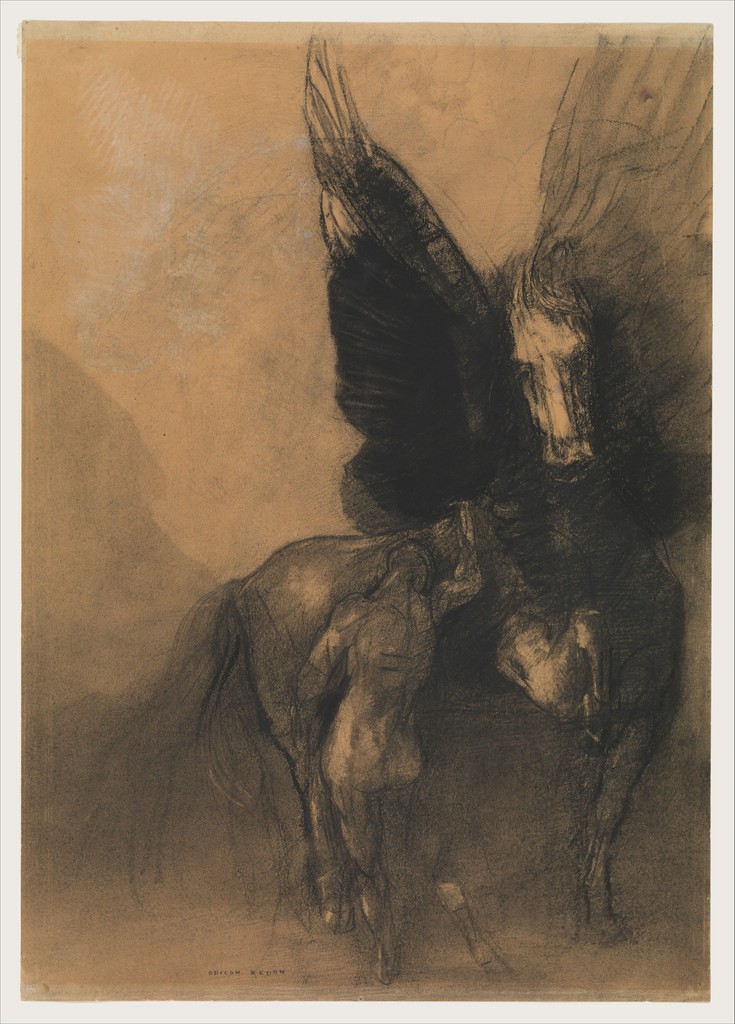
Redon's own sheets demonstrate this variety. The Met records Pegasus and Bellerophon of about 1888 as charcoal, charcoal with water wash, white chalk and Conté crayon, with highlights produced by erasure, on buff blue-toned paper that has darkened. Its materials include dry particles, a fluid application, a denser crayon and a light recovered from the support.[8] Armor of 1891 uses charcoal and Conté crayon; the Met draws attention to the tonal distance between the helmet's velvety dark and the pallor of the face.[9]
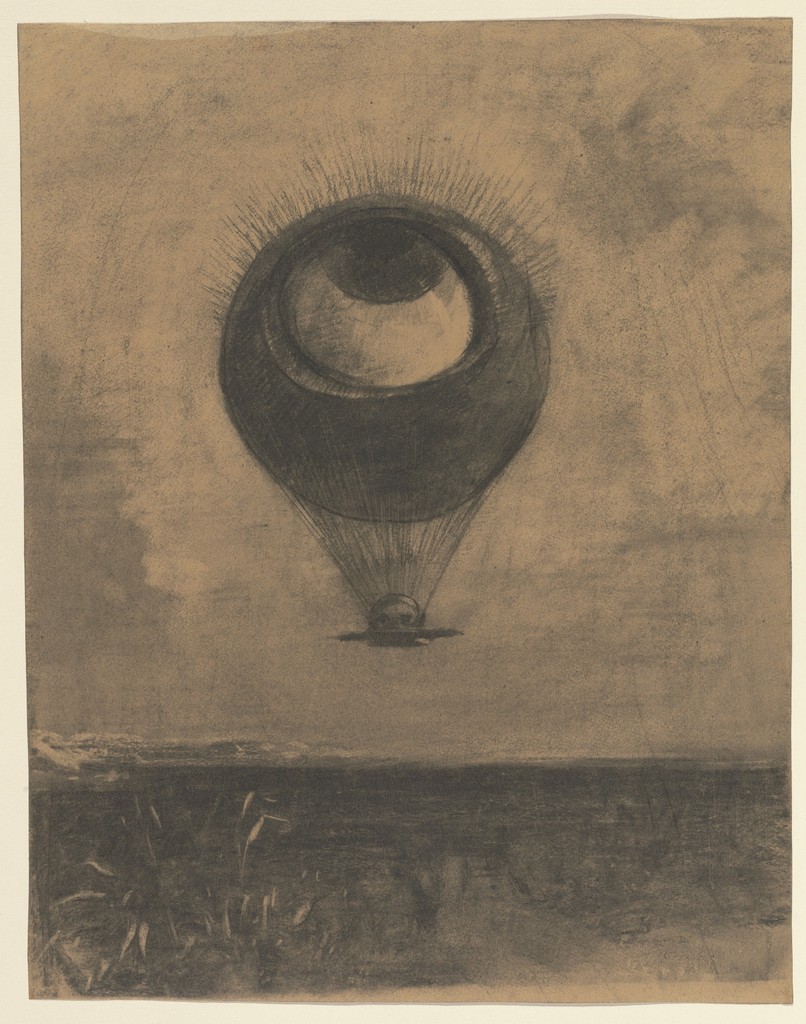
Prepared and coloured papers were not neutral backgrounds. A cream sheet altered toward gold, a brown support or a blue-toned paper could supply a middle value before Redon added either black or white. The support might glow through a thin veil, disappear beneath compressed darkness, or become the light of a face after surrounding areas were worked. The 1878 Eye-Balloon is currently catalogued by MoMA as charcoal and chalk on coloured paper; the material relation between diffuse black and the toned sheet is central to its charged sky.[4]
No single recipe applies across the noirs. Getty's selected works include charcoal mixed with powdered charcoal, black chalk and touches of pastel, and document stumping and removal on particular sheets.[1] Exact museum medium lines matter because appearance alone cannot reliably distinguish vine charcoal from a compressed stick, black chalk from a crayon, or original paper colour from later change. Redon's range is impressive precisely because it was built from specific, variable combinations rather than a mysterious universal “black medium.”
Drawing by Addition and Removal
Redon developed forms through both depositing black and taking it away. Stumping spreads loose particles with a soft tool, suppressing the obvious stroke and producing a continuous haze. Rubbing or wiping can broaden a tone; a stick or crayon can restore a firm contour. Erasing, scraping and lifting expose the support again, while an incised line cuts through a dark layer. White chalk can add a highlight rather than merely revealing paper. Current museum records document these techniques in different combinations, not as a checklist used on every sheet.[1][2][10][11]
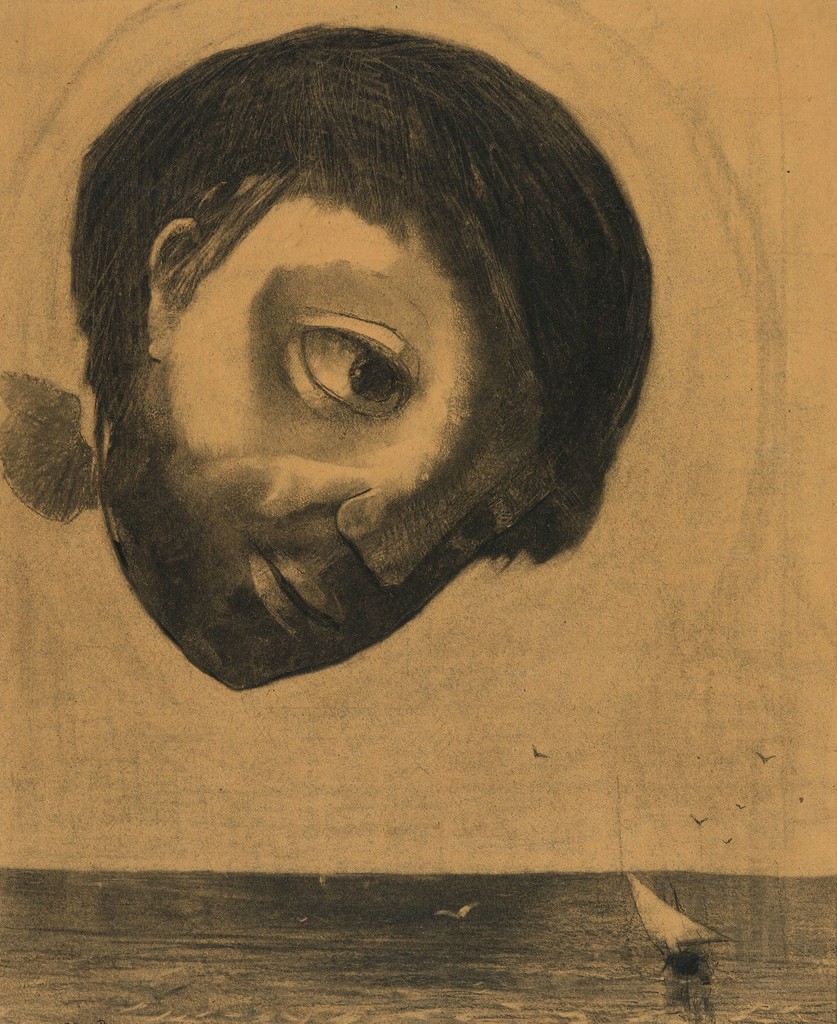
This back-and-forth helps explain the peculiar light of the noirs. In the Guardian Spirit of the Waters, the immense head does not sit cleanly in front of a uniformly shaded background. Its pale volume is surrounded by worked black, and the small boat below gives the apparition a disquieting scale.[10][11] In Eye-Balloon, MoMA identifies blurred and erased charcoal around the airborne eye as the means by which the sky acquires a nebulous, foreboding charge. Atmosphere is not an empty area around the subject; it is part of the subject's making.[4]
These methods also complicate the idea of drawing as decisive line. Redon could draw an edge, bury it, recover part of it and allow the remainder to dissolve. A face may be sharply marked at the eyelid but lose its cheek in powder. A creature may have enough anatomy to seem possible while its environment refuses measurement. The visible form and the surrounding darkness remain mutually dependent.
Bresdin, Fantin-Latour and the Turn to Lithography
Rodolphe Bresdin was crucial to Redon's early understanding of printmaking. In Bordeaux, the older artist introduced him to the concentrated world of the etched plate and to an art in which minute marks could sustain fantastic landscapes. A historical MoMA catalogue nevertheless cautions against turning that relationship into a simple account of Redon's mature lithography. Redon practised etching intermittently, while charcoal became his preferred field of invention through the later 1860s and 1870s.[12]
Henri Fantin-Latour provided a later practical impetus. Redon recalled that Fantin-Latour showed him lithographic crayon and transfer paper and suggested multiplying charcoal designs through lithography. The Lemercier workshop in Paris supplied professional printing expertise. This sequence matters: Bresdin's example established printmaking as an imaginative art, but Redon's characteristic lithographs developed after a decade of intensive charcoal practice and with further technical guidance.[5][12]
The first substantial result was In Dreams (Dans le rêve) in 1879, a portfolio of ten lithographs. Several images derived from or varied earlier drawings. That origin did not make them mechanical copies. Redon had to restate tonal masses, lines and pale openings in a medium designed for inking and repeated impressions. The portfolio announced that the intimate scale and uncertain spaces of the charcoal studio could circulate as a deliberately ordered printed work.[1][12]
Lithography Was More Than Reproduction
Lithography depends on the opposition of grease and water on a prepared stone or comparable matrix. The artist draws with a greasy medium; after processing, ink adheres to the drawn areas while dampened blank areas resist it. Paper receives the image under pressure. Redon could also work on transfer paper, which allowed a drawing made away from the stone to be transferred for printing. Because direct and transfer methods can produce similar impressions, the method should not be guessed from a reproduction.[7][12]
The process suited Redon's developed language of black. MoMA stresses lithography's capacity for fine line, deep darks and close gradations, as well as its ability to issue an image in multiples.[5] Yet the matrix demanded decisions unlike a one-off charcoal sheet. Tonal transitions had to survive processing and printing; each impression emerged through the work of artist, printer, paper and ink. In many examples a thin sheet described as chine appliqué was printed and attached to a stronger backing sheet, giving the image a subtly different surface from the surrounding paper.[5][6]
Redon's 1882 The Eye like a Strange Balloon Mounts toward Infinity demonstrates why lithography should be treated as an independent medium. It revisits the eye-balloon conception, but it is not the same object as the 1878 charcoal drawing. MoMA records the print as a lithograph on chine appliqué, printed by Lemercier and published by G. Fischbacher. Its design is reconfigured for the stone and belongs to the six-print homage To Edgar Poe.[5][12] The active artwork article in this guide concerns the 1878 drawing; the 1882 lithograph is a related reinvention, not another date or state of that sheet.
Portfolios, Authors and Suggestive Titles
Redon often organised lithographs in albums. A portfolio could create rhythm through sequence: a pale apparition after a dense plate, a single floating organ after a crowded hybrid, or a caption that changes how the next image is anticipated. The ordering encourages association without producing a continuous illustrated plot. Getty's current gallery text discusses eleven print portfolios, while MoMA describes albums as the principal setting for many of his lithographs. Such figures depend on definitions, so they should not be converted into a definitive total for his complete printed output.[1][5]
The 1882 To Edgar Poe is an homage rather than a line-by-line visual edition of one Poe story. Poe's name establishes a literary climate—psychological pressure, the uncanny and unstable perception—but the strange eye-balloon had already existed as a charcoal idea in 1878. The album shows how a title can relocate an image within a new network of associations.[4][5]
Gustave Flaubert prompted a different, sustained engagement. Redon made three lithographic projects connected with The Temptation of Saint Anthony. MoMA's 1896 impression of …And Eyes without Heads Were Floating like Mollusks belongs to the third series, a portfolio of twenty-three lithographs published by Ambroise Vollard and printed by Blanchard.[6] The caption originates in Flaubert's hallucinatory text, yet the image does not simply stage a conventional scene. Detached eyes, marine softness and black space turn a verbal fragment into a new visual event.
This distinction accords with Redon's resistance to being called merely literary or illustrative. Orsay notes that, despite references to Shakespeare and Poe, he rejected a narrowly illustrative account of his work.[3] Words can trigger attention, establish a tonal key or sharpen an enigma. They need not close down the image by explaining it. That open exchange between caption and form is central to Redon's place within Symbolism, dreams and imagination.
Editions, Proofs and States
A printed image exists through impressions, and apparently identical impressions may have different positions in its history. An edition is the group authorised for publication, normally planned in a stated quantity. A proof may precede or sit outside that numbered group. A state records a change to the matrix: if Redon altered the stone or transfer and printed again, the later impression could represent another state. Edition, proof and state are therefore related terms, not synonyms.[5][7]
Object records provide concrete checks. MoMA's impression of the 1882 eye lithograph is a proof without letters outside an edition of fifty.[5] Its absence of lettering distinguishes that impression from published examples carrying text, but it remains a lithograph of the same design rather than the 1878 charcoal. The 1896 Eyes without Heads plate is recorded as one of twenty-three in the portfolio, in an edition of fifty, with Vollard as publisher and Blanchard as printer.[6] Those facts belong to those impressions and should not be projected onto every print in an album.
This is also why approximate lifetime totals must remain approximate. MoMA offers a broad estimate of close to thirty etchings and roughly two hundred lithographs, while older catalogues arrive at nearby but not identical figures.[5][12] Counts can differ according to states, trial proofs, posthumous impressions and what a compiler treats as a separate work. The responsible conclusion is that printmaking was extensive and central to Redon's reputation—not that one summary number settles the catalogue.
Eyes, Heads, Hybrids and Scientific Forms
Redon's recurrent eye is an organ of vision detached from ordinary bodily scale. In Eye-Balloon it becomes a vehicle; in Eyes without Heads a group of eyes floats with mollusc-like softness. An eye can watch, travel or expose the viewer to being watched. Its recurrence does not prove a single fixed symbol. Each work changes the organ's relation to body, space, caption and medium.[4][6]
Heads behave similarly. They emerge without shoulders, hover in aureoles or join bodies that belong to fish, plants and insects. Hybrids can seem fantastic while retaining persuasive anatomy. That tension connects Redon's imagination with empirical looking. Orsay emphasises the importance of natural forms and nineteenth-century botany and zoology to his inventions.[3] The microscopic and marine worlds offered structures that were real but unfamiliar to ordinary vision—cells, tendrils, membranes and drifting organisms that could be combined with human features.
The noirs therefore need not be forced into a choice between science and dream. Redon could begin from a recognisable eye, skull, cactus or mollusc and alter its scale, context or attachment. The result may resemble an organism newly discovered in darkness. It obeys enough visual logic to hold together while refusing the normal world in which its parts would be separated. That balance is one reason the creatures remain disturbing: they look invented, but not arbitrary.
Black Continued Inside Colour
By the mid-1890s Redon was increasingly turning to pastel and painting, and Orsay says he gradually abandoned the noirs as a dominant practice.[3] “Gradually” is essential. Pastel was another dry, powdery medium, and charcoal could remain beneath or beside colour. Dark contours, rubbed passages and forms emerging from undefined fields survived the change in palette. The later work did not cancel the material intelligence acquired in black.[1]
Readers comparing these works with Redon's paintings and pastels should look for continuity as well as contrast. A late flower may glow instead of looming, but it can still float against an indeterminate atmosphere. A coloured head can retain the isolation of a charcoal apparition. The noirs established a durable visual grammar: emergence, suspension, unstable scale and the productive incompleteness of surrounding space.
How to Look at a Noir
Begin by separating the object from its title. Identify what is actually visible—perhaps an eye, a head, a boat, a stem—before allowing the caption to guide interpretation. Then examine the support. Where does its tone remain exposed, and where has black become dense enough to feel opaque? A pale area may be untouched paper, an erased passage or added white; the museum record can prevent a confident but false technical diagnosis.[2][8][10]
Next, follow changes of edge. Notice where a line is asserted, softened by stumping, cut through a dark field or lost altogether. In a print, compare broad grainy tones with fine linear marks and remember that printer, edition and paper affect the impression. Finally, step back. Redon's technique matters not as virtuoso display by itself, but because accumulations and removals make the image oscillate between object and atmosphere.
Researched works directory
This searchable evidence census was assembled from public museum records and a reproducible Wikidata snapshot. It is not a catalogue raisonné, a claim to complete oeuvre coverage, or a substitute for Alec Wildenstein's printed catalogue, which was not consulted for this directory.
| Name | Date | Medium |
|---|---|---|
| A La Vieillesse (To Old Age) | 1886 | |
| A Madman in a Dismal Landscape | 1885 | |
| A Woman Reading a Book or Reading | 1914 | Painting |
| Allégorie : un arbre rouge non rougi par le soleil | 1905 | Painting |
| Alsace | 1914 | Painting |
| Andromeda | 1907 | Painting |
| Andromeda | 1912 | Painting |
| Andromeda enchained | 1905 | Painting |
| Anémones | Date unknown | Painting |
| Anemones and Tulips | 1902 | Painting |
| Animals at the Bottom of the Sea | Date unknown | Painting |
| Antoine: Quel Est Le But de Tout Cela? ... | Date unknown | |
| Apache (Man on Horseback) | Date unknown | Painting |
| Apache (Man on Horseback II) | Date unknown | Painting |
| Apollo | 1905 | Painting |
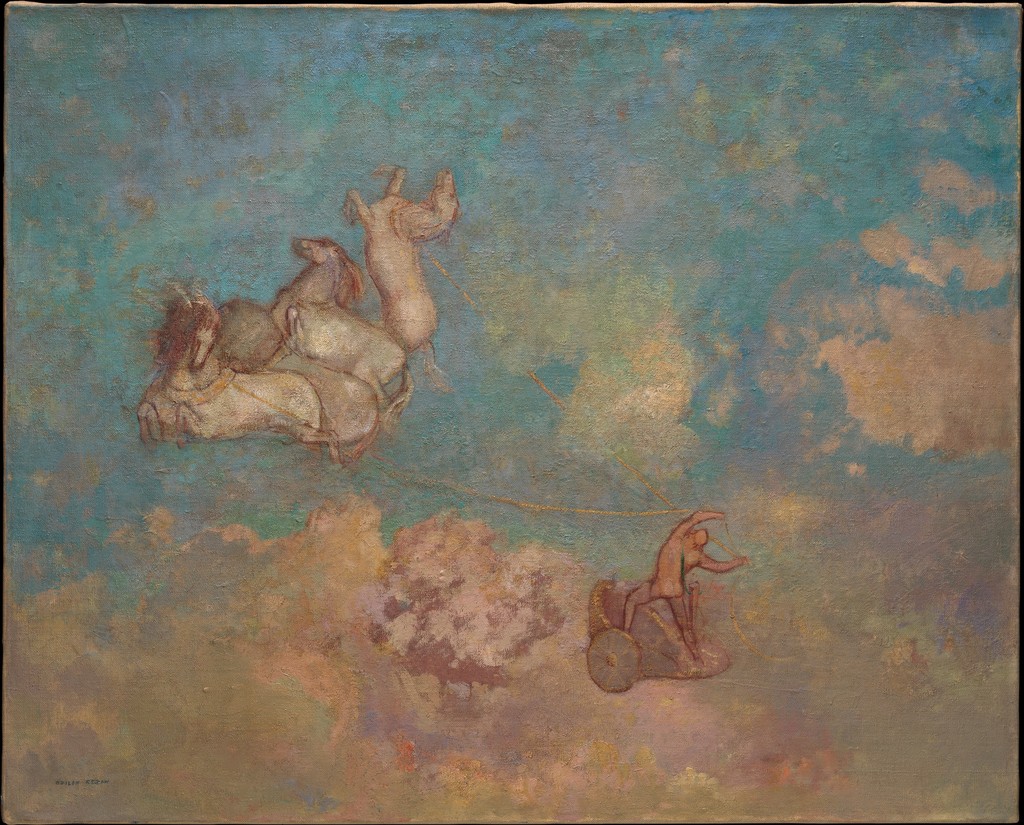
| Apollo's chariot | 1910 | Painting |
| Apollon vainqueur du serpent Python | 1872 | Painting |
| Apollonius | 1896 | Drawing |
| Apparition | 1905 | Painting |
| Apparition | 1907 | Painting |
| Apres cela je vis descendre du ciel un ange qui avait la clef de l'abime, et une grande chaine en sa main (And I saw an angel come down from heaven, having the key of the bottomless pit and a great chain in his hand) | 1899 | |
| Arabe musicien | 1893 | Painting |
| Arbre dans la lande | Date unknown | Painting |
| Arbre (Tree) | 1892 | |
| Arbres sur un fond jaune | 1901 | Painting |
| Ari | 1898 | |
| Armor | 1891 | Drawing |
| At the Bottom of the Sea | 1905 | Painting |
| Au réveil j’aperçus la Déesse de l’Intelligible au profil sévère et dur [Bij het ontwaken zag ik de godin van het begrijpelijke in een streng en hard profiel], uit de reeks Hommage à Goya. 6 lithographies par Odilon Redon | 1885 | |
| Autoportrait en buste | 1876 | Painting |
| Bain de Venus | 1900 | Painting |
| Barbizon en automne | Date unknown | Painting |
| Baronne de Domecy | 1900 | Painting |
| Baronne Robert de Domecy | 1900 | Painting |
| Barques | 1885 | Painting |
| Barques dans le port | 1880 | Painting |
| Battle with the dragon | 1907 | Painting |
| Beatrice | 1885 | Painting |
| Béatrice | 1897 | |
| Bell-Tower Keeper | Date unknown | Painting |
| Black Sun | 1900 | Painting |
| Bloemstilleven | 1901 | Painting |
| Boqueteau | Date unknown | Painting |
| Bouddha dans sa jeunesse | Date unknown | Painting |
| Bouleaux à Bièvres | Date unknown | Painting |
| Bouquet au vase noir | Date unknown | Painting |
| Bouquet de fleurs | 1900 | Painting |
| Bouquet de fleurs | 1908 | Painting |
| Bouquet de fleurs au mimosa | Date unknown | Painting |
| Bouquet in a Chinese Vase | 1912 | Painting |
| Bouquet of Flowers | 1902 | Painting |
| Bouquet of flowers | 1904 | Painting |
| Bouquet of Flowers in a Green Vase | 1915 | Painting |
| Breton Village | 1890 | Painting |
| Brunnhilde | 1894 | |
| Butterflies | 1910 | Painting |
| C'est le Diable | 1888 | |
| C'est moi, Jean, qui ai vu et qui ai oie ces choses (And I John saw these things and heard them | 1899 | |
| C'etait un voile, un empriente (It was a veil, an imprint) | 1891 | |
| Cain and Abel | 1886 | |
| Caïn et Abel | Date unknown | Painting |
| Caliban, petit monstre ou gnome | 1881 | Drawing |
| Calvary | 1895 | Painting |
| Carnations | Date unknown | Drawing |
| Carton de vitrail | 1911 | Painting |
| Cavalier Galopant (Galloping Horseman) | 1866 | |
| Cellule Auriculaire | 1894 | |
| Cellule Auriculaire (Auricular Cell) | 1894 | |
| Centaur visant les Nues (Centaur aiming at the Clouds) | 1895 | |
| Chaumière bretonne | Date unknown | Painting |
| Chemin près de la mer | Date unknown | Painting |
| Cheval aile (Winged Horse) | 1894 | |
| Cheval cabré sur une cime | Date unknown | Painting |
| Christ | 1887 | |
| Christ and the Samaritan Woman (The White Flower Bouquet) | 1895 | Painting |
| Christ on the cross | 1910 | Painting |
| Ciel couvert sur une lande | Date unknown | Painting |
| Citroen en paprika | 1901 | Painting |
| Cliff Scene | 1895 | Painting |
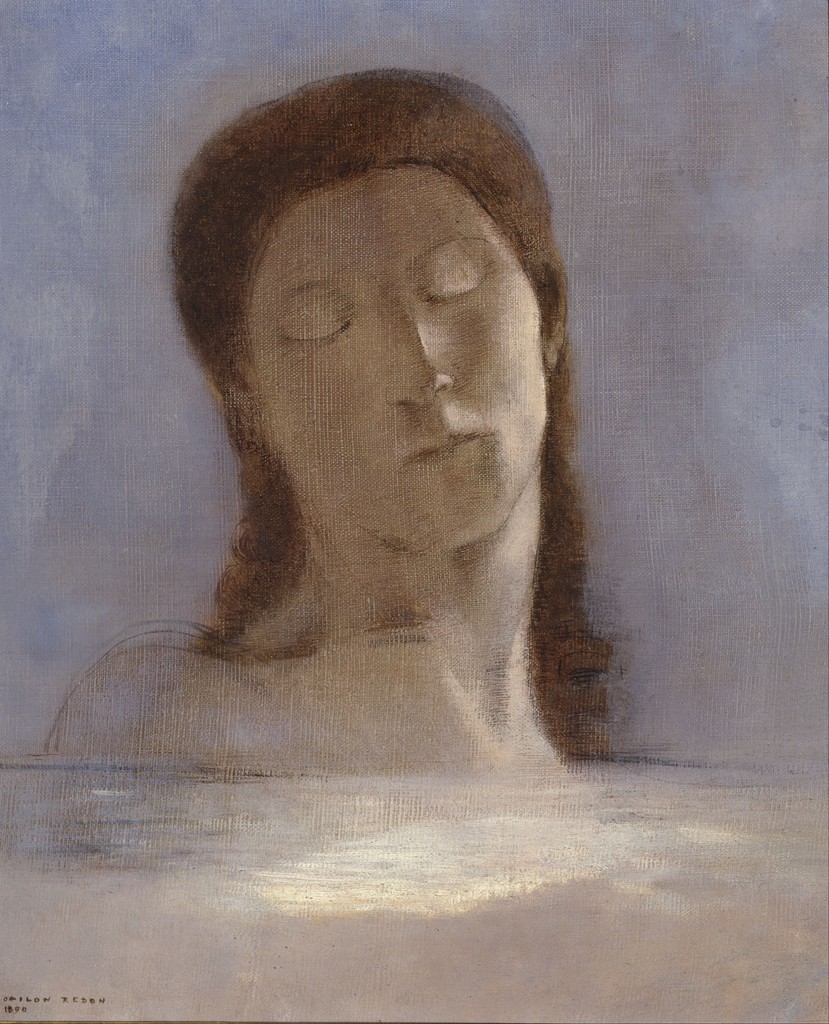
| Closed Eyes | 1890 | Painting |
| Closed Eyes (Yeux Clos) | 1890 | |
| Colline, près de Royan | Date unknown | Painting |
| Combat équestre | 1910 | Painting |
| Composition à trois personnages (Flagellation ?) | Date unknown | Painting |
| Composition: Flowers | Date unknown | Painting |
| Composition: Flowers without a Vase | Date unknown | Painting |
| Conque marine | Date unknown | Painting |
| Conversation mystique | Date unknown | Painting |
| copie d'après 'La chasse aux lions' de Delacroix | 1865 | Painting |
| Copie d'après 'La Grèce sur les ruines de Missolonghi' de Delacroix | Date unknown | Painting |
| Coquelicots | 1885 | Painting |
| Couverture - Frontispice | 1890 | |
| Crucifixion | Date unknown | Painting |
| Cul-de-Lampe | 1890 | |
| Dans l'Ombre des Gens Pleurent et Prient Entourés d'Autres Qui Les Exhortent | Date unknown | |
| Dans mon rêve, je vis au ciel un visage de mystère | 1885 | |
| Dante and Beatrice | 1914 | Painting |
| De oude Ridder | 1896 | |
| De Strijdwagen van Apollo | Date unknown | Painting |
| Den helige Antonius, bröstbild | 1906 | Drawing |
| Des Fleurs Tombent, et la Tête d'un Python Parait | Date unknown | |
| Des Peuples Divers Habitent Les Pays De L'Océan | Date unknown | |
| Die Kathedrale - 13080 - Bavarian State Painting Collections | 1914 | Painting |
| Druidesse | 1891 | |
| Druidesse | 1892 | |
| Dunes | Date unknown | Painting |
| Edouard Vuillard | 1900 | |
| Een man van het volk. Tekening voor een illustratie in Le Juré van Edmond Picard | 1887 | Drawing |
| Eerbetoon aan Goya | 1895 | Painting |
| Elle Tire de Sa Poitrine une Éponge Toute Noire, La Couvre de Baisers | Date unknown | |
| Elle tire de sa poitrine une eponge toute noire, la couvre de baisers (She draws from her bosom a sponge, perfectly black, and covers it with kisses) | 1896 | |
| Escape to Egypt | Date unknown | Painting |
| Esquisse de vitrail | 1905 | Drawing |
| Et celui qui était monté dessus se nommait la Mort (And his name that sat on him was Death) | 1899 | |
| Et il avait dans sa main droit sept etoiles, et de sa bouch sortait une epee aigue a deux tranchants (And he had in his right hand seven stars; and out of his mouth went a sharp two-edged sword) | 1899 | |
| Et Il Distingue Une Plaine Aride et Mamelonneuse | Date unknown | |
| Et il tombe du ciel une grande etoile ardente (And there fell a great star from heaven burning as it were a lamp) | 1899 | |
| Et l'homme parut, interrogeant le sol d'ou il sort et qui l'attire, il se fraya la voie vers (And Man appeared; questioning theearth from which he emerged and which attracts hi m, he made his way toward somber brightness) | 1883 | |
| Et la-bas l'idole astrale, l'Apotheose (And beyond, the star idol, the apotheosis) | 1891 | |
| Et le diable qui les seduisait, fut jete dans l'etang de feu et de soufre, ou es la b ete et le faux prophete (And the devil thatdeceived them was cast into the lake of fire and brimstone, where the beast and the false prophet are) | 1899 | |
| Et le lia pour mille ans (And bound him a thousand years) | 1899 | |
| Et moi, Jean, Je vis la sainte cite, la nouvelle Jerusalem, qui descendait du ciel, d'aupres de dieu (And I John saw the holy city, new Jerusalem, coming down from God out of heaven) | 1899 | |
| Et Partout ce Sont des Colonnes de Basalte,... La Lumière Tombe des Voutes | Date unknown | |
| ...Et Que Des Vuex Sans Tête Flottaient Comme Des Mollusques | Date unknown | |
| Et un autre ange sortit du temple qui est au ciel, ayant lui aussi une faucille tranchante (And another angel came out of the temple which is in heaven, and he also having a sharp sickle) | 1899 | |
| Etruscan Vase with Flowers | 1905 | Painting |
| étude pour 'La chasse aux lions' d’après Delacroix | 1867 | Painting |
| Eve | 1904 | Painting |
| Evocation of Butterflies | 1910 | Painting |
| Evocation of Roussel | 1912 | Painting |
| Eye-Balloon | 1878 | Drawing |
| Falaise dominant la mer | Date unknown | Painting |
| Fantasia | 1910 | Painting |
| Fantasmagorie | Date unknown | Painting |
| Femme a la torque ornee (Woman with a plumed hat) | 1900 | |
| Femme de Profil (Profile of a Woman) | 1900 | |
| Femme en rouge | 1898 | Drawing |
| Ferme et rochers | Date unknown | Painting |
| Figure | 1901 | Painting |
| Figure cornue | Date unknown | Drawing |
| Figure devant un arbre | 1894 | Drawing |
| Figure portant une tête ailée | 1876 | Drawing |
| Figure, yellow flower | 1901 | Painting |
| Fireplace screen | 1908 | Painting |
| Fishing Boat | Date unknown | Painting |
| Fishing Boats: Memory of Venice | 1908 | Painting |
| Fishing Village, Brittany | 1883 | Painting |
| Five Butterflies | 1912 | Drawing |
| Fleurs | Date unknown | Painting |
| Fleurs dans un paysage de montagne avec visage | Date unknown | Painting |
| Fleurs dans un vase | 1907 | Painting |
| Fleurs dans un Vase bleu | 1903 | Painting |
| Fleurs dans un vase : pivoines | Date unknown | Painting |
| Fleurs des champs | 1906 | Painting |
| Fleurs étranges | 1910 | Painting |
| Flower Clouds | 1903 | Drawing |
| Flowers in a Japanese Vase | 1908 | Painting |
| Flowers in a Vase | 1910 | Painting |
| Flowers in Green Vase | Date unknown | Painting |
| Flowers: Poppies and Daisies | 1867 | Painting |
| Frieze of flowers and berries | 1901 | Painting |
| Frise de fleurs, marguerite rose | 1901 | Painting |
| Frontispiece | 1889 | |
| Gekruisigde Christus | Date unknown | Drawing |
| Geraniums and other Flowers in a Stoneware Jug | 1910 | Painting |
| Grand Bouquet | 1901 | Painting |
| Grand bouquet de fleurs des champs | 1903 | Painting |
| Grand panneau à décor végétal, fond clair | 1901 | Painting |
| Grand tapis de prière | 1908 | Painting |
| Green Death | Date unknown | Painting |
| Grey frieze | 1901 | Painting |
| Groupe de maisons blanches aux toits rouges | Date unknown | Painting |
| Guardian Spirit of the Waters | 1878 | Drawing |
| Hantise (Obsession) | 1894 | |
| Hélène (Ennoia) | Date unknown | |
| Hommage à Goya. 6 lithographies par Odilon Redon | 1885 | |
| Icarus | 1890 | Painting |
| Il Tombe Dans L'Abime, La Tête En Bas | Date unknown | |
| Il y eut aussi des êtres embryonnaires [Er waren ook embryonale wezens], uit de reeks Hommage à Goya. 6 lithographies par Odilon Redon | 1885 | |
| Il y eut des luttes et des vaines victoires (There were struggles and vain victories) | 1883 | |
| Il y eut peut-etre une vision premiere essayee dans la fleur (There was perhaps a first vision attempted in the flower | 1883 | |
| Immédiatement Surgissent Trois Déesses | Date unknown | |
| Initiation to Study—Two Young Ladies | 1905 | Painting |
| J'ai Quelquefois Aperçu Dans Le Ciel Comme Des Formes D'Esprits | Date unknown | |
| Jacob and the Angel | 1907 | Painting |
| Jacob's Struggle with the Angel | 1910 | Painting |
| Jacob Wrestling with the Angel | 1907 | Painting |
| Je Me Suis Enfoncé dans la Solitude. J'habitais L'Arbre Derrière Moi | Date unknown | |
| Je Suis Toujours la Grande Isis! Nul N'A Encore Soulevé Mon Fruit Est Le Soleil | Date unknown | |
| Je t'adore a l'egal de la voute nocturne. O vase de tristesse, o grande taciturne (I adore you as I adore the vault of the night sky, O vessel of sadness, O tall silent woman) | 1890 | |
| Jésus et la Samaritaine | Date unknown | Painting |
| L'Aile impuissante n'eleva point la bete en ces noirs espaces (The impotent wing did not lift the animal into that black space | 1883 | |
| L'Aile (The Wing) | 1893 | |
| L'ange déchu | 1875 | Painting |
| L'ange guerrier | 1900 | Painting |
| L'apparition | Date unknown | Painting |
| L'Araignée souriante | 1881 | Drawing |
| L'Arbre | Date unknown | Painting |
| L'Art Celeste (The Celestial Art) | 1894 | |
| L'Automne en Médoc | 1897 | Painting |
| L'Enlèvement de Ganymède | Date unknown | Painting |
| L'Intelligence Fut A Moi! Je Devins Le Buddha | Date unknown | |
| La Baie des Trépassés | Date unknown | Painting |
| La Barque | 1900 | Painting |
| La Barque rouge | 1900 | Painting |
| La Branche fleurie jaune | 1901 | Painting |
| La captive | 1914 | Painting |
| La Chute de Phaéton | 1906 | Painting |
| La Chute de Phaëton | 1910 | Painting |
| La fleur du marécage, une tête humaine et triste [De moerasbloem, een triest menselijk hoofd], uit de reeks Hommage à Goya. 6 lithographies par Odilon Redon | 1885 | |
| La Mare à Peyrelebade | 1897 | Painting |
| La Mer à Morgat | 1883 | Painting |
| La Mort: C'est Moi Te Rendes Sérieuse; Enlaçons-Nous | Date unknown | |
| La Mort d'Orphée | 1908 | Painting |
| La mort. Mon ironie dépasse toutes les autres! | 1890 | Painting |
| La Mort: Mon ironie depasse toutes les autres! (Death: My iron surpasses all others!) | 1889 | |
| La palme | Date unknown | Painting |
| La Peur (Fear) | 1865 | |
| La route de Bièvres | 1890 | Painting |
| La sirene sortit des flots vetue de dards (The Siren clothed in barbs, emerged from the waves | 1883 | |
| La Sulamite (The Shulamite) | 1897 | |
| La Vieille: Que Crains-tu? Un Large Trou Noir! Il Est Vide Peut-être? | Date unknown | |
| La Vieille: Que Crains-tu? Un large trou Noir! Il est vide peut-etre? (What are you afraid of? A wide black hole! It is empty, perhaps!) | 1896 | |
| Lady of the Flowers | 1892 | Painting |
| Lande avec une mare | Date unknown | Painting |
| Lande nue | Date unknown | Painting |
| Landscape | 1872 | Painting |
| Landscape | Date unknown | Painting |
| Landscape at Daybreak | 1872 | Painting |
| Landscape with Rocks near Royan | Date unknown | Painting |
| Large Vase with Flowers | 1912 | Painting |
| Le Bouddha | 1895 | |
| Le Bouddha | 1906 | Drawing |
| Le Buddha | 1895 | |
| Le Centaure à l'arc | Date unknown | Painting |
| Le Centaure aux coquelicots | 1910 | Painting |
| Le centaure et le dragon | Date unknown | Painting |
| Le char d'Apollon | 1905 | Painting |
| Le Chemin à Peyrelebade | Date unknown | Painting |
| Le Chêne | Date unknown | Painting |
| Le Coursier (The Race Horse) | 1894 | |
| Le Gue (The Ford) | 1865 | |
| Le Jour (Day) | 1891 | |
| Le Jour Enfin Parait,... Et Dans Le Disque Même Du Soleil, Rayonne La Face de Jésus-Christ | Date unknown | |
| Le Liseur (The reader) | 1892 | |
| Le paravent rouge (avec Pégase) | Date unknown | Painting |
| Le pavot noir | Date unknown | Painting |
| Le Petit Vase vert | Date unknown | Painting |
| Le Polype difforme flottait sur les rivages, sorte de cyclope souriant et hideux (Thedeformed polyp floated on the shores, a sort of smiling and hideous Cyclops | 1883 | |
| Le Regard | 1901 | Painting |
| Le Regard | 1910 | Painting |
| Le Rêve – Fleurs et Visage | 1890 | Drawing |
| Le Rocher rose | 1880 | Painting |
| Le Satyre au cynique sourire (The Satyr with the cynical smile) | 1883 | |
| Le Silence | 1895 | Painting |
| Le Vitrail | 1906 | Painting |
| Les Anemones (Still Life with Anemones) | 1905 | Painting |
| Les Bêtes De La Mer Rondes Comme Des Outres | Date unknown | |
| Les Croisés | Date unknown | Painting |
| Les Landes à Peyrelebade | 1885 | Painting |
| Les Parques | Date unknown | Painting |
| Les Quais à Bordeaux | 1900 | Painting |
| Les rochers (Rochers en Bretagne) | 1875 | Painting |
| Les Sciapodes: La tete le plus bas possible, c'est le secret du bonheur! (The Skiapods: "The head as low as possible, that is the secret of happiness!") | 1889 | |
| Les trois vases bleus | 1910 | Painting |
| Liserons et coquelicots dans un petit pichet vert | 1866 | Painting |
| Lueur precaire, une tete a l'infini suspendue(Precarious glimmering, a head suspended | 1891 | |
| Lumière | Date unknown | |
| Lumiere (Light) | 1893 | |
| Madame Arthur Fontaine (Marie Escudier, born 1865) | 1901 | Painting |
| Madame Odilon Redon | 1882 | Painting |
| maison avec deux arbres | Date unknown | Painting |
| Marguerites | 1901 | Painting |
| Marguerites et baies de Sorbier | 1901 | Painting |
| Maurice Denis | 1903 | |
| Médoc, arbres dans la prairie | Date unknown | Painting |
| Médoc, l'arbre | Date unknown | Painting |
| Médoc, la lande | Date unknown | Painting |
| Médoc, le bouquet d'arbres | Date unknown | Painting |
| Melancholy | 1868 | Drawing |
| Mes Baisers ont le Gout d'un Fruit Qui Se Fondrait Dans Ton Coeur!... | Date unknown | |
| Meules couvertes de bâches près d'un arbre | Date unknown | Painting |
| Mme Sabouraud (Thérèse Balandier) | 1907 | Drawing |
| Mon Enfant (My Child) | 1892 | |
| Montagnes des Pyrénées | Date unknown | Painting |
| Morgat vue des dunes de la Palue | Date unknown | Painting |
| moulin en Bretagne | Date unknown | Painting |
| Mystery | 1910 | Painting |
| Mystical Conversation | 1896 | Painting |
| Nasturtium | 1905 | Painting |
| Nature morte | 1901 | Painting |
| Navet | 1875 | Painting |
| Noce juive au Maroc | Date unknown | Painting |
| Nocturne | Date unknown | Painting |
| Nuages clairs sur une lande | Date unknown | Painting |
| Oannès | 1905 | Painting |
| Oannès | 1908 | Painting |
| Oannes and the Sphinx | 1910 | Painting |
| Oannès: Moi, La Première Conscience Du Chaos, J'ai Surgi de L'Abime Pour Durcir la Matière, Pour Régler les Formes | Date unknown | |
| Offrande | Date unknown | Painting |
| Old Man With Wings and Beard or Winged Old Man with a Long White Beard | 1870 | Drawing |
| Ophelia | 1901 | Painting |
| Ophelia | 1905 | Painting |
| Ophelia | Date unknown | Painting |
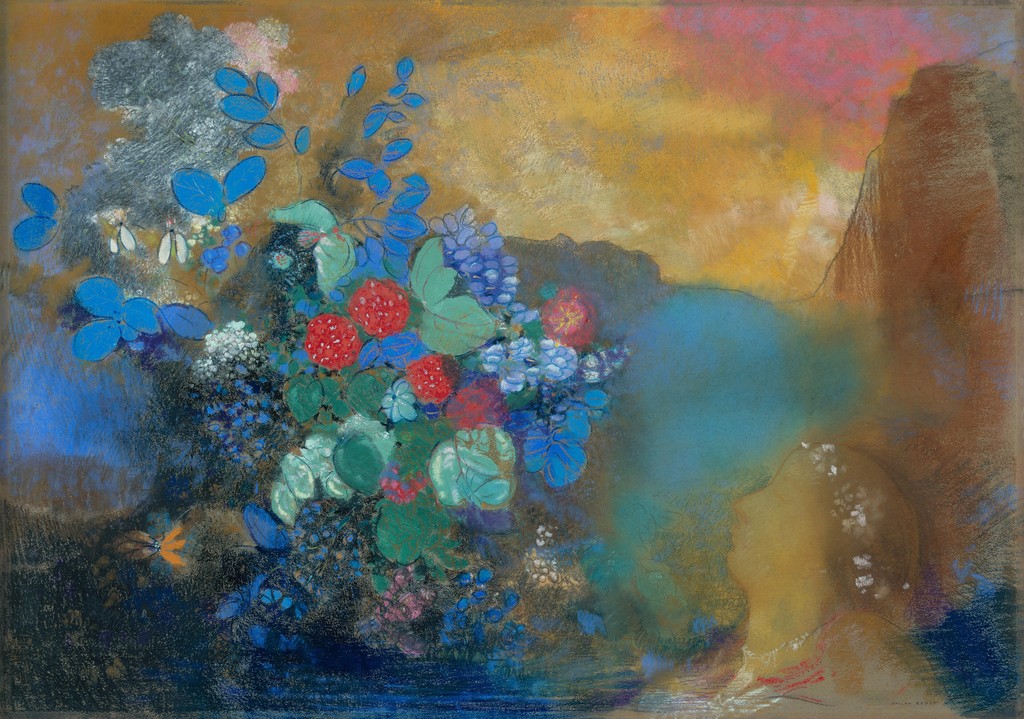
| Ophelia among the Flowers | c. 1905–1908 | Drawing |
| Ophelia with a Blue Wimple in the Water | 1900 | Painting |
| Orphée | 1910 | Painting |
| Orphée | Date unknown | Painting |
| Orpheus | 1903 | Drawing |
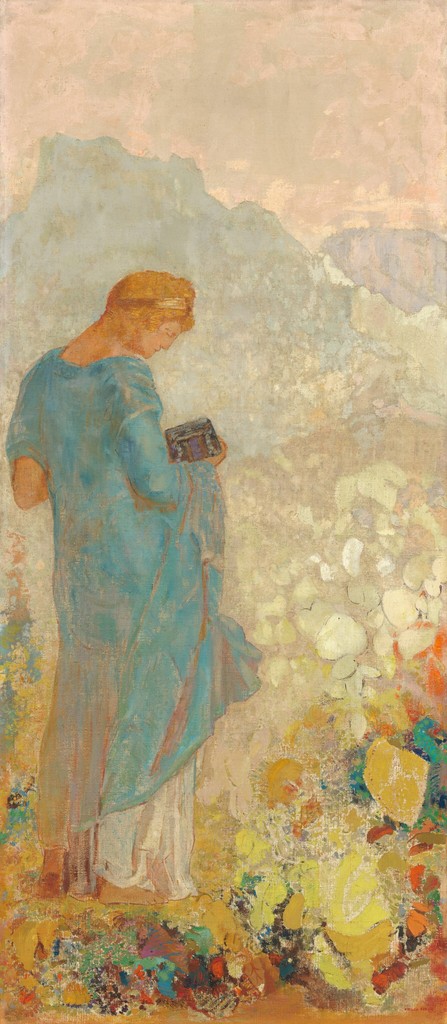
| Pandora | 1910/1912 | Painting |
| Panneau décoratif | 1902 | Painting |
| Pansies | 1905 | Drawing |
| Papillons | 1910 | Painting |
| Paravent d'Olivier Sainsère | 1903 | Painting |
| Parfois on trouve un vieux flacon qui se souvient, d'ou jaillit toute vive une ame qui revient (Sometimes one finds an old reminiscing flask, whence issues in full life a returning soul) | 1890 | |
| Parsifal | 1892 | |
| Passage d'une Ame (Passage of a Spirit) | 1891 | |
| Paul Gauguin | 1904 | Painting |
| Paul Serusier | 1903 | |
| Paysage de Venise | 1908 | Painting |
| Pégase et l'Hydre | 1900 | Painting |
| Pegasus | 1914 | Painting |
| Pegasus and the Hydra | 1907 | Painting |
| Pegasus, the Horse on the Rock | 1908 | Drawing |
| Pélerin du monde sublunaire (Pilgrim of the sublunary world) | 1891 | |
| Perversité | 1891 | |
| Perversite (Perversity) | 1891 | |
| Petite fille tricotant | Date unknown | Painting |
| Peupliers à Peyrelebade | Date unknown | Painting |
| Peyrelebade | 1888 | Painting |
| Pierre Bonnard | 1900 | |
| Piety Beside a Red Tree | 1905 | Painting |
| Pivoine, géranium et lilas | Date unknown | Painting |
| Plante verte dans une urne | Date unknown | Painting |
| Pond in les Landes | 1880 | Painting |
| Port breton | Date unknown | Painting |
| Portrait d'Arï Redon au col marin | 1897 | Painting |
| Portrait d'Arï Redon en profil | 1892 | |
| Portrait de Jeanne Chaine | 1903 | Drawing |
| Portrait de jeune fille sur fond d'arcatures | 1911 | Painting |
| Portrait de Madame Redon | 1911 | Painting |
| Portrait de Paule Gobillard | 1908 | Drawing |
| Portrait of A.M.L. Bonger-van der Linden | 1905 | Painting |
| Portrait of Emile Bernard | 1901 | Drawing |
| Profil de jeune fille parmi les fleurs | 1905 | Painting |
| Profil de lumiere (Profile of light) | 1886 | |
| Profile | Date unknown | Painting |
| Profile and Flowers | 1912 | Drawing |
| Profile of a Woman with a Vase of Flowers | 1900 | Painting |
| Profile on Red Meanders (formery known as Jeanne d'Arc) (see Google Books) | 1900 | Drawing |
| Prophète | Date unknown | Painting |
| Puis l'ange prit l'encensoir (And the angel took the censer) | 1899 | |
| Quadrige, le char d’Apollon | 1909 | Painting |
| Quand s'eveillait la Vie au Fon de la matiere obscure (When life was awakening in the depths of obscure matter | 1883 | |
| Reflections | 1903 | Drawing |
| rocher en Bretagne | Date unknown | Painting |
| Rocher sur la grève | Date unknown | Painting |
| Rochers de Vallières, près de Royan | Date unknown | Painting |
| Rochers en Bretagne | 1884 | Painting |
| Rochers près de Royan | Date unknown | Painting |
| Rochers sur la plage | Date unknown | Painting |
| Rocks on the Beach | 1883 | Painting |
| Rocky Peak | 1875 | Painting |
| Rocky Slope | Date unknown | Painting |
| Roger and Angelica | 1910 | Drawing |
| Roger et Angélique | Date unknown | Painting |
| Roger Marx | 1904 | |
| Roland à Ronceveaux | 1862 | Painting |
| Rose, iris et marguerites dans un vase vert | Date unknown | Painting |
| rue à Saint-Georges-de-Didonne | Date unknown | Painting |
| Rue de village | 1875 | Painting |
| Rue Douarnenez | 1880 | Painting |
| Sailboats (Allegorical Landscape) | 1907 | Painting |
| Saint Anthony and the Two Temptresses (Saint Antoine et deux Tentatrices) | 1896 | Drawing |
| Saint-Antoine...A travers ses longs cheveux qui lui couvraient la figure, j'ai cru reconnaitre Ammonaria (Saint Anthony: "Beneathe her long hair , which covered her face, I thought I recognized Ammonaria) | 1889 | |
| Saint-Antoine: Au Secours Mon Dieu! | Date unknown | |
| Saint George and the Dragon | Date unknown | Drawing |
| Saint George and the Dragon (Saint Georges et le dragon) | 1909 | Painting |
| Saint Jean | 1910 | Drawing |
| Saint John | 1900 | Painting |
| Saint Sebastian | 1900 | Painting |
| Saint Sebastian | 1910 | Painting |
| Saint Sebastian (Basel) | 1910 | Painting |
| Saint Sébastien | 1910 | Painting |
| Salomé | 1910 | Painting |
| Sans cesse a mes cotes s'agite le demon (Ceaselessly by my side the demon stirs) | 1890 | |
| Seated Man | Date unknown | Painting |
| Self-portrait | 1867 | Painting |
| Self-portrait | 1880 | Painting |
| Self-portrait | 1885 | Painting |
| Si par une nuit lourde et sombre, un bon chretien, par charite, derriere quelque vieux decombre, enterre votre corps voute (If on a close dark night a good Christian, out of charity, behind some old ruin, buries your arched body) | 1890 | |
| Silence | 1911 | Painting |
| Siren | 1900 | Painting |
| Small Grey Panel I | 1901 | Painting |
| Small Grey Panel II | 1901 | Painting |
| Sommeil de Caliban | 1895 | Painting |
| Sous-bois au printemps | Date unknown | Painting |
| Sous l'aile d'ombre | Date unknown | |
| Sous l'aile d'ombre, l'etre noir appliquait une active morsure (Beneath the wing of shadow the black creature was biting energetically) | 1891 | |
| Spring | 1907 | Painting |
| Still Life with Flowers | 1905 | Painting |
| Still Life with Fruit | 1905 | Painting |
| stillife | Date unknown | Painting |
| Sur le fond de nos nuits dieu de son doigt savant dessine un cauchemar multiforme et sans treve (On backdrop of our nights God with His knowing finger traces a multiform implacable nightmare) | 1890 | |
| Symbolic Head | 1890 | Painting |
| Tete d'Enfant avec Fleurs (Head of a Child with Flowers) | 1897 | |
| Tete d'Enfant (Head of a Child) | 1899 | |
| Tête d'Orphée | Date unknown | Painting |
| The Angel Raphael Leaving Tobit and His Family | 1862 | Painting |
| The Birth of Venus | 1906 | Painting |
| The Birth of Venus | 1912 | Painting |
| The Book of Light | 1893 | Drawing |
| The Buddha | 1904 | Painting |
| The Chariot of Apollo | 1905–1916 | Painting |
| The Chariot of Apollo series | Date unknown | Painting |
| The chariot of the Sun | 1910 | Painting |
| The Crucifixion | 1904 | Painting |
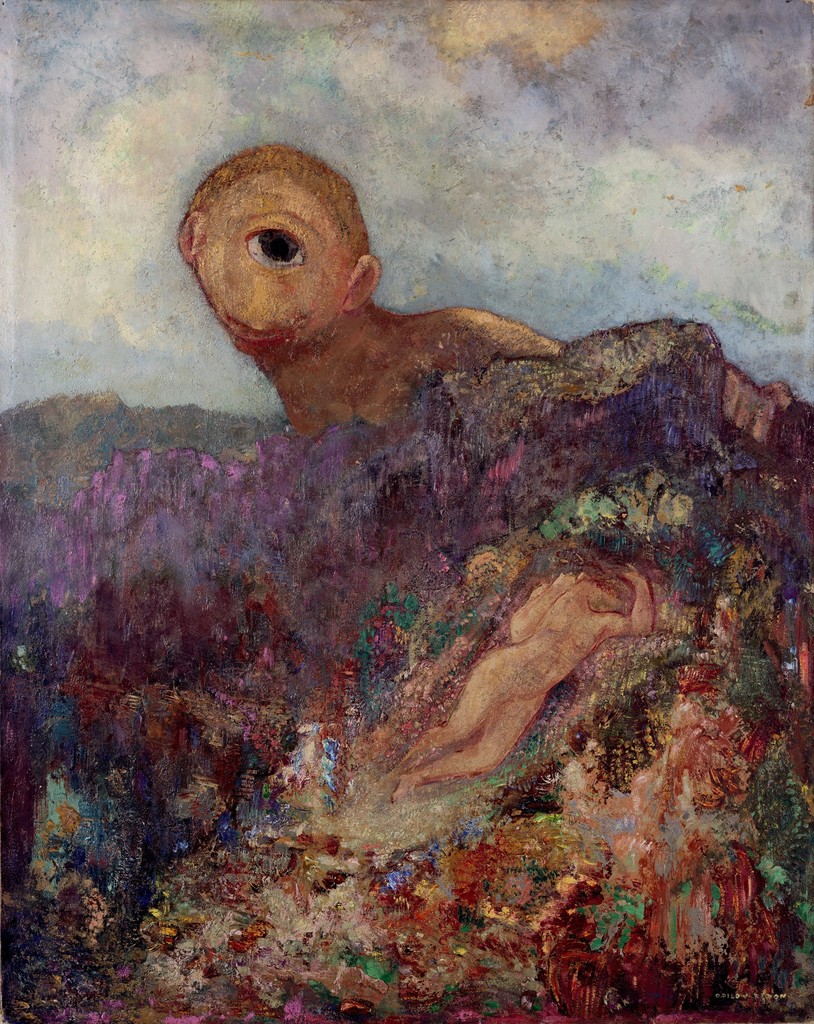
| The Cyclops | c. 1914 | Painting |
| The Death of Orpheus | 1904 | Painting |
| The Devil (Le Diable) | 1896 | Drawing |
| The Dog | 1896 | |
| The Fisherwoman | Date unknown | Drawing |
| The Flowers in a Blue Vase | 1913 | Drawing |
| The Golden Cell | 1892 | Painting |
| The Gothic Window | 1900 | Painting |
| The Green Vase | Date unknown | Painting |
| The Grey Sail | Date unknown | Painting |
| The Haunting (Hantise) | 1893 | Artwork |
| The Headhunter and His Family | 1870 | Drawing |
| The Mount of Calvary | 1895 | Drawing |
| The Muse on Pegasus | 1908 | Painting |
| The Port of Morgat | 1882 | Painting |
| The Potted Geranium | 1865 | Painting |
| The Prayer | 1893 | Painting |
| The Queen of Sheba (La Reine de Saba) | 1896 | Drawing |
| The Red Boat | 1910 | Painting |
| The Red Man | 1905 | Painting |
| The red poppy | 1895 | Painting |
| The Red Tree | 1905 | Painting |
| The Sea in Brittany | Date unknown | Painting |
| The Shadow (L'Ombre) | 1896 | Drawing |
| The Tree | 1875 | Painting |
| The Two Graces | 1900 | Painting |
| The Winged Man | 1890 | Painting |
| The Yellow Sail | 1905 | Painting |
| Three Fates | 1900 | Painting |
| Trees in Bièvres | Date unknown | Painting |
| Trees in the Blue Sky | 1883 | Painting |
| Triumph of Truth | 1870 | Painting |
| Tronc d'arbre dans la plaine | Date unknown | Painting |
| Two Dancers | Date unknown | Painting |
| Two Young Girls among Flowers | 1912 | Painting |
| Un étrange jongleur [Een vreemde evenwichtskunstenaar], uit de reeks Hommage à Goya. 6 lithographies par Odilon Redon | 1885 | |
| Underwater Vision | 1910 | Painting |
| Une femme revêtue du Soleil (A woman clothed with the sun) | 1899 | |
| Une longue chrysalide couleur de sang (A longchrysalis, the color of blood) | 1889 | |
| Vase de fleurs | 1915 | Painting |
| Vase de fleurs | Date unknown | Painting |
| Vase of Flowers | 1867 | Painting |
| Vase of Flowers | 1890 | Painting |
| Vase of Flowers | 1901 | Painting |
| Vase of Flowers | 1904 | Painting |
| Vase of Flowers | 1905 | Painting |
| Vase of Flowers, after Cézanne | 1896 | Painting |
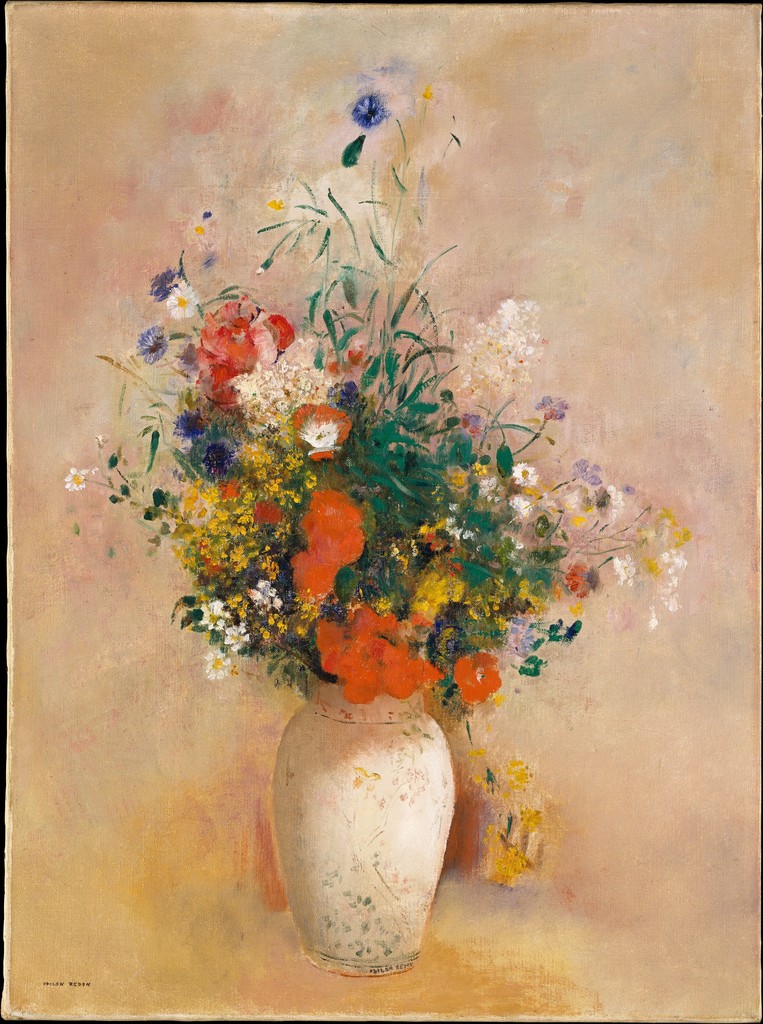
| Vase of Flowers (Pink Background) | c. 1906 | Painting |
| Vase with Bindweed and Camomile | 1867 | Painting |
| Vase with Wild Flowers | 1900 | Drawing |
| Vieil arbre dans une prairie | Date unknown | Painting |
| Vierge | 1916 | Painting |
| Vieux Chevalier (Old Knight) | 1896 | |
| Village by the Sea in Brittany | 1880 | Painting |
| Village dans les Basses-Pyrénées | Date unknown | Painting |
| Village Square, Brittany | 1883 | Painting |
| Village sur la côte de Bretagne | Date unknown | Painting |
| Vision | 1890 | Painting |
| Vision dans les nuages | 1900 | Painting |
| Vision- vase of flowers | 1900 | Painting |
| Voici La Bonne-Déesse, L'Idéenne des Montagnes | Date unknown | |
| Volupte, Fantome Elastique! (Pleasure, elastic phantom!) | 1890 | |
| Wildflowers | 1905 | Drawing |
| Wildflowers in a Long Neck Vase | Date unknown | Painting |
| Window | 1907 | Painting |
| Winged Horse | 1895 | |
| With Closed Eyes | Date unknown | Painting |
| Woman in a gothic arcade- woman with flowers | 1905 | Painting |
| Yellow frieze | 1901 | Painting |
| Yeux Clos (Closed Eyes) | 1890 | |
| Young Man (Jeune Homme) | 1896 | Drawing |
| Young Woman in Profile | 1910 | Drawing |
| Young woman standing | Date unknown | Painting |
Frequently Asked Questions
A noir is a work in black belonging to Redon's sustained charcoal and lithographic practice, especially from the 1870s through the mid-1890s. The term links black material to a mode of suggestion in which forms emerge from darkness. It should not be applied automatically to every drawing: Redon also made landscape studies, sketches and later works in graphite, pastel and mixed media that have different purposes and material identities.[1][3]
He used varied charcoals alongside materials such as black chalk, Conté crayon, charcoal wash, pastel and white chalk, often on toned, prepared or coloured papers. He manipulated them by stumping, wiping or rubbing, erasing, scraping, lifting and incising; white could be recovered from the support or added as heightening. The combination differs from sheet to sheet, so the holding museum's medium description is the safest guide.[1][2][8][10]
Lithography uses a greasy drawing on a prepared stone or related matrix: after processing, printing ink adheres to the image while damp blank areas resist it, and pressure transfers the design to paper. Redon also used lithographic transfer paper, but not every impression reveals whether the design was drawn directly or transferred. Specialist printers such as Lemercier and Blanchard helped turn his tonal designs into editions.[5][6][7][12]
Edgar Allan Poe and Gustave Flaubert are the clearest examples. To Edgar Poe of 1882 frames six images as a homage, while Flaubert's Temptation of Saint Anthony prompted three separate print projects. Redon used titles and textual fragments to create resonance rather than merely illustrating a narrative scene by scene. His images remain materially and imaginatively independent even when their captions come from literature.[3][5][6]
Eyes, floating heads and hybrids let Redon turn familiar anatomy into unfamiliar visual events. Their shapes draw on sustained observation as well as imagination; museum scholarship connects his inventions to botany, zoology and scientific interest in forms not normally visible to the naked eye. The motifs do not carry one universal meaning. Their effect changes with scale, caption, material and the darkness or atmosphere in which they appear.[3][4][6]
Discussion
Use this evidence-led guide as a starting point for close looking rather than a final verdict.
Share an observation about Odilon Redon Noirs, Prints and Drawings or a source that adds useful context.
Reader Insights
Which material decision best defines Redon's practice in this group of works?
Where do you see observation and invention working together rather than as opposites?
Which work would you add to the selected group, and what would it change?
Join the Conversation
Add your reading below, keeping observations specific and evidence clear.
References
- J. Paul Getty Museum, Odilon Redon: Otherworldly Visions — Gallery Text, accessed 30 August 2026.
- Getty Conservation Institute, “Noir: Technical Examination and Analysis of 19th-century Black Drawing Materials.”, accessed 30 August 2026.
- Musée d'Orsay, “Drawings by Odilon Redon (1840–1916).”, accessed 30 August 2026.
- Museum of Modern Art, “Odilon Redon: Eye-Balloon (Œil-ballon), 1878.”, accessed 30 August 2026.
- Museum of Modern Art, “Odilon Redon: The Eye like a Strange Balloon Mounts toward Infinity, 1882.”, accessed 30 August 2026.
- Museum of Modern Art, “Odilon Redon: …And Eyes without Heads Were Floating like Mollusks, 1896.”, accessed 30 August 2026.
- Metropolitan Museum of Art, French Prints in the Era of Impressionism and Symbolism, accessed 30 August 2026.
- Metropolitan Museum of Art, “Odilon Redon: Pegasus and Bellerophon.”, accessed 30 August 2026.
- Metropolitan Museum of Art, “Odilon Redon: Armor.”, accessed 30 August 2026.
- Art Institute of Chicago, “Odilon Redon: Guardian Spirit of the Waters.”, accessed 30 August 2026.
- Art Institute of Chicago, “Guardian Spirit of the Waters — API Record.”, accessed 30 August 2026.
- Museum of Modern Art, Odilon Redon, Gustave Moreau, Rodolphe Bresdin, accessed 30 August 2026.