


Women appear in painting as named sitters and imagined figures, rulers and workers, mothers and performers, mythological beings and artists representing themselves. Those roles cannot be collapsed into a single story. A formal portrait records a particular encounter between painter and sitter; a tronie explores a type or expression rather than identifying an individual; a mythological nude belongs to a different tradition again. Even two works that show the same person may make very different choices about pose, setting, dress and address.
This chronological guide brings together eleven paintings in which a woman, or a group including women, is central to what we see. It is a route through depicted subjects, not a ranking of beauty and not a directory of women artists. The sequence begins with Renaissance images of Venus and portrait identity, moves through court spectacle and self-representation, and ends with nineteenth-century scenes of labour, care, outdoor leisure and professional performance.
Each painting retains its own history. Some women are named, while others remain unknown; some figures were observed from life, while others were shaped by artistic convention. The links below lead to fuller accounts of the individual works and artists. For other ways of browsing, return to the Paintings hub, explore Painting Genres, or visit Famous Paintings for a broader selection of widely recognised works.
Portrait, tronie, self-portrait and imagined figure
“Painting of a woman” describes a visible subject, not a single genre. In a portrait, the identity and social presence of a sitter are usually important, although the degree of likeness and idealisation can vary. A self-portrait makes the artist both maker and depicted subject. A tronie, such as Vermeer's Girl with a Pearl Earring, presents an anonymous character, expression or costume rather than a commissioned likeness. Mythological figures such as Venus may be recognisable through story and convention without representing a documented sitter.
The distinction matters because identity changes the questions we can reasonably ask. With Lisa Gherardini, Madame Moitessier or the circus artist Miss La La, a name connects the image to a particular life, even when much remains beyond the canvas. With Millet's gleaners, anonymity redirects attention towards shared action, posture and labour. In Las Meninas, several identities and several acts of looking operate at once. No single category explains them all.
The chronological order also reveals shifts without pretending to offer a universal history of women in art. These works belong to European and American museum collections and cover only a small portion of painting's traditions. Their value here is comparative: they show how a figure can command the centre, meet the viewer's gaze, turn away, work with others, watch over a child or perform at a vertiginous height.
Eleven paintings in chronological order
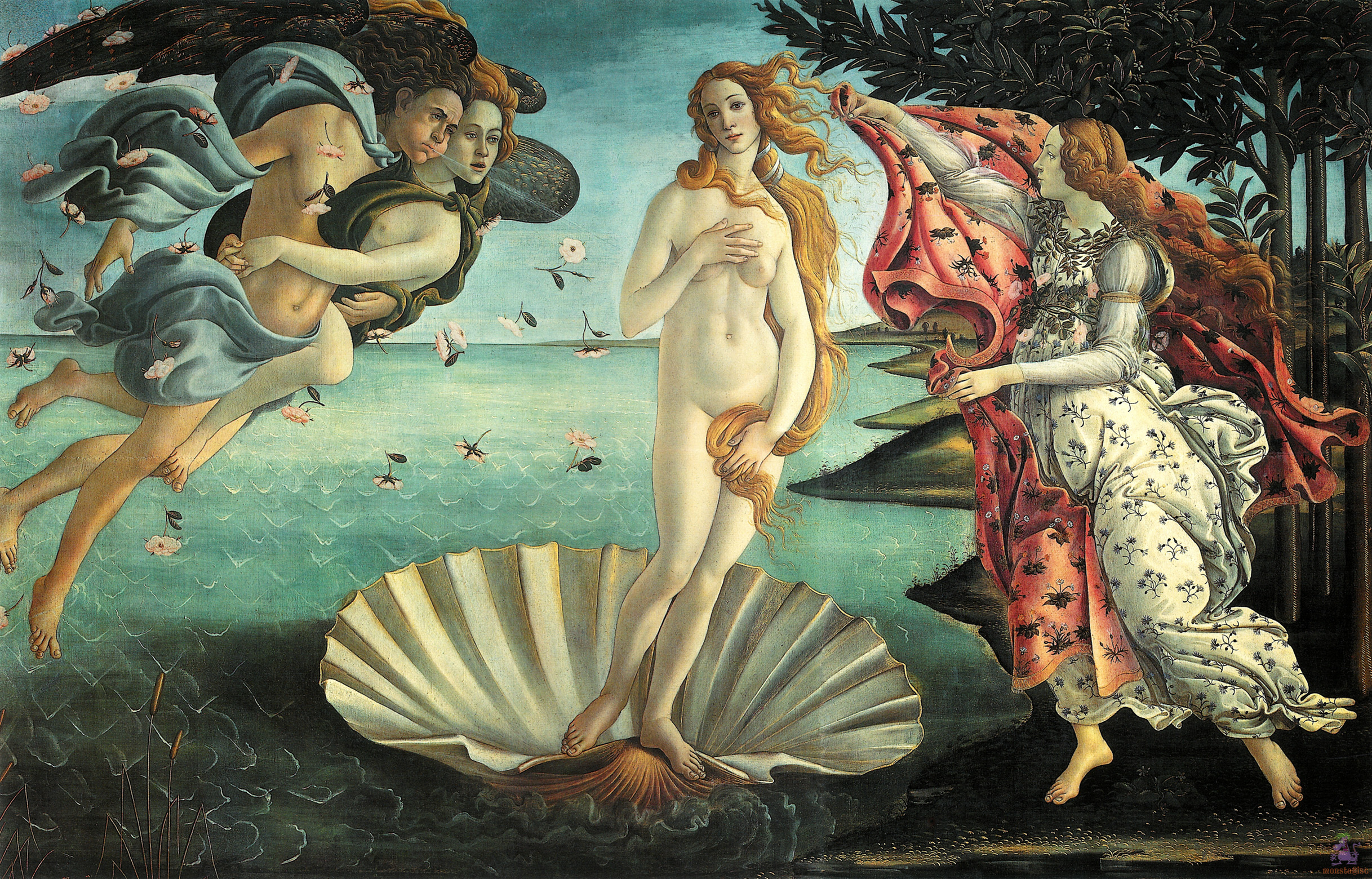
1. The Birth of Venus — Sandro Botticelli, c. 1485
In The Birth of Venus, Venus stands upright on a shell as it reaches the shore. Wind-driven figures occupy the left of the composition, while a waiting attendant extends a flowered covering from the right. The long contours of Venus's body and hair make her the still centre of an otherwise breezy, directional scene.
This is not a portrait of an identified Florentine woman. It is an image of a mythological being, and its idealised body belongs to the painting's poetic construction. That distinction keeps the work from being treated as evidence about an unknown sitter. The Uffizi Galleries date the tempera on canvas painting to about 1485 and record it as inventory 1890 no. 878.[1] Read more about Sandro Botticelli and the individual work.
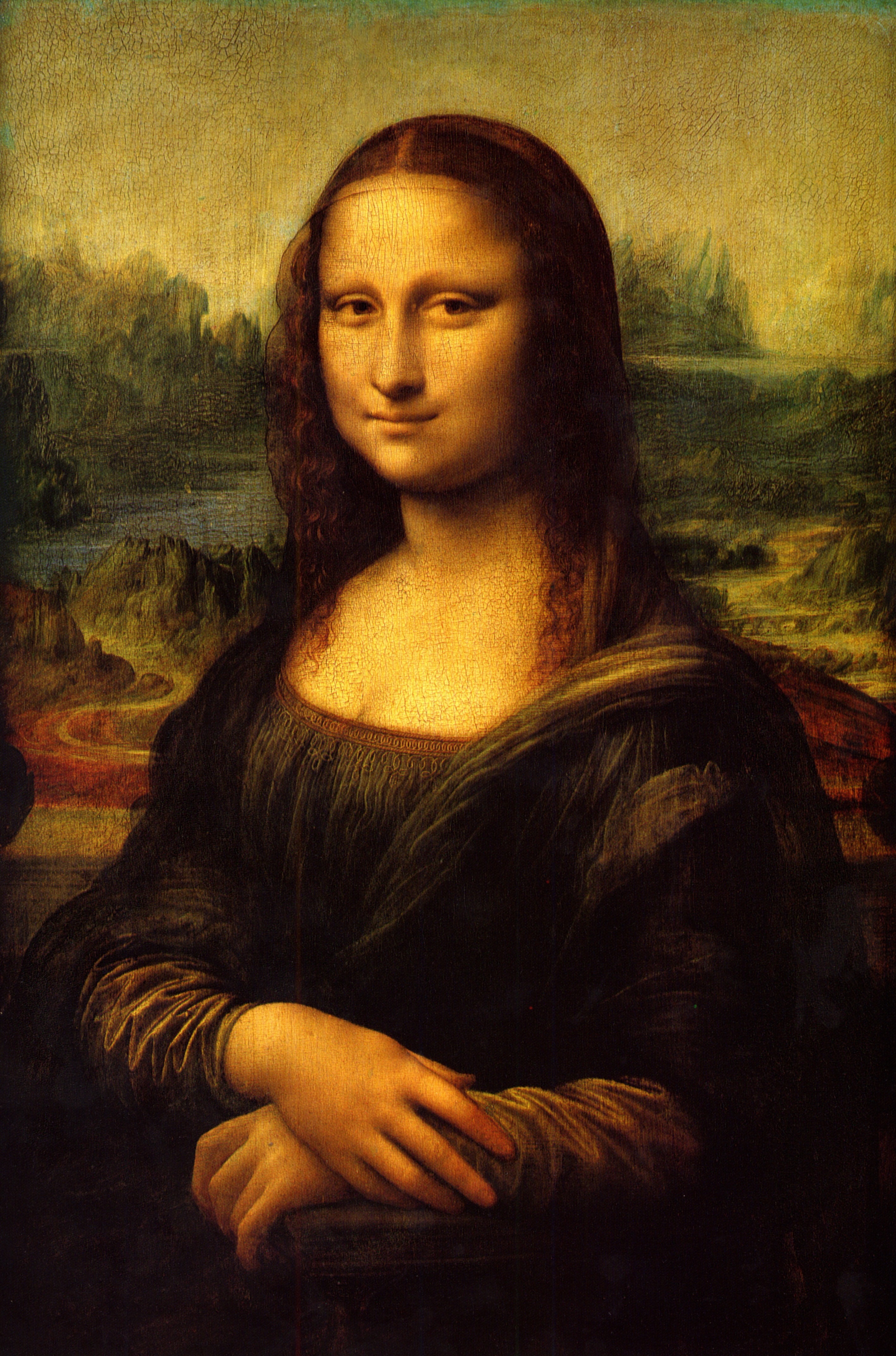
2. Mona Lisa — Leonardo da Vinci, c. 1503–1519
Leonardo's Mona Lisa replaces mythological certainty with a sitter whose identity is attached to the object record. Lisa Gherardini sits behind a parapet with her hands folded, turning towards the viewer while a distant landscape unfolds behind her. The face, hands and atmospheric terrain are bound together by gradual transitions rather than hard separations.
The Louvre identifies the work as a portrait of Lisa Gherardini, wife of Francesco del Giocondo, dates it to about 1503–1519 and describes its medium as oil on poplar panel.[2] Her expression has encouraged centuries of interpretation, but the painting does not offer a simple key to her thoughts. Its power lies partly in that controlled reserve: a named person appears vividly present while remaining inaccessible. Explore more by Leonardo da Vinci.
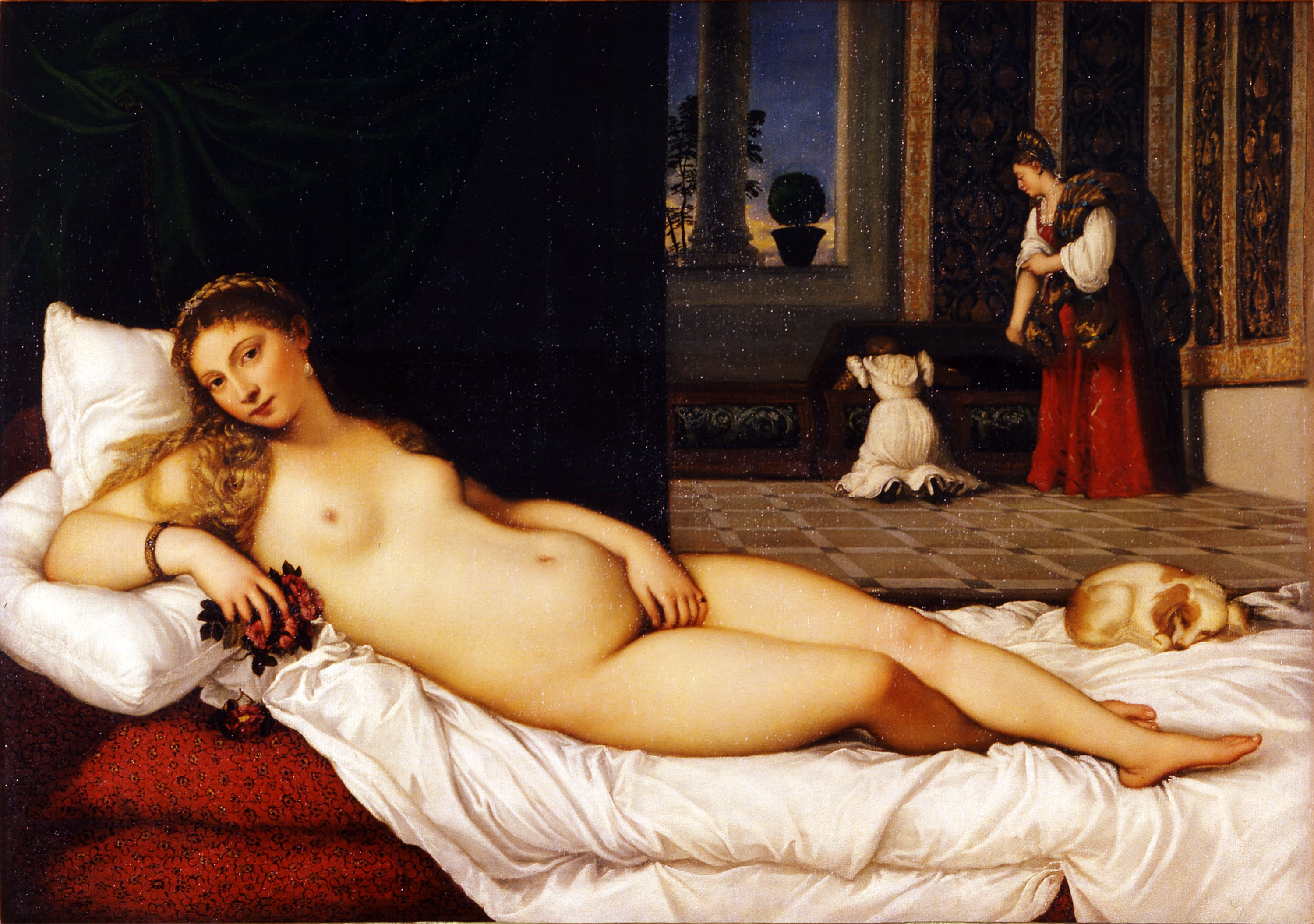
3. Venus of Urbino — Titian, 1538
Titian's Venus of Urbino places a reclining nude in a richly furnished interior. She looks directly out of the picture, one hand resting across her body and the other holding flowers. A small dog sleeps near her feet, and two attendants search through a chest in the background. The strong division between the bed and the rear room makes intimacy and household space coexist.
The Uffizi dates this oil-on-canvas painting to 1538 and records it as inventory 1890 no. 1437.[3] Interpretations have connected its details with marriage, fidelity and domestic life, but such meanings should be presented as readings rather than settled biography. Within this sequence, the work demonstrates how a mythological title, direct gaze and contemporary interior can complicate the boundary between ideal figure and social setting. Continue to Titian for the artist's wider body of work.
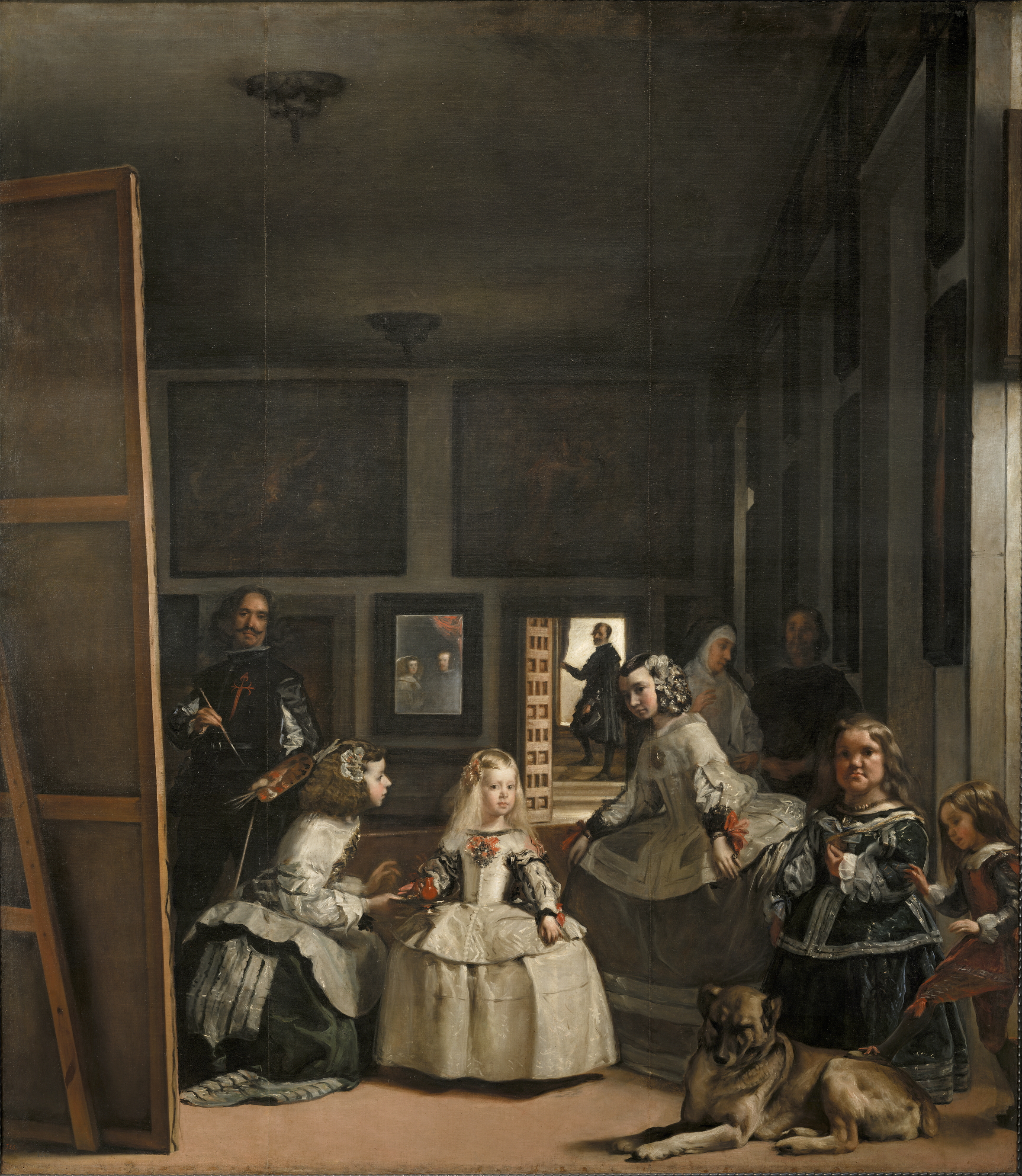
4. Las Meninas — Diego Velázquez, 1656
Las Meninas is centred on the Infanta Margarita, yet it resists becoming a straightforward portrait of one child. Attendants, court figures and a dog share the room. Velázquez stands at a large canvas on the left, while the king and queen appear in a mirror at the back. Viewers must work out who is looking at whom and where the unseen royal subjects might stand.
The Prado records the painting as a 1656 oil on canvas, inventory P001174.[4] Its women and girls occupy different court roles: infanta, attendants and chaperone belong to a structured household, while their glances create a more unsettled visual exchange. The result is both a court image and a reflection on painting, spectatorship and presence. The fuller work page and Diego Velázquez hub place this dense ensemble in context.
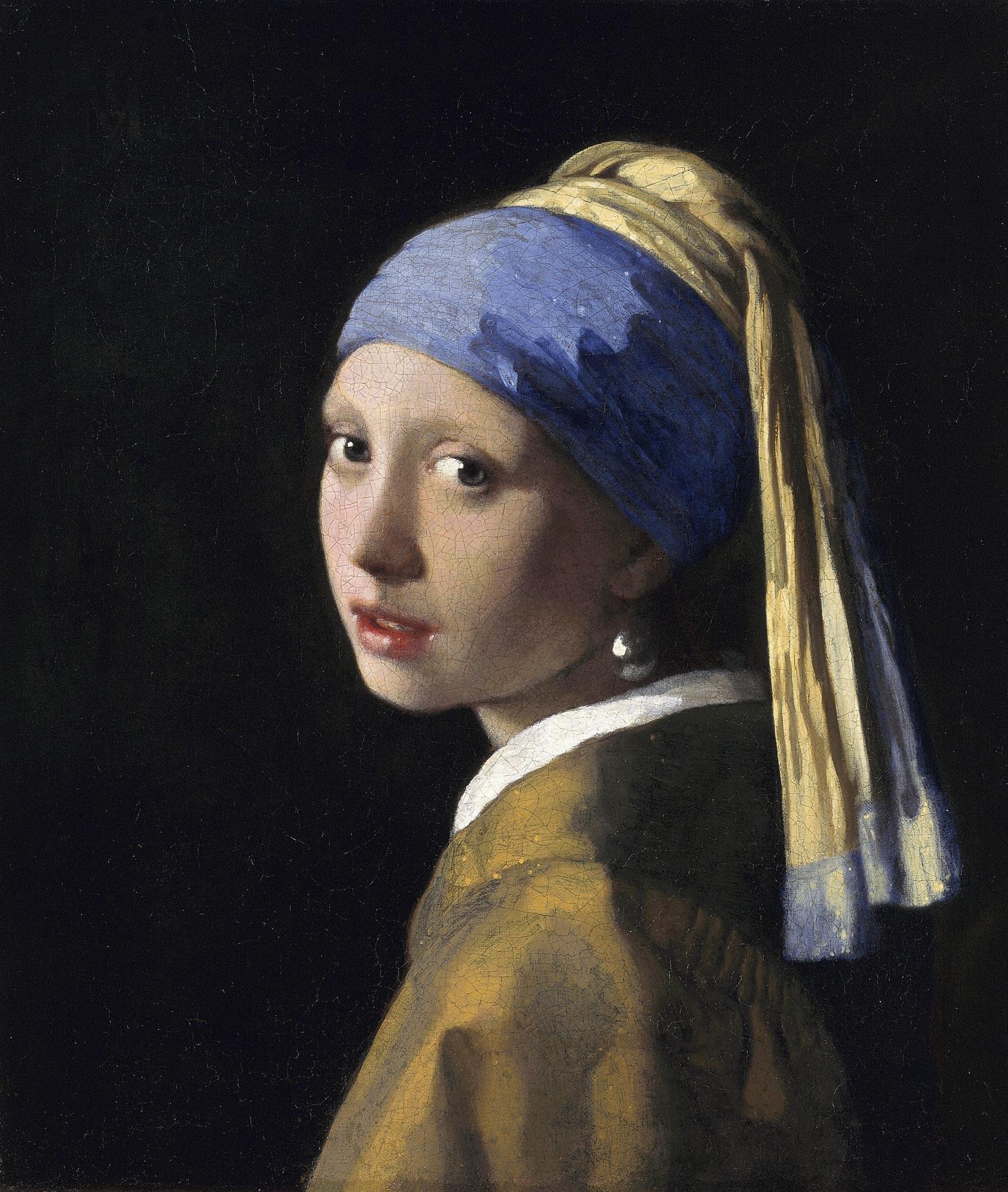
5. Girl with a Pearl Earring — Johannes Vermeer, c. 1665
The young figure in Girl with a Pearl Earring turns towards us against a dark ground. Light catches her face, lips, head covering and earring, while her body remains largely undescribed. The close crop and backward glance create immediacy, but they do not identify a specific sitter.
The Mauritshuis classifies the painting as a tronie: a study of a character or type, not a portrait made to preserve an individual's likeness. It dates the oil-on-canvas work to about 1665 and records it as no. 670.[5] Calling the figure “the girl” should therefore not be mistaken for biographical knowledge. Her anonymity is part of the work's open-ended appeal, while the unusual dress and luminous earring help construct the imagined character. See Johannes Vermeer for related interiors and figures.
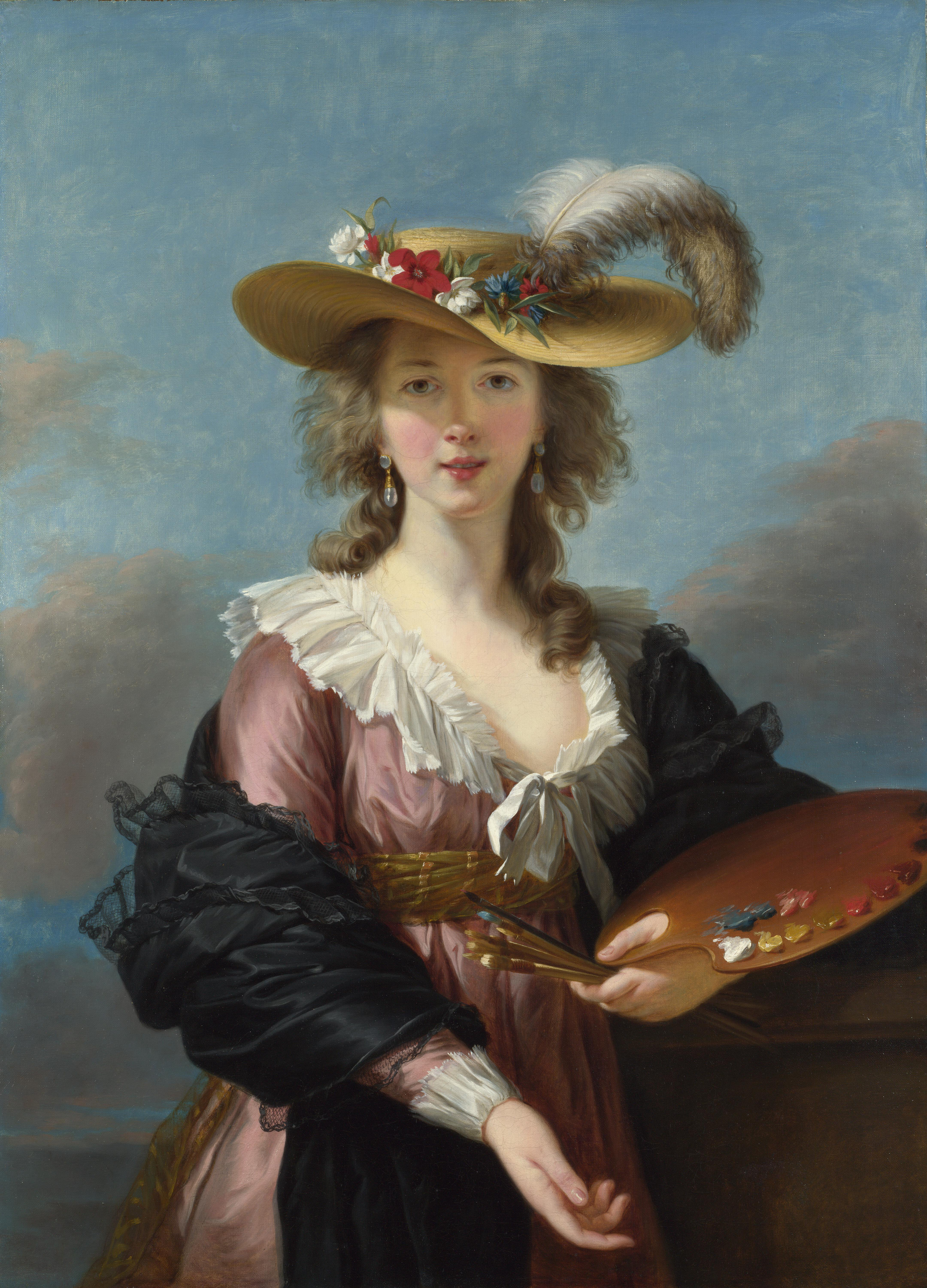
6. Self Portrait in a Straw Hat — Élisabeth Louise Vigée Le Brun, 1782
In Self Portrait in a Straw Hat, the artist meets the viewer beneath an outdoor sky. Flowers and a feather decorate the broad hat; a palette and brushes make her profession visible. Light falls across her face and dress while the tools in her hand prevent the image from becoming only a display of fashionable appearance.
The National Gallery identifies its painting as Vigée Le Brun's own 1782 copy of an earlier version of the composition, executed in oil on canvas and catalogued as NG1653.[6] The distinction between versions matters. So does the decision to represent artistic work directly: she controls both the image and the manner in which its maker is seen. Visit Élisabeth Louise Vigée Le Brun for more of her portraits and self-portraits.
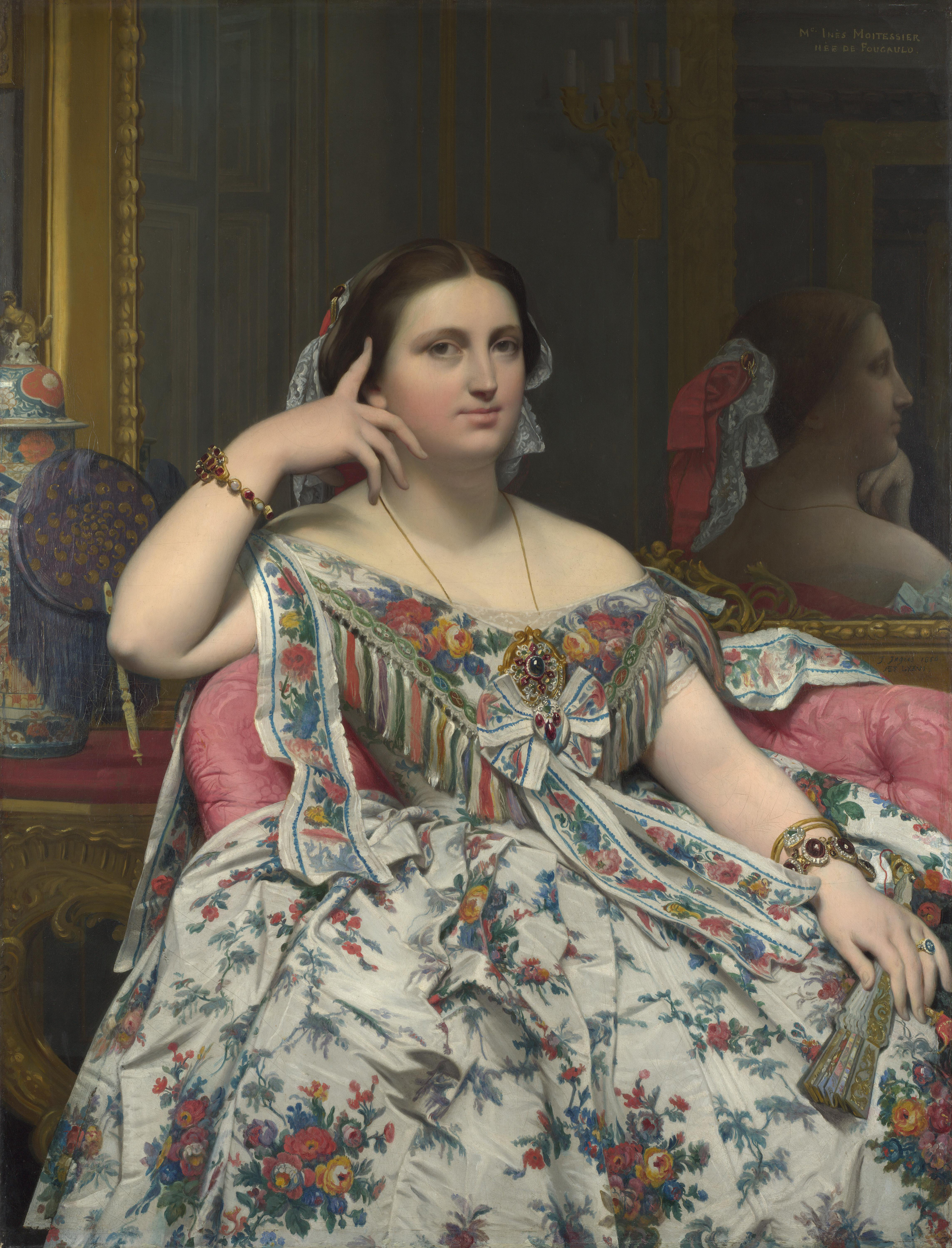
7. Madame Moitessier — Jean-Auguste-Dominique Ingres, 1856
Madame Moitessier presents Marie-Clotilde-Inès de Foucauld seated in a flower-patterned dress. She supports her head with one hand, while a mirror repeats her profile behind her. Jewellery, textiles and furniture contribute to the sitter's public presentation, yet the frontal face and reflected profile also invite a slower comparison of two views.
The National Gallery dates the oil-on-canvas painting to 1856 and records it as NG4821.[7] Ingres also made a separate standing portrait, so the seated London work must retain its exact identity. Here dress and interior are not incidental decoration: they help stage status, composure and visual abundance around a named sitter. The Jean-Auguste-Dominique Ingres collection provides a wider context without replacing this work-led reading.
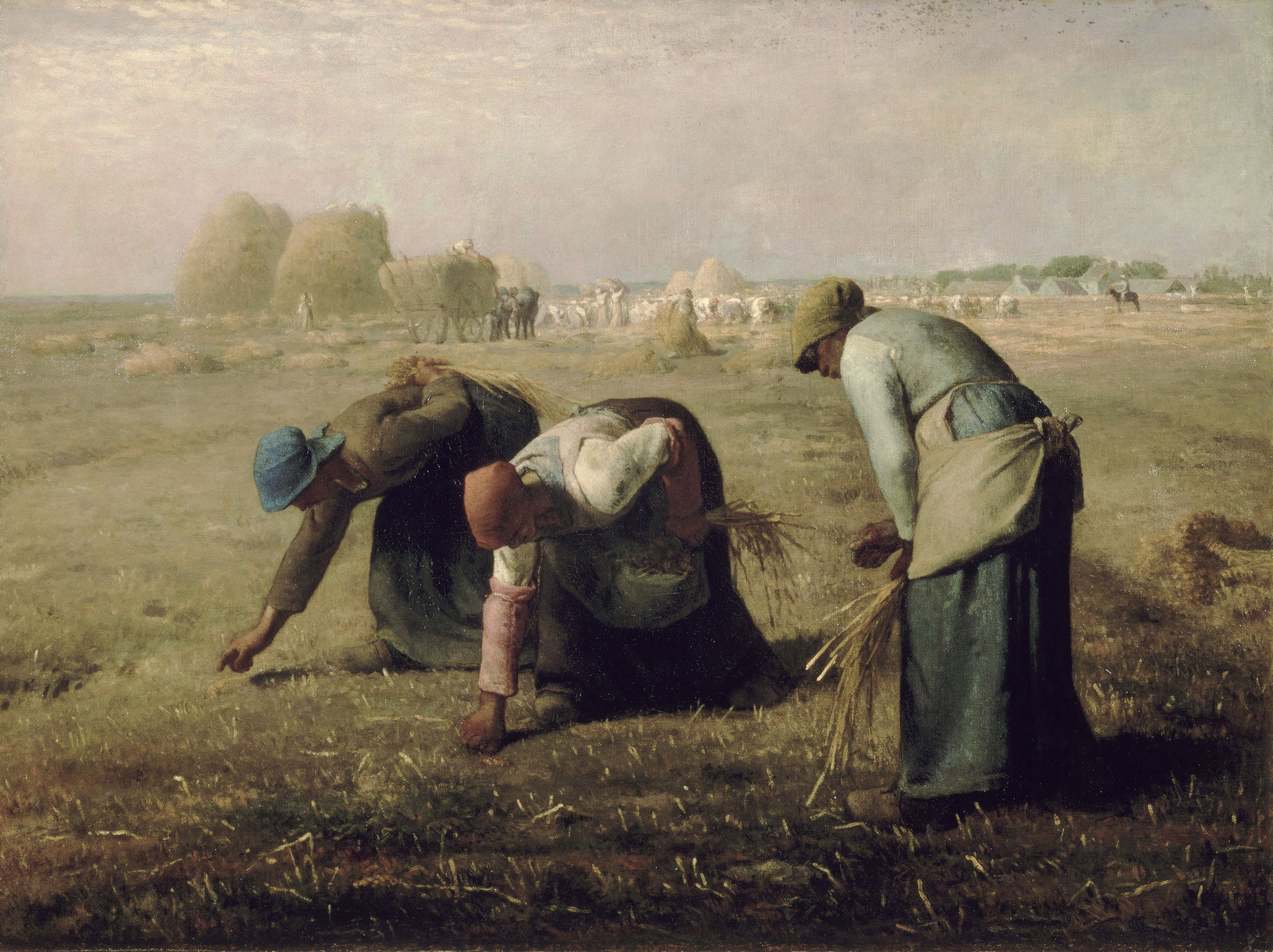
8. The Gleaners — Jean-François Millet, 1857
Three women bend across the foreground of The Gleaners, collecting remnants of grain after the main harvest. Their repeated stooping postures create a rhythm across the field. Farther back, stacks, carts and numerous workers suggest the larger agricultural operation from which the gleaners are spatially separated.
The Musée d'Orsay dates Millet's oil-on-canvas painting to 1857 and records it as RF 592.[8] The women are not named in the object record, so invented biographies would distract from what the painting establishes: strenuous repeated movement, shared labour and a contrast between the sparse foreground gathering and distant abundance. Their anonymity does not make their work generic; bodily differences and small variations in gesture keep the group specific. Explore Jean-François Millet for further rural subjects.
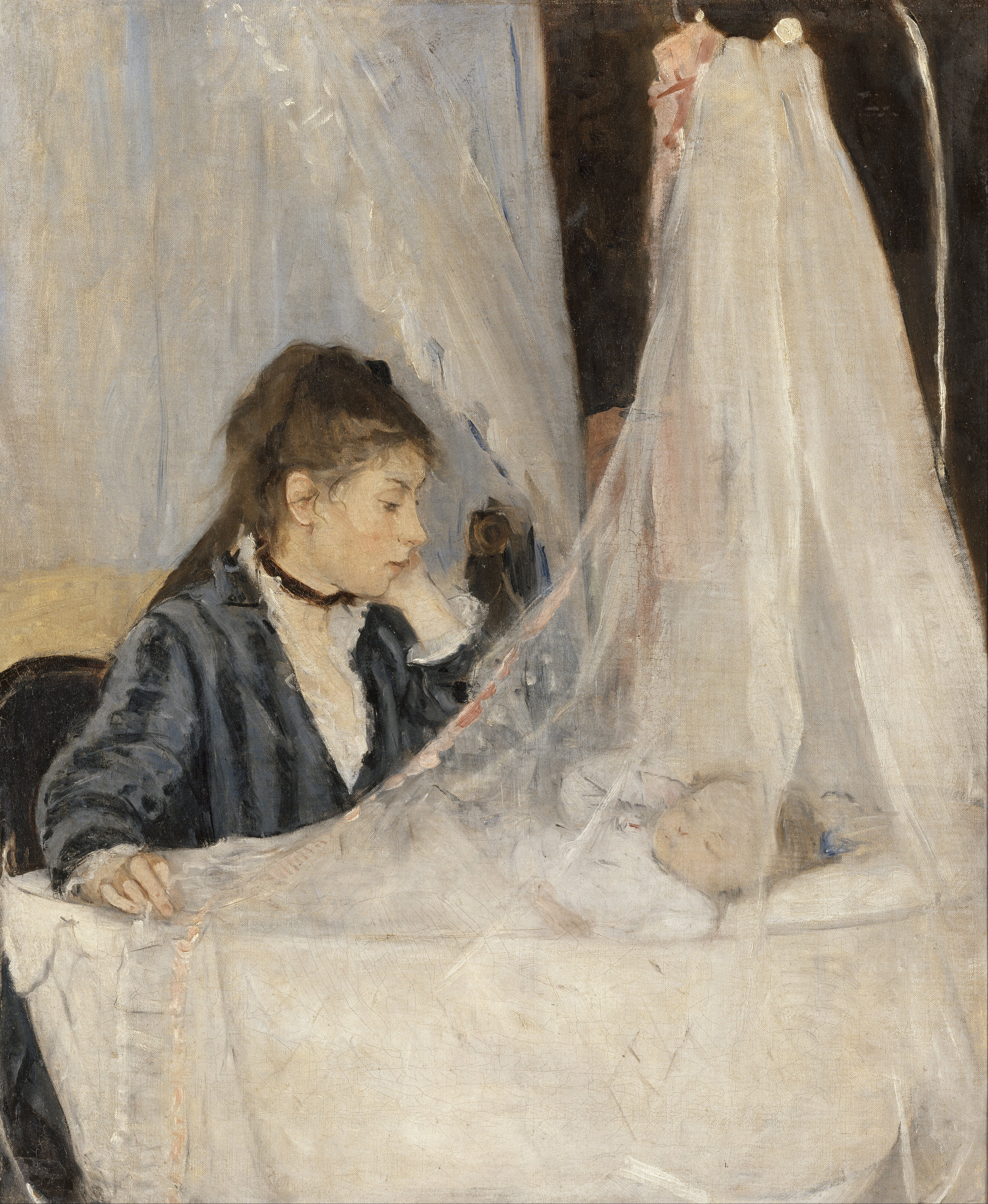
9. The Cradle — Berthe Morisot, 1872
Berthe Morisot's The Cradle shows her sister Edma watching over Edma's sleeping daughter, Blanche. A translucent curtain crosses the cradle diagonally, partly screening the infant while visually linking mother and child. Edma's bent arm and lowered gaze echo the enclosed shape of the cradle without turning the scene into a formal pose.
The Musée d'Orsay dates the oil-on-canvas work to 1872 and records it as RF 2849.[9] Because the sitters are known, the painting can be described as a particular family scene rather than a universal image of motherhood. Its quietness still carries active looking: Edma watches Blanche, while the viewer looks through the gauze boundary. More work by Berthe Morisot shows how domestic experience and modern painting can meet without being reduced to a single theme.
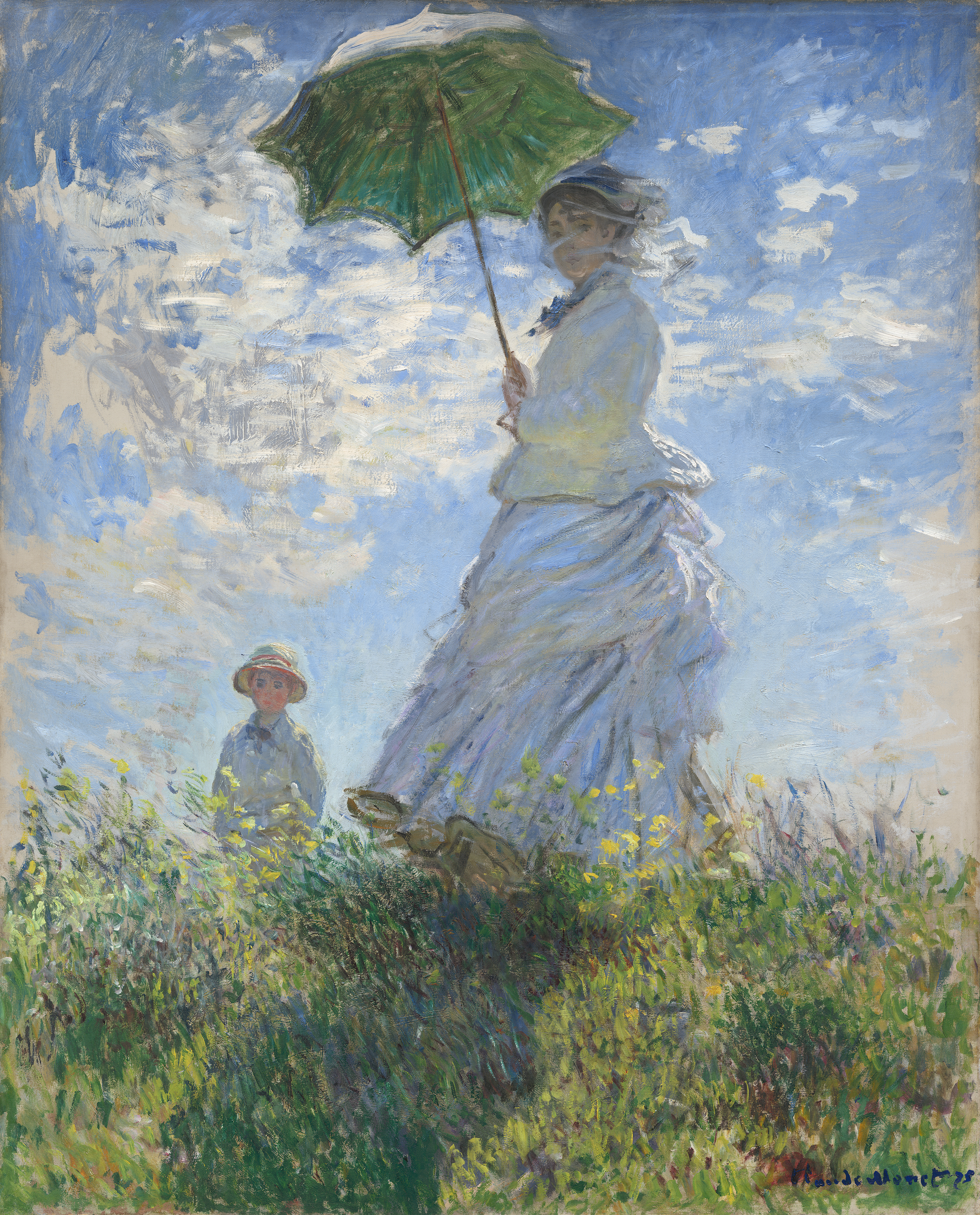
10. Woman with a Parasol — Madame Monet and Her Son — Claude Monet, 1875
In Woman with a Parasol — Madame Monet and Her Son, Camille Monet stands on a rise with a green parasol, while Jean Monet appears farther behind. The low viewpoint pushes both figures into a sky filled with moving cloud. Camille's dress, veil and parasol respond to the wind, making changing weather central to the figure's presence.
The National Gallery of Art dates the oil-on-canvas painting to 1875, identifies the sitters as the artist's wife and son, and records it as 1983.1.29.[10] It is a family image, but not a static indoor portrait. Light, air, slope and fleeting movement shape how Camille is seen. The title preserves her relationship to Monet, while the object record restores her name. Browse Claude Monet for other treatments of figures, gardens and outdoor light.
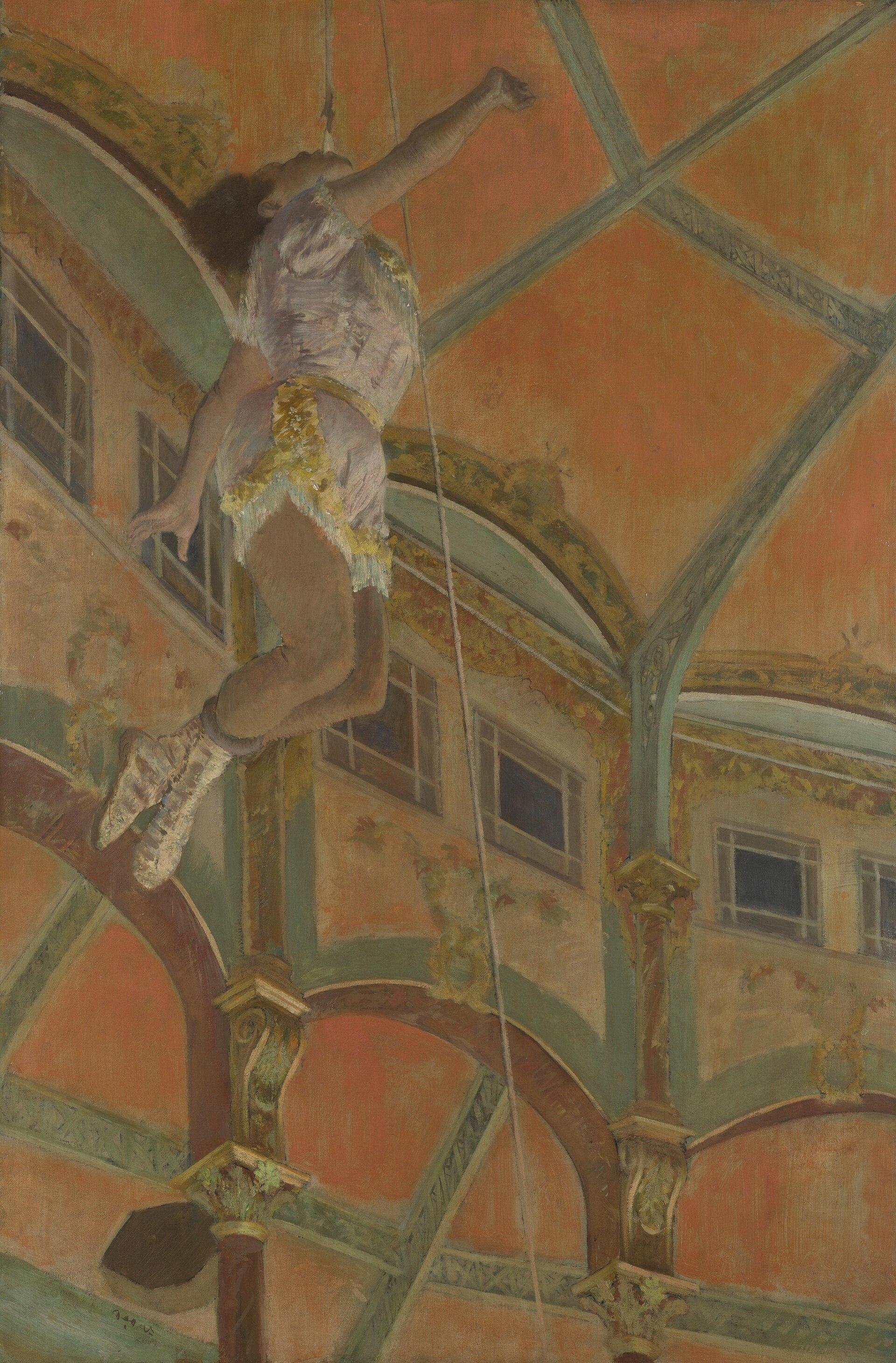
11. Miss La La at the Cirque Fernando — Edgar Degas, 1879
Degas gives the final and most vertiginous view in Miss La La at the Cirque Fernando. The aerialist hangs high above the spectator's viewpoint, suspended by her teeth as the circus roof sweeps around her. Large areas of architecture emphasise the distance between performer and audience, while her extended body records extraordinary strength and control.
The National Gallery identifies Miss La La as Anna Albertine Olga Brown, a mixed-heritage circus performer, and dates the oil-on-canvas painting to 1879, catalogue NG4121.[11] Naming her matters: she is neither an anonymous spectacle nor merely a device in Degas's composition. The painting transforms professional labour into a radical view of space, but the feat remains hers. The Edgar Degas collection offers further context for his images of performance and rehearsal.
Comparing agency, identity and attention
Across these paintings, a woman's position within a composition does not automatically tell us how much is known about her. Venus can dominate the centre and remain an imagined being; Vermeer's figure can feel close while retaining no documented identity. By contrast, the names Lisa Gherardini, Marie-Clotilde-Inès de Foucauld, Edma and Blanche Pontillon, Camille and Jean Monet, and Anna Albertine Olga Brown connect images to particular people. Naming should deepen attention rather than encourage claims the sources cannot support.
Gaze provides another useful comparison. Botticelli's Venus appears absorbed within a mythic arrival, while Titian's reclining figure and Ingres's Madame Moitessier address the viewer more directly. In Las Meninas, looking becomes a network involving the infanta, attendants, painter, reflected monarchs and implied spectator. Morisot redirects attention inward, from a mother to a sleeping child. Degas places the audience far below a performer who must concentrate on the physical task above them.
Work also takes more than one form. Vigée Le Brun declares her identity as a painter by holding her tools. Millet's gleaners repeat an exhausting agricultural action. Miss La La's poised body is the product of trained performance, even though the circus setting may first appear spectacular. These differences resist a single sentimental account of women in painting.
The sequence is therefore best read as eleven specific encounters, not a complete survey. Following the links to each artwork preserves the details that broad categories can lose: object identity, collection, medium, sitter, version and historical setting. Taken together, the paintings show why a subject-led guide can open several paths at once while still keeping every person and every work distinct.
References
- Uffizi Galleries, “The Birth of Venus”.
- Musée du Louvre, “Portrait de Lisa Gherardini, dite Monna Lisa”.
- Uffizi Galleries, “Venus of Urbino”.
- Museo Nacional del Prado, “Las Meninas”.
- Mauritshuis, “Girl with a Pearl Earring”.
- National Gallery, London, “Élisabeth Louise Vigée Le Brun, Self Portrait in a Straw Hat”.
- National Gallery, London, “Jean-Auguste-Dominique Ingres, Madame Moitessier”.
- Musée d'Orsay, “The Gleaners”.
- Musée d'Orsay, “The Cradle”.
- National Gallery of Art, “Woman with a Parasol — Madame Monet and Her Son”.
- National Gallery, London, “Edgar Degas, Miss La La at the Cirque Fernando”.