by Tom Gurney
Tom Gurney BSc (Hons) is an art history expert with over 20 years experience
Published on October 6, 2016 / Updated on March 24, 2026
Email: tomgurney1@gmail.com / Phone: +44 7429 011000
Woman with a Parasol - Madame Monet and her Son was painted by Claude Monet in 1875 while living in Argenteuil, France.
Monet in Argenteuil
The artist had moved from England to the Netherlands in 1871, and then to Argenteuil where he lived for six years.
Argenteuil is only just a fifteen-minute train journey from France's capital, Paris, which made it all the more of an ideal getaway for anyone living nearby who were looking for a break from city life. Even by the middle of the 1800s, when factories were flooding the town, it still provided a picturesque landscape and a relaxed setting to feel at peace in.
Monet lived in Argenteuil during the 1870s. At the time, the area was a popular destination for leisure, offering open landscapes, river views, and a sense of escape from the growing industrial city. For Monet and other Impressionists, Argenteuil became a laboratory for modern painting. Scenes of boating, walking, and family life replaced historical and mythological subjects, reflecting the changing rhythms of nineteenth-century society.
The town of Argenteuil was the place where impressionist painters could envision their inspiration. In Woman with a Parasol, it shows exactly that a woman with a parasol, a green parasol, and a child. Argenteuil was famed for its places where families could enjoy walks, and this is what Monet painted in Woman with a Parasol.
In this article we examine Monet's Woman with a Parasol - Madame Monet and her Son in detail, discussing technical details about the portrait, as well as examining the role of Camille in Monet's wider career, and their time spent in Argenteuil.
- Artist:Claude Monet
- Title:Woman with a Parasol
- Alternative Title:The Stroll (La Promenade)
- Date:1875
- Medium:Oil on canvas
- Genre:Impressionism
- Subjects:Camille Doncieux, Jean Monet
- Location:National Gallery of Art, Washington, D.C.
- Significance:One of Monet's most iconic Impressionist works
Description
The focus of the painting is on the figure in the centre, Monet's wife Camille. She stands dead centre on the top of a hill, and the blue sky behind her as the backdrop. The woman is dressed in a white dress that has twirled because it has blown in the wind. Monet often experimented with colour and light, and this can be seen clearly by the way he has coloured the woman's dress.
Some parts are quite light, where as other parts of the dress are darker. This could be because the sun is behind her. Further down the hill from the woman is a boy, his waist only visible, and his legs are hidden tall strands of grass, and yellow flowers that have grown there.
Style and Composition
The painting is a representation of Monet's impressionist style that he presented in many of his other pieces of art work during the period, and he did this in the perfect setting of Argenteuil. The work Monet produced was something that hadn't been seen before him. The contrast of a town and a holiday resort, which was full of new and rising industry was the sort of place that attracted these types of artists.
Rise of Impressionism
Long before impressionism, academies were where the rules about what art would be displayed and celebrated would be determined, and not just that but they also decided what art the artists should be painting. Those artists were Monet, Renoir, and Sisley, as well as other impressionist artists formed themselves into an artists group.
Pierre-Auguste Renoir was only 21 when he entered the art academy. He wanted to make a career as a painter and so he worked hard towards being exhibited at the Paris salon, as it was the place every artist wanted to be. Though he struggled to afford paint and to pay the bills, he decided to paint decorations on blinds, fans and signs for money.
He soon became friends with other like minded artists and students, Claude Monet and Alfred Sisley. Little did they know that they would one day become renowned for their art. Once Monet was able to get away from the constraints of the Academies, it meant that he could finally paint something like Woman with a Parasol, something from the heart as it shows his family on an afternoon walk.
Capturing a Moment in Time
As the figures in the picture are looking towards the viewer, the view that Monet took when he first painted the picture. We see what he saw and by conparision it is as if they have been there the entire time without interruption on their quiet stroll through nature, but they have taken a momentary pause to glance toward Monet.
It is interesting to think why they that, and was it a natural accurrence or perhaps Monet asked them to look towards him for a brief moment. This spontaneity was a clever convention by Monet and used it again in his other works.
He chose to paint his family in their everyday life and with Monet's application of quick brushstrokes it gives the painting a real sense that the event in the picture happened in real time.
Large, Detailed Images of Woman with a Parasol by Claude Monet
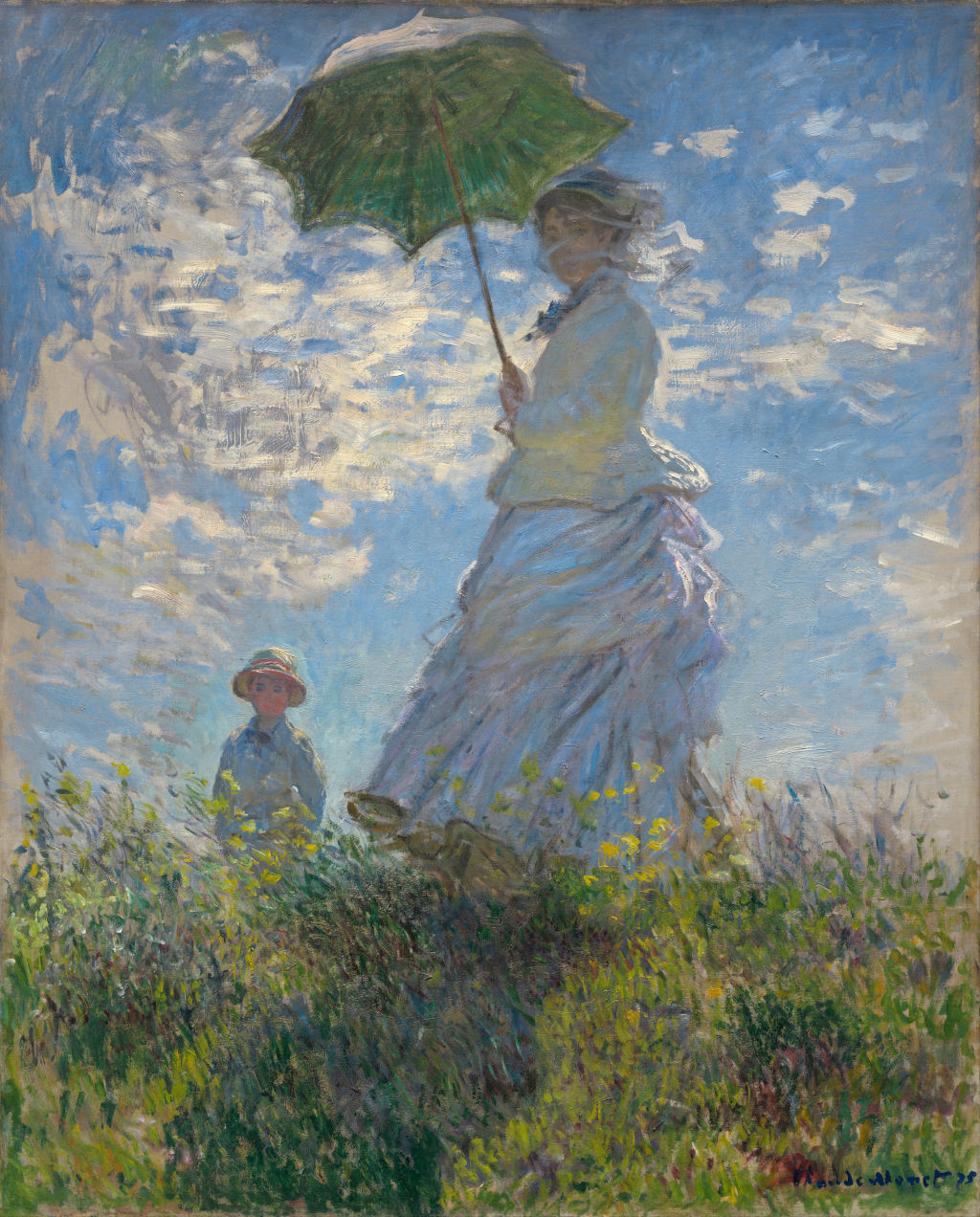
Claude Monet, Woman with a Parasol (1875), depicting Camille Doncieux and Jean Monet in Argenteuil, a defining example of Impressionist light and movement.
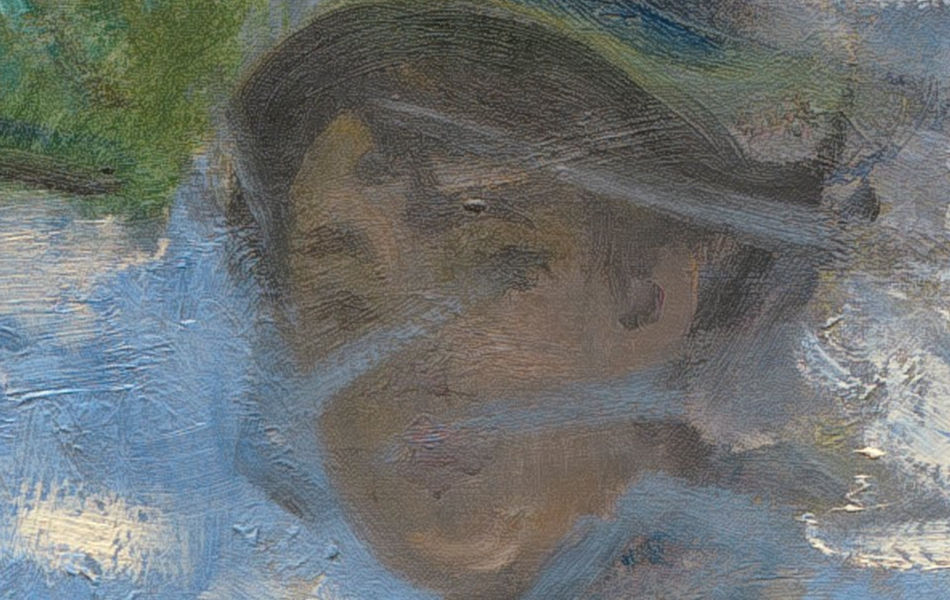
Camille Doncieux Close-up
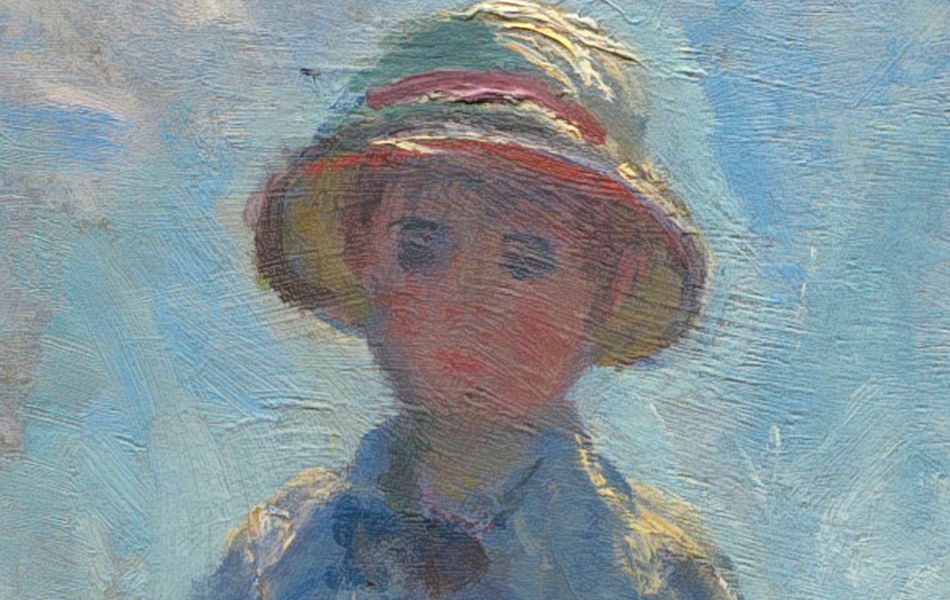
Jean Monet Close-up
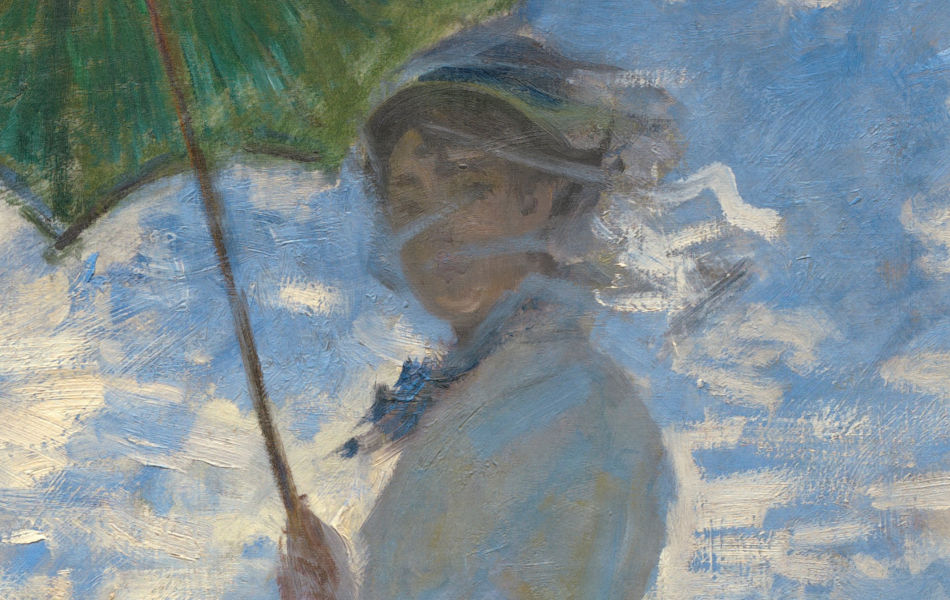
Madame Monet under her Parasol

Detail of the parasol and sky, illustrating Monet's use of light and colour to create a luminous, atmospheric effect.
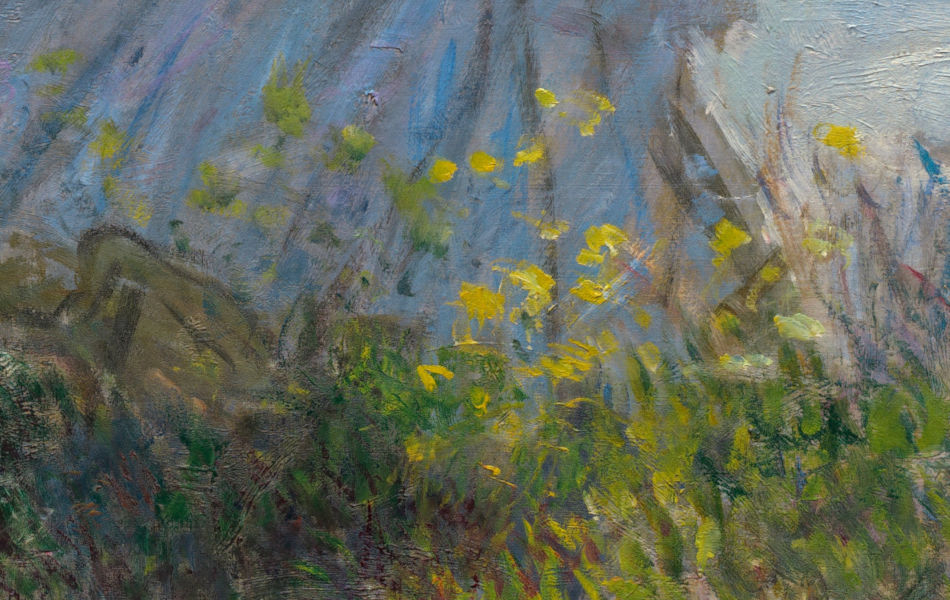
Array of flowers and plants
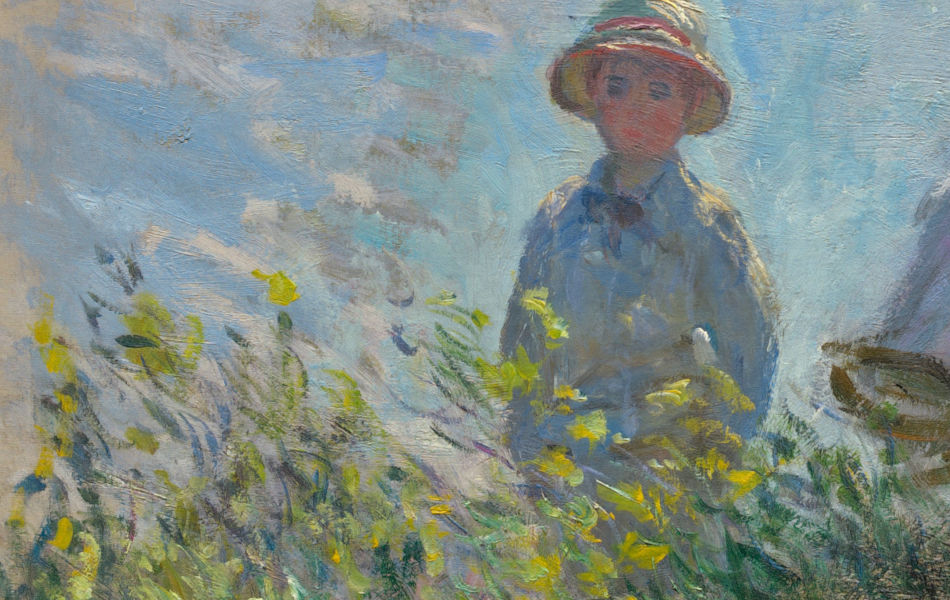
Foreground detail showing Monet's rapid brushstrokes, suggesting tall grass moving in the breeze rather than carefully defined forms.
Camille Doncieux in Monet's Paintings
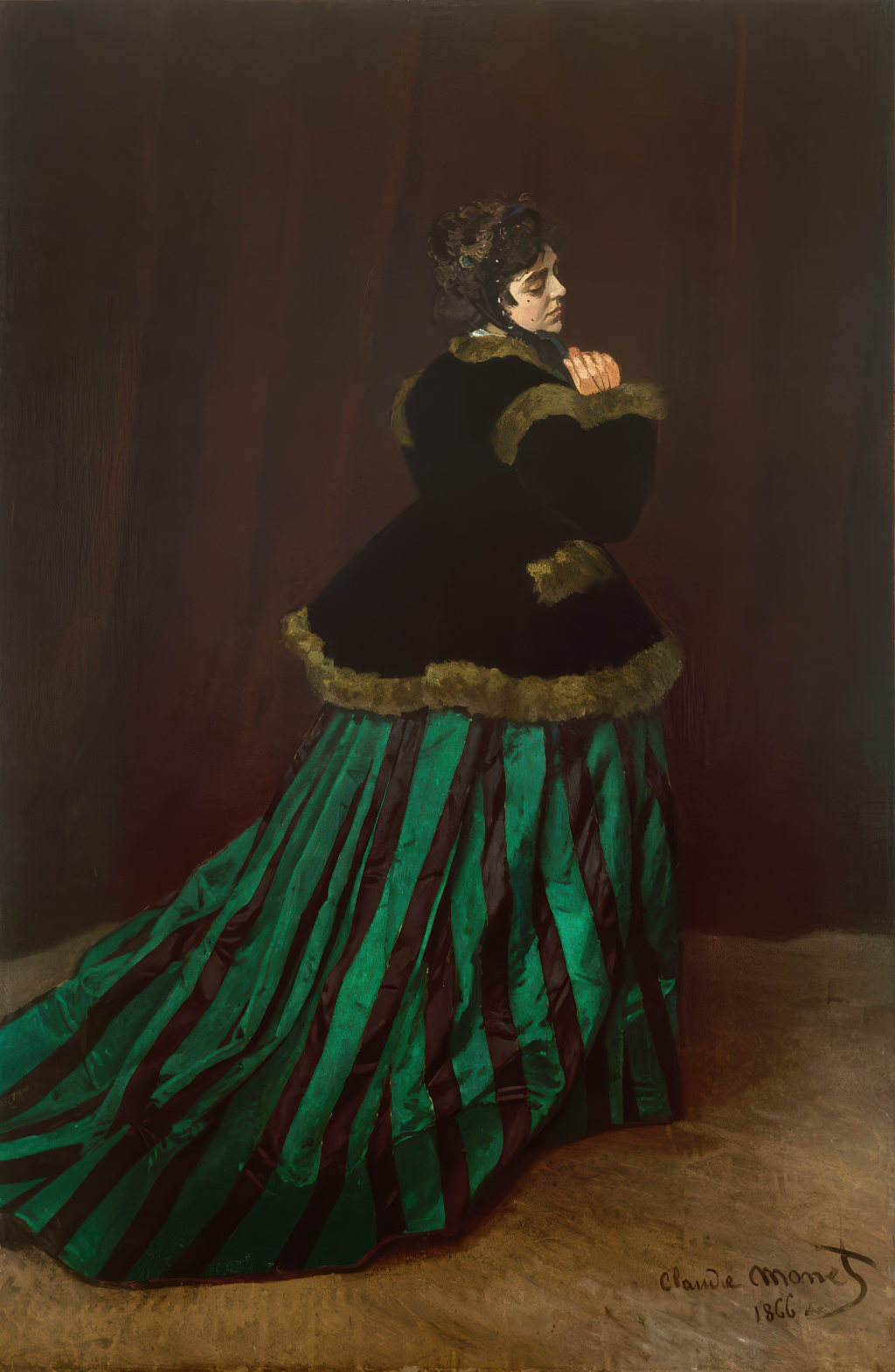
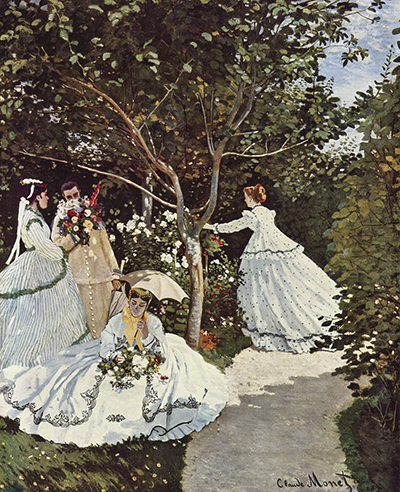
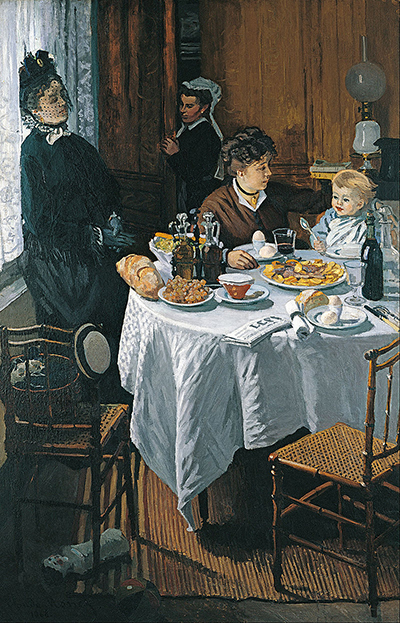
Camille would become Monet's favourite model, and appeared in a large number of his most famous paintings. One can observe their relationship over time through the portraits that he completed of her, as well as their children, Jean and Michel.
Provenance
The painting was acquired directly from Claude Monet in 1876 by Dr. Georges de Bellio, a Paris-based collector and early supporter of the Impressionists. Following his death in 1894, the work passed by inheritance to his daughter, Victorine de Bellio, and her husband Ernest Donop de Monchy, remaining in their possession until at least the late 1890s.
In the early twentieth century, the painting may have entered the stock of the dealer Paul Rosenberg, though this remains uncertain. By 1924, it was in the collection of Georges Menier in Paris, who lent it to an exhibition organised for the Société des Amis du Luxembourg that same year.
The work remained with the Menier collection until it was sold at auction at the Palais Galliera in Paris on 15 June 1965. It was purchased at that sale by the dealer Hector Brame on behalf of Paul Mellon.
Mellon retained the painting in his collection in Upperville, Virginia, before donating it to the National Gallery of Art in 1983, where it remains today.
Exhibitions
- 1876
Le 2e Exposition de Peinture [Second Impressionist Exhibition], Paris, no. 161, as Promenade - 1924
Première exposition de collectionneurs au profit de la Société des Amis du Luxembourg, Paris, no. 166, reproduced - 1966
French Paintings from the Collections of Mr. and Mrs. Paul Mellon and Mrs. Mellon Bruce, National Gallery of Art, Washington, no. 85, reproduced - 1986-1987
Capolavori Impressionisti dei Musei Americani, Museo e Gallerie Nazionali di Capodimonte, Naples; Pinacoteca di Brera, Milan, no. 30, reproduced - Gifts to the Nation: Selected Acquisitions from the Collections of Mr. and Mrs. Paul Mellon, National Gallery of Art, Washington, unnumbered checklist
- The New Painting: Impressionism 1874-1886, National Gallery of Art, Washington; The Fine Arts Museums of San Francisco, no. 32, reproduced
- 1990
Französische Impressionisten und ihre Wegbereiter aus der National Gallery of Art, Washington und dem Cincinnati Art Museum, Neue Pinakothek, Munich, no. 35, reproduced - 1992-1993
From El Greco to Cézanne: Masterpieces of European Painting from the National Gallery of Art, Washington, and The Metropolitan Museum of Art, New York, National Gallery of Greece, Athens, no. 47, reproduced - 1995
Claude Monet: 1840-1926, The Art Institute of Chicago, no. 42, reproduced, as The Stroll, Camille Monet and Her Son Jean (Woman with a Parasol) - 1996
Rings: Five Passions in World Art, High Museum of Art, Atlanta, unnumbered catalogue, reproduced - 1999
Masterpieces from the National Gallery of Art, Washington, Kyoto Municipal Museum of Art; Tokyo Metropolitan Art Museum, no. 42, reproduced - Around Impressionism: French Paintings from the National Gallery of Art, Los Angeles County Museum of Art, no catalogue (returned early to NGA)
- An Enduring Legacy: Masterpieces from the Collection of Mr. and Mrs. Paul Mellon, National Gallery of Art, Washington, D.C., 1999-2000, no catalogue
- 2000
The Impressionists at Argenteuil, National Gallery of Art, Washington, D.C.; Wadsworth Atheneum, Hartford, no. 46, reproduced - 2006
Claude Monet - Fields in Spring, Staatsgalerie Stuttgart, no. 4, reproduced - 2006-2007
Women in Impressionism: from Mythical Feminine to Modern Woman, Ny Carlsberg Glyptotek, Copenhagen, no. 64, reproduced - 2010-2011
Claude Monet 1840-1926, Galeries nationales du Grand Palais, Paris, no. 155, reproduced - 2011
Impressionist and Post-Impressionist Masterpieces from the National Gallery of Art, The Museum of Fine Arts, Houston; The National Art Center, Tokyo; Kyoto Municipal Museum of Art, no. 31, reproduced - 2017-2018
Monet: Framing Life, Detroit Institute of Arts, no. 6, reproduced - 2020-2021
Riffs and Relations: African American Artists and the European Modernist Tradition, The Phillips Collection, Washington, plate 1
Where is Woman with a Parasol - Madame Monet and her Son Today?
Woman with a Parasol - Madame Monet and Her Son, 1875 by Claude Monet is to be found today in the permanent collection of the National Gallery of Art in Washington, DC, USA.
National Gallery of Art
Constitution Ave. NW,
Washington,
DC 20565,
United States
Summary
Woman with a Parasol is considered by many to be one of the finest examples of Impressionism, demonstrating perfectly its fundamental core principles - painting outdoors, capturing fleeting light, and portraying everyday life with spontaneity and immediacy.
Upon its unveiling in 1876 this piece underlined the transition that Monet was undertaking - loose brushwork, a vibrancy of colour and innovative technique which had moved his work on from previous decades. He was now more confident, bolder and less willing to compromise on his work.
Today, the painting remains one of Monet's most beloved works. Its enduring appeal lies in its ability to transform a simple, intimate moment into something timeless—an image of light, air, and movement that continues to resonate with viewers.