


 by
Tom Gurney
Tom Gurney BSc (Hons) is an art history expert with over 20 years experience
Published on October 6, 2016 / Updated on October 23, 2026
Email:
tomgurney1@gmail.com
/ Phone:
+44 7429 011000
The Luncheon
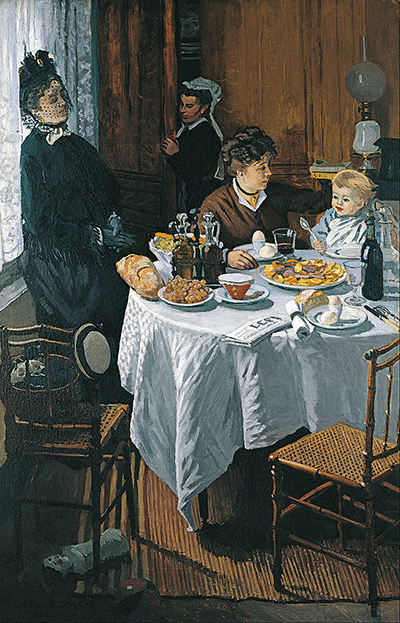
The Luncheon is Claude Monet's large indoor family scene of 1868-1869, now in the Stadel Museum in Frankfurt. [1] A meal, a mother and child, a visitor and a maid occupy a tall, dimly lit room. The white tablecloth brings the everyday subject forward with a brightness that makes the surrounding dark clothes and woodwork feel especially substantial.
At a Glance
- Artist Claude Monet
- Date 1868-1869
- Medium Oil on canvas
- Dimensions 231.5 x 151.5 cm
- Collection Stadel Museum, Frankfurt am Main
- Inventory SG 170
- Catalogue Wildenstein 132. [1]
A family meal in Etretat
Monet began the painting during the winter of 1868-1869 at Etretat . The Musee des Beaux-Arts de Lyon places it within the period when he rented a house there with his family, working on interiors as well as the coastal subjects for which the town is famous. [3]
Camille Doncieux sits beside their young son, Jean, on the far side of the table. A veiled visitor stands near the window, while a maid appears at the doorway behind them. The grouping makes the room both a family space and a place where different household roles meet.
The figures do not all turn towards the same point. The mother and child form a close pair, while the standing women give the scene a more open, less symmetrical arrangement. A visitor can look around the picture rather than being directed towards a single dramatic gesture.
The catalogue raisonne adds a useful caution about treating this as a literal record of one gathering: it states that Camille posed for the standing visitor and possibly for the seated woman. [5] A recognisable domestic scene can therefore also be a constructed arrangement of models, poses and objects.
Light from the window
The main light enters from the left, through the pale curtains. It catches the tablecloth, the child's clothes and parts of the faces, while leaving much of the room in brown and near-black shadow. The result is not an evenly illuminated inventory of a household.
The veiled woman's dark dress forms a strong vertical beside the window. Behind her, the curtains provide a delicate, patterned boundary between the bright opening and the interior. Across the room, the lamp and woodwork make a quieter sequence of upright shapes.
On the tablecloth, white is not a single flat colour. Folded passages turn grey and blue, and the cloth becomes darker as it descends towards the floor. The long folds make the table seem solid, even though its legs are largely hidden.
The figures emerge through differences in lighting as much as through outline. Jean's pale clothing stands out against the dark background, while Camille's brown dress belongs more closely to the room's colour. Their proximity becomes clear without isolating them from the meal around them.
The table as a still life
Bread, bottles, cups and dishes occupy a large area between the viewer and the sitters. Their shapes are varied: the loaf has an uneven surface, bottles rise in narrow verticals, and the plates form bright ellipses across the table.
The newspaper near the front edge introduces a different kind of surface. Its folded, rectangular form sits among the rounded crockery and food. Together, these details make the meal feel specific without requiring a story about every object.
Two empty chairs project into the foreground. One carries a hat; the other presents its woven seat towards us. They make the table accessible in imagination, but they do not prove that particular people are about to enter.
A doll lies on the floor near the lower left. It extends the domestic world beyond the table and helps connect the child's presence with the surrounding room. The picture's interest is distributed between people and possessions, rather than confined to a conventional head-and-shoulders portrait .
Why the scale matters
At more than two metres high, The Luncheon gives an ordinary interior an unusually imposing presence. The Stadel interprets this scale in relation to the prestige of history painting, traditionally associated with important religious, mythological or historical subjects. [1] [2]
Here, the large format is occupied by a meal and its furnishings. The falling tablecloth, foreground chairs and standing visitor use the tall canvas fully. The subject is private, but its physical ambition is public.
The effect is easiest to imagine by comparing the size of the real painting with the small reproduction. A chair that seems like a minor foreground detail on a screen becomes a substantial form at the original scale. The viewer's encounter with the room is therefore bodily as well as descriptive.
This is also why calling the painting merely a family souvenir is insufficient. Monet was giving a familiar setting the space and attention of a major exhibition work. Its modest subject and ambitious presentation are inseparable.
Changes beneath the surface
The Stadel's X-ray research shows that the composition developed during painting. The woman by the window was considered in seated and standing positions, initially looking outwards. In the finished arrangement, she is raised slightly and faces into the room. The bread also changed: two baguettes were replaced by the loaf. [2]
These revisions alter both the human grouping and the still life. Turning a figure inward makes her participate differently in the space; changing the bread changes the shapes nearest the light.
The technical evidence is a reminder that apparent ease can be carefully made. A domestic subject need not have been recorded in a single uninterrupted sitting. The completed surface presents a settled arrangement, while the hidden layers preserve some of the choices that preceded it.
From Salon rejection to independent exhibition
The Salon jury rejected The Luncheon in 1870. Four years later, Monet included it in the first Impressionist exhibition. [1] It was therefore an earlier, deliberately composed interior shown alongside newer work, not a painting produced simply to illustrate the group's emerging name.
The National Gallery of Art's Paris 1874 exhibition text interprets its inclusion as an assertion of Monet's pride in an ambitious canvas. It records an asking price of 5,000 francs, the highest at the exhibition. [4] That is an offered price, not evidence of a sale at that amount.
The distinction matters for understanding Monet's early career. Independence from the Salon gave him another place to present a work that its jury had refused. The Luncheon belongs to that history even though its handling differs from the freely painted outdoor scenes often associated with Impressionism.
Not the later garden luncheon
Monet also painted a different Luncheon around 1873, now at the Musee d'Orsay. That horizontal garden scene shows the aftermath of an outdoor meal, with Jean playing nearby. It appeared in the second Impressionist exhibition in 1876 as a decorative panel. [6]
The Frankfurt painting is the earlier, vertical interior. Keeping the two distinct makes it possible to follow Monet's changing treatment of family life without confusing their dates, collections or exhibition histories. The Stadel acquired this work in 1910. [1]
The Luncheon remains compelling because neither the people nor the objects are incidental. Window light joins them within one room, while the scale asks us to give an ordinary meal sustained attention.
Frequently Asked Questions
At the Stadel Museum in Frankfurt, inventory SG 170. [1]
The museum dates it 1868-1869; the canvas bears an 1868 inscription. [1]
Yes, after its rejection by the Salon jury in 1870. [1]
No. That is a separate painting of around 1873. [6]
Discussion
Look again at the images and ideas explored in The Luncheon. These editorial prompts invite your observations.
Reader Insights
How do the empty chairs affect your imagined position in the room?
Which table objects first draw your attention?
How might the scene change if the visitor looked out of the window?
Join the Conversation
Share a detail, comparison or question about The Luncheon below.
References
- Stadel Museum , The Luncheon, 1868-1869, SG 170: object record and collection history. View source .
- Stadel Museum , Monet and the Birth of Impressionism: Lunch at Monet's, scale and X-ray research. View source .
- Musee des Beaux-Arts de Lyon , Claude Monet: the Pursuit of a Motif, Etretat and The Luncheon. View source .
- National Gallery of Art , Paris 1874: The Impressionist Moment, exhibition label for The Luncheon. View source .
- Daniel Wildenstein , Monet: Catalogue raisonne, 1996, volume II, W132, pp. 63-64, Wildenstein Plattner Institute digital edition. View source .
- Musee d'Orsay , Le Dejeuner. Panneau decoratif, circa 1873, RF 2774, a separate painting. View source .







